lab 17, Mitosis and meiosis
 Call Kai
 Learn
Learn Practice Test
 Spaced Repetition
 Match
Match Flashcards
 Knowt Play
1/56

There's no tags or description
Looks like no tags are added yet.
Name | Mastery | Learn | Test | Matching | Spaced | Call with Kai |
|---|
No analytics yet
Send a link to your students to track their progress
57 Terms
Literally means “colored material.” This is the term for the uncoiled DNA in the nucleus when the cell is undergoing its normal activity. The chromatin coils during prophase to form the chromosomes.
uncoiled DNA
in nucleus
normal cell activity
chromatin
Literally means “colored bodies.” These are the rod-shaped structures of DNA present in the cell during a cell division process, either mitosis or meiosis. They form from chromatin condensing during prophase. “Chromosome” can be used as a general term for DNA during any part of the cell cycle.
rod shaped DNA
condense during Prophase
chromosomes
The two identical strands of DNA that form a chromosome after DNA replication, during S-phase. The sister chromatids are held together by the centromere. The sister chromatids are separated into two different cells during mitosis and meiosis II.
indentical strands of DNA
form after replication
held together by centromere
separate during mitosis and meiosis II
two long identical strands
chromatid
What is sister chromatid?
held together by the centromere
are separated into two different cells during mitosis and meiosis II.
____ cells only have one complete set of chromosomes. This is the number of chromosomes found in eggs or sperm. The ____ number of chromosomes in humans is 23.
1 complete set of chromosomes (23)
haploid
____ cells have two complete sets of chromosomes. Humans have a ____ number of 46 chromosomes. Occurs when a haploid egg combines with a haploid sperm. This is the normal number of chromosomes in regular body cells.
2 complete sets of chromosomes (46)
Diploid
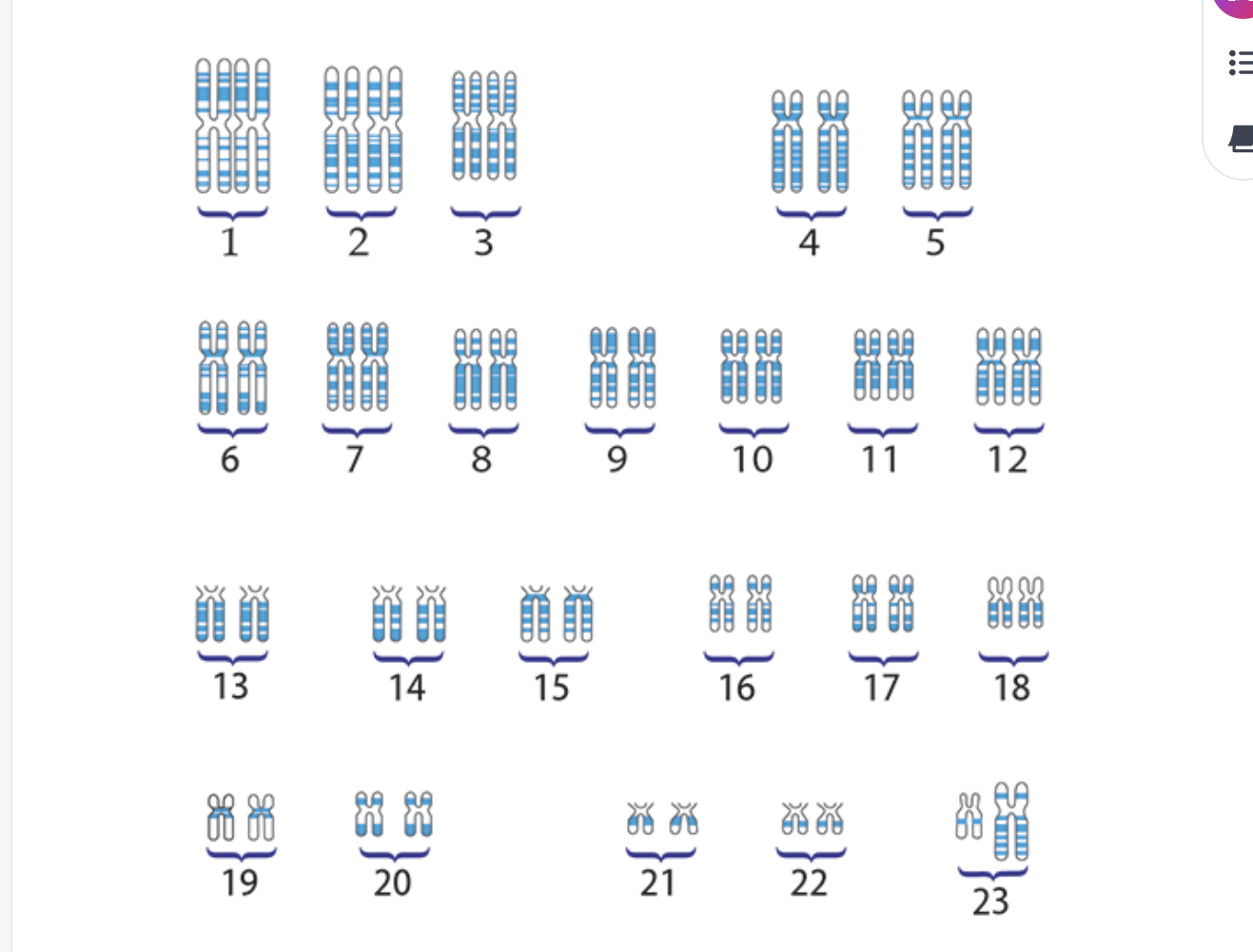
Humans have 23 pairs of ____ chromosomes. Each pair consists of a chromosome inherited from each parent. ______ chromosomes are identical in size and shape, and possess the same genes. The exception is chromosome pair #23, the sex chromosomes. Females contain two copies of the X chromosome and males contain an X and Y chromosome.
23 pairs of chromosomes. One of each is inherited from each parent. Each pair is the same size and shape, except for the sex chromosomes.
homologus chromosomes
The period of time between nuclear divisions is called?
interphase
The cell undegoes normal activity for the majority of its life cycle while in?
while in interphase
During interphase, the chromosomes are unwound into the form of?
chromatin
Interphase is is subdivided into three phases. What are they?
gap 1 (G1) phase
S (synthesis) phase
gap 2 (G2) phase
What happens during the Gap 1 (G1) phase?
the cell grows by creating cytoplasm and organelles. It also engages in other normal activities for that particular kind of cell, like the synthesis of particular proteins
cell growth and normal activities, like protein synthesis
What happens during the S (synthesis) phase?
the DNA is replicated so that each chromosome consists of two chromatids
DNA replicaiton
What happens during the gap 2 (G2) phase?
the cell prepares for division by continuing to grow, synthesis of organelles and proteins, and the replication of the centrioles
cell growth, organelle and protein synthesis, centriole replication
What are the processes by which cells reproduce?
mitosis and cytokinesis
What reproduces the nucleus?
Mitosis
What subdivides the cytoplasm?
cytokinesis
Process produces two identical daughter cells with same number of chromosomes as parent cell
mitosis
The result of these two processes is the production of two identical daughter cells which contain the same number of chromosomes as the parent cell. The function of _____ and ____ is general body growth as well as the replacement of old and worn out cells, and damaged tissues.
the process of mitosis and cytokinesis
What is the purpose of the cell division, mitosis
general body growth as well as the replacement of old and worn out cells and damaged tissues
Mitosis is a continuous process subdivided into four phases, name them.
prophase, metaphase, anaphase, and telophase
Chromosomes condense from chromatin and the nuclear membrane disappears. Centrioles produce spindle fibers
chromatin condenses to chromosomes
nucleus membrane disappears
centrioles produce spindle fibers
prophase, which is a phase of mitosis
Spindle fibers attach to the centromere connecting sister chromatids. This attachment causes chromosomes to line up along the equatorial plane of the cell.
spindle fibers attach to centromeres
chromosomes line up along the equatorial plane (the middle)
metaphase, which is a phase of mitosis
The spindle fibers shorten, separating the sister chromatids on each chromosome, and moving the daughter chromosomes toward opposite poles of the cells.
spindle fibers shorten
sister chromatids separate
daughter chromosomes move toward opposite poles
anaphase, which is a phase of mitosis
A nuclear membrane forms around each group of daughter chromosomes, at the poles of the cell. Chromosomes begin to unwind, and assume the form of chromatin.
daughter chromosomes reach poles of the cell
nuclear membrane forms around each group
chromosomes unwind into chromatin
telophase, which is a phase of mitosis
Division of the cytoplasm is not part of mitosis, but it usually occurs at the same time. Here, the cytoplasm of the cells divide in half. Each half receives approximately half of the cytoplasm. ____ typically begins during anaphase and continues through telophase.
can begin during anaphase, but mainly during telophase
produces two equal daughter cells
cytokinesis
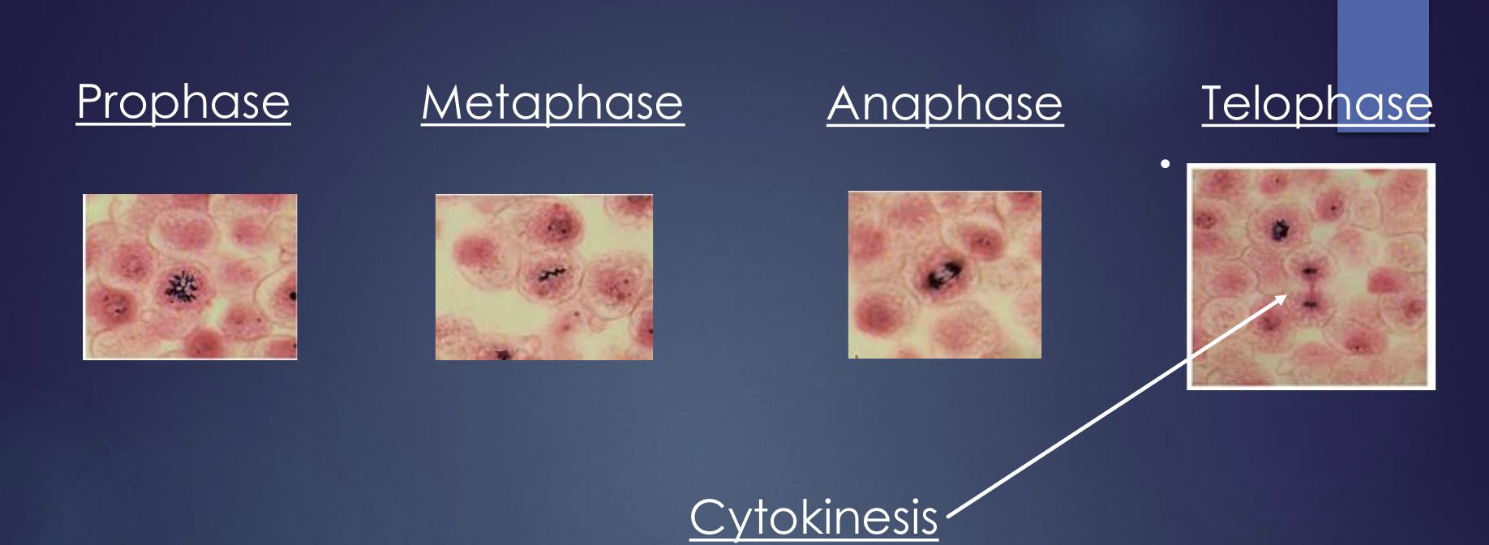
Identify the phases of mitosis under the microscope
I will Identify the phases of mitosis under the microscope
For sexual reproduction to occur the number of chromosomes in a cell must be reduced by?
half
the process that reduces the diploid number chromosomes from 46 to the haploid number of 23 to produce the gametes, eggs and sperm.
meiosis
Meiosis consists of two cycles called?
meiosis I
meiosis II
What is the 1st step of producing gametes by reducing the number of chromosomes from diploid to haploid?
Meiosis I
What separates the homologous chromosomes into two different cells.
Meiosis I
What separates the sister chromatids of the chromosome into different cells? These cells then differentiate into haploid eggs and sperm. Fertilization of the egg by the sperm results in the restoration of the diploid number of chromosomes, and thereby maintains the normal chromosome complement of 46,
Meiosis II
Chromatin condenses to form the chromosomes. The homologous chromosomes form pairs in an event called “synapsis.” Chromosomes can crossover during synapsis. During crossing-over, the chromatids of homologous chromosomes can exchange segments of the chromatids. The result of crossover is that sister chromatids of one chromosome are no longer genetically identical. Crossover is one of the mechanisms that generates genetic variability. The nuclear envelope disappears and the spindle apparatus forms during late ______ _
chromatin condenses to chromosomes
holologus chromosomes pair and crossing over occurs
nuclear membrane disappers
centrioles produce spindle fibers
prophase I
Spindle fibers connect to each homologous chromosome. The homologous chromosomes pair along the equatorial plane of the cell so each homolog is on the opposite side of the plane.
spindle fibers attach
homologus chromosomes line up along equitorial plane
metaphase I
The spindle fibers shorten, separating the homologous chromosomes and bringing them to the poles of the cell.
spindle fibers shorten
homologous chromosomes separate to poles
anaphase I
The homologous chromosomes reach the poles of the cell, and cytokinesis occurs. Nuclear membranes form around each haploid group of chromosomes. Each chromosome consists of two chromatids. The chromosomes relax into chromatin.
daughter chromosomes reach poles of the cell
nuclear membrane forms around each group
chromosomes unwind into chromatin
telophase I
What are the phases of Meiosis I
Prophase I
Metaphase I
Anaphase I
Telophase I
Is meiosis I haploid or diploid?
starts with diploid but it goes to haploid
______ consists of prophase II, metaphase II, anaphase II, and telophase II. During _____ the two sister chromatids of each chromosome are separated. The result is four haploid cells, each containing 23 different chromosomes.
meiosis II
Is meiosis II haploid or diploid?
haploid
What is the 2nd step of producing gamates by separating the sister chromatids to form 4 truly haploid cells?
Meiosis II
What are the phases of Meiosis II
Prophase II
Metaphase II
Anaphase II
Telophase II
Chromatin condenses to chromosomes
nuclear membrane disappears
centrioles produce spindle fibers
Prophase II, a phase of meiosis II
spindle fibers attach
chromosomes line up along the equitorial plane
metaphase II, a phase of meiosis II
Spindle fibers shorten
sister chromatids separate
anaphase II, a phase of meiosis II
daughter chromosomes reach poles of the cell
nuclear membrane forms around each group
chromosomes unwind intro chromatin
telophase II, a phase of meiosis II
the term for gametogenesis (the formation of gametes) in males. It is the formation of sperm by the processes of meiosis and differentiation. meiosis reduces the chromosomes from their diploid to their haploid number. You begin with a diploid spermatogonium, which goes through S-phase replication to develop into the primary spermatocyte
produced 4 equally sized haploid sperm from a single spermatogonium
Spermatogenesis
The primary spermatocyte undergoes meiosis I to yield,
The secondary spermatocytes then go through meiosis II to form the,
haploid secondary spermatocytes
four haploid spermatids
During differentiation, the spermatids acquire an enzyme head and flagellum to become
functional spermatozoa
the term for gametogenesis in females. It is the formation of a haploid secondary oocyte and two or three polar bodies by the process of meiosis. It begins with a diploid oogonia, which goes through S-phase replication to develop into a primary oocyte.
produces a single, large, haploid oocyte
because of production of polar bodies which are incapable of fertilization
oogenesis
The primary oocyte undergoes meiosis I to produce a, _____The polar body is produced due to uneven cytokinesis during telophase I.
The secondary oocyte receives most of the cytoplasm and cellular contents, while the polar body receives very little. The polar body may or may not go through meiosis II and will eventually disintegrate. The secondary oocyte will begin meiosis II, and if fertilization occurs, will produce a _____
haploid secondary oocyte and a polar body.
mature ovum and another polar body
How many functional spermatozoa are produced from one spermatogonium during spermatogenesis?
4
How many mature ovums are produced from one oogonia during oogenesis?
1
What is the term for the number of chromosomes found in eggs or sperm?
haploid
What are two things that occur in the G1 phase of mitosis?
cell growth
protein synthesis
In which phase of meiosis do homologous chromosomes separate, and are drawn to the opposite sides of the cell (be sure to give Roman numeral)?
Anaphase I

