Volcanoes
 Studied by 10 people
 Call with Kai
 Learn
Learn Practice Test
 Spaced Repetition
 Match
Match Flashcards
 Knowt Play
1/58

There's no tags or description
Looks like no tags are added yet.
Name | Mastery | Learn | Test | Matching | Spaced | Call with Kai |
|---|
No study sessions yet.
59 Terms
How is magma produced?
Through the melting of the Earth’s mantle.
What conditions allow magma to partially melt?
Reduction in pressure containing that mantle rock.
Can add fluids to the mantle which reduce melting temperature.
What are Holocene volcanoes?
Volcanoes that have been active in recent time.
Which plate boundary does holocene volcanoes form at?
Convergent plate boundaries (subduction)
plate sinks beneath another.
Divergent plate boundary
plates move apart, magma fills the gap.
middle of the ocean.
What are the 3 tectonic settings of volcanism?
Volcanic arcs/ subduction zones (convergent boundary)
Rift (divergent boundary)
Intraplate (hotspots)
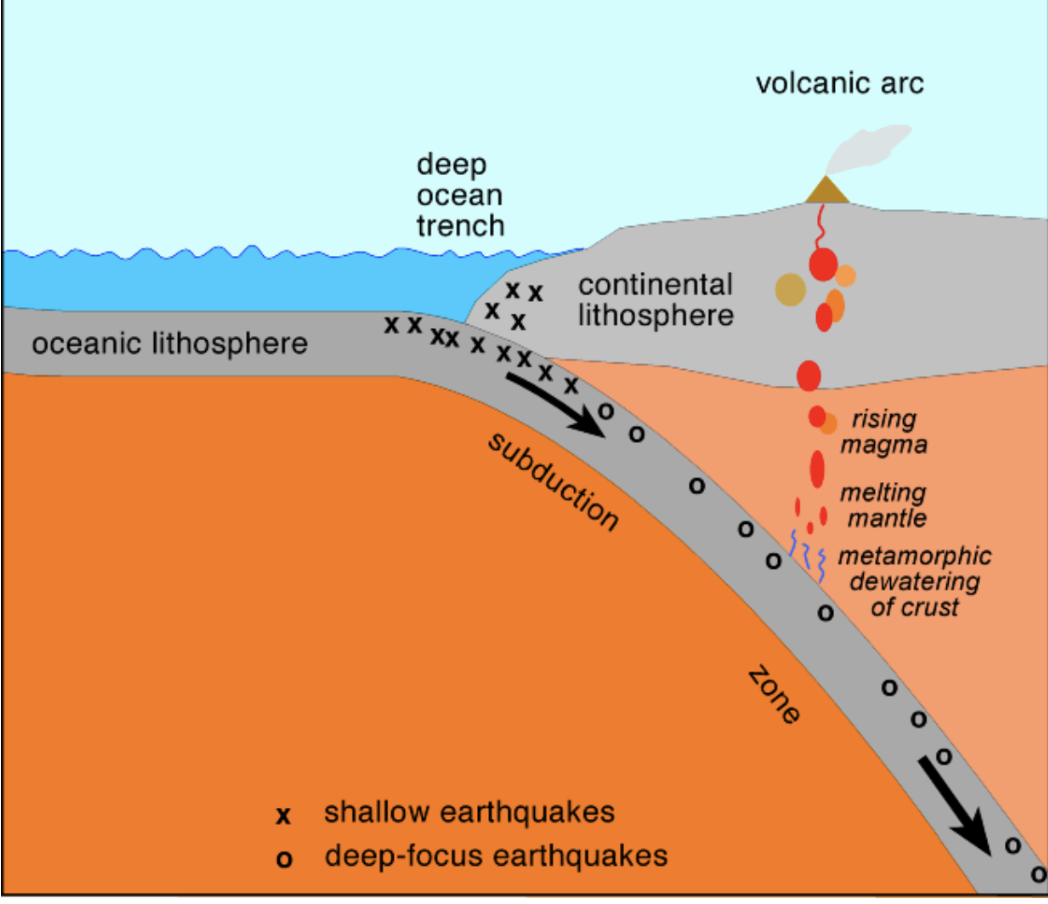
How do volcanic arcs form at subduction zones?
A plate subducts beneath another plate.
The subducting plate releases water from hydrated minerals.
Water is added to the overlying mantle ⟵ this is flux melting
The added water lowers the melting point of the mantle.
The mantle partially melts, forming magma.
E.g. Japan and Indonesia.
How do volcanoes form at the rift setting?
The Earth’s crust pulls apart.
Hot mantle rock rises up.
Pressure on the rising mantle drops.
The mantle melts because of the pressure drop (decompression melting).
Magma rises straight to the surface.
Volcanoes form along the rift.
E.g. Iceland and East African rift systems.
How do volcanoes from at a intraplate setting?
Magma is just hotter.
A hot plume of mantle rises from deep within the Earth.
The plume is hotter than the surrounding mantle.
As it rises, pressure decreases.
The hot mantle melts due to decompression.
Magma forms and rises toward the surface.
Volcanoes form within the plate, away from boundaries.
What material is melted during partial melting?
The mantle peridotite.
As magma is buoyant, it rises and then mixes with other magmas or rocks to form its rock composition.
What’s the difference between Basalts and Rhyolites?
Basalt - mafic, low silica = less viscous.
Rhyolite - felsic, high silica = very viscous = erupts explosively.
What are the 5 properties of magma?
Volatile content - substances that easily vaporise.
Chemical composition
Viscosity
Temperature
Crystallinity - how the particles are structured.
What is a polygenetic volcano?
Stratovolcano/ composite volcano - erupts many times over a long period.
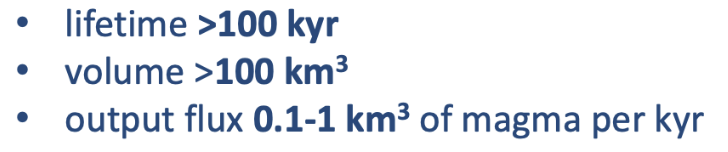
What is a monogenetic volcano?
Volcanoes that only erupt once from a single event.
Hundreds of vents, active in single eruptions and forming monogenetic cones.
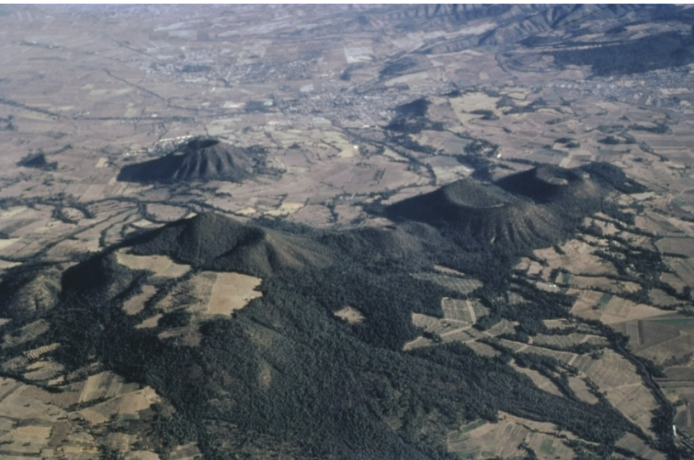
What would you say is a hazard challenge of a monogenetic volcano?
Don’t know where next volcano will be.
Why do volcanoes pose a wide range of hazards?
produce a range of eruption styles, sizes and magma composition.
Difficult for monitoring data to predict potential impacts.
What is the process of crystal formation?
Magma ascends
Pressure reduces as it cools
Volatiles form bubbles by going into the gas phase.
Magmas are a mixture of crystals bubbles and silicates.
What conditions allow magma to reach the surface?
Input of fresh magma, the exsolution of volatiles, causes overpressure to build.
overpressure > strength of rock - fracture forms where magma can ascend.
How can you increase viscosity?
Reduced water content and temperature.
Increase crystallinity - control cooling rate.
What is viscosity?
A measure of a fluid’s resistance to flow.
What are the ways to study hazards?
Remote Sensing and GIS
Surveying and mapping
Modelling
Tree-ring dating
What are the 2 broad classes of the behaviour of magma?
Explosive - lava flows violently.
High silica
High viscosity
Effusive - lava flows out steadily.
Low silica
Low viscosity
How does low viscosity magma form?
Bubbles escape/ there’s insufficient gas to drive explosive fragmentation of the magma.
How does high viscosity magma form?
There is gas loss.
What’s the difference between lava flows and domes?
Lava flows are of low viscosity (mafic) and lava domes are of higher viscosity (felsic).
Lava domes are crystallised during the ascent.
What are the characteristics of lava flows in Hawaii?
Fast
Sheet like
Not water rich, but have high temps and crystal poor = low viscosity.
Fed by fissures (crack) where dykes breach the ground surface.
Mount Etna - lavas generally more crystalline, more viscous and slower moving.
What does the lava flow length show?
Eruption and cooling rate.

What are lava tubes?
Lava flows in a channel or river during an eruption.
The surface of the lava flow cools and solidifies, forming a crust.
Beneath this crust, the lava continues to flow as a liquid.
Over time, if the lava drains away, it can leave behind a hollow tunnel — a lava tube.
Can lava flows be stopped?
Can be possible as they are too slow to be life-threatening. However, can be fast.
Why are lava domes a hazard?
Highly unstable
Dome can collapse with associated landslides and pyroclastic flows.
Can explode.
Most important impact is on the local population. - no specific end date, timing or magnitude of hazard.
Compare Hawaii eruptions with Mount Etna and Montserrat.
Hawaii - requires the fastest response because there is rapid flowing lava.
Soufriere Hills (Montserrat) - eruption can last years but is unstable.
Hawaii and Mount Etna have effusive eruptions and Montserrat explosive.
Therefore, evacuation zone at Soufriere Hills would be much larger.
What causes magma to erupt in a violent explosive style as it reaches the Earth’s surface?
Volatile content - can’t get volatile content without volatile species, they want to go into the gas phase. E.g. carbon dioxide, sulphates, halogens etc.
Only way to get volatile behaviour without volatile content is the interaction of magma content with water at the Earth’s surface.
How does size affect the explosive behaviour of eruptions?
Powerful eruptions = fine grained, ash rich.
Weaker eruptions like Hawaii produce ash locally.
How is the presence and behaviour of bubbles in magma fundamental to explosive eruptions?
water is the dominant gas species, water excels as it comes out the solution.
The reason it excels is because there’s a relationship between the pressure of a liquid and the solubility of volatile phases. This is a fundamental relationship. Like a fizzy drink when open bubbles come to the top.
What happens when bubbles form?
High pressure deep underground, volatiles are completely dissolved.
Magma rises, pressure drops.
Low pressure = gas comes out. Think about it as low-pressure clouds.
As bubbles form density decreases = increasing buoyancy, which increases ascent velocity.
How does bubble behaviour change in low-viscosity and high-viscosity magma?
Low viscosity magma - bubbles expand, coalesce and escape the magma.
Fragmentation is less efficient.
High viscosity magma - bubbles cannot escape.
High fragmentation.
If the magma reaches the surface, without fragmentation what eruption does this cause?
Effusive eruption
Insufficient volatile content to lead to fragmentation or gas has escaped.
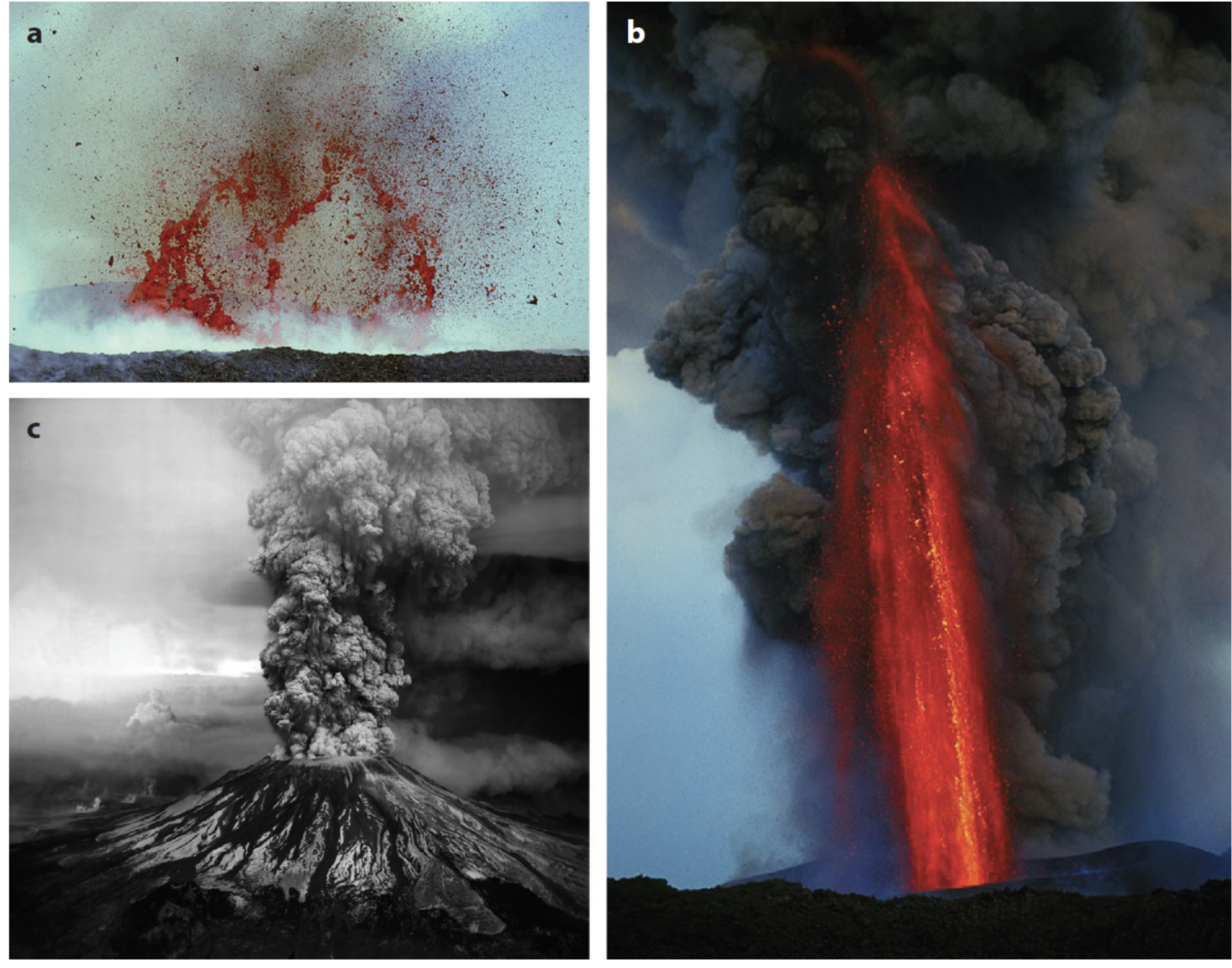
Can you describe the bubbles in the image?
a = bursting of a single/ large bubble in a gas.
b = fountain of behaviour, some ash produced but not efficient in generating fine grains
c = fine grains , high plume and plinian behaviour.
What are pulsatory explosions?
Eruptions in repeat bursts.
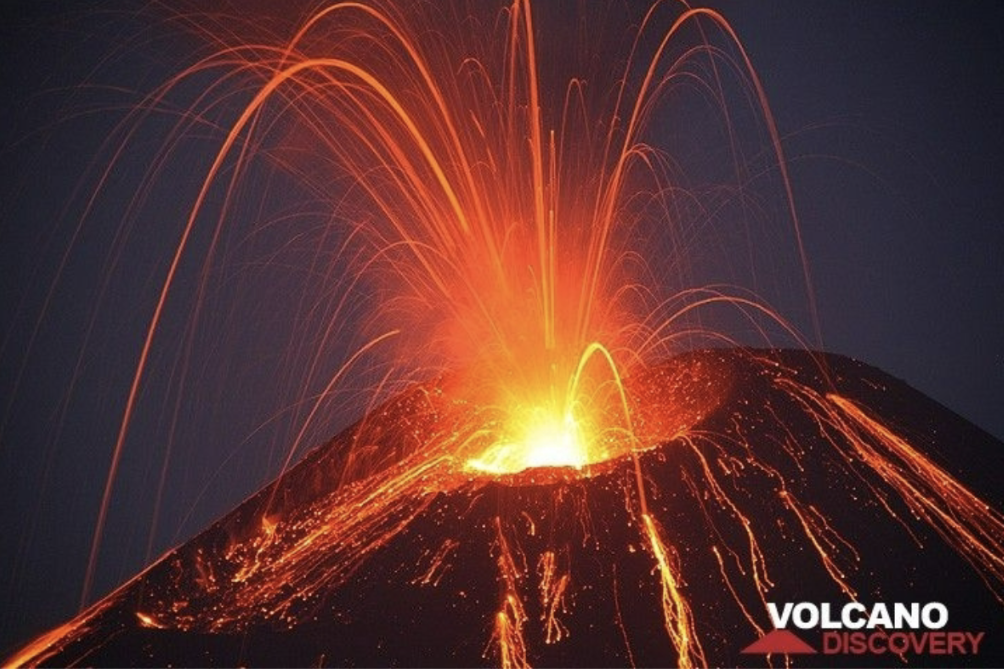
How do pulsatory explosions form cinder cones?
Low ash content and height means pyroclasts fall back to Earth locally.
They are deposited layers around the vent.
How do you form an eruption plume?
Plume needs to be buoyant to ascend to the top. Need fragmentation and gas expansion. This produces an expanding jet of material.
How does it get it’s buoyancy?
Needs to mix with atmosphere and so exchange heat = drive rapid expansion = sufficient expansion = buoyant.
What happens if the material mixes sufficiently?
Tephra fallout - showers of volcanic debris.
What happens if the material mixes insufficiently?
Material falls back to the ground and pyroclastic density currents are generated.
What is the condition needed for plume ascent to high levels?
Plume density < Atmosphere
Buoyancy is critical.
When density > atmosphere - PDCs are formed.
What are tephra fall deposits and what are the 5 things it is controlled by?
Tephra particles out of the cloud.
Thickest one near volcano, finer as further away.
Dispersal is controlled by wind speed and direction, particle size and density and the column height.
What are the typical characteristics of fall deposits?
Blanket topography
Well sorted
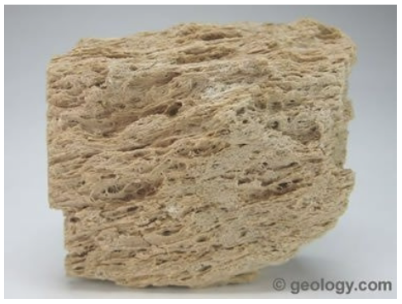
What are the impacts of fall deposits?
Structural damage, roof collapse
Air quality, agriculture, electrical systems and pumps.
Aerosol sulphate released, cooling effect.
What 2 processes are explosive volcanism divided into?
Fall - fall deposits
Flow - pyroclastic density currents.
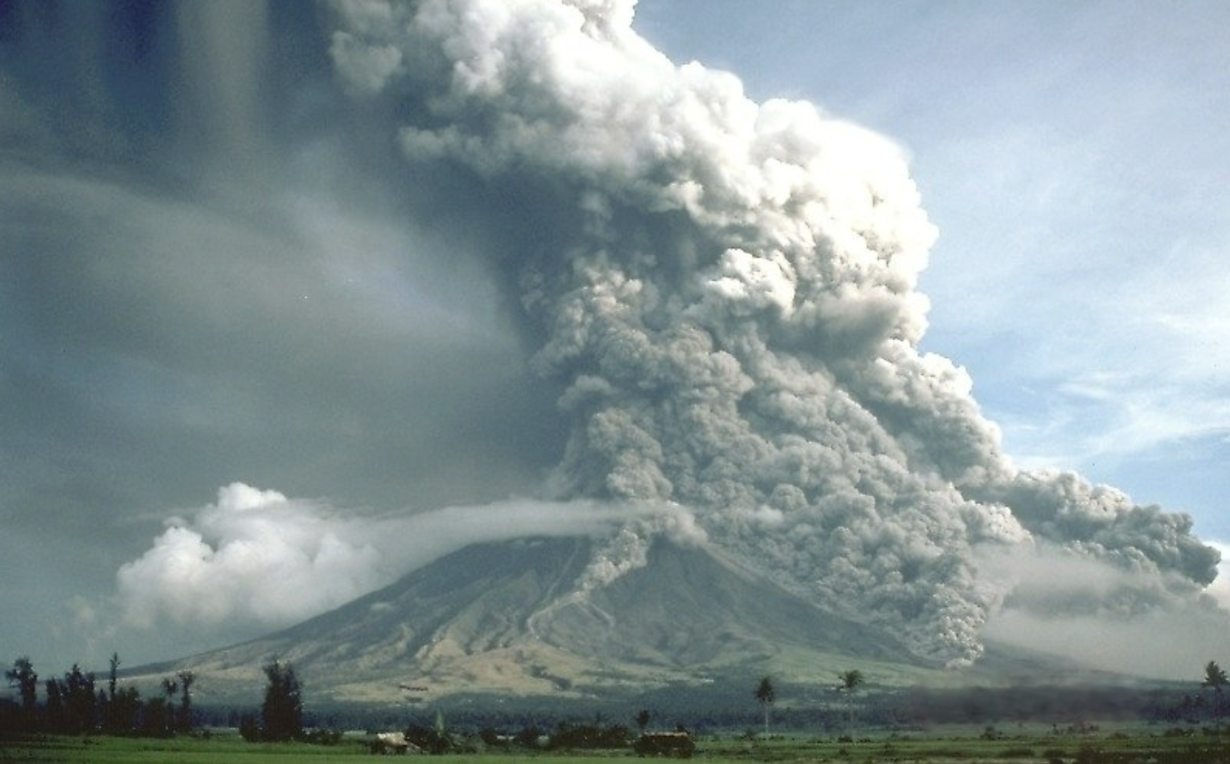
What are Pyroclastic Density Currents (PDCs)?
The most destructive and deadly volcanic hazard.
hot mixture of gas and solid.
high velocity and mobility.
ignimbrites produced.
dome can collapse.
Two types:
flow - coarse and dense
surge - low density and turbulent flow.
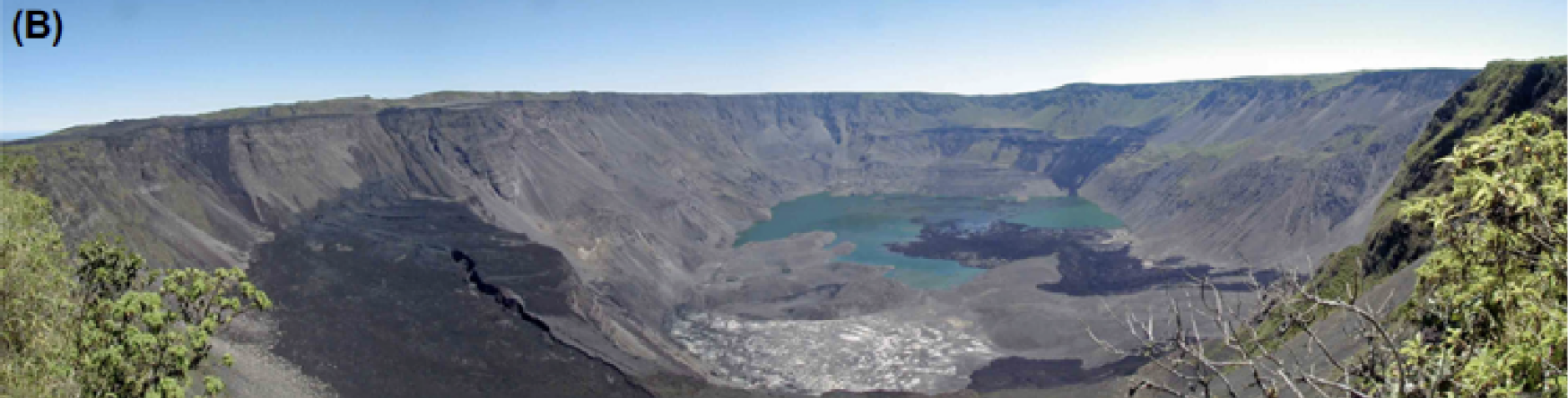
What is a Caledra?
Large volcanic depression formed when a volcano collapses inward.
much larger than craters.
form in the summit region of composite volcanoes - cone.
What are phreatomagmatic eruptions?
Magma comes into contact with water, causing rapid steam expansion that violently fragments the magma.
high fragmentation
highly unpredictable
produce fall and flow deposits.
What are Lahars?
Slurries of water and volcanic sediment.
can be primary and secondary e.g. direct by eruption or remobilised by rainfall.
erosive
can exceed channel capacity
slow at lower gradients, steep slopes travel rapidly.
can erupt beneath ice.
What are volcanic debris avalanches?
Volcanic landslide can occur due to lateral collapse processes e.g. rapid growth leading to steep slopes.
Can you give an example of an eruption, which was successfully monitored?
Merapi eruption (2010):
probability of one large event every 100/200 years.
monitoring saved 10-20,000 lives through evacuation.
pyroclastic flows travelled further than usual resulting from dome collapse.
Why are some buildings damaged and some left undamaged?
Different building styles
Shelter from vegetation or topography
What factors do you consider when monitoring?
Frequency and magnitude
Deformation (movement of ground)
Seismicity (seismic energy release)
Gas emissions or changes in lake chemistry. Main volatile is water but can’t be measured in atmosphere.
Infrasound
Angle of a slope using a tilt meter.
What are the issues with using past records to predict/ monitor volcanoes?
Hard to date events especially effusive events as they produce few ash layers and can last for years.
Small and frequent events can be absent from the record.
Can miss the rare but extreme event.
What is another well-monitored volcano?
Kelud, Indonesia
Several eruptions = good historical record
Associated lahar hazards, PDCs and ash fall.
Why was Nevado del Ruiz (1985) the 2nd worst volcanic disaster of the 20th century?
Different methods of messaging between local community and government - disbelief of hazard.
Not a clear official evacuation order.
How can you reduce the risk arising from a hazard?
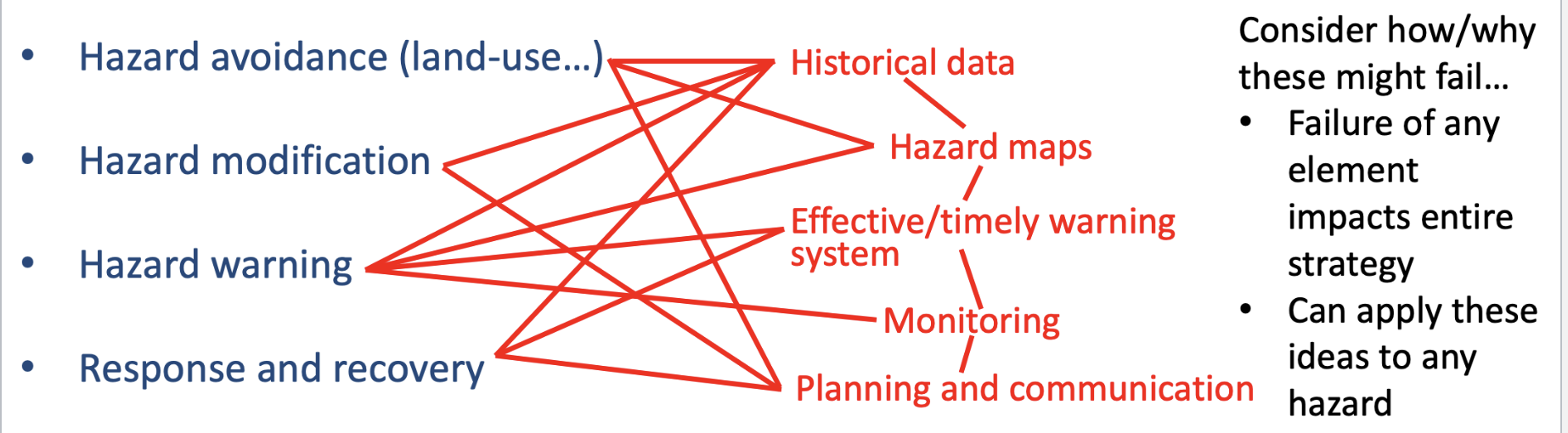
 Note
Note  Flashcards (182)