X-ray Production, Spectrum, and Interaction in Radiology
 Call Kai
 Learn
Learn Practice Test
 Spaced Repetition
 Match
Match Flashcards
 Knowt Play
1/250

There's no tags or description
Looks like no tags are added yet.
Name | Mastery | Learn | Test | Matching | Spaced | Call with Kai |
|---|
No analytics yet
Send a link to your students to track their progress
251 Terms
The KE of the incident electron is an x-ray tube is
about 1% efficient in the production of XRs
The shift of the characteristic XR spectrum to higher energy occurs because of which of the following
an increase in target atomic number
Useful characteristic XRs are produced in tungsten
by removal of a K-shell electron
A L-shell electron (binding energy = 26 keV) is removed from an atom that has M-shell binding energy of 4 keV and N-shell binding energy of 1 keV. If a free electron fills the vacancy in the L-shell, the characteristic x-ray photon produced will have an energy of:
26 keV
What is produced when the incident electron excites an outer-shell electron
thermal energy
The energy of characteristic x-rays increases with increasing
atomic number of the anode target
XRs are produced when
incident electrons interact with anode target atoms
Characteristic XRs
are characteristic of target Z#
When a tungsten-targeted XR tube is operated at 68 kVp
some incident electrons may have 68 keV
Gold is sometimes used as target material in special types of radiation-producing systems. Its electron-binding energies are as follows: K-shell 81 keV; L-shell 14 keV; M-shell 3 keV; and N-shell 1 keV. Which of the following characteristic x-rays would be produced with operation at 90 kVp?
67 keV
In a tungsten-targeted XR tube operated at 90 kVp, the most abundant x-ray would be a
30 keV bremsstrahlung x-ray
Which of the following electron transitions results in the most useful bremsstrahlung x-ray
none; brems has nothing to do with electron transitions
Bremsstrahlung radiation is produced by
the conversion of incident electron KE to electromagnetic energy
Bremsstrahlung x-rays produced in a tungsten-targeted XR tube
outnumber characteristic x-rays
Which of the following incident electron-target interactions results in XR emission
removal of an inner-shell electron
When mAs is increased, XR quantity
increases proportionally
When XR tube filtration is increased, XR quantity
decreases
In general, XR quantity will increase with an
increase in kVp
Another meaning of "x-ray quantity" is x-ray
intensity
Which of the following does not affect x-ray quantity
radioactivity
When filtration is added to an XR tube, which of the following increases
radiation quality
It is often stated that mAs controls quantity and kVp controls
quality
An x-ray beam can be made to have higher effective energy is which of the following occurs
filtration is added
Reducing kVp will do which of the following
soften the x-ray beam
XRs of higher maximum energy can be obtained by doing which two of the following
increasing kVp and increasing atomic number of target material
The area under the curve of the x-ray emission spectrum represents
the total number of x-rays
A general emission spectrum contains
both characteristic and bremsstrahlung x-rays
The x-ray emission spectrum represents
x-rays emitted from the tube
The amplitude of the Bremsstrahlung x-ray emission spectrum
has maximum value at energy approximately one third of the kVp
To construct an x-ray emission spectrum, one must know the
number of x-rays at each energy interval
Define photon
small bundle of massless energy; what is produced when the high-speed electrons from the cathode strike an anode target
What are photons depicted by
a wavy arrow
Define characteristic cascade
the process of outer shells filling the void of an ejected electron
Define binding energy
the energy required to remove the electron from its shell
What is binging energy measured in
electron volts (eV)
Define incident electron
the electron that causes a brems (by interacting with the nuclear force field) or characteristic (by ejecting an inner-shell [k-shell] electron) XR
What is an incident electron represented by
a solid arrow
Heterogenous beam
a beam of radiation consisting of a spectrum of photon energies (polyenergetic)
Homogeneous beam
a monoenergetic beam consisting of particles or photons with the same energy
Average energy
equal to 1/3 of the kVp; the average amount of penetrability power a photon in the XR beam can have
Maximum energy
kilovoltage peak; the max amount of penetrability power a photon in the XR beam can have
Emission spectrum
Graphical representations that measures the type of x-rays (Brems vs. Characteristic) comprising the primary beam; x axis = quality (energy); y axis = quantity (amplitude/intensity)
Quantity
Represents the total number of X-ray photons in the beam; also called intensity
Quantity is measured as Exposure in units of
c/kg or Air-Kerma in units of Gya
Quantity is controlled by
mAs (via thermionic emission)
Quality
Represents the average energy/penetrability of the XR beam
Quality is controlled by ____ and equal to ___________
kVp; 1/3 of the kVp
Quality is measured in
half-value layers
Tube potential
The difference in charge between the negative cathode and the positive anode side
Tube potential ____________ as kVp increases
increases
Tube potential is measured in units of
kilovoltage
Tube current is measured in
milliamperage
Tube current begins at the _____________ and is...
filament via thermionic emission; the number of actual electrons flowing across the tube (from filament wires on the cathode side to the anode target on the anode side)
Exposure time
the amount of time electrons are flowing through the tube and x-rays are being produced
Exposure time is measured in
seconds
What is the source of electrons within the x-ray tube?
Filament wires via thermionic emission
Where, specifically, do tube interactions occur?
Within 0.25-0.5 mm of anode target
What are the possible interactions that can occur between an incident electron and target atom?
Heat, Bremsstrahlung, and Characteristic
The type of interaction that occurs in the production of x-rays is dependent upon
kVp (above or below 70)
What percent of target interactions result in the production of x-rays?
Less than 1%
List the other names is Brems interaction is known by
Continuous radiation, polychromatic, white radiation, braking rays
With what part of the atom does the incident electron interact?
Nuclear force field
When will a bremsstrahlung photon be produced
When incident electron brakes; in the XR beam, it will make up 100% of the interactions occurring when the kVp is less than 70 and 85% when the kVp is over 70
The energy of a bremsstrahlung photon is dependent upon
kVp // energy of the incident electron and the proximity of the incident electron to the nucleus as it passes
The maximum energy of a bremsstrahlung photon is equal to
The given kVp // incident electron energy (ex. if the kVp is set to 65, then the maximum energy that the photon can have is 65 kev)
During an exposure, an incident electron strikes the anode with an energy of 100 kVp: If the electron passes very close to the nucleus, what is the approximate energy of the photon created?
High, likely near 100 kVp (~99 keV)
During an exposure, an incident electron strikes the anode with an energy of 100 kVp: If the electron passes very far from the nucleus, what is the approximate energy of the photon created?
Low energy; a lot less than 100 kVp (~1 keV)
During an exposure, an incident electron strikes the anode with an energy of 100 kVp: If the electron passes very far from the nucleus, what is the approximate energy of the electron as it exits?
It would still have somewhat of a high energy since it did not convert much energy into a photon (~99 keV)
At 60 kVp, what percent of the primary beam is made up of bremsstrahlung photons
100%
At 95 kVp, what percent of the primary beam is made up of bremsstrahlung photons
85%
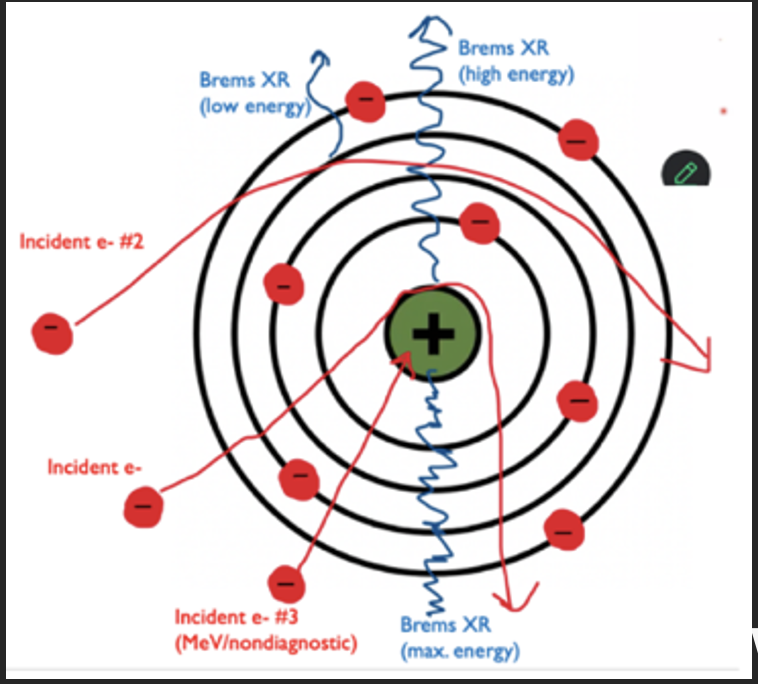
Which interaction is this
Bremsstrahlung
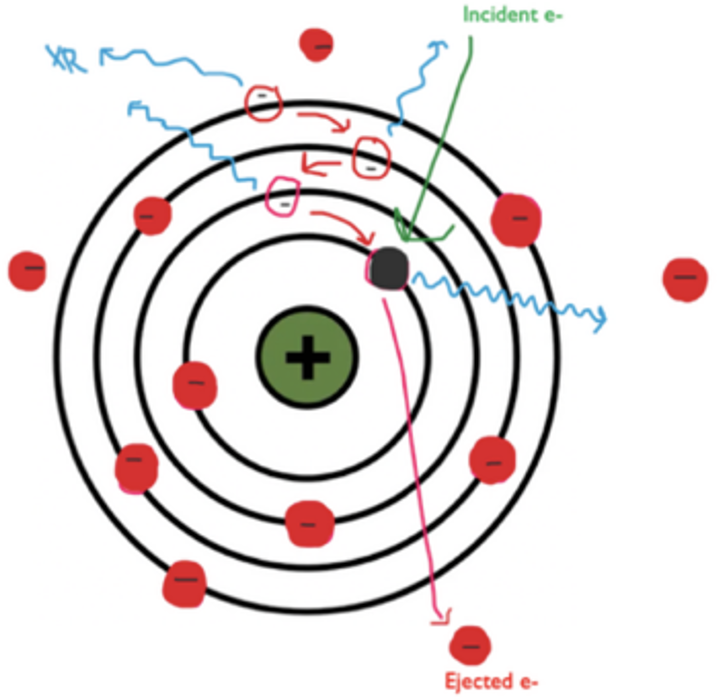
Which interaction is this
Characteristic
What other name is characteristic interactions known by
discrete
With what part of the atom does the incident electron interact?
Inner-shell electrons (K-shell)
When is a characteristic photon produced?
during cascade effect
The energy of a characteristic photon is dependent upon
The atomic number of the target material (binding energies of the shells)
The maximum energy of a characteristic photon is equal to
the binding energy of the K-shell, usually 69.5 keV since tungsten is often the target material used; only occurs when a free electron fills the ionized K-shell
During an exposure, an incident electron with an energy of 110 keV ejects a k-shell electron from orbit. What is the maximum energy of the characteristic photon produced?
69.5 keV
The energy of characteristic photons will change when which of the following is modified? (Choose one.) kVp, mA, filtration, anode material, generator type
anode material
What are the binding energies of a tungsten atom: K-shell
69.5 keV
What are the binding energies of a tungsten atom: L-shell
12.1 keV
What are the binding energies of a tungsten atom: M-shell
2.8 keV
What are the binding energies of a tungsten atom: N-shell
0.6 keV
What are the binding energies of a tungsten atom: O-shell
0.08 keV
At 50 kVp, what percent of the primary beam is made up of characteristic photons?
0%
At 85 kVp, what percent of the primary beam is made up of characteristic photons?
15%
With what part of the atom does the incident electron interact?
Valence (outer-shell) electrons
At what point in the interaction is heat produced?
When incident electrons excite valence electrons AND return from the excited state
List two alternative names for heat
Infrared radiation and thermal energy
What percentage of tube output is heat?
99.8%
A general emission spectrum demonstrates which interactions
brem and characteristic
A discrete emission spectrum demonstrates which interactions
characteristic only
A continuous emission spectrum demonstrates which interactions
brems only
On a spectrum, bremsstrahlung radiation is represented by a
bell curve or brems hump
On a spectrum, characteristic radiation is represented by
vertical lines called characteristic peaks
An increase or decrease in amplitude represents changes to
quantity
A peak shift right or left represents changes to
quality
An increase in which factor(s) will result in an increase in amplitude?
mAs, kVp, generator efficiency, atomic number
An increase in which factor(s) will result in a peak shift to the right?
kVp, filtration, generator efficiency, and atomic number
An increase in which factor will result in a decrease in amplitude?
Filtration

