RTVF 010 - Film Studies - Final Study (Concepts)
 Studied by 0 people
 Call Kai
 Learn
Learn Practice Test
 Spaced Repetition
 Match
Match Flashcards
 Knowt Play
1/43

There's no tags or description
Looks like no tags are added yet.
Name | Mastery | Learn | Test | Matching | Spaced | Call with Kai |
|---|
No analytics yet
Send a link to your students to track their progress
44 Terms
Graphic Relations (Editing)
Connecting through similar shapes, colors, movements
Rhythmic Relations (Editing)
Editors manipulate the rhythms experienced by viewers through juxtapositions of longer and shorter shots as well as through transitional devices that affect the viewer's sense of beat or tempo.
Spacial Relations (Editing)
Using the space provided to create the shots necessary for the movie (Continuity, Discontinuity, "Creative Geography", and Crosscutting)
Spacial Continuity
maintaining consistency in geography through which actions can flow in a logical and seamless manner; made to seem like all the shots are from the same area
Spacial Discontinuity
A films space doesn't flow as smoothly. Breaking 180 degree line, adding jump cuts, or nondiegetic inserts
"Creative Geography"
angling/editing shots together to create the illusion that they are of the same space
EX: gold rush climbing the mountain scene
Crosscutting
Editing that alternates shots of two or more lines of action occurring in different places, usually simultaneously.
Temportal (Time) Relations
The use of time in relation to how it is portrayed in the film (Temporal Continuity and Discontinuity)
Temporal Contiunity
Illusion that the film is during one continuous time (even if it really was shot over multiple weeks)
Temporal Discontinuity
A narrative or editing approach that disrupts the normal flow of time, creating an experience of temporal dislocation (not chronological)
EX: Montage Sequence - condenses time to show progression over a shorter period
"Intellectual" Relations
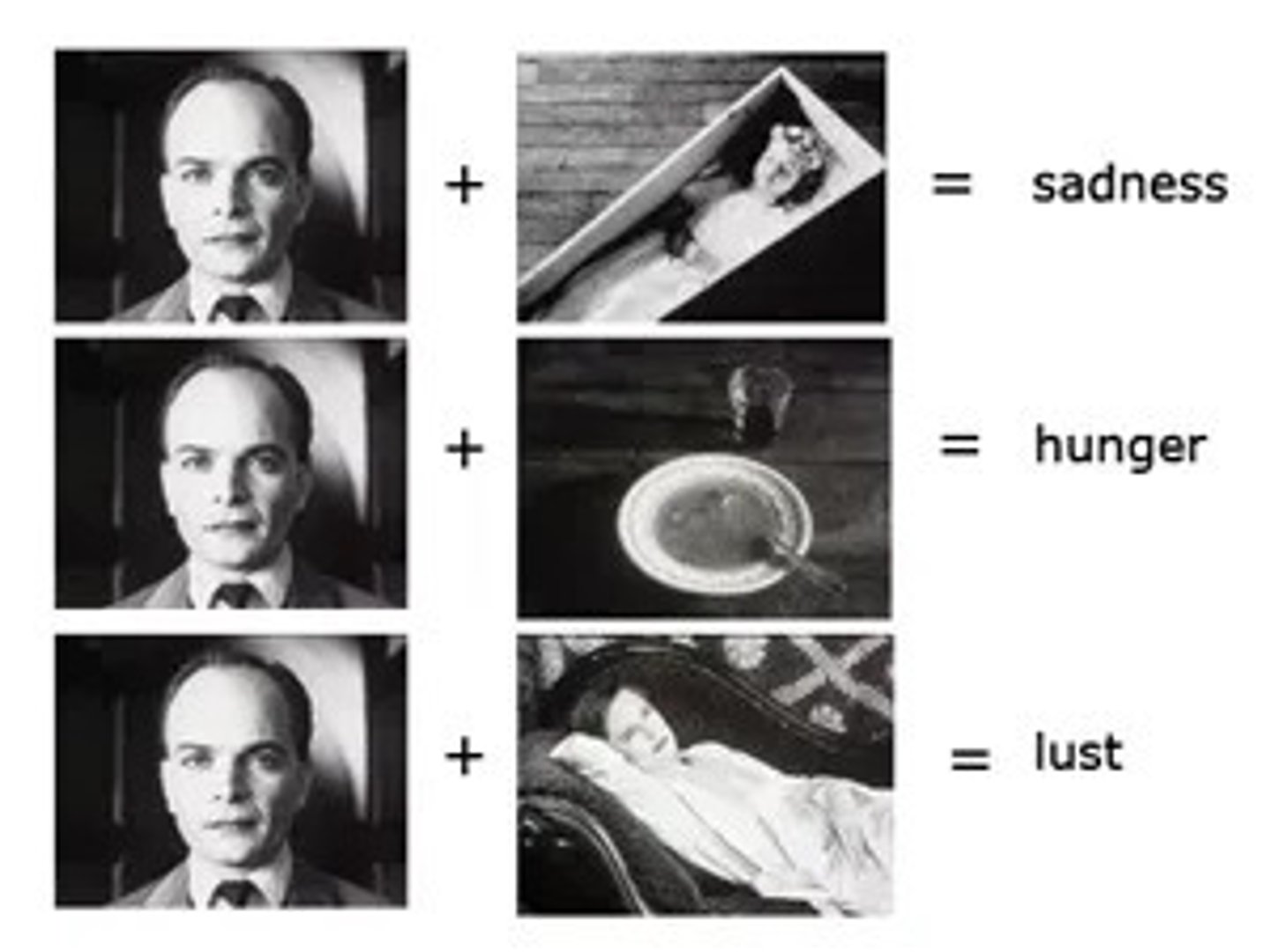
Combining shots to create an idea, Kuleshov effect
180-degree rule/system
maintains the illusion of spatial reality by shooting from one side of an imaginary line
30 degree rule
the camera must move at least 30º around the subject between consecutive, similar shots to ensure a smooth transition and maintain continuity
Jump Cut
Violation of the 30-degree rule; jarring bc the subject "jumps" slightly within the frame; discontinuity
Dialogue, Music, Sound Effects
3 Categories of Sound Analysis
Diegetic Sound
originates from within the story world (characters can interact); heard by both the audience and charatcers
NonDiegetic Sound
elements (music scores, narration, text) outside (characters do not notice); not heard by the characters, but by the audience
Timbre
the unique quality that distinguishes different sounds
(even when pitch and volume are identical)
Pitch
frequency: how high or low it is
Volume
amplitude: how loud or soft it is
Spacial Aspects (Sound)
enhances realism and immersion by creating a three-dimensional soundscape, allowing sound designers to position, move, and layer audio—including height and depth—beyond traditional surround sound
Temporal Aspect (Sound)
order, duration, and frequency of a sound
Analyzing A Film
1. Identify narrative structure
Salient Stylistic Techniques
2. Notable/Important/Standout
3. Patterns in the Salient (Notable) Stylistic Techniques
4. Pose/Suggest how these patterns function in relation to the narrative
Genre List
Horror
Romance
Comedy
Western
Thriller
Musical
War
Drama
Action
Expectations: Western
- Grizzled middle-aged white man as protagonist
- Action
- Widescreen
- Setting
Expectations: Horror
- Monster
- Makes you afraid
- Eerie music
- Dark lighting
- Fear of the unknown
- Atmospheric
- Uncanny: Something strange, or partially human
*Cautionary Tale*
Dual Structures
EX: (good vs evil, nature vs civilization, etc)
common in genre films
Genre Phases
Primitive, Classical/Mature, Revisionist, Parodic
Primitive Genre Phase (1)
Still forming, tropes are being founded and experiments
are made
Classical/Mature Genre Phase (2)
Tropes are formed, several films show off the
conventions
Revisionist Genre Phase (3)
After the genre has been well-established for a while,
someone will turn the tropes on their head
(EX: instead of cowboys good and natives bad, they'll flip that)
Parodic Genre Phase (4)
Spoofs and satires, like Scary Movie or Blazing Saddles
Formalist Theory
(1st) 1910s-20s
Promoted Film as an art form
Emphasized how the film medium differs from reality and connections to other artistic media
Differs:
- scripted narrative
- performance
- cinematography
- silent
- editing
Realist Theory
(Response, 2nd) 1940s-50s
Film is an Art form, Formalist Argument no longer needed
Recognized important connection between film and reality; film should maximize these
photochemical(light)/physical connections
Techniques:
- deep staging
- location shooting
- deep focus cinematography
- long takes
- moving camera
- color
- sound
- de-emphasized editing
*Does not mean story is "realistic"*
Neo-Formalist Approach
Bordwell-Thompson
Techniques of realism are also formal choices
formal devices create meaning and artistic expression rather than searching for hidden thematic messages
Hollywood Narration
Clear 3-act structure
*Quick exposition
*Conflict
*Resolution
Clear protagonist, traits and goals
Tight cause-effect chain of events
Style serves the narrative
Unified ending
*Coherent and Cohesive*
Art-Cinema Narration
- Delayed exposition
- Character traits and goals less clearly defined
- Looser cause-effect relationships
- Story events are de-dramatized
- "The Game of Form" — a different kind of "game" from hollywood
- Requires interpretation, indifferent levels — "commentary"
- Style for its own sake - or to reflect mental states of chars
- Lack of clear resolution
*ALL LEADS TO A HIGHER DEGREE OF AMBIGUITY*
A different approach to "realism"
º Art cinema sees "reality as less knowable, less coherent, more ambiguous º
Documentary Subgenres
More often related to approach than subject
- Educational
- "Talking Heads" - Interviews
- Compilation
- Direct Cinema/Cinéma Vérité
Robert Drew/Primary (1960)
D.A. Pennebaker/Dont Look Back (1967)
- Portrait - intimate, essence of individual
- Personal documentary - biographical
"Major Genres"/Supergenres
Fictional Feature (Horror/Sci-Fi/etc)
Documentary
Experimental
Experimental Film
'MTV BRAIN', Reflexivity, Direct Theory
'MTV BRAIN'
M- Mental imagery/psychological, dreamlike
T - Technical innovation/experimentation
V - avoidance of Verbal Language
B - Brevity (films tend to be brief)
R - Reflexivity (more to come on this one)
A - Acollaborative (not collaborative)
I - highly Independent in nature
N - Non - Narrative structures
Direct Theory
The films themselves address questions of film theory:
- what is cinema?
- how do we experience it visually and psychologically?
Experimental Film Sub-Genres
European Avant-Garde: 1910s-20s
American Underground: 1950s-60s
European Avant-Garde
Related to similar movements in other arts
Response to WWI - means of political/social change
Cubism / Futurism / Dadaism / Surrealism
 Note
Note  Flashcards (130)