identifying atypical development
 Studied by 0 people
 Call Kai
 Learn
Learn Practice Test
 Spaced Repetition
 Match
Match Flashcards
 Knowt Play
1/34

There's no tags or description
Looks like no tags are added yet.
Name | Mastery | Learn | Test | Matching | Spaced | Call with Kai |
|---|
No study sessions yet.
35 Terms
what 3 factors make atypical development hard to define
individual differences in rate of development
individual differences in traits including both strengths + weaknesses —> issues when generalising to whole population
‘atypical’ definition is dependent on cultural differences in interpretation
definition of atypical development
‘the extremes of individual differences in development’, including both advanced + delayed development —> equivalent of falling 2/3 SDs from the mean
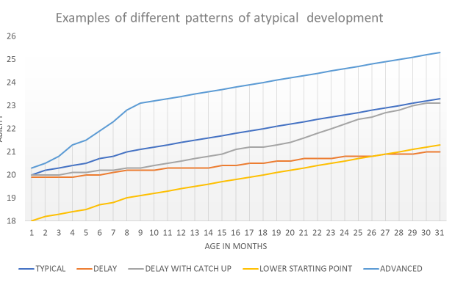
what are 6 patterns of developmental trajectory
typical —> steady increase in capability
delay —> starts at same ability level, but gap increases due to ability not developing at the same rate
delay with catch-up —> child initially doesn’t develop at the same rate, but ability level eventually increases
lower starting point —> starts from lower ability level, so develops at same rate as typical, but isn’t catching up
advanced —> develops ability at a faster rate than typical
developmental regression —> period where a particular skill initially develops along a typical trajectory, but skill is eventually diminished/lost
in what conditions + which what abilities is developmental regression often observed in
typically seen in children with ASC or an intellectual disability. most commonly effects language skills (may learn vocab but become non-verbal later in development), eye contact motor skills
which 5 main domains does development occur across
adaptive behaviour
social development
cognitive development
physical development
motor skills
what are examples of adaptive behaviours that may be assessed
daily living skills, e.g. ability to work + manage money
functional decision making skills
personal safety
personal responsibility
independence
what are examples of social behaviours that may be assessed
language abilities/verbal communication
understanding social interactions/different types of relationships
non-verbal communication e.g. facial expressions, gestures, reciprocal eye contact
conversational turn-taking
emotional IQ + empathy
what are examples of cognitive abilities that may be assessed
core/basic cognitive functions e.g. memory, attention + inhibition
higher-order e.g. IQ, language, EFs + numerical ability
what are examples of physical attributes that may be assessed
more medical than psychological, but may be associated with various neurodevelopmental conditions. includes:
facial dysmorphism
micro/macrocephaly
differences in stature
organ differences e.g. in heart function/size or muscle tone
what are examples of motor skills that may be assessed
fine motor skills —> movement of hands/fingers e.g. handwriting/drawing
gross motor skills —> movement of limbs for whole-body movements e.g. walking/catching a ball
balance + coordination (commonly affected by neurodevelopmental conditions e.g. William’s syndrome
how we can identify if development is atypical + what 2 things does this require
group comparisons against a representative (normative) sample of the population —> therefore we can see where the individual lies on a normal distribution curve. this requires
an appropriate control group
developmental trajectory to be tracked overtime —> gives insight into any changes we can expect later
why it is important to assess a child using appropriate/varied control groups
by using varied control groups (e.g. matched on chronological + mental age), we can assess what a child’s individual strengths/weaknesses relative to these populations
e.g. child may have poorer than average verbal reasoning abilities matched on chronological age, but average abilities based on mental age
why it is important to consider relative strengths of a child’s developmental profile
we cannot gain full understanding of a child’s abilities without relative strengths —> skills they are good at compared to their other skills, rather than in comparison to other people
this allows for appropriate interventions to be tailored to the individual based on their relative strengths, e.g. receiving verbal interventions as this is a relative strength in comparison to visuospatial skills
what are two main methods of measuring cognitive development
specific experimental designs —> designed to target specific behaviours
standardised tests —> designed to measure broader knowledge or skills
format + examples of specific experimental designs
format varies depending on research question. includes face recognition tasks, theory of mind tasks, EF tasks, online questionnaires, eye tracking + brain scans
results can be compared with matched control group, e.g. based on age or gender
format + 4 examples of standardised tests
follows a fixed + consistent format with specific instructions, questions + scoring procedures
participants’ raw scores can be standardised —> assigned a value that indicates how well they performed compared to others who have taken the test
method allows for broader assumptions to be drawn across large population
examples include IQ, Weschler Adult Intelligence Scale (WAIS), Weschler Intelligence Scales for Children (WISC) + British Ability Scales (measures adaptive abilities)
what 3 factors are important to consider when deciding between specific vs standardised methods of measurement
goal → standardised tests aim to measure broader knowledge or skills, while experiments aim to test a specific skill or test hypotheses.
scope → standardised tests are broad in scope, covering a range of topics or skills, while experiments are focused on a specific research question
generalisability → standardised tests aim to generalise results to a larger population, while experiments may have limited generalisability depending on the sample and conditions
what is the WISC and what 5 main indices does it measure
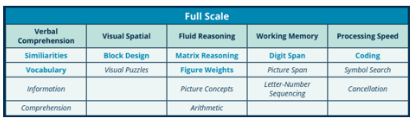
the Weschler Intelligence Scale for Children assesses intelligence in children ages 6-16. tasks start easy, then get progressively harder until participant cannot answer correctly, then test stops. indices assessed include:
verbal comprehension index (VCI) —> measures a child’s ability to understand + use language as well as verbal reasoning
visual spatial index (VSI) —> measures child’s ability to perceive, analyse + manipulate abstract visual info
fluid reasoning index (FRI) —> measures ability to solve novel problems using abstract logic + think flexibly
working memory index (WMI) —> measures ability to hold information in the mind
processing speed index (PSI) —> measures ability to quickly + accurately process info
what tasks are necessary to assess full scale IQ (FSIQ) in the WISC
VCI —> similarities + vocabulary test
VSI —> block design
FRI —> matrix reasoning + figure weights
WMI —> digit span
PSI —> coding test
what is VABS and what 5 indices does it measure (3,3,3,2,2)
the Vineland Adaptive Behaviour Scales measures adaptive behaviour using a semi-structured interview with the child’s parent, caregiver, teacher etc. its domains include:
communication —> receptive, expressive + written
daily living skills —> personal, domestic + community (use of time, money etc.)
socialisation —> interpersonal relationships, play/leisure time + coping skills (how responsibility + sensitivity to others is shown)
motor skills (optional) —> gross motor + fine motor
maladaptive behaviour (optional) —> internalising + externalising behaviour, as well as other undesirable behaviour that may interfere with adaptive functioning, e.g. meltdowns
how does semi-structured interview format used by VABS benefit the test
means the experimenter can follow up questions with prompts to gain more key information —> means test isn’t too rigid and behaviour outside of the norm can be more easily identified (even if parent isn’t aware)
2 possible tests of skills for non-verbal participants (as most tasks rely on giving verbal responses/listening to verbal instruction)
Weschler Nonverbal Scale of Ability (WNV) —> assesses non-verbal reasoning + problem-solving skills in individuals aged 4-21
Leiter International Performance Scale - Revised (Leiter-R) —> assessed cognitive abilities in individuals 3-75
what subtests does the WNV contain and who is it suitable for
subtests include object assembly, block design + picture arrangement
its use of visual stimuli + minimal verbal instruction make it suitable for non-verbal children/those with language difficulties
what subtests does the Leiter-R contain and who is it suitable for
uses variety of tasks e.g. matching pictures, completing patterns + solving mazes to capture different aspects of intelligence
suitable for assessing individuals with autism, language or hearing impairments
2 developmental scales suitable for toddlers/babies
Bayley Scales of Infant + Toddler Development (Bayley-III) —> assesses cognitive (e.g. attention span), motor (e.g. rolling), language, socio-emotional + adaptive behaviour in infants aged 1-42 months) using observation
Infant-Toddler Developmental Assessment (IDA) —> assesses cognitive, motor, language, socio-emotional + adaptive behaviour through observation, parent report + standardised tasks
which developmental scale is more often used for infants at risk of developmental delays/conditions
the IDA, as it uses a variety of assessment techniques, so is often used in early intervention programmes to identify children who need additional support
what is a standardised score
generated from raw scores after a standardised test, it’s a value that represents how a participant has performed compared to others in the population (e.g. based on age/gender), without the influence of individual differences
the value indicates where the score falls on a bell-shaped curve of others in the population
how is a standardised score gained
after a standardised test is administered, the raw score (sum of all scores) can be standardised by using a ‘look-up table’ based on an appropriate representative sample, though there are different ways to create standardised scores (e.g. t-scores)
what are t-scores and how are they scaled
an example of a standardised score —> 50 represents the mean, and each 10 represents 1 standard deviation
means if someone gets a score of 60, they are 1 standard deviation above the mean on a bell-shaped curve
what are 4 benefits of using standardised scores
enables researchers/clinicians to compare performance across different populations or tests
they provide common language for discussing test performance regardless of how actual test is designed (focus on results without method)
easily interpretable
though there are different methods of standardisation, they all allow for the same comparison
what did Dale (2021) investigate
whether the WISC-V scores of autistic individuals (with or without a language impairment) differed significantly to that of non-autistic peers —> whether WISC-V is a reliable diagnostic tool
what did previous editions of the WISC often conclude from autistic patients
ASD commonly presented more variability in results than typically-developed peers
½ perform 1 SD below the mean, 1/3 perform 2 SDs below mean
some autistic children have average-to-superior fluid reasoning, VS skills + WM
often have deficits in VCI + PSI
this meant ASD could be distinguished from other conditions based on cognitive profiles in previous editions
what were Dale et al. (2021)’s main findings in relation to participants with language impairments
study produced 95% accuracy for predicting ASD-LI classification —> shows autistic children with language impairment have strong cognitive profile
WMI + VCI were the most predictive factors
what were Dale et al. (2021)’s main findings in relation to participants without language impairments
scores for children with ASD-NLI were much more variable, so were not classified as accurately
WM was often in the normal range
the comprehension (lower score) subtest + similarities subtest (higher score) were predictive of autism
what was Dale et al. (2021)’s conclusion as to why the WISC-V is less sensitive to classifying cognitive profiles of autism in comparison to previous editions
the previous ‘perceptual reasoning index’ was separated into the VSI + FRI —> this means the non-verbal strengths + weaknesses of ASD are now included in separate indices, meaning it may be less useful in differentiating ASD
some subtests that result in significantly different scores between participants, e.g. letter-number sequencing + comprehension tests, are not required in FSIQ administration, meaning cognitive differences may not be picked up
 Note
Note  Flashcards (39)