Macromolecules
 Call Kai
 Learn
Learn Practice Test
 Spaced Repetition
 Match
Match Flashcards
 Knowt Play
1/12

There's no tags or description
Looks like no tags are added yet.
Name | Mastery | Learn | Test | Matching | Spaced | Call with Kai |
|---|
No analytics yet
Send a link to your students to track their progress
13 Terms
What are macromolecules?
Macromolecules are large molecules build by joining together smaller subunits, “monomers”.
Synthetic:
Polymers
Biomolecules:
Carbohydrates
Lipids
Proteins
What are synthetic polymers?
There are many different types of synthetic polymer. They are often classified by their properties or use.
Plastics are large, rigid materials at service temperatures. Plastics are further subdivided into thermoplastics and thermosets.
Rubbers are flexible, low modulus materials which exhibit long-range elasticity.
What are some of the variables that impact the properties of polymers?
Choice of monomer
Molecular weight and molecular weight distribution
Crystallinity
Melting point / glass transition temperature
Branching
Number and type of crosslinks
What is addition polymerisation?
Many monomers unit “add” together
Polymer has same empirical formula as monomer
What is condensation polymerisation?
Monomers react together by condensation
Loss of water as small molecule
What are the thermodynamics of polymerisation?
\Delta G^\circ = \Delta H ^\circ -T\Delta S^\circ
\Delta H^\circ is large and -ve (> -70kJ mol-1) \sigma bonds stronger than \pi bonds
\Delta S^\circ is large and -ve (> -100J K-1 mol-1) many molecules become one polymer
→ At low T, \Delta G^\circ -ve = polymerisation
→ At high T, \Delta G^\circ +ve = cracking at > 427C^\circ
What is radical polymerisation?
Initiator energy produces reactive radical species
Polymer chain continues to grow until:
Two radicals combine
Transfer of hydrogen radical
End groups have little effect on the properties of polymer formed.
What is cationic polymerisation?
Requires initial cation
Produces stable carbocation
What is anionic polymerisation?
Requires nucleophile
Nucleophile attacks electrophile
What are the physical properties of polyalkenes?
R groups on every second carbon
Large or polar R groups = rigid polymer
Chain length depends on conditions
Range of chain lengths always made
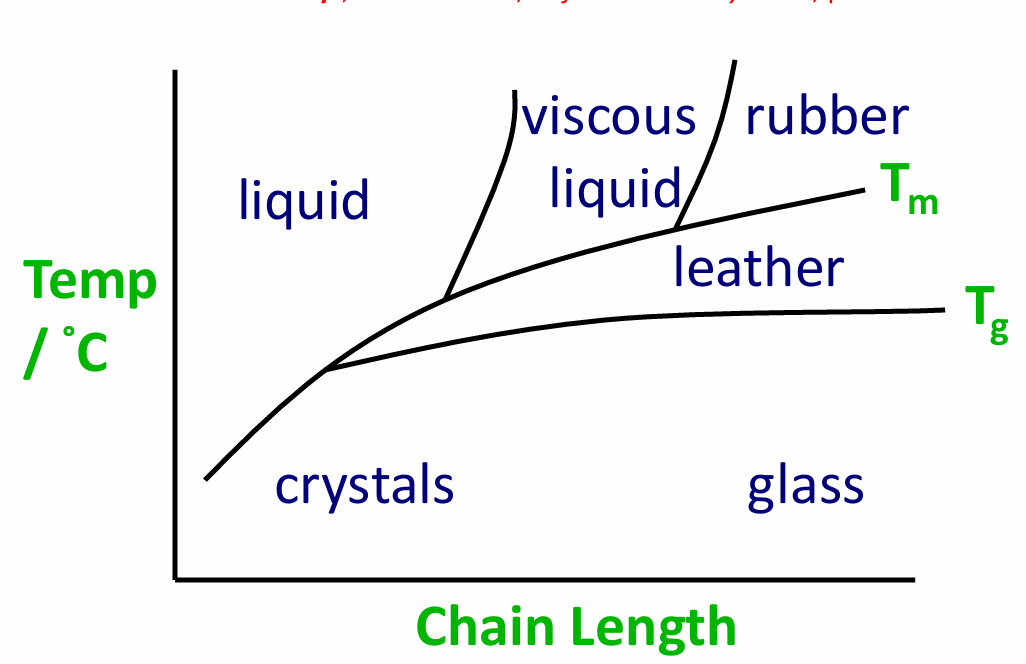
What is the effect of temperature on chain length?
Tg is the temperature at which a glassy brittle polymer becomes flexible
Tm is the temperature at which a thermoplastic begins to flow
Between Tg and Tm a polymer is flexible
What are modified polymers?
Expanded polymers
Plasticisers
Copolymers
Cross-linked polymers
Side-chain modifications

