Chapter 6 - Relaxation Time & Spin Density Quiz
 Call Kai
 Learn
Learn Practice Test
 Spaced Repetition
 Match
Match Flashcards
 Knowt Play
1/35

There's no tags or description
Looks like no tags are added yet.
Name | Mastery | Learn | Test | Matching | Spaced | Call with Kai |
|---|
No analytics yet
Send a link to your students to track their progress
36 Terms
Which of the following is not a principle MRI parameter?
A. Larmor equation
B. spin density
C. T1 relaxation
D. T2 relaxation
A. Larmor equation
Tissue B has higher density than tissue A.Tissue B will:
A. appear brighter
B. appear darker
C. have longer relaxation times
D. have shorter relaxation times
A. appear brighter
Which of the following tissues, based strictly on spin density should appear brightest?
A. fat
B. water
C. muscle
D. bone
B. water
Which of the following tissues, based strictly on spin density should appear darkest?
A. fat
B. water
C. muscle
D. bone
D. bone
In addition to spin density, signal intensity is also affected by:
A. how the spin is chemically bound
B. how the spin is charged
C. the mass of the spin
D. the distribution of the spin
A. how the spin is chemically bound
Spin density most closely related to:
A. bound hydrogen
B. mobile hydrogen
C. transient hydrogen
D. induced hydrogen
B. mobile hydrogen
Spin density can best be defined as hydrogen:
A. concentration
B. charge
C. relaxation
D. configuration
A. concentration
Spin density can be best described as the number of hydrogen nuclei:
A. passing through the voxel
B. at equilibrium in a voxel
C. excited in a voxel
D. in a voxel
D. in a voxel
Spin density is closest to concentration of nuclei in:
A. bound hydrogen
B. mobile hydrogen
C. tissue
D. water
B. mobile hydrogen
Spin density is most closely related to:
A. precession
B. relaxation
C. induction
D. concentration
D. concentration
Net magnetization at equilibrium (M0)
A. spin density
B. T1 relaxation
C. T2 relaxation
D. precession
A. spin density
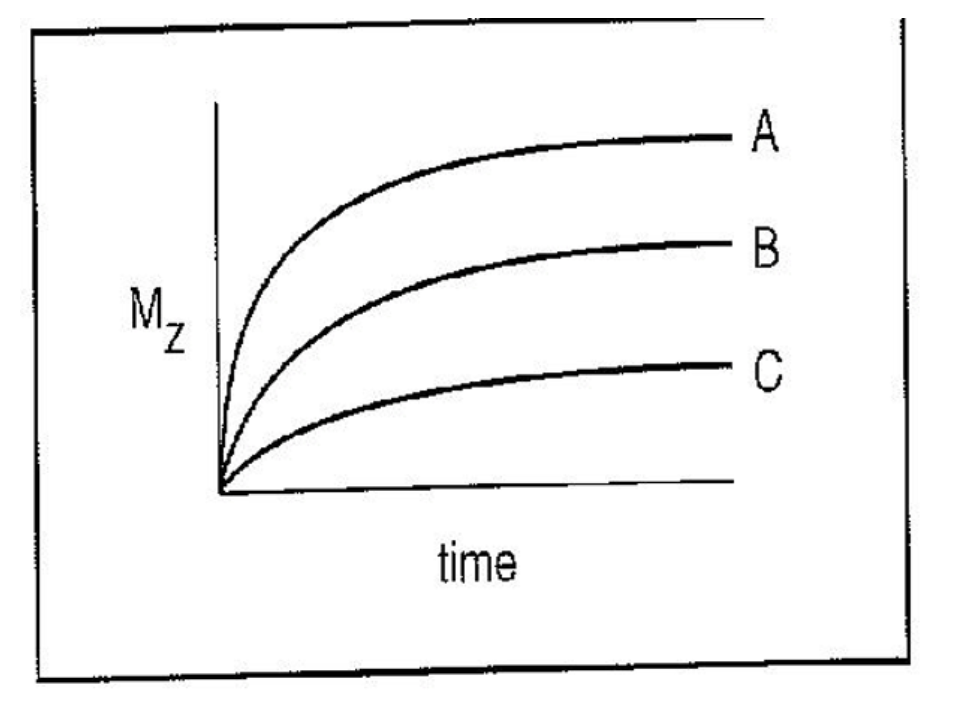
Which of the tissues represented in the above figure has highest spin density?
A. A
B. B
C. C
D. not enough information
A. A
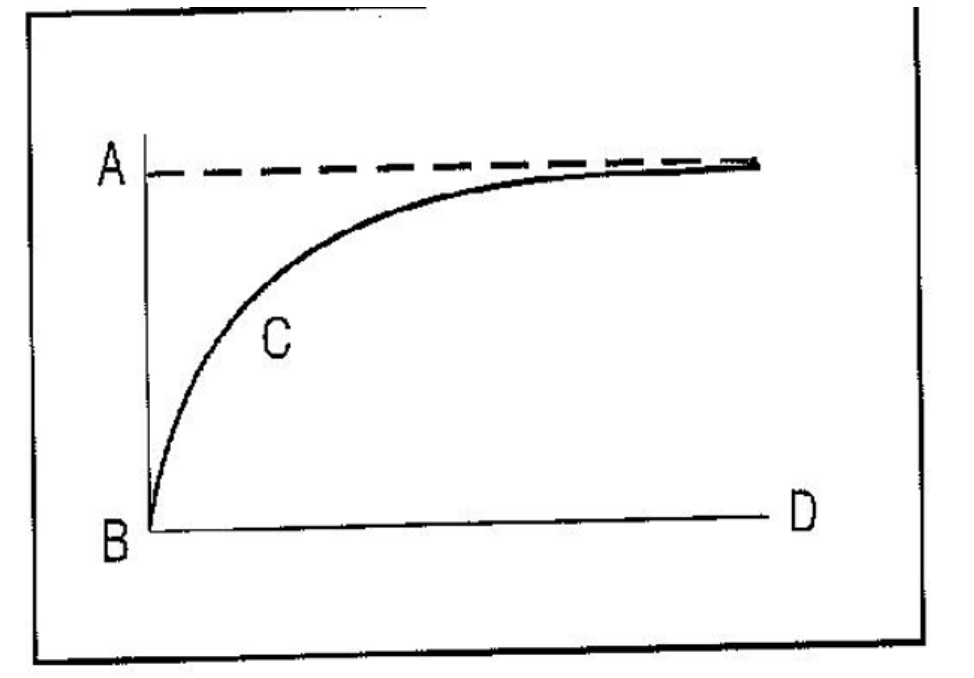
The above figure is a graph of?
A. Spin density
B. Spin density relaxation
C. Longitudinal relaxation
D. Transverse relaxation
C. Longitudinal relaxation
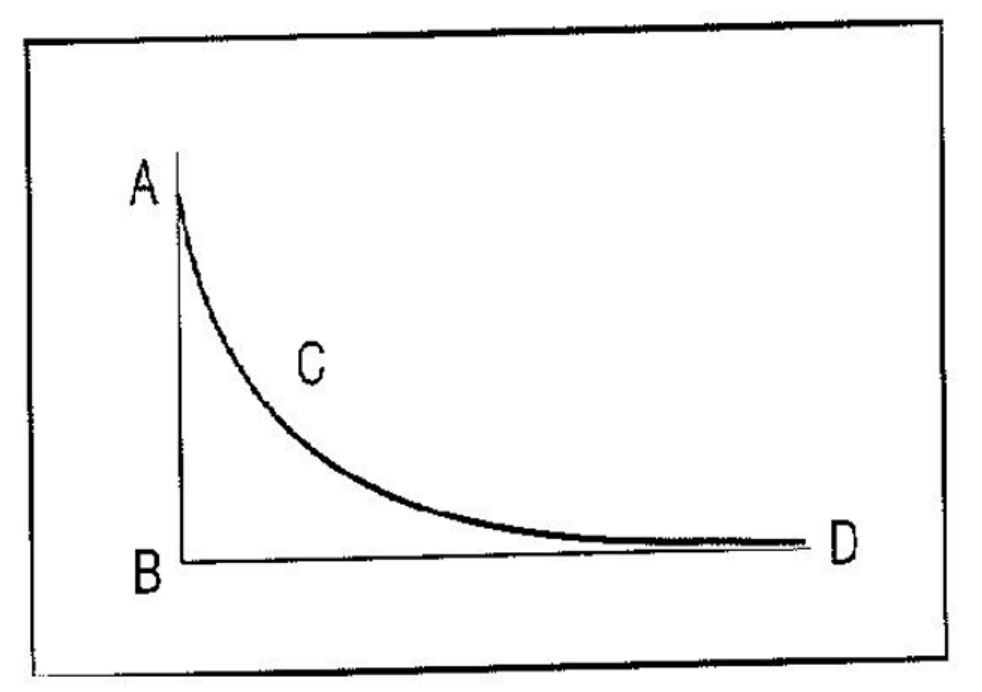
The above figure is a graph of?
A. spin density
B. spin density relaxation
C. longitudinal relaxation
D. transverse relaxation
D. transverse relaxation
At equilibrium Mz equals:
A. Mo
B. Mxy
C. spin density
D. relaxation
A. Mo
At equilibrium Mz is undetectable because:
A. it relaxes too fast
B. the spin density is too low
C. Mo is too high
D. Bo is too high
A. it relaxes too fast
T1 relaxation time is also known as:
A. spin density
B. longitudinal relaxation
C. transverse relaxation
D. precession
B. longitudinal relaxation
T1 relaxation occurs:
A. rapidly at first, then slows down
B. is contestant
C. slowly at first, then speeds up
D. is discontinuous
A. rapidly at first, then slows down
T1 relaxation time is related to the time required for:
A. Mz to return to equilibrium
B. Mxy to return to equilibrium
C. transverse saturation
D. longitudinal saturation
A. Mz to return to equilibrium
The T1 relaxation time is 300ms. What will be the value of Mz after a patient has been in a static magnetic field for 300 ms?
A. 0.37 Mz
B. 0.63 Mz
C. 0.37 Mo
D. 0.63 Mo
D. 0.63 Mo
T1 relaxation times are generally:
A. shorter than T2 relaxation times
B. about the same as T2 relaxation times
C. longer than T2 relaxation times
D. vary from tissue to tissues in relation to T2 relaxation times
C. longer than T2 relaxation times
After removal from the magnet for approximately five T1 relaxation times, Mz will equal approximately:
A. 0
B. 0.37 Mo
C. 0.63 Mo
D. Mo
D.M0
Which of the following tissue has the longest T1 relaxation time?
A. fat
B. brain
C. CSF
D. muscle
C. CSF
The time constant for the return of Mz to Mo is:
A. spin density
B. T1 relaxation time
C. T2 relaxation time
D. precessional frequency
B. T1 relaxation time
In general, as B0 increases the T1 relaxation time will:
A. decrease
B. remain the same
C. increase
D. vary from tissue to tissue
C. increase
When Mz equals 0, it takes approximately _ T1 relaxation time to return to equilibrium?
A. 1
B. 3
C. 5
D. 7
C. 5
The term longitudinal, in longitudinal relaxation time refers to events occurring along the axis of the:
A. patient
B. static magnetic field
C. magnetic field gradient
D. radio antennae
B. static magnetic field
Following an RF pulse, Mz will return to Mo, with a relaxation time described as:
A. precessional
B. inductional
C. longitudinal
D. transverse
C. longitudinal
Relaxation in equilibrium represents return to:
A. a lower energy state
B. the same energy state
C. a higher energy state
D. an energy state that is tissue dependent
A. a lower energy state
In the spin lattice relaxation time, lattice refers to:
A. stepping through T1, 2T1, 3T1…..
B. the spin quantum number of hydrogen
C. the electron configuration of hydrogen
D. the molecule in which the hydrogen is bound
D. the molecule in which the hydrogen is bound
During the return to equilibrium, spins give up energy to:
A. other spins
B. electrons
C. the molecules
D. the tissue
C. the molecules
Generally, the appearance of tissue having a short T1 relaxation time on a T1 weighted image will appear:
A. dark
B. gray
C. bright
D. varies with tissue type
C. bright
In general, The T1 relaxation time:
A. is shorter for diseased tissue
B. is longer for diseased tissue
C. remains unchanged for diseased tissue
D. is longer for some disease tissue and shorter for others
D. is longer for some disease tissue and shorter for others
The T1 relaxation time for a given tissue is 400 ms. What will be the value of Mz when a patient has been in a magnet for 800 ms?
A. 0.63 Mz
B. 0.86 Mz
C. 0.63 Mo
D. 0.86 Mo
D. 0.86 Mo
Transverse magnetization is symbolized by:
A. Bo
B. Mo
C. Mxy
D. Mz
C. Mxy
Relaxation of transverse magnetization is controlled by:
A. spin density
B. T1 relaxation
C. T2 relaxation
D. precession
C. T2 relaxation

