Week 12 Speciation, Taxonomy, Systematics
 Studied by 0 people
 Call Kai
 Learn
Learn Practice Test
 Spaced Repetition
 Match
Match Flashcards
 Knowt Play
1/56

There's no tags or description
Looks like no tags are added yet.
Name | Mastery | Learn | Test | Matching | Spaced |
|---|
No study sessions yet.
57 Terms
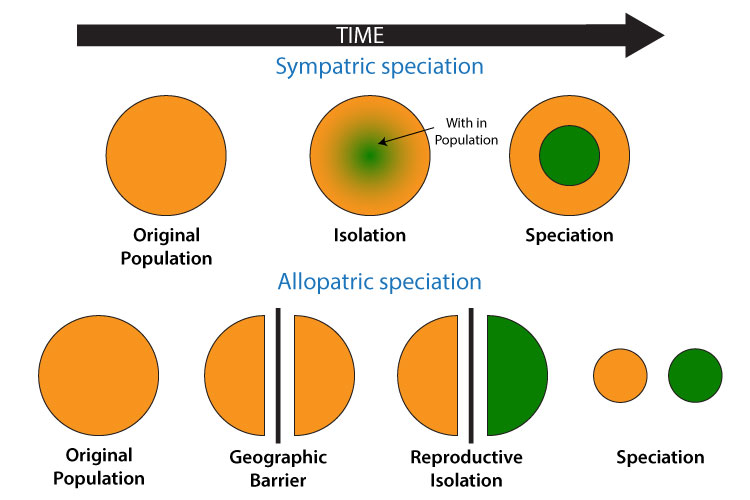
Allopatric Speciation
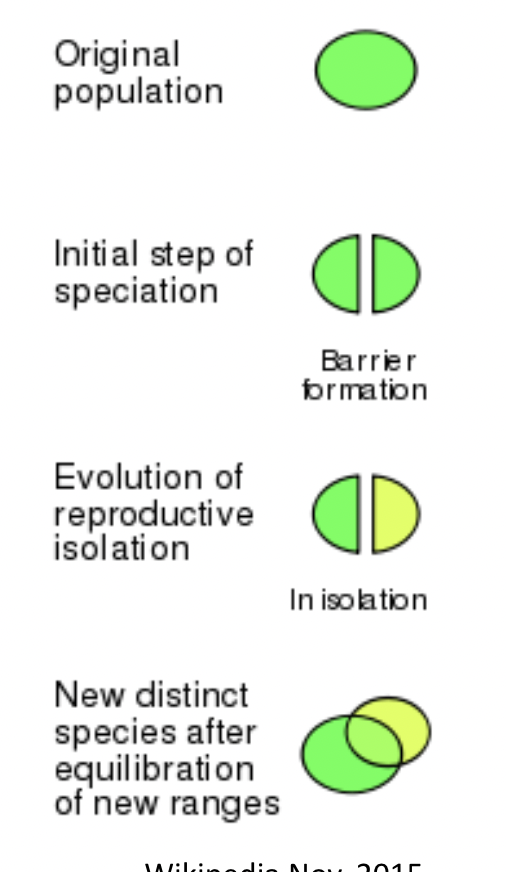
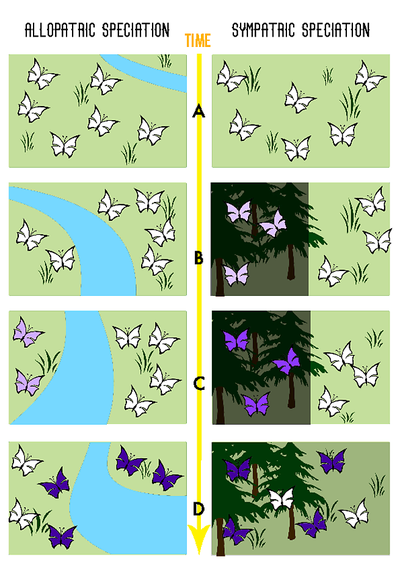
Allopatric speciation
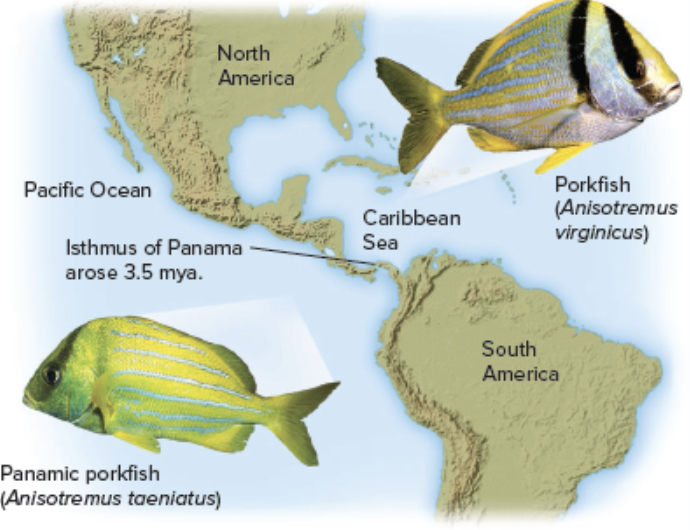
Speciation by geographic isolation
first proposed by a paleontologist studying fossil record of mammals
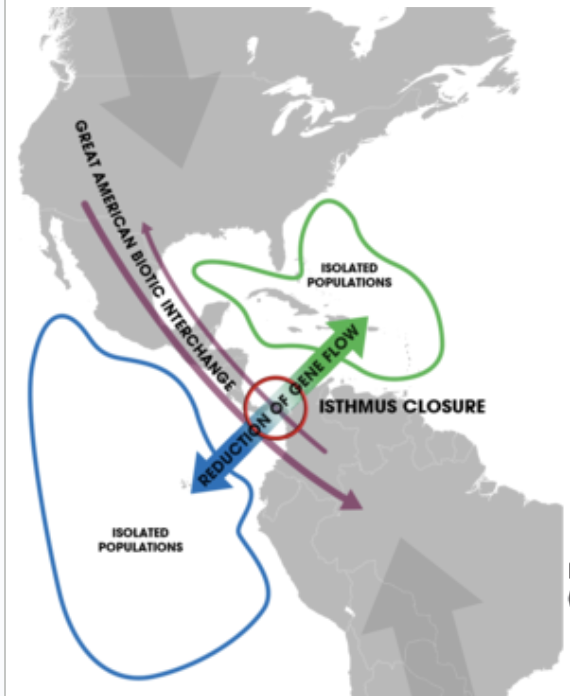
gene flow between the soon-to-be species must be greatly reduced — but it doesn’t have to be reduced completely to zero.
Sympatric speciation
The evolution of a new species from a surviving ancestral species while both continue to inhabit the same geographic region.
occurs when members of a species that are within the same range diverge into two or more different species even though there are no physical barriers stopping them from breeding
there are no geographic barriers preventing gene flow
Can occur due to polyploidy, hybrid speciation, adaptation to local environments, and sexual selection.
Polyploidy
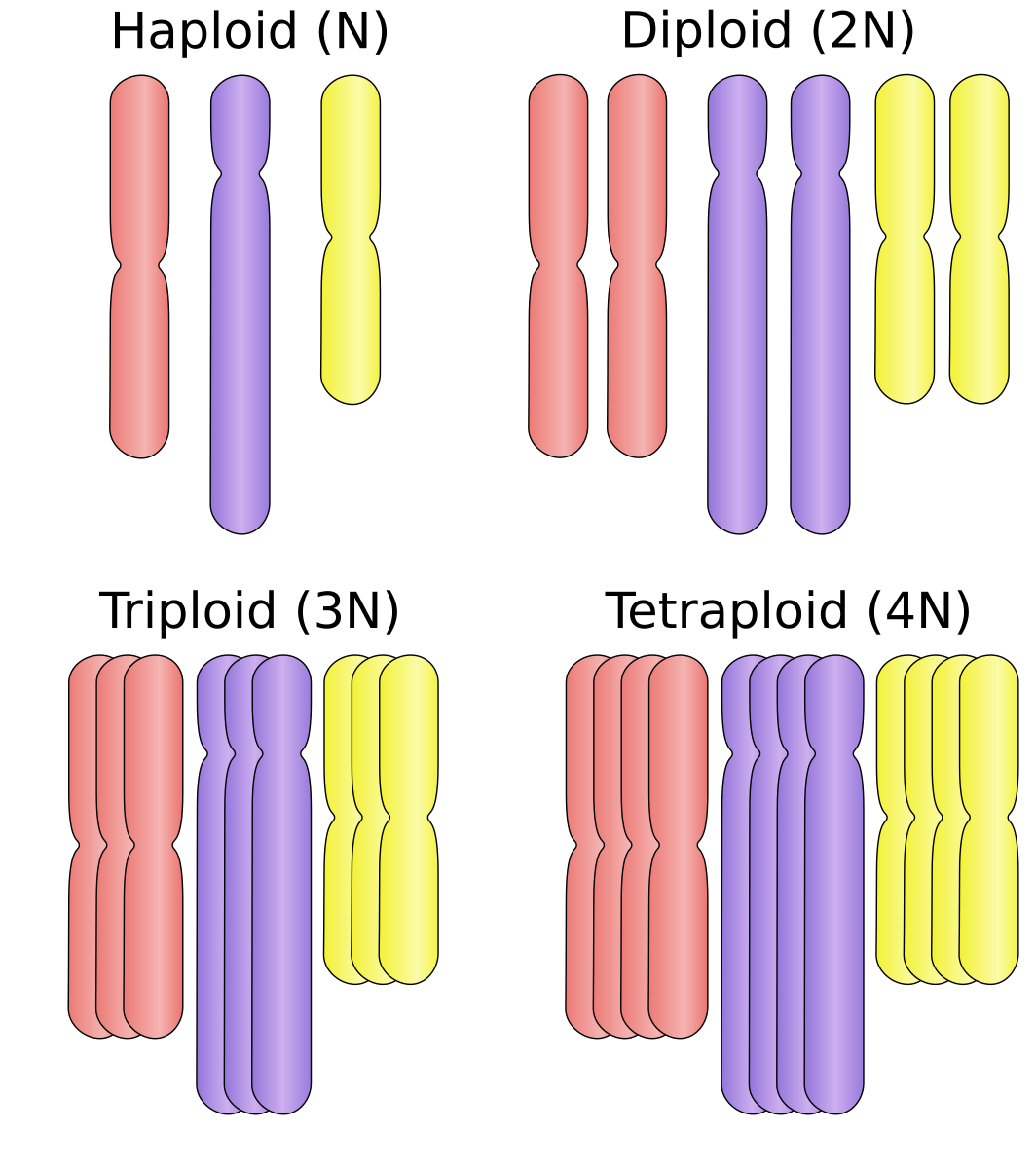
The heritable condition of possessing more than two complete sets of chromosome (more than two paired sets of (homologous) chromosomes)
Common in plants, as well as among certain groups of fish and amphibians.
How does it occur: One mechanism is complete nondisjunction of chromosomes, which increases the number of chromosome sets in a given species (autopolyploidy).
Biogeography
The scientific study of the distribution of living organisms across different regions of the Earth and the factors influencing that distribution over time.
Biological species concept
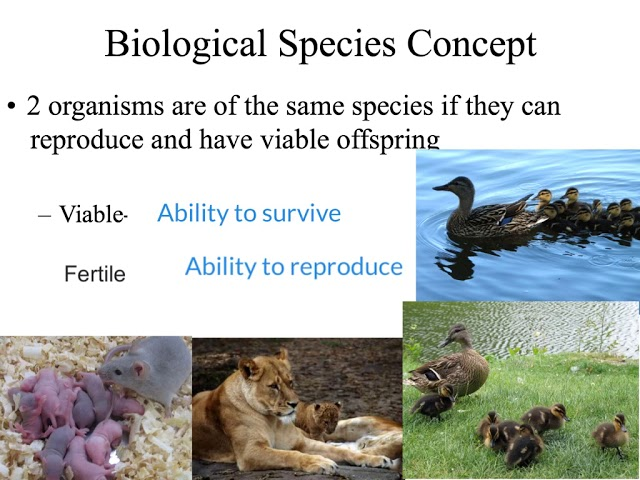
If organisms can interbreed and produce viable, fertile offspring they are members of the same species
Members of populations that actually or potentially interbreed in nature
Advantages: once lineages can’t interbreed, then species are independent
not arbitrary based on evolutionary processes
Disadvantages: doesn’t work for extinct species, doesn’t work for some groups
Morphological species concept
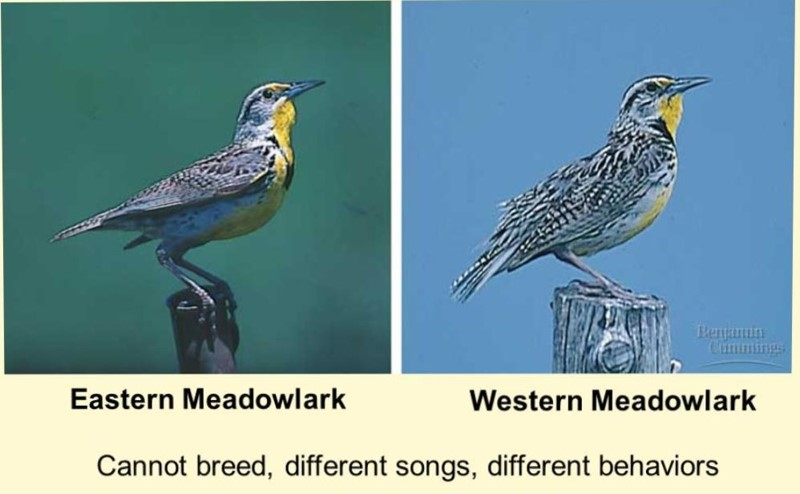
Classifies organisms into species based on their morphology
Advantages:
No knowledge of genetics is necessary
Equally applicable to sexual, asexual, and fossil species
Disadvantages:
A single polymorphic species may be split into two species
cannot identify cryptic species that differ in non-morphological traits
subjective
Phylogenetic species concept
The smallest monophyletic group on the tree of life
A monophyletic group (clade, lineage) consists of an ancestral population plus all of its descendants.
Advantages:
identifies entities with distinct evolutionary histories
Disadvantages:
phylogenies not always available, hard to resolve
probably lead to recognition of many more species than other major species concepts (advantage? disadvantage?)
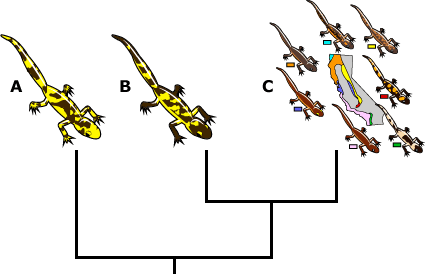
Ex: Lineage C is a single species, according to the phylogenetic species concept.
Monophyletic group
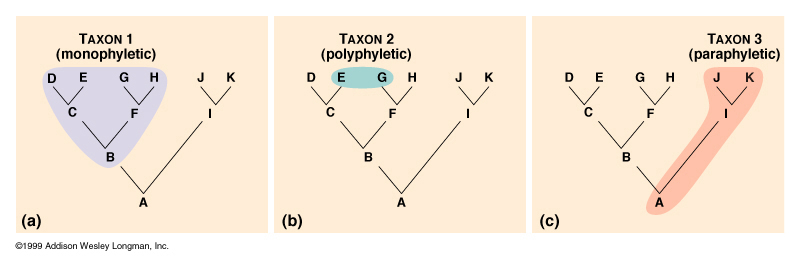
Sometimes called a clade, includes an ancestral taxon and all of its descendants. A monophyletic group can be separated from the root with a single cut,
Founder effect
The loss of genetic variation that occurs when a new population is established by a very small number of individuals from a larger population.
thought to lead to the speciation and subsequent evolution of new species.
Hox genes
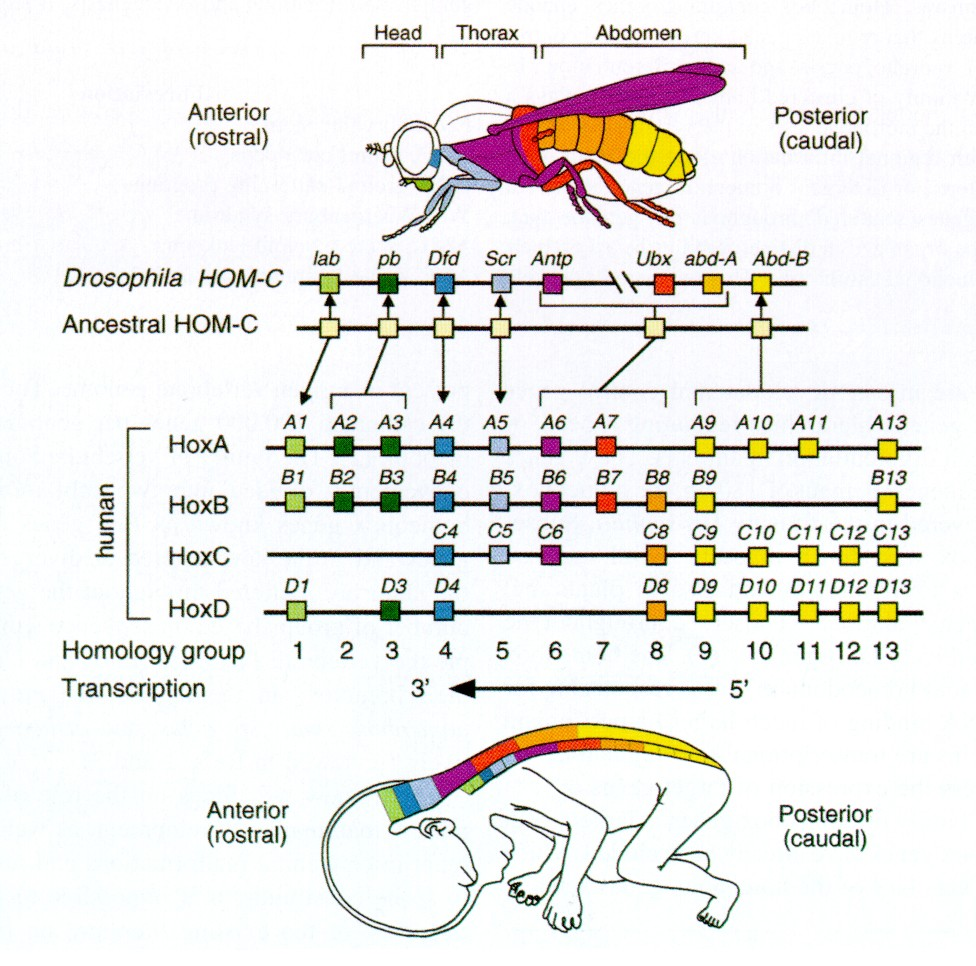
The genetics of major morphological change
Ex: conserved functions from flies to mammals
Ancestral character state
The character state present in a lineage immediately before a character state change.
binomial nomenclature
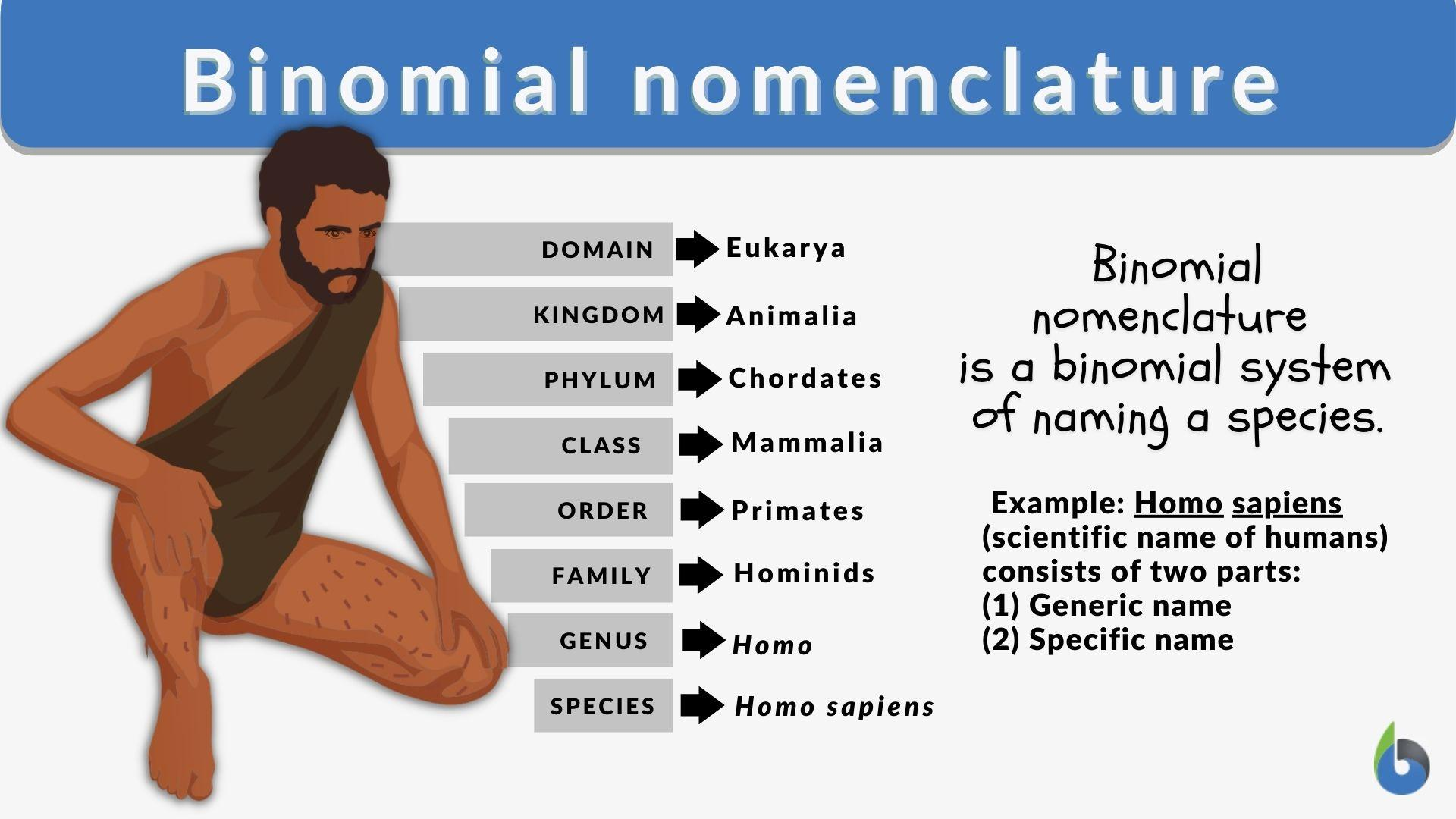
the system of nomenclature in which two terms are used to denote a species of living organism, the first one indicating the genus and the second the specific epithet.
Character
A recognizable feature of an organism. Characters may be morphological, behavioral, physiological, or molecular. They are used to reconstruct phylogenies.
Character state
defined as discrete or discontinuous features used in phylogenetic analysis, representing distinct conditions of a character, such as variations in molecular or morphological traits.
Prezygotic
Barriers to mating
Habitat
Temporal
Behavioral
Mechanical
Reproductive Isolation

Reproductive Isolation: Gametic isolation
mating occurs, but fertilization does not
Reproductive Isolation: Postzygotic
Happens when hybrids of two species encounter issues in surviving or reproducing
Hybrid inviability
Hybrid sterility
Hybrid breakdown
Reproductive Isolation
The mechanisms of reproductive isolation are a collection of evolutionary mechanisms, behaviors and physiological processes critical for speciation. They prevent members of different species from producing offspring, or ensure that any offspring are sterile.
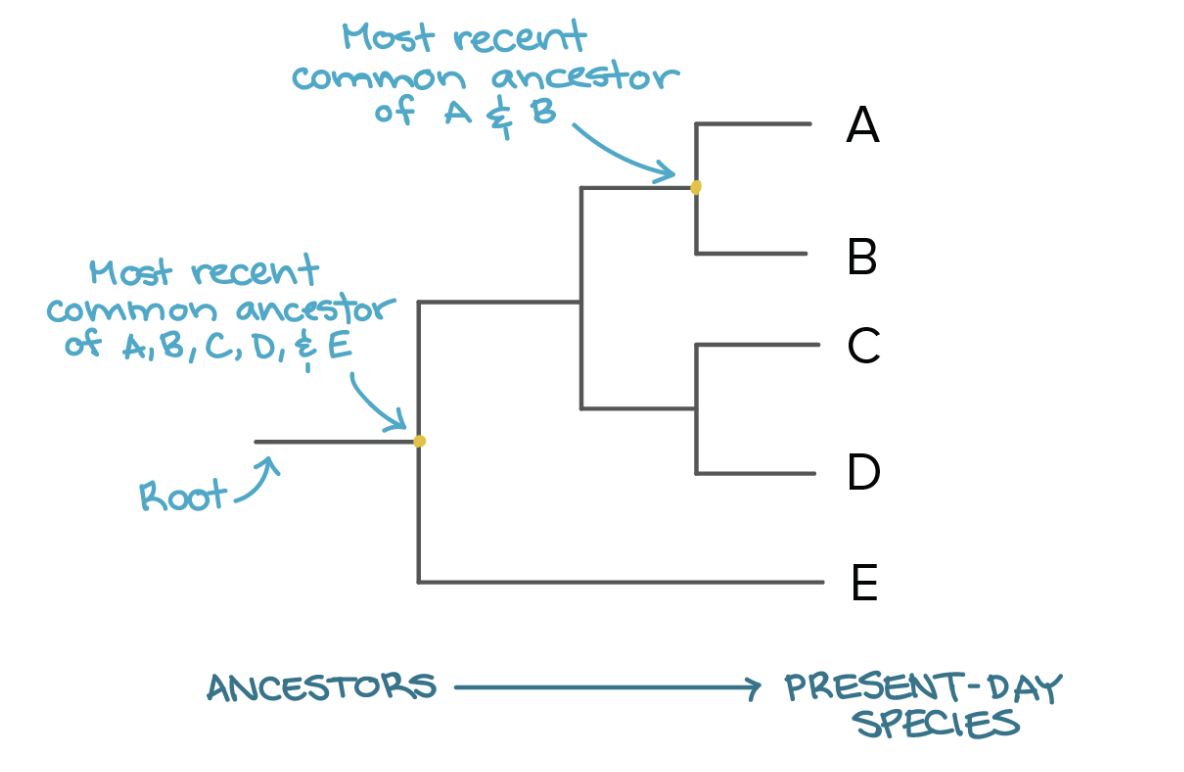
phylogenetic tree
(cladogram, tree of life, or evolutionary tree)
graphical representation resembling a tree that illustrates the evolutionary and phylogenetic relationships between biological taxa based on their physical or genetic characteristics
phylogeny
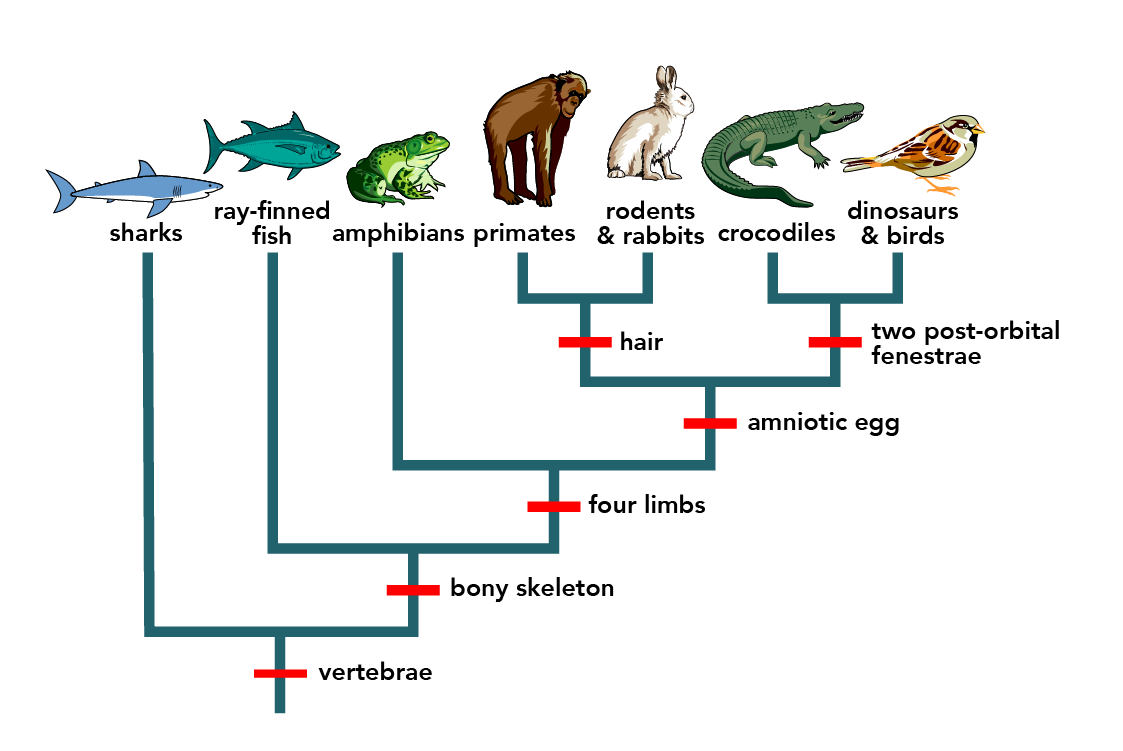
study of the evolutionary history of life using observable characteristics of organisms, which is known as phylogenetic inference.
Parsimony
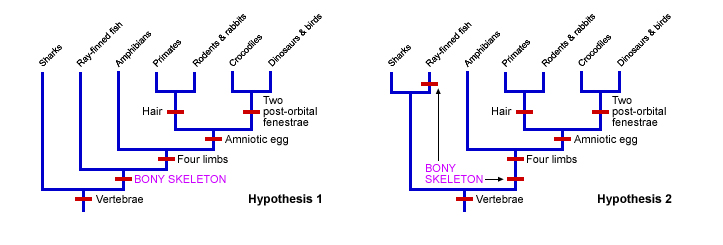
The principle that the simplest explanation that can explain the data is to be preferred.
Ex: Hypothesis 1 is better due to having 6 evolutionary changes, compared to hypothesis 2 where there is 7 evolutionary changes
Systematics
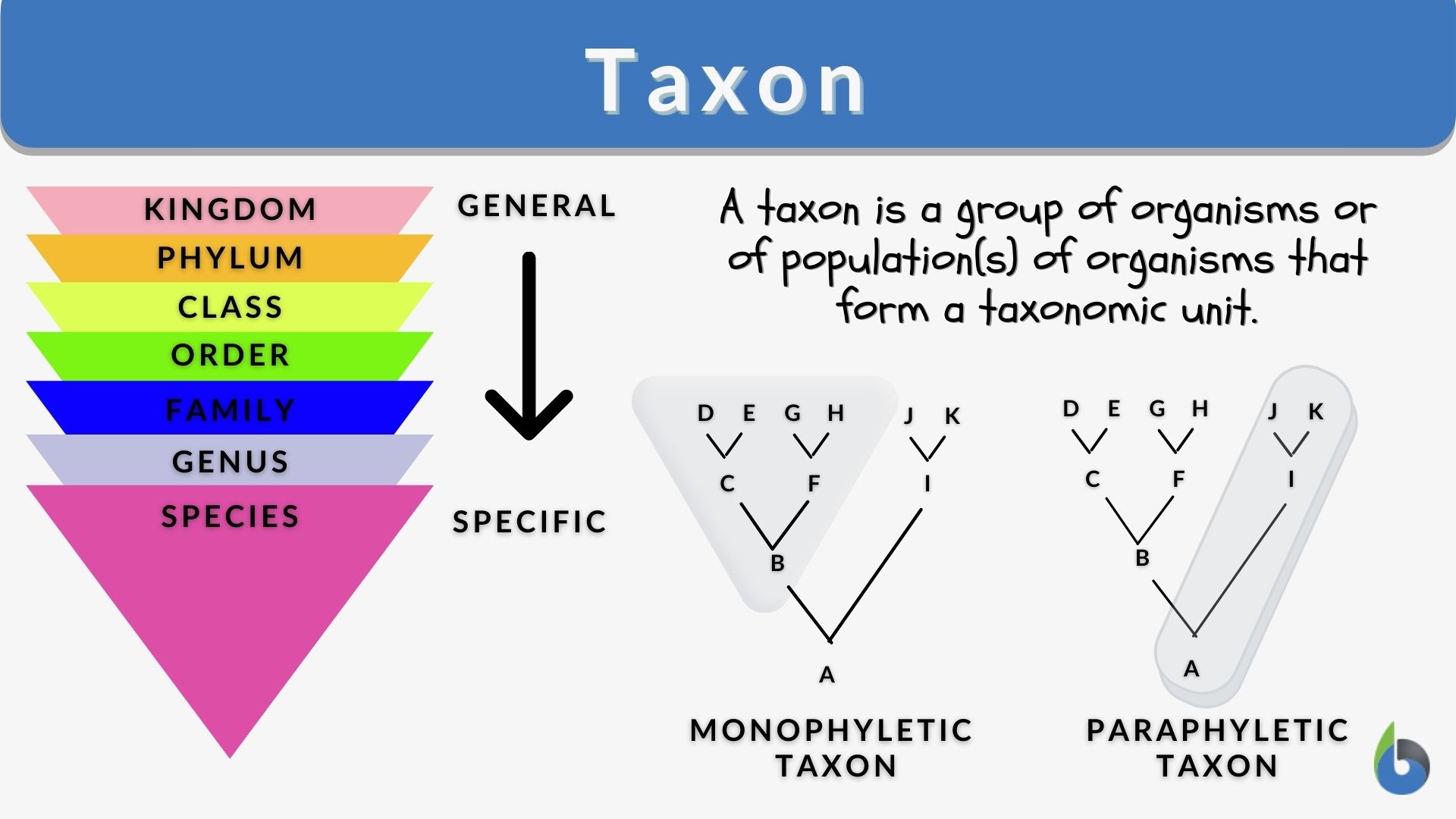
Taxon (taxa-plural)
represents a level of grouping of organisms that is based on some easily observable characteristics
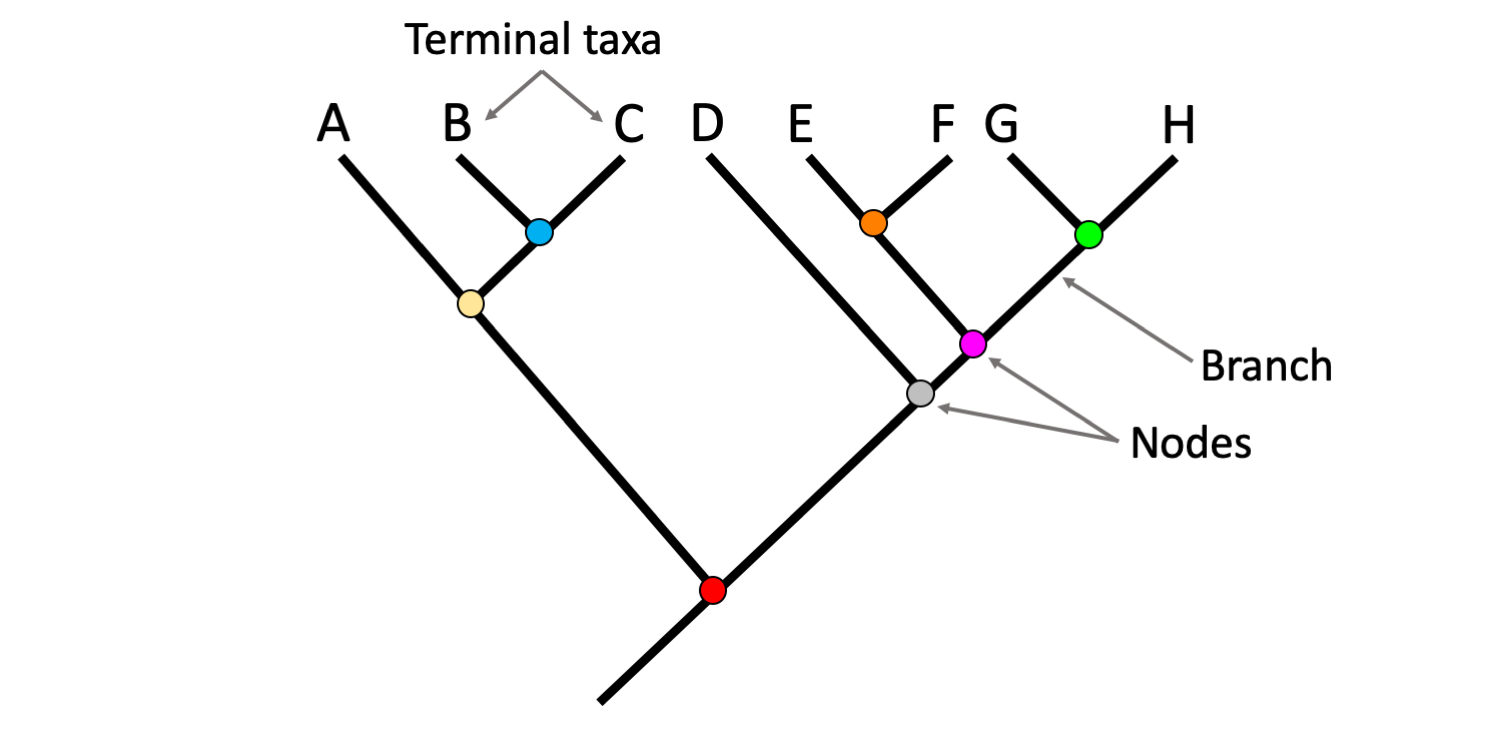
A phylogenetic tree is an illustration depicting the hypothesized degrees of evolutionary relationship amongst a selected set of taxa (singular = taxon)
taxonomy
the science of naming, describing and classifying organisms
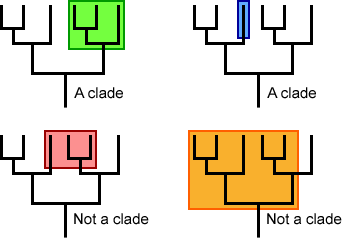
Clade
A clade (also known as a monophyletic group) is a group of organisms that includes a single ancestor and all of its descendents.
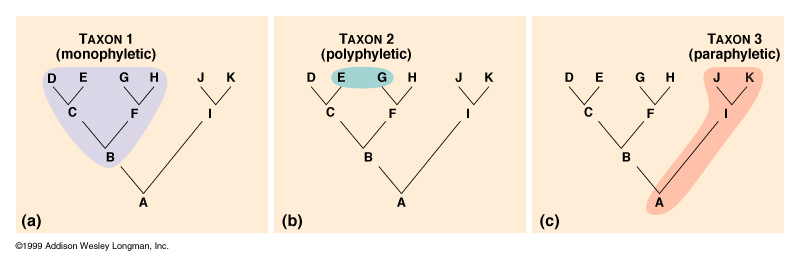
Monophyly taxon
groups consisting of all the descendants of one (hypothetical) common ancestor
keeps descending from one common ancestor
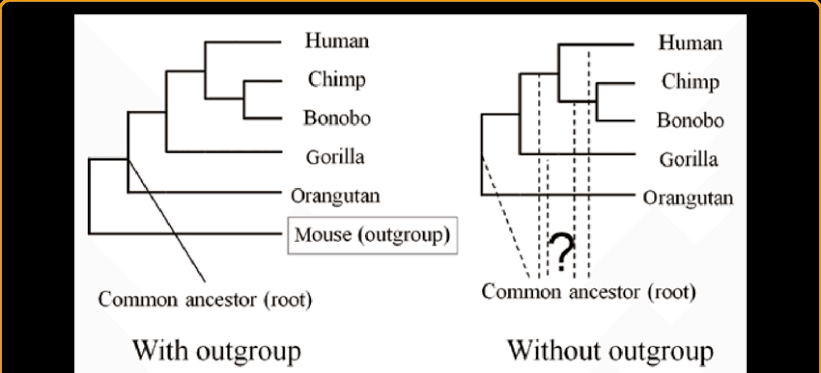
outgroup
an outgroup is a more distantly related group of organisms that serves as a reference group when determining the evolutionary relationships of the ingroup
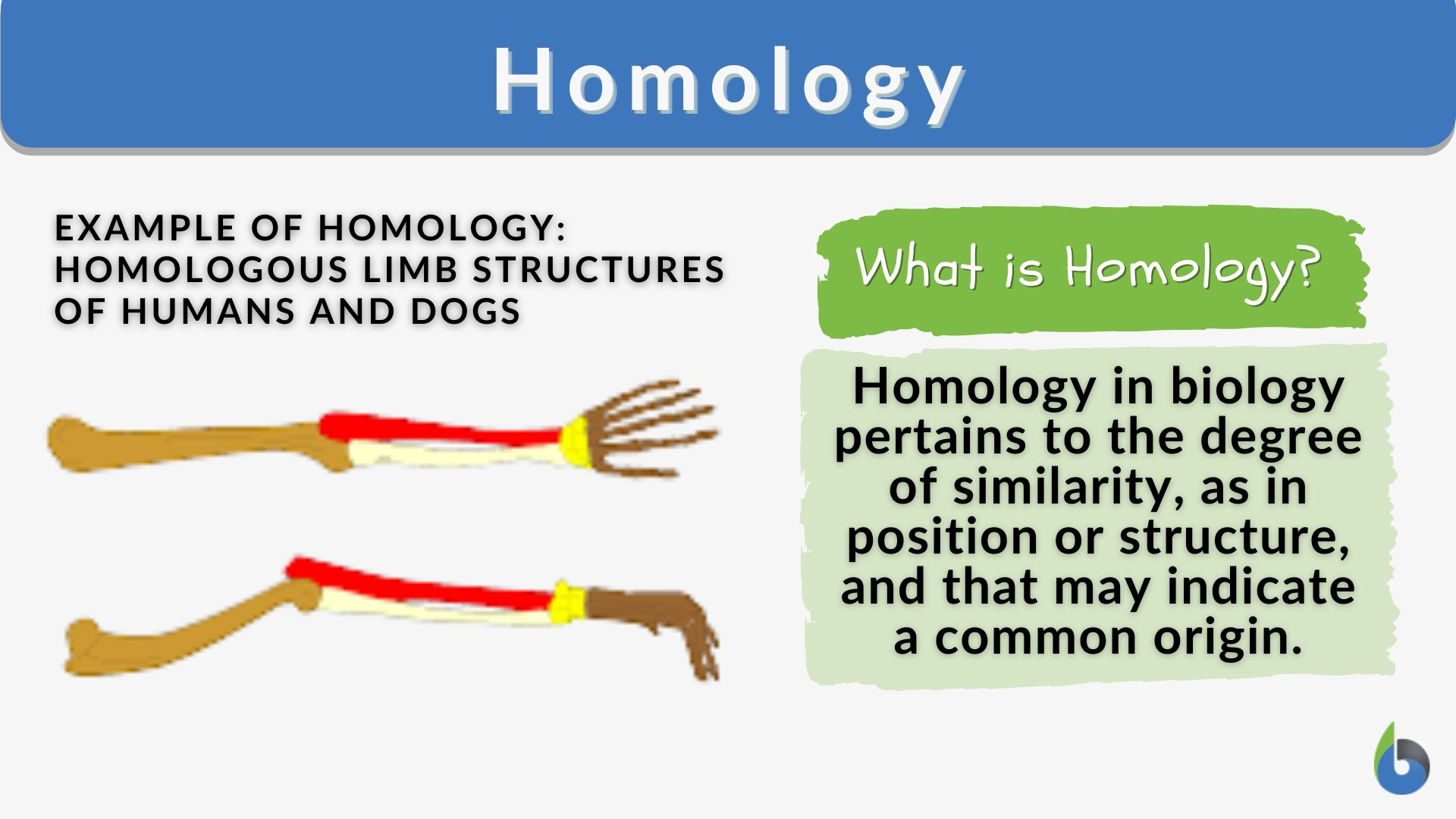
homology
biological features including genes and their products that are descended from a feature present in a common ancestor.
Which of the following can cause postzygotic reproductive isolation (mark all that are correct)?
A) Temporal isolation
C. Behavioral isolation
B) Gametic isolation
D. None, these are all prezygotic
D) None, these are all prezygotic
Temporal isolation – prezygotic
Behavioral isolation – prezygotic
Gametic isolation – prezygotic
Sympatric speciation differs from allopatric speciation because in sympatric speciation
a population becomes geographically isolated
there are no geographic barriers preventing gene flow
two populations of the same species merge to form a single population
hybrids are inviable
here are no geographic barriers preventing gene flow
For a sexually reproducing species to split into two species, which of the following is necessary:
two populations must live in very different habitats
gene flow between two populations must be limited
the populations must experience very strong selection that favors different phenotypes
populations must start to diverge phenotypically
gene flow between two populations must be limited
Hybrid breakdown occurs when offspring produced by mating between species (interspecific hybrids)
do not develop past the early embryonic stages
have shortened life spans
are infertile
are fertile but produce offspring with reduced viability and fertility
4) are fertile but produce offspring with reduced viability and fertility
“Hybrid breakdown occurs when the first-generation (F1) hybrids of two different species are viable and fertile, but subsequent generations (F2 and beyond) are inviable or sterile.”
Which best describes the concept of punctuated equilibrium:
the rate of evolution is constant, interspersed with short periods of no phenotypic evolution
long periods of little phenotypic change are interrupted by short periods of major phenotypic change
evolution occurs gradually over time
small genetic changes accumulate, producing phenotypic change and speciation
long periods of little phenotypic change are interrupted by short periods of major phenotypic change
Which of the following would most directly lead to ecological speciation in birds
Genetic drift that results in different alleles fixing in different populations
Habitat fragmentation that prevents gene flow among populations
Adaptation to seed characteristics affects characteristics of bird song
Gene flow between partially isolated populations
A clade is a:
paraphyletic group C. monophyletic group
polyphyletic group D. none of the above
C. monophyletic group
Polyploidy can promote speciation because:
triploids are infertile (or at least have very very low fertility)
triploids are not viable
ploidy level affects cell size
polyploids have higher mutation rates than diploids
all of the above
Which statement represents the best explanation for the observation that nuclear DNA sequences from wolves and domestic dogs are highly similar? Dogs and wolves _____.
have very similar morphologies
share a very recent common ancestor
belong to the same Order
have converged to have similar morphologies and behavior and therefore the genes responsible for these traits must be similar
The ___________________ states that most of the genetic variation found in populations is not subject to natural selection:
principle of parsimony
neutral theory
maximum likelihood principle
neutral theory of molecular evolution
that most of the genetic variation found in populations, particularly at the molecular level (DNA sequences), is selectively neutral, meaning it is not subject to natural selection. These neutral mutations are instead primarily governed by random genetic drift, with selection playing a minor role in their frequency changes within a population.
Which of the following is true (mark all that are correct)?
animals and fungi are more closely related to one another than plants and fungi
plants and fungi are more closely related to one another than plants and animals
plants and animals are more closely related to one another than fungi and animals
plants, fungi, and animals are all equally related to one another
animals and fungi are more closely related to one another than plants and fungi
The last common ancestor of fungi and animals was a protist (a single-celled eukaryote) that lived about 1 to 1.5 billion years ago. This ancestor was the precursor to both the fungi and animal lineages.
Hox genes (mark all that are correct)
are a direct cause of reproductive isolation
are the genetic basis of color vision
play an important role in animal development
play an important role in plant development
play an important role in animal development
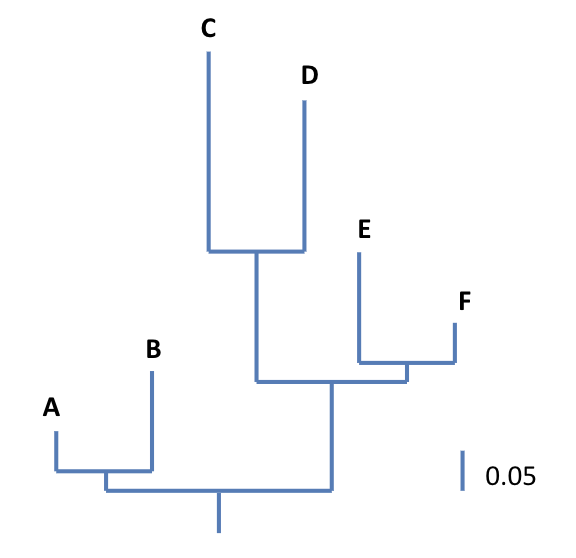
Ultrametric tree:
Tips equidistant from the root
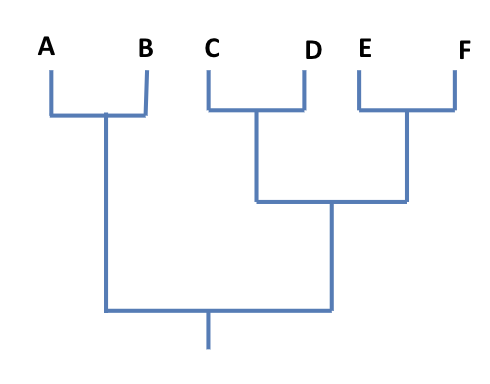
Not ultrametric:
More informative
Branch lengths proportional
to differences from root
Which of the following processes contribute to the evolutionary divergence of populations?
A. Allopatry B. Sympatry
C. Hybridization D. Selection
E. Gene flow F. Genetic drift
G. Mutation H. Pleiotropy
A. Allopatry: geographic isolation reduces gene flow → divergence
B. Sympatry: divergence can also occur without physical separation
C. Hybridization: can introduce new combinations of alleles → divergence
D. Selection: different selective pressures cause divergence
F. Genetic drift: random changes cause populations to diverge
G. Mutation: provides new genetic variation leading to divergence
Paraphyly
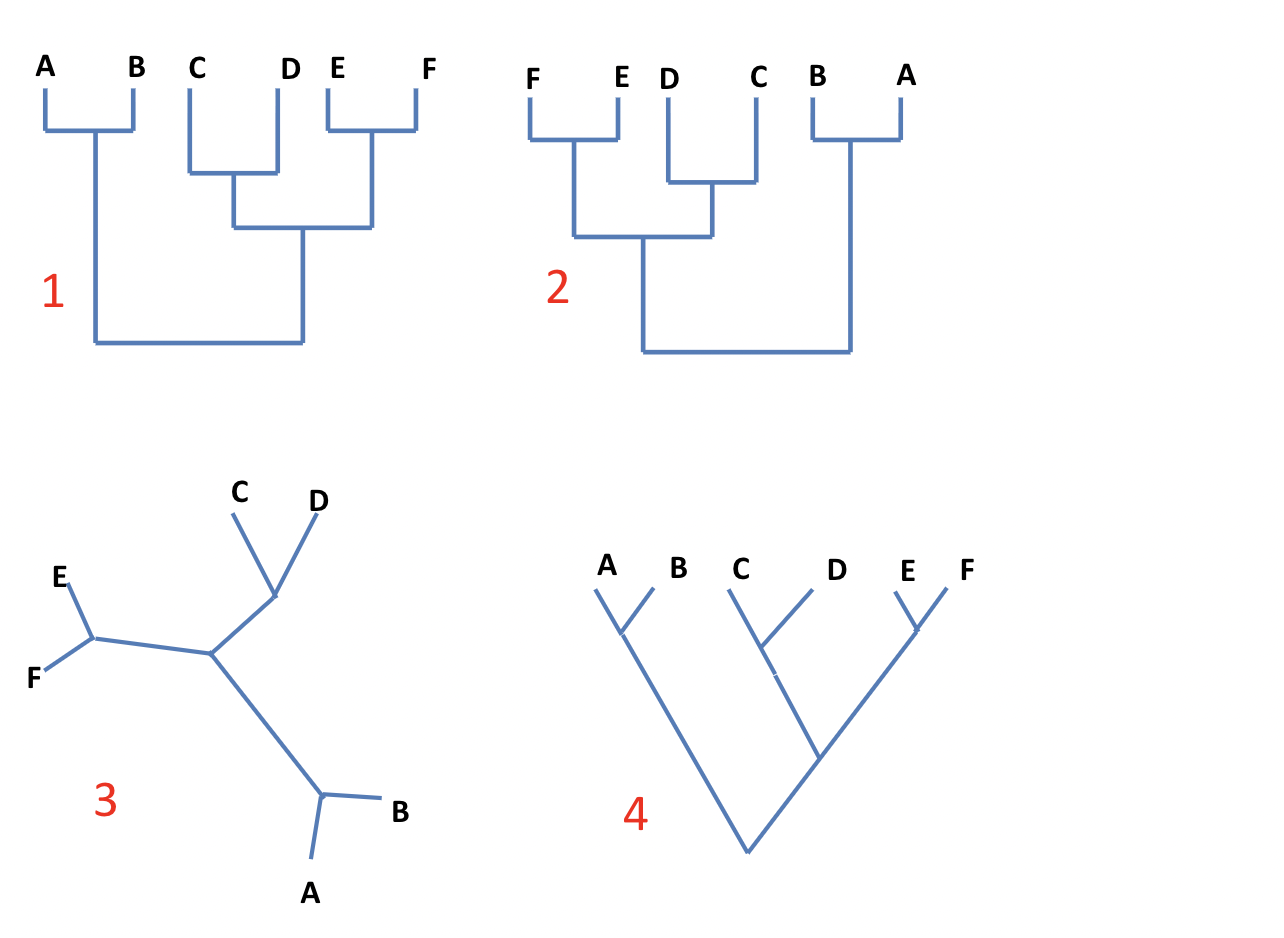
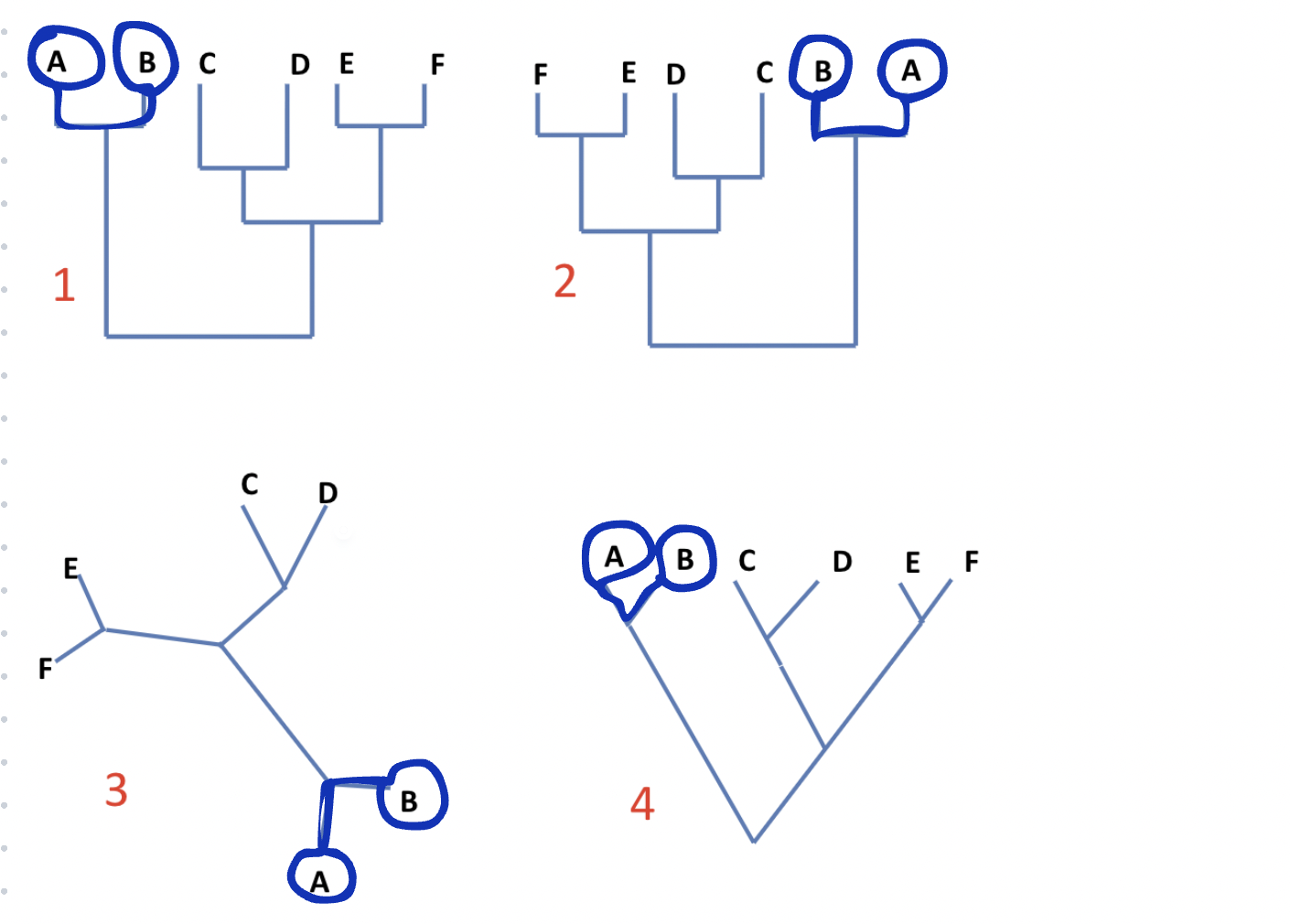
True or False, these phenlogy trees are the same
True: Look at the species and then trace the nearest related species and see if it matches across all trees
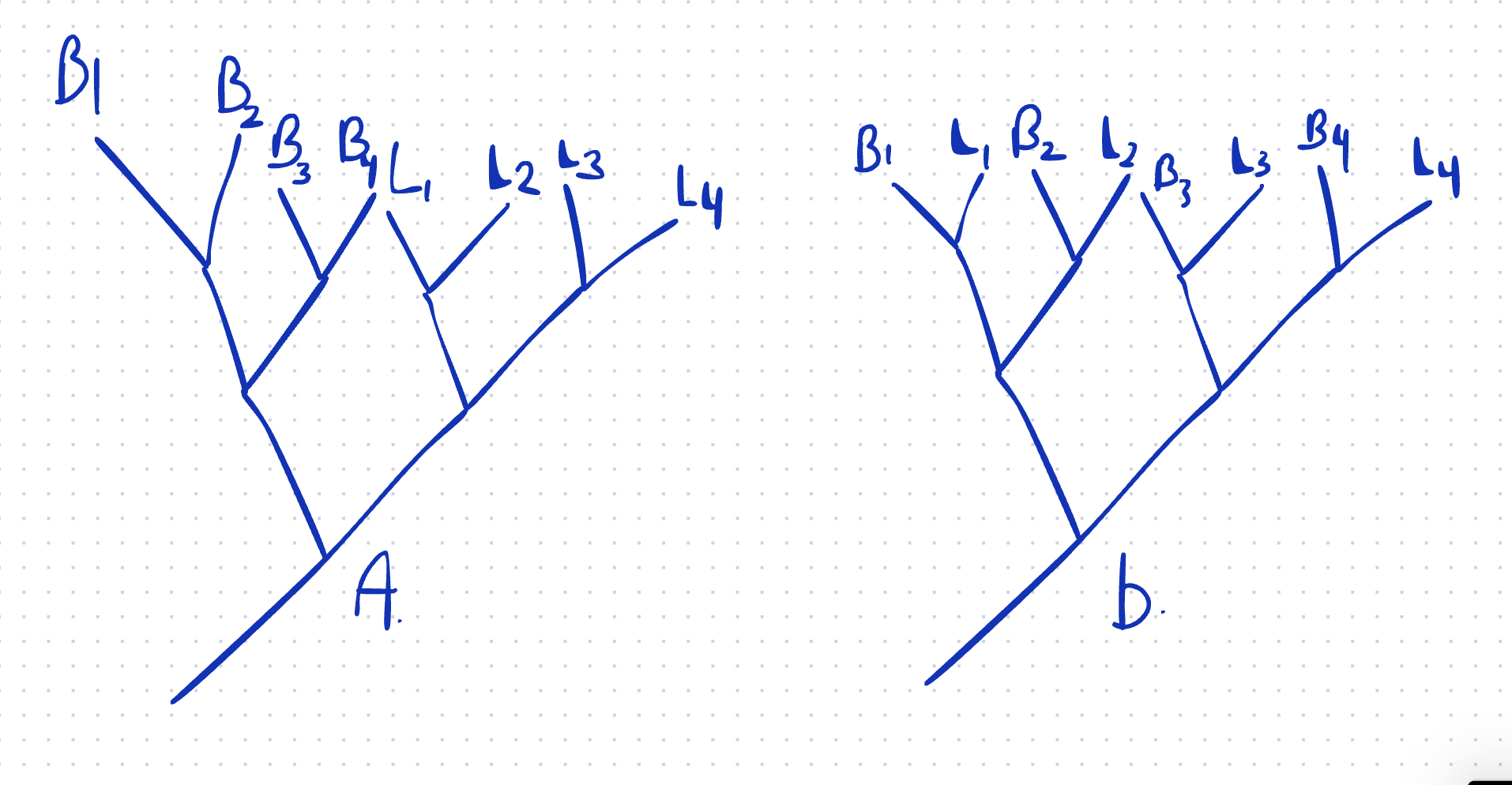
Suppose benthic (B) and limnetic (L) forms were sampled from each of four lakes
Benthic forms: B1, B2, B3, B4
Limnetic forms: L1, L2, L3, L4
where 1, 2, 3 & 4 refer to the lakes.
Draw on your team's whiteboard what you think the phylogenetic tree for these 8 populations would look like if:
A. the benthic form had evolved only one time.
B. the benthic form had evolved in each lake independently
Neutral traits
DNA sequence data: intergenic sites, introns, synonymous sites
4 states: A T G C
These are used for molecular DNA to trace species
Some challenges
same state due to independent mutations (homoplasy)
reversals A 🡪 T 🡪 A
mutations overwrite history
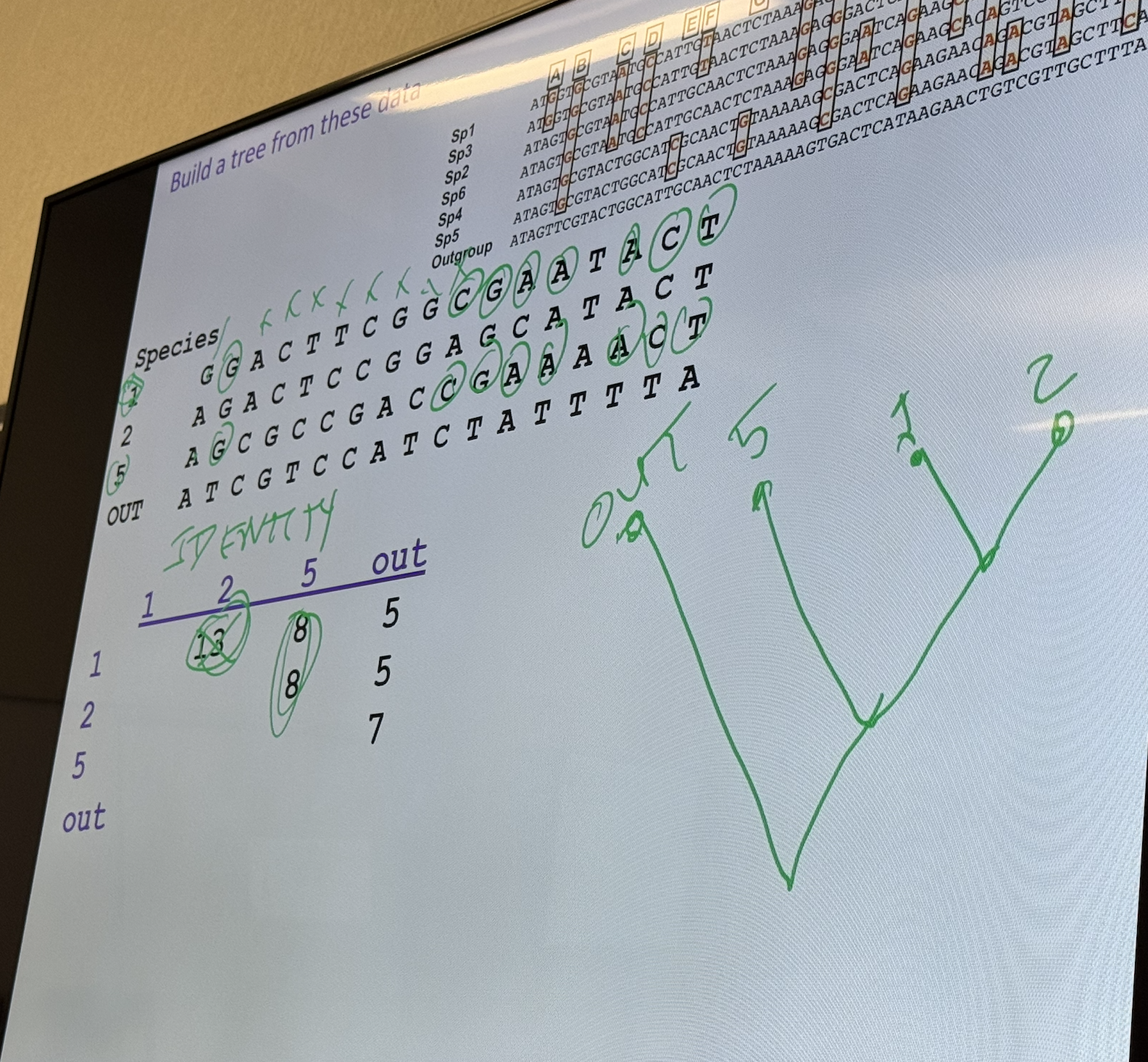
Build a tree from these data
Species
1: GGACTTCGGCGAATACT
2: AGACTCCGGAGCATACT
5: AGCGCCGACCGAAAACT
OUT: ATCGTCCATCTATTTTA
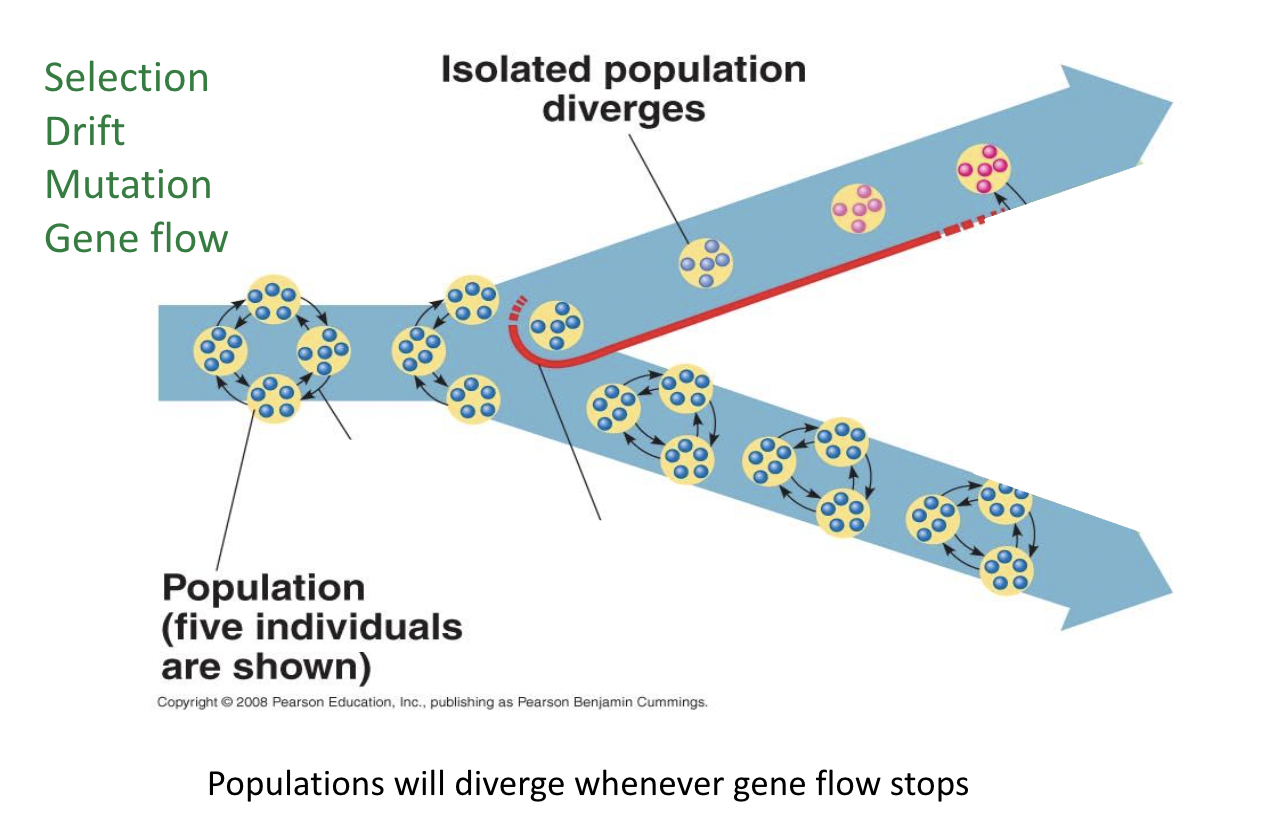
Speciation
Divergence of genetic composition of lineages
Ex: In the picture once the gene flow stops the populations diverge from one another
(Aka once populations diverge gene flow ends)
Sympatric
Genetic polymorphism leads to gene flow stopping, thus creating speciation as they can no longer mate with each other
Ex: Hawthorne vs Apple maggot fly
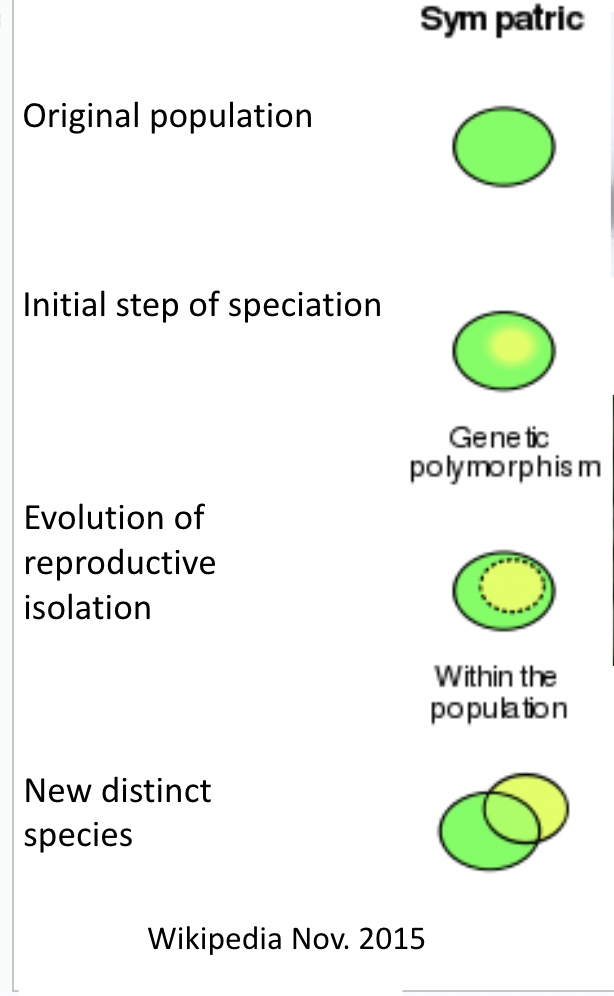
how does selection contribute to speciation?
Its not able to pass on it’s genes to the next generation
Speciation → Hybridization
Large Cactus Finch got blown over to another island and mated with the only medium brown finches that lived on that island
Hybrids would only mate with each other
Happened very rapidly
Sympatric speciation by polyploidy
Polyploidy – results from an error in meiosis or mitosis
that doubles chromosome number
Triploids offspring lead to their offspring being sertile
Quick way to lead to speciation
 Note
Note  Flashcards (46)