Paleo 204 Midterm
0.0(0)
 Studied by 0 people
 Call Kai
 Learn
Learn Practice Test
 Spaced Repetition
 Match
Match Flashcards
 Knowt Play
Card Sorting
1/117

Earn XP
Description and Tags
Last updated 2:02 AM on 12/10/25
Name | Mastery | Learn | Test | Matching | Spaced | Call with Kai |
|---|
No analytics yet
Send a link to your students to track their progress
118 Terms
1
New cards
Dollo's law
Louis Dollo's 'law of irreversibility', which is no longer accepted, was an evolutionary theory suggesting that lost structures of ancestors could not be regained by decedents.
2
New cards
Ischium
Bone at a base of a pelvis
3
New cards
Saurischia
Lizard-hipped dinosaurs; have a forward facing orientation of the pubis in the pelvis. Includes Theropoda and Sauropodomorpha.
4
New cards
Sir Richard Owen
Coined the term 'dinosauria' in 1842, and was instrumental in the early description, publication and display of the earliest dinosaur finds.
5
New cards
Ornithischia
Bird-hipped dinosaurs; have a backward facing orientation of the pubis in the pelvis. Includes Thyreophora, Ornithopoda and Marginocephalia.
6
New cards
Sauropodomorpha
Clade of saurischian dinosaurs that includes the long necked sauropods and their basal relatives such as Plateosauria (formerly referred to as Prosauropods). Characteristics include large nares, elongated necks, and spatulate teeth.
7
New cards
Theropoda
meaning 'beast feet', theropods were a group of typically bipedal saurischian dinosaurs originating in the Late Triassic period, that evolved a number of bird-like features, such as pneumatic bones and a furcula. This clade includes extant birds.
8
New cards
Charles Darwin
'The father of evolutionary science' who's most well known work: 'On the Origin of Species', published in 1859, suggested that inherited traits were changed over time by natural selection and that species descended from common ancestors becoming "branches in the lines of descent". Also proposed geographical isolation lead to speciation events
9
New cards
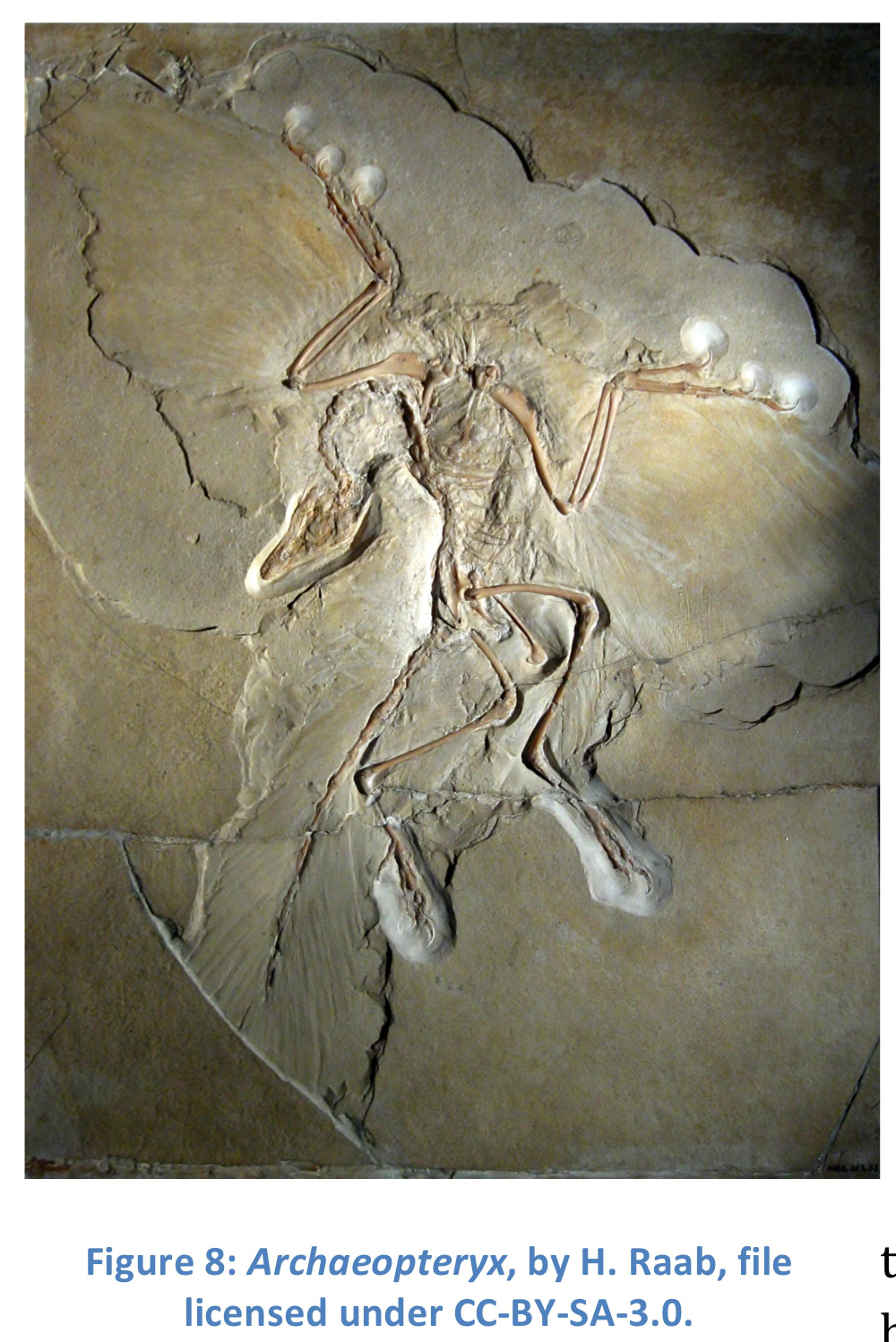
Thomas Huxley
Darwin's Bulldog; early champion of Darwin's ideas on natural selection. He became the first person to draw comparisons between carnivorous dinosaurs and birds, by comparing a skeleton of Compsognathus with the skeleton of Archaeopteryx.
10
New cards
Gerhard Heilmann
Early twentieth century palaeontologist who, on the basis of Dollo's Law, rejected theropods as the ancestors of birds in favour of thecodonts. Published “origins of birds”
11
New cards
Archaeopteryx
Have gastralia, teeth, breastbone, long bony tail, 3 claws like Dino’s, but had furcula wings and birds
12
New cards
First Hypothesis of birds and Dino Relationships
Heilmann believed Triassic archosaur family Thecodontia as bird transistion. But Thecodontia has very little bird like features. Unstable because there is no specific species to prove, so now obsolete
13
New cards
Longisquanna and Megalancosaurus
Thought to represent bird transition, but poorly known because bird features misrepresent and superficial
14
New cards
Second Hypothesis of birds and Dino Relationships
Birds evolved from early crocodilians, based on ear region of birds and crocodylomorph sphenosuchus in the braincase. Defended by Alick D. Walker. Not true because similarities present in more groups. Ear evolved convergent, and independently derived due to ecological pressures
15
New cards
Third Hypothesis of birds and Dino Relationships
John Ostrum proposed birds evolved from small carnivorous Dino’s in the Jurassic (theropod). Supported by phylogeny and fossil record
16
New cards
John Ostrom
Paradigm-shifting palaeontologist who first discovered and described Deinonychus; he made anatomical and behavioural comparisons between theropods and birds which gained large scale acceptance in the late 1960s/70's and catalyzed the 'Dinosaur Renaissance'.
17
New cards
Pneumatization
A process which creates hollow, lightweight bones in the skeleton; a condition shared by both birds and non-avian theropod dinosaurs. Strut like internally in bones to avoid collapsing.
Lighter skeleton means flying, denser skeleton means diving and swimming
Lighter skeleton means flying, denser skeleton means diving and swimming
18
New cards
Air Sacs
Air pockets in the bones that form part of the respiratory system in birds, and probably theropod dinosaurs.
19
New cards

Birds Respiratory System
Composed of lungs and 9 air sacs, Air sacs in cervical, thoracic, abdominal, air moves in one direction
20
New cards

Bird Inhalation
Air enters posterior air sacs and lungs. Air from previous breath leaves lungs and posterior air sacs to anterior air sacs
21
New cards

Bird Exhalation
Air moves from posterior air sacs to anterior air sacs, Air from anterior air sacs moves out trachea, takes in air
22
New cards
Mammal Respiratory System
Have lungs and tubes that connect to the nose and mouth. Only exchange some air in lungs, so some air always remains in lungs, do not fully collapse
23
New cards
Bird Flight
Rigid skeleton to support weight in air (clavicles fused to form a furcula/wishbone), strong musculature needed, large flattened bones like keel in sternum. Larger bone surface means stronger muscles. Pelvis widened out for spreading wings and provide muscle attachment for walking
24
New cards
Bird Trunk
Rigid thorax, composed of rib cage breastbone and pectoral girdle, Broader sternums - stronger fliers. Keel in midline for broad muscle surface. Pectoral girdle formed scapulae fused to clavicles and coracoids
25
New cards
Coracoids
Attached to breastbone to brace wings apart
26
New cards
Keel
Structure on the sternum that provides a broad surface for the attachment of the flight muscles; less pronounced in non-flying birds/theropods
27
New cards
Sternum
The breastbone of vertebrates- a site for rib attachment that is particularly large in flying birds/theropods as it is also the main attachment sight for flight muscles.
28
New cards
Pectoral Girdle
Formed by the shoulder blades or scapulae, the wishbone or furcula and the coracoids.
29
New cards
Scapulae
Shoulder blades in vertebrate animals.
30
New cards
Uncinated Process
Overlap ribs to increase trunk rigidity, additional bony processes, vertebral column rigid below neck
31
New cards
Synsacrum
Middle of vertebral column to tail fused to pelvic girdle
32
New cards

Bird Neck
Flexible neck needed for feeding, seeing prey and predators and preening feathers, variable number of cervical vertebrae, smooth s-shape joints for more movement. Necks connects to back of skull. Skull divided to braincase, orbits and beaks
33
New cards
Mammal Neck
7 cervical vertebrae, neck connects beneath skull, dentary attached to directly to skulls, mammals can only move lower jaw
34
New cards
Nasal Frontal Hinge
Connect upper part of beak with quadrate and jugal bar. Allows flexibility in upper mandible
35
New cards
Bird Skull
Dentary joins skull through quadrate, makes dentary more flexible
36
New cards
Bird Beaks
Very sensitive, formed by porus bone that have pores have blood vessels and nerves 2 parts can move both mandibula
1. Upper mandibula and maxilla
2. Lower mandibula and dentary
1. Upper mandibula and maxilla
2. Lower mandibula and dentary
37
New cards
Bird upper mandibula and maxilla
Supported by 3 pre maxillary bones, thin nasal bones connected at the base, attached through skull by nasofrontal hinge
38
New cards
Bird Lower mandibula and dentary
Dentary joins skull through quadrate, quadrate becomes more flexible
39
New cards
Bird Teeth
Mesozoic birds had teeth, beak and dentition reduced teeth, today have a horny beak and muscular gizzard
40
New cards
Hallux
First toe pointed backward, other 3 toes face forward and have different modifications for gripping, swimming, walking
41
New cards
Tarsals
Ankle bones
42
New cards
Alula
First digit of hand that moves independently and moves upward and forward to slow down fligh. Good for manoeuvring and preventing stalling, 2nd digit is longest, 3rd digit is shorter than 2nd
43
New cards
Bird Hind Limbs
Short and thick robust femurs, muscles attached and surround back end. Maintains bird centre of gravity but not capable to much movement. Backward-forward motion in the knee joint. Tibia and fibula below knee joint
44
New cards
Tibiotarsarus
Formed with lower end of tibia fused with tarsals
45
New cards
Tarsometarus
Formed by ankle bones fusing to metatarsals, could be mistaken for ankle bones in birds
46
New cards
Bird Forelimbs
Wings made of upper arm, forearm and hand. Humerus attached to pectoral girdle by flexible joint, forearm composed of radius and ulna. Ulna has raised bones where feathers attach. All Carpals except first row are fused
47
New cards
3 types of contour feathers
Remiges, Rectrices, coverts
48
New cards
Remiges
Flight feathers attached to bone by ligaments, has primary, secondary and tertial feathers
49
New cards
Primary Remiges
Longest and attached to hand of bird
50
New cards
Secondary Remiges
Attached to forearm between primaries and body, provide lift
51
New cards
Tertial Remiges
Protective cover for primary and secondary feathers when folded, attached to humerus, not true remiges because they are not related to flight
52
New cards
Rectrices
Tail feathers attached to pogostyle, provide stability and control
53
New cards
Pogostyle
Fusion of last caudal vertebrae that form tail, fusion where the rectrices are arranged
54
New cards
Coverts
Overlap remiges and rectrices, shape wing, provide insulation
55
New cards
Early Theropod Candiates
Eoraptor, Herrerasaurs, Staurikosaurus, appeared during middle/late Triassic
56
New cards
Early late Triassic Theropods
Eodromaeus (Argentina), Guaibasaurus (Brazil), Tawa (New Mexico), Daemonosaurus (New Mexico)
57
New cards
4 characteristics of primitive theropods
1. Laterally compressed serrated teeth (not sharp but with strong jaws it severs meat fibres, have denticles)
2. Intramandibular joint to open mouth wider
3. Premaxillary fenestra
4. Grasping hands to catch prey
58
New cards
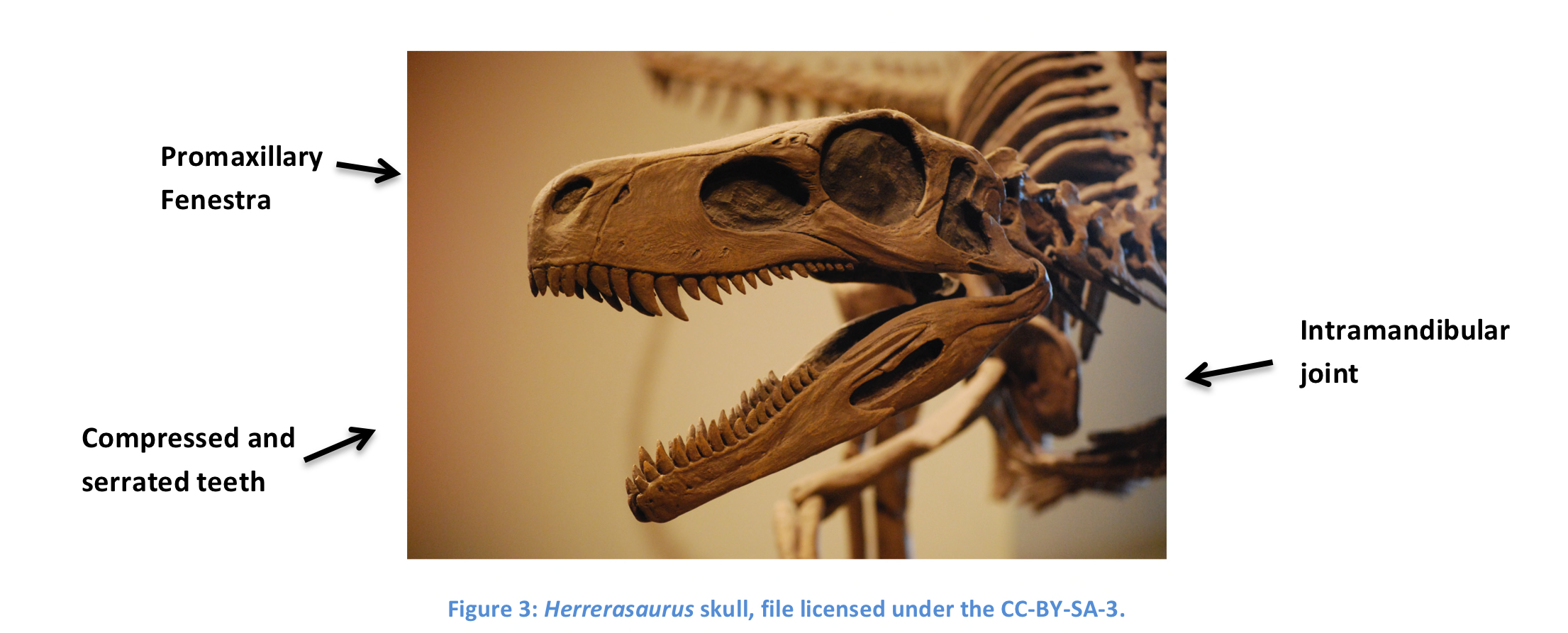
Herrerasaurus
Primitive theropod that proves theropods were meat eaters and skulls display 3 primitive characteristics

59
New cards

3 other early theropod features
1. Short humerus
2. Lack of phalanges in 5th finger
3. Back of tail became stiff to make Dino more agile and to stabilize
60
New cards

Early theropod competitors
Curotarsans- croc-like, ex. Prestosuchus and archosaurs, both nearly wiped out during late Triassic extinction events
61
New cards

Abelisauridae
The other branch of Abelisauroidea; they were top predators during the Late Cretaceous of South America, India, Madagascar, and Europe. They have horns and spikes as well as short round snouts, thickened teeth, reduced forearms and short, stocky arms. Well known members include Carnotaurus, Manjungasaurus and Abelisaurus
62
New cards

Carnotaurus
Part of abelisaurids, late Cretaceous of Argentina, reduced robust forelimbs, forearm is quarter the size of the upper arm, metacarpals articulated directly with forearm, 4 digits, large spur shaped metacarpal, digits 2 and 3 have phalanges. Shared features with Avcasaurus and majungasaurus
63
New cards
Abelisauroidea
Group within Ceratosauria that emerged during the Jurassic that include heavily cranially ornamented predators such as Carnotaurus and Majungasaurus. Other characterisitcs include a large mandibular fenestrae, femoral flange, special vertebral prongs, a round humeral head and small teeth with large neck muscles. 2 divisions Noasaurids and abelisaurids
64
New cards
Abelisauroidea Charcteristics
1. Enlarged external madibular fenestrae in lower jaw
2. Head of humerus is rounded
3. Special prong in vertebrae
4. Flange (ridge in femur)
5. Doubled lateral and medial grooves
6. Small teeth and robust neck muscles
65
New cards

Allosauridae
Clade of carnosaurs with large claws and long, tridactyl hands, from the Late Jurassic; include Allosaurus and the 13 metre long Saurophaganax of North America and Europe. Small horns above eyes (extension of lacrimal bones, covered in keratin)
66
New cards

Allosauridae Characteristics
1. Better developed sinus in maxilla (better than ceratosaurus)
2. Short strong forelimbs
3. Claws with 3 fingers (large tubercule on inside bone, attached to tendon to flex claw inward, positioned low near finger bone)
4. Broad and flat claws to pierce prey
5. Modified carpal in wrist
6. Ascending process on astralagus on foot
67
New cards
Averostra
“Bird snout” late Jurassic but scarce in middle Jurassic. More derived and replaced Cryolophosaurus and coelophysis. 2 groups: certatosauria and tetanurae. Big and robust, part of the predator prey armrace
68
New cards
Averostra Characteristics
Asymmetrical pre maxillary teeth, strap like scapulae, ends of ilia expanded to have hook like blades, hatchet like skulls (mediolaterally narrow and dorsal ventrally deep, good for biting hard and slicing prey, not good for holding and shaking prey)
69
New cards
Avetheropoda
“Bird theropods” 2 clades- Carnosauria and Coelurosauria
1. Maxillary fenestra
2. Reduction on digit 4 (Tridactyl hand)
3. Complex air sac chambers in vertebrae (no connection to lungs
1. Maxillary fenestra
2. Reduction on digit 4 (Tridactyl hand)
3. Complex air sac chambers in vertebrae (no connection to lungs
70
New cards
Carcharodontosauria
Carcharodontosauria were the dominant carnosaurs in the Cretaceous and are composed of two major groups: Carcharodontosauridae and Neovenatoridae.
71
New cards
Carcharodontosauridae
Part of Carcharodontosauria. Among the largest theropod dinosaurs that ever existed, they were specilaised for predation of the huge herbivorous sauropods with which they coexisted. Include Giganotosaurus and Carcharodontosaurus, Acrocanthosaurus concavenator.
72
New cards
Carnotarus
Part of ceratosauria, heavily ornamented skulls, has grooves, pits, bony projections, 2 horns above the eyes
73
New cards
Carnosauria
Large theropods that were top predators from the Middle Jurassic to the Early Cretaceous of Europe, Asia and America. Characterized by extra openings on the maxillae and nasals, as well as and the large size of their naris (nostril). Include the allosaurids, carcharodontosaurids and Metriacanthosaurids.
74
New cards
Ceratosauria
Group of large averostrans that first appeared first in the early part of the Late Jurassic (Not very abundant), but survived to become apex predators in the Late Cretaceous of South America and Europe. Includes: elaphrosaurs, ceratosaurids, noasaurids and abelisaurids.
75
New cards
Ceratosauria Characteristics
1. Dorsal parapophyses that project laterally on vertebrae (6 or more sacral vertebrae)
2. Deep coracoids (reduced muscle scars and joint surfaces on the humerus)
3. Reduced fingers (weak, probably functionless hands)
76
New cards

Ceratosauridae
Group within Ceratosauria characterized by their relatively short necks and reduced arms. Ceratosaurus and Eoabelisaurus are good examples of this group. Very long teeth compared to skull (shaped like blades with slight backward curve), denticles on canines. Crest (unknown function) formed by lacrimal bone and triangular horn on snout. Dental armour and ostroderms along the back
77
New cards
Coelophysidae
First major radiation of theropods in the Late Triassic; includes Coelophysis. Small predators (1-3 metres) with a furcula, grasping hands, three functional digits on hand, narrow pelvis, and a tridactyl foot with a raised hallux.
78
New cards

Coelophysis
Meaning 'hollow bones' this Late Triassic dinosaur shows the typical coelophysid traits and is best known from one of the world's densest bone beds at Ghost Ranch New Mexico, showed gregarious behaviour. Small, not apex predators. Sexual dimorphism in sacral vertebrae (gracile females/robust males)
79
New cards

Coelophysis major differences to herrarasaurus
1. Earliest known furcula
2. Grasping forearms
3. Hands with 4 digits, only 3 functional
4. Tridactyl and raised hallux
5. Shortened ischium in pelvis
80
New cards
Coelophysoidea
Primitive Neotheropoda group including the two branches: Coelophysidae and Dilophosauridae.
81
New cards
Coelophysidae
First major theropod deviation, slender scales, stereoscopic vision (overlapping fields of vision and depth and 3-dimension recognition) Sclerotic rings in eyes (similar to birds of prey, sigmoid curvature and elongated neck cervical centra
82
New cards
Crurotarsans
Contemporaries of the primitive Triassic theropods; these were crocodile-like animals that included the large apex predator Prestosuchus.
83
New cards
Cryolophosaurus
The 'Frozen Crested Lizard; this large, Early Jurassic predator was the first theropod discovered in Antarctica and has a transverse crest at the top of the skull formed by lacrimal bones. Part of Dilophosauridae. Extinct by end of Jurassic
84
New cards
dentary
Most anterior portion of the lower mandible. Entire lower jaw in mammals.
85
New cards
denticles
Serrations on the anterior and/or posterior edge of some theropod teeth.
86
New cards

Dilophosauridae
The second branch in the Coelophysoidea; this was the first major radiation of large predators in the Early Jurassic, and included the crested Dilophosaurus.
87
New cards
Dilophosaurus Characteristics
Early Jurassic North America, double crest (sexual dimorphism, for intra-specific recognition) has premaxillary lacrimal and fenestrae, decreased number of maxillary teeth, each tooth grow longer because top predators. Picivorous due to notch connection between maxilla and premaxilla, extended croc snouts, reduced bite
88
New cards
elaphrosaurs
Informal group comprising the most primitive Ceratosaurs such as Spinostropheus, Limusaurus, Elaphrosaurus, and Deltadromeus.
89
New cards
hallux
The first digit in the foot, usually points backwards in birds, and also in some non-avian theropods.
90
New cards
Herrerasaurus
One of the earliest known theropods, the medium sized predator, is known from the Late Triassic of Argentina
91
New cards
humerus
The upper arm bone in vertebrates
92
New cards
Intramandibular joint
Flexible articulation in the lower mandible of theropods (between dentary-surangular-angular).
93
New cards
lacrimals
Bones situated in front of both eyes that define the anterior rims of the orbits; the extension of these bones towards the upper part of the skull may have helped to make the skull stronger.
94
New cards
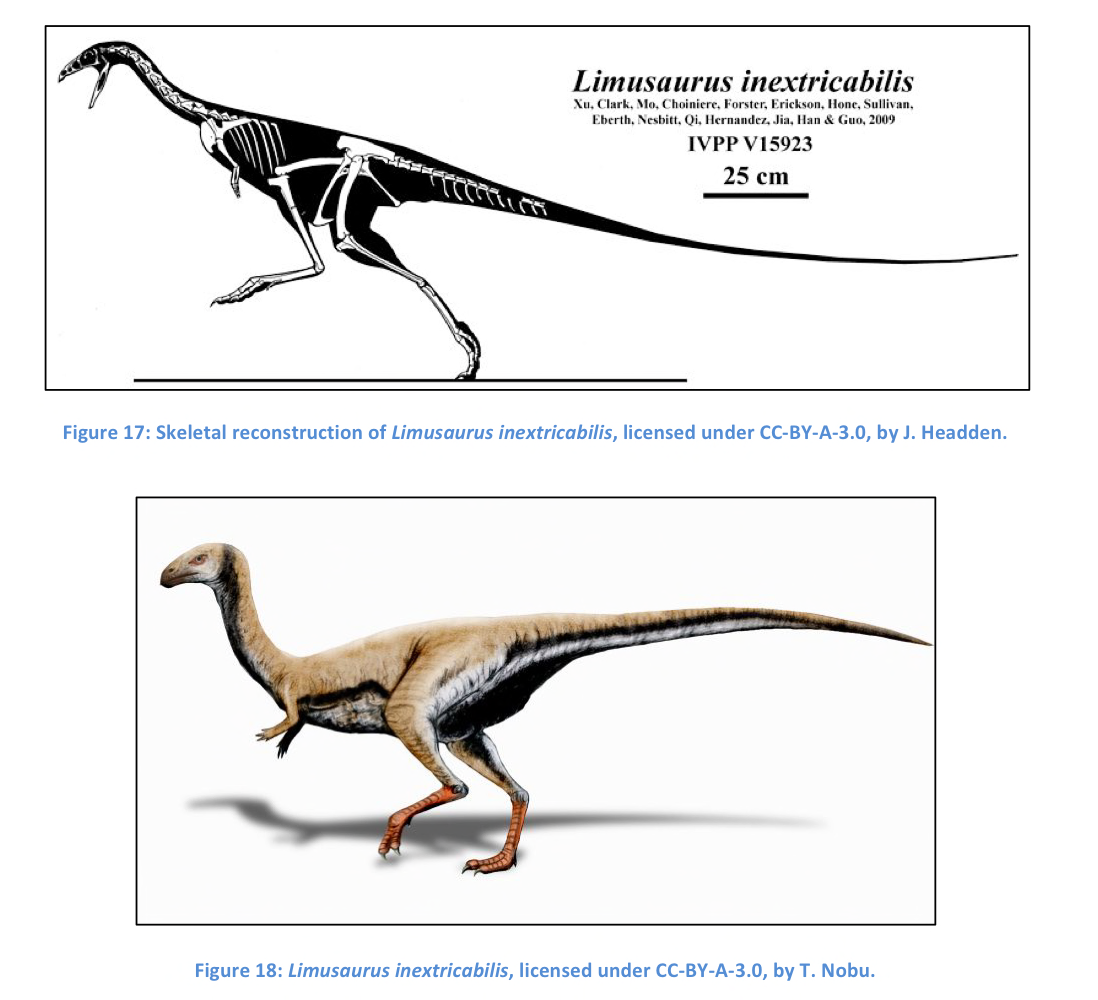
Limusaurus
Part of elaphrosaurs. Meaning 'beaked dinosaur'. This is the oldest known non-carnivorous theropod dinosaur. A small dinosaur, with greatly reduced arms, and elongated legs that are well adapted for running. Has a lack of teeth and has a beak and gastric mill. Herbivorous
95
New cards
Mandibular fenestra
Large opening in the lower jaw. This feature is characteristic of archosaurs, but especially pronounced in some theropods.
96
New cards
Majungasaurus
Heavily ornamented skulls, has grooves, pits bony projection, hollow frontal horn (for display/species recognition)
97
New cards
Megalosauridae
Family inlcuding Middle Jurassic predators such as the European Megalosaurus and the North African Afrovenator, as well as Torvosaurus from the Late Jurassic of North America and Europe. They were robust and muscular, with powerful legs, short and robust arms, hands with three fingers, and had blade-like teeth with very large denticles. (“Chainsaw tooth”)
98
New cards
Megaraptora
Clade in Neovenatoridae. Gracile, enlarged thumb claws, long slender skulls. Includes Megaroptora (Argentina), Aerosteon (South America), Fukviraptor (Japan), Australovenator (Australia), orkoratptor (Argentina). All part of the Cretaceous
99
New cards

Megalosauroidea
Group with elongated skulls and powerful forelimbs- protofeathers have been found in this clade. (Confirmed feather are not just part of coelurosauria) Includes two clades: Megalosauridae and Spinosauridae.
100
New cards
Metriacanthosauridae
Clade of carnosaurs from the Middle and Late Jurassic that includes Sinraptor of China and Lourinhanosaurus of Europe.
 Note
Note  Flashcards (78)