Cell Biology Exam Two - Fermentation and Gluconeogenesis
 Call Kai
 Learn
Learn Practice Test
 Spaced Repetition
 Match
Match Flashcards
 Knowt Play
1/53

There's no tags or description
Looks like no tags are added yet.
Name | Mastery | Learn | Test | Matching | Spaced | Call with Kai |
|---|
No analytics yet
Send a link to your students to track their progress
54 Terms
Fermentation:
anaerobic process but not anaerobic respiration
What does respiration refer to?
Respiratory Electron Transport Chain
Where does fermentation occur in Prokaryotes and Eukaryotes?
Cytoplasm
What is the circumstance needed for fermentation?
Needs deprivation of oxygen
Fermentation regenerates
NAD+
In fermentation coenzyme concentrations are
low
need to recycle ___ back to ____
NADH
NAD+
In fermentation there is no _____ electron acceptor
external
What is the internal electron acceptor?
pyruvate
In fermentation where do electrons and hydrogen ions go?
pyruvate
Who does lactate fermentation?
Some bacteria cells
Muscle cells
What is the enzyme involved in lactate fermentation?
lactate dehydrogenase
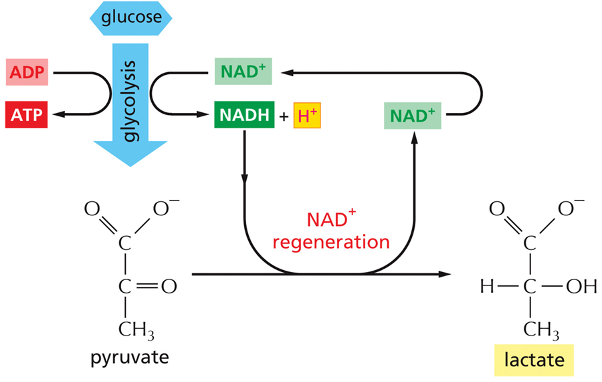
What does this represent?
Lactate Fermentation
Is lactate fermentation a ____ reaction
reversible
Alcoholic fermentation requires ___ steps
two
What is the first step of alcoholic fermentation?
pyruvate loses a carbon (CO2) and is converted to acetylaldehyde
What is the second step of alcoholic fermentation?
NADH reduces acetaldehyde to ethanol
What enzyme(s) are involved in alcoholic fermentation?
Pyruvate decarboxylase
Alcohol dehydrogenase
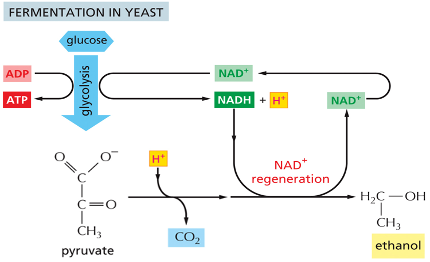
What does this represent?
Alcoholic fermentation
What are some other fermentation pathways?
Propionate fermentation
Acetone
Isopropyl alcohol
Butyrate
ATP count for glycolysis and fermentation
Glycolysis =
2 (net)
ATP count for glycolysis and fermentation
Fermentation =
0 (net)
NADH count for glycolysis and fermentation
Glycolysis =
2 (net)
NADH count for glycolysis and fermentation
Glycolysis fueled by fermentation =
2 (net)
What is the purpose of fermentation?
allows glycolysis to continue by freeing up NAD+
Gluconeogenesis is the formation of
“new” glucose
In gluconeogenesis you are making glucose from
3 and 4 carbon precursors
What are the most common precursors in gluconeogenesis?
pyruvate
oxaloacetate
Most gluconeogenesis reactions are simply glycolysis reaction in
reverse
Is gluconeogenesis reversible
no (bypass reactions)
Reaction 1
Gly-1 requires ATP and is not reversible
Bypass using a simple hydrolytic reaction
Reaction 3
Gly-3 requires ATP and is not reversible
Bypass using a simple hydrolytic reaction
Reaction 10
Gly-10 (PEP to pyruvate) is bypassed by a two reaction sequence requiring both ATP and GTP
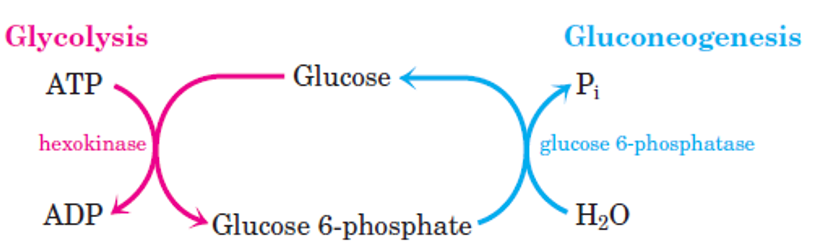
Gluconeogenesis vs Glycolysis Reaction 1
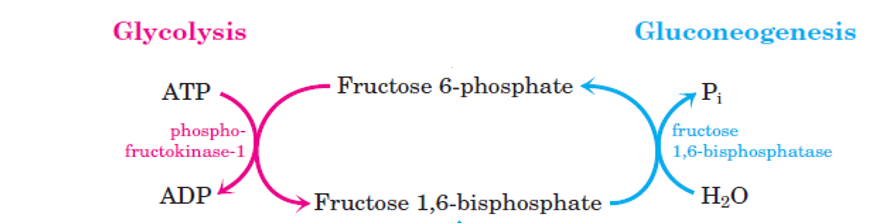
Gluconeogenesis vs Glycolysis Reaction 3
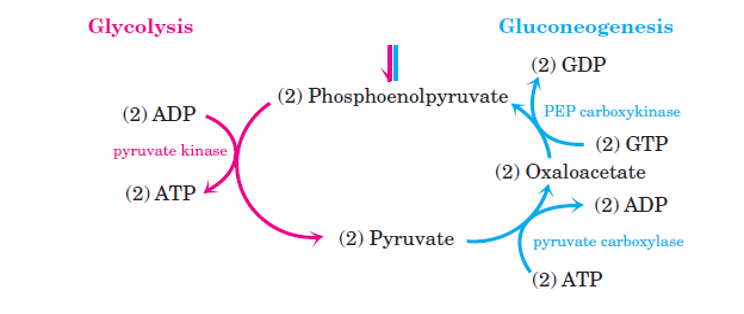
Gluconeogenesis vs Glycolysis Reaction 10
What are the two type of regulation?
spatial
temporal
Spatial Regulation:
both pathways can occur simultaneously in different parts of the body
Temporal Regulation:
cannot do both reactions at the same time in the same part of the body
In relation what happens to the types of regulation?
stimulate one, inhibit the other
What are the key places of allosteric regulation during glycolysis?
hexokinase
phosphofructokinase-1
pyruvate kinase
What are the key places of allosteric regulation during gluconeogenesis?
fructose-1,6-biphosphatase
pyruvate carboxylase
AMP is an ______ for glycolysis and an _____ for gluconeogenesis
allosteric activator
allosteric inhibiter
High energy molecule
inhibit glycolysis
activate gluconeogenesis
low energy molecules
inhibit gluconeogenesis
activate glycolysis
ATP is both a substrate and an allosteric inhibitor of
PFK-2
At low [ATP]
it binds to the active site, glycolysis goes
At high [ATP]
inhibits glycolysis
The most common 3 carbon precursor for gluconeogenesis is
pyruvate
What is the name of the enzyme responsible for the oxidation / reduction reaction in ethanolic fermentation?
Alcohol dehydrogenase
The new output of ATP from glycolysis followed by fermentation is ______, and the NADH yield from glycolysis followed but fermentation is _________.
2 ; 0
During strenuous exercise, you may notice that your muscles burn. Which of the following statements best explains this phenomenon?
Without oxygen, pyruvate is being converted to lactic acid
The process by which lactase is removed from muscle tissue and returned to the liver to produce glucose is called
Gluconeogenesis
Which of the following is NOT an allosteric inhibitor of an enzyme in glycolysis.
Fructose-2,6-biphosphate

