Cell Biology Chapter Four
0.0(0)
 Studied by 1 person
 Call Kai
 Learn
Learn Practice Test
 Spaced Repetition
 Match
Match Flashcards
 Knowt Play
Card Sorting
1/270

Earn XP
Description and Tags
Last updated 11:46 PM on 10/18/22
Name | Mastery | Learn | Test | Matching | Spaced | Call with Kai |
|---|
No analytics yet
Send a link to your students to track their progress
271 Terms
1
New cards
Prokaryote
A unicellular organism that lacks a nucleus and membrane bound organelles
2
New cards
Eukaryotes
Cells that contain nuclei
3
New cards
Archaea
Domain of unicellular prokaryotes that have cell walls that do not contain peptidoglycan. They are also characterized by having species that live in extreme habitats on Earth and have very diverse metabolic strategies
4
New cards
What did Archaea derive from
Eukarya
5
New cards
What two categories were prokaryotes broken into
Bacteria and archaea
6
New cards
Why is the definition of prokaryotes not sufficient or useful?
The definition (non-nucleated cells) is a negative classification based on what cells do not have and partly because it wrongly implies a fundamental similarity among all organisms who lack a nucleus
7
New cards
Methanogens
A group of archaebacteria that produce methane as a by product of their metabolism.
8
New cards
Halophiles
"salt-loving" archaea that live in environments that have very high salt concentrations
9
New cards
Thermacidophiles
Hot temperature and acid loving bacteria
10
New cards
Average size of bacterial or archaeal cells
1-5 micrometers
11
New cards
Average size of animal cells
10-100 micrometers
12
New cards
What is the importance of the surface area/ volume ratio of a cell
The surface area of a cell effectively represents the amount of cell membrane available for the uptake and excretion defined by the cell's volume
13
New cards
Diffusion
the process in which there is movement of a substance from an area of high concentration of that substance to an area of lower concentration
14
New cards
How are cells affected by the rate of diffusion?
Cells need to be able to consistently move throughout the cell. They move based on the rate of diffusion in the cell. Diffusion is the movement of a substance from an area of high concentration of the substance to an area of low concentration
15
New cards
What happens to the rate of diffusion when a cell increases in size
The rate of diffusion decreases as the size of the molecule increase
16
New cards
What macromolecules is the rate of diffusion significant in
In proteins and nucleic acids
17
New cards
Cytoplasmic streaming
Another way to diffuse cellular contents throughout the cell. Moves cells through active movement and the mixing of cytoplasmic contents rather than diffusion
18
New cards
Why do cells need to maintain adequate concentrations within the cell
The cells contain essential enzymes and compounds that are needed for the various processes that cells must carry out. These compounds and reactants need to be able to collide with the aforementioned enzymes. The frequency of these collisions will increase proportionally with an increase in cell size. The more the cell increases along with the concentration however, there is taxing on the cell's synthetic capabilities
19
New cards
What feature of cells can tackle the concentration issue that occurs with an increase in cell size
Cells can compartmentalize
20
New cards
What is cell compartmentalization
Cells can delegate and localize concentrations necessary for cellular processes to specific compounds called organelles
21
New cards
Organelles
Sites of compartmentalization of cellular activities
22
New cards
What does compartmentalization allow cells to do
It allows cells to localize high concentration of specific enzymes and compounds needed for particular cellular processes that can then proceed efficiently
23
New cards
Describe Prokaryotes' lack of a nucleus
Prokaryotes lack membrane-enveloped nuclei. The genetic information of a bacterial or archaeal cell is folded in to a compact structure. This structure is attached to the cell membrane in a particular region of the cytoplasm
24
New cards
What is the genetic information that is folded into a compact structure in a prokaryote called
The nucleoid
25
New cards
Describe a Eukaryote's nucleus
The nucleus contains the bulk of the genetic information of the cell. The nucleus is surrounded by a nuclear envelope which consists of two membranes. The nucleus also has the nucleolus, chromosomes, and the nucleoplasm
26
New cards
Nucleolus
Synthesis site for RNA and proteins required for ribosomes
27
New cards
Where are chromosomes dispersed and as?
They are dispersed throughout the nucleoplasm as chromatin
28
New cards
Describe prokaryotes' ability to segregate function
Though there are a few bacteria that have structures that resemble organelles and have some sort of internal membranes, most conduct their cellular functions in the cytoplasm or on the plasma membrane
29
New cards
Cyanobacteria internal membranes
Cyanobacteria have extensive internal membranes on which photosynthetic reactions are carried out
30
New cards
Describe Eukaryotes' ability to segregate function
Nearly all eukaryotic cells make extensive use of internal membranes to compartmentalize specific functions and they often have numerous organelles
31
New cards
What are some examples of membrane surrounding and delimiting organelles
Mitochondria, chloroplasts, lysosomes, and peroxisomes as well as various kinds of vacuoles and vesicles
32
New cards
Structure of eukaryotic nucleus
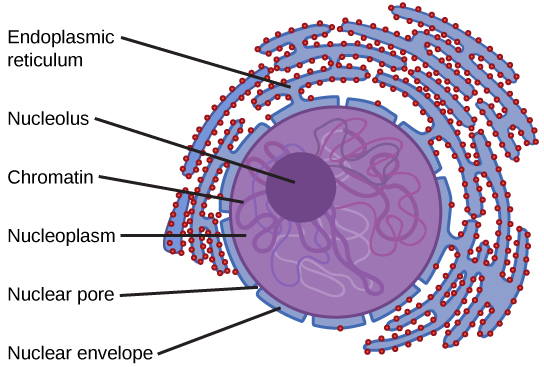
33
New cards
Cytoskeleton
a microscopic network of actin filaments and microtubules in the cytoplasm of many living cells that gives the cell shape and coherence/elasticity
34
New cards
Parts of the cytoskeleton
microtubules, microfilaments, and intermediate filaments
35
New cards
Microtubules basic function
found in the cilia and flagella of many cell types. They are the largest elements of the cytoskeleton. They play a role in motility and chromosome movement as well as the organization of the cytoplasm and intracellular movement of macromolecules and other materials in the cell. They also contribute to the overall shape of the cell, the spatial disposition of its organelles, and the distribution of microfilaments and intermediate filaments
36
New cards
Microfilaments
Found in the muscle fibrils and other structures involved in motility. They are best known for their roles in contraction and motility. The specific thing they are best known for is their role in the contractile fibrils of muscle cells. They can also form connections with the plasma membrane and thereby influence locomotion, amoeboid movement, and cytoplasmic streaming. They also produce the cleavage furrow that divides the cytoplasm of an animal cell after the two sets of chromosomes have been separated by mitotic spindle fibers. They also contribute importantly to the development and maintenance of cell shape
37
New cards
Intermediate filaments function
Especially prominent in cells that are subject to stress. They are seen as a scaffold that supports the entire cytoskeletal framework. They are also thought to have a tension-bearing role in some cells because they often occur in areas that are subject to mechanical stress,
38
New cards
What kind of cells are cytoskeletons found in
eukaryotes
39
New cards
Endocytosis
One of the processes of membrane fusion is found in eukaryotes. Portions of the plasma membrane invaginate and are pinched off to form membrane-bounded cytoplasmic vesicles containing substances that were previously on the outside of the cell
40
New cards
Exocytosis
One of the processes of membrane fusion found in eukaryotes. Membrane-bounded vesicles inside the cell fuse with the plasma membrane and release their contents to the outside of the cell
41
New cards
The organization of DNA for prokaryotic cells
Prokaryotic cells have circular DNA that is associated with a few amount of proteins. Though very long (much longer than the bacteria or archaea cells themselves) the DNA is folded compactly in the cell.
42
New cards
The length of bacterial and archaeal cells in comparison to their DNA
Bacteria and archaea are typically only about a micrometer long while their DNA can be as long (or longer) that 1300 micrometers in circumference (it is circular)
43
New cards
The organization of DNA for eukaryotic cells
Some eukaryotic cells (like yeast or fruit flies) have about 10 to 50 times the amount of DNA that bacterial and archaeal cells possess, but many can have as much as 1000 times as much DNA! Size is not an issue with DNA in eukaryotic cells however given that they can organize their DNA into complex structures called chromosomes which contain as many histone proteins as DNA
44
New cards
How do Bacterial cells segregate their genetic information
They do so using the simple process of binary fission which results in bacteria dividing and giving one molecule of the replicated DNA and half of the cytoplasm going to each daughter cell
45
New cards
How do eukaryotic cells segregate genetic information
They do so through the processes of mitosis and meiosis. Chromosomes are distributed equally to the daughter cells. Cytokinesis follows the processes of mitosis and meiosis.
46
New cards
How do eukaryotic cells express DNA
They tend to transcribe genetic information in the nucleus into large RNA molecules and depend on later processing and transport processes to deliver RNA molecules of the proper sizes to the cytoplasm for protein synthesis. Each RNA molecule typically encodes one polypeptide
47
New cards
How do prokaryotic cells express DNA
Bacteria transcribe very specific segments of genetic information into RNA messages and often a single RNA molecule contains the information to produce several polypeptides. In bacteria, little to no processing of RNA occurs; a moderate amount is seen in archaea though less than in eukaryotes
48
New cards
Unity in cells
All cells resemble each other in fundamental ways.
49
New cards
Unity in cells: Function
Virtually all cells oxidize sugar molecules for energy, transport ions across membranes, transcribe DNA into RNA and undergo division to generate daughter cells
50
New cards
Unity in cells: Structures
all cells are surrounded by a selectively permeable plasma membrane, all have ribosomes for the purpose of protein synthesis, and all contain double-stranded DNA as their genetic information
51
New cards
Why do we also study diversity of cells
it is important to study the features that are especially prominent in a particular cell type to understand how certain processes work
52
New cards
What cell would be good to study to understand how the process of protein secretion works
it is advantageous to consider a cell that is highly specialized for that particular function. Cells from the human pancreas are a good choice for studying this process because they secrete large amounts of digestive enzymes.
53
New cards
The division of labor in specialized structures in eukaryotes vs prokaryotes
Single celled organisms must be able to carry out any and all of the functions necessary for survival, growth, and reproduction. It typically does not overemphasize any single function at the expense of others. Eukaryotes, however, are characterized by their division of labor that they have among tissues and organs that not only allows for but also depends on specialization of structure and function. Whole groups of cells become highly specialized for a particular task, which then becomes their specific role in the overall functioning of the organism.
54
New cards
What four major structural features does a typical eukaryotic cell possess
An external plasma (or cell) membrane to define its boundary and retain its contents, a nucleus to house the DNA that directs cellular activities, membrane-bounded organelles in which various cellular functions are localized, and the cytosol interlaced by a cytoskeleton of microtubules and microfilaments
55
New cards
What do eukaryotic plant cells possess
In edition to the four main structural elements all eukaryotic cells possess, plant and fungal cells have rigids cells walls external to the plasma membrane while animal cells do not
56
New cards
Instead of a cell wall, what are animal cells surrounded by
an extracellular matrix consisting primarily of proteins that provide structural support
57
New cards
Plasma Membrane
It surrounds every cell. It defines the boundaries of the cell and ensures that its contents are retained.
58
New cards
What does the plasma membrane consists of
Phospholipids, other lipids, and proteins and is organized into two layers
59
New cards
What does each layer of the plasma membrane contain
Two hydrophobic "tails" and a hydrophilic "head" which makes the structure amphipathic
60
New cards
Lipid bilayer
general structural of all plasma membranes which in turn is the basic structural unit of virtually all membranes and serves as a permeability barrier to most water-soluble substances
61
New cards
What are the membrane proteins in terms of affinity to water
They are amphipathic
62
New cards
Glycoproteins
protein with hydrophilic regions exposed on the external side of the plasma membrane and short carbohydrate side chains known as oligosaccharides attached to them
63
New cards
The different types of membrane proteins
enzymes, anchors, transport proteins, receptors, and transmembrane proteins
64
New cards
Membrane enzymes
catalyze reactions known to be associated with the membrane such as cell wall synthesis
65
New cards
Membrane anchor proteins
Structural elements of the cytoskeletons
66
New cards
Membrane transport proteins
Responsible for moving specific substances (ions and hydrophilic solutes) across the membrane
67
New cards
Membrane receptor proteins
receive external signals that trigger specific processes within the cell. They bind to specific molecules
68
New cards
Transmembrane proteins
they have hydrophilic regions protruding from both sides of the membrane. These regions are connected by one of the more hydrophobic, membrane-spanning domains
69
New cards
Types of transmembrane proteins
transport and receptor proteins
70
New cards
What does the nucleus of eukaryotic cells serve as
The information center of the cell
71
New cards
Nuclear envelope
Made up of the inner and outer nuclear membranes
72
New cards
What is unique to the membranes of the nuclear envelope
small opening called pores
73
New cards
What do nuclear pores do
Each pore is a channel through which water-soluble molecules and supramolecular complexes can move between the nucleus and cytoplasm. Ribosomal subunits, messenger RNA molecules, chromosomal proteins, and enzymes needed for nuclear activities are transported across the nuclear envelope through its pores.
74
New cards
Chromatin
chromosomes during interphase. They are DNA-protein fibers
75
New cards
nucleoli
synthesizes the RNA and protein components needed to form the ribosomes
76
New cards
What is the cytoplasm referred to as?
The internal volume of the cell exclusive of the nucleus
77
New cards
What is mitochondria the site of
aerobic respiration
78
New cards
What are the dimensions of an average mitochondria
1 micrometer across and several micrometers long
79
New cards
Mitochondrial features
Mitochondria have two inner and outer cell membranes They also have small, circular molecules of DNA that encode some of the RNAs and proteins needed along with the ribosomes involved in protein synthesis
80
New cards
What is mitochondria's main function
To oxidize sugars and other cellular "fuel" molecules to carbon dioxide in the effort to extract energy from food molecules to be conserved as ATP (adenosine triphosphate)
81
New cards
What important cellular processes occur in the mitochondria
The TCA cycle, fat oxidation, and ATP generation
82
New cards
Cristae
Infoldings of the inner mitochondrial membrane
83
New cards
What is found in the cristae
Molecules that are involved in transporting electrons from oxadizable food molecules to oxygen
84
New cards
Mitochondrial matrix
semi-fluid matrix that fills up the inside of the mitochondrion
85
New cards
What occurs in the mitochondrial matrix
the other reaction sequences, particularly those of the TCA cycle and those involved in fat oxidation
86
New cards
How are mitochondrion localized
They are located where the energy need is greatest
87
New cards
MtDNA
the genome of the mitochondria
88
New cards
How many base-pairs long are MtDNA
it is 16,500 base-pairs long
89
New cards
How many genes does mtDNA code for
37
90
New cards
Chloroplasts
the site of photosynthesis in plant cells
91
New cards
Dimensions of chloroplasts
A few micrometers in diameter and about 5-10 micrometers long making them larger than mitochondria (but not, mostly, larger than nucleus)
92
New cards
Structure of chloroplasts
Have three membranes; an inner and outer membrane and a membrane built of thylakoids that are interconnected by stroma thylakoids
93
New cards
Grana
Thylakoids stacked together
94
New cards
What is the mitochondria capable of encoding
some but not all of its own proteins
95
New cards
What can human mitochondrial DNA genes encode
22 of them specify transfer RNAs (tRNAs), 2 specify ribosomal RNAs (rRNAs) and the remaining 13 encode polypeptides all of which are components of the respiratory complexes that carry out oxygen-dependent ATP synthesis
96
New cards
What are located in chloroplasts
the enzymes, intermediates, and light-absorbing pigments needed for photosynthesis
97
New cards
Photosynthesis
the enzymatic reduction of carbon dioxide to sugar
98
New cards
What reactions occur in the thylakoid membrane system
reactions that depend directly on solar energy
99
New cards
What reactions occur within the stroma
Reactions involved in the reduction of carbon dioxide to sugar molecules
100
New cards
Stroma
the semi fluid material that fills the interior of the cholorplast
 Note
Note  Flashcards (20)