Regression (incl. hypothesis testing), confidence intervals, sum of squares, coefficient of determination
 Call Kai
 Learn
Learn Practice Test
 Spaced Repetition
 Match
Match Flashcards
 Knowt Play
1/11

Earn XP
Description and Tags
Topic 9
Name | Mastery | Learn | Test | Matching | Spaced | Call with Kai |
|---|
No analytics yet
Send a link to your students to track their progress
12 Terms
Hypothesis testing - regression
We need to test the estimated equation for the statistical significance of the relationship - if we can show the slope coefficient is different from zero, we can conclude using the regression equation adds to our ability to predict the dependent variable based on the independent variable
Consider y = a + bx + e to be the estimated version of the true regression line y=\alpha+\beta x+\epsilon
We are testing whether \beta parameter is zero or non-zero
so hypothesis test is:
H_0:\beta=0
H_1:\beta\ne0
Confidence intervals - testing significant relationship
Bounds of CI would be given by
b ± tcvse(b)
tcv = degrees of freedom tn-2 distribution for 0.05 sig. level typically
se(b) - standard error
Reject null that \beta =0 if 0 isn’t included in the interval
Or
Find t statistic using
t=\frac{b-\beta}{se\left(b\right)} where beta = 0 and find t critical value and reject H0 if t > t critical value
\left\vert t\right\vert>\left\vert tcriticalvalue\right\vert
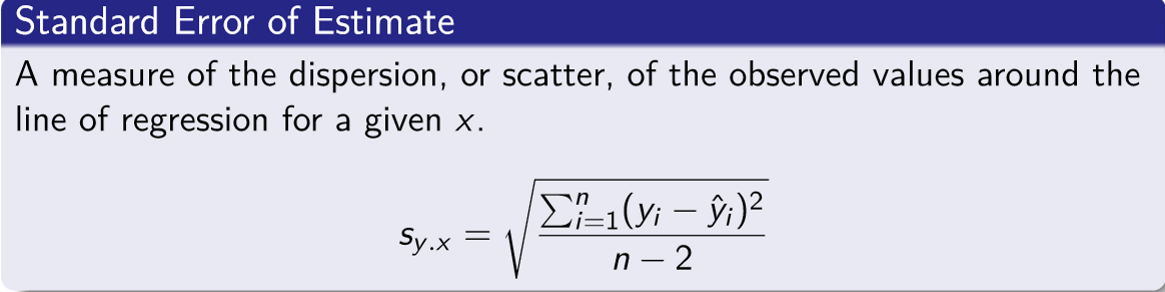
Standard error of estimate
Measures dispersion along the regression line
Formula: image attached
If the standard error estimate is small it indicates the data is relatively close to the regression line and the regression equation can be used to predict y with little error
Coefficient of determination
Most common measure of goodness of fit = R2
Is also inversely correlated to the standard error of estimate
Measures the proportion of the total variation in the dependent variable (y) that is explained by the variation in the independent variable (x)
Ranges from 0 - 1, and closer to 1 = better fit
BUT doesn’t indicated whether relationship is +ve OR -ve
When there is only ONE independent variable the R2 is the square of the coefficient of correlation r2
OR can be calculated using R2 = SSR/SSTotal
If it is a multivariate model R2 would refer to the whole model’s predictive power
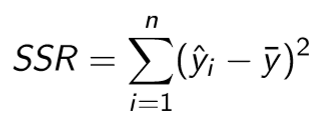
Regression Sum of Squares
Residual/error sum of squares

Total sum of squares
Sum of regression and error sum of squares
Assumptions underlying linear regression
For each value of x there are corresponding y-values
y-values follow the normal distribution
The means of these normal distributions lie on the regression line
These normal distributions have the same standard deviation
The y values are statistically independent
Relationship between mew ± one standard deviation encompassing 68% of the observations, ± two s.d. encompassing 95% and ± 3 s.d. encompassing almost all of them ALSO applies to predicted values y hat, and standard error of estimate
Confidence interval for the mean of y
Used when the regression equation is used to predict the mean value of y for a given value of x

Prediction interval
Used when the regression equation is used to predict an INDIVIDUAL y for a given value of x

Confidence AND prediction intervals
CI:
First substitute the value of x into the y = a +bx to find the midpoint
Then find the critical t value - using n-2 degrees of freedom
Use confidence interval formula and find the range
PI:
Use prediction interval formula
Find t statistic value using n-2 degrees of freedom
PI much larger than CI usually - as intuitively there is a lot of individual variation
Transforming data
Linear regressions assumes the relationship between variables is linear, but what if there is a relationship but it’s not linear
Solution: rescale one or both of the variables so the new relationship IS linear e.g. take the log of the dependent variable y
Other common transformations incl. taking the square root, reciprocal, or square of one of both variables

