AP World Unit 3 Study
 Studied by 2 people
 Call Kai
 Learn
Learn Practice Test
 Spaced Repetition
 Match
Match Flashcards
 Knowt Play
1/35

There's no tags or description
Looks like no tags are added yet.
Name | Mastery | Learn | Test | Matching | Spaced | Call with Kai |
|---|
No analytics yet
Send a link to your students to track their progress
36 Terms
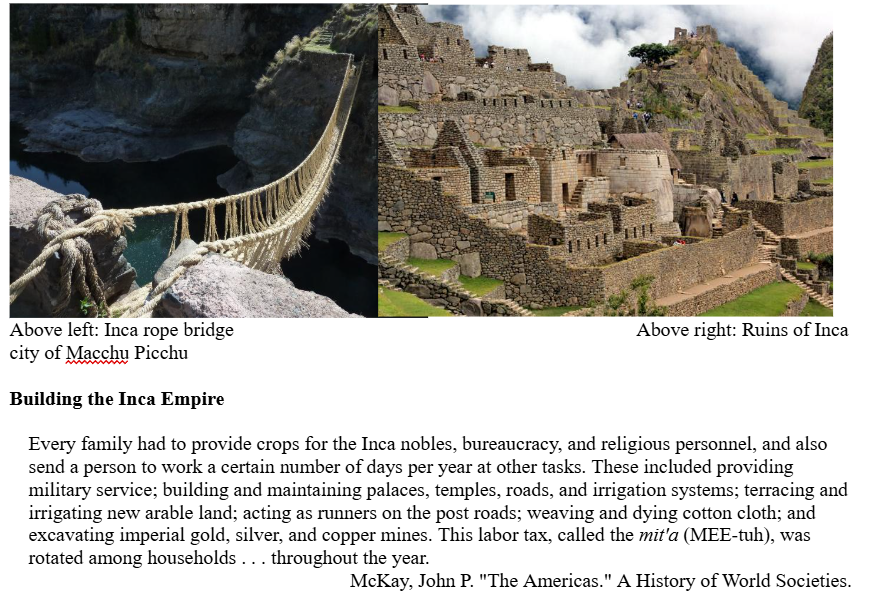
1. Which of the following presented a significant challenge to Inca builders?
(A) Lack of rainfall
(B) High mountains and steep valleys
(C) Inexperienced workers
(D) Frequent rebellions
(B) High mountains and steep valleys
Based on the source and your knowledge of world history, Inca builders
(A) relied on materials from the Amazon rain forest
(B) utilized extensive written blueprints
(C) adapted materials at hand for their construction needs
(D) harnessed the power of sophisticated metal tools
(C) adapted materials at hand for their construction needs
On which of the following did Inca builders rely?
(A) The strength and mobility of horses and oxen
(B) The skill and industry of an experienced labor force
(C) Cleverly constructed wheeled carts, which helped haul materials up steep mountain slopes
(D) Knowledge gained from the Maya
(B) The skill and industry of an experienced labor force
Martin Luther: Table Talk, Early 16th Century
“No greater mischief can happen to a Christian people, than to have God’s Word taken from them or falsified, so that they no longer have it pure and clear. The ungodly papists prefer the authority of the church far above God’s Word; a blasphemy abominable and not to be endured; wherewith, void of all shame and piety, they spit in God’s face.
Pope, cardinals, bishops, not a soul of them has read the Bible; ‘tis a book unknown to them. They are a pack of guzzling, stuffing wretches, rich, wallowing in wealth and laziness, resting secure in their power, and never, for a moment, thinking of accomplishing God’s will.”
Martin Luther’s statement best reflects his belief that
The source of salvation was faith, not good works, so the intercession of the Church was unnecessary to salvation.
The Pope holds the ultimate authority in faith and doctrine.
The source of salvation was a blend of faith, good works, and sacraments performed by the priest.
Only through reading the Bible and memorizing its passages could a person expect salvation.
The source of salvation was faith, not good works, so the intercession of the Church was unnecessary to salvation.
Martin Luther: Table Talk, Early 16th Century
“No greater mischief can happen to a Christian people, than to have God’s Word taken from them or falsified, so that they no longer have it pure and clear. The ungodly papists prefer the authority of the church far above God’s Word; a blasphemy abominable and not to be endured; wherewith, void of all shame and piety, they spit in God’s face.
Pope, cardinals, bishops, not a soul of them has read the Bible; ‘tis a book unknown to them. They are a pack of guzzling, stuffing wretches, rich, wallowing in wealth and laziness, resting secure in their power, and never, for a moment, thinking of accomplishing God’s will.”
The spread of Luther’s ideology caused which of the following changes in European civilization throughout the period of 1450 to 1750?
The power of monarchies throughout Europe were weakened.
An increase in literacy occurred for both men and women throughout Europe.
Women enjoyed a much greater participation in the church hierarchy.
Luther’s ideology gained a monopoly of Christians, and the adherents of the Catholic faith diminished to a minority.
The power of monarchies throughout Europe were weakened.
Martin Luther: Table Talk, Early 16th Century
“No greater mischief can happen to a Christian people, than to have God’s Word taken from them or falsified, so that they no longer have it pure and clear. The ungodly papists prefer the authority of the church far above God’s Word; a blasphemy abominable and not to be endured; wherewith, void of all shame and piety, they spit in God’s face.
Pope, cardinals, bishops, not a soul of them has read the Bible; ‘tis a book unknown to them. They are a pack of guzzling, stuffing wretches, rich, wallowing in wealth and laziness, resting secure in their power, and never, for a moment, thinking of accomplishing God’s will.”
The Protestant Reformation most directly led to which of the following changes?
The Scientific Revolution and the Age of Enlightenment.
The creation of the Anglican Church in England.
The discovery of the Americas under the sponsorship of Spain’s Catholic rulers.
The Crusades which served to increase the power of the Catholic Church
The Scientific Revolution and the Age of Enlightenment.
Which of the following contributed most to the emergence of Russia as an expanding Eurasian power in the period between 1450 and 1750?
Its absorption of traditions and technology from the Byzantine Empire and Western Europe.
Its success in creating alliances with European powers to expel Turkish invaders from the south.
The eradication of Islam from Central Asia.
The use of its strong navy to acquire colonial holdings worldwide.
Its absorption of traditions and technology from the Byzantine Empire and Western Europe.
(A) Samurai lost all power in Japan, having been overcome in position by the more highly esteemed merchants.
Why was the unification of Japan under the Tokugawa shogun significant in the history of Asia?
(A) Japan became more influenced by outside cultures during the Tokugawa shogunate.
(B) Ending the civil wars allowed Japan to significantly increase the power of the Emperor.
(C) Japan developed a less rigid social hierarchy as the samurai brought order to the countryside.
(D) The Tokugawa shogunate ruled over a more centralized Japan, eventually almost ending all foreign influence.
(D) The Tokugawa shogunate ruled over a more centralized Japan, eventually almost ending all foreign influence.
The samurai’s position in Tokugawa Japan’s government was most similar to that of
(A) soldiers in the Aztec Empire
(B) a knight or vassal in feudal Europe.
(C) a highly ranked military officer in Spain.
(D) a member of the scholar gentry in China.
(B) a knight or vassal in feudal Europe.
Based on the stimuluses, what can one infer about the attitude of Sultan Suleiman towards his French counterpart King Francis and Europe as a whole?
(A) The belief that he and Francis I are equals.
(B) The belief that God is the only sovereign of their realms.
(C) A recognition that he reveres the position of King Francis.
(D) An assumption that Francis is of significantly lower rank and prestige.
(D) An assumption that Francis is of significantly lower rank and prestige.
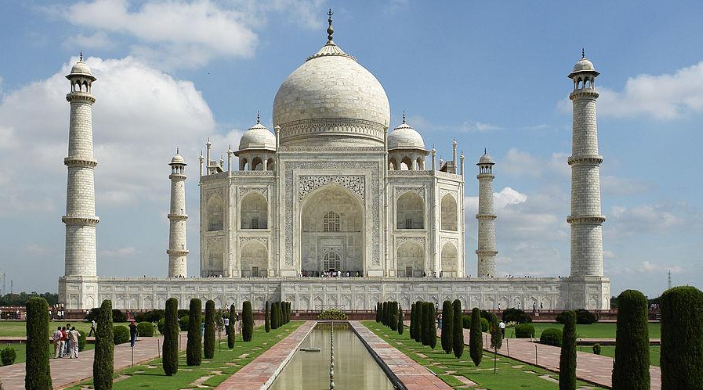
The main reason that this building was constructed between 1632 and 1649 was to serve as
(A) a palace for the ruler
(B) a mausoleum for the ruler’s dead wife
(C) a place of worship for people of many faiths
(D) an administrative building for the government
(B) a mausoleum for the ruler’s dead wife
The building was constructed in a place ruled by the
(A) Ottoman Sultan.
(B) Mughal Emperor.
(C) Mongol Khan.
(D) Gupta Emperor.
(B) Mughal Emperor.
“Animated by the spirit of this fatwa, conforming to the Quran, the code of divine laws, and wishing on one side to strengthen Islam, on the other to liberate the lands and peoples who writhe under your yoke, we have resolved to lay aside our imperial robes in order to put on the shield and coat of mail [armor]...
-Letter written by Sunni Ottoman Sultan Selim I to the Shia Safavid Shah Ismail
14. The letter above written by the Sunni Ottoman Sultan Selim I to the Shia Safavid Shah Ismail highlights
(A) the intensification of the split between Sunni and Shia sects of Islam.
(B) a strong desire to use the Quran to resolve differences nonviolently.
(C) an increasing tension between Muslims and Jews in the Ottoman Empire.
(D) a growing united front among Muslims against the spread of Christianity.
(A) the intensification of the split between Sunni and Shia sects of Islam.
Which of the following contributed the most to the Ottoman Empire’s successful expansion in Europe and the Middle East and Mughal expansion into India in the period from 1450 to 1600?
(A) The use of revenues from transoceanic trade to build a powerful army.
(B) The adoption of the latest gunpowder and artillery technology.
(C) The exploitation of Muslim desire to avenge the Crusades.
(D) The use of nomadic tribes as cavalry troops.
(B) The adoption of the latest gunpowder and artillery technology.
Which of the following is a similarity between the Ottoman and Chinese governments during the period 1450-1750?
(A) The dominance of the imperial government by a landed aristocracy.
(B) Heavy reliance on overseas trade for government revenues.
(C) The creation of overseas colonial holdings.
(D) An extensive governmental bureaucracy.
(D) An extensive governmental bureaucracy.
Based on the information presented in the map, which developments in a contemporary civilization had the greatest impact on the foreign relations of the Ottoman, Mughal, Safavid, and Songhai empires in the period 1450-1750?
(A) Drive of the Romanov dynasty in Russia for territorial expansion.
(B) Movement of the maritime West toward the core of a new global trade network.
(C) Mounting trade expeditions into the Indian Ocean basin launched by the Ming dynasty.
(D) Flooding of global markets in precious metals through massive expansion of the gold-salt trade by West African kingdoms.
(B) Movement of the maritime West toward the core of a new global trade network.
This development facilitated increased trade connections and cultural exchanges, significantly affecting the foreign relations of the empires involved.
From 1450 to 1750, Eurasian rulers sponsored the arts primarily for which of the following reasons?
(A) To display power and legitimize their rule
(B) To spend excess money collected in taxes
(C) To encourage tourism and pilgrimages
(D) To increase employment opportunities for struggling artists
) To display power and legitimize their rule
Likely causes for the development of the feudal system described above in Japan were
(A) Frequent warfare and dependence on agriculture
(B) The threat of foreign invasion
(C) Dependence on long distance trade
(D) Chinese influence
(A) Frequent warfare and dependence on agriculture
Which society employed a similar system to Japan’s?
(A) Song China
(B) The Aztec Empire
(C) Western Europe
(D) The Mali Empire
(C) Western Europe
Using the passage, what new technology allowed Hideyoshi and other shoguns to enforce such edicts over powerful daimyo landowners?
(A) Steel samurai swords
(B) Bows and arrows
(C) Warships
(D) Gunpowder and muskets
(D) Gunpowder and muskets
The policies of Hideyoshi, like those of Peter the Great in Russia and Louis XIV in France, were designed to
(A) Give more power to elected leaders to make laws
(B) Apply lessons in government learned by studying England
(C) Centralize governmental power and control the upper class
(D) Increase the military power of the local landlords
(C) Centralize governmental power and control the upper class
In order for the Tokugawa shogunate to protect its conquered land, the shogun employed
(A) Merchants
(B) Samurai
(C) Peasants
(D) Daimyo
(B) Samurai
The main purpose of Mexica/Aztec tribute lists, Mughal zamindar tax collection, and Ottoman tax farming was to
(A) generate revenue in order to forward state power and expansion
(B) build monumental architecture to legitimize Eurasian leaders’ rule
(C) recruit elites for rulers to maintain centralized control over their populations and resources
(D) develop military professionals for rulers to maintain centralized control over their populations and resources
(A) generate revenue in order to forward state power and expansion
Large palaces and buildings, such as the ones above, were built for which reason?
(A) To show the power of the ruler
(B) To symbolize the monarch’s relationship with God
(C) To provide an emergency haven for all of the rulers’ citizens
(D) To prop up failing economies by giving peasants jobs building palaces & mausoleums
(A) To show the power of the ruler
This passage is best understood in the context of the Ottoman practice of
(A) Allowing traders in occupied areas to serve as middlemen, profiting from the exchange of goods
(B) Inviting sons of Islamic peasants to become janissaries and government officials
(C) Allowing local public servants to grow wealthy by collecting taxes from the peasants
(D) Converting Christian boys to Islam and training them in the skills of politics and the military
(D) Converting Christian boys to Islam and training them in the skills of politics and the military
Which development in the Ottoman Empire contradicted the opinions of government bureaucracy expressed in the passage?
(A) European slaves were purchased from the Barbary pirates and forced into naval service as galley slaves as well as officers.
(B) Christians and Jews who lived in the empire rose to high positions and undermined the power of the sultan.
(C) Public servants grew wealthy and corrupt by collecting taxes from the peasants and skimming money themselves.
(D) Many parents wanted their sons to be recruited as janissaries as a path to upward mobility.
(D) Many parents wanted their sons to be recruited as janissaries as a path to upward mobility.
The passage most directly describes the Ottoman practice of
(A) Allowing religious tolerance
(B) Hiring foreign bureaucrats
(C) Training skilled military leaders
(D) Maintaining an aristocratic system
(C) Training skilled military leaders
“...ascertaining the truth, which is the noblest aim of the human intellect. Therefore we associate at convenient seasons with learned men of all religions, thus deriving profit from their exquisite discourses and exalted aspirations.”
Mughal Emperor Akbar, letter to Spanish Emperor Philip II, 1582
29. Based on the letter above, a historian could conclude that the Mughal Empire by the mid-seventeenth century had
(A) fostered tolerance between the religions of South Asia.
(B) cut off trade with foreign merchant empires.
(C) forced strict Islamic sharia law on non Muslims.
(D) accepted Hinduism as the state religion.
(A) fostered tolerance between the religions of South Asia.
Which of the following best explains the process illustrated in the image?
(A) States increasingly relied on slave soldiers to establish large empires.
(B) The invention of the stirrup allowed expanding states to use cavalry more effectively.
(C) The development of new types of armor reduced casualties and allowed states to expand faster than before.
(D) States used gunpowder weapons to establish large empires.
(D) States used gunpowder weapons to establish large empires.
The methods of warfare shown in the image were instrumental in explaining the territorial expansion of all of the following land-based empires EXCEPT
(A) the Safavid empire
(B) the Qing dynasty
(C) the Aztec (Mexica) empire
(D) the Ottoman empire
(C) the Aztec (Mexica) empire
Which of the following explains the most common effect that the process illustrated in the image had on relationships between states in Afro-Eurasia in the period 1450–1750?
(A) It led to deepening rivalries and conflicts as states’ military capabilities grew.
(B) It led to the emergence of new religious disputes over theological interpretations.
(C) It led to the establishment of pan-Eurasian nomadic empires, such as the Mongol Empire.
(D) It led to the adoption of feudal systems of government, as monarchs could not prevent the rising power of military aristocracies.
(A) It led to deepening rivalries and conflicts as states’ military capabilities grew.
According to the passage above, what development allowed Russia to send sailing vessel to “the remotest oceans?”
(A) The establishment of a port on the Mediterranean Sea
(B) The expansion into Siberia
(C) The building of a naval shipyard on the Volga River
(D) The creation of St. Petersburg as the new capital
(D) The creation of St. Petersburg as the new capital
What is the main reason that the Russian individual's beard is being cut in the image above?
(A) to make him comply with an official order intended to make Russia more modern
(B) to make him pay homage to a conquering ruler
(C) at his request, to enable him to be named by his ruler as a member of the highest elite group
(D) as a requirement for all men who fight in the military
(A) to make him comply with an official order intended to make Russia more modern
Which of the following empires in the period 1450–1750 engaged in a type of territorial expansion most similar to that depicted in the map above?
(A) The Spanish Empire
(B) The Portuguese Empire
(C) The British Empire
(D)The Ottoman Empire
(D)The Ottoman Empire
Which of the following was a method rulers in Eurasia used to legitimize and consolidate their power during the period 1450 C.E. to 1750 C.E?
(A) Developing professional militaries
(B) Promoting free trade
(C) Adopting the religious practices of minority groups
(D) Enacting reforms to decrease economic and social inequalities
(A) Developing professional militaries
 Note
Note  Flashcards (63)