botany oldtests
 Call Kai
 Learn
Learn Practice Test
 Spaced Repetition
 Match
Match Flashcards
 Knowt Play
1/30

There's no tags or description
Looks like no tags are added yet.
Name | Mastery | Learn | Test | Matching | Spaced | Call with Kai |
|---|
No analytics yet
Send a link to your students to track their progress
31 Terms
explain the two phenomena (1) dispersal and (2) distribution, each in a brief sentence.
The process of diaspore movement
The range as a result from dispersal & establishment
Name the southern hemispheric counterpart (scientific name) of the Fagaceae, which forms extensive forests in the southern temperate zone (e.g. New Zealand or southern South America).
Nothofagaceae - Nothofagus
Define the term bract and (2) give a brief description of what is understood under bracteose bracts?
A modified or specialized leaf (typically associated w/ a rep structure, ex. flower/inflorescence)
Flowers/inflorescences that have conspicuous, numerous, or well-developed bracts. Bracts being larger/more prominent & sometimes resembling petals
What is the evolutionary and morphological novelty in the angiosperm flower?
flowers hermaphroditic
perianth has function
reduced gametophytes
(1) Define briefly the term rhizome? (2) Name one plant species (common or scientific name) with a rhizome.
A horizontal, underground shoot system modified for clonal propagation & storage
Bambusa bambos, Giant thorny bamboo (or Zingiber officinale - ginger)
Why is the term "banana tree" wrong?
Because a banana tree is not a tree, but a herb. The “trunk” is not a woody trunk, but instead tightly packed leaf bases, thus it's s pseudostem and not a tree.
Name one plant family (scientific name) where stem succulence is commonly observed:
Cactaceae
Name three main strategies to avoid selfing.
Herkogamy : spatial separation
Dichogamy : temporal separation (protandry, protogynous)
Self incompatibility
Please briefly define the term platycladium.
A flattened, leaf-like stem which does photosynthesis (often replaces true leaves)
Flowers that transitioned to secondary anemophily show typical adaptations to anemophily as pollination syndrome. Name three typical characteristics of secondary anemophilous flowers.
Reduction of perianth and reward (nectar)
Increase of pollen production per anther / no. of anthers per flower / no. of male flowers
Exposed anthers ( long, pendulous filaments or pedicels)
Reduction of no. ovules per carpel/carpels per flower or female flowers
Exposed, large, often long papillose stigmas
Inflorescences exposed and/or flowering before leaf development on naked branches
Name (1) the second branching order of the monocots and (2) one family within this order.
Alismatales
Araceae
Name the main three root modifications in Orchids.
Root tubers
Coralloid roots
Aerial roots
(1) Name the four basic floral organs and (2) the corresponding collective
terms for each of the those floral organs?
1. anthers, ovary, petals, sepals
2.androecium, gynoecium, corolla, calyx
Names the three monocot families (scientific name) which are usually referred to as "grass-like".
Juncaceae
Cyperaceae
Poaceae
Name the two earliest branching, extant orders of Angiosperms.
Amborellales
Nympaeales
Which family has a capitulum as typical inflorescence?
Asteraceae
What is a phyllodium? Give a brief discription.
A leaf with a flattened petiole and reduced lamina
Name (1) one genus and the (2) corresponding family we presented in the lecture, in which the male flower is detached from the plant in order to pollinate the female counterpart.
Elodea
Hydrocharitaceae
Please give (1) a short definition of what is understood under the term stolon, and (2) one plant species (common or scientific name) where stolons can be observed.
Horizontal above ground shoot axis ending in plantlet or tuber
Solanum tuberosum (potato)
Name one plant family we presented in the lecture, where sexual mimicry and rendezvous attraction are relatively common types of specialized pollination syndromes.
Orchidaceae
Where is the genus (1) Hypseocharis distributed and (2) to which family
(scientific name) does it belong to?
Andes and Andean foothills (Argentina to Peru)
Hypseocharitaceae
Complete the floral formula of Saxifragaceae by adding values for the number
of sepals, petals, anthers and carpels. (2) What is the typical position of the
ovary in this family.
1.K5 C5 A10 G(2)
2. superior
Name three evolutionary morphological trends which can be observed in the
early angiosperms.
1. woody or herbaceous
2. perianth usually present, usually with „function"
3. „flowers" originally hermaphroditic
4. „gametophytes" completely reduced
a) How do you call a flower with only one plane of symmetry?
b) Name one family (scientific name) where this type of symmetry is
predominant.
1. Monosymmetrical
2.Lamiaceae
Name the family of the model plant Arabidopsis thaliana.
Brassicaceae
Name the three scientific terms for pollination by (1) birds, (2) insects and (3) bats.
Ornithophily
Entomophily
Chiropterophily
a) Which basic organ is modified to form a potato (the structure, not the plant species)?
b) What is the scientific term for a potato (the structure, not the plant species)?
c) What are the functions of the potato (the structure, not the plant species)?
1. Shoot
2. Stolon Tubers
3. Storage
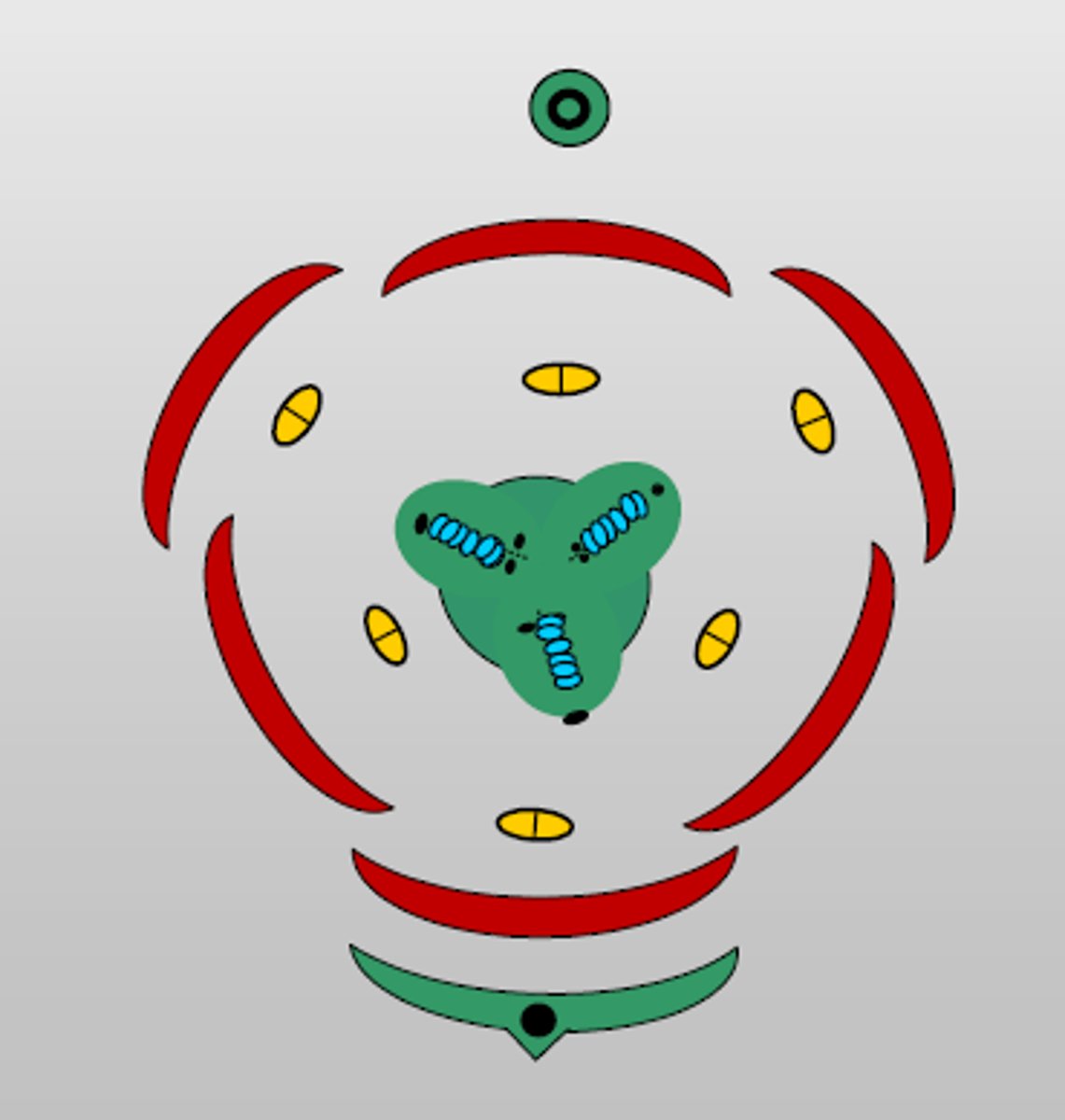
Complete the floral formula of Lilliaceae by adding values for the number of
the tepals, anthers and the gynecium. What is the typical position of the ovary
in this family?
P___ A___ G___. The Ovary is _________
P3+3 A3+3 G3
superior
From which family (scientific name) do we get red, black and white currants and gooseberries?
Grossulariaceae
The pappus is in which (1) family (scientific name) responsible for the
dispersal of the seeds and what is the (2) flower organ from which it
phylogenetically derived?
1. Asteraceae
2. calyx
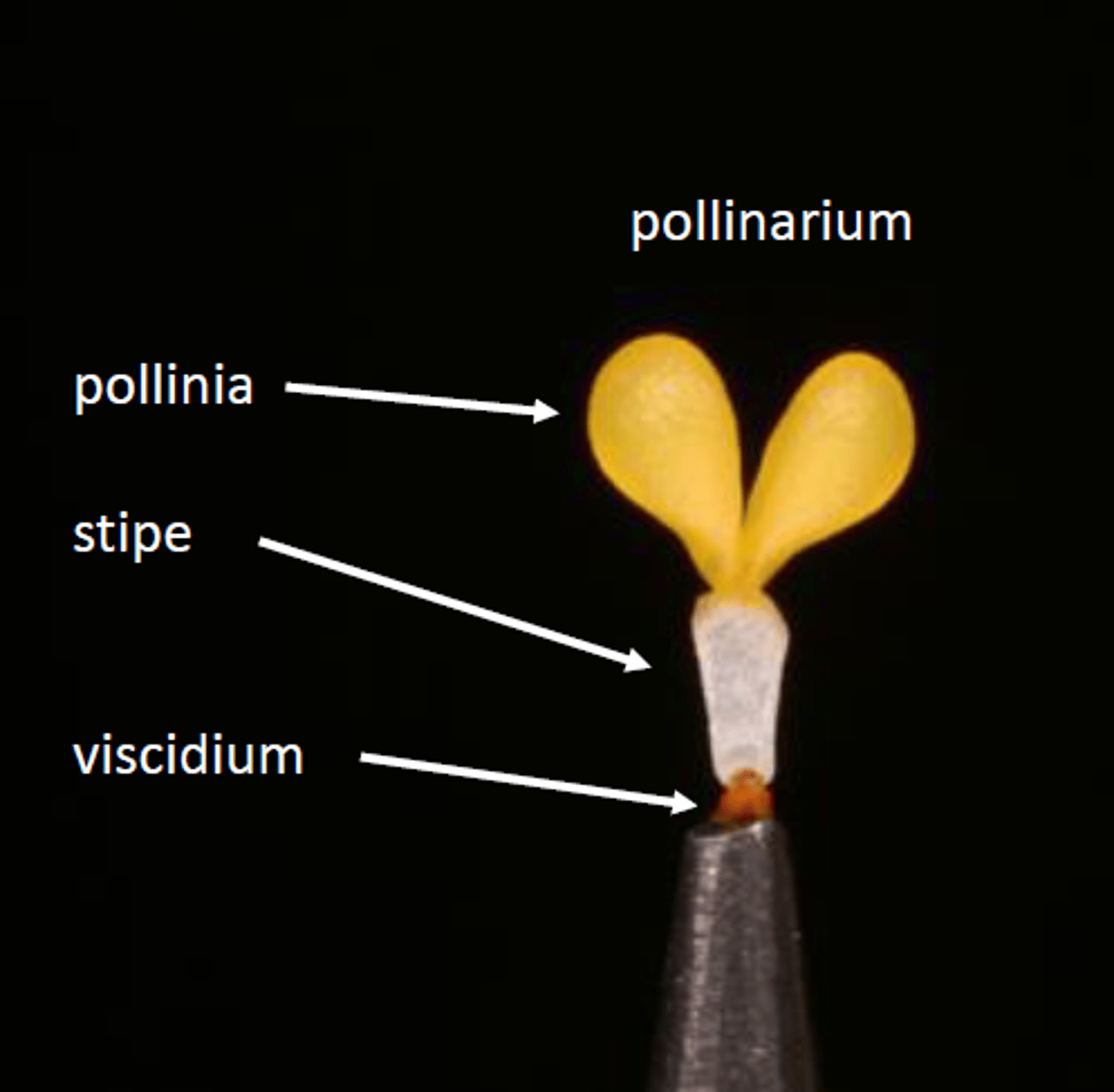
Name the three parts that make up the pollinarium, the modified male organ in orchids.
pollinia, stipe, viscidium