L4: Mitosis and Cell division

0.0(0)
Studied by 0 people
call kaiCall Kai
learnLearn
examPractice Test
spaced repetitionSpaced Repetition
heart puzzleMatch
flashcardsFlashcards
GameKnowt Play
Card Sorting

1/80

encourage image

There's no tags or description

Looks like no tags are added yet.

Last updated 10:33 PM on 3/26/26
Name
Mastery
Learn
Test
Matching
Spaced
Call with Kai

No analytics yet

Send a link to your students to track their progress

81 Terms

1
New cards

Recap of 1aBoC: interphase

  1. Cell growth

  2. centrosome duplication

  3. chromosome replication

  4. establishmnet of sister chromatid cohesion

2
New cards

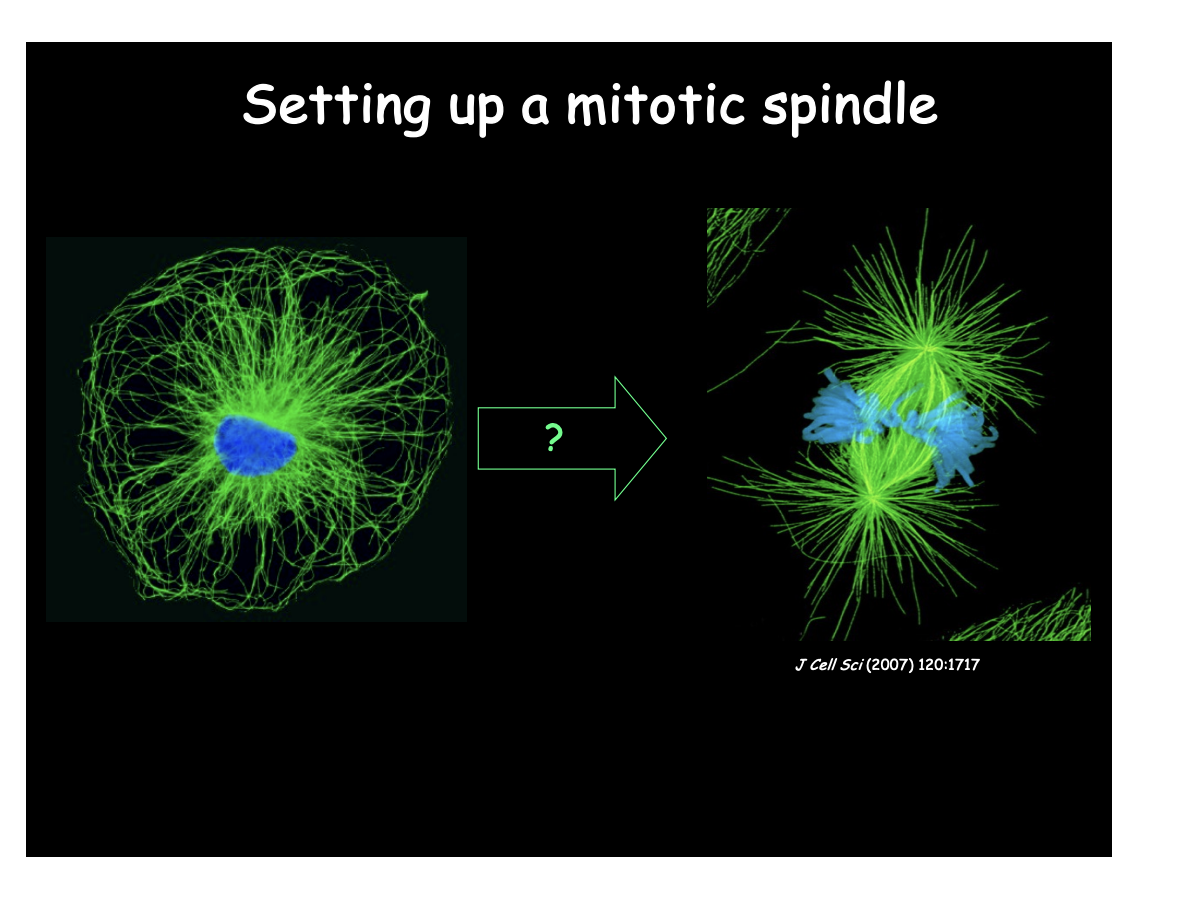
What happens when enter M phase

Radical remodelling of cytoskeleton

  1. MT-based spindle drives chromosome segregation

  2. contractile actomyosin ring powers cytokinesis

  3. other cellular components segregated along the cytoplasm (e.g ribosomes)

  4. Regulated vesiculation and fusion controls the segregation of endomembraneous structures

3
New cards

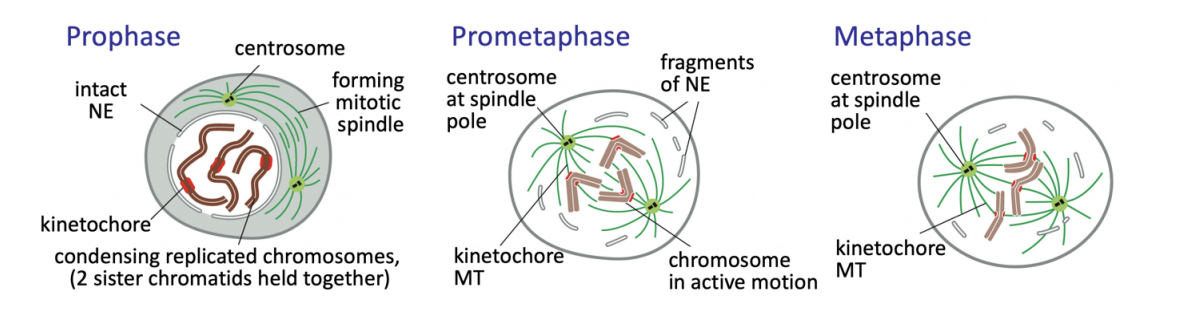
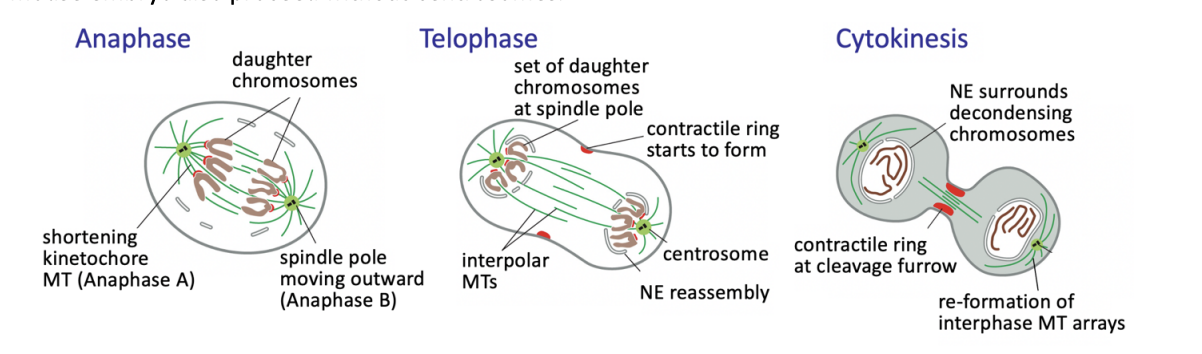
Phases of mitosis based on its cytological landmarks

  1. Prophase

  2. Pometaphase

  3. Anaphase A and B

  4. Telophase

4
New cards
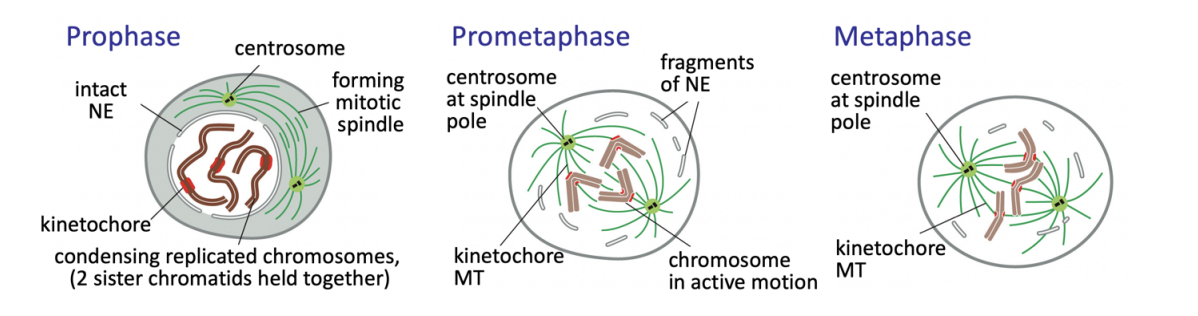
  1. Prophase

  • chromatin condenses into well-defined chromosomes

    • two sister chromatids held together

  • Duplicated centrosomes (in most animal cells) split

  • migrate to set the spindle poles

  • As interphase MT network disassembles, centrosomes begin nucleating highly dynamic MTs
<ul><li><p>chromatin condenses into well-defined chromosomes</p><ul><li><p>two sister chromatids held together</p></li></ul></li><li><p>Duplicated centrosomes (in most animal cells) split </p></li><li><p>migrate to set the spindle poles</p></li><li><p>As interphase MT network disassembles, centrosomes begin nucleating highly dynamic MTs</p></li></ul><p></p>
5
New cards
  1. Prometaphase

  • Nuclear envelope (NE) breakdown complete

    • OPEN MITOSIS

  • MT capture at kinetochores assembled at the centromeric region of each chromosome begins

  • chromosomes then congress to cell equator→ metaphase plate

    • remains under tension

<ul><li><p>Nuclear envelope (NE) breakdown complete</p><ul><li><p><strong>OPEN MITOSIS</strong></p></li></ul></li><li><p>MT capture at kinetochores assembled at the centromeric region of each chromosome begins</p></li><li><p>chromosomes then congress to cell equator→ <strong>metaphase plate</strong></p><ul><li><p>remains under tension</p></li></ul></li></ul><p></p>
6
New cards
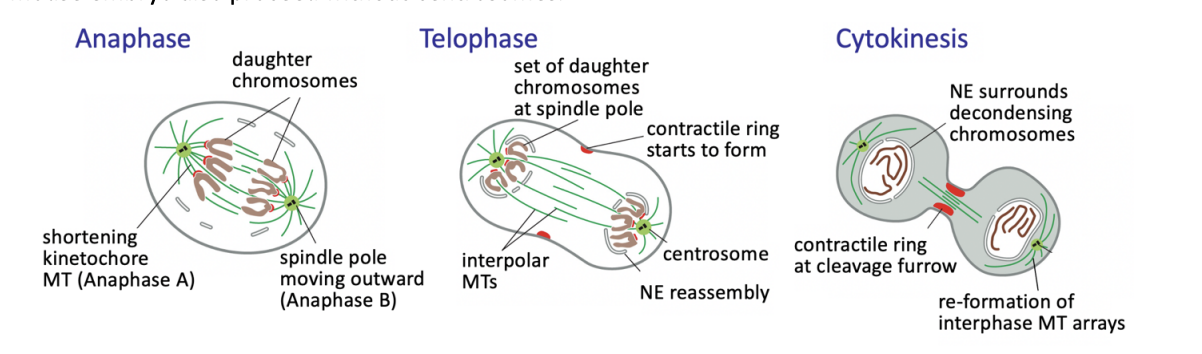
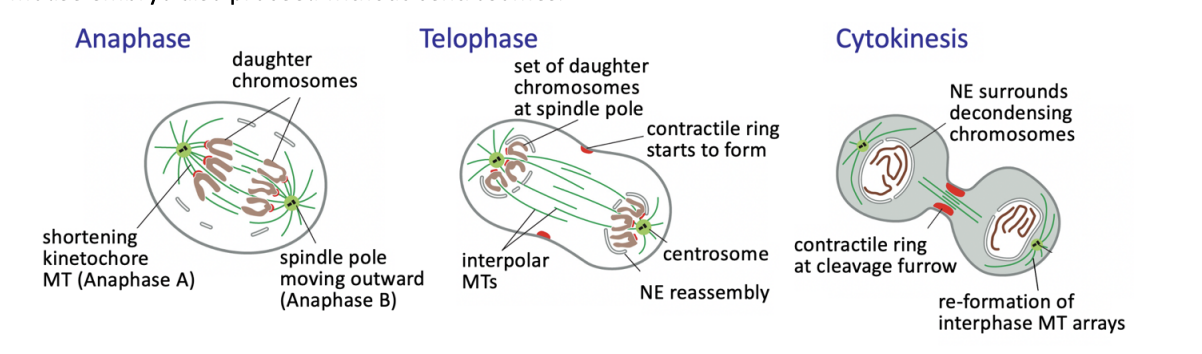
  1. Anaphase

  • triggers loss of cohesion and separation of all sister chromatids

  • defines the birth of two new cells

    • from then on, each sister chromatid is referred to as a chromosome

Anaphase A

  • Kinetochore-MT shortening the chromosomes move poleward

Anaphase B

  • interpolar MTs grow and slide outwards

  • further separating the spindle poles

<ul><li><p>triggers loss of cohesion and separation of all sister chromatids</p></li><li><p>defines the birth of two new cells</p><ul><li><p>from then on, each sister chromatid is referred to as a chromosome</p></li></ul></li></ul><p>Anaphase A</p><ul><li><p>Kinetochore-MT shortening the chromosomes move poleward</p></li></ul><p>Anaphase B</p><ul><li><p>interpolar MTs grow and slide outwards</p></li><li><p>further separating the spindle poles</p></li></ul><p></p>
7
New cards
  1. Telophase

  • chromosomes reach the poles

  • NEs refordm around them

  • chromatin recondenses

<ul><li><p>chromosomes reach the poles</p></li><li><p>NEs refordm around them </p></li><li><p>chromatin recondenses</p></li></ul><p></p>
8
New cards

How is fungal mitosis different

Closed mitosis

  • mitotic spindle is formed within an intact nucleus

9
New cards

How is female meiosis in many animal species different

  • bipolar spindles are formed in the absence of centrosomes

10
New cards

What about the first mitotic divisions of the mous embryo?

  • also proceeed without centrosomes!

11
New cards

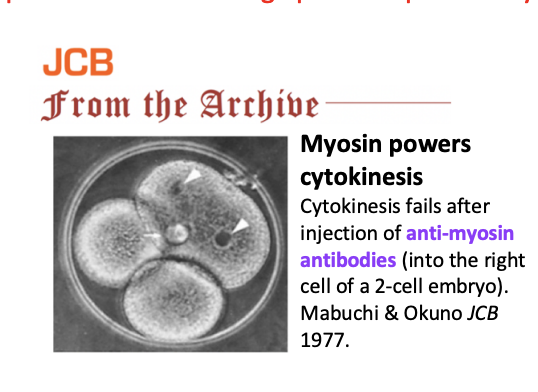
Cytokinesis: Animals

  • divide by constriction of an actomyosin contractile ring
<ul><li><p>divide by constriction of an actomyosin contractile ring</p></li></ul><p></p>
12
New cards

Cytokinesis : Yeast

  • dividing by combining constriction of an actomyosin ring and the deposition of a septum
<ul><li><p>dividing by combining constriction of an actomyosin ring and the deposition of a septum</p></li></ul><p></p>
13
New cards

Cytokinesis: Plants

  • All of mitosis the same but just without centrioles

  • Cytokinesis

    • without contractile ringe

    • instead: deposition of specialised vesicle based structure

      • occurs at the site of division→ the cell plate
14
New cards
<p>Focus of this lecture</p>

Focus of this lecture

  1. How are these structures assembled?

  2. How do they work?

  3. How is spatial and temporal coordination between the two achieved?
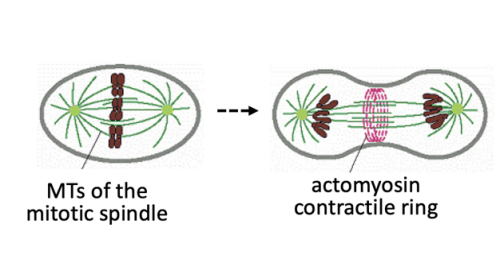
<ol><li><p>How are these structures assembled?</p></li><li><p>How do they work?</p></li><li><p>How is spatial and temporal coordination between the two achieved?</p></li></ol><p></p>
15
New cards

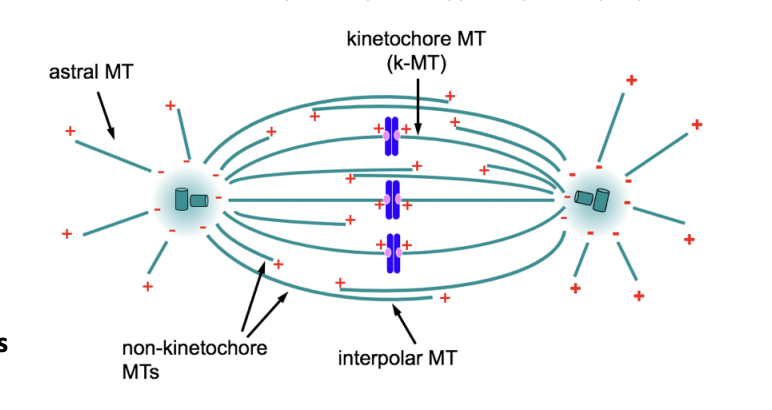
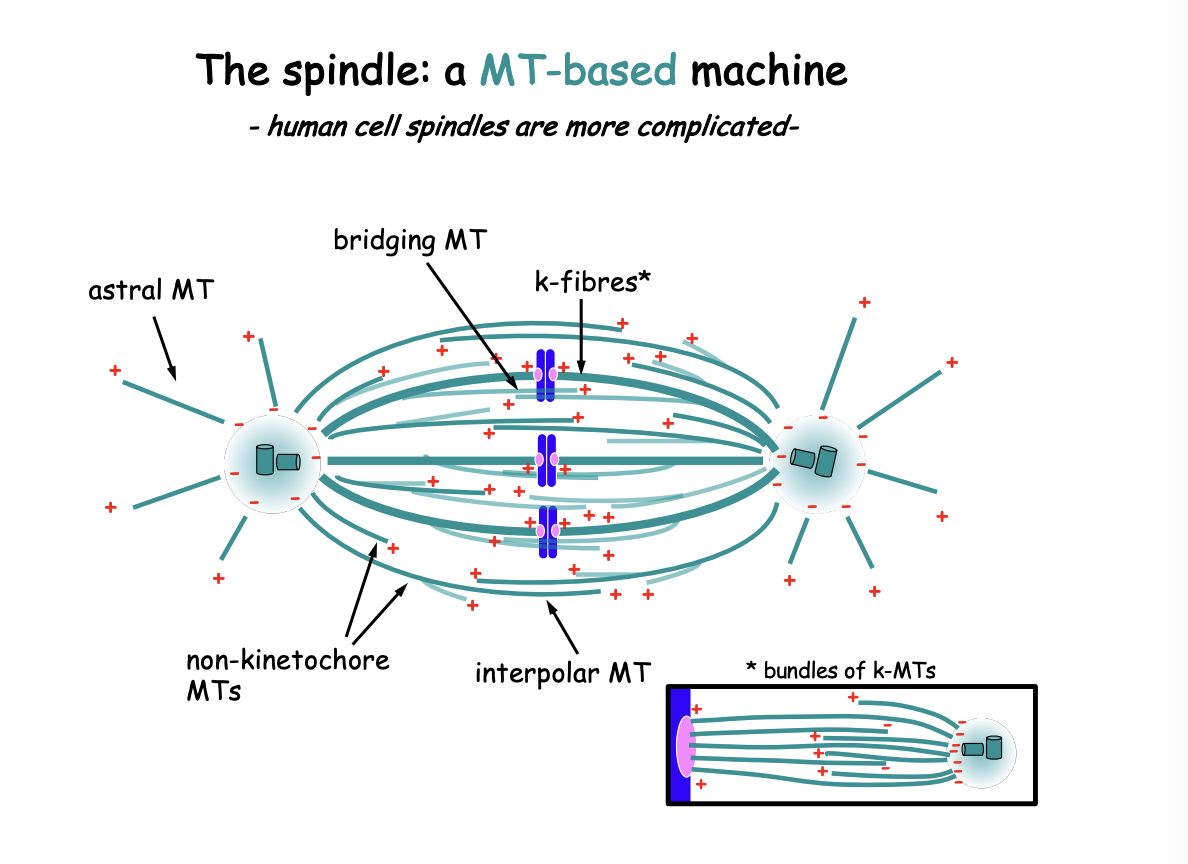
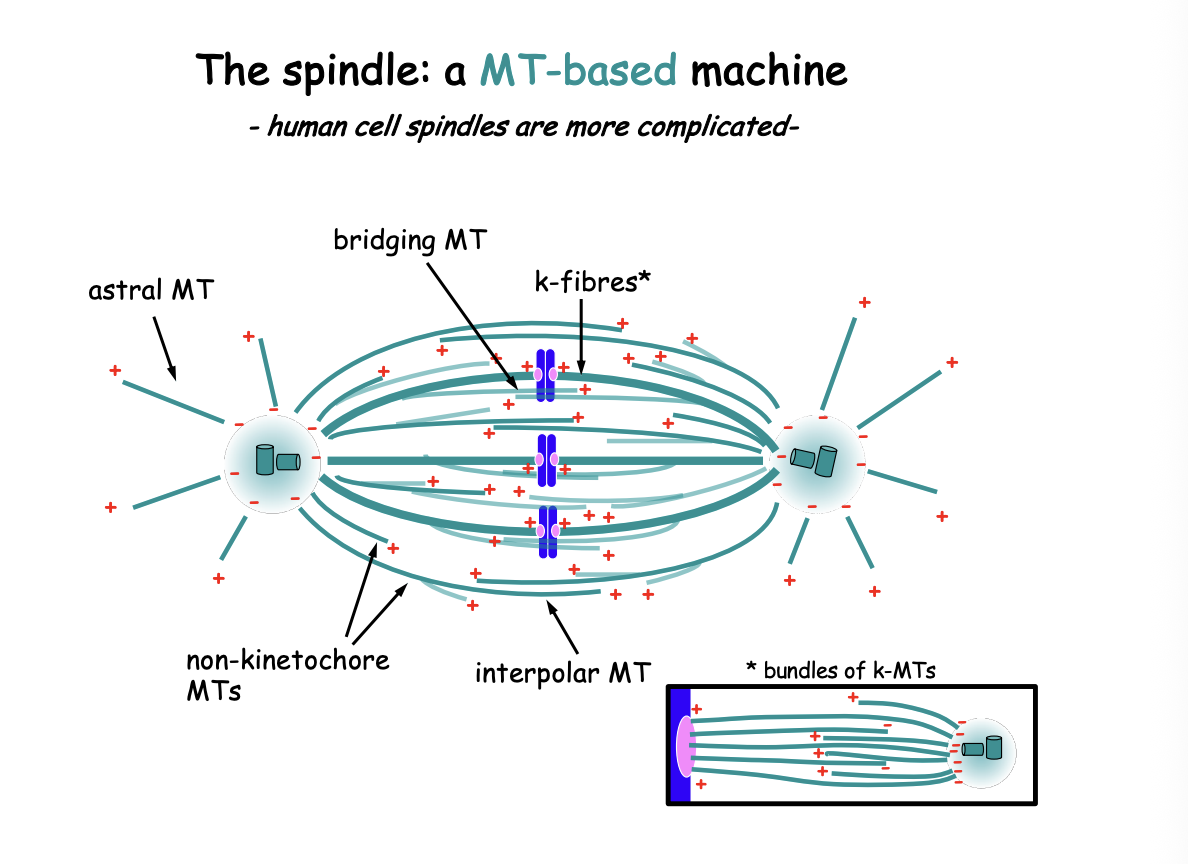
Overview: The spindle- an MT-based machine→ What is the spindle

Self organised bipolar array of microtubules

  • made up of three main classes of MTs

16
New cards

What three main classes of MTs

All

  • - ends focused at the spindle poles

  • typically set up by the centrosomes

BUT differ in regard to oreientation:

  1. Kinetochore MTs (kMTs)

    • interact with kinetochores of mitotic chromosomes

  2. Interpolar MTs

    • non-kinetochore MTs

    • interact at overlaps with non-kinetochore MTs emanating from the opposite pole

    • become cross-linked generating the spindle mid-zone

  3. Astral MTs (aMTs)

    • extend toward the cell cortex

<p>All</p><ul><li><p>- ends focused at the spindle poles</p></li><li><p>typically set up by the centrosomes</p></li></ul><p>BUT differ in regard to <strong>oreientation</strong>:</p><ol><li><p>Kinetochore MTs (kMTs)</p><ul><li><p>interact with kinetochores of mitotic chromosomes</p></li></ul></li><li><p>Interpolar MTs</p><ul><li><p>non-kinetochore MTs</p></li><li><p>interact at overlaps with non-kinetochore MTs emanating from the opposite pole</p></li><li><p>become cross-linked generating the spindle mid-zone</p></li></ul></li><li><p>Astral MTs (aMTs)</p><ul><li><p>extend toward the cell cortex</p></li></ul></li></ol><p></p>
17
New cards

kinetochore MTs in yeast vs animals

Yeast

  • single kMTs attach each sister kinetochore

Animals

  • each kinetochore ends up attached to a bundle of 20 kMTs

  • → Kinetochore fibre (k-fibre)

<p>Yeast</p><ul><li><p><em>single</em> kMTs attach each sister kinetochore</p></li></ul><p>Animals</p><ul><li><p>each kinetochore ends up attached to a <em>bundle</em> of 20 kMTs</p></li><li><p><strong>→ Kinetochore fibre (k-fibre)</strong></p></li></ul><p></p>
18
New cards

What has the 3MT population view been challenged by?

  • variety of advances in 3D microscopy analysis

  • E.g

    • 3D reconstruction of entire spindles

19
New cards

What do these studies suggest?

  • mitotic spindle contains significantly more complex MT based modules:

    1. may branch off from other MTs

    2. not all (-) ends are buried near the centrosome

    3. MTs may form antiparallel bridges between k-fibres

      • also contributing to spindle dynamics

    4. Suggest human k-fibres contain BOTH MTs emanating from the centrosome AND MTs that do not reach the spindle pole

      • those may be crosslinked or interact through various MT-associated components
<ul><li><p>mitotic spindle contains significantly more complex MT based modules:</p><ol><li><p>may branch off from other MTs</p></li><li><p>not all (-)  ends are buried near the centrosome</p></li><li><p>MTs may form antiparallel bridges between k-fibres</p><ul><li><p>also contributing to spindle dynamics</p></li></ul></li><li><p>Suggest <strong>human</strong> k-fibres contain BOTH MTs emanating from the centrosome AND MTs that do not reach the spindle pole</p><ul><li><p>those may be crosslinked or interact through various MT-associated components</p></li></ul></li></ol></li></ul><p></p>
20
New cards

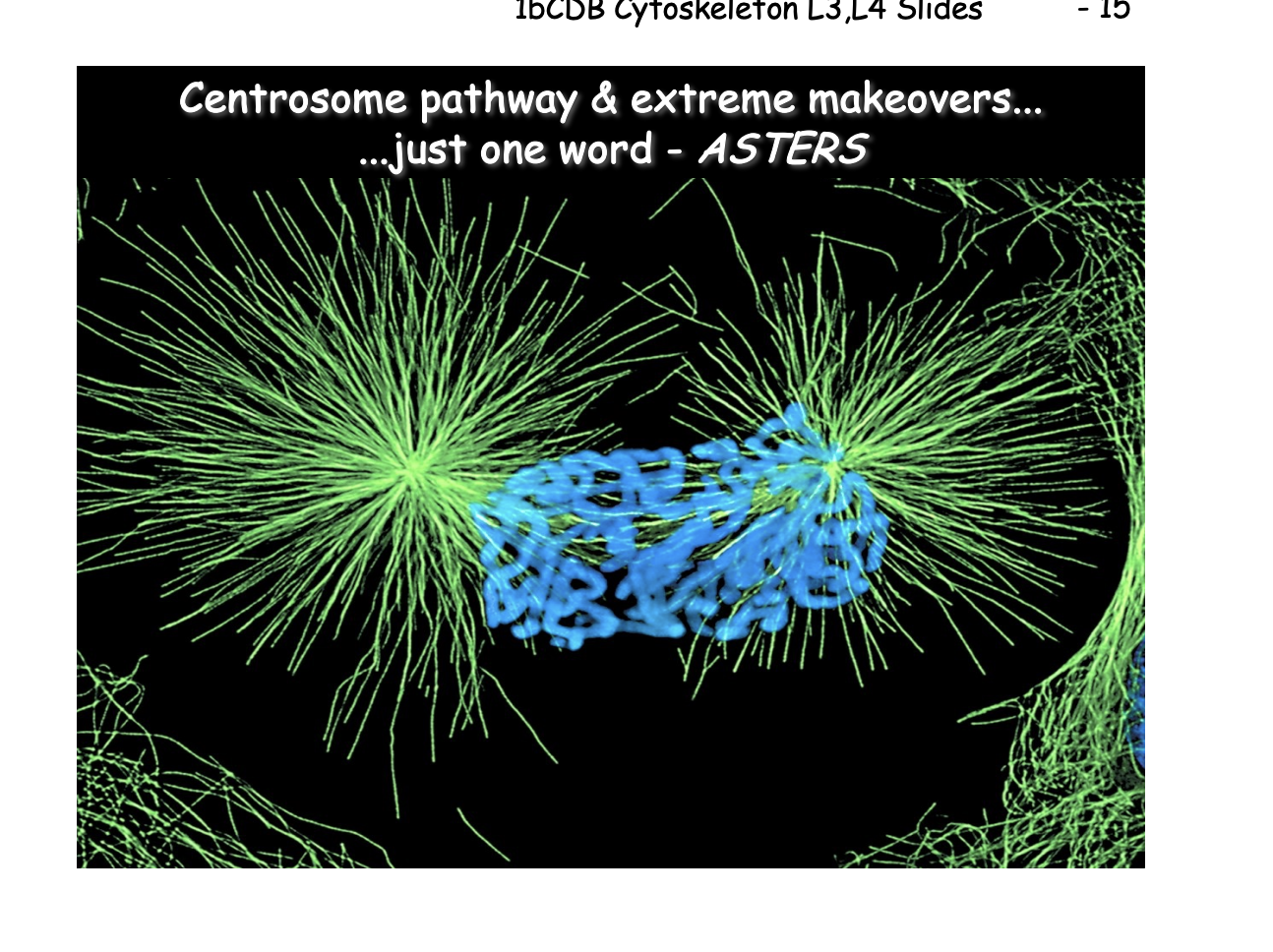
How and when do these MTs arise

When:

  • M phase

How:

  • from parallel pathways from MT nucleation:

    1. centrosome-dependent pathway

    2. centrosome-independent pathways

  • In both need:

    • Dynamic instability

    • large collection of MT interacting proteins

    • Search and capture of chromosomes

  • Once all chromosomes are bi-oriented→ they will essentially aligned at the spindle equator
21
New cards
<p>Centrosome-dependent pathway: when does centrosome duplication happen</p>

Centrosome-dependent pathway: when does centrosome duplication happen

interphase

  1. G1→ single centrosome is present with mother and daughter centrioles

  2. S phase→ centrosome duplication begins

    • helped understand with super-resolution microscopy

    • semi-conservative

  3. M phase→ each new centrosome in M phase carrying one of the original centrioles present in G1
<p><strong>interphase</strong></p><ol><li><p>G1→ single centrosome is present with mother and daughter centrioles</p></li><li><p>S phase→ centrosome duplication begins</p><ul><li><p>helped understand with super-resolution microscopy</p></li><li><p><strong>semi-conservative</strong> </p></li></ul></li><li><p>M phase→ each new centrosome in M phase carrying one of the original centrioles present in G1</p></li></ol><p></p>
22
New cards

Outline of the pathway (please check this slide!)

  1. Increased MT dynamics, centrosome separation and aster formation

  2. Antagonistic activities of MAPs and kinesin-13 control aster MT dynamics

  3. Dynamic instability allows MTs to probe the 3D space of the cell
<ol><li><p>Increased MT dynamics, centrosome separation and aster formation</p></li><li><p>Antagonistic activities of MAPs and kinesin-13 control aster MT dynamics</p></li><li><p>Dynamic instability allows MTs to probe the 3D space of the cell</p></li></ol><p></p>
23
New cards

In early prophase, asters form by

  1. increase in MT turnover: MAP vs Kinesin-13

  2. Increase in centrosome nucleation capacity (maturation)

  3. MT moto-driven centrosome separation

After NEBD MTs gain access to ‘search and capture’ chromosomes

  • lateral attachments are converted to end-on attachments

24
New cards
  1. Increased MT dynamics, centrosome separation and aster formation

  1. Dramatic increase in MT turnover during early prophase

  2. centrosome separate (due to MT-based motors)

  3. complete ‘maturation’→ progressively recruit more PCM increasing their nucleation capacity

  4. Asters are formed

  5. Astral MTs interact with the cell cortex to help aster separation

    • these interactions are powered by dynein/dynactin anchored at the cell cortex
<ol><li><p>Dramatic increase in MT turnover during <strong>early prophase</strong></p></li><li><p>centrosome separate (due to MT-based motors) </p></li><li><p>complete ‘maturation’→ progressively recruit more PCM increasing their nucleation capacity</p></li><li><p>Asters are formed</p></li><li><p>Astral MTs interact with the cell cortex to help aster separation</p><ul><li><p>these interactions are powered by dynein/dynactin anchored at the cell cortex</p></li></ul></li></ol><p></p>
25
New cards
  1. Antagonistic activities of MAPs and kinesin-13 control aster MT dynamics

  1. Dis1 family MAPs (XMAP215, HsTOG) promote MT stability

  2. BUT growth counteracted by the MT-depolymerising kinesin-13

  3. This shifts in favour of MT depolymerisation by negative regulation of the MAP

    • through CDK-mediated phosphorylation as cells enter M-phase
<ol><li><p>Dis1 family MAPs (XMAP215, HsTOG) promote MT <strong>stability</strong> </p></li><li><p>BUT growth counteracted by the MT-depolymerising <strong>kinesin-13</strong></p></li><li><p>This shifts in favour of MT depolymerisation by <strong>negative regulation of the MAP</strong></p><ul><li><p>through CDK-mediated phosphorylation as cells enter M-phase</p></li></ul></li></ol><p></p>
26
New cards

This activity is demonstrated in vitro how

Exposing MTs to mitotic vs interphase cell extracts

  • to measure the ensuing MT dynamics

  • EXP: Add MT stabilising compound Taxol

  • RESULT: Prevents bipolarity

    • centrosomes fail to separate leading instead to the cell assembling a ‘mono-polar’ spindle

  • SUGGESTS: shows the critical role of MT dynamics and turnover throughout this pathway
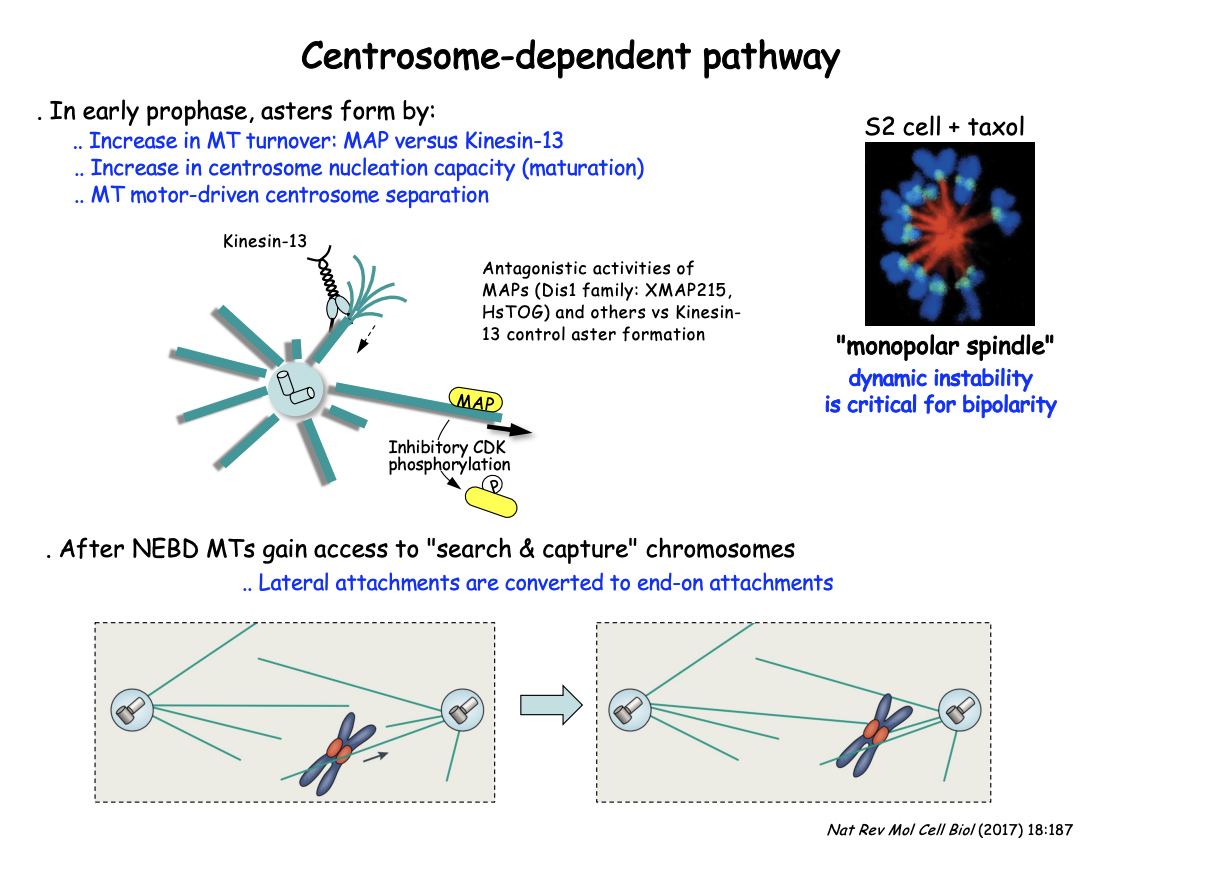
<p>Exposing MTs to mitotic vs interphase cell extracts</p><ul><li><p> to measure the ensuing MT dynamics</p></li><li><p>EXP: Add MT stabilising compound <strong>Taxol</strong></p></li><li><p>RESULT: Prevents bipolarity </p><ul><li><p> centrosomes fail to separate leading instead to the cell assembling a ‘mono-polar’ spindle</p></li></ul></li><li><p>SUGGESTS: shows the critical role of MT dynamics and turnover throughout this pathway</p></li></ul><p></p>
27
New cards
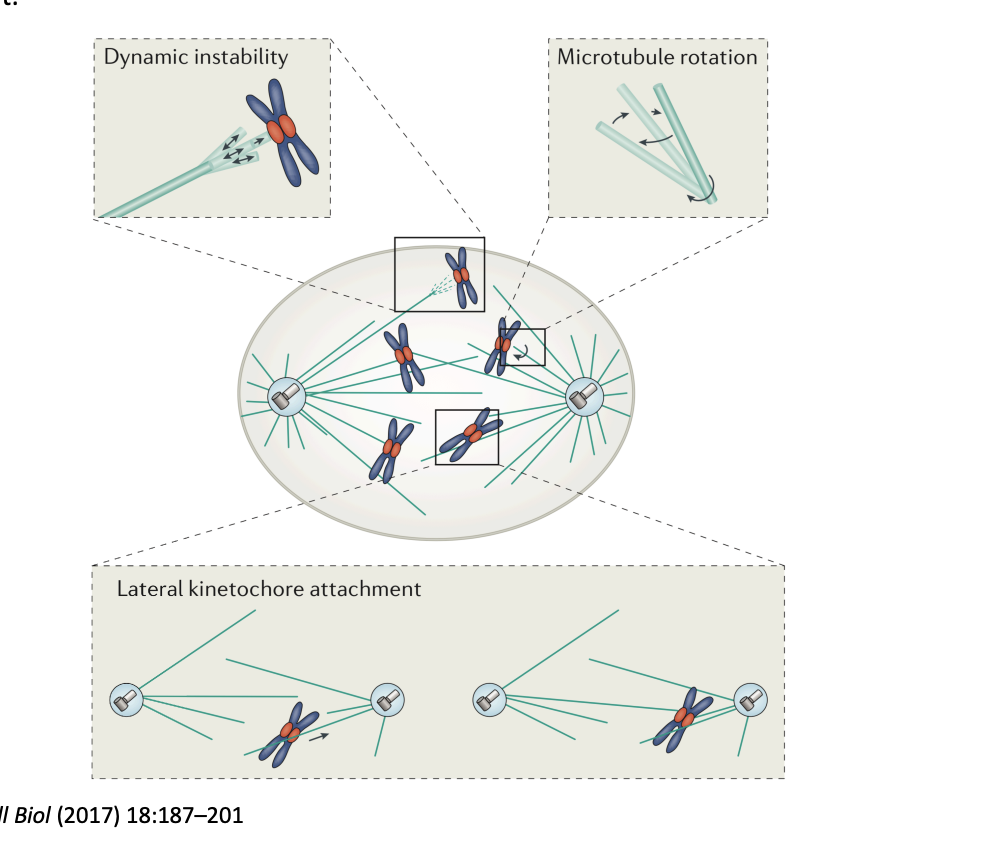
  1. What does dynamic instability allow MTs to do

  • probe the 3D space of the cell

28
New cards

How is this done?

Search and capture

  1. dynamic MT is nucleated by the centrosome

  2. contacts kinetochore

  3. captured

    1. begins by lateral kinetochore- MT attachments

    2. then are converted to end-on attachments

    3. or reorient a kinetochore to favour an end-on attachment

  4. dynamics suppressed

<p><strong>Search and capture</strong></p><ol><li><p>dynamic MT is nucleated by the centrosome</p></li><li><p>contacts kinetochore</p></li><li><p>captured</p><ol><li><p>begins by <strong>lateral</strong> kinetochore- MT attachments </p></li><li><p>then are converted to end-on attachments</p></li><li><p><strong>or</strong> reorient a kinetochore to favour an end-on attachment</p></li></ol></li><li><p>dynamics suppressed</p></li></ol><p></p>
29
New cards

Why is it suggested that additional mechansims are at play?

Mathematical modelling

  • shows that unbiased ‘search and capture’ of kinetochores would significantly exceed the duration of spindle assembly observed in cells

  • THEREFORE: must be additional mechanism at play

30
New cards

What happens in particular?

  • density of MT ends generated by centrosomes (a critical determinant for efficient search and capture)

  • decreases with increasing distance from the poles

31
New cards

What do centrosome-independent pwathway do

  • ultimately promote MT end density near kinetochores

  • form sufficient MTs to permit the assembly of a functional bipolar spindles

    • even in the absence of centrosomes

    • both in vitro and in cells

32
New cards

Centrosome-independent pathways: what demonstrated by

Cell-free systems

  • show how spindles assembly

    • involving chromatin and self-organisation drivenby motors

  • But can also be demonstrated in cell too

33
New cards
  1. Bipolar spindle can assemble without centrosomes: in cell-free system

  1. Bipolar spindle assembly is triggered by DNA-coated beads

  2. convert into chromatin upon addition to xenopus egg extract in absence of centrosomes

What DNA can be used

  • even works with bacterial DNA!

34
New cards

What is required for spindle self-assembly

Motor proteins

35
New cards

How was the role of motor proteins probed

Cell-free systems

  • by determining the impact of specific inhibitors or specific antibody-based depletion

Findings:
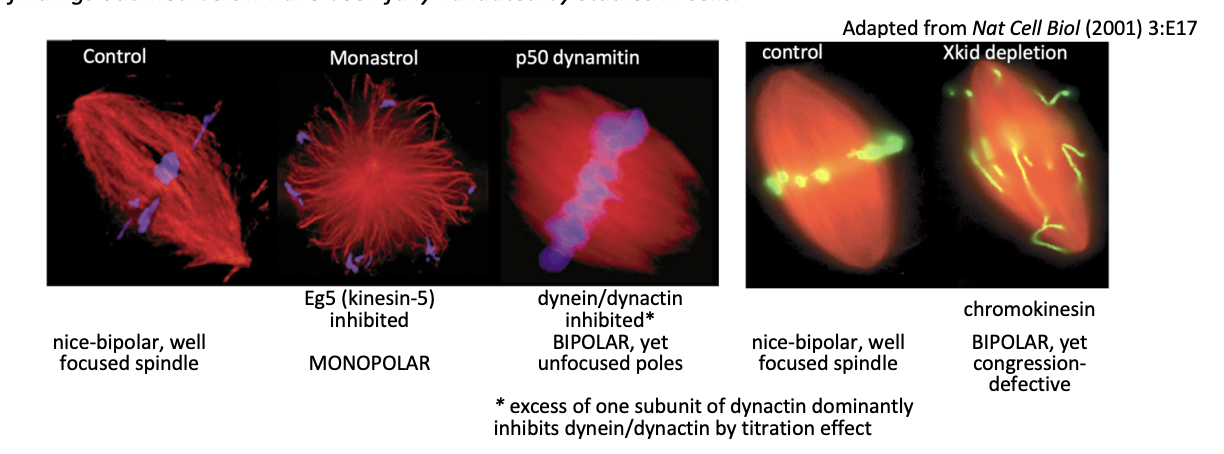
<p>Cell-free systems</p><ul><li><p>by determining the impact of specific inhibitors or specific antibody-based depletion</p></li></ul><p>Findings:</p><p></p>
36
New cards

What Motors are used and what are they used for to help self organise MTs into bipolar arrays

  1. Chromokinesins (Kinesin-4 and 10) for MT nucleated near chromatin

    • Bind chromatin as cargo

    • + end directed

    • push parallel MT (-) ends away on each side on the chromatin mass

    • resolved the initial array around chromatin into 2 half spindles

  2. Kinesin 5

    • bipolar, tetrameric + end-directed

    • crosslinks and slides antiparallel MTs past each other

    • organising the two halves into bipolar spindle

    • supports the MT overlap at the mid-zone

  3. Dynein

    • Multimeric(-) end directed

    • moves along parallel MTs

    • focuses the poles by bringing (-) ends close together

note: picture→ black arrows indicate the direction of movement of an MT

  • other arrows mark the direction of motor movement
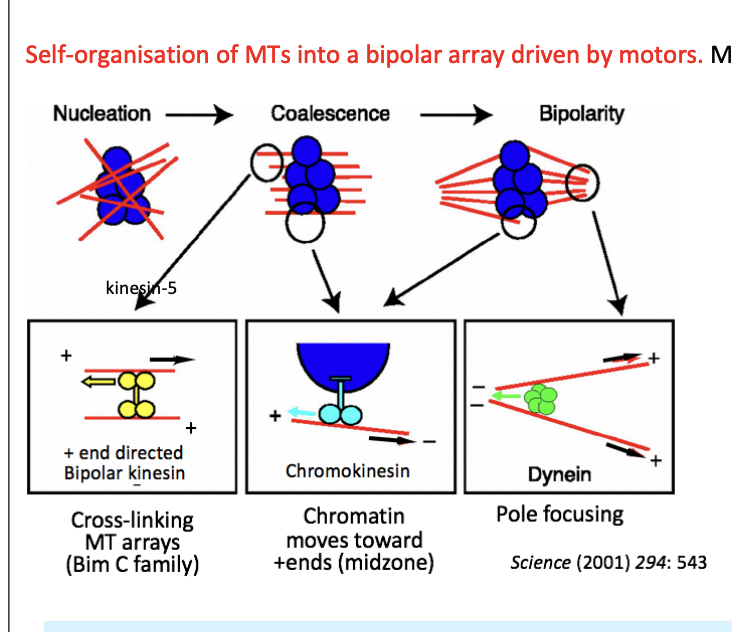
<ol><li><p>Chromokinesins <strong>(Kinesin-4 and 10) for MT nucleated near chromatin</strong></p><ul><li><p>Bind chromatin as cargo </p></li><li><p>+ end directed</p></li><li><p>push parallel MT (-) ends away on each side on the chromatin mass</p></li><li><p>resolved the initial array around chromatin into 2 half spindles</p></li></ul></li><li><p><strong>Kinesin 5</strong></p><ul><li><p>bipolar, tetrameric + end-directed</p></li><li><p>crosslinks and slides antiparallel MTs past each other</p></li><li><p>organising the two halves into bipolar spindle</p></li><li><p>supports the MT overlap at the mid-zone</p></li></ul></li><li><p><strong>Dynein</strong></p><ul><li><p>Multimeric(-) end directed</p></li><li><p>moves along parallel MTs </p></li><li><p>focuses the poles by bringing (-) ends close together</p></li></ul></li></ol><p><em>note: picture→ black arrows indicate the direction of movement of an MT</em></p><ul><li><p><em>other arrows mark the direction of motor movement</em></p></li></ul><p></p>
37
New cards

Centrosome-independent spindle assembly relies on what

  • alternative pathways for MT nucleation

  • the key molecular players and sites have been identified

  • They also require gamma-TURCs for their function

38
New cards

Molecular basis for centrosome-independent pathways: three pathways

  1. Chromatin-dependent nucleation of MTs

  2. MT-dependent nucleation

  3. MT nucleation near kinetochores

39
New cards
  1. Chromatin-dependent nucleation of MTs

  1. RanGEF RCC1 binds to chromatin while the Ran GAP is in the cytoplasm

  2. Creates a gradient of Ran GTP near chromatin

  3. Ran GTP causes the release of TPX2 from importins (see michaelmas stuff)

  4. Free TPX2 promotes MT nucleation (via- gamm-TuRCs) and stabilty

  5. Favours polymerisation around chromatin
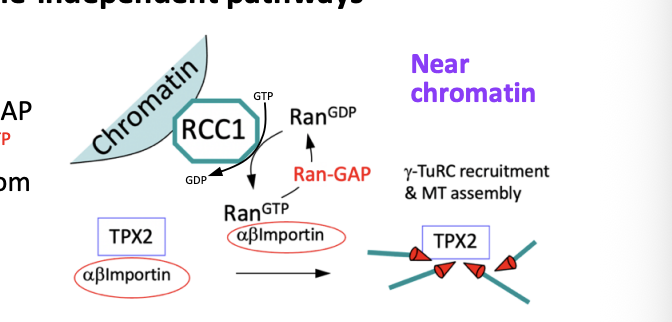
<ol><li><p>RanGEF RCC1 binds to chromatin while the Ran GAP is in the cytoplasm</p></li><li><p>Creates a gradient of Ran GTP near chromatin</p></li><li><p>Ran GTP causes the release of TPX2 from importins (see michaelmas stuff)</p></li><li><p>Free TPX2 promotes MT nucleation (via- gamm-TuRCs) and stabilty</p></li><li><p>Favours polymerisation around chromatin</p></li></ol><p></p>
40
New cards
  1. MT-dependent nucleation

  1. Octameric Augmin Complex also recruits gamma-TuRCs to the side of a pre-existing MT

  2. nucleating a new MT (MT branching)

  3. This contributes to MT amplification

  4. new MTs are transported along pre-existing MTs to join the spindle
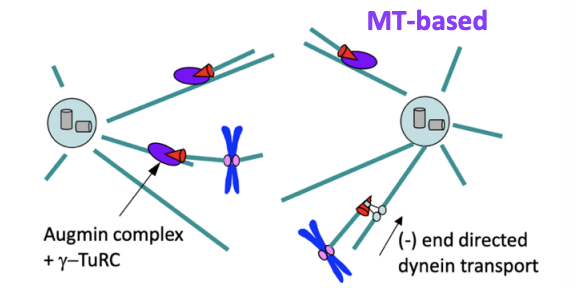
<ol><li><p><strong>Octameric Augmin Complex</strong> also recruits gamma-TuRCs to the side of a pre-existing MT</p></li><li><p>nucleating a new MT (MT branching)</p></li><li><p>This contributes to MT amplification </p></li><li><p>new MTs are transported along pre-existing MTs to join the spindle</p></li></ol><p></p>
41
New cards
  1. MT nucleation near kinetochores

  • may be another mechanism for initiating kinetochore capture

  • through non-centrosomal MTs that join the spindle ensemble via dynein-mediated transport or interactions with other cross linkers
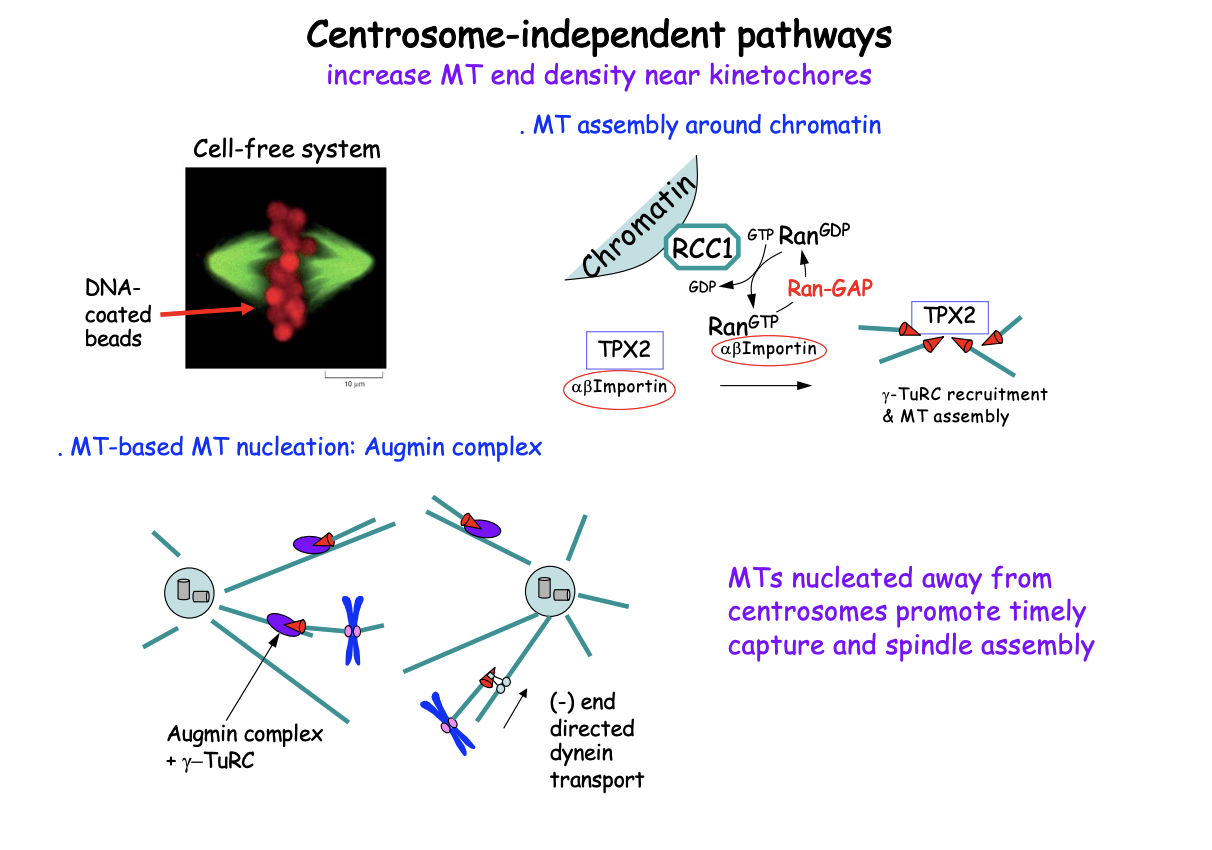
<ul><li><p>may be another mechanism for initiating kinetochore capture</p></li><li><p>through non-centrosomal MTs that join the spindle ensemble via dynein-mediated transport or interactions with other cross linkers</p></li></ul><p></p>
42
New cards

Bipolarity at metaphase: overall what sets the length of the metaphase spindle (pole-pole distance)

  • balance of pulling and pushing forces

  • leads to dynamic alignment of chromosomes held under tension at the metaphase plate

43
New cards

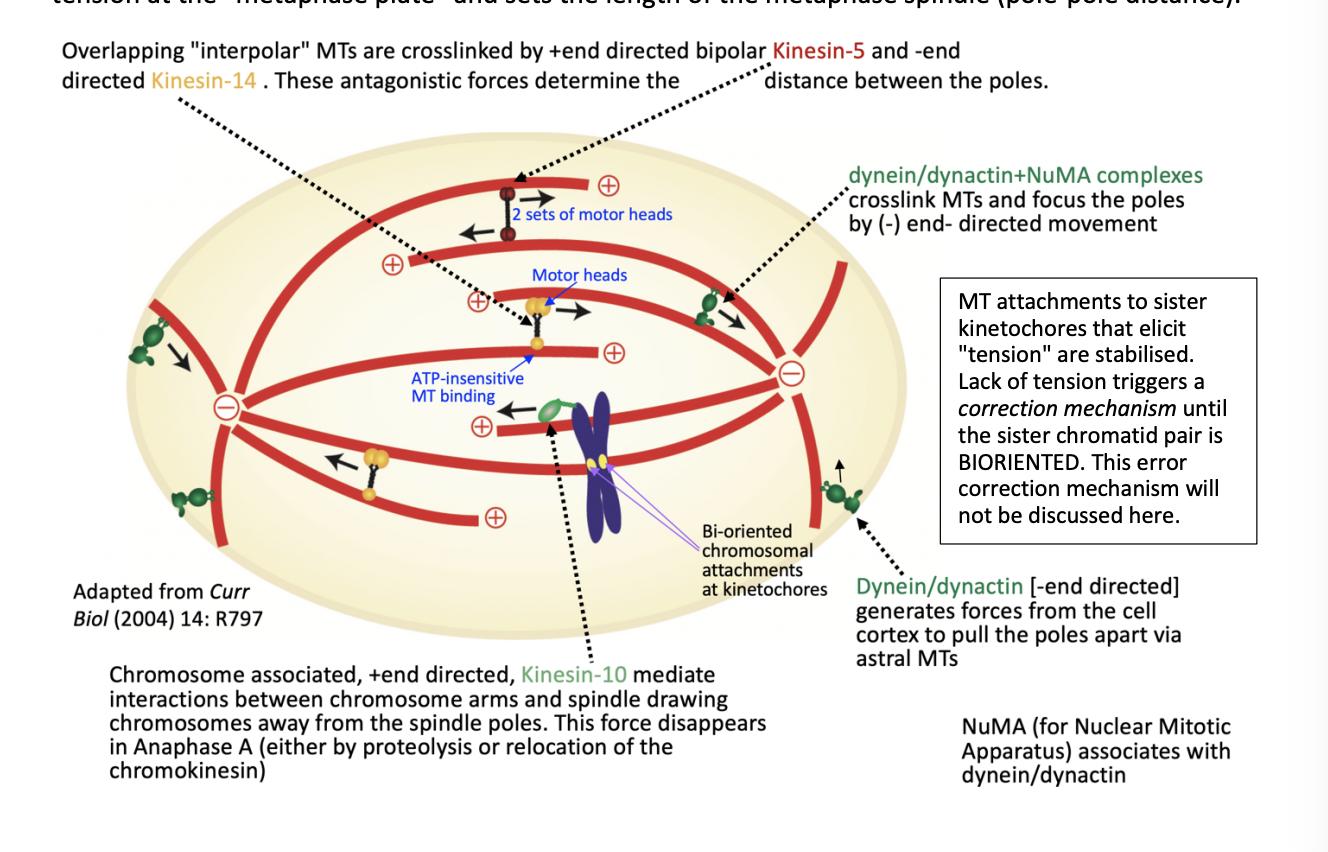
Balance of pushing and pulling: kinesins and dyneins

  1. Overlapping ‘interpolar’ MTs are cross linked by

    • + end directed kinesin 5

    • - end directed kinesin-14

      • antagonistic forces determine distance between the poles

  2. dynein/dynactin +NuMA complexes

    • crosslink MTs and focus the poles by (-) end directed movement

  3. Forces from cell cortex to pull the poles apart via astral MTs

    • Dynein/dynactin

      • - end directed

      • generates forces from cell

  4. Draw chromosomes away from the spindle poles

    • Chromosome associated + end directed kinesin-10

    • interactions between chromosome arms and spindle

    • This force disappears in Anaphase A

    • Due to:

      • proteolysis

      • relocation of the chromokinesin

<ol><li><p>Overlapping ‘interpolar’ MTs are cross linked by</p><ul><li><p>+ end directed <strong>kinesin 5</strong></p></li><li><p>- end directed <strong>kinesin-14</strong></p><ul><li><p>antagonistic forces determine distance between the poles</p></li></ul></li></ul></li><li><p><strong>dynein/dynactin +NuMA complexes</strong></p><ul><li><p>crosslink MTs and focus the poles by (-) end directed movement</p></li></ul></li><li><p>Forces from cell cortex to pull the poles apart via astral MTs</p><ul><li><p><strong>Dynein/dynactin</strong></p><ul><li><p>- end directed</p></li><li><p>generates forces from cell </p></li></ul></li></ul></li><li><p>Draw chromosomes away from the spindle poles</p><ul><li><p>Chromosome associated + end directed <strong>kinesin-10</strong></p></li><li><p>interactions between chromosome arms and spindle</p></li><li><p><strong>This force disappears in Anaphase A</strong></p></li><li><p><strong>Due to:</strong></p><ul><li><p>proteolysis</p></li><li><p>relocation of the chromokinesin</p></li></ul></li></ul></li></ol><p></p>
44
New cards

What are NuMA

Nuclear mitotic Apparatus

  • associates with dynein/dynactin

45
New cards

Error correction mechansism

  • MT attachments to sister kinetochores that elicit tension are stabilised

  • lack of tension triggers a correction mechanism until the sister chromatid pair is BIORIENTED

46
New cards

Dynamic MTs at the metaphase spindle: even though MTs are stabilised in a spindle, the MTs are actaully…

  • Under continuous treadmilling

  • POLEWARD FLUX:

    • addition at the (+) ends (near spindle equator

    • is balanced by

    • Tubulin loss at (-) ends near the centrosomes

47
New cards

Evidence for poleward flux using what

Flouresencet Speckles Microscopy

  • FSM

48
New cards

How FSM shows Poleward flux: Xenopus extract spindle

  • Low density of Rhodamine-labelled tubulin

  • generates speckles that can be followed as fiduciary marks

First (left)

  • Whole spindle pictures

Kymograph (Right)

  • series of strips from the centre of spindle taken at 10s intervals

  • displayed side by side

  • diagonal streaks represent individual speckles moving towards the pole as a result of flux

  • Slope of the line→ reflects flux veolcity
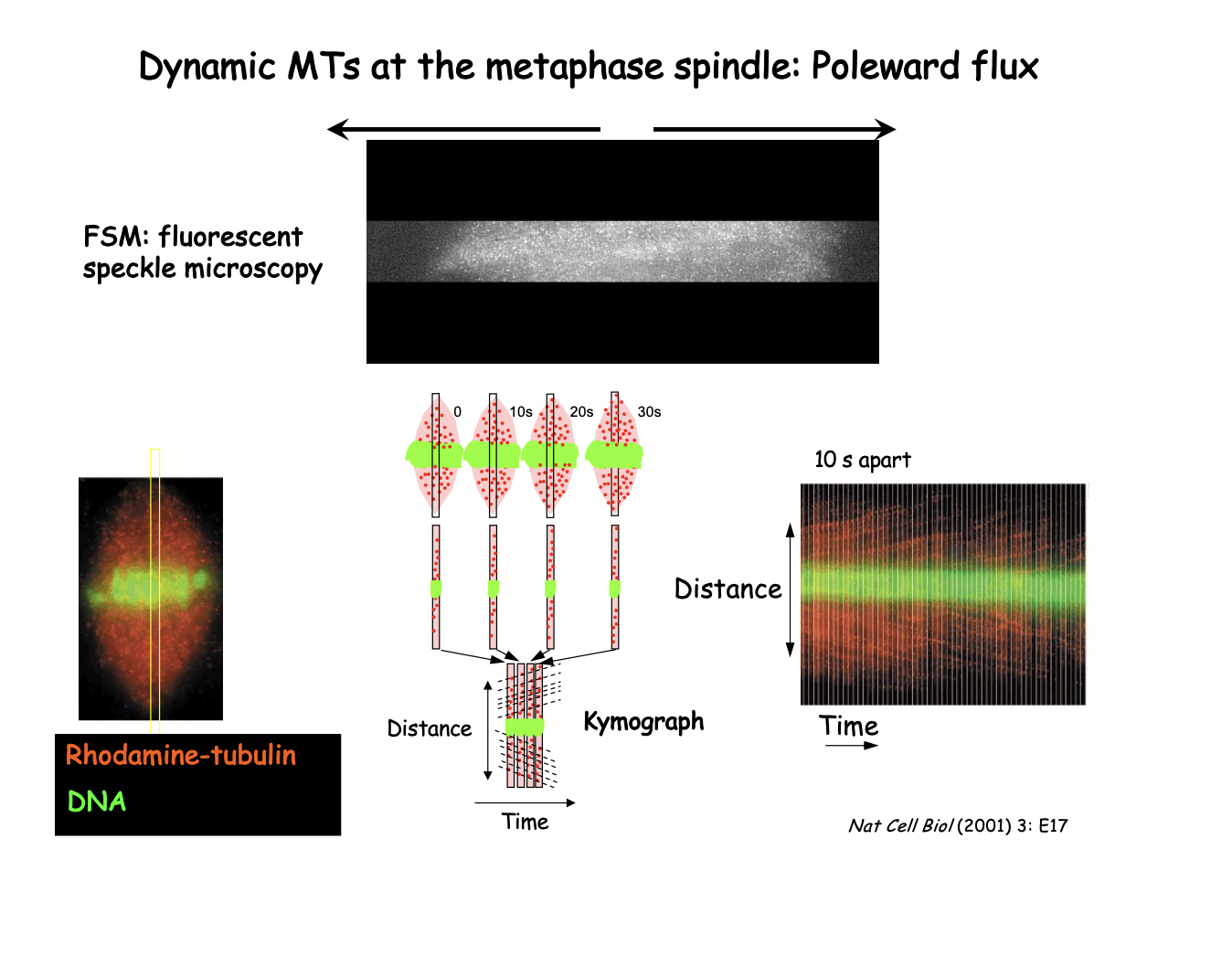
<ul><li><p>Low density of Rhodamine-labelled tubulin</p></li><li><p>generates speckles that can be followed as fiduciary marks</p></li></ul><p>First (left)</p><ul><li><p>Whole spindle pictures</p></li></ul><p><strong>Kymograph</strong> (Right)</p><ul><li><p>series of strips from the <strong>centre </strong>of spindle taken at 10s intervals</p></li><li><p>displayed side by side</p></li><li><p>diagonal streaks represent individual speckles moving towards the pole as a result of flux</p></li><li><p>Slope of the line→<strong> reflects flux veolcity</strong></p></li></ul><p></p>
49
New cards

Assembly of bipolar mitotic spindle key concepts
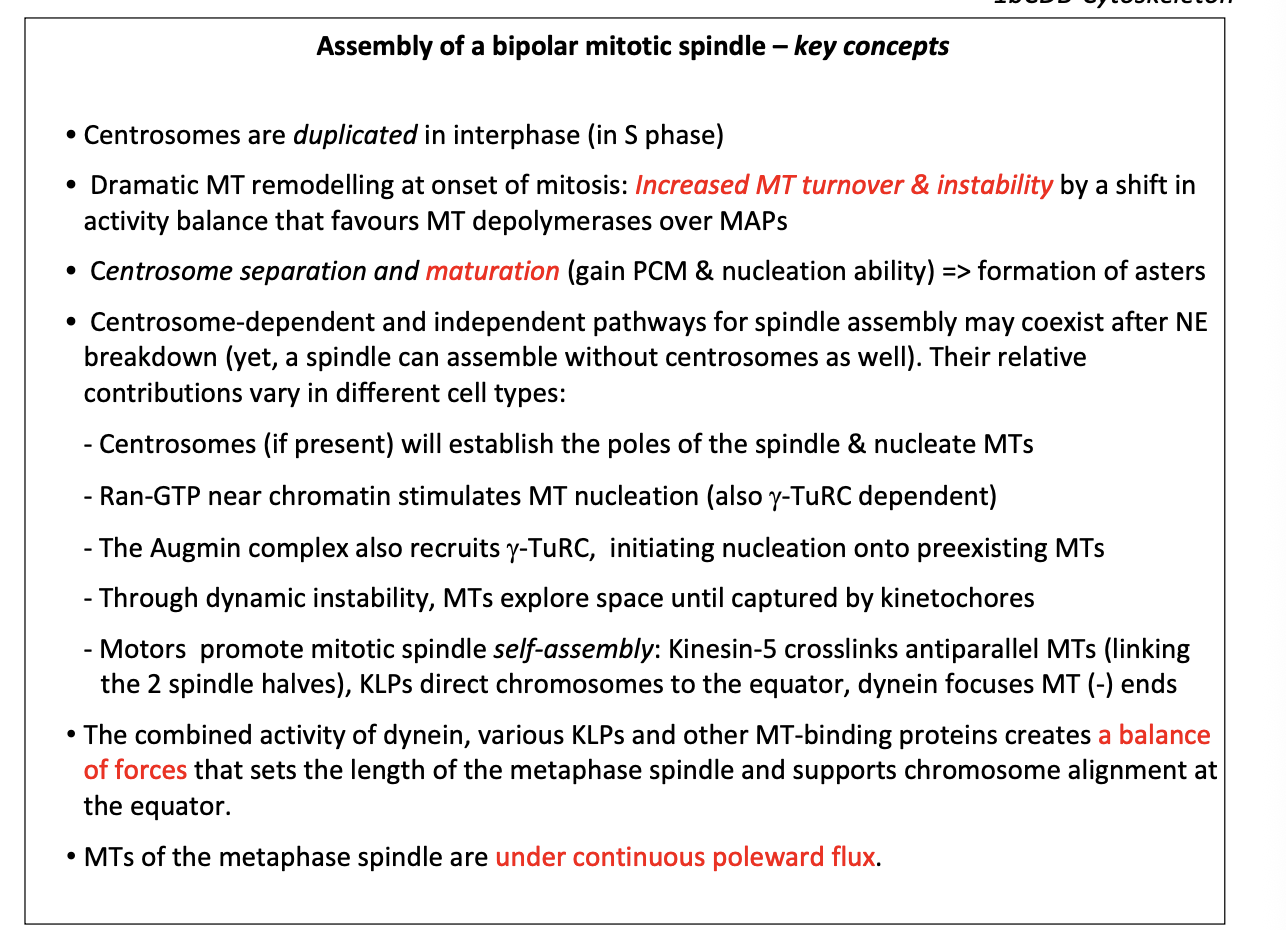
knowt flashcard image
50
New cards
51
New cards

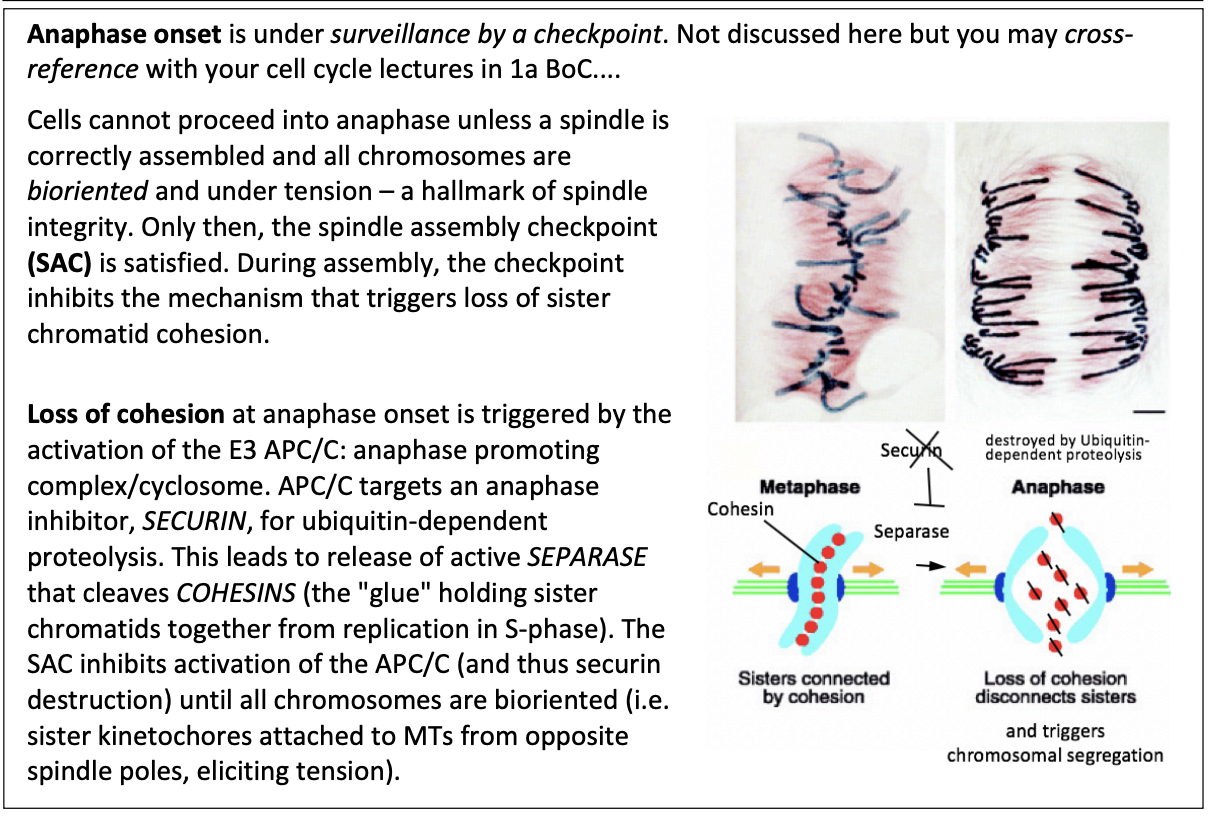
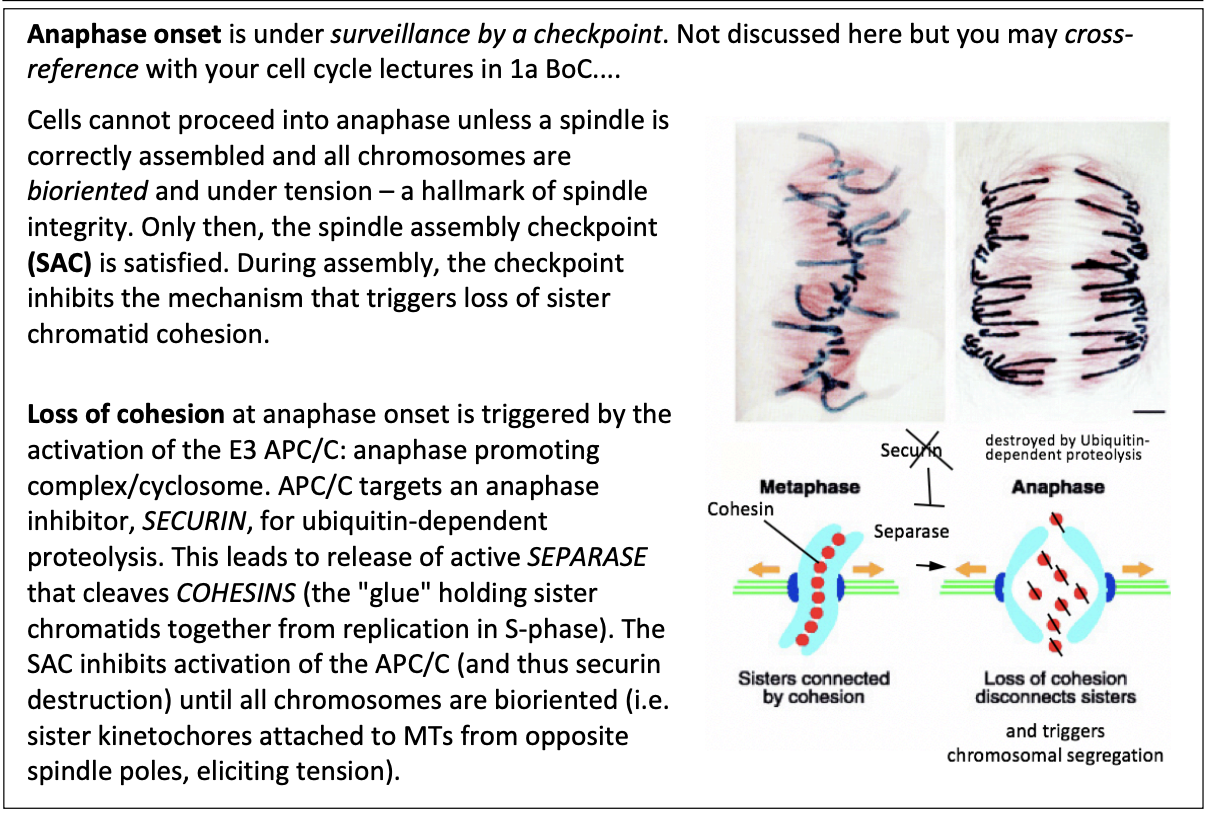
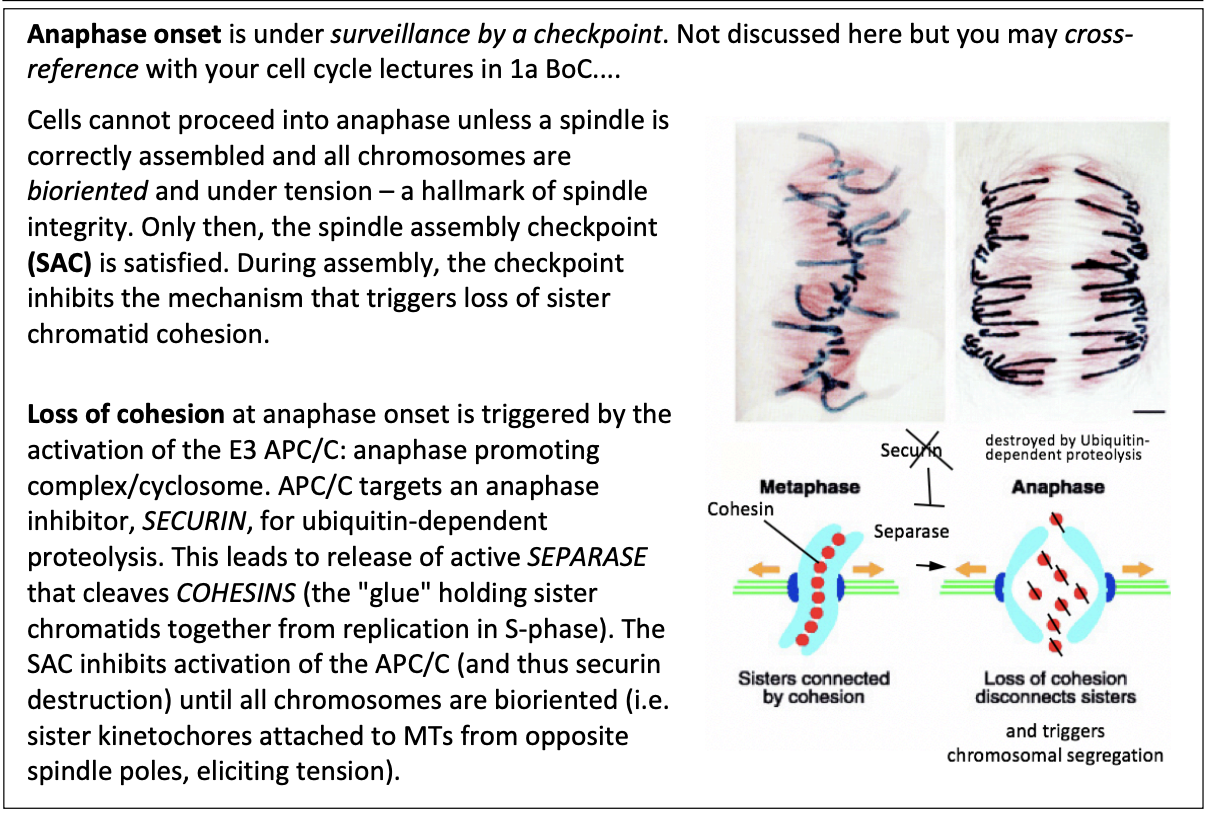
Anaphase onset is under surveillance by

a checkpoint→ Spindle Assembly Checkpoint

  • see 1a BoC notes

<p>a checkpoint→ <strong>Spindle Assembly Checkpoint</strong></p><ul><li><p>see 1a BoC notes</p></li></ul><p></p>
52
New cards

Cell cannot proceed into anaphase unless…

  • spindle is correctly assembled

  • all chromosomes are bioriented under tension

    • hallmark of spindle integrity

If this is done then…

  • spindle assembly checkpoint (SAC) is satisfied
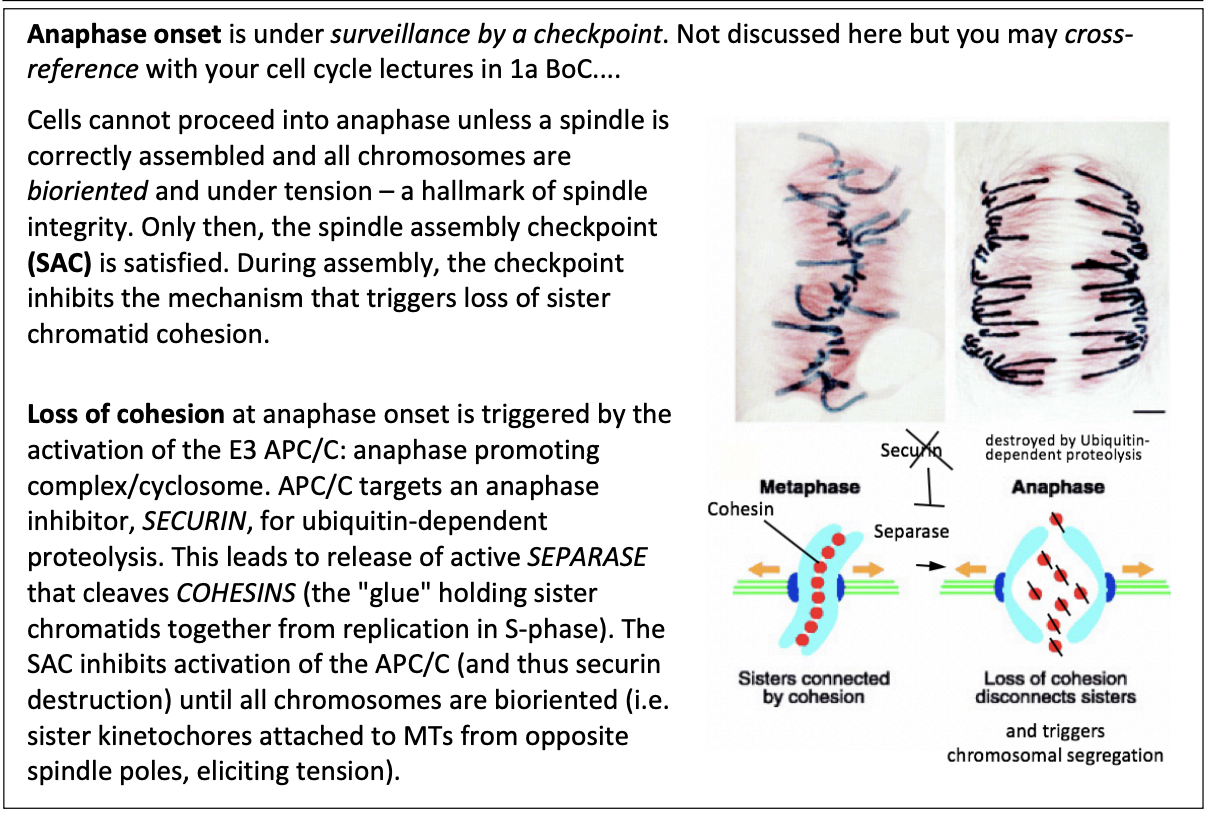
<ul><li><p>spindle is correctly assembled </p></li><li><p>all chromosomes are <strong>bioriented</strong> under tension</p><ul><li><p>hallmark of spindle integrity</p></li></ul></li></ul><p>If this is done then…</p><ul><li><p>spindle assembly checkpoint (SAC) is satisfied</p></li></ul><p></p>
53
New cards

During assembly, the checkpoint inhibbits…

  • the mechanism that triggers loss of sister chromatid cohesion
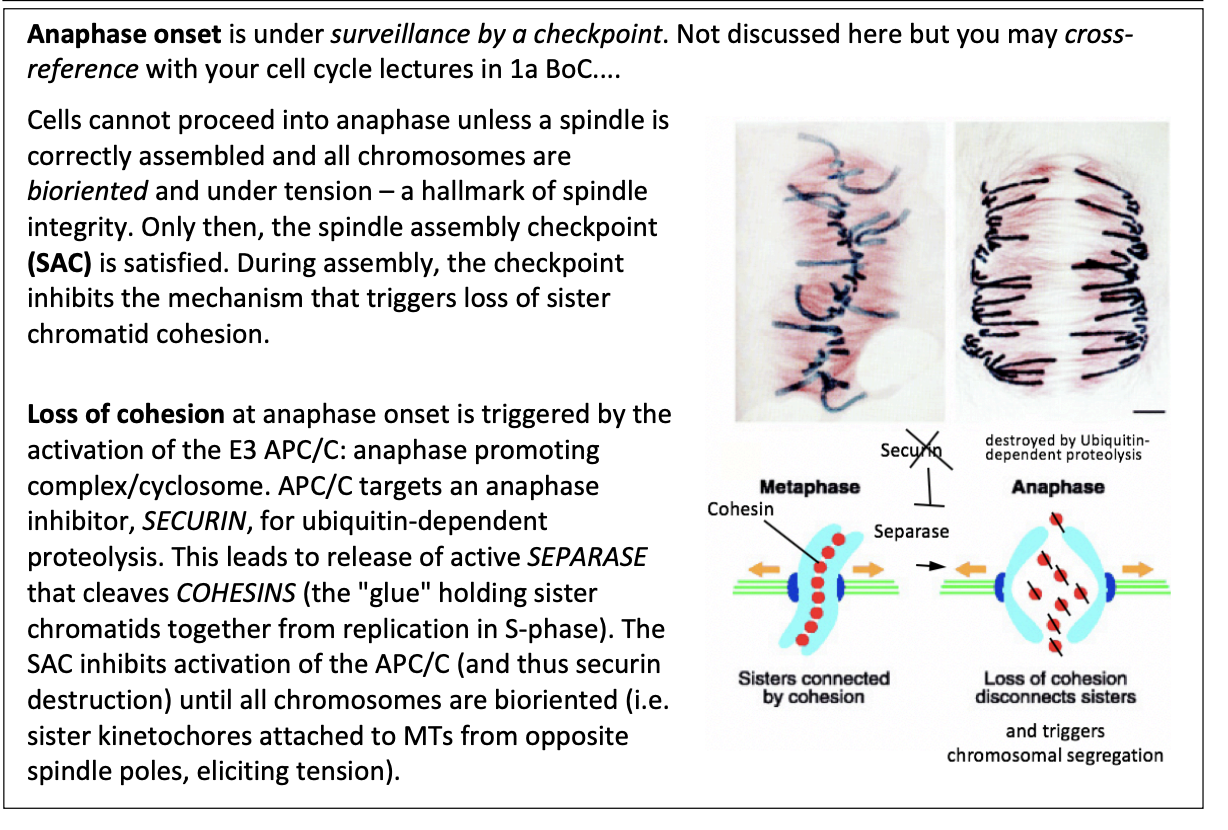
<ul><li><p>the mechanism that triggers loss of sister chromatid cohesion</p></li></ul><p></p>
54
New cards

This loss of cohesion is triggered by what

Activation of E3 APC/C

  • anaphase promoting complex/cyclosome

<p><strong>Activation of E3 APC/C</strong></p><ul><li><p>anaphase promoting complex/cyclosome</p></li></ul><p></p>
55
New cards

How does this work?

  1. APC/C targets an anaphase inhibitor SECURIN for ubiquitin-dependent proteolysis

  2. leads to release of active SEPARASE

  3. cleaves COHESINS (the glue holding sister chromatids together from repication in S phase)
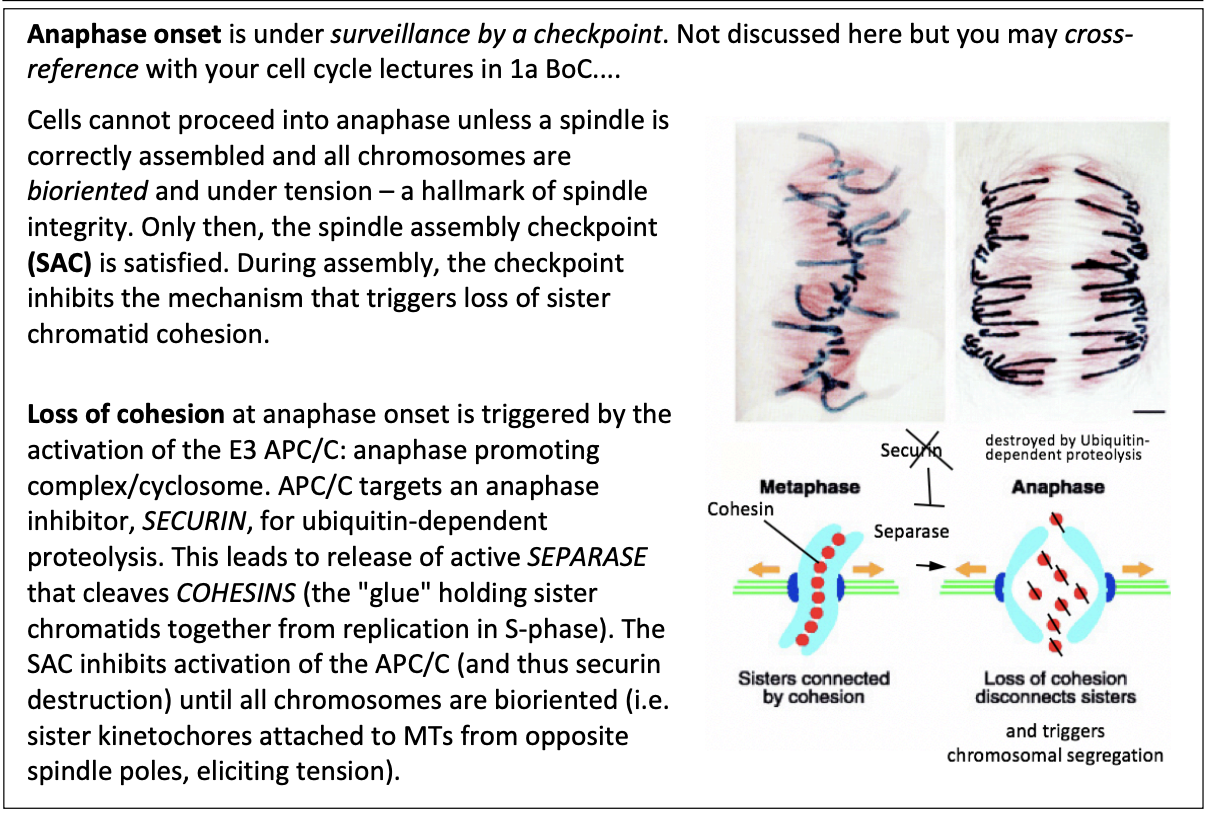
<ol><li><p>APC/C targets an anaphase inhibitor <strong>SECURIN</strong> for ubiquitin-dependent proteolysis</p></li><li><p>leads to release of active SEPARASE </p></li><li><p>cleaves COHESINS (the glue holding sister chromatids together from repication in S phase)</p></li></ol><p></p>
56
New cards

What does SAC do then?

  1. Inhibits activation of APC/C

  2. thus securin destruction inhibited

  3. until all chromosomes are bioriented

    • sister kinetochores attached to MTs from oppsoite spindle poles

    • eliciting tension

<ol><li><p>Inhibits activation of APC/C</p></li><li><p>thus securin destruction inhibited</p></li><li><p>until all chromosomes are bioriented </p><ul><li><p>sister kinetochores attached to MTs from oppsoite spindle poles</p></li><li><p>eliciting tension</p></li></ul></li></ol><p></p>
57
New cards

Anaphase: What is anaphase A

Initial period of anaphase in which chromosomes move toward the respective poles along a spindle of constant length:

  1. kMTs shorten

  2. kinetochore acting like a ‘pacman’ at the + end

  3. while MT poleward flux continues

  4. result: chromosomes move toward the poles

  5. while pole-to-pole distance remains constant
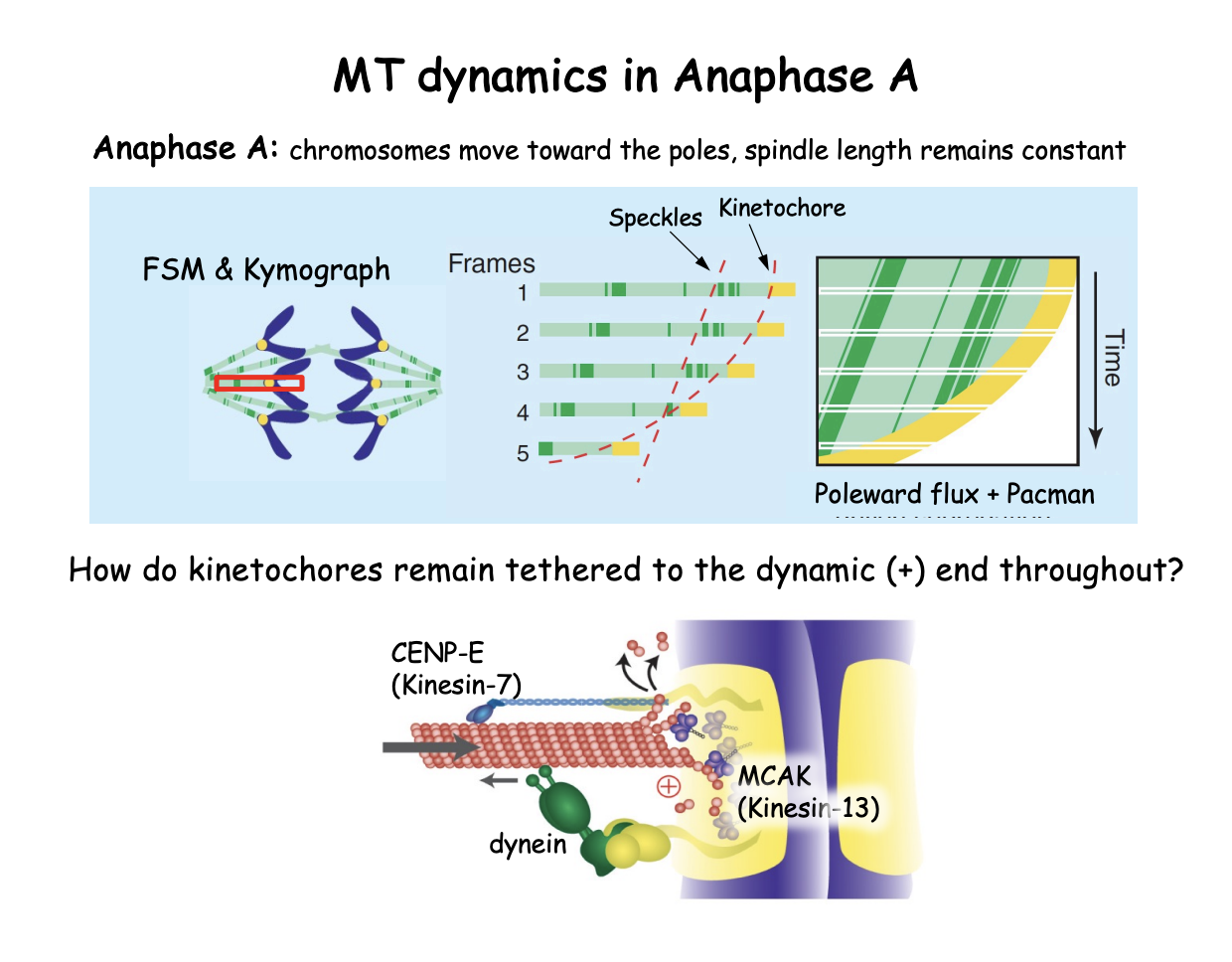
<p>Initial period of anaphase in which chromosomes move toward the respective poles along a spindle of <strong>constant length:</strong></p><ol><li><p>kMTs shorten</p></li><li><p>kinetochore acting like a ‘pacman’ at the + end </p></li><li><p>while MT poleward flux continues</p></li><li><p>result: chromosomes move toward the poles</p></li><li><p>while pole-to-pole distance remains constant</p></li></ol><p></p>
58
New cards

FSM followingg 2 fluorescnet items reveals the underlying MT dynamics of this:

  1. Lines of constant slope→ reflecting the flux of MT subunits

  2. kMTs also shorten over time accelerating the kinetochore mark that overtakes MT speckles

    • SHOWS: + end ‘pacman’ style depolaymerisation of kMTs overlapping with poleward flux
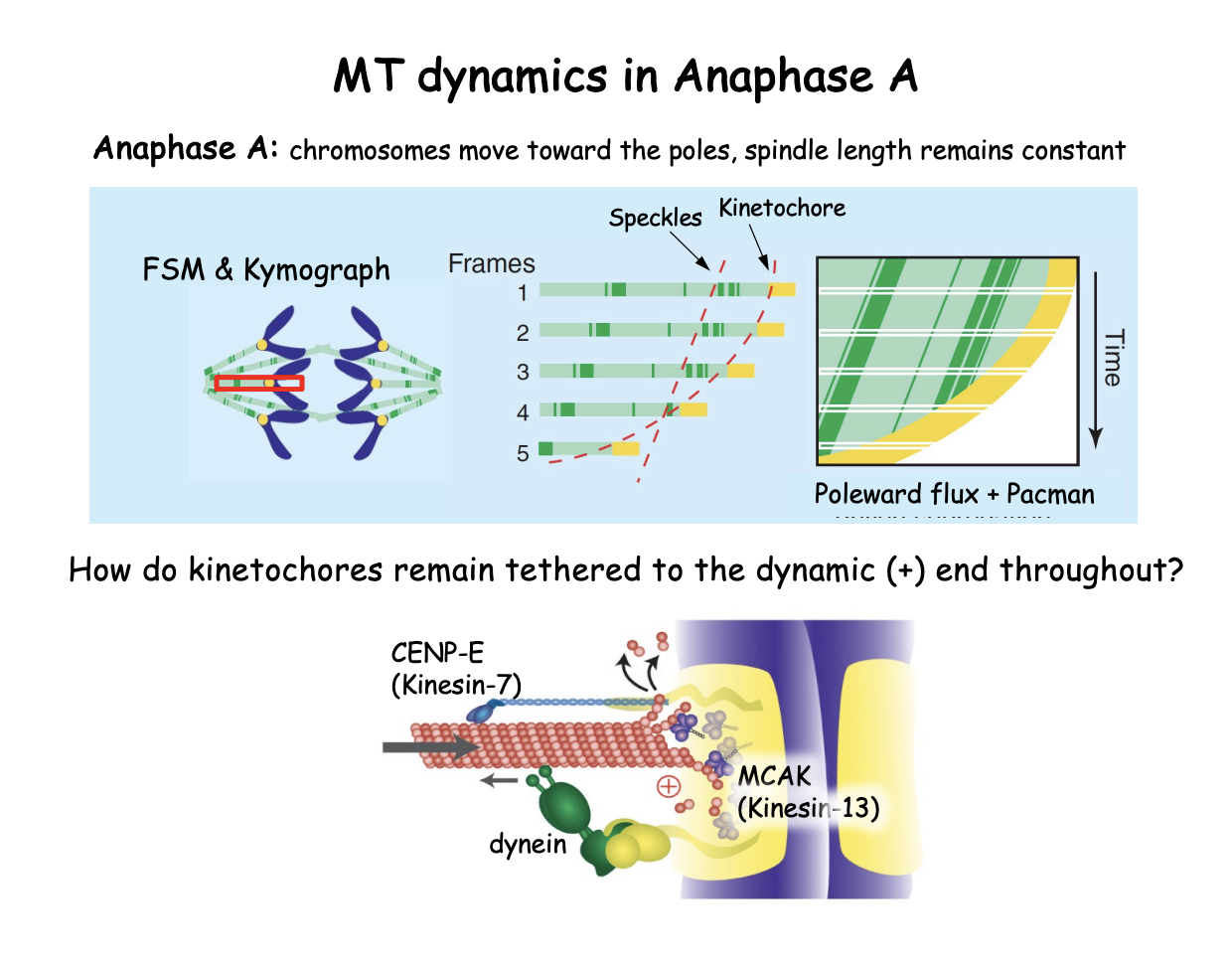
<ol><li><p>Lines of constant slope→ reflecting the flux of MT subunits</p></li><li><p>kMTs also shorten over time accelerating the kinetochore mark that overtakes MT speckles</p><ul><li><p>SHOWS: + end ‘pacman’ style depolaymerisation of kMTs overlapping with poleward flux</p></li></ul></li></ol><p></p>
59
New cards

What has also been proposed about how kMTs move towards poles

  • chromosomes attachmed to short k-MTs may also move toward the poles by synein-drievn transport

    • short kMT as cargo

60
New cards

Evidence of this: Laser ablation

  • Exp: Laswer ablation to cut spindle MTs

  • RESULT: severed MTs linnked to chromosomes are delivered to the pole by dynein walking along an intact MT

61
New cards

Remaining questions to answer

  1. How does MT depolymerization at the kinetochore end (+end) drive chromosome movement?

  2. How are kinetochores retained despite MT shrinnkage?
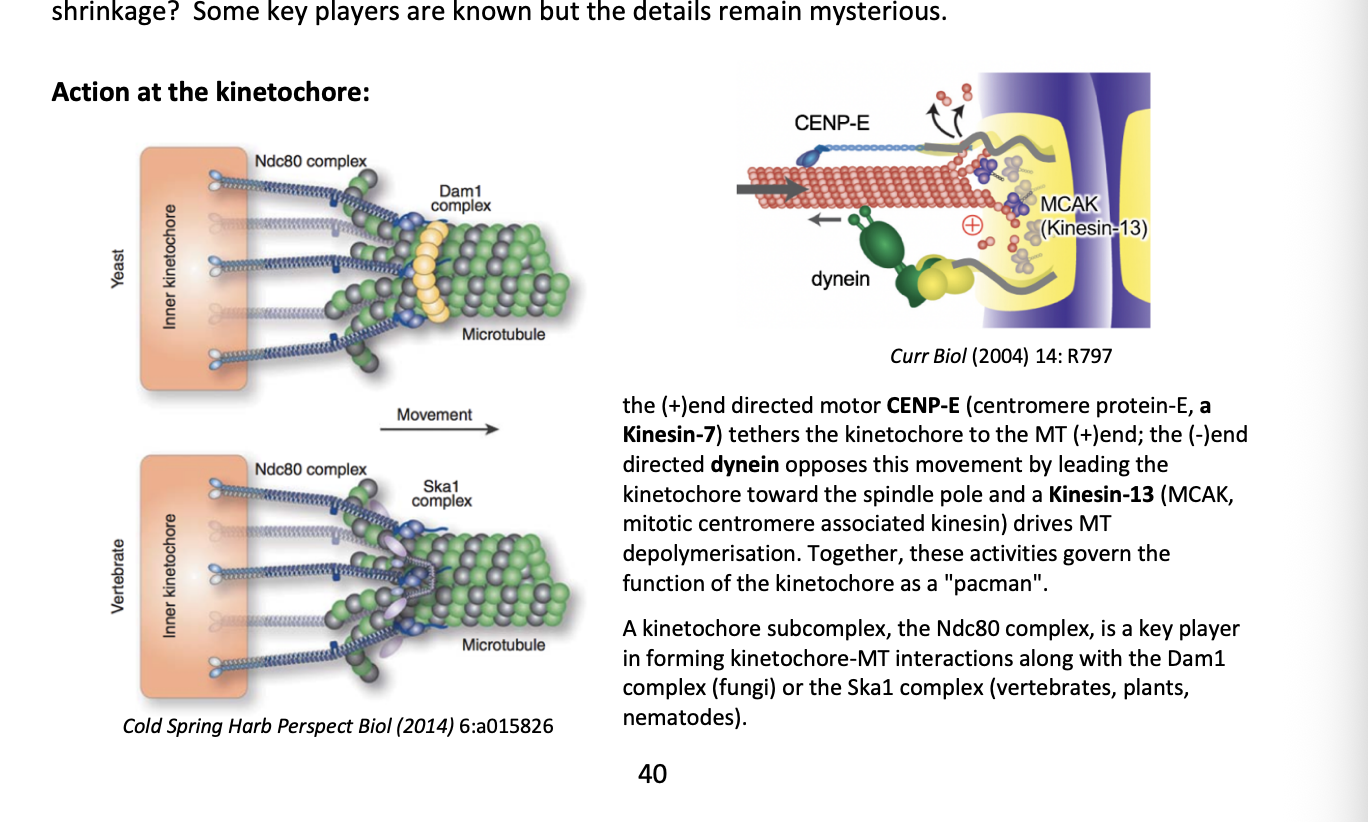
<ol><li><p>How does MT depolymerization at the kinetochore end (+end) drive chromosome movement?</p></li><li><p>How are kinetochores retained despite MT shrinnkage?</p></li></ol><p></p>
62
New cards

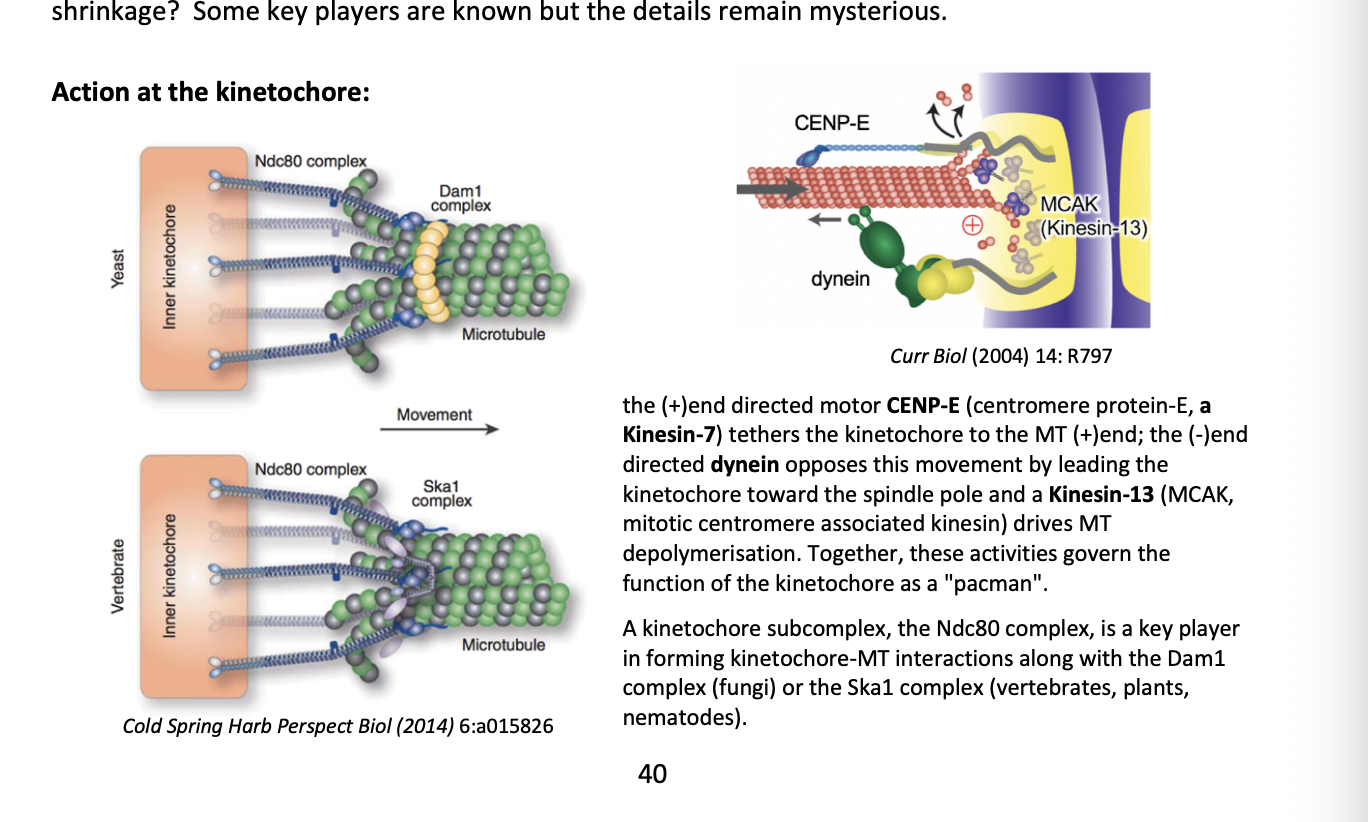
What govens the function of the kinetochores as a ‘pacman’

  1. + end directed motor CENP-E

    • (centromere protein E, a Kinesin-7)

    • tethers the kinetochore to the MT (+) end

  2. - end directed dynein

    • opposes this movement by leading the kinetochore toward the spindle pole

  3. Kinesin-13 (MCAK→ mitotic centromere associated kinesin)

    • drives MT depolymersation

<ol><li><p>+ end directed motor <strong>CENP-E</strong></p><ul><li><p>(centromere protein E, <strong>a Kinesin-7</strong>)</p></li><li><p>tethers the kinetochore to the MT (+) end</p></li></ul></li><li><p>- end directed <strong>dynein</strong> </p><ul><li><p>opposes this movement by leading the kinetochore toward the spindle pole</p></li></ul></li><li><p><strong>Kinesin-13</strong> (MCAK→ mitotic centromere associated kinesin)</p><ul><li><p>drives MT depolymersation</p></li></ul></li></ol><p></p>
63
New cards

What is the Ndc80 complex

  • Kinetochore subcomplex

  • key player in forming kinetochore-MT interactions along

    • the Dam1 complex (fungi)

    • or

    • Ska1 complex (vertebrates, plants, nematodes)
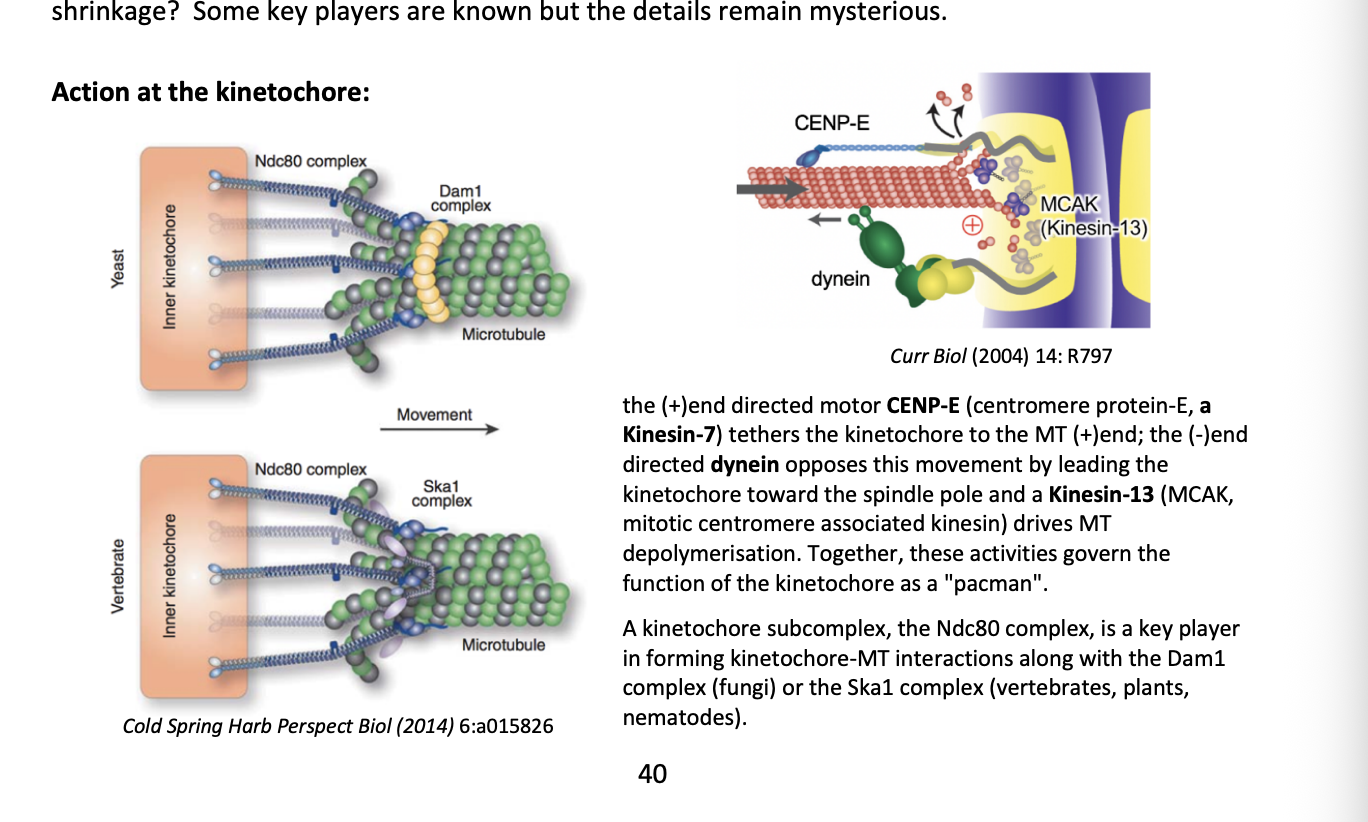
<ul><li><p>Kinetochore subcomplex</p></li><li><p>key player in forming kinetochore-MT interactions along </p><ul><li><p>the Dam1 complex (fungi)</p></li><li><p>or</p></li><li><p>Ska1 complex (vertebrates, plants, nematodes)</p></li></ul></li></ul><p></p>
64
New cards

Anaphase B: what happens

  1. spindle poles move further apart along with clustered chromosomes

    • pushed by bipolar (+) end directed Kinesin-5

      • causes the sliding of antiparallel MTs at the overlap zone

  2. Dynein (-end directed motor)

    • anchored at the cell cortex helps to pull the poles apart

  3. Integrity of the spindle midzone depends on additional MAPs
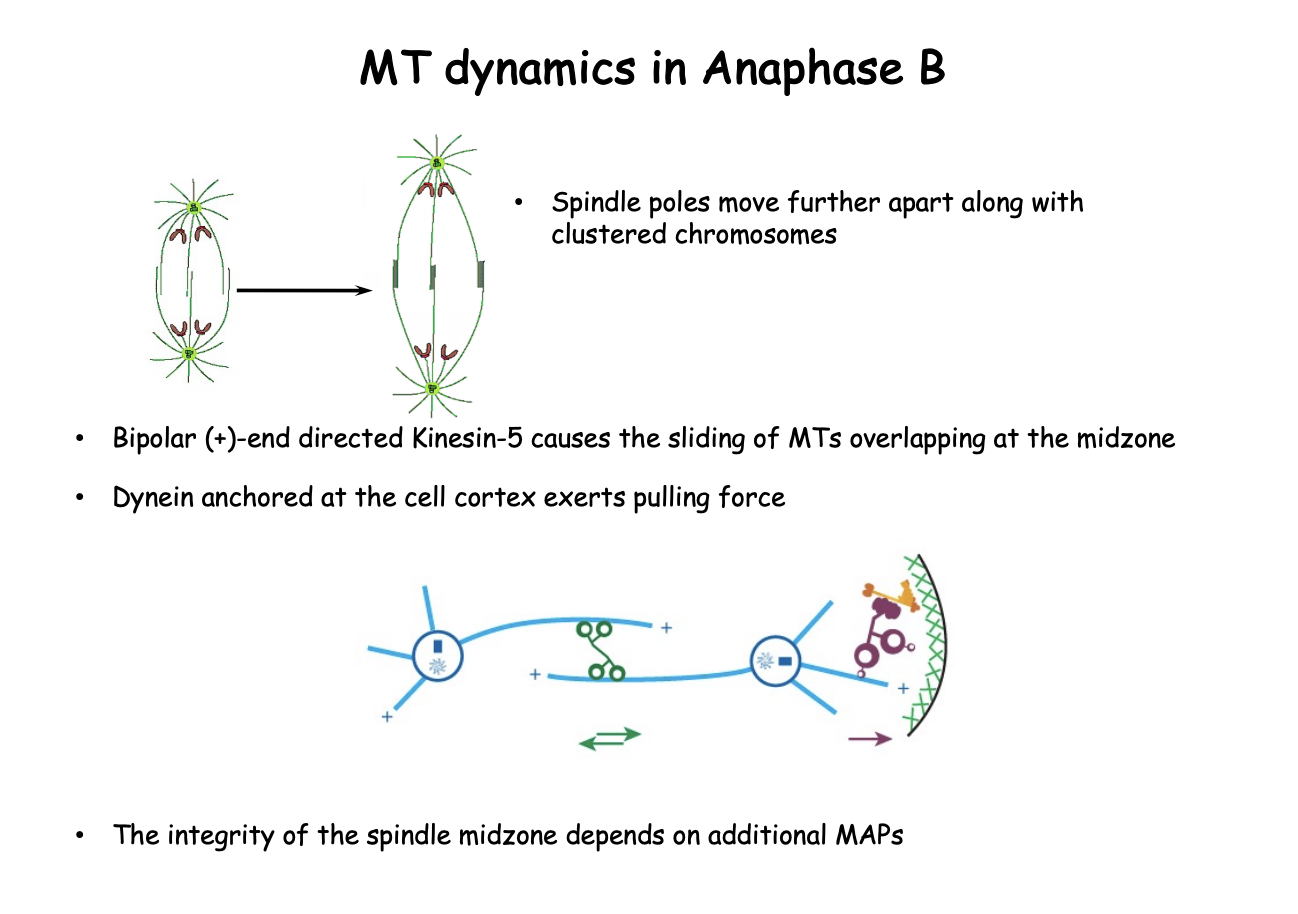
<ol><li><p>spindle poles move further apart along with clustered chromosomes</p><ul><li><p> pushed by bipolar (+) end directed <strong>Kinesin-5</strong></p><ul><li><p>causes the sliding of antiparallel MTs at the overlap zone</p></li></ul></li></ul></li><li><p><strong>Dynein</strong> (-end directed motor)</p><ul><li><p>anchored at the cell cortex helps to pull the poles apart</p></li></ul><p></p></li><li><p>Integrity of the spindle midzone depends on additional MAPs</p><p></p></li></ol><p></p>
65
New cards

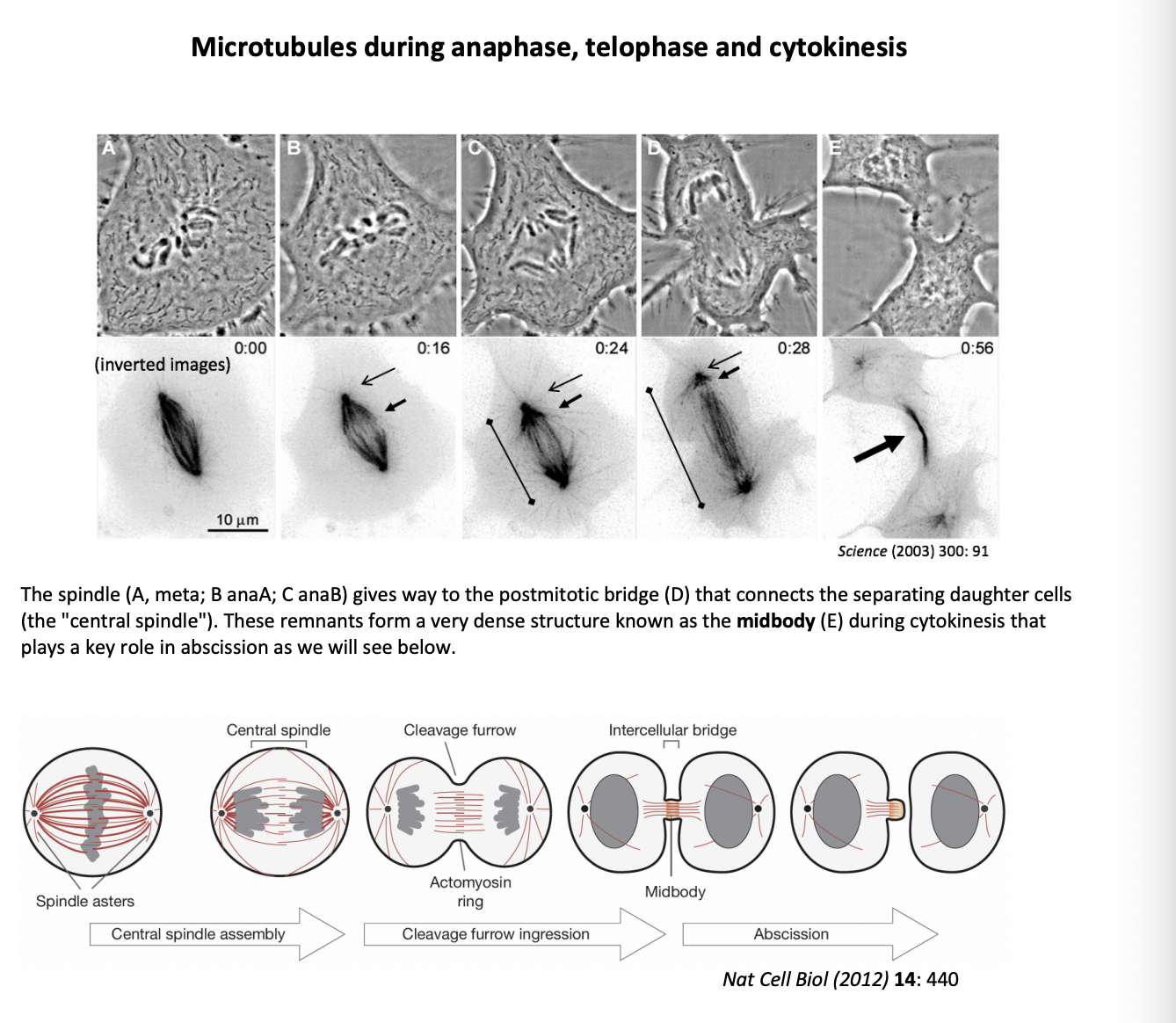
Mictrotubules during anaphase, telophase and cytokinesis

  • the spindle gives way to a postmitotic bridge (D)

  • connects the separating daughter cells (central spindle)

  • these remnants form a very dense structure→ midbody during cytokinesis

  • plays a key role in abscission

<ul><li><p>the spindle gives way to a postmitotic bridge (D)</p></li><li><p>connects the separating daughter cells (central spindle)</p></li><li><p>these remnants form a very dense structure→ <strong>midbody</strong> during cytokinesis</p></li><li><p>plays a key role in abscission </p></li></ul><p></p>
66
New cards

Mitotic spindle dynamics key concepts
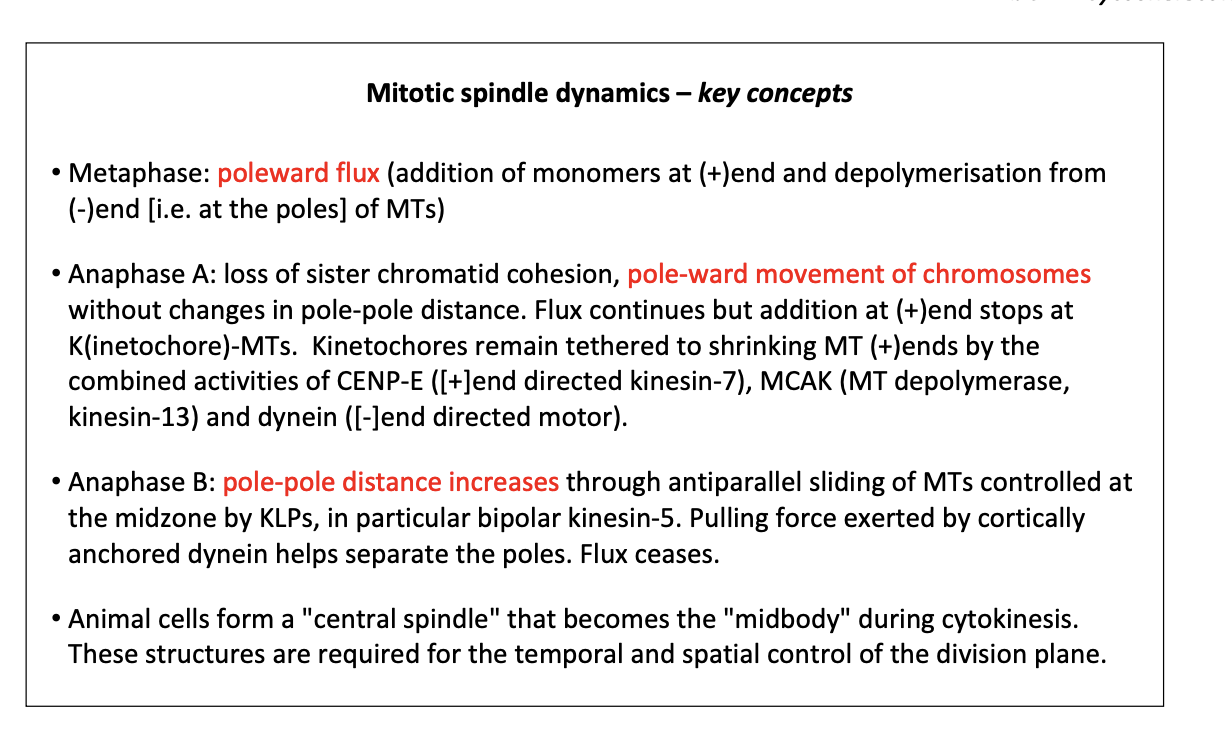
knowt flashcard image
67
New cards

Cytokinesis and Cell separation: why is coordination between the mitotic apparatus and division plane needed

  • ensure cytokinesis end stages DO NOT occur before chromosome separation has been completed

  • prevents unevent chromosome distribution or damage

68
New cards

how is cell division plane arranged in respect to spindle axis

Orthogonal
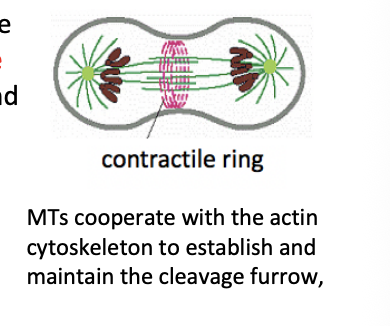
<p><strong>Orthogonal</strong></p>
69
New cards

But are all cell dvisions symmetrical?

No

  • some are asymmetric

    • E.g for cell diversity generation in development

70
New cards

In animal cells, what is the position of the cleavage plant specified by

Mitotic apparatus

71
New cards

What does cytokinesis involve

  1. formation of a furrow that encircles the cell

  2. deformation of the plasma membrane

  3. insertion of new membrane components

  4. force of furrow ingression is provided by contractile ring

    • composed of arrays of F-actin interspersed with myosin II thick filaments

72
New cards

Evidence that myosin powers cytokinesis

  • EXP: Inject anti-myosin antibodies (into the tight cell of the 2 cell embryo)

  • RESULT: cytokinesis fails

<ul><li><p>EXP: Inject anti-myosin antibodies (into the tight cell of the 2 cell embryo)</p></li><li><p>RESULT: cytokinesis fails</p></li></ul><p></p>
73
New cards

Special cytokinesis events in specific examples

  1. Early embryoninc division in Drosophila

    • cytokinesis is suppressed

    • nuclei divide in common cytoplasm

  2. Oogenic cyst of Drosophila

    • Cytokinesis is incomplate

    • cells remain connected by cytoplasmic bridges

  3. Budding and fission yeast

    • cytokinesis results from activity of an actomyosin contractile ring (similar to animals)

    • COMBINED with the deposition of a septum

74
New cards

Furrow ingression is powered by a contractile ring
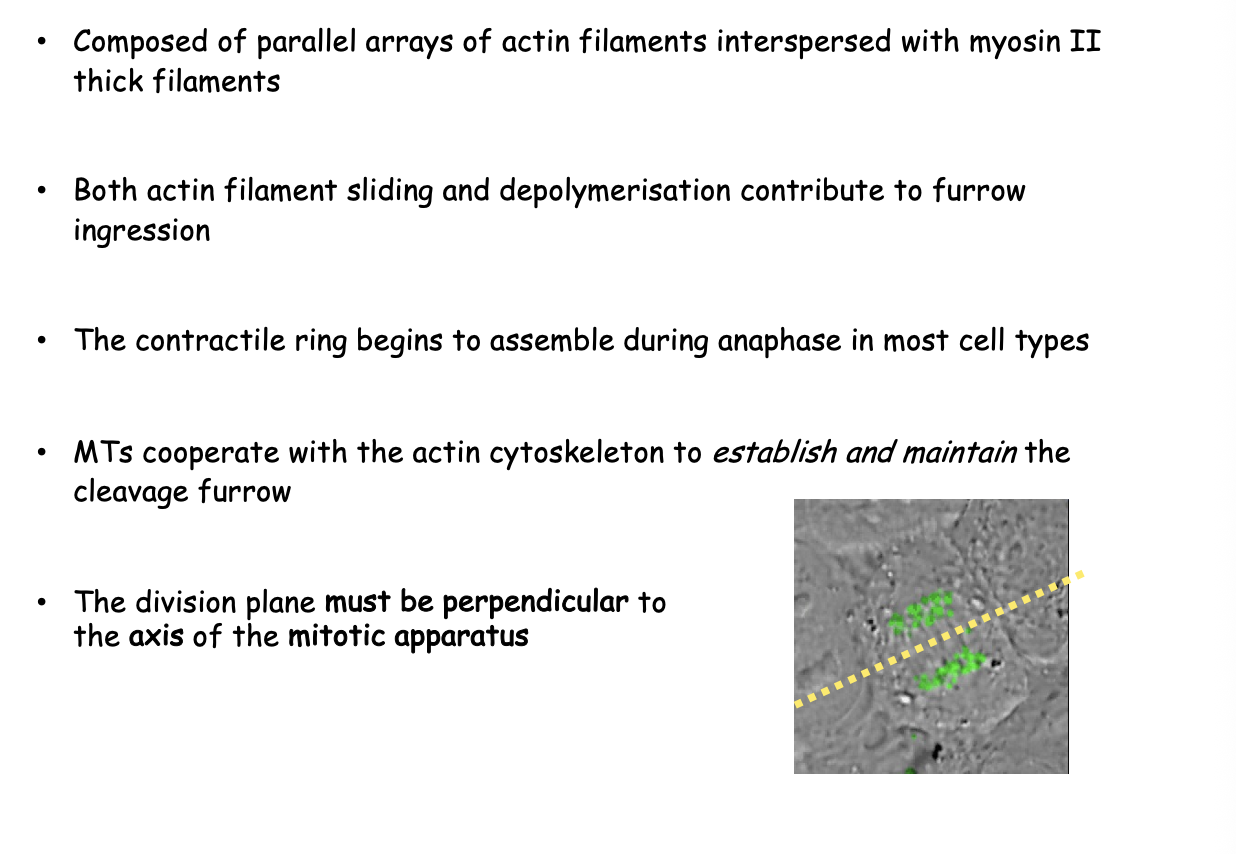
knowt flashcard image
75
New cards

Influence of mitotic apparatus on the position of the division plane in animals: aMTs or central spindle?

  1. aMTs may be sufficient to localise the division plane in large embryonic cells

    • e.g Rappaport 1961

  2. BUT in other experiments: when glass barrier was placed to interfere with aMTs, cytokinesis could still occur
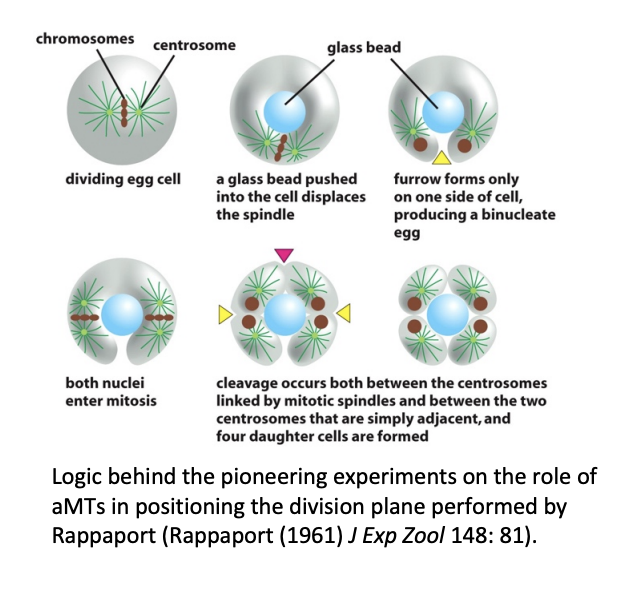
<ol><li><p>aMTs may be sufficient to localise the division plane in large embryonic cells</p><ul><li><p>e.g Rappaport 1961</p></li></ul></li><li><p>BUT in other experiments: when glass barrier was placed to interfere with aMTs, cytokinesis could still occur</p></li></ol><p></p>
76
New cards
77
New cards
78
New cards
79
New cards
80
New cards
81
New cards

Explore top notes

note
AP Biology Course Review Part 2
Updated 1636d ago
0.0(0)
note
June exam
Updated 1029d ago
0.0(0)
note
Medical Terminology
Updated 1220d ago
0.0(0)
note
Travail et État — Philosophes
Updated 1027d ago
0.0(0)
note
APES 5.3
Updated 443d ago
0.0(0)
note
Chapter 7: Impulse and Momentum
Updated 716d ago
0.0(0)
note
Sources of Finance for Businesses
Updated 361d ago
0.0(0)
note
AP Biology Course Review Part 2
Updated 1636d ago
0.0(0)
note
June exam
Updated 1029d ago
0.0(0)
note
Medical Terminology
Updated 1220d ago
0.0(0)
note
Travail et État — Philosophes
Updated 1027d ago
0.0(0)
note
APES 5.3
Updated 443d ago
0.0(0)
note
Chapter 7: Impulse and Momentum
Updated 716d ago
0.0(0)
note
Sources of Finance for Businesses
Updated 361d ago
0.0(0)

Explore top flashcards

flashcards
vocab lesson 19 and 20
95
Updated 1046d ago
0.0(0)
flashcards
psych chapter 8
33
Updated 1232d ago
0.0(0)
flashcards
Latin Wk. 2
54
Updated 953d ago
0.0(0)
flashcards
Nl woorden 23-44
22
Updated 158d ago
0.0(0)
flashcards
PSY 411 Chapter 1 Notes
39
Updated 1124d ago
0.0(0)
flashcards
vocab lesson 19 and 20
95
Updated 1046d ago
0.0(0)
flashcards
psych chapter 8
33
Updated 1232d ago
0.0(0)
flashcards
Latin Wk. 2
54
Updated 953d ago
0.0(0)
flashcards
Nl woorden 23-44
22
Updated 158d ago
0.0(0)
flashcards
PSY 411 Chapter 1 Notes
39
Updated 1124d ago
0.0(0)