Neurobiology 523 Exam 1
 Studied by 4 people
 Call Kai
 Learn
Learn Practice Test
 Spaced Repetition
 Match
Match Flashcards
 Knowt Play
1/133

There's no tags or description
Looks like no tags are added yet.
Name | Mastery | Learn | Test | Matching | Spaced | Call with Kai |
|---|
No analytics yet
Send a link to your students to track their progress
134 Terms
Levels of analysis in neuroscience
1. nervous system
2. body responding to a signal
3. moving the body (controlling the body)
4. Imaging the brain (seeing what parts of the brain are active and what is going on)
important to be able to move between the levels of analysis to see how the levels overlay and play into one another
how many neurons do humans have
86 billion meaning there are trillions of connections within the nervous system
what does it mean if an organism has more neurons than another
the animal has more complex behaviors/abilities
anatomy of the neuron
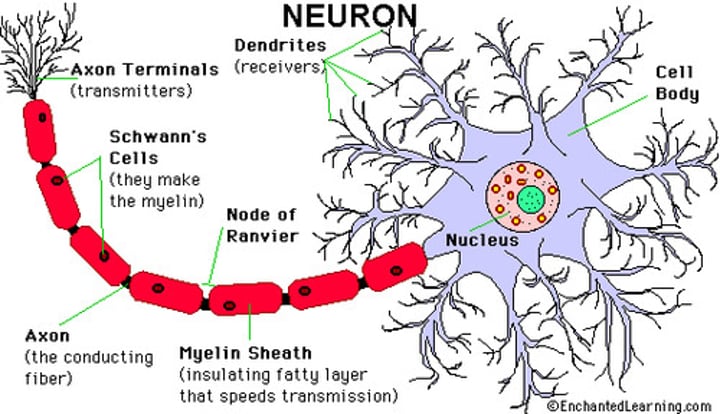
what animal was the action potential mechanism discovered in?
a squid because they have giant axons
differences between neuron and regular cell
- have to distinguish the cell body since there are other parts that protrude off the soma
- they can receive/give off signaling molecules and some are excitable
how are the names of the types of neurons categorized?
by shape
To what extent is the nervous system involved in different parts of human physiology? Examples?
The nervous system regulates and coordinates almost all aspects of physiology
-Ex. heart rate, immune system, digestion, endocrine system
Heart rate: regulating the heart beat
Respiration: Endogenous bursting behavior in neurons regulation
Immune system: regulating neurotransmitters for immune responses
Digestion: regulate motility, secretion, and growth
endocrine system: in combination with the hippocampus the nervous system facilitates the stopping and starting of hormone secretion
what tools does the neuron use to move things around inside the cell?
Cytoskeleton
Not static, has internal scaffolding of the neuronal membrane: these help move things around inside the cell
-Microtubules
-Microfilaments
-Neurofilaments
What does the neuron need to support high internal activity?
neuron has lots of active transport and high internal activity so it needs lots of mitochondria to make ATP
what do glial cells do and what are some types?
- support and protect neurons
Types:
Myelinating glia/Oligidendrigal cells:
Insulate axons to speed the propagation of action potentials
Astrocytes:
Regulate the blood-brain barrier
ratio of glial cells to neurons
Close to 1:1 ratio (glia:neurons) in humans
Ratio varies between species
How do neurons code for different levels of input or signal intensity?
Different levels of intensity have different frequencies:
Lower frequency=less intense
Higher frequency=more intense
*more action potentials for larger impulses, not bigger action potentials
what is a current clamp?
by placing an electrode into a cell you are able to inject current and record changes in membrane potential within the cell due to depolarizing events (makes mV graph)
Types of firing patterns in neurons
1. quiet with few or no action potentials unless activated by stimulus
2. tonic: consistent action potentials
3. bursting action potentials (producing rhythmic behaviors)
4. one action potential with a strong stimulus
impact of larger current on action potential
more action potentials (stronger signal)
What is the membrane potential (Vm) and what are the ranges for a typical neuron?
Membrane potential: the voltage across a membrane (difference in voltage inside and outside cell) at any moment
Typical range ~ 40mv to -70mv
What is the resting potential and how does this relate to Vm?
Resting potential: Vm of a neuron when it is not firing an action potential
The average resting potential is around -70mv which shows that there is a difference in the voltage across the membrane (more negative in the membrane than external environment)
hydrophyllic vs hydrophobic
Hydrophilic: atoms or molecules with a net electrical charge (cations, anions) dissolves in water. The cytosol and extracellular fluid of the neuron is made of water so it allows ions to dissolve inside and outside cell
Hydrophobic compounds: have no electrical charge (eg. oil) Lipids are hydrophobic, and they contribute to resting and action potentials
Voltage
the difference in electric potential between two points
why are some parts of proteins found within the lipid bilayer, while other parts stick out either into the neuron or the extracellular space?
Charged particles (hydrophilic) cannot cannot easily cross the membrane (need channel or transporter) so portions that are inside the membrane are likely hydrophobic (lipids and carbon chains) while the portions sticking out of the membrane are hydrophilic (charged)
The chain of amino acids make a helix that is hydrophobic allowing proteins to be inbedded in the cell membrane
Ex. ligand gated ion channels (for ion selectivity and gating) (has a hydrophilic and hydrophilic portion of the protein)
where proteins are synthesized associated with where they can be found
- synthesized on rough ER = found in membrane
(rough ER embeds proteins in membrane right away)
- synthesized on free ribosomes = found in cytosol
cations and anions found in neurons
cations: K+, Na+, Ca++
anions: Cl-
how does diffusion work?
Diffusion involves entropy (random movement of molecules)
- there is naturally a higher probability that more molecules will end up migrating to the side that originally had less concentration (just due to there being less molecules and more open space there)
relationship of resistance and conductance
resistance = 1/conductance
(inversely proportional)
What is Ohm's law and how does is relate to neuroscience?
Ohms law:
Current = conductance *voltage
(I= G*V)
OR:
Current = voltage /resistance (I=V/R)
- A lipid bilayer can prevent the flow of electricity,
meaning when there are no channels/transports open there is high resistance and low current (they are inversely proportional)
- channels can allow the flow of electricity, which decreases resistance and increases current

conductance
the measure of how easily electricity flows along a certain path through an electrical element
conductance is considered the opposite of resistance
resistance
a measure of opposition to the flow of electric current
*when channels are closed, resistance = 0
voltage
the difference in electrical potential energy between two places (inside and outside the cell)
current
ionic flow across membrane
What does the Na+/K+ pump do? How is this important for establishing the resting potential of neurons?
Pumps 2 K+ into the cell and 3 Na+ out of the cell (against their concentration gradients) which maintains the resting potential of the cell (-70mV)
higher concentration of sodium extracellularly and a higher level of potassium intracellularly
For Na+, K+, Cl-, and Ca++, what are the relative concentrations for inside versus outside of the neuron? What would happen if you opened a channel for each, and what would happen to Vm (membrane potential)?
all have higher concentrations outside the cell except K+ which has a higher concentration inside the neuron
K+ would leave the cell and all others would enter the cell if channels were opened for each
Vm increases as positive charge moves into the cell (excitatory) and Vm decreases as positive charge moves out of the cell (inhibitory)
Can ions move in either direction across a channel and can they use one another's channels?
Ions can move either way across the cell but cannot use one another's channels
concentration and electrical gradients determine which direction an ion will flow at a given time
What is the equilibrium potential (reversal potential, Eion)? What forces cause this to happen?
The equilibrium potential is when enough ions have crossed the membrane that there is an electrical attraction (pull) in the opposite direction that balances out the concentration gradient pull
(competing electrical and chemical gradient forces make net flow of ions through channels 0)
For K+ what is a typical equilibrium potential? What is it for Na+?
K+: -80mv
Na+: +60mv
If you increase the concentration of K+ outside of the neuron, what happens to the Vm (membrane potential)?
If the extracellular potassium concentration surrounding a myocyte increases, then the potassium gradient accross the cell membrane increases, and therefore the resting membrane potential will become more positive.
this depolarizes the membrane because K+ enters the cell
What is the Nernst equation and what does it calculate?
calculates the value of the equilibrium potential for each ion in mV
it takes into consideration:
-charge of the ion
-temp
-ratio of external and internal concentrations
-gas constant
Ek= 61.54 log[K out]/[K in]
ENa= 61.54 log[Na out]/[Na in]
Ecl= -61.54 log[Cl out]/[Cl in]
Eca= 30.77 log[Ca out]/[Ca in]
*if [out] is larger than [in] you will get a positive number after logging
What is capacitance and where in the neuron does the charge difference take place?
capacitance is the electrical charge that is stored along either side of the thin membrane due to opposing charge attraction
Do you need to change the entire balance of ions inside and outside of the neuron to change the Vm?
minuscule changes in ionic concentration lead to a large change in Vm (membrane potential)
however, if electric current is injected into the neuron the build up of capacitance (opposing charge on either side of the membrane) will induce a current across the membrane changing the membrane potential
what is the role of conductance in setting the resting potential? (what ion channel has the highest conductance?)
Conductance is how easily a charge can move through a substance, and in this case it refers to the amount of channels that are open to let the ions through
(conductance = permeability)
resting membrane potential (-70mV) is close to the equilibrium potential of K+ (-80mV) because it is mostly permeable to K+ (K+ leak channel conductance is high, Na+ leak channel conductance is low)
What has a higher permeability in terms of setting the negative resting potential, Na+ or K+ leak channels?
K+ leak channels have a much higher permeability, so the mV falls much closer to the potassium equilibrium potential (-80mV) at -70 mV
what does the goldman equation calculate?
resting membrane potential
(ion concentration and channel permeability's affect on resting membrane potential)
what creates the negative resting potential in the Neuron?
- set up by the Na+/K+ pump that creates higher Na+ outside and higher K+ inside (thus allowing K+ to leak out of the cell down its concentration gradient)
- mostly due to the high permeability of the K+ leak channel which leaks K+ out of the cell
-refined by leak Na+ channels that let Na+ ions in the cell (provides a little balance to the cell)
what happens if K+ levels are too high outside the cell and how can this be avoided?
depolarization of the cell
To prevent this we have the blood-brain barrier which regulates the potassium in the extracellular fluid and we also have astrocytes that can take up potassium at certain levels creating a potassium buffer (glial cells)
What is gene duplication and what are the contributions of this process to evolution?
- any duplication of a region of DNA that contains a gene
- important because while one copy can stay intact and perform neccessary function, the other copy can undergo random sequence changes that allow for new functions to arise (evolution)
What is the structure of leak K+ channels and how are leak K+ channels related to voltage gated K+ channels?
- Leak K+ channels (2 domains, 2TM) are a duplication of the original K+ channel (1 domain, 2TM)
- Voltage gated K+ channels (4 domains, 6TM) are a multiple duplication and modification of the K+ channel (1 domain, 2TM)
*came from the same base gene
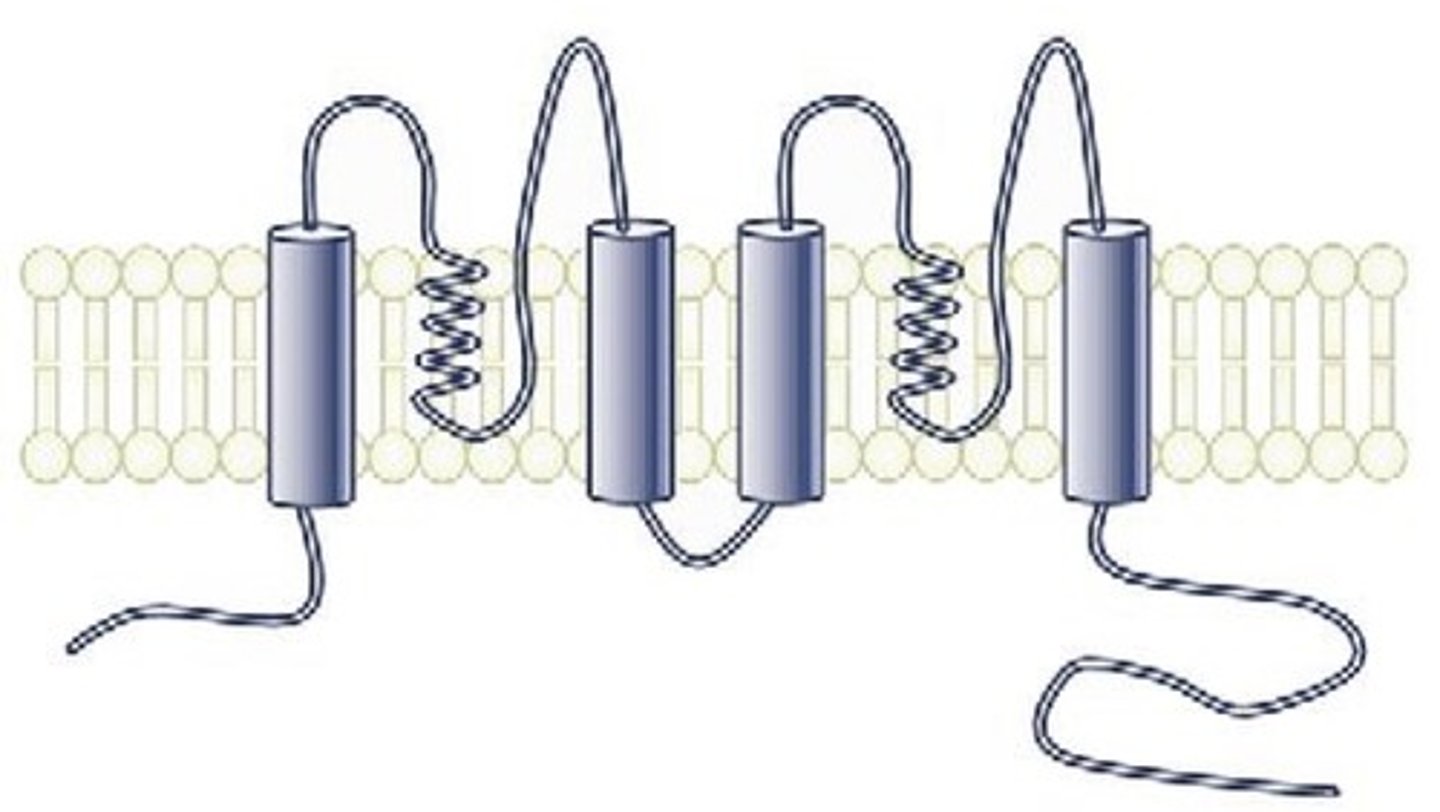
A given voltage gated K+ channel gene codes for protein that crosses the membrane six times (consider this a domain). How many domains are typically needed for a functional voltage gated K+ channel?
4 domains are needed to make one voltage gated K+ channel
*picture is one domain
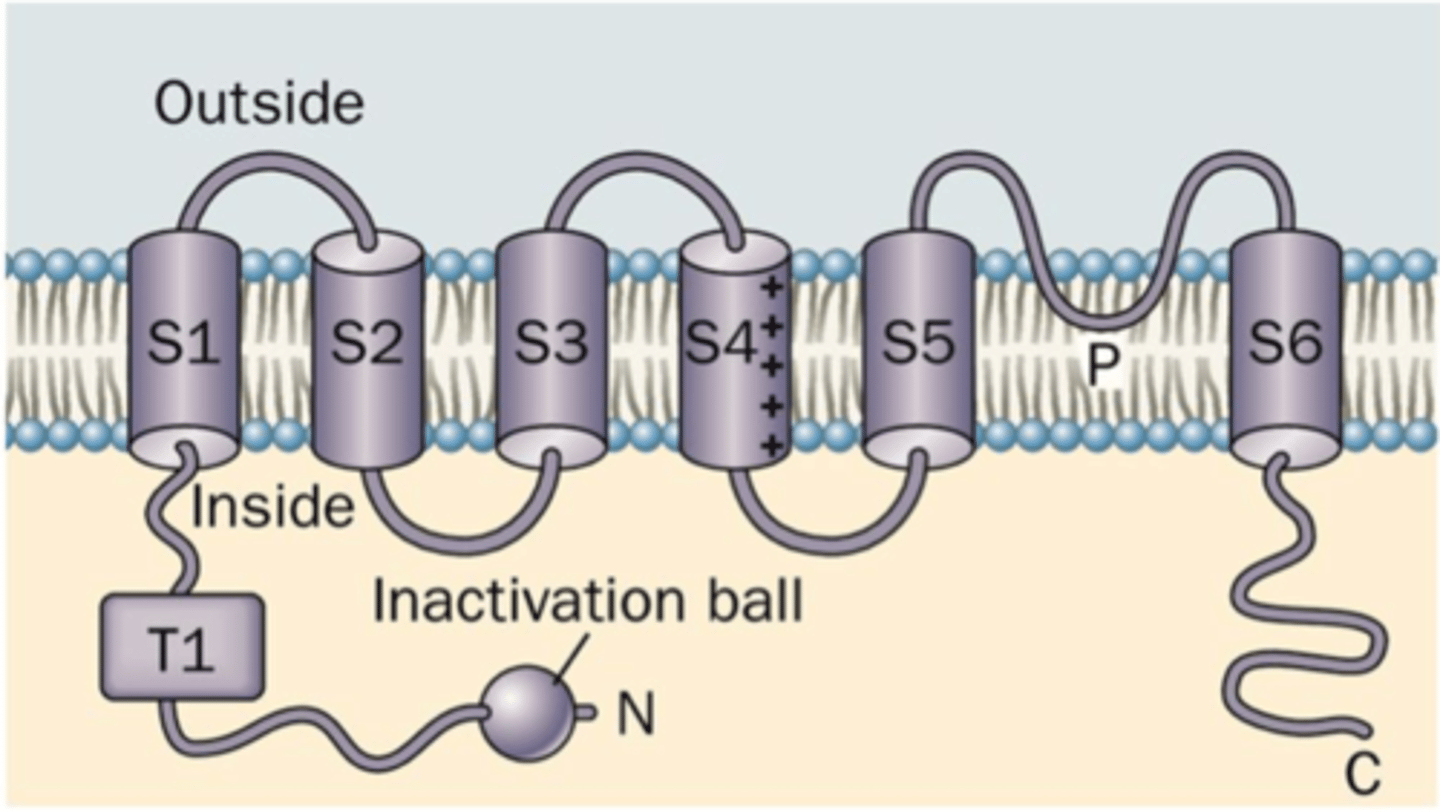
how does a voltage gated K+ channel open?
Voltage gated K+ channels have a voltage sensitive region that allows it to change shape in response to membrane potential changes allowing it to open and close to let potassium ions through
What is the overall structure of the leak Na+ channel and how does this differ from the leak K+ channel?
The leak K+ channel only has 2 domains, whereas the Na+ leak channel is similar to the voltage gated K+ channel being that it has 4 domains
How similar are the voltage gated ion channels (K+, Ca++, & Na+) in terms of structure? Does the voltage gated Na+ channel also have 4 domains and in each domain does the protein crosses the lipid bilayer six times? What are the differences between these VG ion channels?
Similarities: The voltage gated ion channels are very similar in structure, they each have 4 domains and the ion crosses the barrier 24 times (4 domains*6 crossings)
differences: voltage gated Na+ and Ca++ channels have a single gene that codes for everything
In the voltage gated K+ channel, has a different gene coding for each domain
Where in the voltage gated ion channels is the voltage sensing part and where is the pore created?
voltage sensitive region = purple
pore = red (in between pore linings)
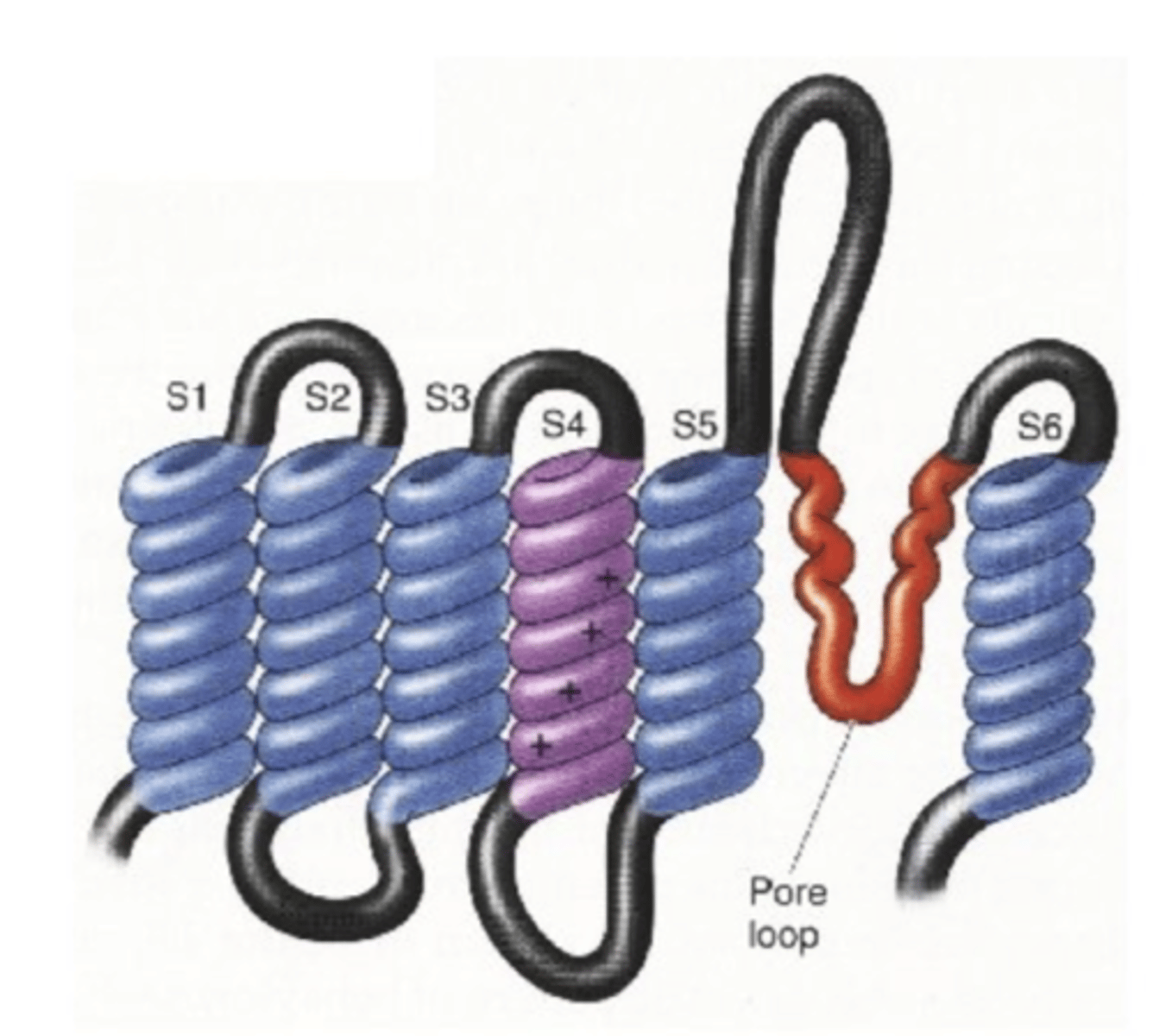
Ball and chain model of voltage gated Na+ channel
1. The cell is depolarized which opens the pore (shape change)
2. The ion is let through (further depolarizing cell)
3. ball blocks the channel, allowing the cell to repolarize
4. The cell becomes hyperpolarized which prompts the shape change of the pore back to normal (closed) and the ball comes out
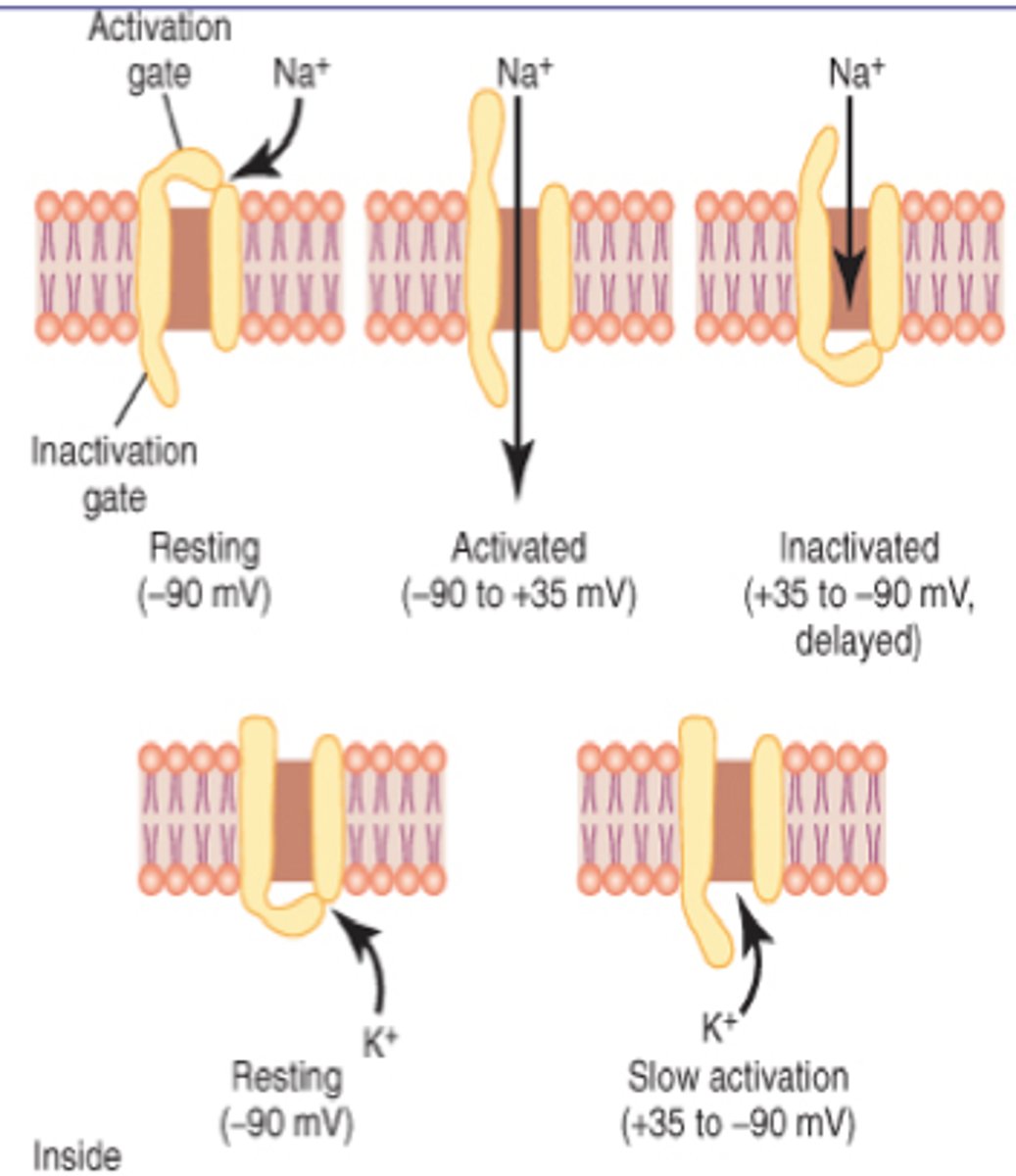
How does the size of the pore in voltage gated Na+ channels help with selectivity for Na+ ions, but against K+ ions?
Voltage gated channels are highly selective towards certain ions due to the size selectivity filter within the channel (hydrated K+ is too large to fit in the selectivity filter for voltage gated Na+ channels)
How does understanding the principles of movement of Na+ and K+ in creating the resting potential help with understanding how the action potential works?
The opening of Na+ channels can depolarize the membrane potential and move Vm in a more positive direction (possibly creating an action potential)
The opening of K+ channels for repolarization moves Vm in the negative direction
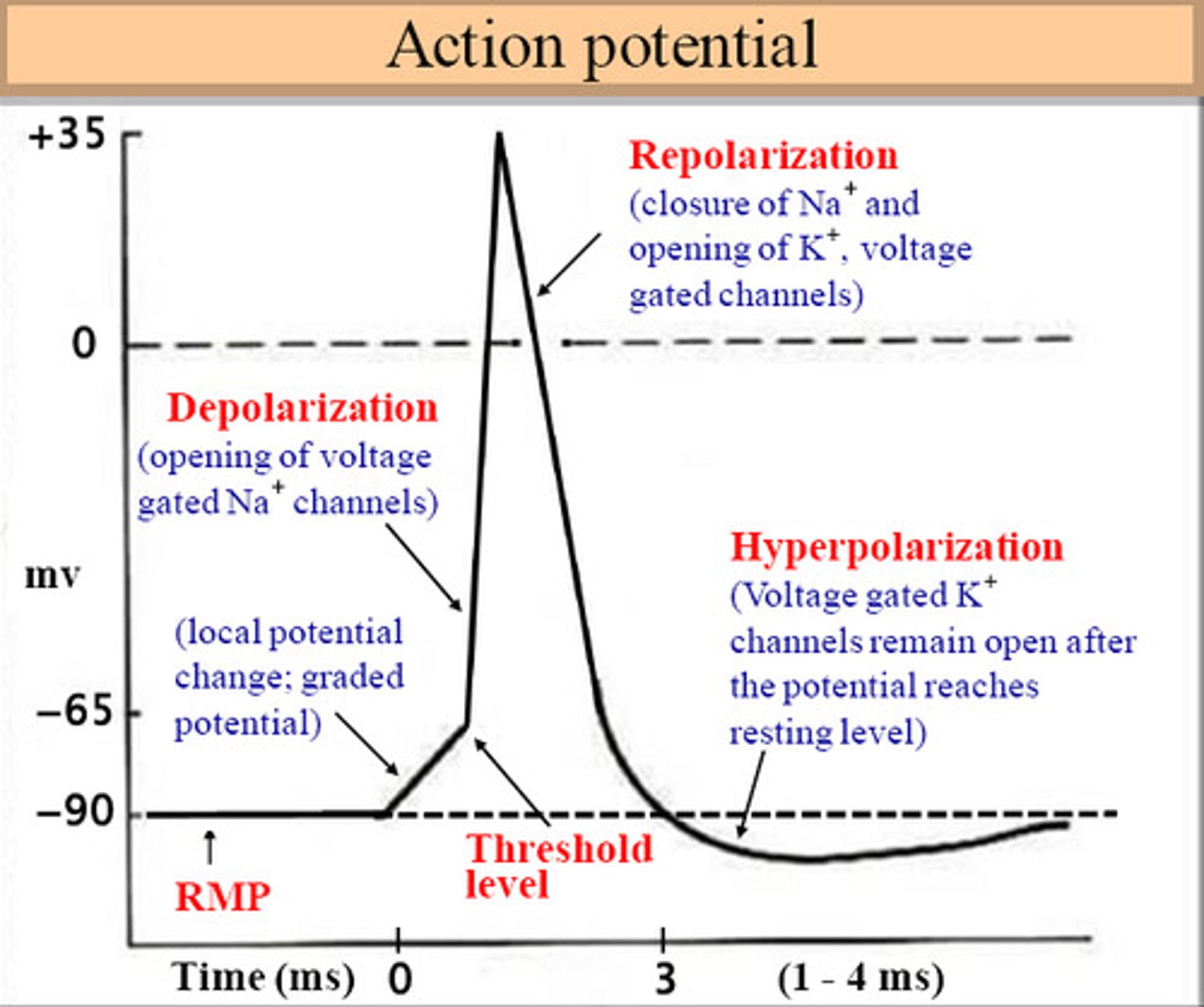
parts of the action potential
resting membrane potential, rising phase, overshoot, falling phase, undershoot phase, refractory period
depolarize
when the cell becomes more positive due to leak of Na+ into the cell prompting an action potential if the threshold is met
hyperpolarize
when the cell is repolarizing due to the leak of K+ out of the cell and the Vm becomes more negative (undershoot) than the resting potential (-70mv)
threshold
The level that a depolarization (voltage) must reach for an action potential to occur. In most neurons the threshold is around -55mV to -65mV
Explain the sequence of events that occurs in the action potential just focusing on the opening and closing of voltage gated ion channels. Do the Na+ or K+ voltage gated ion channels respond to depolarization at the same voltage and do they close with the same delay? Why is it important that voltage gated Na+ channel have an inactivation component?
- voltage-gated Na+ channels open when slightly depolarized (@ -55mV) causing further depolarization (open before K+ channels)
-When some VG Na+ channels start to open it causes a positive feedback loop that causes other VG Na+ channels to open (more depolarization)
- VG Na+ channels close quickly (ball blocks channel)
- cannot be opened again immediately by depolarization (refractory period)
- VG K+ channels open when cell is depolarized (after Na+ channels)
-cause repolarization/hyperpolarization (K+ going out)
- channels close more slowly than Na+ (causing undershoot)
The VG Na+ channel needs to have an inactivation component so that the cell can repolarize (inactivation due to ball and chain mechanism)
Why does the action potential stop rising? What causes the undershoot of the action potential?
1. The action potential stops rising due to the closing of the voltage gated Na+ channels causing repolarization of the cell
2. also due to the Vm becoming closer to Na+ equilibrium potential (which is why the Na+ channel closes)
The undershoot is the product of the efflux (out of the cell) of K+ ions due to the opening of the voltage gated K+ channels
Undershoot = K+ channel slowly closing while Na+ channel is inactivated
When an action potential occurs, what is the effect on the overall concentration of ions inside and outside of the neuron?
The K+ goes down slightly in the cell (and up slightly outside the cell)
Na+ goes up slightly in the cell (and slightly down outside the cell)
Use Ohm's law to think about the movement of ions through voltage gated ion channels. What should current be if the channel is closed? What can current be if the channel is open? What is the relationship of an open channel with resistance?
If the channel is closed current will be 0 because resistance is high
Current can be high if the resistance is low (channel is open)
Open channel = low resistance, closed channel = high resistance
*if channel is closed then conductance is 0 so current is 0
*if membrane potential = equilibrium potential of the ion, there will be no current

Why does knowing the equilibrium potential for an ion help determine how much current can flow at a given Vm?
Current = voltage/resistance and voltage = the difference between the equilibrium potential for the ion and the membrane potential (Vm)
so, if membrane potential = equilibrium potential of the ion, there is no current
natural toxins that affect voltage-gated ion channels and their functions
- TTX (pufferfish) blocks Na+ channels
- alpha and beta toxins (scorpion) shifts opening and closing of Na+ channels
- apamin (honey bee) blocks K+ channels
- dendrotoxin (mamba) blocks K+ channels
What is voltage clamp?
voltage clamp blocks all channels but one type (ex. Na+) and then voltage clamp holds the membrane at a certain potential and then jumps it to a different potential while inputing the neccessary current to maintain a constant membrane potential, recording how much was needed to do so
the amount of current needed to maintain the membrane potential is equivalent to the ionic current flowing across the membrane in response to the voltage step
What role does the use of chemicals to block specific channels play in how voltage clamp is used in neuroscience?
We can use drugs as voltage clamps to block all channels but one, so we can see how the ion concentration/permeability of on ion changes during an action potential
What is a common drug for blocking voltage gated Na+ channels and what animal did this chemical come from?
Tetrodotoxin (TTX) blocks voltage gated Na+ channels - this came from the pufferfish
*can use this to measure the current of other ions across the membrane during an action potential using voltage clamp
patch clamp method
allows measurement of currents through a single channel molecule
*inward positive current (ex. open Na+ channel) shows up as a downward deflection
*outward positive current (ex. open K+ channel) shows up as an upward deflection
*you can see how long a channel is open ---proving that Na+ channels close faster than K+
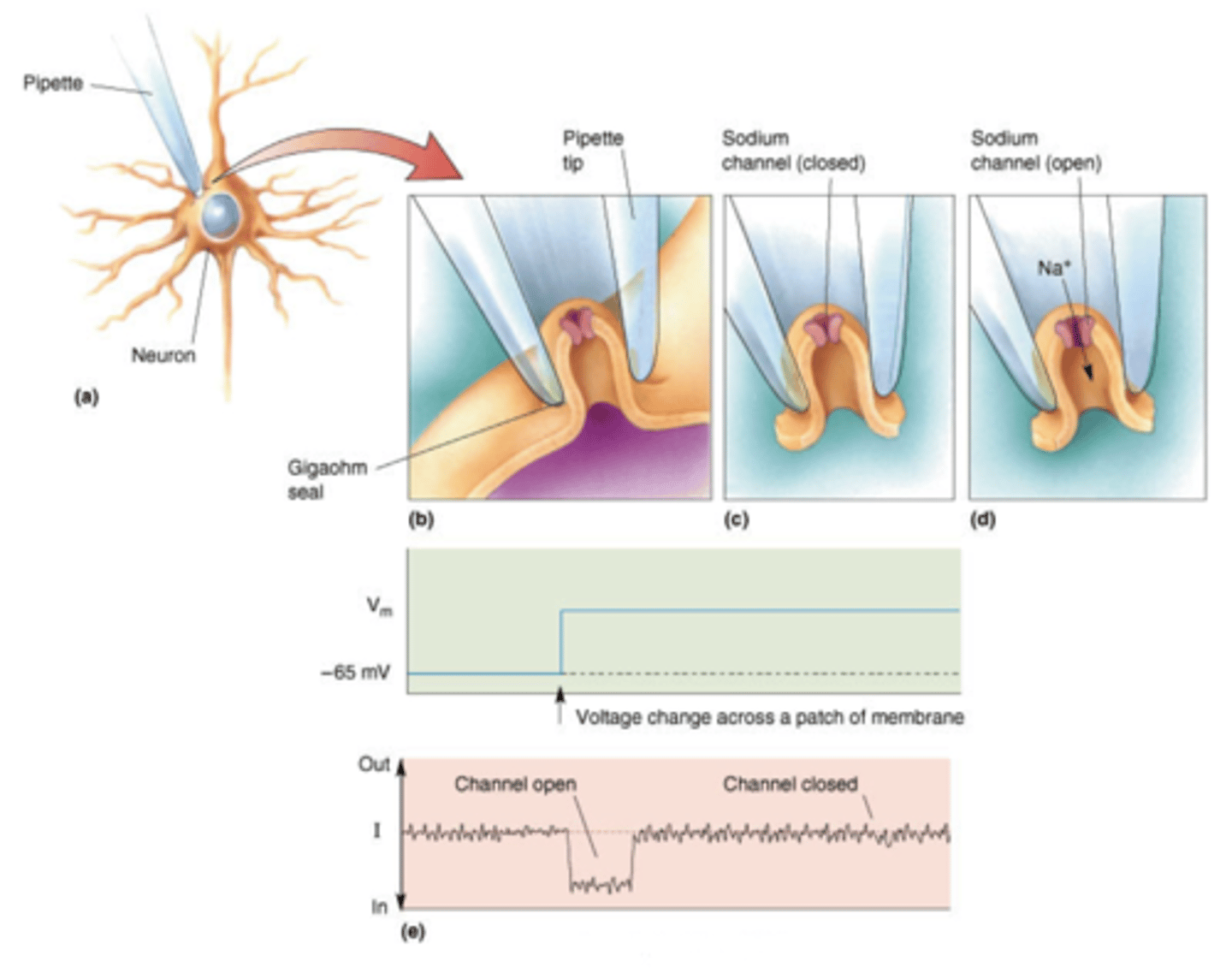
When voltage gated K+ channels are viewed through voltage clamp, what is the timing of their opening and closing relative to the voltage gated Na+ channels? What is another name for the voltage gated K+ channel?
The voltage gated K+ channels open after the Na+ channels and stay open longer
another name for the VG K+ channel is the "delayed rectifier" which makes sense because its opening during depolarization is delayed compared to Na+
For a given neuron at the height of the action potential, why does the membrane potential never reach the equilibrium potential of Na+?
1. The height of the action potential doesn't reach the Na+ equilibrium potential due to the leak of K+ ions going on in the background
2. As the Vm gets closer and closer to the equilibrium potential of Na+, the driving force for Na+ decreases
What is the axon hillock, what role does is play in the neuron, and what do you find in high concentration there?
It is the spike initiation zone that begins the propagation of the action potential down the axon
It has a large number of VG Na+ channels
Explain why the action potential moves down the membrane towards the nerve terminal, but doesn't start moving in the reverse direction when halfway down the axon?
The opening of one VG Na+ channel stimulates neighboring VG Na+ channels, but the process can not go in reverse because there is an inactivation period for the VG Na+ channel (preventing it from becoming stimulated right away again)
What is absolute refractory period? What is relative refractory period?
absolute refractory period: time period when you cannot get a second action potential due to Na+ channel inactivation
Relative refractory period: time period when you can get a second action potential (if stimulus is large enough), but conditions slightly inhibit a second action potential
orthodromic conduction
axonal conduction in the normal direction - from the cell body toward the terminal
antidromic conduction
axonal conduction opposite to the normal direction; conduction from axon terminals back toward the cell body (doesn't often happen)
features of the axon that can help increase the speed of action potentials
- larger spread of the action potential (dependent on axon structure)
- traveling inside the axon, rather than across the axon membrane
- larger diameter = less resistance = faster
- more voltage gated ion channels = faster
- myelinated axon (insulates and creates less resistance inside the axon)
What is myelin and how does it increase action potential speed? Where are the voltage gated Na+ channels concentrated in myelinated neurons?
No channels under the myelin sheath
No resistance, high current = very fast under sheath portions
Voltage gated Na+ channels are concentrated at nodes of ranvier
if the length of the sheath is too long, then action potential signal is lost
What is lidocaine, what is it used for and how does it act?
Lidocaine is a numbing medication that works by blocking the voltage gated Na+ channels
how many protein coding genes are there in humans? Given this number, what helps simplify things in terms of understanding how various genes contribute to the function of the nervous system?
~ 20,000 protein coding genes in humans
What simplifies things is that most of our genes are derived from related ancestors (families)
if resting potential of the neuron is close to the threshold, is the neuron more or less likely to produce multiple action potentials with the same stimulus?
more likely
What are some of the causes for variation in action potential patterns among various neurons?
differences in expression of different ion channels contributes to the range of action potential profiles
What levels of Ca++ are found inside the neuron and how might that reflect the level of regulation of Ca++ and the relative importance of Ca++?
Very very little concentration of Ca++ is found inside the cell (0.002M)
The ratio of outside to inside concentration is 10,000:1
This means that the cell is very sensitive to influx of Ca++
Where can one find the voltage gated Ca++ channel in the neuron and what are the different functions? Is there just one of these channels or different types that vary in their function?
There are MANY different types of voltage gated Calcium channels
Find them:
- In the axons for action potential firing
- In presynaptic terminals responsible for neurotransmitter release
how similar is the structure of the voltage gated Ca++ channels relative to the voltage gated Na+ channel?
The structure of the voltage gated Ca++ channel is almost identical to the voltage gated Na+ channel
For the heart pacemaker cells, what is the role of voltage gated Ca++ channels? Do you expect all the voltage gated ion channels in the heart to be identical to the ones found in a typical axon? Why or why not?
Voltage gated Ca++ channels in the heart help trigger the depolarization process (Ca++ influx into cell)
I would not expect the voltage gated Ca++ channels in the heart to be identical to the ones found in a typical axon due to the fact that membrane potential in heart neurons is never resting
In the heart cells, how might the presence of both voltage gated Ca++ channels and voltage gated K+ channels that are Ca++ activated contribute to the rhythmic action potentials?
the voltage gated K+ channel was modified to be sensitive to the presence of Ca++ because VG K+ can then sense the increase of Ca++ inside the cell (depolarization) which triggers K+ channels to open and repolarize the cell
What are channelopathies? Give an example of a channelopathy?
Disorders due to problems with an ion channel (ex. Cystic fibrosis)
What is the difference between a presynaptic and a postsynaptic neuron? Can a given neuron be both?
A presynaptic neuron is the neuron that is transmitting the signal (either chemical or electrical) to the postsynaptic neuron
The postsynaptic neuron is the neuron that is receiving the signal
A neuron is both the presynaptic neuron and the postsynaptic neuron
What kinds of synapses are there?
chemical and electrical
What is an electrical synapse?
The electrical synapse is a gap junction consisting of a field of connexin pores that pass ions and signaling molecules directly from one cell to another without passing through the extracellular fluid. (only found in a minority of neurons)
cells connected by this synapse are said to be "electrically coupled"
The gap junction is a gap that electrically connects the two types of cells
Can ions move in both directions across the electrical synapse? What is the role of connexon?
The gap junction is not gated in any one particular direction so ions can travel both ways, however if an action potential (depolarization) is moving from one cell to the other, there is an increased likelihood of the ions moving from that cell to the other
The membranes of the two cells are close enough that the connexon from each of the lipid bilayers is able to connect to each other creating the gap junction channel (connexon is formed by 6 connexins)
advantage of electrical synapse
quick transmission of ions from cytoplasm of one cell to the other
Does an action potential in one electrically coupled neuron always produce an action potential in the other neuron? If not, what might typically happen?
an action potential from one neuron does not always produce an action potential in another neuron
If no action potential is observed in the postsynaptic neuron this most likely means that the action potential in the presynaptic neuron was not strong enough to trigger the action potential in the postsynaptic neuron
How is synchronization affected by loss of gap junctions in certain brain stem neurons?
Without the gap junction, the two neurons will generate action potentials but they will no longer be synchronous
For a chemical synapse, do the two neurons physically contact one another?
For chemical synapses the neurons do not actually touch each other, they have a gap between them called the synaptic cleft where neurotransmitters travel across
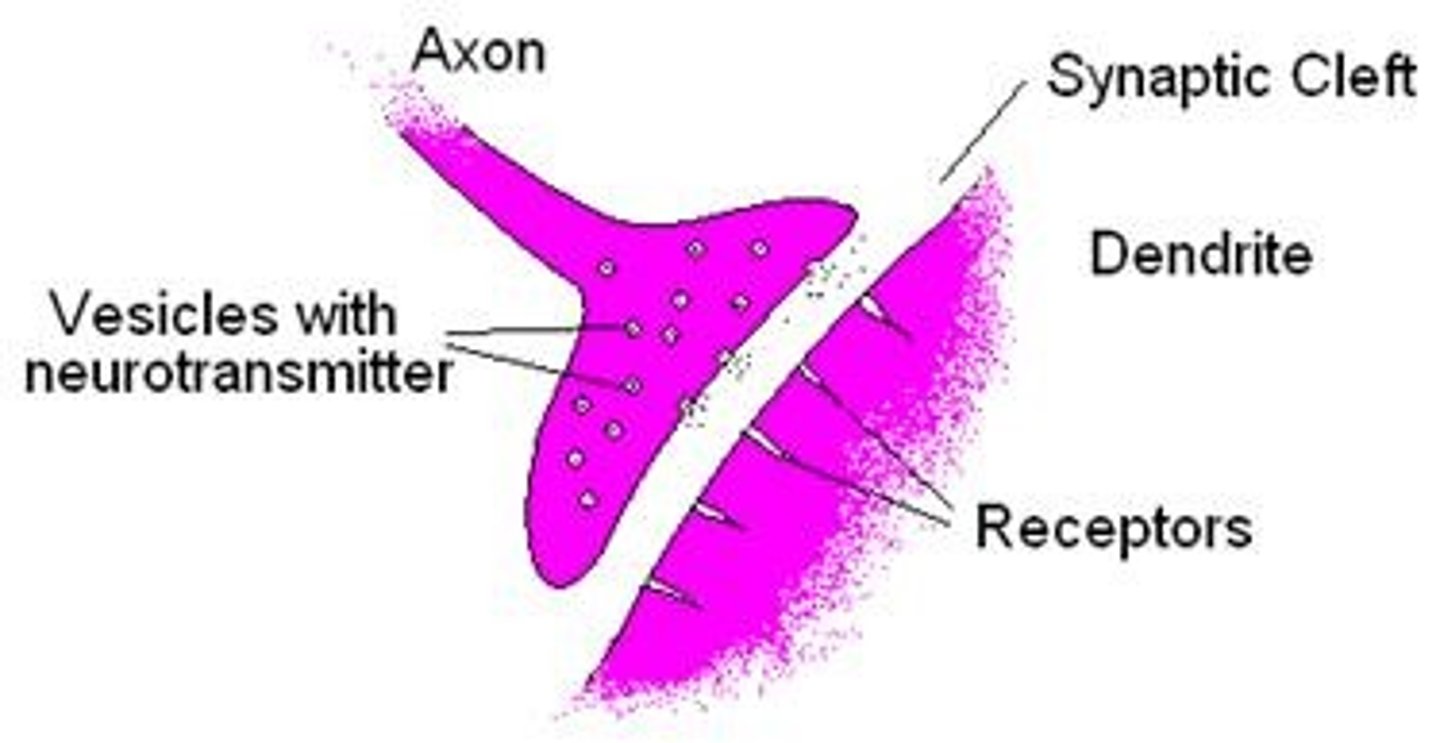
What distinguishes a dense core vesicle from a typical synaptic vesicle? Can a given neuron have both?
A dense core vesicle is a vesicle in the synapse that releases larger sized particles (neuropeptides) than a synaptic vesicle (amino acids and amines)
a single neuron can have both dense core vesicles and synaptic vesicles
Where are the different possible locations that a presynaptic neuron can synapse onto another neuron? Is it just the dendritic field?
Axodendritic: axon to dendrite
Axosomatic: axon to cell body
Axoaxonic: axon to axon
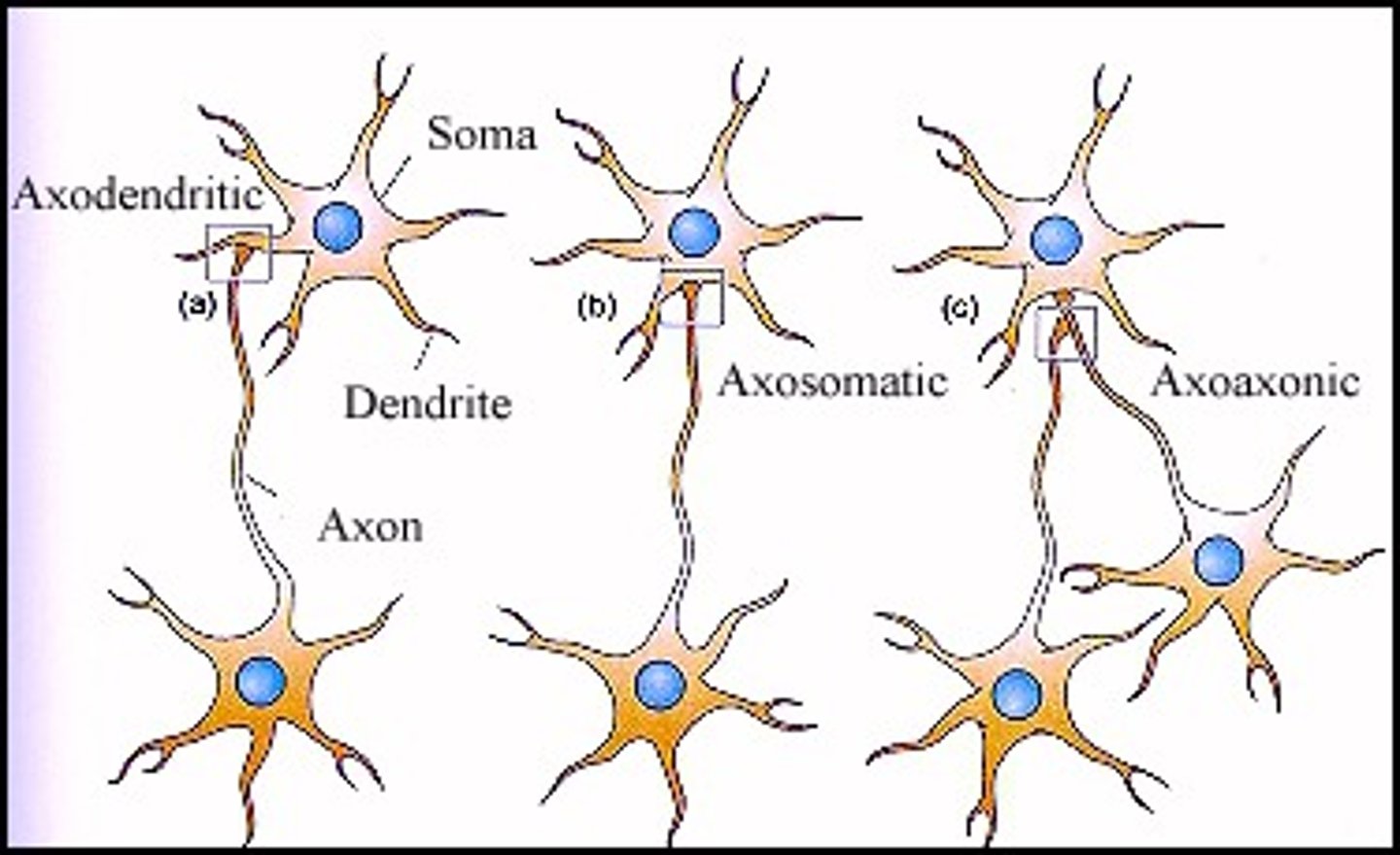
what is inside the synapse and are there different types of synapses?
The synapse includes mitochondria, synaptic vesicles (responsible for neurotransmitter release), and ion channels
synapses can be inhibitory or excitatory (many different types)
What are axonal boutons and dendritic spines?
Axonal boutons: Enlarged parts of the axon at the synapse (presynaptic terminal)
Dendritic spines: protrusions from dendrite at synapse (postsynaptic terminals)
Steps of chemical synaptic transmission
1. Action potential depolarizes presynaptic membrane
2. Depolarization opens calcium channel, Ca2+ flows into the presynaptic neuron
3. Synaptic vesicles fuse with cell membrane, neurotransmitter is released. Diffuses across cleft and binds to ligand-gated receptor
4. removal of the neurotransmitter from the synaptic cleft
 Note
Note  Flashcards (46)