Ch 9 Social Development
 Studied by 0 people
 Call Kai
 Learn
Learn Practice Test
 Spaced Repetition
 Match
Match Flashcards
 Knowt Play
1/66

There's no tags or description
Looks like no tags are added yet.
Name | Mastery | Learn | Test | Matching | Spaced |
|---|
No study sessions yet.
67 Terms
Social Development is the Development of Children's Understanding of:
others' behaviors, attitudes, and intentions
relationships between self and others
how to behave and interpret their social world.
Freud's Theory of Psychosocial Development
Proposed that behavior is driven by unconscious drives and internal conflicts. Early childhood experiences shape later development.
The Unconscious
Freud's idea that behavior is influenced by hidden psychological drives often expressed symbolically (e.g., dreams).
Freud's Personality Structure
ID (instinctual drives, immediate gratification), Ego (rational problem-solving, mediator), Superego (moral conscience and ideals).
Psychosexual Development
Freud's theory that children pass through stages where pleasure focuses on different erogenous zones.
Old age people love grapes
Oral Stage
0-1 - Pleasure from mouth activities (sucking, eating).
Anal Stage
1-3 Pleasure from defecation; focus on control and autonomy.
Phallic Stage
3-6 Pleasure from genitalia; development of gender identity.
Latency Stage
7-11 Period of calm where sexual drives are hidden; focus on learning and peers.
Genital Stage
12 + Sexual maturation and establishment of mature relationships.
Freud's Contributions
Introduced the role of the unconscious, early experiences, and developmental view of sexuality.
Erikson's Theory of Psychosocial Development
Expanded Freud's ideas into eight psychosocial crises across the lifespan. Each stage requires resolution before moving on.
Trust vs. Mistrust - Trust in intimate relationships
Autonomy vs. Shame/Doubt - Fostering of independence (dress themselves)
Initiative vs. Guilt - Healthy conscience development (plan a game)
Industry vs. Inferiority - “Can I contribute to the world?” - Project, sports
Identity vs. Role-Confusion - “Who am I? Where do I fit in? - explore career paths
Trust vs Mistrust (Infancy)
Developing trust in caregivers to meet needs; forms basis for relationships.
Autonomy vs Shame/Doubt (Toddlerhood)
Developing independence and self-control; overcontrol leads to doubt and shame.
Initiative vs Guilt (Early Childhood)
Children set goals and take initiative; overrestriction leads to guilt or fear of trying.
Industry vs Inferiority (Middle Childhood)
Focus on competence and contributing meaningfully; failure leads to feelings of inferiority.
Identity vs Role Confusion (Adolescence)
Exploration of personal identity and social roles; unresolved conflict leads to confusion.
Erikson's Contribution
First to highlight adolescence as a key stage of development and emphasize social challenges
Development happens beyond childhood
Behaviorism (Watson)
Argued psychology should study only observable behavior; behavior is learned through environment.
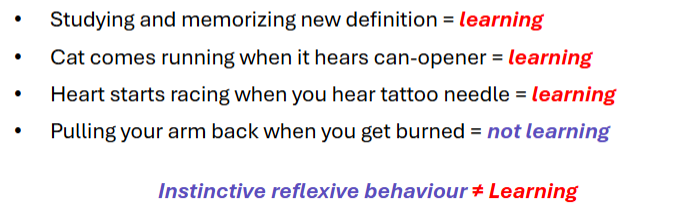
Learning Definition
Any lasting change in behavior or knowledge due to experience; instinctive reactions are not learning.
Watson's View on Development
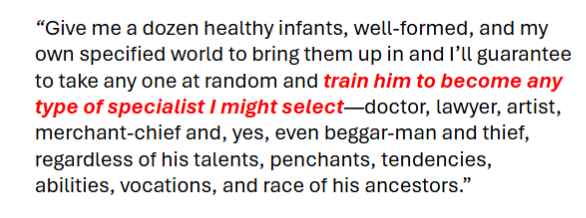
Children are blank slates shaped entirely by experience (nurture over nature).
Waiting to be conditioned by parents, teachers, society
• No innate temperaments (nature)
• Experience is everything (nurture)
Little Albert Experiment - stim gen
Classical conditioning of fear by pairing a white rat (NS) with a loud noise (UCS); generalized fear to similar stimuli.
Albert became fearful other similar stimuli (rabbit, fur coat, Santa Claus mask)
Stimulus generalization: CR extends to other stimuli similar to the original CS
Really, he was just traumatized
Skinner and Operant Conditioning
Behavior is shaped by consequences: reinforcement strengthens behavior; punishment weakens it
Attention of the parents is a possible reinforcer
By yelling at your kid your giving them rignforcement
Positive Reinforcement
Adding a desirable consequence to increase behavior (e.g., praise).
Negative Reinforcement
Removing an unpleasant stimulus to increase behavior.
Punishment
Applying negative consequences to reduce behavior; harsh punishment may increase aggression or anxiety.
You shlould punish and pair with other-oriented induction
Other-Oriented Induction
Discipline strategy highlighting how a child's actions affect others' feelings; promotes empathy
Need guidance to figure out now to regulate
Intermittent Reinforcement
Occasional reinforcement increases resistance to extinction; behavior persists longer.
Key Lesson from Behaviorism
Attention is powerful; inconsistent reinforcement sustains behavior; discipline should guide, not shame.
Bandura's Social Learning Theory
Children learn by observing and imitating others, especially when seeing others reinforced or punished.
Preschool kids watch adult assault Bobo
• Group 1: see adult rewarded
• Group 2: see adult punished
• Group 3: no consequences
When left alone with Bobo:
• Kids from Group 1 & Group 3 acted more violently
• Kids from Group 2 less so
All groups acted violently - Even the kids who didn’t spontaneously act violently had learned from their observations
Observational Learning
Learning through watching others' actions and their outcomes; reinforcement is indirect.
Vicarious Reinforcement
Learning from others' rewards or punishments without direct experience.
Reciprocal Determinism
Children influence and are influenced by their environments (e.g., violent play attracts similar peers).
Media and Violence - violent movie gun story
Violent or competitive media can temporarily increase aggression, but effects are generally small and short-term.
Kids who saw violent movie:
• Spent more time playing with the gun
• Pulled the trigger more often
Why do people find false relations with media consumption and violence
Most studies find no relation between media consumption and actual criminal violence
People are very quick to draw unempirical connections between media and behaviour
These baseless assumptions often reflect people’s own biases and desires than truths about
human psychology
Video games and violence
Meta-analyses currently divided on the effects of video games on kids’ behaviour
The effect sizes we see are usually small
Most studies with sig. effects focused on small scale, short-term outcomes Vs. long-term outcomes like violent crime
Correlation does not equal causation!
• Children who are higher in aggression
Dodge's Social Information Processing Theory
Explains how children interpret and respond to social cues; errors can lead to aggression
Some interpret events as accidental
• No big deals, mistakes happensOthers interpret them as intentional
• Assume negative intent; “What a jerk!
Hostile Attribution Bias
Interpreting ambiguous actions as hostile; linked to reactive aggression and harsh parenting → associated with reactive agression
Reactive = Reaction (emotional outburst)
Proactive = Plan (purposeful action)
HAB association
Hostile attribution biases are associated with harsh parenting:
Children exposed to frequent punishment may see others as more hostile; anxious children interpret neutral cues as negative
Dot probe task → attention bias
If you have an attentional bias towards a particular emotion (happy or angry)..
You’ll spot the X faster when it appears when it appears in the location where your attention was pulled by that emotion
• All children biased toward happy faces
• Only children high in anxiety symptoms showed bias toward angry faces
Dweck's Mindset Theory
Explores how beliefs about ability affect motivation and achievement - kids are motivated by different things
Performance Goals
Focus on demonstrating success or avoiding failure (external validation)
Praise, avoiding failure
Learning Goals
Focus on improving skills and mastering new challenges (intrinsic motivation).
Improving skills
Mastering new tasks
Entity Theory of Intelligence
Attribute outcomes to innate abilities, individual differences
Success: “I’m smart!” Failure: “I must be dumb...”
Self-worth: performance outcomes
linked to lower motivation over time → no change in math scores over time
Encouraging: “your so smart” - to much focus on outcomes
Incremental Theory of Intelligence
Belief that intelligence grows with effort and practice; associated with persistence and higher achievement
Success: “I earned this!” Failure: “I should try harder.”
Self-worth: self-improvement
Higher math socres over 2 years
Promoting Incremental Mindset
Praise effort and strategies ("You worked hard!") rather than fixed traits ("You're smart!").
Self-fulfilling prophecy
Stereotypes lead people to adopt an entity (fixed) mindset, which causes avoidance, anxiety, and poor performance, creating a self-fulfilling prophecy that maintains the stereotype.
“girls are bad at math”
→ She starts believing ability is fixed (entity).
→ She avoids math challenges.
→ Her math skills don’t grow.
→ It looks like the stereotype was right — a self-fulfilling prophecy.
Critiques of Mindset Theory
Replications show smaller effects than claimed; intelligence influenced by genetics and environment.
Lots of factors influence achievement
• Many may not be easy to change through effort
• E.g., genetic component of intelligence
We dont want kids thinking they have the wrong mindset
Can having an incremental orientation influence your fluid intelligence
No
Incremental mindset more likely affects crystallized (learned) intelligence than fluid (problem-solving) intelligence.
Self-Socialization
Children actively shape their own social development through their beliefs, goals, and behaviors.
Selman's Role-Taking Theory
Children's ability to understand others' perspectives develops through stages.
Stage 1 (6-8)
Recognize others have different perspectives due to different information.
Stage 2 (8-10)
Understand others can have different views and can think about their perspective.
Stage 3 (10-12)
Compare own and others' perspectives to evaluate understanding.
Stage 4 (12+)
Consider perspectives in relation to generalized social norms and group expectations.
Ethology
Study of behavior in evolutionary context; behaviors have adaptive survival functions.
Imprinting
Early attachment process where young animals bond to a caregiver during a sensitive period.
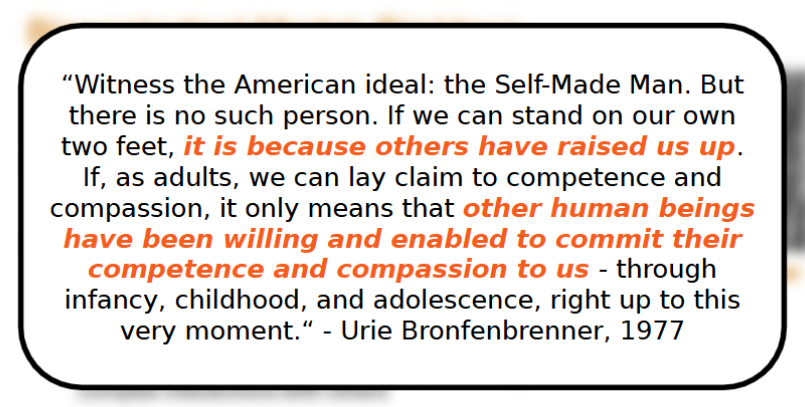
Bronfenbrenner's Bioecological Model
Human development occurs within nested environmental systems influencing each other - 5 levels of context: Microsystem, mesosystem, excosystem, macrosystem, chronosystem
Allowed for better examinations of the role of context in influencing human development
Theories are not static!
Bronfenbrenner later added ideas: Children influence their environments, Children are born with genetic potential, Whether they reach it is influenced by their environment
Microsystem
Immediate relationships and activities (family, peers, teachers).
Mesosystem
Connections among microsystems (e.g., parent-teacher relationships).
Exosystem
Indirect environments affecting the child (e.g., parent's workplace).
Macrosystem
Cultural values, laws, customs, and societal norms shaping development.
Chronosystem
Changes over time (e.g., historical events, technology).
Children and Media
Media exists in the exosystem but is shaped by macro- and microsystem factors like culture and parental involvement.
Sesame Street Effects
Educational benefits vary by generation (chronosystem) and access to quality media (macrosystem).
Screen Time Recommendation
Children ages 2-5 should have ≤1 hour per day of quality screen time with parental guidance.
Media Exposure Concerns
Excessive screen time linked to reduced brain myelination and slower cognitive development.
 Note
Note  Flashcards (53)