BIO230 PART 1 --- EVOLUTION + SPECIES
 Call Kai
 Learn
Learn Practice Test
 Spaced Repetition
 Match
Match Flashcards
 Knowt Play
1/72

There's no tags or description
Looks like no tags are added yet.
Name | Mastery | Learn | Test | Matching | Spaced | Call with Kai |
|---|
No analytics yet
Send a link to your students to track their progress
73 Terms
What is binomial Nomenclature & its significance
binomial nomenclature is carols Linnaeus’ system of a two-part latin name and a hierarchal classification; binomial nomenclature is in italics and it follows Genus, species; we still use this naming/reference system for each species
What 2 important ideas did the Judeo-Christian culture of Darwin’s day impress upon Darwin
and others, which would have made it difficult to generate the theory of evolution? **!*!*!*HELPHEL;PHELP[
earth young and species all at once bc god goat
jean Bapiste Lamarck +impact on Darwin
Lamarck’s theory proposed that species changed overtime by inheritance of acquired characteristics that the organism develops during its lifetime. He believed that these traits wouldn’t be passed to offpsring; Lamarck’s theory helped Darwin confirm that species changed in one way or another
Charles Lyell + impact on Darwin
Lyell argued that geological processes have gradually shaped Earth’s surface; this theory implied that earth was far older than people had believed, which Darwin concluded the evolution of Earths surface (even farther when he found the rocks on area that used to be a beach on the HMS Beagle
Artificial selection + impact on Darwin
Artificial selection is when people breed organisms to have certain traits which benefit humans; this informed Darwin that offspring have variations by chance and that it can be inherited. These offspring might have a better chance at survival and pass this trait onto the next offspring.
Thomas Malthus + impact on Darwin
Malthus argued that human populations grew faster than the resources they depend on. “struggle of existence” which inspired Darwin’s idea of fitness and fueled the idea of natural selection where the fittest for each environment will survive and reproduce.
exaptation
structures that evolve in one context but become adapted for another function; such as flight feathers where light bones of dinosaurs turned to enlarged forelimbs
paedomorphosis
the retention into adulthood features that were solely juvenile in ancestral species; examples include us is skull of fetus comparing to chimpanzee
evo-devo
“evolutionary developmental” studies the evolution of developmental processes in multicellular organisms
homeotic genes
the master control genes which program development by controlling the role, timing, and spatial pattern of changes from zygote into adult
macroevolution
evolutionary change above the species level
order of classification
domain, kingdom, phylum, class, order, family, genus, species
What do images of the forelimb of whales, cats, bats & humans tell us about the common
ancestor of these organisms?
bone structure similar homologous structures = they have common ancestor
the 3 domains; 4 kingdoms of eukaryote
3 domains are bacteria, archea, and eukaryote
systematics
a discipline of biology that focuses on classifying organisms and determining their evolutionary relationships
taxonomy
the identification, naming, and classification of species
homologous structures
similarities between structures of different organisms which help classify their closeness (greater amount= closer species in terms of evolution)
analogous structures
similarities between structures of different organisms by convergence, meaning these similarities are results of independent evolution which are built from different original structures
cladogram
diagrams represent hypothesis of ancestral relationships between organisms. squares represent newly acquired traits, different lines stemming off of the original represent new species as time passes
cladistics
grouping by common ancestry which is based on darwinian concept of descent with modification from a common ancestor
two major ideas of Darwin’s theory of evolution
evolution occurs (organisms change over time and live on earth has changed as descendants diverged from common ancestors); evolution occurs by natural selection (process where organisms with beneficial traits produce more offspring and results in changes in traits overtime)
4 main observations by Darwin made on the scientific expedition (+what expedition)
on HMS beagle:
visited tropical rainforests and new habitats which showed the diversity of life. this implies that different places make organisms adapt to different traits; rocks with fossil seashells due to an earthquake which raised the sea floor. this suggests a dramatic change of continents and oceans over time; rock ledges that were once beaches which indicates slow, steady process of Earth’s surface evolution over time; found fossils of extinct animals which meant that different looking organisms didn’t survive and hints toward natural selection
finches on Galapagos HOLY GUAC ADD I NEED SOMEONES NOTES
Darwin found different finches on the different Galapagos islands. They
fitness
organism’s relative ability to survive and produce fertile offspring. nature selects useful varieties hence the term for natural selection
vestigial structures
structures that reduce in size due to evolution since they are no longer used in organisms; examples include human appendix and tail bone
the 5 lines of evidence for evolution
fossil records, biogeography, comparative anatomy, comparative embryology, and molecular biology
fossil record; meaning, support of evolution, examples, any inconsistencies, and how it helped Darwin
fossils are remains of prehistoric organisms. They support evolution by marking milestones in an organisms development which can be compared and demonstrate transformations over time. An example includes horse fossils which represent that they had toes which eventually turned into one and later a hoof, they grew taller over time, and their teeth got longer in order to grind tougher grass. On the HMS beagle, Darwin found fossils of extinct animals which convinced him of changes occurring overtime and that organisms with unsuitable traits will die off.
Biogeography; meaning, support of evolution, ex, inconsistencies, how it helped Darwin
the study of how and why plants and animals live where they do. An example is camels that originally lived in North America. Some camels moved and eventually adapted new traits for this new environment and they evolved independently. Darwin experienced this concept of biogeography when he reached the Galapagos island. He saw finches of different beaks which were tailored for the food meant on those islands.
Comparative anatomy; meaning, support of evolution, ex, inconsistencies, how it helped Darwin
the study of similarities in the structures of different species. There are different types of structures such as homologous and analogous, which aren’t always easy to differentiate.
comparative embryology; meaning, support of evolution, ex, inconsistencies, how it helped Darwin
the study of similarities and differences in the embryos of different species. Many species share similarities as embryos and grow out of them.
Molecular biology; meaning, support of evolution, ex, inconsistencies, how it helped Darwin
reading DNA and amino acids to find a way to organize evolutionary ancestry. Also, when organisms have similar DNA and less mutations in comparison, it supports the idea that organisms adapt and indicates a close relationship
sources of genetic diversity/variation
mutation and sexual reproduction
mutation as source of genetic diversity
random changes in nucleotide sequence of DNA that can result in new alleles and produces genetic variation; immediately adds to gene pool of a population
sexual reproduction as source of genetic diversity
fresh assortments of different alleles thanks to the process of independent assortment, random fertilization, and crossing over. Each zygote has a unique assortment of alleles
Hardy-Weinberg Equilibrium
a non evolving population that is in a constant gene pool; genotypes are unchanged
microevolution
a change in a population’s frequency of alleles; “evolution is a generation to generation change in a population’s frequency of alleles”
what each term represents in the ultimate hardy Weinberg equilibrium
p = relative frequency of one allele; q = relative frequency of the other allele; p squared is the probability of drawing gametes resulting in homozygous of that allele while q squared is the other allele and 2pq represents the homozygous —— P² + 2PQ + Q² = 1
How do genetic variation within a population/species and overproduction of offspring set the
stage for “differential reproductive success?” How does DRS yield evolution by natural
selection?
Genetic variation provides the raw material for natural selection, while overproduction of offspring leads to competition for resources. Those individuals with advantageous traits are more likely to survive and reproduce, thus passing on those traits to future generations, resulting in evolutionary change. Basically, species with beneficial traits will survive in the “struggle for existence” and pass on this mutation/genetic variation.
relative fitness
the contribution an individual makes to a gene pool of the next generation relative to the contribution of other individuals; fittest individuals in the context of evolution are those that produce fertile offspring
natural selection
evolutionary process where organisms best suited to their environment are more likely to survive and pass on their traits to future generations + is adaptive since it promotes traits that lead to survival and reproduction
types of natural selection
directional selection, disruptive selection, and stabilizing selection
directional selection
shifts the overall makeup of a population by selecting in favor of one extreme phenotype over the other; example being insect populations shifting toward a greater frequency of pesticide resistance and the rat fur favoring very light gray over very dark or vice versa
disruptive selection
balance between two or more contrasting extreme phenotypes in a population; ex light and dark grey being favored over intermediate fur
stabilizing selection
favors intermediate phenotypes and typically occurs in a relatively stable environment; example of human baby weight balanced between 2-4 kg.. lower or higher weight results in infant mortality; other example is mice with intermediate fur being favored over unusually light or dark mice
genetic drift
a change in the gene pool of a population due to chance (smaller population which misrepresents the original generation of alleles); is not usually adaptive since it results in less genetic variability
types of genetic drift
founder effect and bottleneck effect
founder effect
results from establishment of a small, new population whose gene pool differs from that of the parent population; example is the 15 British individuals that founded an island on Tristan da Cunha. One arrived with the recessive allele for blindness which raised the frequency of this allele
bottleneck effect
due to drastic reduction of a population size; examples including natural disasters which reduce the gene pool to the surviving population and a large amount of cheetahs dying in the last ice age which resulted in less genetic variability and reduced the capacity of adaptation
gene flow
a population gains or loses alleles when fertile individuals move into or out of the populations or gametes are transferred between populations; example is humans migrating very often today which transfers genetic material between populations
sexual selection
a form of natural selection in which individuals with certain traits are more likely to obtain mates
sexual morphism
distinction in appearance that aren’t necessarily connected to reproduction or survival which are referred to as secondary sex structures; examples include male peacock’s tale which are picked by a female
mutation as a mechanism of microevolution
a change in the sequence of bases in DNA which creates new genetic variations in a gene pool
Do natural selection and sexual selection align in terms of which traits are
adaptive?
Natural selection and sexual selection can align as they may both favor traits that enhance fitness, but sometimes they can be at odds if a trait advantageous for mating reduces survival. ex: male peacock tail attracts mates if its like brighter in color but its also harder to maintain
how can species be defined
there are different concepts to apply due to certain limitations; there is a biological species concept and a morphospecies concept
morphospecies
species defined by their anatomical features
biological species concept
a population or group of populations whose members have the potential to interbreed in nature and produce fertile offspring
speciation
the process in which one species splits into two or more species; there is allopatric speciation and sympatric speciation
allopatric speciation + ex
when a population forms a new species after being geographically isolated from its parent population; initial block to gene flow is geographic barrier. Examples include the speciation that occurred on the Galápagos Islands following the migration of one finch from South America to then split into multiple different species by altering beaks to tailor it to food sources
sympatric speciation + ex
the origin of a new species without geographic isolation where it becomes REPRODUCTIVELY isolated; occurs when part of a population becomes new species while still in midst of parental population. Example includes when an accident occurs during cell division which results in polypoid cells which cannot produce fertile hybrids.
allopatric and sympatric speciation in terms of salamander
!!!!!!!!!
In what way is the process of evolution like tinkering or editing? What is being edited? But,
what is natural selection acting upon?
The process of evolution occurs through random mutations that can be beneficial, neutral, or harmful. As mutation occurs (altering DNA bases), nature supports the traits given by these mutations which are beneficial. The organism with that mutation will have an easier time surviving and reproducing.
reproductive barrier
anything that prevents individuals of closely related species from interbreeding; examples include traits like odor, coloration, or courtship ritual
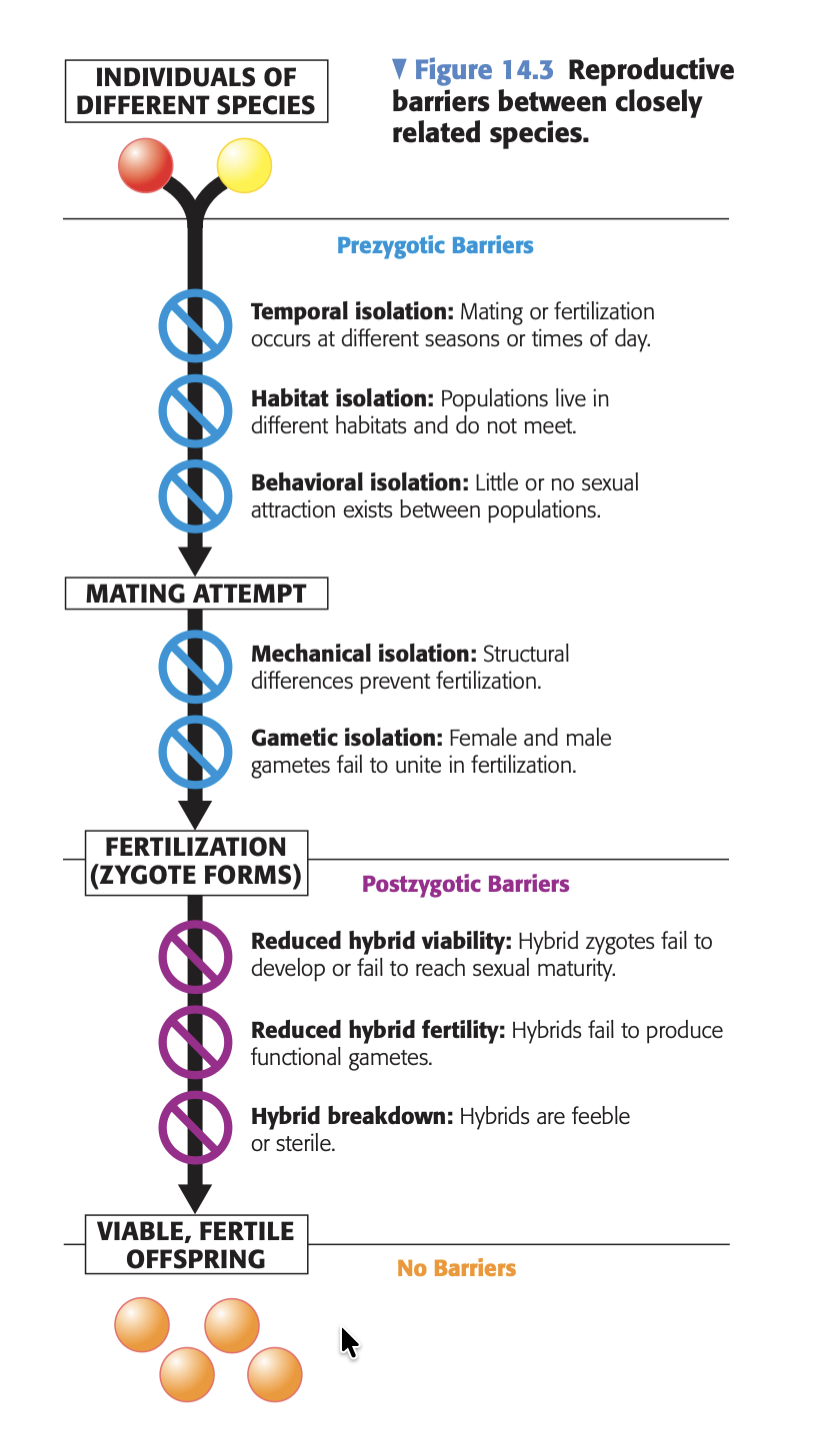
pre-zygotic barriers
barriers that occur before forming zygote between two different species; types include temporal, habitat, behavioral, mechanical, and gametic
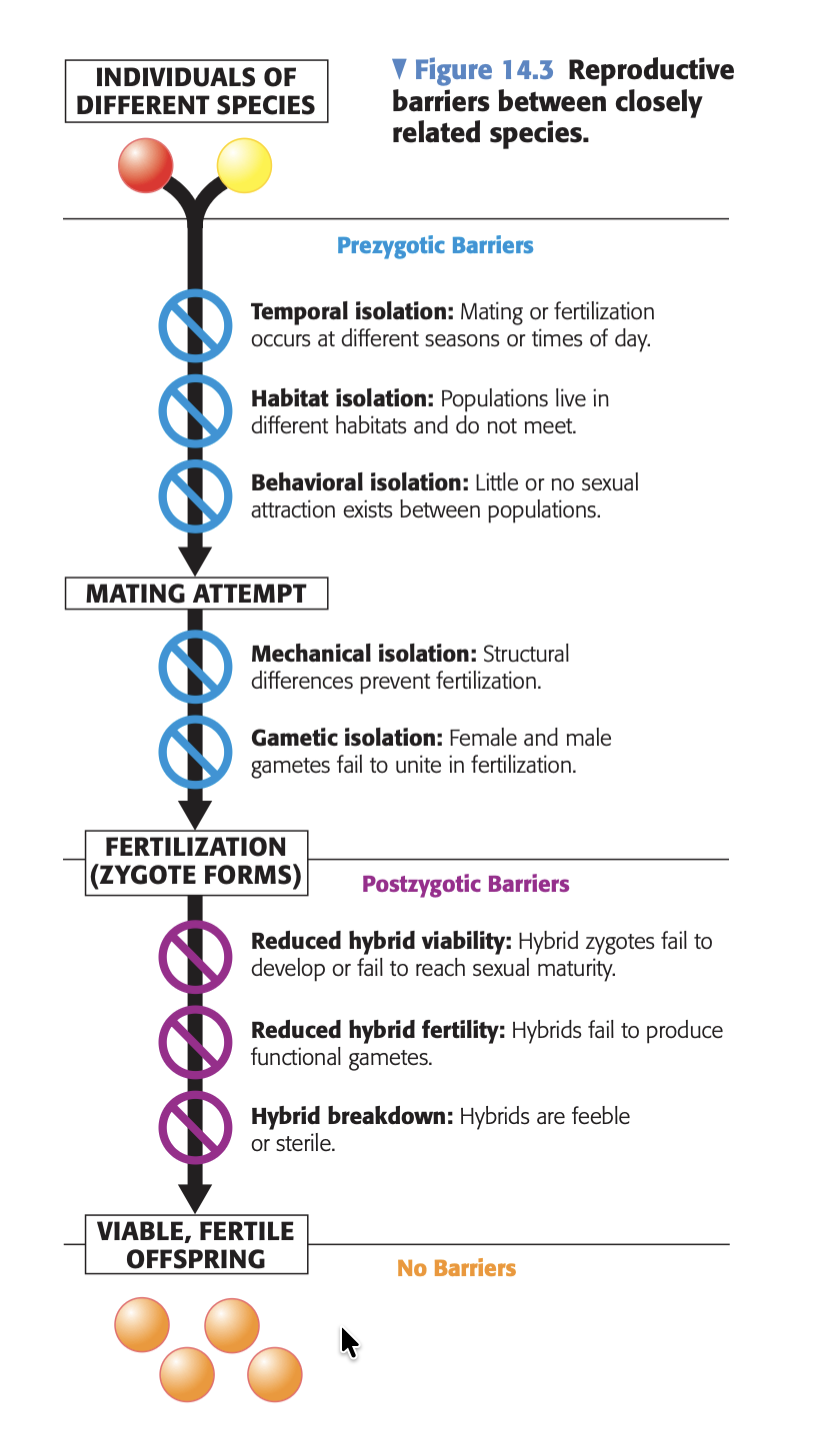
temporal isolation
time based barrier that prevent species from mating (such as western versus eastern skunks which breed during different seasons)
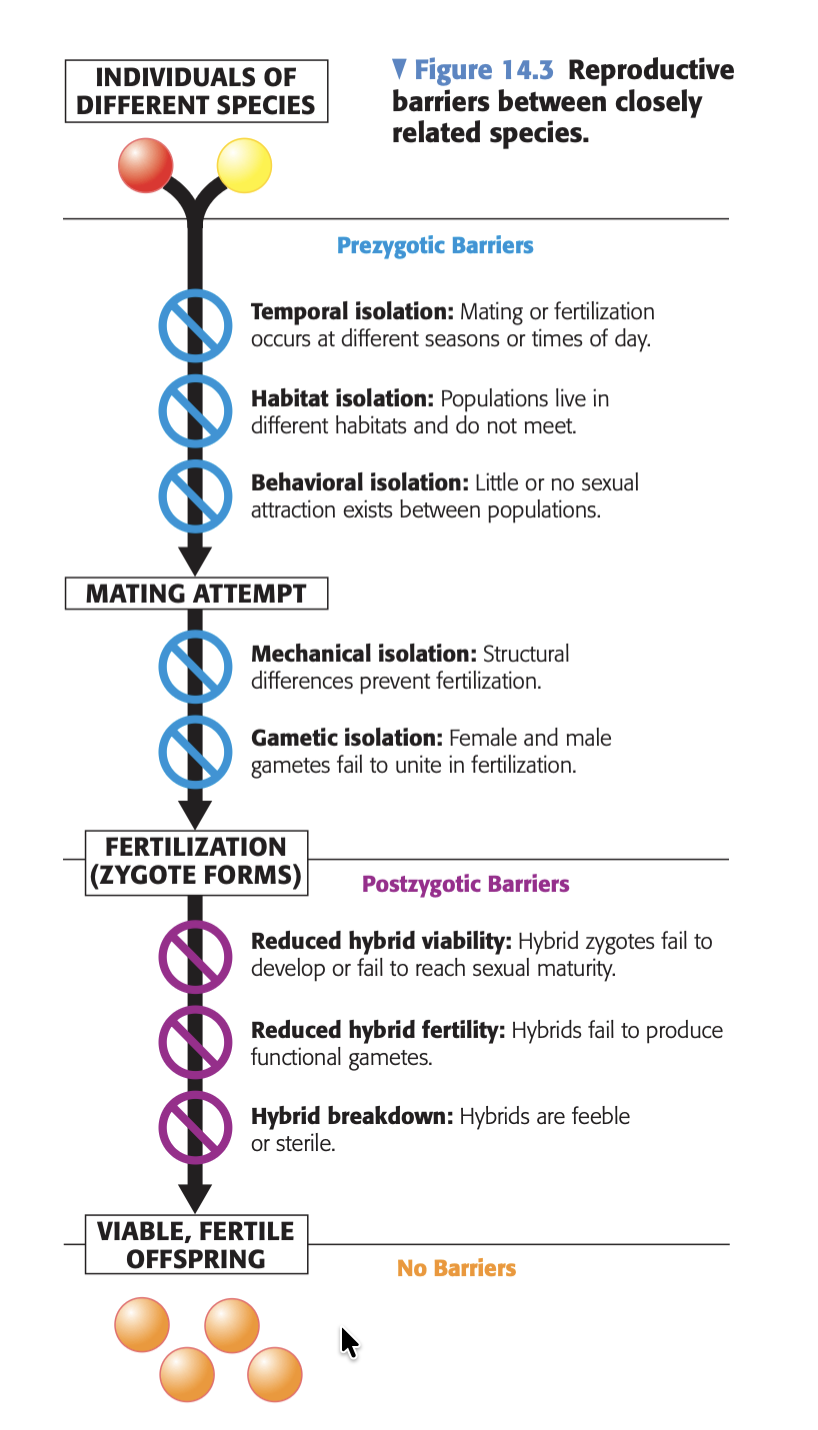
habitat isolation
species living in same region but not in same habitat (like land vs water garter snakes)
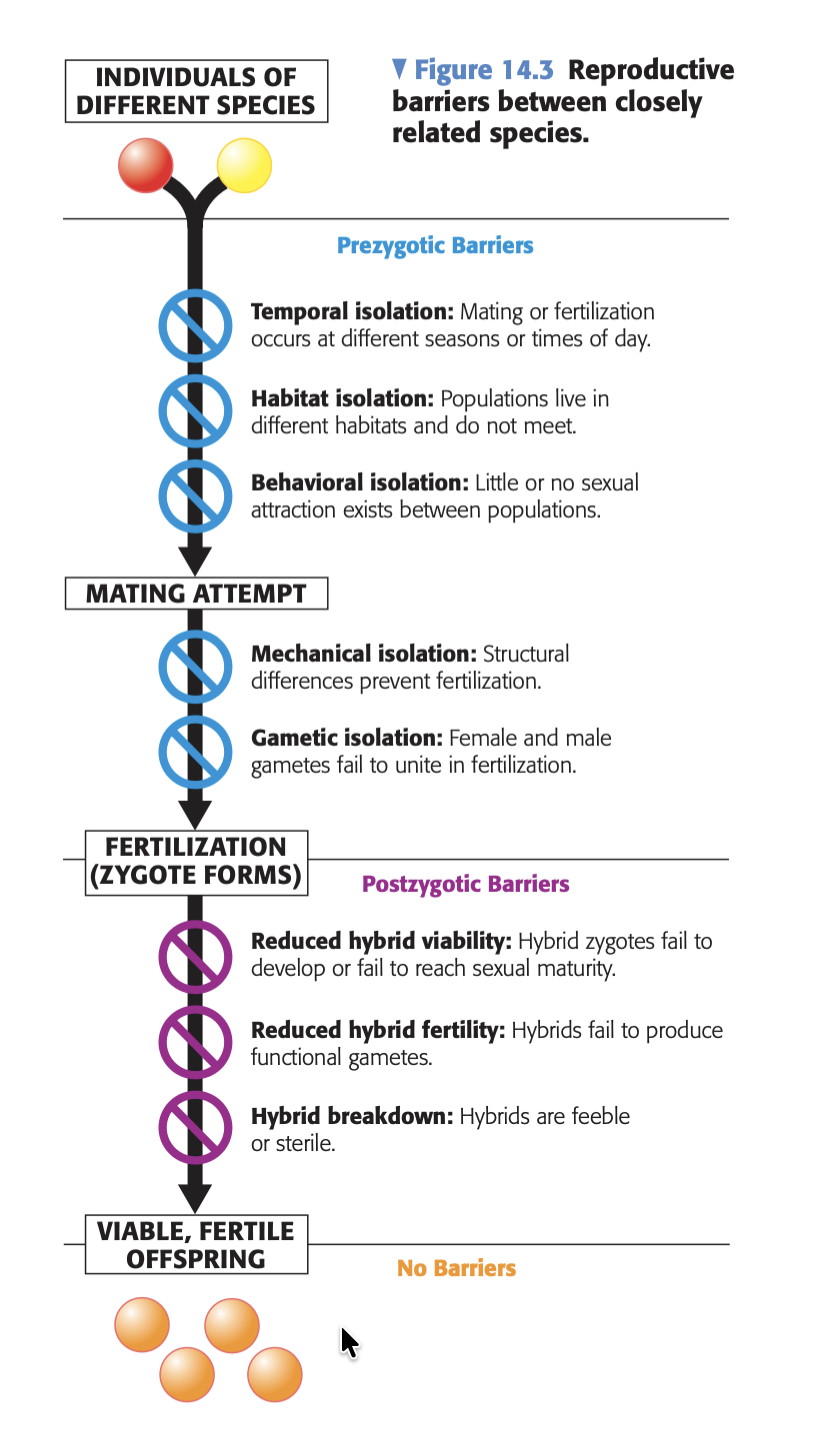
behavioral isolation
little to no sexual attraction between species
mechanical isolation
The gamete producing structures of different species are anatomically incompatible; example being two closely related species of snails who cannot join their sex organs due to their shells spiraling in different directions
gametic isolation
female and male gametes failing to unite during fertilization since these gametes are incompatible; gametic isolation is especially important when fertilization is external. Male and female sea urchins release eggs and sperm into the sea, but fertilization only occurs if species-specific molecules on the surfaces can attach to each other.
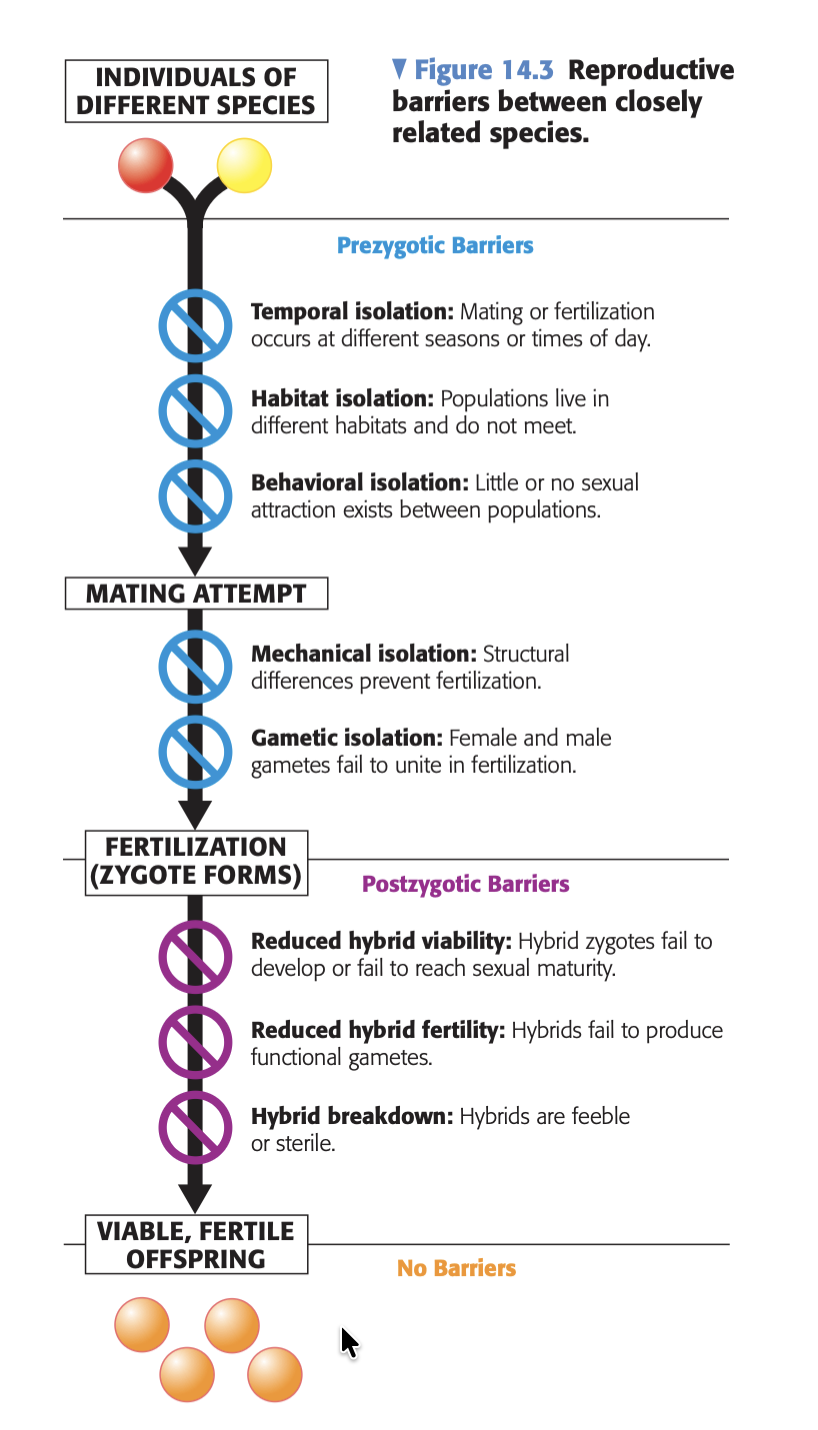
post-zygotic barrier
operate if interspecies mating actually occurs and results in hybrid zygotes; types include reduced hybrid viability, reduced hybrid fertility, and hybrid breakdown
reduced hybrid viability
occurs when hybrid offspring die before reproductive maturity; example of salamanders of different species that have offspring which fail to develop normally due to genetic incompatibility
reduced hybrid fertility
when hybrids fail to form functional gametes; example: male donkey x female horse = mule, which cannot successfully breed with another mule (due to horses and donkeys not having even homologous pairs for cell division)
polypoid
often, an accident during cell division that results in an extra set of chromosomes is a common route to sympatric speciation; new species that evolve like this have polypoid cells and cannot produce fertile hybrids with its parent species
hybrid breakdown
if these first generation hybrids are viable and fertile and breed, these hybrid x hybrid offspring are far too meager or feeble to survive and reproduce

