Final - Lesson 9 - Neuroplasticity & Development
 Studied by 0 people
 Call with Kai
 Learn
Learn Practice Test
 Spaced Repetition
 Match
Match Flashcards
 Knowt Play
1/23

There's no tags or description
Looks like no tags are added yet.
Name | Mastery | Learn | Test | Matching | Spaced | Call with Kai |
|---|
No study sessions yet.
24 Terms
What is the Life History Theory?
Study the process of life: birth, growth, reproduction, death
Energy allocation to:
Growth (particularly focused on)
Repair and maintenance
Reproduction
What are some notable developments in the history of human life?
Altriciality
Late reproduction (compared to other primates)
Long lifespan
High investment of parental care (due to altriciality)
Bi-parental investment
Social learning, cultural transmission
What is Altriciality?
Humans are born helpless; they cannot fend for themselves.
They are reliant on another(s) human to take care of them.
What is Bi-Parental Care?
Two parents take care of the offspring.
In humans there is usually also a larger network to take care of offspring (kin).
What are the 5 stages of primate life development?
Gestation
Lactation
Juvenile
Adult Reproductive Period
Post-Reproductive Period
What is noteworthy about human’s life stage lengths compared to non-human primates?
Humans have the longest gestation period.
Humans live much longer (especially in post-reproductive period).
But compared to other primates (esp. chimpanzees) we have the same amount of juvenile period and reliance on parents until adulthood.
How large are human newborns compared to other great apes?
~2x the size.
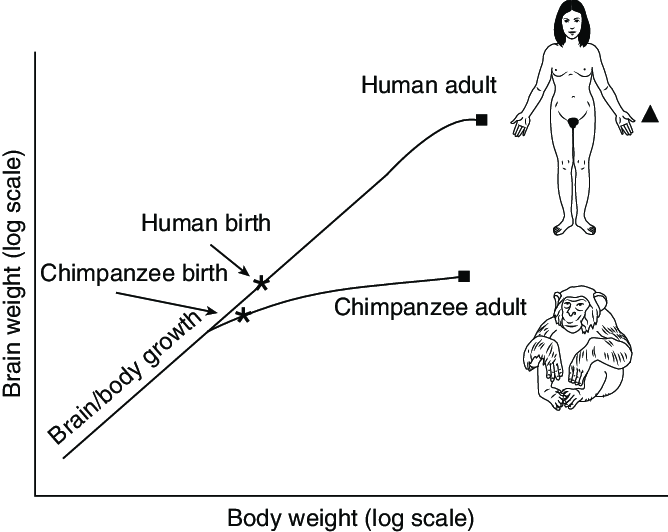
How heavy are human brains compared to other great apes (neonatal and adult)?
Human neonatal brain weight = 25% of adult brain weight
Chimpanzee neonatal brain weight = 35% of adult brain weight
How does brain growth in humans and chimpanzees compare during development?
In humans, after birth, the brain keeps growing at a fast rate beyond the point when it stops growing in chimpanzees, but the human body does not grow longer than the body grows in chimpanzees.
In chimpanzees — the body continues to grow, but the rate at which the brain grows is slower
In Humans — the brain develops more and faster (the accelerated growth post-natally is part of the reason why our brains are so large).
What is the brain growth during development in humans, gorillas, chimpanzees, old world monkeys, and new world monkeys?
Human brains grow in volume much more than other apes, and it is very accelerated in the first few years of life before plateauing.
Apes you still see a little bit of accelerated growth, but the slope is much less steep, the brain volume is less than half (less growth + shorter amount of times than in humans)
Monkeys barely have any accelerated growth, it is almost like the brain at birth is the size it is going to be throughout their adult life
How do human babies compare to chimpanzees?
Human babies are bigger in body size than chimpanzees.
Human neonatal brain is less developed than chimpanzees.
Human babies are born helpless (altricial).
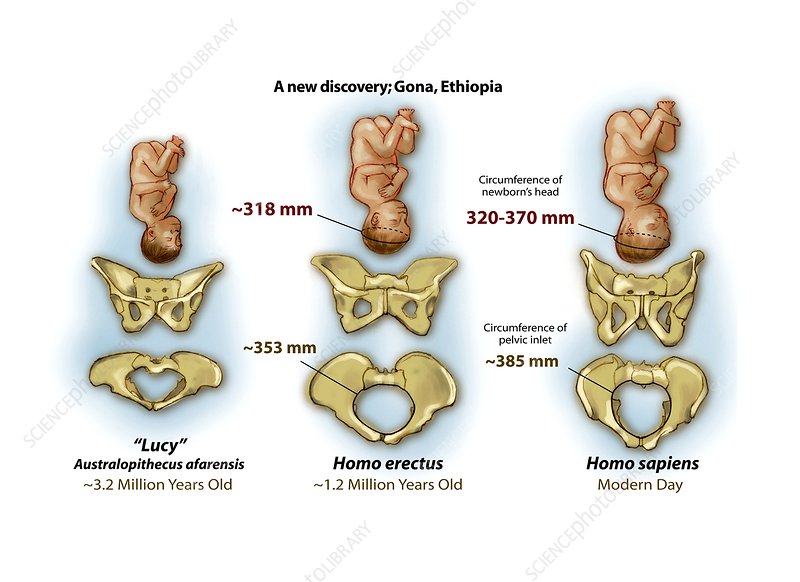
What is the 1st hypothesis of why human brains are less developed after birth?
Obstetrical constraints.
What are obstetrical constraints to growing a large brain?
Pelvic adaptations to bipedalism in humans.
As we developed bipedalism, our physical skeleton changed and reflected anatomic differences to support this mechanical need, which in this case is a shorter pelvis.
Tight fit in the birth canal as brain size increases during human evolution.
Maybe babies are born with smaller brains because there are physical constraints that limit the birth process without severely endangering the mother and baby.
What is the 2nd hypothesis of why human brains are less developed after birth?
Metabolic constraints.
(also applicable to chimpanzees, but particularly important for humans because of the excessive need for energy)
What are metabolic constraints to growing a large brain?
Around 9 months of gestation, fetus’ energy demands exceed the mother’s capacity for supply
Afterwards, to keep growing a baby with such a large brain, it would exceed the mother’s capacity to supply the baby with necessary energy without depleting herself and her survival
Therefore, gestation must end
Hence, humans are born with immature brains
Brain maturation is completed after birth (postnatally)
Fast brain growth rate, energetically demanding
Energy supplied externally (in utero)
What does this mean for the development of the human brain?
This is looking at Tinbergen’s development level of analysis (lifespan) / ontogeny.
Human brain growth is highly influenced by the environment.
It allows for greater neuroplasticity.
What is neuroplasticity?
The capacity of the brain to reorganise neural connections in response to experience, learning, and injury.
Because the brain continues to develop after birth, it is highly influenced by the environment, hence why there is a higher capacity for neuroplasticity.
What are the two types of neuroplasticity?
Structural plasticity
eg. forming new synapses
connections between neurons, helps learning
Functional reorganization
eg. following a stroke
areas of the brain may take on new functions after a particular area is affected
What is synaptogenesis?
Formation of new synapses between neurons.
Occurs throughout the lifespan, but especially during early years of brain development.
Followed by synaptic pruning (removal or weakening of synapses)
Important for learning new skills
When does the prefrontal cortex mature?
Later in life.
Different areas develop and undergo synaptogenesis and pruning at different times in life.
Specifically, the prefrontal cortex (association cortex) develops later in life (inputs from other brain areas).
Primary motor and somatosensory cortices process inputs from direct inputs (eg sensations), not other brain areas, develop very early in life and then are pretty much done for the rest of life.
—> makes sense considering babies need sensory functions very early after birth, mainly interact and develop sensory functions.
How did the delayed maturation of the human prefrontal cortex evolve?
Tinbergen’s evolution level of analysis.
Delay in prefrontal cortex development is not present/apparent in monkeys and chimpanzees.
What are the functional types of cortical areas?
Motor areas
Sensory areas
Association areas (eg prefrontal cortex)
What did Hill et al. study?
Association areas expanded in the human brain.
Similar patterns of cortical expansion during human development and evolution.
Humans have up to 32x larger areas of the brain.
—> esp the prefrontal cortex is much larger in humans than macaques
 Note
Note  Flashcards (23)