Topic 10 – Population Ecology
 Call Kai
 Learn
Learn Practice Test
 Spaced Repetition
 Match
Match Flashcards
 Knowt Play
1/22

There's no tags or description
Looks like no tags are added yet.
Name | Mastery | Learn | Test | Matching | Spaced | Call with Kai |
|---|
No analytics yet
Send a link to your students to track their progress
23 Terms
Population ecology
groups of individuals of the same species living together, examining how their numbers and distribution change over time
divided into spatial attributes (size, range, dispersion) and temporal attributes (demography, life history, population dynamics)
Abundance
Total number of individuals (absolute or relative)
Density
Number of individuals per unit area/volume
Quadrat
Defined survey area used to count sessile organisms
Mark-recapture
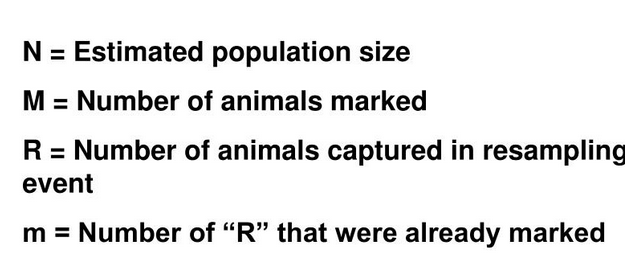
Method estimating mobile population size using N = RM/m
Population index
Indirect evidence (tracks, scat, eDNA) used to estimate population size
Dispersion
Spatial pattern of individuals: clumped, uniform, or random
Demography
Study of population age/stage structure over time
Survivorship
Proportion of individuals surviving to a given age
Type I survivorship
Low early mortality, high late mortality (e.g. humans, elephants)
Type II survivorship
Constant mortality throughout life (e.g. songbirds)
Type III survivorship
Very high early mortality, few survive to reproduce (e.g. fish, frogs)
Fecundity
Average number of female offspring produced per female per lifetime
Life history trade-off
Resources invested in reproduction reduce investment in survival, and vice versa
Semelparous
Reproducing once then dying (e.g. salmon, century plant)
Iteroparous
Reproducing multiple times over a lifetime (e.g. elephants, trees)
Per capita growth rate (r)
Rate of population change per individual; r = (B−D)/N
Exponential growth
Accelerating growth when r is constant and resources are unlimited (J-curve)
Logistic growth
Growth that slows as population nears carrying capacity (S-curve)
Carrying capacity (K)
Maximum population size a habitat can sustainably support
Density-dependent factors
Factors whose impact scales with population size (competition, disease, predation)
Density-independent factors
Factors that affect populations regardless of size (weather, disasters, habitat loss
Age structure
Distribution of individuals across age classes; predicts future population growth

