spaceflight
 Studied by 2 people
 Call Kai
 Learn
Learn Practice Test
 Spaced Repetition
 Match
Match Flashcards
 Knowt Play
1/17

There's no tags or description
Looks like no tags are added yet.
Name | Mastery | Learn | Test | Matching | Spaced | Call with Kai |
|---|
No analytics yet
Send a link to your students to track their progress
18 Terms
what is the Hohmann transfer
The minimum-energy, two-impulse transfer orbit between two coplanar circular orbits.
t consists of:
First impulse to enter an elliptical transfer orbit.
Second impulse at the destination to circularise.
Key features:
Transfer orbit is tangent to both initial and final circular orbits.
It is the most fuel-efficient transfer (but not the fastest).
Used extensively in interplanetary missions.
comment on viability of the Hohmann of earth and another planet
Key points:
Very high ΔV requirement (~9–10 km/s) just to circularise at Mercury.
Mercury’s deep gravity well makes capture extremely expensive.
Large inclination change is required because Mercury’s orbit is tilted (~7°) relative to Earth.
Strong solar gravity near perihelion → high velocities → difficult braking.
Thermal environment near the Sun is severe.
1(a) How is the principal direction defined in Orbital Mechanics? [5]
The direction from the central body (focus of the orbit) to the periapsis of the orbit.
More formally:
It is the direction of the eccentricity vector.
It lies in the orbital plane.
It points toward periapsis (perigee/perihelion).
It defines the reference direction for measuring true anomaly θ.
True anomaly is measured from the principal direction.
Key examiner phrases to include:
“Direction to periapsis”
“Along the eccentricity vector”
“Reference direction in the orbital plane”
“Used to define true anomaly”
What are ecliptic and equatorial coordinates?
Equatorial coordinates are defined with respect to:
Earth’s equatorial plane
Earth’s rotation axis
They use:
Right Ascension (RA) – like longitude, measured in the equatorial plane
Declination (Dec) – like latitude, measured north/south of the equator
Used mainly for Earth-based observations and satellite tracking.
Ecliptic coordinates are defined with respect to:
The plane of Earth’s orbit around the Sun (the ecliptic plane)
They use:
Ecliptic longitude
Ecliptic latitude
Used mainly for solar system dynamics and interplanetary motion.
What are Keplerian Orbital Elements and how are they used?
these enable the precise size, shape and location of a Keplerian orbit to be defined in 3 dimensions and for the satellite to be located.
Six parameters that uniquely define the size, shape, orientation, and position of an orbit in space. Keplerian elements define the geometry and orientation of an orbit and locate the spacecraft on that orbit at any time.
They are:
Semi-major axis (a) – size of the orbit
Eccentricity (e) – shape of the orbit
Inclination (i) – tilt of the orbit relative to reference plane
Right Ascension of Ascending Node (Ω) – orientation of the line of nodes
Argument of Periapsis (ω) – orientation of periapsis in the orbital plane
True anomaly (θ) – position of the spacecraft on the orbit
They are used to:
Completely describe an orbit
Predict spacecraft position and velocity
Design and analyse trajectories
Propagate orbits in time
ballistic coefficient BC
It is a measure of the capacity of an aerospace vehicle or projectile to “punch through” the atmosphere with minimal loss of speed
An object with a high BC will be slowed down less during its passage through a gas than will an object with a low BC; a feather, for example, will have a much lower BC than a pebble of the same mass. (Imagine trying to throw a feather).

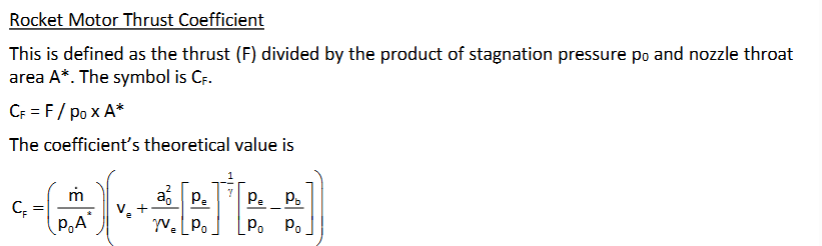
rocket motor thrust coefficient
characteristics velocity definition

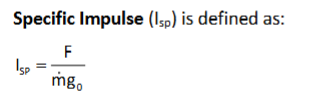
specific impulse definitions
It is a measure of the overall propulsion system performance and has
dimensions of time. Specific Impulse is numerically equal to the time in seconds for which a given
quantity of propellant mixture would produce its own weight in thrust.
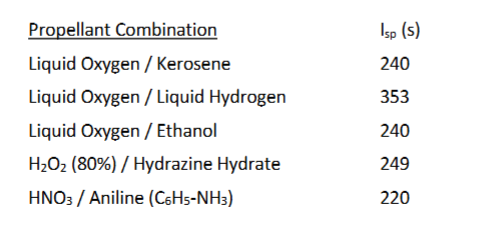
types of propellant combination
what is staging and why is it used
mass reduction means better performance
Rockets are extremely sensitive to mass. Carrying empty tanks and dead engines hurts efficiency. By dropping spent stages, the remaining vehicle is lighter, so:
It accelerates more easily
It can reach higher speed (∆v) for the same fuel
Optimizing engines for different flight regimes
Different parts of flight have different needs:
First stage: high thrust, works in dense atmosphere
Upper stages: lower thrust, high efficiency in vacuum
Staging lets you use the best engine type for each phase instead of compromising with one design.
Structural and thermal limits
Lower stages are built strong to handle:
High loads
Atmospheric pressure
Heating
Upper stages can be lighter and more delicate because they operate in near-vacuum.

types of staging
Types of staging
Serial (stacked) staging: one on top of another (most common)
Parallel staging: boosters burn alongside the core (e.g., Falcon Heavy, Space Shuttle)
Air-launch staging: first “stage” is an airplane (e.g., Pegasus)
Key considerations in controlled atmospheric entry
1. Thermal loads (heating)
Aerodynamic heating due to compression and friction
Must keep heat flux and total heat within TPS limits
2. Deceleration (g-loads)
High drag → high deceleration
Must keep within human / structural tolerance
3. Trajectory & flight path angle
Too steep → excessive heating and g
Too shallow → skip-out or excessive range
4. Vehicle stability & control
Must maintain correct attitude
Avoid tumbling / loss of control
5. Landing accuracy & footprint
Entry corridor must place spacecraft near target
Important for recovery and safety
6. Atmospheric uncertainty
Density variations, winds, weather
The design of controlled entry is governed by thermal protection limits, allowable deceleration, trajectory shaping to avoid skip-out or burn-up, vehicle stability and control, and landing footprint accuracy under atmospheric uncertainty
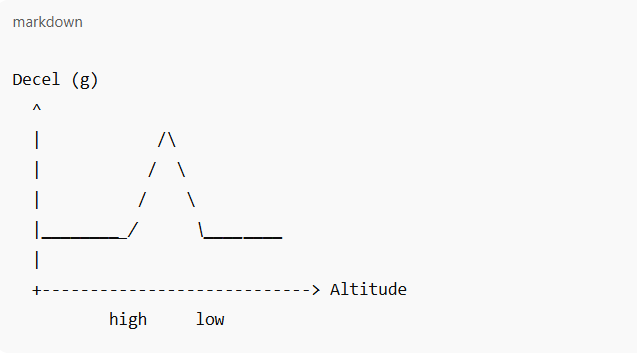
Deceleration vs altitude for ballistic capsule
Explanation:
At high altitude:
density is very low → drag small → low deceleration
As altitude decreases:
density rises exponentially → drag increases rapidly → deceleration rises sharply
Near lower atmosphere:
speed drops → drag reduces → deceleration peaks then falls
so deceleration peaks at intermediate altitude
parameter that influence deceleration
Ballistic coefficient β=mCDA\beta = \frac{m}{C_D A}β=CDAm
high β → deeper penetration, higher peak g
low β → earlier decel, lower peak g
Entry velocity
Atmospheric density profile
Drag coefficient CDC_DCD
Entry angle
Cryogenic and hypergolic propellants
cryogenic = propellants stored at extremely low temperatures (liquid hydrogen and liquid oxygen
Features:
Very high performance (high Isp)
Complex storage, boil-off issues
hypergolic = fuel and oxidizer ignite spontaneously on contact (MMH + N204)
Features:
Very high performance (high Isp)
Complex storage, boil-off issues
How launch to LEO proceeds
Vertical lift-off
Pitch-over manoeuvre
Gravity turn
First stage burnout and separation
Upper stage burn to reach orbital velocity
Circularisation burn
why staging is used
because Dead mass severely reduces performance (rocket equation).
Staging:
discards empty structure
increases mass ratio
improves efficiency
 Note
Note  Flashcards (100)