Karyotype and Pedigree review
 Studied by 0 people
 Call with Kai
 Learn
Learn Practice Test
 Spaced Repetition
 Match
Match Flashcards
 Knowt Play
1/41

There's no tags or description
Looks like no tags are added yet.
Name | Mastery | Learn | Test | Matching | Spaced | Call with Kai |
|---|
No study sessions yet.
42 Terms
Karyotype
A display of the chromosome pairs of a cell arranged by size and shape.
Sex Chromosomes
Chromosomes that determine the sex of an organism (X or Y in humans)
Autosomes
non-sex chromosomes
Genetic Disorder
An abnormal condition that a person inherits through genes or chromosomes
Trisomy
3 copies of a chromosome
Monosomy
missing a chromosome
Down Syndrome
a condition of intellectual disability and associated physical disorders caused by an extra copy of chromosome 21.
Turner Syndrome
A chromosomal disorder in females in which either an X chromosome is missing
Nondisjunction
Error in meiosis in which homologous chromosomes fail to separate.
Pedigree
A diagram that shows the occurrence of a genetic trait in several generations of a family.
Homozygous
Having two identical alleles for a particular gene
Heterozygous
having two different alleles for a trait
Carrier
A person whose genotype includes a gene that is not expressed in the phenotype.
Dominant
Describes a trait that covers over
Recessive
Describes a trait that is covered over
chromosomal disorders
disorders that result when too many or too few chromosomes
Genome
all of an organism's genetic material
sex chromosomes
Chromosomes that determine the sex of an individual
Inheritance
The process in which genetic material is passed from parents to their offspring.
Mutation
A change in a gene or chromosome.
generation
A group of people born around the same time
law of segregation
the law stating that members of each pair of genes separate or segregate when gametes are formed
law of independent assortment
the law that describes genes encoding for different traits separating from one another independently during the formation of gametes
product rule
the rule that states that the probability of 2 or more independent events occurring together is the product of the individual probabilities of each event occurring alone
complete dominance
no mixing of colors of fur, hair, etc
incomplete dominance
mixing of the colors, neither trait is dominant
codomiance
they mix together entirely, both traits are shown in the phenotype, BW, WW, BB
autosome
chromosome that isn’t a sex cell
sex linked trait
when the trait is controlled by a gene found on one of the sex chromosomes, most sex linked traits are carried on the X chromosome (the dad), color-blindness is carried by the woman but usually found on the son
polygenic inheritance
a process in which two or more genes affect the same characteristic
karyotype
a line on the chromosome that identifies itself as a different trait
down syndrome
extra chromosome
klinefelter’s syndrome
a man with XXY (an extra X chromosome, meaning he probably makes more estrogen than testosterone)
turner syndrome
a genetic disorder resulting from a missing ex chromosome, female has only one X chromosome
restriction enzyme
the little line on the DNA fingerprinting machine from the forensics video
gel electrophoresis
basically making the DNA more visible
determine if the trait in the pedigree is dom or recessive
step 1
determine the genotypes of the individuals
step 2
use the genotypes to create a punnett square to solve the pedigree
step 3 and final step of solving a pedigree
monohybrid cross
a genetic cross involving individuals both heterozygous (Tt) for one trait
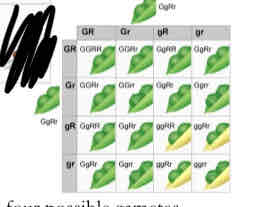
dihybrid cross
a genetic cross involving individuals both heterozygous for 2 traits, requires a larger punnett square, meaning 4 of each parent
 Note
Note  Flashcards (20)