Georgia Social Studies 8 - 2nd Semester interim
 Studied by 7 people
 Call Kai
 Learn
Learn Practice Test
 Spaced Repetition
 Match
Match Flashcards
 Knowt Play
1/49

Earn XP
Description and Tags
Name | Mastery | Learn | Test | Matching | Spaced | Call with Kai |
|---|
No analytics yet
Send a link to your students to track their progress
50 Terms
Regions
Appalachian Platteau, Ridge and Valley, Blue Ridge, Piedmont, Coastal Plain
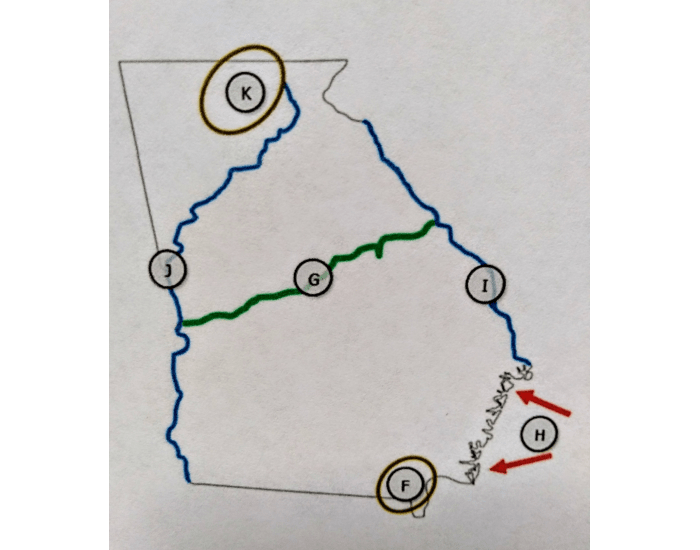
Physical features
K - Appalachian Mountains
J - Chattahoochee River
I - Savannah River
G - Fall Line
F - Okefenokee Swamp
H- Barrier Islands
Entrepreneur
A person who creates a business, taking on greater financial risks in order to do so
Budget
A detailed plan of how money should be used
Important Industries
Agriculture - MOST IMPORTANT
Manufacturing
Entertainment
Service
Technology
Voting Requirements
Adult (18 or more y/o)
US citizen
Resident of GA and of district where you wish to vote for
Not serving prison sentence due to felony convictions
Not declared mentally incompetent
House of Representative Requirements and Term Length
∙ 21 years old
∙ Resident of Georgia for two years
∙ Resident of district for one year
∙ U.S. Citizen
. 2 years term
Senate Requirements and Term Length
. 25 years old
∙ Resident of Georgia for two years
∙ Resident of district for one year
∙ U.S. Citizen
. 2 years term
Governor Requirements and Term Length
30 years old
US citizen for 15 years
Resident of GA for 6 years
4 years term
Has to take a break tern
Lieutenant Governor Requirements and Term Length
30 years old
US citizen for 15 years
Resident of GA for 6 years
4 years term
Can serve unlimited terms consecutively
Law Making Process
Bill started as an idea and is created
Bill is formally introduced to one of the two chambers in the GGA
Bill is assigned to a standing committee to study and revise
Chamber will vote on bill
YAY: approved, will go to next chamber
NAY: disapproved, bill is killed
If YAY, bill is introduced to next chamber
Same process continues, committee will study the bill and put it to vote
If bill is approved by both chambers, it will go to Governor
Governor can:
Sign: approve, bill will become law
Veto: disapprove, bill will be sent back to the GGA to vote again
Approve: override veto, bill still becomes law
Disapprove: kill the bill
Nothing: bill still becomes law after 40 days
Civil vs Criminal Law
Civil:
Deals with dispute between private organizations and individuals
The plaintiff usually seek for monetary compensation
The defendant may be forced to testify
“Preponderance of evidence”
Criminal:
Deals with a law being violated (between government and individuals)
The plaintiff (government) would seek for punishment
The defendant has the right not to testify
“Beyond a reasonable doubt”
Adult Criminal Justice Process
Pre-trial:
Arrest
Booking
Initial Appearance
Preliminary Hearing
Indictment
Assignment before Superior Court judge and Plead Bargain
Guilty: no trial, will go straight to sentencing
Not guilty: go to trial
Trial:
Selecting Jury
Opening Statement
Presentation of Evidence
Closing Statement
Jury deliberation and verdict
Sentencing
Appeal
Juvenile Justice Process
Intake
Release or Detained
Informal Adjustment
If this is the first time law is violated, intake officer can decide to use informal adjustment, which would release them and put them on Court supervision for 90 days
Petition
Adjudication (Trial)
Disposition (Sentencing)
Appeal
Mississippian
Native Americans lived in GA, they are large scale farmers, traders, and organized themselves in a chiefdom society
Mississippian - Culture
Crops: Mainly plant three sisters: maize (corn), squash, bean
Shelter: Wattle and Daub
Live style: Mostly agriculture, some hunting, fishing, and gathering
Spanish Exploration
First European to go to GA: Hernando de Soto
Purposes: 3G’s: God, Gold, Glory
Impact: Was not successful in finding gold, but created a hostile relationship with the natives and also spread diseases to them, wiping out almost all of their population
Charter of 1732
Charter granted by King George the II to James Oglethorpe that establishes the GA colony
3 Purposes: philanthropy, economics, defense
Groups
Highland Scots: Scottish fighters, help defend the colony
Salzburgers: German speakers who seek religious freedom in the colony, known for their industriousness and were against slavery
Malcontents: Wealthy people that purchases their own land, support slavery
Jews: Were originally banned but later allowed because the colony needed a doctor to cure malaria
Causes of the Revolution
French and Indian War: war between Great Britain against France - Indians alliance. This costly war put Britain in debt, pushing further actions such as the Stamp Act, which upset the colonies
Proclamation of 1763: issued by Britain to prevent conflicts with the natives by setting the boundaries of the colonies east of the Mississippi River. This caused trouble because the colonies were expecting to gain more land
Stamp Act: placing taxes on everyday items that are made of paper. This upset the colonists as they were not represented in the Parliament, and they believed it was not fair
Declaration of Independence
3 Section
Preamble: Stating the right of citizens, that they are allowed to replace the current government with a new want if they are not serving them well
Grievances: States the wrong doings that King George the III has done to the colonies
Declaration: Formally stating the independence of the 13 colonies and establishing the United States nation
Signers from GA: Lyman Hall, Button Gwinnett, George Walton
American Revolution Battles in GA
Battle of Kettle Creek:
Patriots won, giving them much needed supplies and boosted morale
Siege of Savannah
Loyalist and Britain won, they kept Savannah for the remainder of the war
Patriot vs Loyalist
Patriot: People who dislike Great Britain and wanted independence, created the Sons of Liberty, are mostly younger people
Loyalist: loyal with Great Britain, are mostly older people
In Georgia, their were more Loyalist than Patriot
William McIntosh
Muscogee leader who signed a treaty that removes Indians from their land without the tribe’s consent. He was later killed
John Ross
Muscogee leader who tried to defend their land in US Supreme Court, however, he was not successful
John Marshall
A Justice of US Supreme Court, ruled that the Muscogee was an independent nation within the United States, therefore, the state has no authority over it.
Andrew Jackson
7th president of the United States, refused to carry out decision of the Supreme Court and led to the removal of the Muscogee
Dahlonega Gold Rush
First Gold Rush in the US. In 1829 – President Jackson signed Indian Removal Act, which removed any Indian from their land if gold was found on it
Worcester v GA
Samuel Worcester was a white missionary living on the Muscogee land, he was arrested and tried because he was living on native’s land without a license. The case later moved on to the Supreme Court, where justice John Marshall removed his conviction and declared that the Muscogee was an independent nation
Trails of Tears
Indians who were removed from their land will be forced to move West along this path, from the East to present day Oklahoma. Tenth of thousands of Indians have died along this path due to harsh conditions
Sequoyah’s syllabary
The alphabet of the Cherokee nation, shown as their attempt to establish a nation that models the United States with a constitution and a written language. However, this was still not enough to prevent them from being removed from their land.
Causes of The Civil War - Slavery
The root and most noticeable cause
The North dislike slavery: it can harm their economy, and many abolitionists think it is unethical
The South like slavery: they are free labor that helps the South agricultural economy, slave owners claim that it is their right to own slaves.
The two region contrast opinions on slavery causes disagreement and make further conflicts to stem
Causes of Civil War - States’ Right
In the constitution, it is stated that: powers not delegated to the federal government are reserved to the states or the people.
North: Dislike it because they believe that the federal government would not be able to pass law
South: Like it because any power that was not granted to the federal government in the constitution would be granted to the states
Because the constitution didn’t specifically legalize or illegalize slavery, S. states use this as their reason to keep it
Causes of Civil War - Nullification
Tied with states’ rights, this is a belief that states could be able to nullify a federal law if it harms them
North: Dislike it because they wanted to pass tariff on British goods to protect their industries
South: Like it because they are dependent on Britain to export their agricultural products so they wanted to nullify the tariff
South Carolina even threaten to secede
Causes of the Civil War - Compromise of 1850
In 1849, California applied to join the Union as a free state, this will offset the balance between slave states and free states in Congress
A compromise was made as a deal that would give the South some benefits in turn of California joining the Union
North: Will get California
South: Will get Fugitive Slave Law
GA Platform: A document made by Georgia to convince other S. states to accept the Fugitive Slave Law, prevent a possible secession from happening right away
Causes of the Civil War - Fugitive Slave Law
An act passed by Congress that benefits the South in turn of CA joining the Union, where runaway slaves (fugitives) if caught in the North would have to be returned to their owner in the South.
Causes of the Civil War - Dred Scott case
Case where Supreme Court ruled that slaves were properties of the owner so being in a free state does not change that, it also overturn the Missouri Compromise by stating it is unconstitutional. This increased more tension between N. and S.
Union Blockade
Also known as “Anaconda Plan”, this will slowly destroy the South’s economy by preventing them from trading with France and Britain
Emancipation Proclamation
Issued by President Abraham Lincoln, declares that the South has to surrender and they can keep their slaves, or continue fighting and they will be conquered by the Union army and also every slaves in the Confederate States will be freed.
Even though the Proclamation cannot free slaves if Confederate did not surrender, it still changes the purpose of the war to a fight against slavery, justifying the Union’s action and prevent other countries from supporting the South
Atlanta Campaign
Series of battle that leads the Union into occupying Atlanta, destroying the industrial and railroad center of the South and help them move one step closer to ending the war
March to The Sea
Lead by Union general William T. Sherman, as his army marched from Atlanta to Savannah, they will destroy every city they went through, this is to break the Confederate’s economy and morale, help ending the war faster
13th Amendment
Formally illegallize slavery withing the US territory
14th Amendment
Granting freedmen (former slaves) citizenship and equal protection under the law
15th Amendment
Give freedmen the right to vote
Rejoining of Georgia
Requirements:
Has to ratify the 13th, 14th, and 15th amendments
Repeal the Ordinance of Secession
At least 10% of the population take an oath of loyalty
Write a new constitution
Problems with Georgia during Reconstruction
GA released black codes that limit the rights of black people
Refused to ratify the 14th amendment
Rise of Klu Klux Klan and violence against black people
So Congress refused their readmission and put GA under military control
Bourbon Triumvirate
Three powerful individuals who switched roles between GA Governor and US Senator that dominated politics for 16 years
Henry Grady
Journalist, editor of the Atlanta Constitution. He wrote many editorials expressing his idea about the New South, believing that industrialization will help the South recover from the war
International Cotton Exposition
Created to show the resources that GA has in order to attract investment into the state
Tom Watson
Leader of Populist Party, supported the well being of common people before changing to white supremacist

