Romanticism (Unit 2)
 Studied by 1 person
 Call Kai
 Learn
Learn Practice Test
 Spaced Repetition
 Match
Match Flashcards
 Knowt Play
1/118

There's no tags or description
Looks like no tags are added yet.
Name | Mastery | Learn | Test | Matching | Spaced | Call with Kai |
|---|
No analytics yet
Send a link to your students to track their progress
119 Terms
Romanticism
International movement that touched all art scenes throughout Western Europe. At its base level, it is a counter to the Enlightenment and focused on emotion, feeling, and the soul rather than intellect and logic.
Ingres
Jacques-Louis David’s most famous pupil. Took over David’s master role as Napoleon’s painter
Repurposing images
One of the things Ingres was well-known for. Technique used in Napoleon on the Imperial Throne which takes direct inspiration from Jupiter and Thetis to liken Napoleon to the Roman king of gods
Jupiter
The Roman equivalent of Zeus. King of the gods
Thetis
Mother of Achilles. Asked Zeus to make the Trojans strong so her son would gain more fame in his triumph against them
Working by imagination
How Ingres composed his ideas
Transitional artist
The kind of artist Ingres was known as, blending Neoclassical and Romantic art
Odalisque
A slave girl / girl who’s meant to be part of a harem. An exotic image of the orient
orient
A term that was popular throughout the 19th century. A place that does not exist except in the imaginations of Western Europeans. A fantastical place that is the conglomeration of exotic, foreign lands from North Africa to Southeast Asia to even Russia. Does not refer to a real geographic place
Orientalism
Devotion/love to all things oriental. Gets popular with Napoleon after he conquered North Africa (particularly Egypt) and the discovery of the Rosetta Stone
Rosetta Stone
Allowed scholars to translate Ancient Egyptian hieroglyphics
Erotic fantasy
A widespread narrative about how some French businessman’s wife would be kidnapped and sold into white slavery where she would spend her time lounging on silk sheets, fanning herself, smelling incense, and smoking opium. Not an event that actually happened
Devotion to old masters
One of Ingres’s Neoclassical elements. His deep respect for the old painters, particularly Titian and Raphael
Correction of the human body
One of Ingres’s Neoclassical elements. His imposing of an aesthetic system on the natural world, such as elongating the subject’s spine in the Odalisque
Subject matter
The romantic element of Ingres’s work
Fusion of Neoclassicism and Romanticism
Ingres’s style. Becomes the default style of the Academy for the entire 19th century
Johann Wolfgang van Goethe
His philosophies made the Romantic movement more intellectual
German Romanticism
Approached the movement on a philosophical basis
Sturm and Drang
“Storm and stress.” Goethe’s idea of Romanticism. Out of storm and stress, the self is fashioned; who we are is not only determined by rational experiences but by storm and stresses we undergo
classical influences
What Sturm and Drang rejected
Subjectivity
What Goethe celebrated in his philosophy as opposed to objectivity
Collision between how we see the world and how it actually is
A major focal point of Goethe’s philosophy that tied into how he felt that, in ever-differing ways, we are always creating who we are and creating the world we inhabit. Sturm and Drang arose from this conflict. Goethe believed it should be celebrated in art
Fantasy world
The subjective world we create in our minds about who we are and what our lives mean. A Goethe idea
Real world
The reality of life
“Feeling is all”
A quote from Goethe that effectively encapsulates Romanticism
Casper David Friedrich
German Romantic artist who painted the landscape/natural world as his emotions and subjectivity changed it
Deep contemplation of nature
Where Friedrich felt his work arose out of
Obsession with nature
One attribute all Romantics shared
Inner spiritual eye
Where Friedrich’s work came from rather than an objective eye
raison d’etre
The point
In studio
Where most Romantic artists painted most of their landscapes
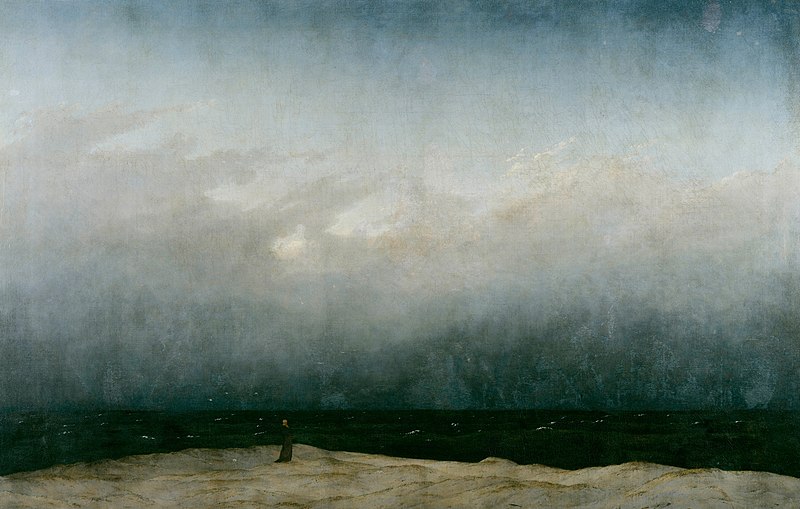
Monk by the Sea
A work by Friedrich that completely mystified his audience since it was absent of a narrative or character. Instead, it had a theoretical point to it
Rational mind and the irrational spirit
The struggle between these two things is the focus of Friedrich’s Monk by the Sea
Sublime
A deeply complex philosophical concept. In its relevance to the art world, it is the idea of an experience so powerful it overwhelms the rational mind. Meant to be scary and threatening. Craved by Romantics. Believed to allow us to understand our own minds by suddenly becoming aware of them when we usually are not
the natural world
A major focal point of Romanticism. Contrary to widespread belief, it is often portrayed as unfeeling and a malevolent force rather than something peaceful
Romanticism in Great Britain
One of the first countries to adopt Romanticism where it found an eager audience primarily due to Neoclassicism’s association with the French Revolution. Appealing since it casted off the chains of the Enlightenment
Starving artist
This portrayal of artists is a product of Romanticism. One whose unique artistic spirit is so powerful that it gives them physical pain when they express it. Many artists try to embody this notion
Henry Fuseli
One of the earliest British Romantic artists. Major proponent of artists’ individual visions and originality
The Nightmare
An incredibly controversial work by Fuseli due to its subject matter of sexuality and portraying a virgin woman enjoying terrifying sex dreams. Features a black horse and an incubus sitting atop a sleeping woman
Incubus
The creature in The Nightmare representing sexuality and bad dreams. Arguably Fuseli’s self portrait
white
The color of the dress the woman in The Nightmare is wearing, suggesting she is a virgin
Shakespeare
One of Fuseli’s favorite authors. English Romantics’ love for his works even after he had become unpopular began a resurgence interest in his works and entered him into the Western canon. The subject matters of his players were decidedly Romantic
Gothick
Happening at the same time as Fuseli’s works. A Romantic version of the Gothic filled with monsters, humans getting their comeuppance, and madness
Dracula and Frankenstein
Two famous Gothick novels
Landscape painting
One of the ways Romanticism found its cleanest expression. The fore of the Romantic movement
John Constable and Turner
The two masters of British Romantic landscape painting
Prokofiev
Romantic composer who composed the music for Romeo and Juilet
natural objective
What Constable sought to balance with a more romantic understanding of nature
nature as a symbol for the self
What Constable sought to balance with true objective landscape painting. An emotional and fantasized reality that corresponds to various higher level emotions and thinking
Constable
Sought to find a balance between the scientific and poetic in his landscape paintings. Exact and arranged all elements of his works so
Drawing from nature
How Constable created his compositions, taking elements from different areas
rural England
The subject matter of Constable’s works which he felt were being destroyed by the rise of industrial society. Idealized.
industrial society
What Constable felt was destroying rural England and, therefore, English culture/people
soil of a nation
A Romantic idea. Supposedly made the spirit of said nation. Created a connection between landscapes and the spirit of a people
Nationalism
Romanticism went hand-in-hand with the rise of this in the 1800s. The unification of Germany and Italy into one nation state arose from people’s interest in their roots and discovering/rediscovering their past
“land of the nation”
A notion introduced by Romanticism. Stood for the culture of the people. Eventually filtered down into the core tenants of the Nazi party
gestural and abstract
Turner’s unconventional painting style which made him very controversial during his entire career
The Fighting Temeraire
The subject of Turner’s nautical painting. One of the great British wooden sailing war ships that is decommissioned by a new steam-powered ship
naval tradition
What the British were very proud of
sun setting and rising
Represents setting on the past and rising on the future of British oceanic dominance in Turner’s The Fighting Temeraire
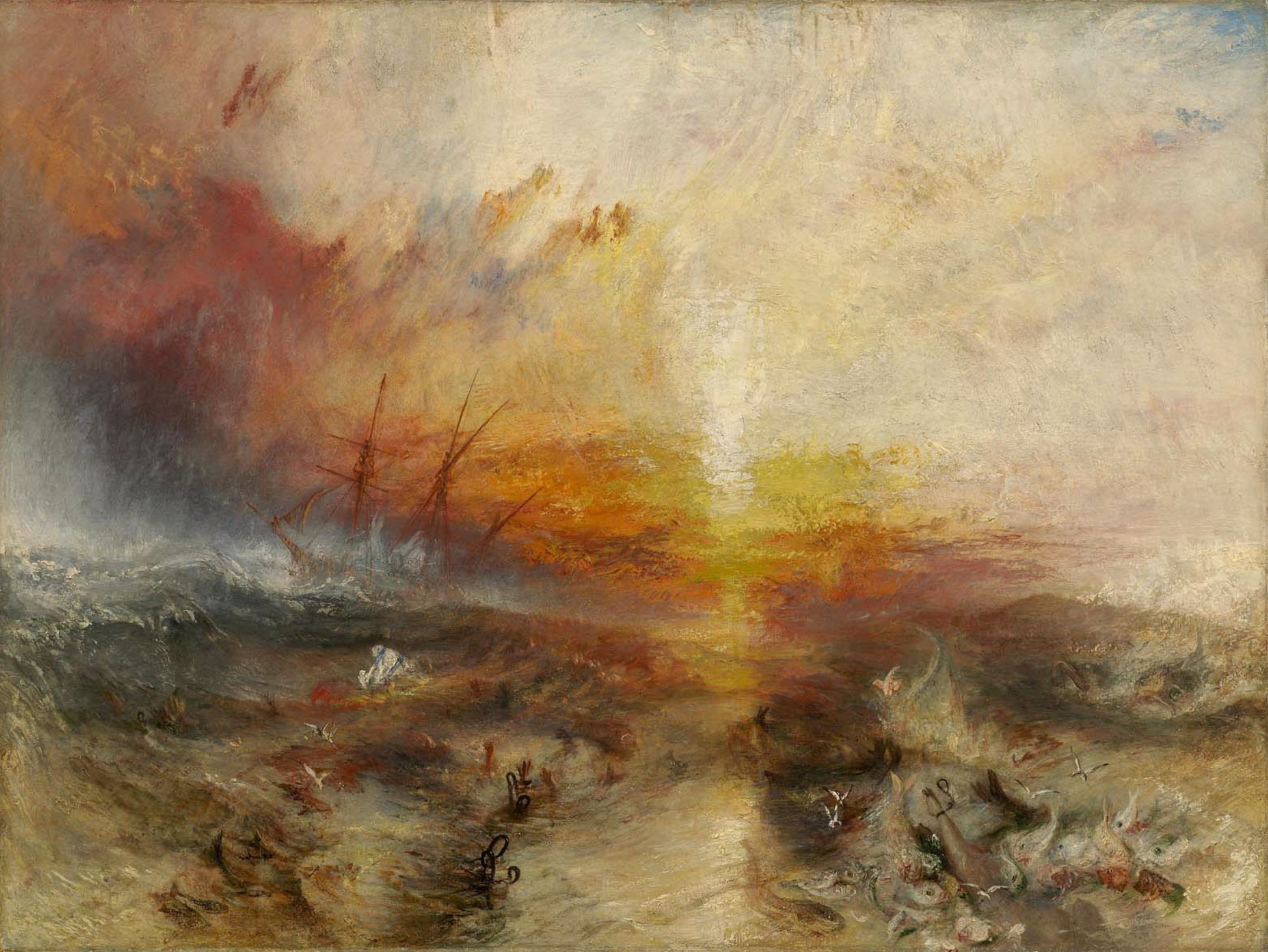
Slave Ship
A piece by turner based on a contemporary event where a slave ship dumped its human cargo into the ocean, believing the ship to be more important than the people it was carrying. Widespread outrage
contemporary subject matter
What Romanticism often focused on rather than historical subject matter. There is now a rise of artists making work about current events - news being turned into artworks. The more violent or upsetting the news, the more attracted artists were to paint it
Romanticism in France
Took a while for Neoclassicism to be shaken out of this country’s artistic establishment, because it was the government’s official style, and they did not want to revert to Rococo. Took a while to be embraced
Gericault
One of the first French Romantic painters. Had a reputation as an independent, public-minded artist who didn’t care for money or fame. A rebel who valued spontaneity and passion over traditional elements of art
autobiographies
Become commonplace for Romantic artists who are interested in how they appear to the world (often emphasizing traits that aligned with Romantic ideals or playing up a persona). Though not all artists felt the pressure, self promotion became common
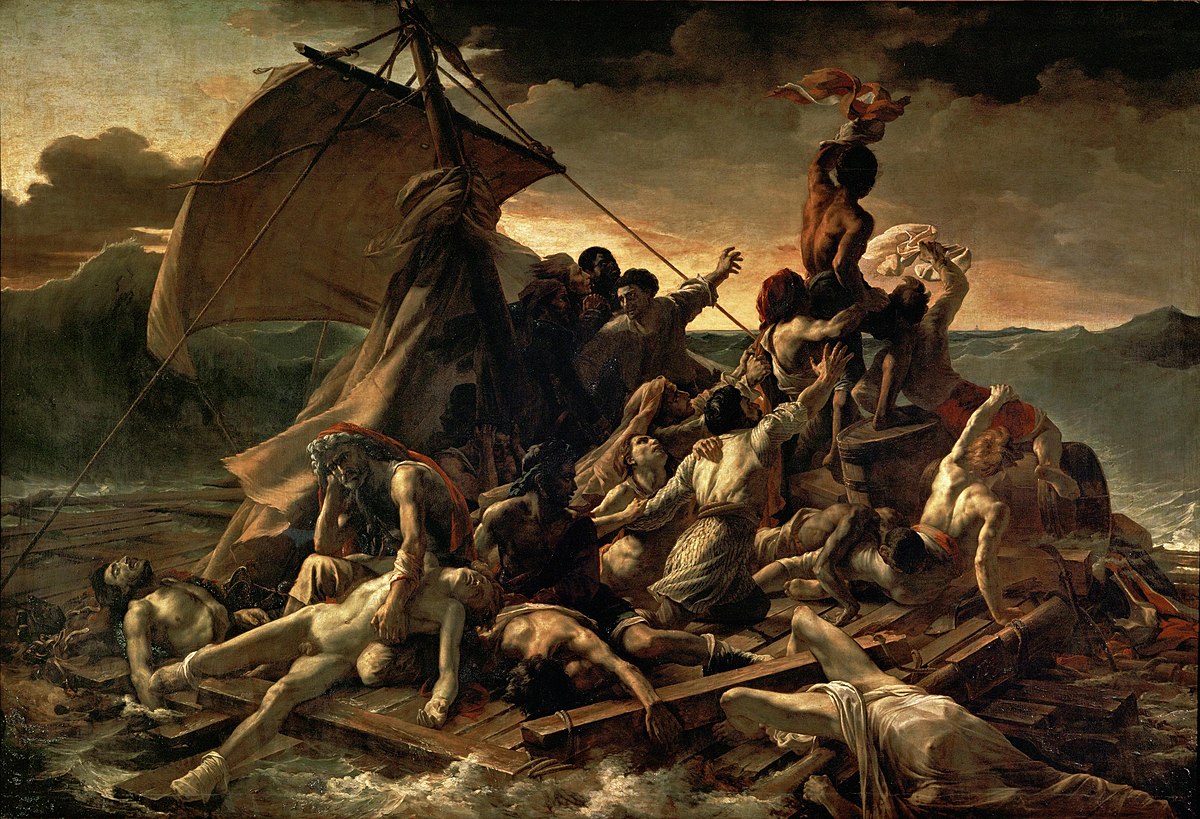
Raft of the Medusa
A triumphant work for Gericault completed over the course of two years shortly before his death. Featured the crazy story of a raft that fell apart with few survivors (those with lower social statuses didn’t make it onto the lifeboat). Huge scale
large scale paintings
Initially reserved for history paintings. Later, the notion that important scenes must be on larger canvases arose, and Romantic artists experimented with portraying contemporary events on the scales of historical paintings
hospital
What Gericault bought a studio next to because of the painting’s size, and because he created studies of and sketched people who were brought in with diseases
amputated limbs
What Gericault paid mortuary workers to let him keep for his daily studies and sketches
triangular shape
How Gericault designed the raft in The Raft of Medusa. This in combination with the eye level gives the illusion that the raft is rising up, and all the corpses are falling onto the viewer’s face
insane asylums and public executions
Where Gericault hung around on top of hospitals and mortuaries for his works. The sort of drama Romantics loved
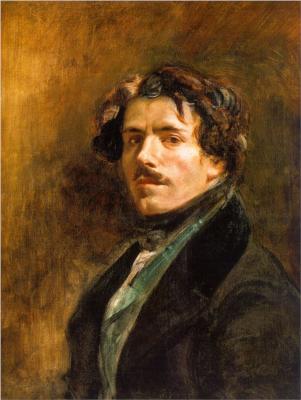
Eugene Delacroix
Big name in French Romanticism. Worked for a time with Gericault. Known for being undisciplined
painting from [his] spirit
What Delacroix as known for in combination with his lack of learned routines
imagination and creativity
The focuses of Delacroix’s inspiration process. Spontaneous, fast execution to catch ideas as quickly as they came
Chios
The name of the town whose townspeople were murdered or sold into slavery following a Greek revolt against their Turkish overlord
Greeks
Believed by Romantics to represent Western civilization which was under threat by barbarism (the Turks)
depicting Greeks and Turks as oriental
A controversial decision of Delacroix’s in his painting Massacre at Chios in how it did not celebrate the Greeks and made them identical to the “barbaric” Ottoman Turks
Massacre at Chios
The first work that got Delacroix attention. Has a strange earthy tone to it, an awkward composition, and no real unifying design other than bizarre colors. Composed of seemingly unrelated vignettes. Most likely compiled of unrelated news stories
Death of Sardanapalus
Another Delacroix Orientalist painting. Inspired by a play by Lord Byron with a vague oriental feel to it. Includes Indian elephants, Moorish, Egyptian hoods, and more. Controversial reception at the Salon it was featured in. Delacroix loved the attention it got
Sardanapalus
A madman hero - the perfect Romantic subject. Upon his city being sacked, he poisoned himself, set his things on fire, and watched the destruction of his material goods as he died
black romanticism
What works such as the Death of Sardanapalus became known as. Romanticism heavily involved in ideas of destruction, decay, death, and violence
“This time, Delacroix has gone too far”
The headline in the newspaper in response to the Death of Sardanapalus’s showing at a Salon
Delacroix’s oriental works
A bit more truthful than other oriental works such as Ingres’s large Odalisque, since he was more familiar with Africa
Liberty Leading the People
Another contemporary event by Delacroix. Commemorating the event
July Revolution
The event that Liberty Leading the People is depicting. In 1830, the French people overthrew their king and installed a new one (who lasted 18 years before being overthrown)
upheaval in France
Did not stop with the French Revolution. Throughout the 19th century, there were revolutions, civil wars, or invasions every other decade. Many protests and rebellions
Liberty
An allegorical figure in Delacroix’s most famous piece. Holds a tricolor flag and is leading a cross section of the French populace: a young boy, a middle class man, and a working class man as they storm over the barricades. Delacroix imagined it as a metaphor for Romanticism’s victory over classicism
Les Miserables
The modern theatre production that takes direct inspiration from Liberty Leading the People in its aesthetics and other elements
Goya
Entered Spain on its downward trajectory
Mismanagement
The primary reason for Spain’s ruin in the beginning of the 19th century. Successions of incompetent royals and ministers
Spain at the beginning of the 19th century
Largely ruined, nation went bankrupt at one point
Spain and artistic revolutions
Country left behind by much of the artistic revolutions occurring since the Baroque. Lagged behind France, Italy, etc. by a few decades
Mings
Group of people whom Goya worked with
The Parasol
One of Goya’s first works. It’s Rococo style is a testament to how Spain was lagging behind the rest of Europe artistically
Charles IV
The Spanish monarch who was interested in Goya and appointed him as one of his official painters
Family of Charles IV
A resoundingly successful painting for Goya that got the attention of Charles IV
tension between Enlightenment and Romantic ideals
What Goya and Spanish intellectuals were torn between
Spanish nobles
By Goya’s time had become increasingly scared of the populace and referred to the lower classes as “useless”
Reserved and conservative
Traits of the Spanish monarchy
War of the Pyrenees
War between Spain and France in 1793 that invigorated a revolutionary spirit in the country
 Note
Note  Flashcards (20)