AP Psychology - Unit 3B Test
 Studied by 0 people
 Call with Kai
 Learn
Learn Practice Test
 Spaced Repetition
 Match
Match Flashcards
 Knowt Play
1/19

There's no tags or description
Looks like no tags are added yet.
Name | Mastery | Learn | Test | Matching | Spaced | Call with Kai |
|---|
No analytics yet
Send a link to your students to track their progress
20 Terms
(Unit 3B - Learning - Part 1) Learning Defined
What is LEARNING?
Relatively permanent change in behavior that is the result of experience
(Unit 3B - Learning - Part 1) Learning Defined
What does “RELATIVELY PERMANENT” indicate?
Rules out short-term changes
“Relatively” - can go away under certain conditions (brain damage, concussions)
Ex> something you learn in class sticks with you for the rest of your life
(Unit 3B - Learning - Part 1) Learning Defined
What does “CHANGE IN BEHAVIOR” (or behavior potential) indicate?
Behavior potential is included because learning is not always immediately obvious in behavior
Learning could create the potential for a change in behavior when the conditions are right (e.g. an incentive is present)
(Unit 3B - Learning - Part 1) Learning Defined
What does “EXPERIENCE” indicate?
result of outside stimuli (nurture-based phenomenon)
This rules out changes in behavior resulting from maturation
Problem: How do you know what is the result of maturation vs. experience?
(Unit 3B - Learning - Part 1) Learning vs. Maturation
What is MATURATION?
new tasks accomplished as a result of biological development and NOT experience
Maturation is generally seen as preparing a species to learn a skill rapidly
Ex> crawling/walking doesn’t result from learning, but instead maturation
(Unit 3B - Learning - Part 1) Learning vs. Maturation
Is it easy to separate experience from maturation?
It is hard to separate experience from maturation and say something is purely learned or purely genetic.
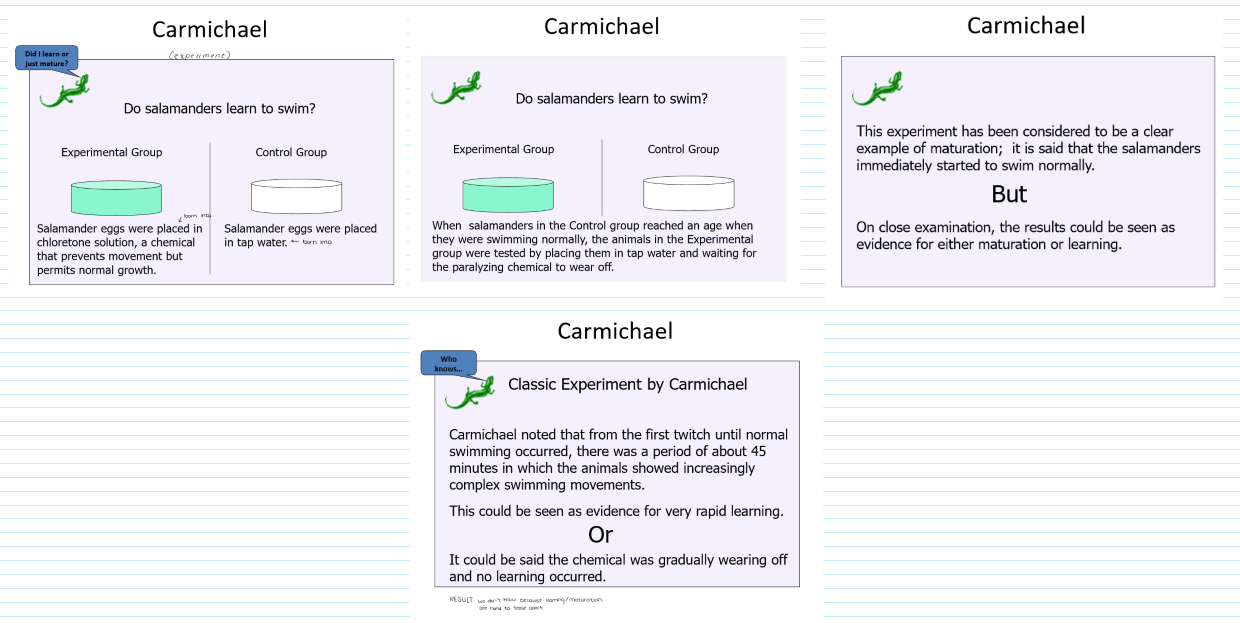
(Unit 3B - Learning - Part 1) Carmichael Experiment
Explain how Carmichael addressed the question, “Do salamanders learn to swim?”
(Unit 3B - Learning - Part 1) Associative Learning
What is ASSOCIATIVE LEARNING?
A simple form of learning in which we comprehend that certain events occur together
Ex> getting sprayed in the face and “can”
Contrast with Cognitive Learning
(Unit 3B - Learning - Part 1) Associative Learning
What are the different types?
Habituation
Sensitization
Classical (Pavlovian) Conditioning
Operant (Instrumental/Skinnerian) Conditioning
(Unit 3B - Learning - Part 1) Habituation and Sensitization
What is HABITUATION?
Decreased response to a stimulus judged to be of little or no importance
brain is getting used to the stimulus and decides it’s not important anymore, person-to-person specific
We engage in this type of learning so we can tune out unimportant stimuli and focus on what matters
Ex> hearing the sound of train until 1AM in new apartment, eventually brain tunes the noise out; Mr. D’Elia birds
(Unit 3B - Learning - Part 1) Habituation and Sensitization
What is SENSITIZATION?
Increased response to a stimulus when we are anticipating an important stimulus
person-to-person specific
We engage in this type of learning so we are prepared for dangerous situations
Ex> able to tune out train at first, but gets increasingly annoying (brain thinks it’s important); at first, don’t understand importance of lockdown drill so continue coloring, but teacher tells you to go in corner and you become sensitized to lockdowns for the future; Mr. D’Elia’s roommate w/ birds
(Unit 3B - Learning - Part 1) Classical Conditioning
What is CLASSICAL CONDITONING?
Learning in which a response naturally caused by one stimulus comes to be elicited by a different, formerly neutral stimulus:
NATURALLY: must naturally flinch to getting sprayed in the face with water even without any words being said (otherwise the experiment wouldn't work)
Unconditioned Stimulus (UCS) → Unconditioned Response (UCR)
Neutral Stimulus (NS) + UCS → UCR
Conditioned Stimulus (CS) → Conditioned Response (CR)

(Unit 3B - Learning - Part 1) Classical Conditioning
Who is IVAN PAVLOV?
Accidentally discovered classical conditioning
Also worked with conditioning a defensive reflex
(Unit 3B - Learning - Part 1) Classical Conditioning
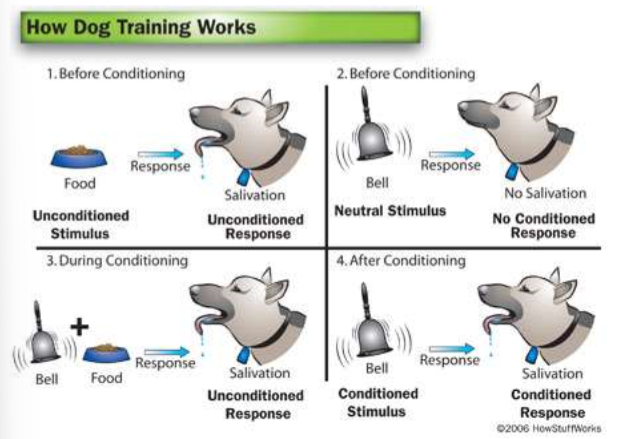
Explain how dog training works and connect it to the spray bottle demo.
Dogs can associate the noise of opening a cabinet with food…
BEFORE CONDITIONING: Food would be put out in front of the dog, and the dog would start salivating.
No teaching/learning required --> dog would automatically respond (unconditioned stimulus)
Ex> our spray bottle = our unconditioned spray bottle because we didn't have to teach/learn the subject to flinch when sprayed in the face; our unconditioned response was flinching
BEFORE CONDITIONING: Take something that doesn't usually cause a response in the dog. Dogs don't usually salivate from a bell.
Neutral Stimulus --> doesn't cause a natural response in the dog
Ex> the word can = our neutral stimulus because the subject wouldn't normally flinch on the word can
DURING CONDITIONING: The bell is rung and then presents the food everyday. This tries to get the dog to learn that the bell means food is coming. Pavlov pairs the unconditioned stimulus with the neutral stimulus.
AFTER CONDITIONING: Remove the unconditioned stimulus, and the dog will have learned to associate the unconditioned stimulus with the conditioned stimulus. The dog is expecting food when it hears the bell.
Ex> say "can" and don't get sprayed
(Unit 3B - Learning - Part 1) Classical Conditioning: Components
What is an UNCONDITIONED STIMULUS (UCS)?
A stimulus that naturally and automatically causes a specific response in an organism
And example of a UCS would be a food
(Unit 3B - Learning - Part 1) Classical Conditioning: Components
What is an UNCONDITIONED RESPONSE (UCR)?
The response caused by a UCS
The UCR is automatic and unlearned
An example of a UCR is salivation in response to food
(Unit 3B - Learning - Part 1) Classical Conditioning: Components
What is a CONDITIONED STIMULUS (CS)?
A formerly neutral stimulus (NS) that is paired with a UCS and eventually causes the desired response all by itself
An example of a CS is the bell in Pavlov’s studies
(Unit 3B - Learning - Part 1) Classical Conditioning: Components
What is an CONDITIONED RESPONSE (CR)?
The learned response to the CS
An example is salivation in response to the bell
(Unit 3B - Learning - Part 1) Classical Conditioning in Humans
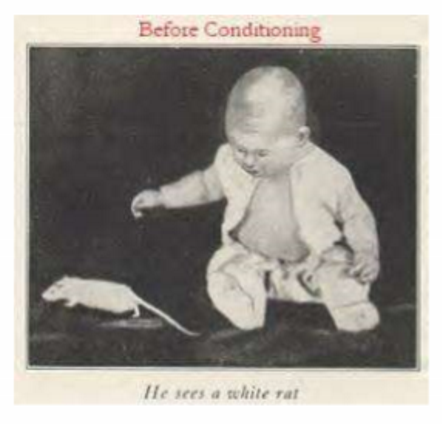
Explain the “LITTLE ALBERT” EXPERIMENT.
The “Little Albert” experiment (Watson) demonstrated a classically conditioned fear of white fluffy things
Albert comes in for a study and is shown a white rat. He doesn't initially respond to the rat (stares at it, looks at it)
Then, two pipes are banged behind his ear. He starts crying.
Then, they present the white rat and bang the pipes over and over again. The neutral system (white rat) is paired with the unconditioned stimulus (the loud noise).
This conditioned a fear of rats.
PHOBIAS… you have bad experiences with something that is technically harmful and associate them together
WATSON & RAYNER are the chief researchers in the baby albert study…
Not ethical today because you can actually cause damage to the ears/brain because they are so delicate but also the baby will leave the study with a fear of rats without intending to!
Ex> throwing up after having a pina colada, so no longer drink pina coladas
Elements:
UCS = loud noise
UCR = fear of noise
NS = white rat
CS = white rat
CR = fear of rat
(Unit 3B - Learning - Part 1) Spray Bottle Demo
Identify the UCS, UCR, NS, CS, and CR.
UCS = spray bottle
UCR = flinching
NS = “can”
usually same as CS
CS = “can”
usually same as NS
CR = flinching/anxiety in response to “can”
 Note
Note  Flashcards (25)