L20 The role of transporter proteins in xenobiotic disposition
 Call Kai
 Learn
Learn Practice Test
 Spaced Repetition
 Match
Match Flashcards
 Knowt Play
1/61

There's no tags or description
Looks like no tags are added yet.
Name | Mastery | Learn | Test | Matching | Spaced | Call with Kai |
|---|
No analytics yet
Send a link to your students to track their progress
62 Terms
how are drug transporters useful in absorption
role in the intestine in facilitating entry of some drugs into enterocytes
also preventing access by some xenobiotics
how are drug transporters useful in distribution
role in allowing entry into target organs for activity but also liver for metabolism
how are drug transporters useful in excretion
roles in both renal and biliary excretion
ABC proteins (ATP dependent) types
MRP
MDR
BSEP
BCRP
solute carrier (SLC) S2 different gene families exist
code for membrane proteins but these proteins have functions including roles in normal physiology
what do facilitative transporters allow
substrates to flow downhill with their electrochemical gradients
what do secondary active transporters allow
substrates to flow uphill against their electrochemical gradient by coupling of transport to that of a co-substrate
facilitative and secondary active transporters are not
ATP-dependent
SLC proteins have 12 membrane spanning domains and are often present on the membrane of
polarised cells with specific location (apical or basolateral side)
SLC familly genes
OAT anion transporter
OATP anion transporter
OCT cation transporter
MATE cation transporter
PEPT mostly peptides but also penicillins
OATP stands for
organic anion-transporting polypeptide
what are OATP proteins encoded by
the SLCO1 to SLCO6 genes
families 1 and 2 of OATP transporters are the most important in relation to
drug disposition
SLCO1 and SLCO2 (OATP1 and OATP2)
OATP proteins are important in drug transport across sinusoidal membranes in the liver
OATP1B1, OATP1B3, OATP2B1 are most important in the liver
kidney also has OATPs present but they have a more limited role in
renal excretion
drug substrates are normally anionic with high molecular weight (>450)
generally protein bound in plasma
examples of OATP1B1 substrates are
statins
rifampicin
benzylpenicillin
ACE inhibitors
some anti cancer drugs
OAT proteins are members of the
SLC22A subfamily
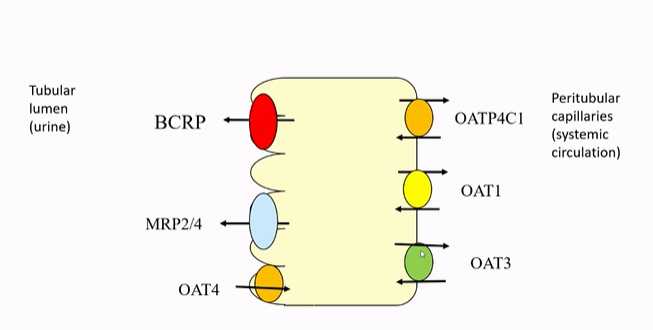
key role in renal excretion but also expressed elsewhere e.g. liver and small intestine
OAT1, OAT2, OAT3 found on basolateral membrane of
proximal tubule cells, facing blood vessels
OAT4 is on the apical membrane of the PCT facing…
urine
can sometimes transport in both directions
secretion of anions/drugs
OA is a drug substrate
A is OAT1, 2, 3
B is a transporter for dicarboxylic acid
C is Na/K transporter
E is OAT4
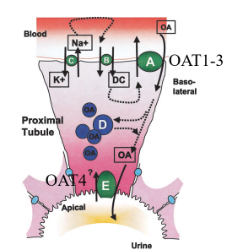
OAT1-3 are coupled to
dicarboxylic acid (energy source)
e.g. alpha-ketoglutarate - sodium dependent
OAT4 transport reabsorbs drugs from
urine and may be bidirectional
OAT 1 to 4 substrates are likely to be
sulfate or glucuronide conjugates
drugs the dont undergo metabolism may also be substrates for
OAT1-4
e.g. penicillins
give an example of an OAT1 substrate
tetracycline
give an example of an OAT2 substrate
AZT (HIV)
diclofenac
diclofenac glucuronide
give an example of an OAT3 substrate
oestrone sulfate
benzylpenicillin
rosuvastatin
give an example of an OAT4 substrate
oestrone sulfate
diclofenac glucuronide
OCT
organic cation transporters
members of SLC22A
OCT1
important transporter of sinusoidal face of liver
substrates include metformin and cisplatin
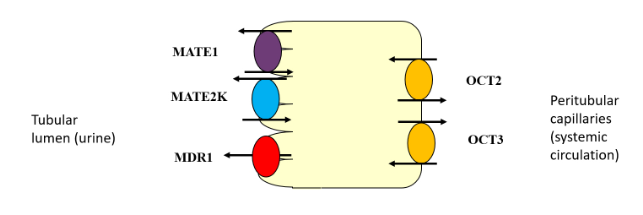
OCT2
high levels on basolateral membrane of kidney
blood side of PCT
substrates metformin, cisplatin and cimetidine
cationic drug and chemical transport
PEPT transporters PEPT1 and 2 of the POT family are
SLC15A
secondary active transporters
where is PEPT1 expressed
intestine and kidney
where is PEPT2 expressed
kidney
PEPT1 and PEPT2 express similar substrate specificities with…
penicillins, ACE inhibitors and valcyclovir
proton dependent transporters -in kidney contribute to drug reabsorption from urine to PCT
MATE transporters
multidrug and toxic extrusion family
identified in bacteria -highly conserved
export pumps contributing to renal and biliary excretion of cationic drugs
where is MATE1 expressed
liver and kidney
where is MATE2-K expressed
kidney only
MCT1
monocarboxylate transporter
ASBT
NA-dependent bile salt transporter
transporter proteins role in liver
xenobiotics need to be transported into hepatocyte across sinusoidal membrane for both metabolism and to reach targets
e.g. HMGCoA reductase for statins
compounds need to enter enterocytes through the brush border membrane and then cross the…
basolateral membrane into the hepatic portal vein
following metabolism, compounds usually need to be transported out either across canalicular membrane (to bile) or …
sinusoidal membrane (back to blood for renal excretion)
describe the basolateral membrane of the kidney tubule
compounds excreted by tubular secretion need to enter
those being reabsorbed need to return to circulation
describe the brush border membrane of the kidney tubule
compounds need to cross this membrane to enter the lumen for final renal excretion
reabsorption may occur
urate transporter transports urate from the…
lumen, back into the proximal tubule cell
what does diclofenac undergo metabolism by
CYP2C9 and UGT2B7
UGT2B7 produces …
acylglucuronide (DF-AG)
only a proportion of diclofenac is metabolised/conjugated
OAT2 and OAT4 is important in renal excretion of…
diclofenac acylglucuronide
diclofenac acylglucuronide can also be excreted via
bile
give an example of inhibition of transport through Organic Anion Transporters
penicillin and probenecid
valuable as penicillin is cleared more slowly
give an example of inhibition of transport through ABCB1
digoxin excretion can be affected by a range of drugs e.g. erythromycin, statins
problematic as high levels are toxic
digoxin is not extensively metabolised -only cleared by kidney
describe induction via PXR
ABCB1, ABCC2, SLCO1B1
potential for drug-drug interactions when rifampicin is prescribed due to induction
results in a rapid clearance of other drugs e.g. cyclosporin, digoxin
st johns wort has a similar effect
OATP1B1 genetic polymorphism is associated with…
higher plasma levels of some statins due to impaired ability to enter hepatocyte
higher plasma level leads to toxicity in muscle cells → potentially fatal rhabdomyolysis where muscle protein dissolves
OCT2 is linked to nephrotoxicity with
cisplatin
OCT2 may also involve…
MATE2
OCT2 drug accumulates in…
tubule cells
cisplatin is very nephrotoxic because…
it is efficiently taken up into the PCT
but rate of secretion is lower
cimetidine is co-administered to inhibit uptake of PCT and prevent cimetidine accumulation

