Materials Ch 9 and 10 Quiz
0.0(0)
Studied by 26 people Call Kai
 Learn
Learn Practice Test
 Spaced Repetition
 Match
Match Flashcards
 Knowt Play
Card Sorting
1/24

Earn XP
Description and Tags
Last updated 12:25 AM on 12/7/22
Name | Mastery | Learn | Test | Matching | Spaced | Call with Kai | Chat |
|---|
No analytics yet
Send a link to your students to track their progress
25 Terms
1
New cards
Definition: Phases
The Physically and chemically distinct material regions that form. (ex α and β)
2
New cards
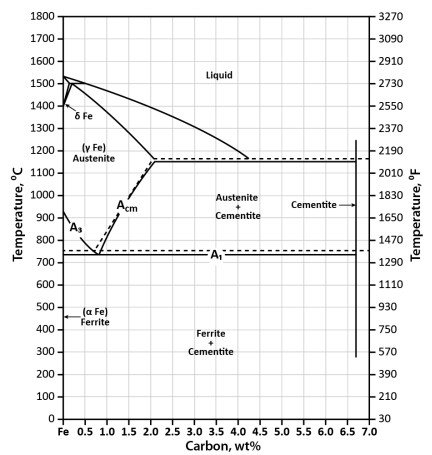
What phase is present at 1000 degC and 1.0 wt% Carbon?
1 Phase:
gamma iron; austenite
gamma iron; austenite
3
New cards
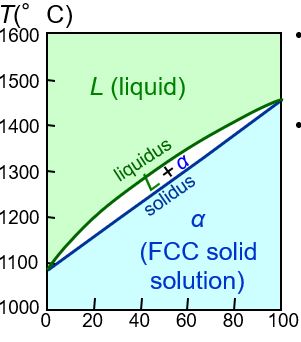
What phase is present at 1250 degC and 35 wt% Ni?
2 Phase
Liquid + alpha (FCC solid solution)
Liquid + alpha (FCC solid solution)
4
New cards
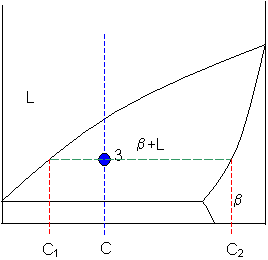
What is a tie line? How is the lever rule applied?
A tie line is drawn through the point connecting the boarder lines of two phases. Sometimes referred to as isotherm (green)
The lever rule identifies the proportions of each present phase.
Phase 1 = (C2 - C) / (C2 - C1)
Phase 2 = (C - C1) / (C2 - C1).
*C is the concentration or wt% on the graph
The lever rule identifies the proportions of each present phase.
Phase 1 = (C2 - C) / (C2 - C1)
Phase 2 = (C - C1) / (C2 - C1).
*C is the concentration or wt% on the graph
5
New cards
Definition: Eutectic
liquid transforms to two solid phases
L <-> α + β
L <-> α + β
6
New cards
Definition: Eutectoid
one solid phase transforms to two other solid phases
S_2 <-> S_1 + S_3
or
γ <-> α + Fe3C
S_2 <-> S_1 + S_3
or
γ <-> α + Fe3C
7
New cards
Definition: Peritectic
liquid and one solid phase transform to a second solid phase
S_1 + L <-> S_2
or
δ + L <-> γ
S_1 + L <-> S_2
or
δ + L <-> γ
8
New cards
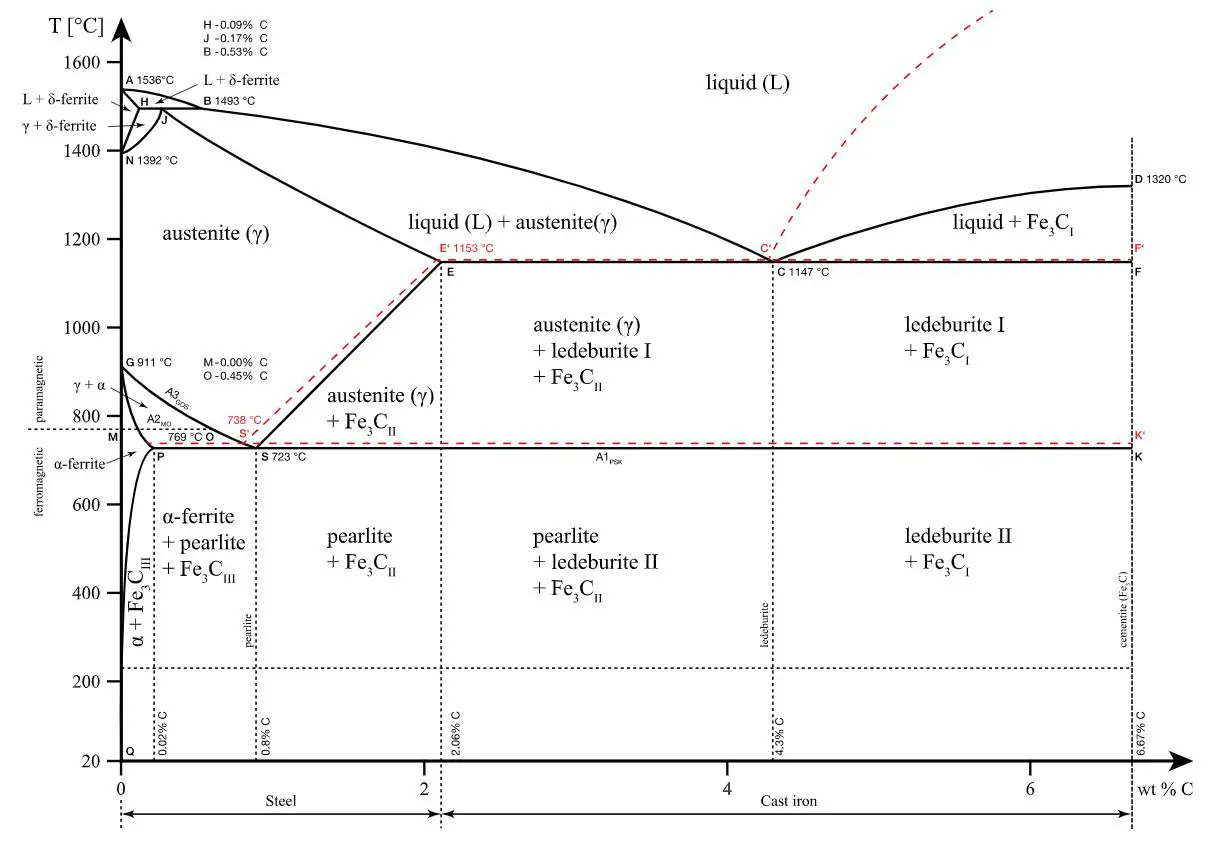
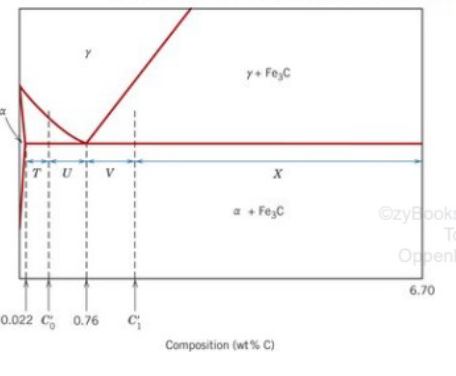
Iron-Carbon Phase Diagram calculations
A.) Eutectic: L -> γ + Fe_3C
B.) Eutectiod: γ -> α + Fe3C
Hypoeutectiod (left):
Wp = T/(T+U)=>(C - 0.022)/(0.76 - 0.022)
Wα = U/(T+U)=>(0.76-C)/(0.76-0.022)
Hypereutectiod (right):
Wp = X/(V+X)=>(C1-0.76)/(6.7-0.76)
WFe_3C = V/(V+X)=>(C1-0.76)/(6.7-0.76)
B.) Eutectiod: γ -> α + Fe3C
Hypoeutectiod (left):
Wp = T/(T+U)=>(C - 0.022)/(0.76 - 0.022)
Wα = U/(T+U)=>(0.76-C)/(0.76-0.022)
Hypereutectiod (right):
Wp = X/(V+X)=>(C1-0.76)/(6.7-0.76)
WFe_3C = V/(V+X)=>(C1-0.76)/(6.7-0.76)
9
New cards
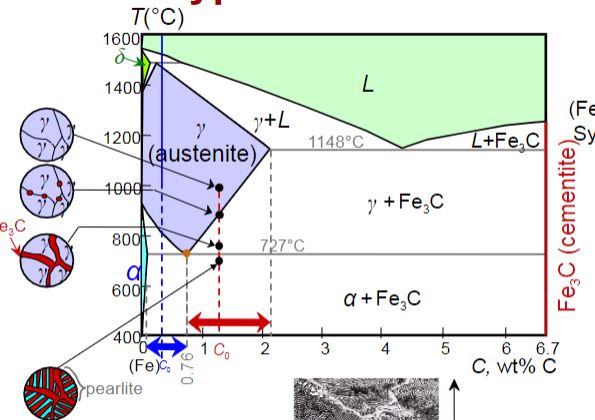
Where is pearlite found?
The eutectoid of the iron-carbon phase diagram
10
New cards
What phase does gamma (γ) represent?
Austenite
11
New cards
What phase does L represent?
Liquid
12
New cards
What does Fe_3C represent in an iron-carbon phase diagram?
Cementite
13
New cards
What does alpha (α) represent?
Ferrite
14
New cards
Reaction Rate
The rate at which a phase transformation happens. The slope on Phase Transformation Diagrams
15
New cards
Phase Transformation Diagrams
Tells you the time and rate at which a transformation occurs
16
New cards
Isothermal Transformation Diagrams
Tells you the time a transformation will take to complete at a certain temperature
17
New cards
Nucleation
When nuclei (seeds) act as templates on which crystals grow. Atoms are continuously added to the nuclei (seed) faster than the atoms are bring lost. Once nucleated, the growth process will proceed until equilibrium is reached.
18
New cards
Supercooling
one of the driving forces to nucleate. When a liquid is cooled below its melting point without it becoming a solid.
19
New cards
Small Supercooling
Slow Nucleation Rate --> Few Nuclei --> Large Crystals
20
New cards
Large Supercooling
Rapid Nucleation Rate --> Many Nuclei --> Small Crystals
21
New cards
How Does Temp Affect Rate of Transformation?
The higher the temp, the quicker the rate of transformation
22
New cards
Bainite
Fe-Fe3C Transformation Product. Results from a moderate cool from Austenite. Composed of both Ferrite and Cementite. Increases Strength but decreases ductility.
23
New cards
Spheroidite
Fe-Fe3C Transformation Product. Formation requires diffusion. Heat Bainite or pearlite at a temp just below eutectoid for a long time. Increases Strength but decreases ductility.
24
New cards
Martensite
Fe-Fe3C Transformation Product. Formation happens rapidly, no diffusion. Transformation only depends on the temp that it is rapidly cooled to. Increases Strength but decreases ductility.
25
New cards
Tempered Martensite
Fe-Fe3C --> Martensite Transformation Product. Heat treat martensite to form tempered martensite. Less brittle and reduces internal stress of martensite caused by quench.