Neuro: Fear, Anxiety, and Stress
 Studied by 0 people
 Call Kai
 Learn
Learn Practice Test
 Spaced Repetition
 Match
Match Flashcards
 Knowt Play
1/61

There's no tags or description
Looks like no tags are added yet.
Name | Mastery | Learn | Test | Matching | Spaced | Call with Kai |
|---|
No analytics yet
Send a link to your students to track their progress
62 Terms
Cued Fear Learning (classical conditioning)
Conditioned stimulus (CS) signals aversive (painful) unconditioned stimulus (US). So presentation of CS can produce a conditioned fear response (CR). Ex. Sound = CS and shock = US
What does fear learning depend upon?
Amygdala especially outputs from the CENTRAL AMYGDALA
What does threatening stimuli activate?
Basolateral amygdala that then in turn activates the central amygdala.
What does activity of neurons in the central amygdala generate?
A fear response in activating fear circuitry responsible for:
freezing of limb movements
sympathetic nervous system activation
increased vigilance
Outputs here give rise to fear (threat) response
Before the pairing
Tone is a neutral stimulus and does not produce fear.
After pairing
Tone is a conditioned stimulus and now produces fear.
What happens when the amygdala is damaged?
No signs of fear and can’t recall experiences of fear and can’t recognize facial expressions of fear.
What temporal alignment is in classical conditioning?
Delay conditioning is most robust. AKA overlap of CS with US but CS plays first.

Fear Extinction
Does not erase fear memory, rather forms new competing memory that is SAFE. Fear response can decrease. If CS is presented many times in absence of US, the fear response to CS diminishes. However, that does not mean it can’t come again.
Spontaneous recovery
even if fear is extinguished, presentation of CS a week later can still produce a fear response so original CS-US fear association was not lost. new additional association, CS-No US aka new (safe) association.
What is the ventromedial prefrontal cortex (vmPFC) critical for?
Extinction learning and recall, and to reduce the fear response
Acquisition of Cued-Fear across age
children, adolescents, and adults can all equally learn fear association
What happens to adolescence in cued-fear extinction?
there is less than in preadolescent and adult.
What about fear extinction in childhood?
It is high, this suggests their memory is less stable. Also less spontaneous recovery of fear.
Is preadolescent “fear extinction” due to simple degradation/decay of the fear memory?
NO! Preadolescent “fear extinction” is not due to simple decay of memory (tone=shock) but instead due to greater susceptibility to interference from competing association (tone = no shock)
Cued Fear
With conditioned stimulus aka tone
Contextual fear
In the room of the place you got shocked but conditioned stimulus not played
Hippocampus is important in what in fear?
Very important in contextual fear learning
What happens to adults and children for freezing response in contextual fear?
High freezing in both.
What happens to adolescents for freezing response in contextual fear?
show no contextual fear because their fear response was suppressed. if they grow to be adults, they will show the fear response. (ex. shocking adolescent mice in a cage and putting them back in the cage as adults and they freeze)
Anxiety disorders
characterized by excessive fear and anxiety in absence of threat
Posttraumatic stress disorder (PTSD)
Social anxiety disorder
Specific phobias
Generalized anxiety disorder
Posttraumatic stress disorder (PTSD)
intense fear is triggered by reminders of a traumatic event, often one that involved threat of death or serious injury.
Social anxiety disorder
Intense fear of social embarrassment and MOST COMMON.
embarrassment in social situations.
DIFFERENT FROM Agoraphobia: avoid crowded or other places that cause panic. avoidant of situations and panic in crowded places (ex. BJ Casey’s son avoiding social situations)
Specific phobias
Anxiety is triggered by specific objects or situations. (ex. spiders, cats, etc.)
Generalized Anxiety Disorder
Persistent and excessive worry. In situations where there is little cause for concern. People with this expect the worse
What happens when individuals with social anxiety, specific phobias, and generalized anxiety disorder are shown photographs with negative emotional content?
High reactivity of the amygdala relative to controls.
What happens when individuals with PTSD are shown photographs with negative emotional content?
Show reduced responsivity of ventromedial prefrontal cortex.
Psychological therapies
Can reduce excessive anxiety.
Psychological therapies: systematic desensitization/exposure therapy
client relaxed when exposed to stimuli that resemble that anxiety and with successive presentation it reduces anxiety
Psychological therapies: Cognitive Behavioral Therapy
client learns to challenge and reevaluate their anxiety-related thoughts processes (can include exposure too)
Drug therapies
can reduce anxiety
Drug therapies: Selective serotonin reuptake inhibitors (SSRIs)
Such as prozac that elevate synaptic serotonin levels
Drug therapies: Benzodiazepines
Such as Xanax that reduces anxiety by increasing effects of inhibitory neurotransmitter GABA
What shows best efficacy when treating excessive anxiety?
Combination of drug and psychological therapies.
How do adolescents respond to exposure therapy?
Less response than adults and children. Children are not reliant on prefrontal cortex. vmPFC-amygdala circuitry and function changes with age
Memories are?
Dynamic and malleable.
Memory reconsolidation
Previously consolidated memories being recalled and actively consolidated. Maintains, strengthens, and modify memories already stored in long-term memory.
Temporal dynamics are key
sweet spot of protein synthesis when memory is consolidated to update memory
Reminder Cue then Extinction
Changes memory to erase the fear and also works in adolescents with developing vmPFC
What are the effects of combining opposing behaviors (cued and contextual fear learning)?
Fear decreases more.
What development changes in the brain may help explain these behavioral effects? PFC?
Involved in both fear expression (PL) and extinction (IL). Fear expression maintain fear (PL to BLA to CEA). Fear extinction inhibits fear (IL to ITC/inhibitory cells to CEA).
How is the hippocampus involved in contextual fear?
It plays an important role in fear expression and fear extinction by modulating the activity.
How are projections into PFC changing during adolescence?
Increased projections to prelimbic cortex (PL) from amygdala and hippocampus. Surge in amygdala projections to PL may explain sustained cued fear (diminished cued fear extinction) while surge in hippocampus projections to PL explain lack of contextual fear,
Stress
Any type of changed that we experience that causes physical, emotional, or psychological strain. It is your body’s response to anything that requires attention or action. May be mild, intense, acute, or chronic.
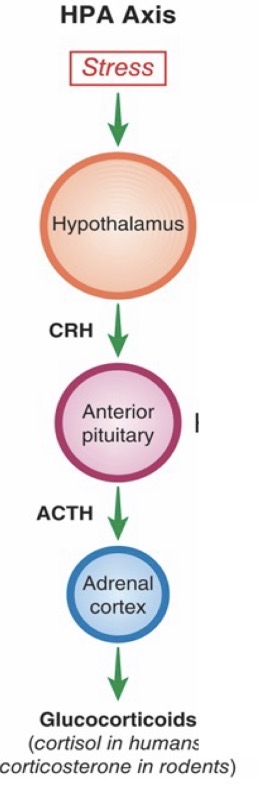
Hypothalamic-pituitary-adrenal (HPA) axis
Hypothalamus, pituitary and adrenal gland make up this and together they control and release the body’s key stress hormones and released from adrenal glands.
What happens when the brain interprets an environmental event as a stressor?
Corticotropin-releasing hormone (CRH) is released from hypothalamus. This triggers released of adrenocorticotropic hormone (ACTH) from the anterior pituitary. Then results in release of glucocorticoid stress hormones from the adrenal cortex. This HPA response is delayed and longer lasting than the fight and flight of the sympathetic nervous system.
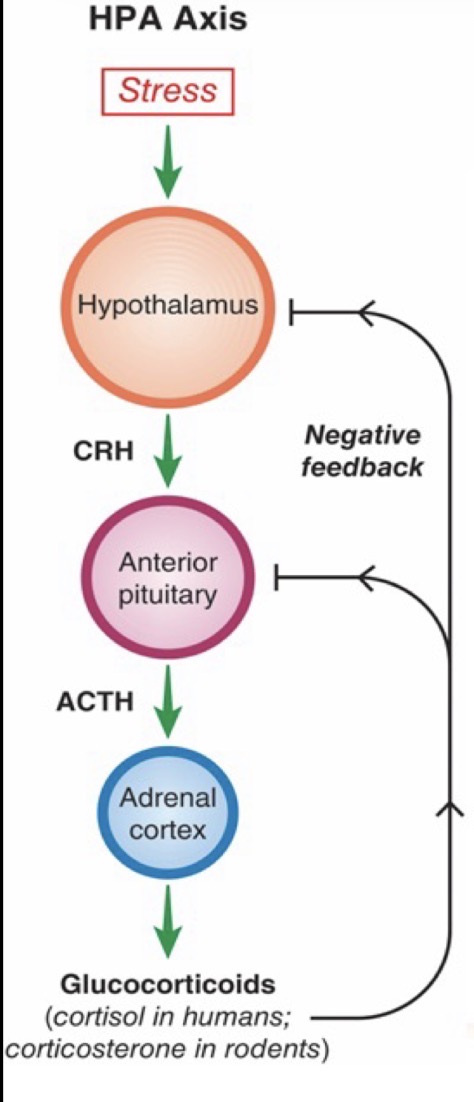
How do you reduce the activity of the HPA axis and limit glucocorticoid release aka negative feedback?
Glucocorticoids pass the blood-brain barrier and nearly all brain areas containing glucocorticoid receptors. High glucocorticoid levels cause hypothalamus to release less CRH and cause the pituitary to release less ACTH. This leads to reduced glucocorticoid release from adrenal cortex.
What happens when experimental animals lack glucocorticoid receptors in the brain?
They act fearless when placed in stressful conditions.
What happens when experimental animals are genetically modified to lack glucocorticoid receptors in the brain?
They also show less stress and fear in stressful conditions.
What are glucocorticoids produces brain changes related to?
Increased amygdala activity and reduced prefrontal and hippocampal activity.
Amygdala in stress
Increased neuronal excitability, dendritic branches, dendritic spines
Hippocampus in stress
Opposite of Amygdala
Decreased neuronal excitability and number of dendrites
Prefrontal cortex in stress
Decreased neuronal excitability and number of dendrites
What happens when the brain detects threatening stimuli?
It activates the sympathetic nervous system and the HPA axis.
What is the key control center for the sympathetic nervous system stress response?
Within the medulla
What about the amygdala and other threat-detecting brain areas? How do they respond to threatening situations?
Communicate with neurons in the brainstem to modulate sympathetic nervous system response to perceived threats. They also activate the hypothalamic pituitary-adrenal (HPA) axis.
Allostatic Load
“wear and tear” on the body with repeated responses to stressful situations both internal and external
Chronic Stress
Worsens medical conditions in the brain and body (depression, cardiovascular and neurodegenerative diseases, and cancer. Inflammation is common pathways of stress-related diseases.
Stability
One’s ability to maintain homeostasis. If good, less response to stressful situations both.
Resilience
ability to return to the balance state quickly even if individual has a big response to stressful.
What makes a person resilient to stress?
Social support, individual’s perspective (aka positive and negative life experiences), feelings of gratitude, exercise, meditation, yoga
How does early life experiences relate to stress responses?
It can produce long-lasting changes in stress responses. (nature vs. nurture)
 Note
Note  Flashcards (33)