Anatomical Descriptions
 Studied by 0 people
 Call with Kai
 Learn
Learn Practice Test
 Spaced Repetition
 Match
Match Flashcards
 Knowt Play
1/34

There's no tags or description
Looks like no tags are added yet.
Name | Mastery | Learn | Test | Matching | Spaced | Call with Kai |
|---|
No analytics yet
Send a link to your students to track their progress
35 Terms
Superior
Closer to head
Inferior
Farther away from the head
Anterior
Toward the FRONT of the body
Posterior
Toward the BACK of the body
Medial
TOWARD the midline of the body
Lateral
AWAY from the midline of the body
Proximal
Closer in proximity to the trunk
Distal
At a DISTANCE from the TRUNK
Superficial
Toward the SURFACE of the body
Deep
INSIDE the body, AWAY from the surface
Flexion
Movement that DECREASES the joint angle (usually sagittal plane)
Extension
Movement that increases joint angle (usually return to anatomical position)
Hyperextension
Beyond the anatomical neutral
Abduction
Moving a segment AWAY from the midline of the body
Adduction
Moving a segment TOWARD the midline of the body
Rotation (internal/external)
Rotating a segment around the longitudinal axis toward the midline or away from the midline respectively
Elevation
Superior movement of the scapula
Depression
inferior movement of the scapula
Pronation
Combined condition of dorsiflexion, eversion, and abduction
Supination
Combined condition of plantar flexion, inversion, and adduction
Horizontal adduction
movement of the limb TOWARDS the midline of the body
Horizontal abduction
movement of the limb TOWARDS the midline of the body
Eversion
Turning the sole of the foot outward, away from the midline
Inversion
Turning the sole of the foot inward, toward the middle
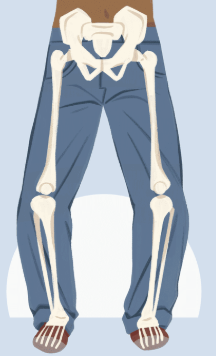
Varus
Leg bowing LATERALLY at the knee (bow legged)
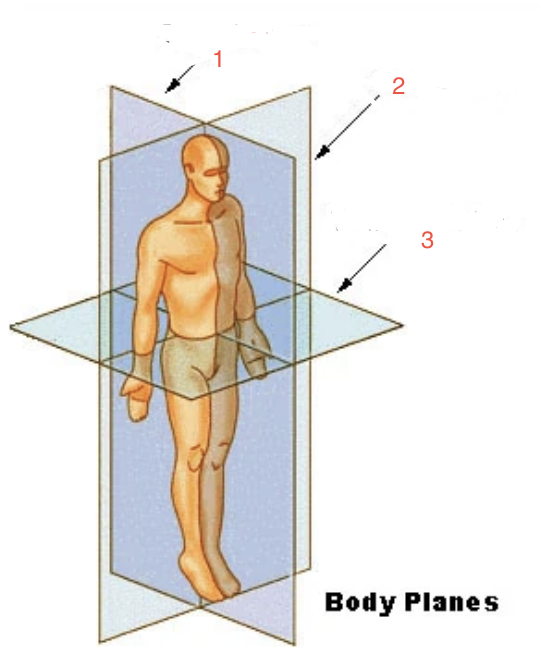
What plane is indicated by 1?
Sagittal plane
(sagittal —> sagittarius —> long word —> sagittal plane runs down midline)
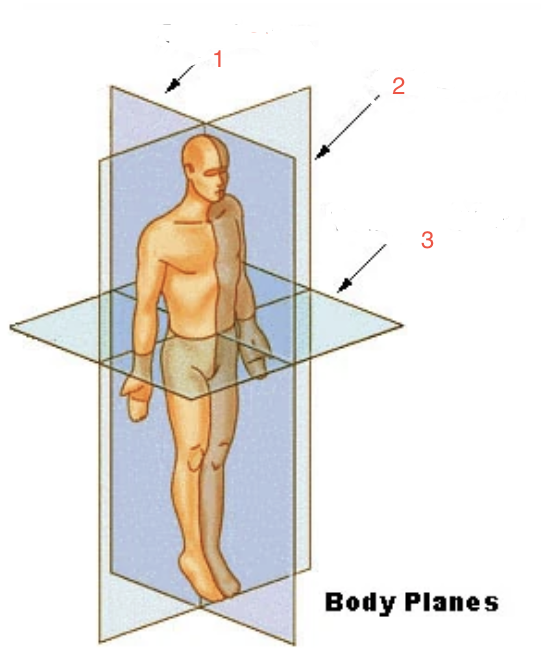
What plane is indicated by 2?
Coronal plane
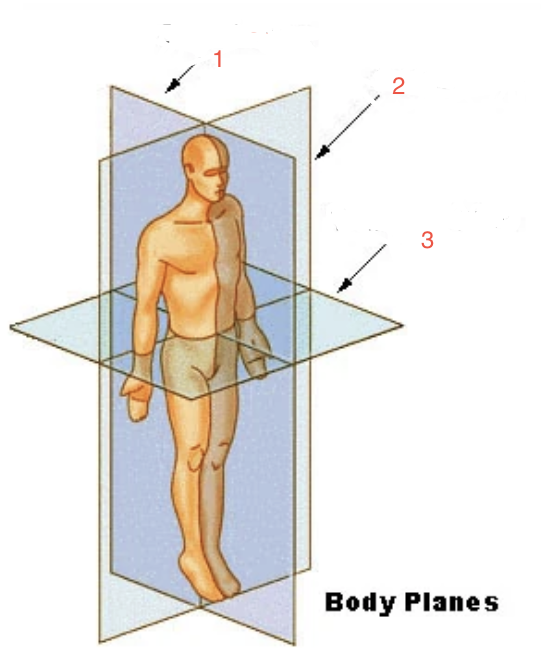
What plane is indicated by 3?
Transverse plane
Rotation occurs ____ to a plane, forming a ___ angle.
Perpendicular; right
What is “an imaginary line that runs through the pivot point of a joint?”
Axis of rotation
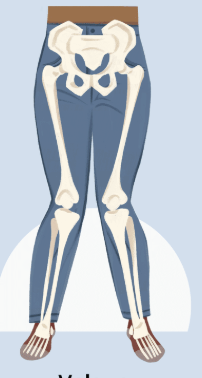
Valgus
leg bowing MEDIALLY at the knee (knock-knees)
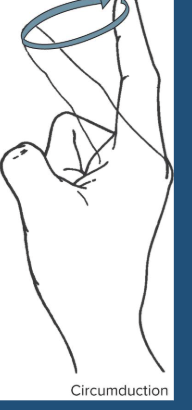
What is “the tracing of an imaginary circle in the air with a fingertip while the rest of the hand is stationary?”
This combines flexion, extension, abduction, and adduction
Circumduction
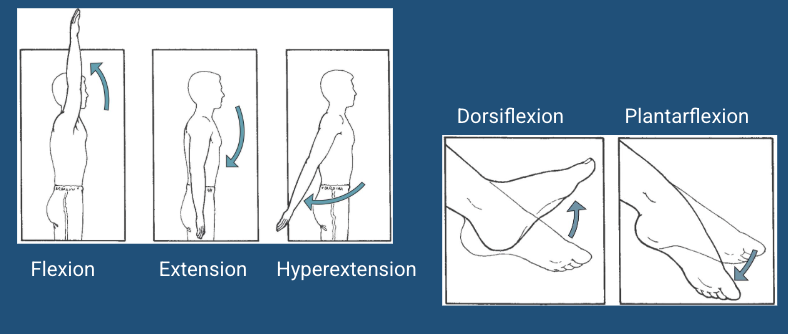
Are these sagittal plane, frontal plane, or transverse plane movements?
Flexion, extension, hyperextension, dorsiflexion, and plantar flexion
Sagittal plane
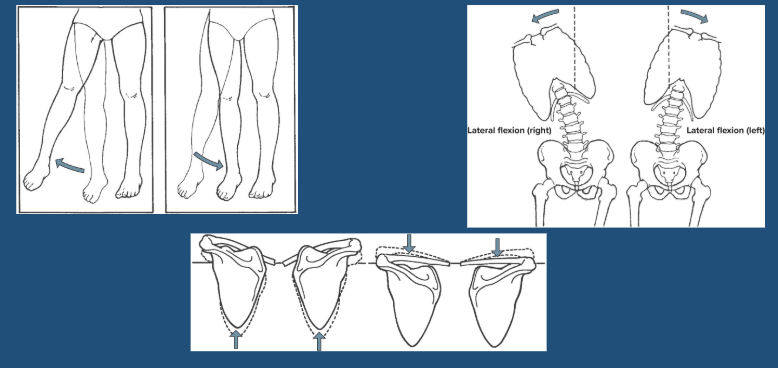
Are these sagittal plane, frontal plane, or transverse plane movements?
Abduction, adduction, lateral flexion, elevation and depression, inversion and eversion, and radial and ulnar deviation
Frontal plane movements
Are these sagittal plane, frontal plane, or transverse plane movements?
Left and right rotation, medial and lateral rotation, supination and pronation, horizontal abduction and adduction
Transverse plane movements
 Note
Note  Flashcards (20)