PSYC 326 Final (Ch. 11, 13, 14, 15, 18, 19)
 Studied by 0 people
 Call Kai
 Learn
Learn Practice Test
 Spaced Repetition
 Match
Match Flashcards
 Knowt Play
1/204

There's no tags or description
Looks like no tags are added yet.
Name | Mastery | Learn | Test | Matching | Spaced | Call with Kai |
|---|
No analytics yet
Send a link to your students to track their progress
205 Terms
Learning
Relatively persistent change in behavior due to an experience
Acquiring new info
Our experiences change our nervous system and behavior
Memory
Long term changes in the nervous system following learning
Stimulus
Anything that an animal can detect with its senses
Ex: lights, tones, odors, food
Response
A measurable behavior by an animal. Often caused or related to a stimulus
Types of Stimulus-Response Learning
Non Associative
Associative
Non-Associative
No connections between stimuli and responses
Involves habituation and sensitization
Habituation
A decline in a response to a stimulus that is not important
Sensitization
An increase in response to stimuli after an avers or highly arousing event
Associative
Connections between stimuli and responses
Classical Conditioning
Operant Conditioning
Classical Conditioning (Pavlovian)
Two stimuli brought together in time
Independent of the animal’s behavior
The animal associates the two stimuli
Ex./ Steps of Classical Conditioning
Unconditioned stimulus (US): food
Unconditioned response (UR): salivation to the food
*Conditioned stimulus (CS): the bell
Conditioned response (CR): salivating to the bell
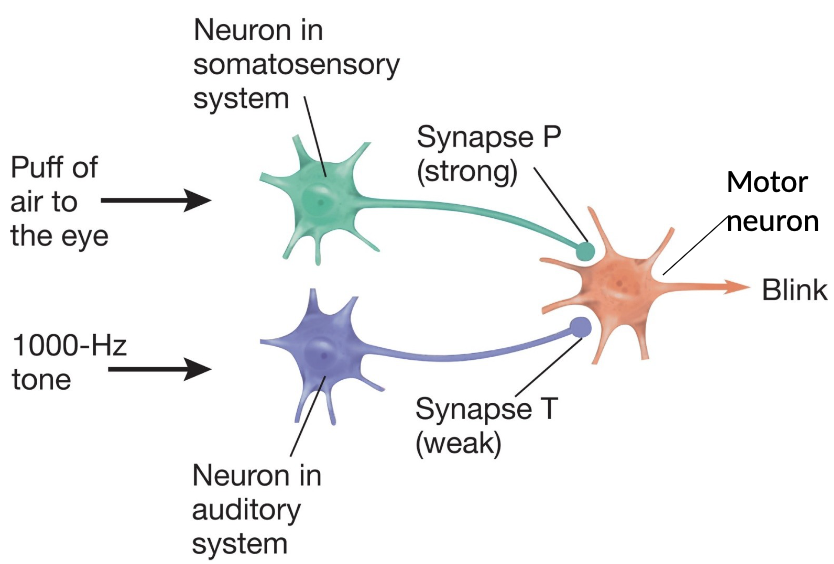
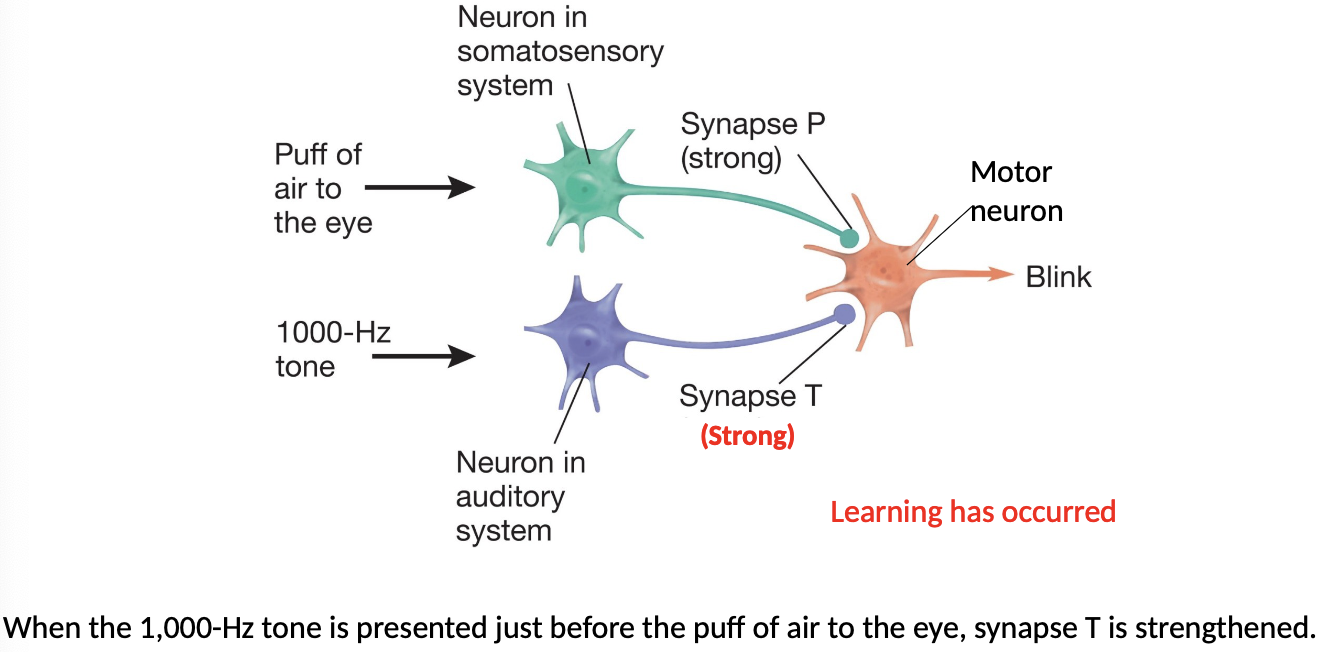
Classical Conditioning in Humans
Unconditioned stimulus (US): puff of air
Unconditioned response (UR): blink of the eye
*Conditioned stimulus (CS): a tone/sound
Conditioned response (CR): tone elicits a blink
Neural Model of Classical Conditioning
Operant Conditioning (instrumental conditioning)
Outcome is dependent on the animal’s behavior
Positive reinforcement: the addition of something to increase a behavior (giving a treat)
Negative reinforcement: the removal of something to get a certain behavior
Motor Learning
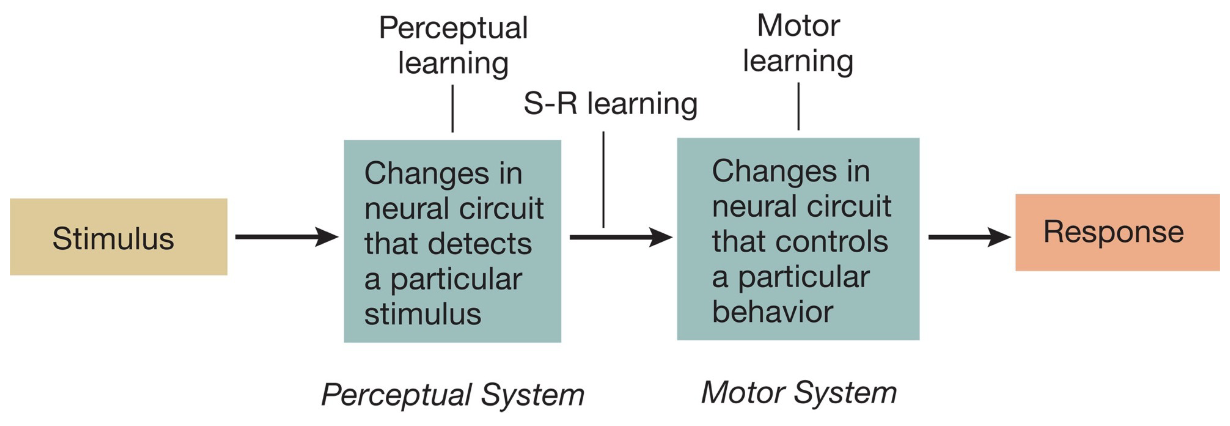
Component of stimulus-response learning
Changes in responses of motor system following a stimulus
Perceptual Learning
Ability to learn to recognize stimuli that have been perceived before
Each sensory system is capable
Relational Learning
Connections between association cortex
Includes spatial learning
Perceptual, Stimulus-Response, and Motor Learning Model
Henry Molaison (H.M)
Had severe epilepsy as a child that originated in the temporal lobes
Received a bilateral temporal lobectomy that removed much of his temporal lobe included a large portion of his hippocampi
He could only maintain short-term declarative memories but no long-term memories
Could still learn practiced motor skill and associative learning
Engram
Anatomical/physical representation of memory
Equipotentiality
The idea that memory is spread equally throughout the cortex
Does hippocampal formation play a part in memory consolidation?
yes
Sensory Memory
Brief and fleeting
Kept only for a few seconds
Short Term Memory
Kept for a few seconds to a minute if rehearsed
Working Memory
Similar to short term memory but used to solve problems
Long Term Memory
If the short term memory is rehearsed a lot and is important
And the memory is returned to at different time then it is transferred from short-term memory to long term memory in a process called consolidation
Non declarative (implicit memory)
Unconscious
Not well controlled
Procedural memory (ex: riding a bike)
Classical conditioning/associative learning
Declarative (explicit memory)
What we can bring to our conscious mind
Memories of place, events, and facts
Episodic Memor
Memory of life events or episodes
Hippocampus helps create episodic memory
Prefrontal cortex (more on the right hemisphere)
Parietal lobe, specifically the precuneus
Semantic Memory
Memory of facts, ideas, and concepts
Hippocampus
Prefrontal cortex
Inferior and medial temporal lobe
Spatial Memory
Memory that represent one’s environment
Uses episodic and semantic memory
Hippocampus is highly involved
Morris Water Maze
Maze with cloudy water
Rats swim around trying to find a platform that it cannot see
Rat gets faster at finding the platform by learning spatial cues
Used for research in spatial memory
Memory Consolidation
Mainly takes place in the hippocampus
Entorhinal cortex (EC) sends axon into the hippocampus to granule cells into the dentate gyrus (DG) in a tract called the performant pathway
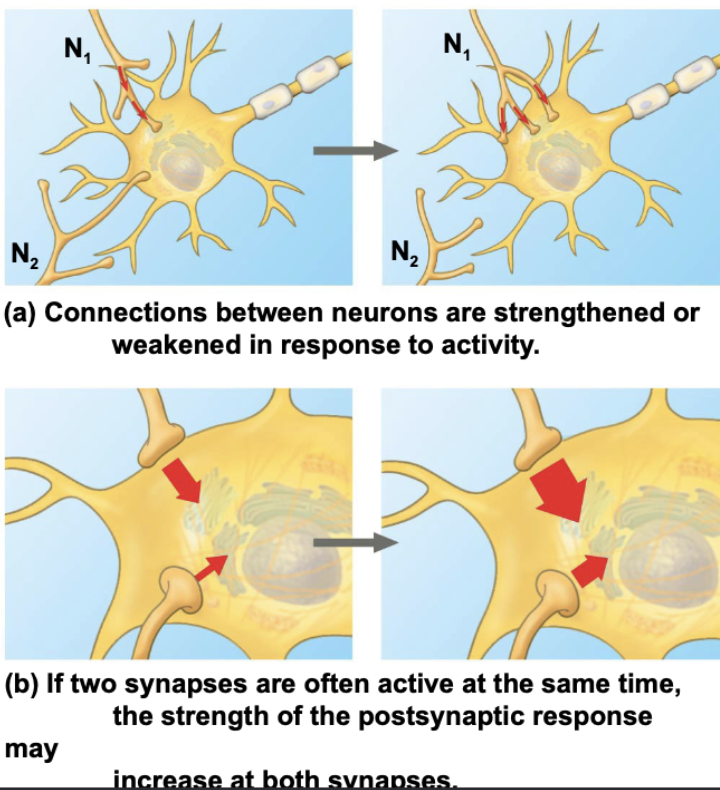
Long term potentiation
Long term potentiation (LTP)
Long term increase in excitability of neuron caused by repeated high-frequency activity of that input
Involves the activation of NMDA glutamate receptor
Increasing AMPA glutamate receptors at synapse
What concepts involve LTP?
Memory
Classical conditioning
Consolidation of long term memories that take place in hippocampus
Neural Plasticity
NMDA receptor for glutamate (postsynaptic)
Glutamate is the #1 excitatory neurotransmitter
Typically only allow a small amount of Ca++
Typically blocked by Mg++
AMPA receptors
Second type of postsynaptic receptor
Allows in Na+
Long Term Potentiation Sequence
Glutamate is released from the presynaptic neuron
Glutamate binds to AMPA and NMDA receptors
Na+ influx via AMPA causes a large depolarization of the post-synaptic neuron causing the Mg++ to be removed from the NMDA receptor
Ca++ influx via NMDA receptors
Ca++ activates intracellular signaling pathways affecting protein kinase
Protein kinase affects CREB
CREB activates genetic markers for the production of proteins involved in synthesizing new synaptic connections
Long Term Potentiation Result
New AMPA receptors are created
New dendritic and axonal branching
New dendritic spines
The communication between the two neurons is more efficient and more easily activated
Long Term Depression
Caused by low-frequency stimulation between neurons for a long time
Opposite of LTP in that it weakens signals between neurons
A way for the nervous system to be adaptable to changes-neuroplasticity
The neurological representation of forgetting
Caused by a slow influx of calcium in the postsynaptic cell that activates the enzyme PP1
Amnesia
A difficulty with memories caused by an event
Damage to the central nervous system caused by a stroke or accident
Taking a psychoactive drug such as alcohol or benzodiazepines
Krsakoff Syndrome
Excessive alcohol use. Alocohol use leads to thiamine deficiency and hinders LTP
Anterograde Amnesia
Difficulty or inability create new memories after an event
Retrograde Amnesia
Difficulties or inability to remember events before an event
Language
The set of symbols that we use as a means of communication
Subserved by the left hemisphere
Speech
The mechanical process of communication
Is supported by the entire motor system for vocalization
How is speech produced?
Speech is produced by airflow from the lungs that passes through the larynx and from there through the oral and nasal cavities
Production of Vowels
created by movements of the lips and tongue that change the size and shape of the oral cavity
Production of Consonants
produced by movements that temporarily obstruct the airflow through the vocal tract
Communication
The context of disturbances of specific areas of the brain that controls language expression and comprehension
Aphasia
A disturbance of language with damage in a specific area of the brain that controls language expression and comprehension
Breakdown in grammar and syntax (arrangement of words and phrases to create well-formed sentences
Anomia
Difficulty finding words
Paraphasias
Produce the wrong sounds
ex: pike isntead of pipe
Dysarthria
Poor articulation
Hypophonia
Soft output
Other disturbances of language
Repetition
Verbal fluency
Writing:
Agraphia
Inability to write
Paragraphia
Writing incorrect words in a manner similar to saying incorrect words
Prosody
Intonation and stress patterns of words
Hyperprosody
Excessive intonation, almost like mania
Dysprosody
Distorted prosody as if one has acquired a foreign accent
Aprosody
Lack of prosody as in parkinson’s
The Wada Test
A neurological test used to determine which hemisphere of the brain is responsible for language and memory functions, typically involving the injection of a barbiturate into one carotid artery.
Lichtheim
Proposed Connectionist model of the brain
Connectionist Model
Different brain centers are interconnected, and that impaired langauge function may result from damage to either to one of the centres or to the pathways between centeres
Geschwin discoverswhat?
Conduction aphasia
Conduct aphasia
Damage to arcuate fasciculus, failure to repeat words
Where is Wernicke’s Area?
Left temporal lobe
Where is Broca’s Area?
Left frontal lobe
Functional Asymmetry
left = verbal
right = non-verbal
Cortical areas involved in language production and perception
auditory cortex
wernicke’s area
arcuate fasciculus
Broca’s area
Motor cortex
Primary visual cortex
Angular gyrus
What is the wernicke-geschwind model?
An early model for understanding how speech is produced in humans
Conversation
Auditory signals are received by the primary auditory cortex
Signals are condcuted to the wernicke’s area where it is comprehended
Neural representaion of thought is transmitted to the Broca’s area through arcuate fasciculus
Broca’s area then articulates the speech in the form of neural signals
Signals are transmitted to the primary motor cortex and muscles of articulation
Reading Aloud
Primary visual cortex analyzes the image and transmits the information to the angular gyrus
Wernicke’s area then sends information to the Broca’s area through the arcuate fasciculus
Broca’s area then triggers motor cortex to read aloud
Angular Gyrus
Decodes the image information to recognize the word
Important for reading
Connects words we read through the visual system to the language system
If lesioned we get pure Alexia
Alexia
Reading disturbance results from a brain damage
Dyslexia
Reading disturbance is developmental
Auditory Code
Transmitted to Wernicke’s area for comprehension
Broca’s Aphasia
Characterized by slow, laborious, nonfluent speech
Better language comprehension than production
Nonfluent aphasia
Difficulty with function words (grammar)
Better with content words (nouns, verbs, adjectives)
Wernicke’s Aphasia
Production of meaningless speech
Speech is fluent and unlabored
The person does not strain to articulate words and does not appear to be searching for them.
“Fluent aphasia”
The patient maintains a melodic line, the the voice rising and falling normally
When you listen to the speech of a person with Wernicke’s aphasia, it appears to be grammatical
Normal use of function words
Use of few content words
Is addiction treated as other neuropsychiatric disorders? (depression, autism, or alzheimer’s disease)
NO (addiction)
Where do problems with addiction come from?
Social stigmas
Personal shaming
Assumptions of character flaws
Addiction
A pattern of compulsive behaviors such as drug taking/ gambling
Measured by the degree it causes harm to the individual or those around them
A disorder that often comes with social stigma
Addiction has components of associative learning (aka classical conditioning)
Risk Factors of Addiction
Adolescents
Other disorders such as depression, anxiety, autism, schizophrenia, antisocial personality disorder, PTSD
Early trauma
Stressful environment
Adolescents and Addiction
25 or older = least likely to become addicted
Drug addiction may be a developmental disorder
Rates of addiction are highly correlated with the age at which the drug is first tried
Disorders and Addiction
Drug abuse and addiction often coincide with or predate neuropsychiatric disorders such as depression, bipolar disorder, and anxiety disorders
Children with ADHD and Addiction
Children with ADHD are more likely to develop problems with addictions
Adults with Autism and Addiction
Adults with Autism and more likely to develop problems with addictions
Antisocial personality disorder and Addiction
Addiction is prevalent in people with APD,
Sensation seeking and Addiction
People who are sensation seeking are more prone to develop addictions
Trauma and Addiction
A strong predictor of drug addiction developing in adolescence and early twenties is whether an individual experienced abuse or trauma as a child
Adolescents suffering from addictions had five times the prevalence of PTSD than their nonaddictive peers
Rat Park Study
Rats that live in a comfortable and socially stimulating environment are not motivated to take drugs
Negative Reinforement Theory
Taking drugs to counteract withdrawal symptoms or a negative state
Problems
Highly addictive drugs like nicotine and cocaine do not produce severe withdrawal symptoms
People relapse long after withdrawal symptoms are gone
Some drugs like tricyclic antidepressants produce withdrawal but do not promote addiction
Positive Reinforement Theory
Taking drugs because they produce euphoric pleasure
Problems
Euphoric feeling often goes away
Some addictive drugs do not produce pleasurable feelings
The destruction of drug addiction. produce far outweigh any pleasure from the drug
Mesotelencephalic dopamine system (MTDS)
Ventral tegmentum sends signals to the nucleus accumbens
Activated by addictive drugs
Activated by the stimuli associated with the drug
Activated in anticipation of a reward or drug
Activated most when there is uncertainty about the rewards
Incentive-sensation theory of drug addiction
The MTDS becomes sensitized to the drugs and to stimuli associated with the drug
When the MTDS is activated it creates strong cravings for the drugs
Classical conditioning of stimuli associated with taking drugs
Dorsal striatum functions in the learning process
Does drug addiction fundamentally change the normal function of the MTSD??
Yes
Dopamine Receptors/ Levels and Addiction
People with an addiction to cocaine and heroin had a decrease in dopamine receptors and endogenous dopamine levels
CREB
Increases in the nucleus accumbens with drug taking
CREB activates genes that produces dynorphin, which reduces the pleasurable feelings of a drug and causes a person to increase dosage
CREB declines quickly when a person stops taking drugs
FosB
Released with drug taking
Causes sensitization of craving behavior to drugs and drug stimuli to create cravings
Long-lasting even after a person stops taking drugs
Increases BDNF that causes dendritic branching and spine formation to the frontal lobes-facilitates learning
Influences relapse
 Note
Note  Flashcards (97)