Scaled Cell Diagrams
 Call Kai
 Learn
Learn Practice Test
 Spaced Repetition
 Match
Match Flashcards
 Knowt Play
1/10

There's no tags or description
Looks like no tags are added yet.
Name | Mastery | Learn | Test | Matching | Spaced | Call with Kai |
|---|
No analytics yet
Send a link to your students to track their progress
11 Terms
Cell Size
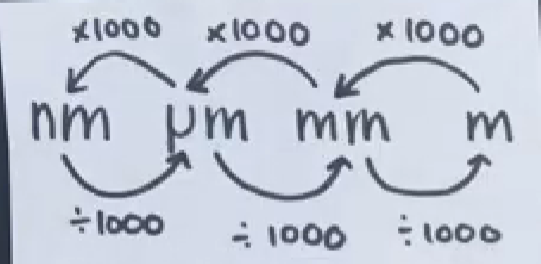
A micrometre is equal to 0.000001 metres. 1 million micrometres is equal to one metre. 1m = 106 micrometres µm.
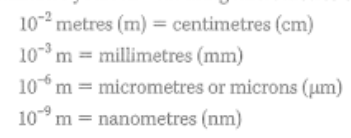
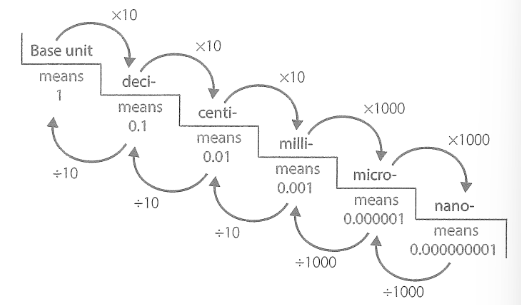
Converting from base unit
Base unit is either metre, gram or litre.
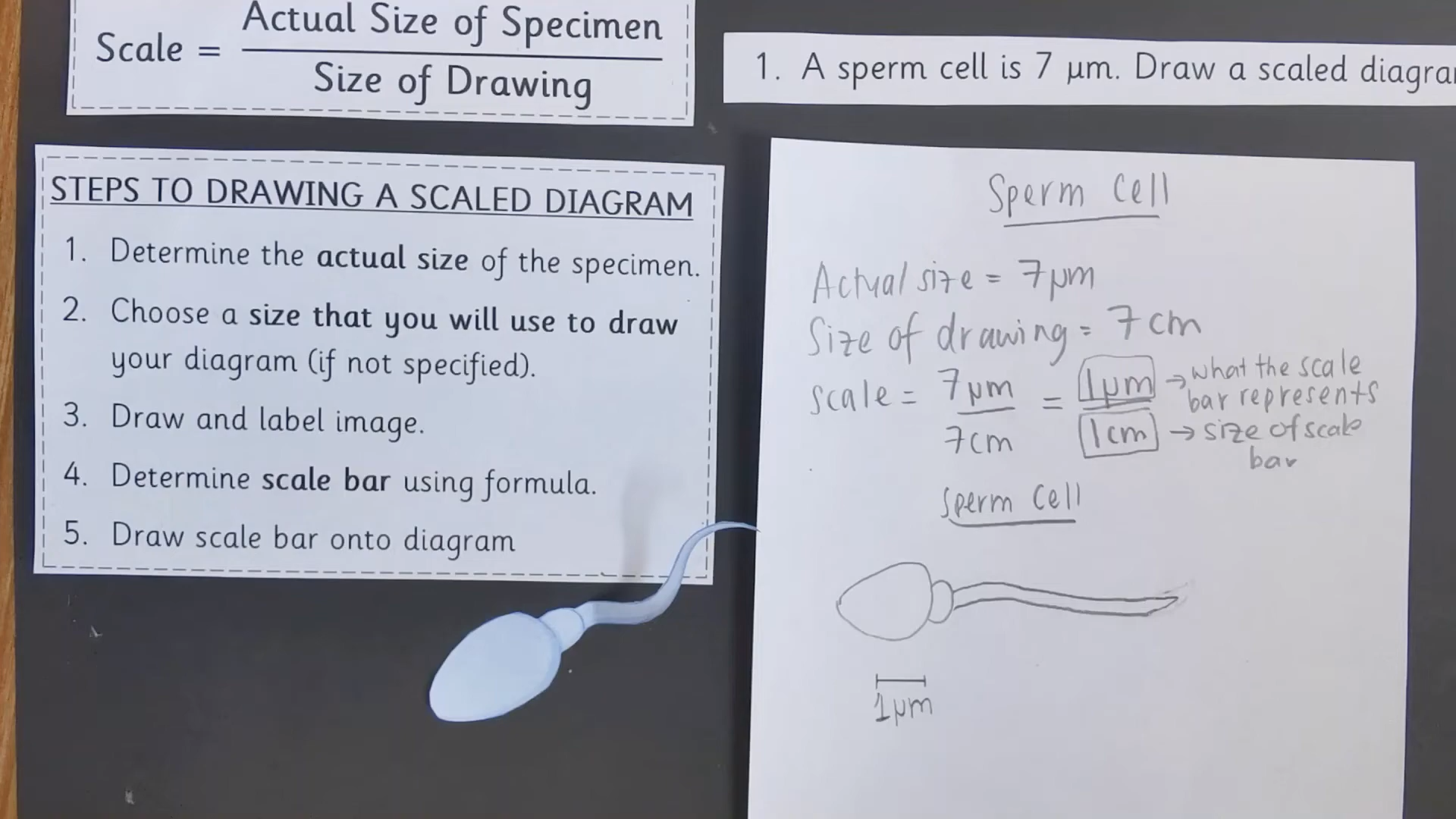
Scale bar
Represents a specific whole number of µm. (Is often 2 to 5cm in length.
To draw the scale bar: determine the actual length of the object to be drawn, divide the actual length by the drawing’s length (should be a whole number).
E.g. Actual length of cell = 30µm, Length of drawing = 10cm. Scale = actual length/length of drawing. A 1cm scale bar would represent 3µm, or a 2c, scale bar would represent 6µm.
Using scale bars to calculate actual size of cells and organelles (shown on drawings/micrograph)
Actual size = length of image (mm)/length of scale bar (mm) x representative length of scale bar (µm)
E.g. actual size = 100/2 × 6, actual size = 30µm
Drawing scaled diagrams
½ page size (large drawings)
Use pencil
Simple, clear lines, don’t cross, one side, no arrows, touch structure, continuous lines, no shading
Title - name and magnification, underline
Needs scale bar (should be a ¼ to a 1/3 of cell) and magnification
The drawn length of bar (d) = Drawn size of cell (D) x actual size from bar (a) / Actual size of cell (A)
Use micrometres or nanometres.
(Draw 2 - 3 cells, only what u see, middle of page)
Working out magnification
Measure the length of the scale bar in mm.
Convert this to the same units as the scale bar (µm)
Divide scale bar length by actual object scale bar length. (Written on scale bar.)
E.g. 1. scale bar is 13mm. 2. 13 × 1000 = 13 000 µm 3. 13 000 / 1 = 13 000x magnification
Magnifiying power
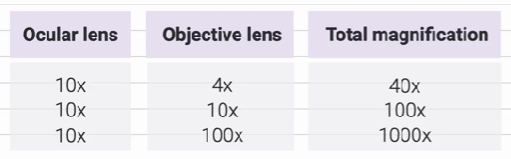
Calculating the total magnification of a microscope = ocular lens power x objective lens power.
Eyepiece is normally 10x for light microscope
Calculating the size of a cell viewed under a microscope
To work out the size fo a cell, you divide the number of cells you can see in the FOV by the diameter of the FOV. This equals the measure length of each cell (mm) - is not the actual length of the cell.
A cell at x100 magnification which fills the FOV is about 1.5mm across. If there are two cells, each is about 0.75mm cross. This is the measured length of the cell.
To calculate the actual length of the cell, divide the measured length by the magnification.
Field of view (mm)/number of cells = measured length of each cell (mm)
E.g. a microscope with ocular x 10 and objective x 40 (average three cells visible across). Total magnification = 10 × 40 = X400. FOV = 450µm (from table) Measured length: 450µm/3 cells = 150µm

Field of View (FOV)
Is the area seen with the eyepiece. The width of the FOV can be emasured using a mini grid slide.

