Transcranial Doppler(TCD) summary and velocities numbers for exam 2
 Call Kai
 Learn
Learn Practice Test
 Spaced Repetition
 Match
Match Flashcards
 Knowt Play
1/13

There's no tags or description
Looks like no tags are added yet.
Name | Mastery | Learn | Test | Matching | Spaced | Call with Kai |
|---|
No analytics yet
Send a link to your students to track their progress
14 Terms
what are the Flow characteristics
Velocity, Turbulent flow, Pulsatility, Systolic upstroke
what angle degree is assumed
Mean velocity is calculated=
Differences between intracranial artery velocities more important than?
Differences between intracranial artery velocities more important than absolute values recorded from an individual
Transtemporal Window Technique, patient is postion how? how is the head?
transducer placed on what bone, how is the psotion like describe it?
window divided into 3 areas what are those areas called?
Patient supine- head straight
Transducer placed on temporal bone superior to zygomatic arch and anterior to the ear
Thinnest portion of the skull
Window divided into 3 areas
Anterior, middle, and posterior
Transtemporal Window Technique
how much gel should you use and why?
angle transducer for what and may require what
allows what visualization of what circulation
Technique
Generous gel ensures good transducer to skin contact
Angle transducer to optimize Doppler angle – may require elevation from skin surface
Allows simultaneous visualization of anterior and posterior circulation
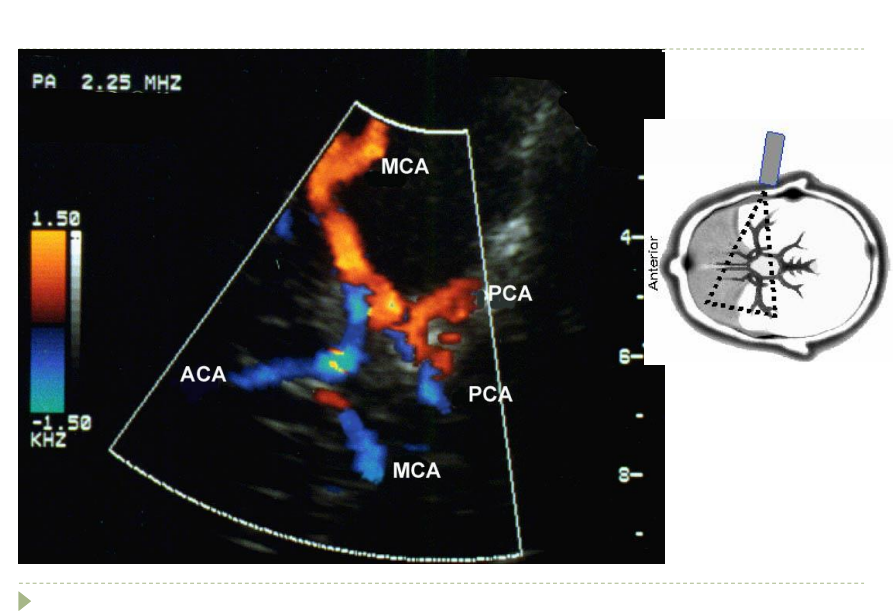
Transtemporal Window Image orientation Ipsilateral hemisphere is at the “where” of monitor-Contralateral hemisphere is at the where
Anterior to the right or left and posterior to the right or left
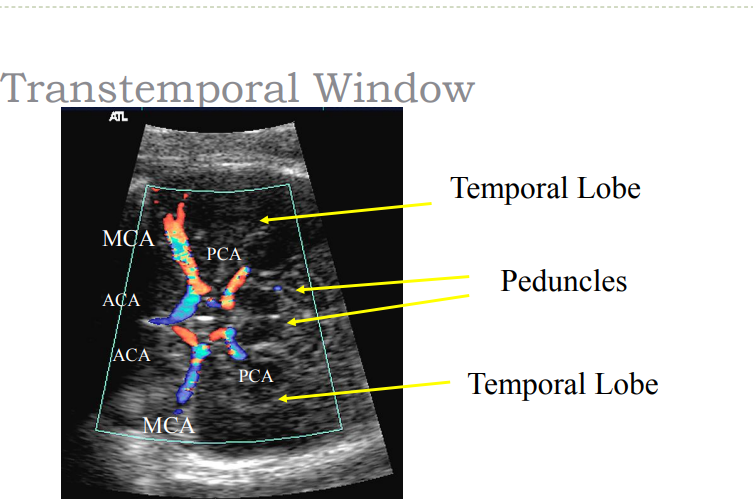
Transtemporal Window Image orientation Ipsilateral hemisphere is at the “top” of monitor-Contralateral hemisphere is at the bottom
Anterior to the left and posterior to the right
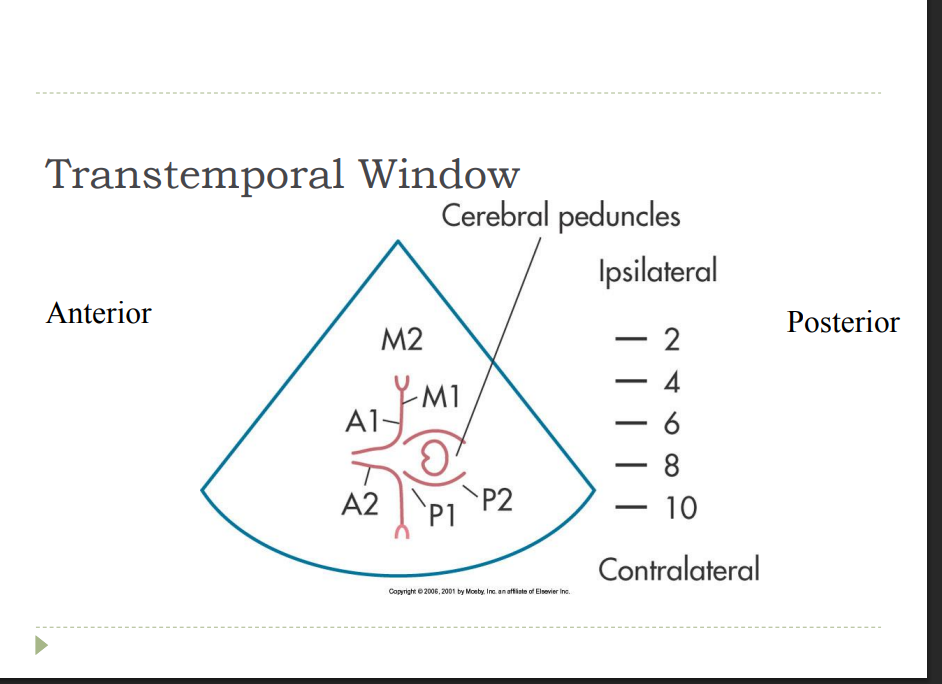
Transtemporal Window – MCA
Depth=
Flow direction
Mean velocity-
Angle
Courses adjacent to
Branches usually in what color, but may be what -why?
Depth 30 – 60 mm
Flow direction – Antegrade; toward
Mean velocity- 55 + 12 cm/sec
Angle – anterior and superior
Courses adjacent to sphenoid wing
Branches usually in red, but may be blue as they curve away from transducer
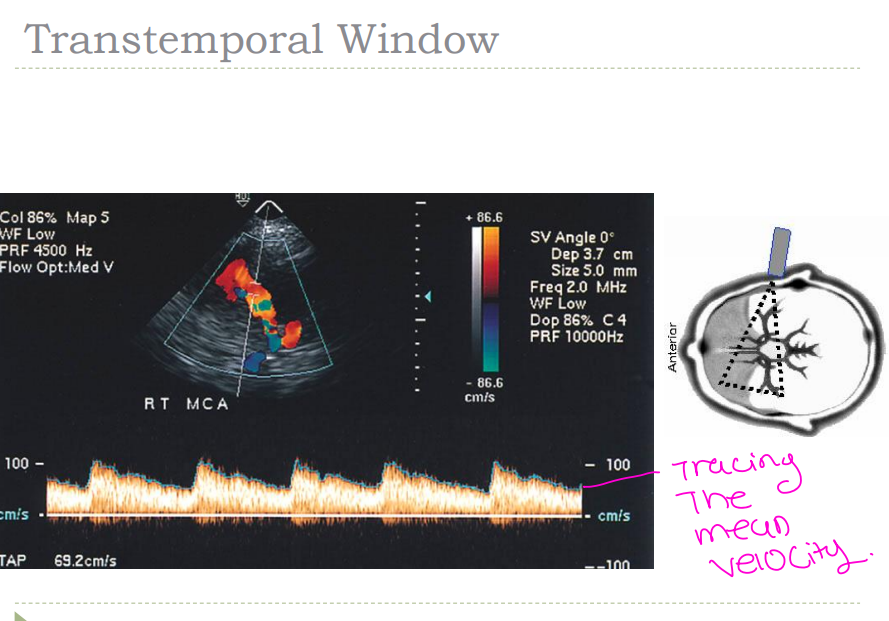
Transtemporal Window – TICA
Depth
Flow Direction
Mean velocity
Angle
what image artifact and occur due what
Depth- 55-65 mm
Flow Direction – toward transducer (red)
May be bidirectional
Mean velocity- 39 + 9 cm/sec
Angle – anterior inferior
Mirror image artifact may occur due to adjacent bone
Transtemporal Window – ACA
Depth
Flow direction
whats the butterfly look direction
Mean velocity
what should you do to the PRF, and why
angle
Depth- 60-80 mm
Flow direction – retrograde / away
ACA/MCA bifurcation toward and away (VT pg 242)
Mean velocity- 50 + 11 cm/sec
Decrease color PRF to visualize low velocity
Angle – anterior and superior
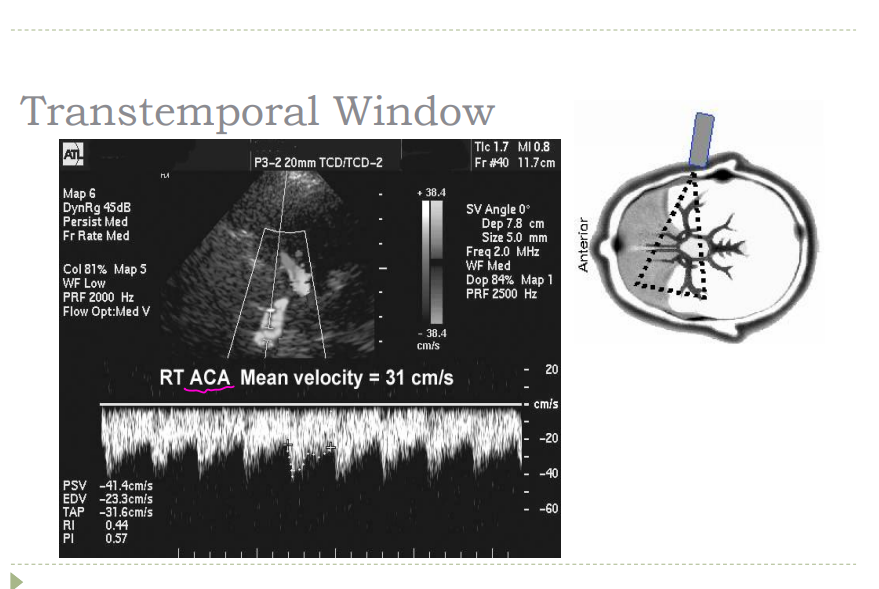
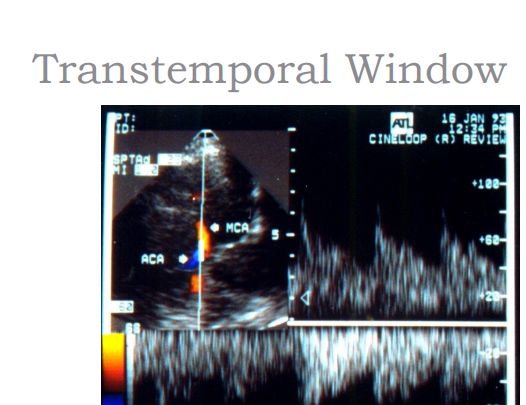
what is this an image of
“Butterfly
MCA-ACA bifurcation
Transtemporal Window – PCA
Depth
Flow direction
Mean velocity
Angle
whats the anatomic landmark
what is the size and shape
and what is the echogenicity?
Depth – 60 – 70 mm
Flow direction – antegrade / toward
Mean velocity – 39 + 10
Angle – posterior and inferior
Cerebral peduncles anatomic landmark
Identical in size and shape
Intermediate echogenicity
Suboccipital Window
evalutes what system
whats the technique of the patient postion and head
transducer is placed how and explain how its directed
Evaluates vertebrobasilar system
Technique
Patient lying on side
Head bowed toward the chest
Transducer placed on posterior aspect of neck
Transducer slightly off midline- beam directed toward bridge of patient’s nose
Suboccipital Window Image Orientation what are they and describe each one name 5
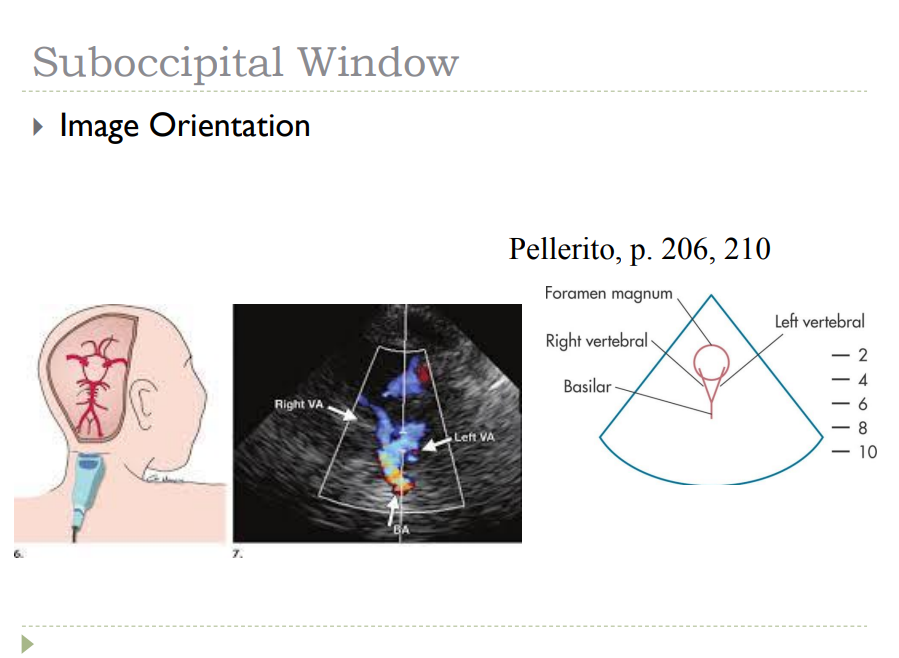
Foramen magnum- large circular anechoic area
Occipital bone- bright echogenic reflection
Right vertebral- left side of image
Left vertebral- right side of image
Basilar artery- deep to vertebrals
Suboccipital Window – Vertebral A
Depth
Flow direction
Mean velocity
Angle
Demonstrates a what shape configuration
Depth – 60 – 90 mm
Flow direction – retrograde / away
Mean velocity – 38 + 10 cm/sec
Angle – right and left of midline
Demonstrates a Y shape configuration
Suboccipital Window – Basilar A
Depth
Flow direction
Mean velocity
Angle
what would you do to your PRF and why
Depth – 80 – 120 mm (deepest)
Flow direction – retrograde / away
Mean velocity- 41 + 10 cm/sec
Angle – midline
Decrease PRF to visualize low flow velocities in verterbrobasilar system

