bio test
 Call Kai
 Learn
Learn Practice Test
 Spaced Repetition
 Match
Match Flashcards
 Knowt Play
1/95

There's no tags or description
Looks like no tags are added yet.
Name | Mastery | Learn | Test | Matching | Spaced | Call with Kai |
|---|
No analytics yet
Send a link to your students to track their progress
96 Terms
What are the basic units of life?
Cells
How do plant and animal cells compare
whilst plant and animal cells contain similar organelles, they differ as plant cells have features such as a cell wall and chloroplast, as well as a larger vacuole
How do prokaryotic cells differ from eukaryotic cells in size and complexity?
Prokaryotic cells: are smaller and simpler, lack nucleus, genetic info is stored in the nucleoid, and lack membrane bound organelles
Eukaryotic cells: are larger, complex, it has a nucleus and specialised organelles
How do specialised cells relate to their function?
Their structure has adapted to become specific to the role they perform. So the type and number of organelles in the cell, change as needed for it’s function to increase efficiency
Example of specialised cells structure adapting
A sperm cell: It’s purpose is to fertilise an egg - so it has a tail, a lot of mitochondria to provide energy, enzymes in the head to penetrate the egg.
Name key organelles
Ribosomes, nucleus, Mitochondria, Chloroplasts, cell membrane.
What is the function of the nucleus?
It stores genetic material (DNA) and controls cell activities
role of ribosomes
Where protein is made
role of the Mitochondria
Where energy/ATP is produced through cellular respiration
role of chloroplast
Carry out photosynthesis which converts light energy into chemical energy in plant cells
role of the cell membrane
control what enters and exits the cell, as well as a protective outer boundary of the cell.
How do organelles interact in larger biological processes?
Organelles work together in coordinated pathways, each organelles performs a specific role which contributes to an overall cellular process
examples of cells working together in a larger biological process
In the exocytosis of proteins, the DNA in the nucleus holds the instructions for protein synthesis. Ribosomes use these instructions to produce proteins. The rough ER folds the protein. The protein is sent to the golgi apparatus to be modified, sorted and package into vesicles. The vesicles fuse with the cell membrane and release protein outside the cell.
What doe diploid and haploid mean in terms of chromosome number?
Diploid: 2n is when a cell has 2 sets of chromosomes one from each parent - 46
Haploid: n is when a cell has 1 set of chromosomes
Main purpose of Mitosis
for growth, repair, replacement and asexual reproduction
What does Mitosis produce
Produces two identical diploid daughter cells
What is the phases of Mitosis
Prophase
Metaphase
Anaphase
Telophase
What are the 2 other essential stages of the cell cycle
Interphase
Cytokinesis
Interphase - mitosis
G1 - cell grows and produces proteins and organelles
synthesis - DNA replication - sister chromatids
G2 - Further growth, prepares machinery for mitosis
Prophase - mitosis
Chromatin condenses into visible chromosomes - each chromosome consist of two sister chromatids
Nucleus disappears
Spindle fibers form from microtubules and attach to centromeres
Metaphases - mitosis
Chromosomes line in the equator of the cell - spindle fibers attached to the centromere pull the chromosomes into alignment
arranged so each chromatid is attached to spindle fibers from opposite poles
Anaphase - mitosis
Sister chromatids are separated at the centromere by spindle fibers
The spindle fibers shorten and pull the chromosomes in opposite directions
Cell elongates as microtubes pull poles apart
this process ensures each daughter cell receives identical sets of chromosomes
Telophases - mitosis
Chromosomes reach the opposite poles
The chromosomes decondense into chromatin
Nuclear envelope form around each set
Nucleolus reappears in each new nucleus
spindle fibers disappear
prepares for cytokinesis.
Cytokinesis - mitosis
The division of the cytoplasm, which divides the parent cell into two identical daughter cells
How does mitosis maintain genetic continuity and what happens if errors occur?
Mitosis ensures that daughter cells receive an identical set of chromosomes, which maintains genetic continuity.
Errors in the cell cycle can lead to mutations, abnormal cell function or diseases like cancer
What is the main purpose of meiosis
To produce gametes (sperm and egg) for sexual reproduction.
What are the produces of meiosis?
4 haploid gametes
What are the 8 stages of meiosis
Prophase
Metaphase
Anaphase
Telophase
Cytokinesis
Prophase II
Metaphase II
Anaphase II
Telophase II
Interphase
G1 - cell grows and produces proteins and organelles
synthesis - DNA replication - sister chromatids
G2 - Further growth, prepares machinery for mitosis
Prophase I - meiosis
Chromatin coils and becomes visible as chromosomes
Homologous chromosomes pair up.
A process of crossing over occurs, where segments of genetic material on one homologous chromosome swap with the other.
Nuclear envelope / membrane disintegrates.
Spindle fibres attach to the centromere of the homologous chromosomes.
Metaphase I - meiosis
Homologous chromosome align at the equator of the cell.
Independent assortment occurs
The orientation of each homologous chromosome pair is random
Maternal and paternal chromosomes assort independently increases genetic variation.
Anaphase I - Meiosis
Spindle fibres pull the homologous chromosomes apart to opposite poles of the cell
Each homologous chromosome still consists of two sister chromatids.
Telophase I - Meiosis
Homologous chromosomes have fully separated
Each pole now has one chromosome from each homologous pair
Cell nuclei are now haploid (n).
Intercytokinesis - Meiosis
Interkinesis is the short resting stage between Meiosis I and Meiosis II.
Occurs after telophase, completing cell division
Ensures each daughter cell receives organelles and cytoplasm in addition to the nucleus
Prophase II - meiosis
Chromosomes condense as they may have partially decondensed during cytointerkinesis
Each chromosome still consists of two sister chromatids joined at the centromere.
Spindle fibres attach to the centromere of each chromosome.
Metaphase II - meiosis
Chromosomes align at the equator of the cell (metaphase plate)
Spindle fibres pull the chromosomes into alignment
Chromosomes are arranged so that:
Each sister chromatid is attached to spindle fibres from opposite poles
Anaphase II - meiosis
Spindle fibres pull the sister chromatids apart to opposite poles of the cell
Each chromosome now consists of a chromatid.
Telophase II - meiosis
sister chromatids are on opposite poles of the cell
Each chromosome now consists of a chromatid.
Each daughter nuclei are haploid (n).
Nuclear membrane reforms and chromosomes decondense into chromatin
Cytokinesis
Occurs after telophase II, completing cell division.
Each daughter nuclei is haploid (n).
Ensures each daughter cell receives organelles and cytoplasm in addition to the nucleus
How doe the four cellular products of meiosis contribute to sexual reproduction and genetic diversity?
Meiosis produces 4 haploid gametes, each genetically unique. These gametes combine during fertilisation to create a diploid zygote, which contributes to genetic variation in offspring.
Compare and contrast mitosis and meiosis in terms of chromosome arrangement and products.
Feature | Mitosis | Meiosis |
|---|
Chromosome arrangement | Chromosomes line up individually at metaphase; sister chromatids separate in anaphase. | Homologous chromosomes pair up at metaphase I; homologs separate in anaphase I, then sister chromatids separate in anaphase II. |
Number of divisions | 1 | 2 |
Products | 2 diploid, genetically identical daughter cells | 4 haploid, genetically unique gametes |
Function | Growth, repair, asexual reproduction | Sexual reproduction and genetic diversity |
How can plant reproduce?
Can produce sexually or asexually
Name the structures that allow plants to sexually reproduce
stamen (Male organ): Anther, Filament
Carpal (female organ): Ovary, Ovule, stigma, style
Stamen
Produces pollen grains, which contain the male gametes (sperm cells)
Anther
The anther is the part of the stamen that produces and releases pollen
Filament
Supports the anther holding it in position for effective pollination
carpel/Pistil
Contains the ovary, style, and stigma, which produces female gametes and receives pollen for fertilisation.
Ovary
Ovary houses the Ovules, which contains the female gametes
Ovule
produces the female gametes and develops into a seed after fertilisation
Stigma
receives pollen during pollination and often has a sticky surface
Style
Connects the stigma to the ovary and allows the pollen tube to grow towards the ovules
Petals
attracts pollinators
Sepals
protect the flower bud before it opens
receptacle
supports flower head
What is the role of pollen, eggs and seeds in sexual reproduction
Pollen contains male gametes, eggs contain female gametes and seeds develop from fertilised eggs to give rise to new plants
Different between cross pollination and self-pollination
Cross-pollination: pollen from a diff plant, increase genetic diversity, requires pollinators
Self-pollination: same plant, offspring genetically similar to parent, can occurs without pollinators
How do animals reproduce and how do mammals differ?
some animals can produce sexual or asexually, but mammals can only reproduce sexually. Mammals require the fusion of male and female gametes, and they produce genetically unique offspring and it involves internal fertilisation.
What structures allow mammals to sexually reproduce?
Male: Testicles, Sperm duct, Penis
Female: Ovaries, Fallopian tubes, Uterus, Vagina:
Testicles
produces sperk
Sperm duct
Transports sperm from testes to penis
Penis
Delivers sperm into female reproductive tract
Ovaries
produces egg cells
Fallopian tube
transports eggs from ovaries to the uterus
Uterus
site for implantation and development of embryo
Vagina
receives sperm and serves as birth canal
Role of sperm, eggs and zygotes in sexual reproduction
Sperm: Fertilizes egg, contains male gametes
eggs: contains female gametes
zygotes: When the sperm and egg fuse during fertilisation - first cell of a new organism, full set of chromosomes
How do sexual and asexual reproduction help plants and animals survival
Sexual reproduction increases genetic diversity, which allows for evolution and adaptation, ensuring long term survival.
Asexual reproduction produces genetically identical offspring, enables rapid population grow, this ensures short-term survival.
How does sexual reproduction enable the survival of mammals?
Sexual reproduction produces genetically unique offspring which helps mammals adapt to a changing environment, predators, or diseases
Example of sexual reproduction enabling the survival of mammals
Humans sexual reproduction produces offspring with different immune system genes, this help populations resist infections
What are the basic building blocks and structure of DNA
DNA is made up of Nucleotides: which contain Deoxyribose sugar, Phosphate, and a Nitrogenous Base (ATCG)
Arranged in a double helix
Draw and identify the 3 components of nucleotides
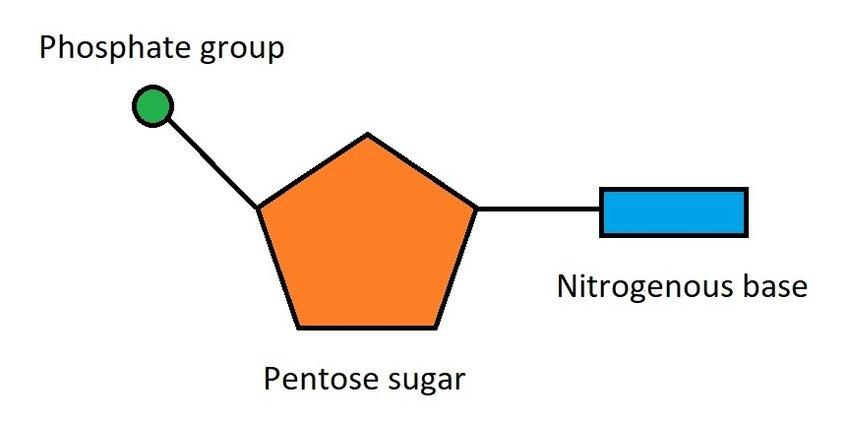
Sugar-phosphate Backbone
is a strong covalent bond between the sugar of one nucleotide and the phosphate of the next
Hydrogen bonds
a weak bond between the complementary nitrogenous bases (Adenine Thymine, Cytosine Guanine)
How does variation in nucleotide sequence contribute to variation in genes
The order of the nucleotide determines the genes instruction, as the nucleotides vary, this causes a difference in the protein it’s instructions produces and there trait.
What makes up Chromosomes?
Chromosomes are condenses chromatin, which is made up of DNA and histones
Histones provide support
Structure of chromosomes
A chromosome can have 1 or 2 sister chromatids
If there are 2 sister chromatids then they are connected at the centromere
In most eukaryotic cells they are linear
Genetic info in prokaryotic cells VS eukaryotic cells
Prokaryotic: a single circular DNA molecule, located in the cytoplasm
Eukaryotic: multiple linear chromosomes made of DNA and Histones. Located in the Nucleus
What is the relationship between genes, DNA, chromosomes the nucleus and cells?
DNA is made of genes, which are organised into chromosomes inside the nucleus of eukaryotic cells
How can human karyotypes be analysed to identify sex and chromosome number
Karyotypes are organised in homologous pairs.
The 23rd pair is the allosomes which are the sex chromosomes - XX female, XY male
typical chromosome number is 46
Genetics
the study of genes, inheritance and variation in living organisms
genetic variation
Differences in DNA sequences between individuals which leads to variation in traits
Heredity
passing of traits from one parent to offspring through genes
Genotype
The genetic makeup of an organism
Phenotype
The observable characteristics of an organism resulting from it’s genotype and environment
What is the relationship between genotype and phenotype
e phenotype is the physical expression of the genotype
How does inheritance of traits arise form gene variation and chromosome rearrangement
Inheritance occurs because of different in alleles of a gene. Since the offspring inherits one trait from either parent, which determines their genotype and phenotype. The Rearrangement of Chromosomes during meiosis in processes like crossing over and independent assortment creates a new combination of alleles
How do mutations arise
When there is a spontaneous change in nucleotide bases in DNA it alters the proteins which causes mutation
How is DNA linked to genetic conditions
Since DNA carries genes, a mutation in a gene can alter the protein which can lead to genetic conditions, such as sickle-cell aenaemia
What are alleles
Different variations of the same gene
What are the notations for dominate and recessive traits
dominate: Capital letters
Recessive: lowercase
Dominate traits
only one allele needs to be present for trait to be expressed, homozygous dominate or heterozygous
recessive
Both traits needs to be expressed for trait to be expresses, only homozygous recessive
Autosomal
located on genes 1 - 22
Sex - linked
located on the X or Y chromosome
written with the letter and then the trait above it
Co- dominace
Heterozygous
Both alleles are full expressed equally
eg AB blood type
Where does mitosis occur in humans
Male: testes
Female: ovaries

