Neural Propagation
 Studied by 0 people
 Call Kai
 Learn
Learn Practice Test
 Spaced Repetition
 Match
Match Flashcards
 Knowt Play
1/14

Earn XP
Description and Tags
DPT 5035
Name | Mastery | Learn | Test | Matching | Spaced | Call with Kai |
|---|
No analytics yet
Send a link to your students to track their progress
15 Terms
Graded/Local Potentials
Small local voltage changes, of varying (“graded”) amplitudes (can be of multiple sizes– less vs. more channels)
Graded potentials are seen at three general locations. Where are they?
Sensory Receptors: always excitatory
Neuromuscular Junction: always excitatory
Synaptic potential: either excitatory (move toward zero) or inhibitory (take away from zero)
EPSP (synapse specific)
Excitatory post-synaptic potential
IPSP (synapse specific)
Inhibitory post-synaptic potential
Sodium channels cause what type of post-synaptic potentials?
Excitatory
Potassium channels cause what type of post-synaptic potentials?
Inhibitory
Synaptic Potentials
Produced by opening of different ion channels in the neuron membrane
EPSPs and IPSPs occur only in nerve cells, at synapses
Not at sensory receptors or muscle end plates
Exist only locally on small area of neuron membrane, spreading only very short distances.
Are not actively propagated along long axons
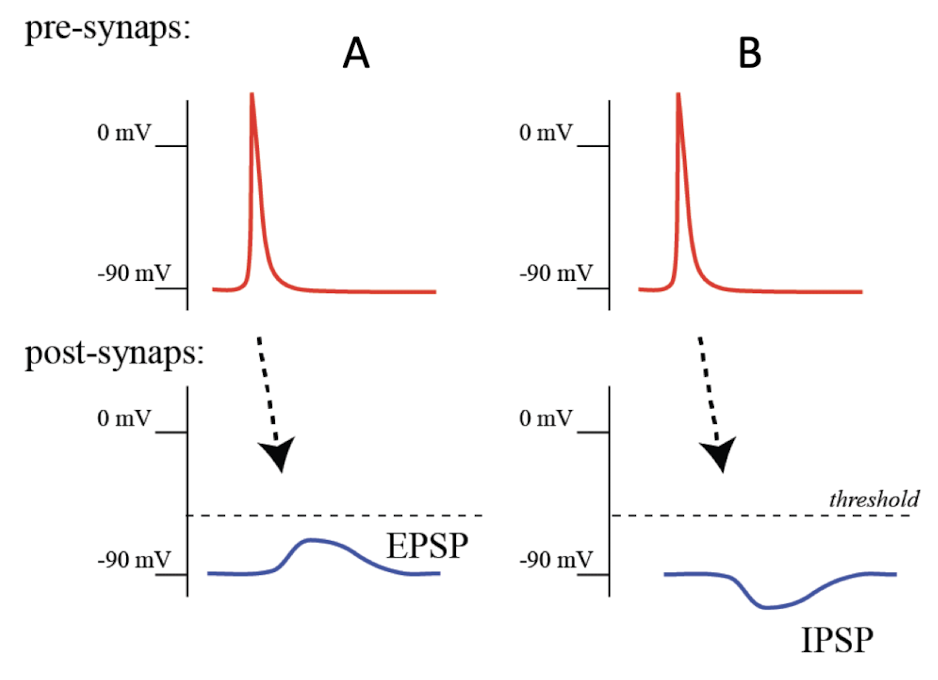
EPSP
A small graded electrical potential (depolarizing), that increases the excitability of the post-synaptic neuron
Depolarizes the inside of the neuron, bringing the resting potential closer to zero.
Increases the excitability of the neuron, bringing the potential closer to threshold for an action potential
Triggered by binding of a chemical neurotransmitter at a synapse site (dendrites or soma)
Ion channels open (only briefly) that allow more neuron permeability to Na+, resulting in increased positive charge entering the neuron
IPSP
A small graded potential (hyperpolarizing) that decreases the excitability of the neuron, making it less likely to have an Action Potential
Ion channels open, allowing for more neuron permeability to K+ or Cl-
Increased positive charge (K+) leaving or negative charge (Cl-) entering
Resting potential declines from -65 mV toward the Cl- and K+ equilibrium potentials of -90mV
Channels are open only briefly, so only few ions flow
Membrane Potential goes from -65 to -75mV, making it less likely to generate an Action Potential
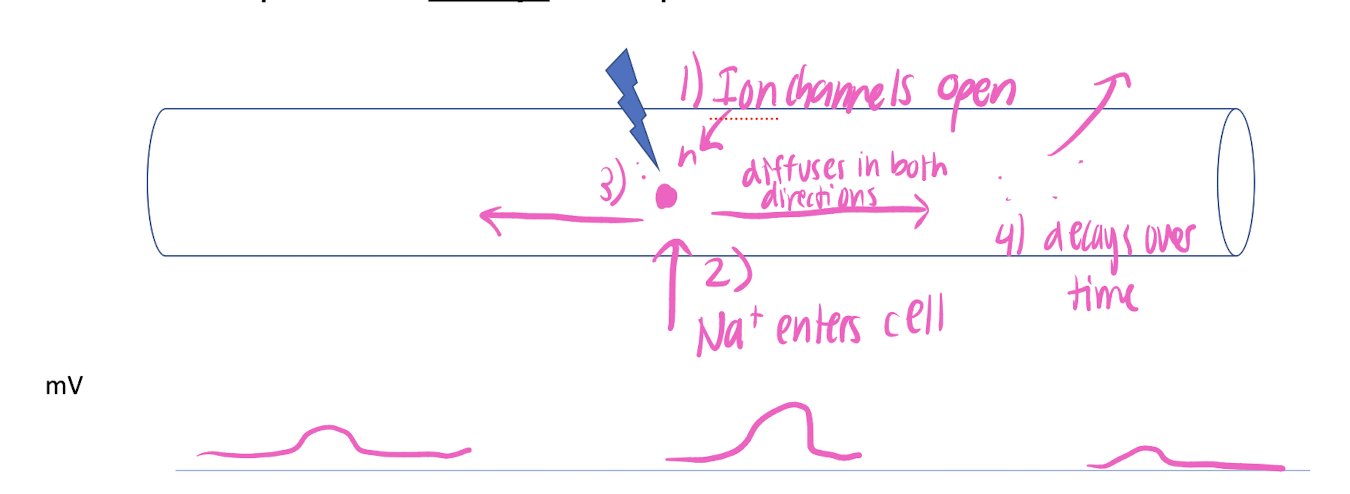
Passive Propagation
For spread of graded potentials (EPSPs & IPSPs)
Depends only on diffusion of ions (ions diffuse from the synapse site on the soma to the axon hillock)
Passive because it does not require cell energy (ATP) or opening of voltage-gated ion channels
Works only for short distances
Called electrotonic propagation
Can occur bidirectionally
Passive Propagation Picture
Leakage of ions occurs
Graded potential decays as it spreads over time and distance
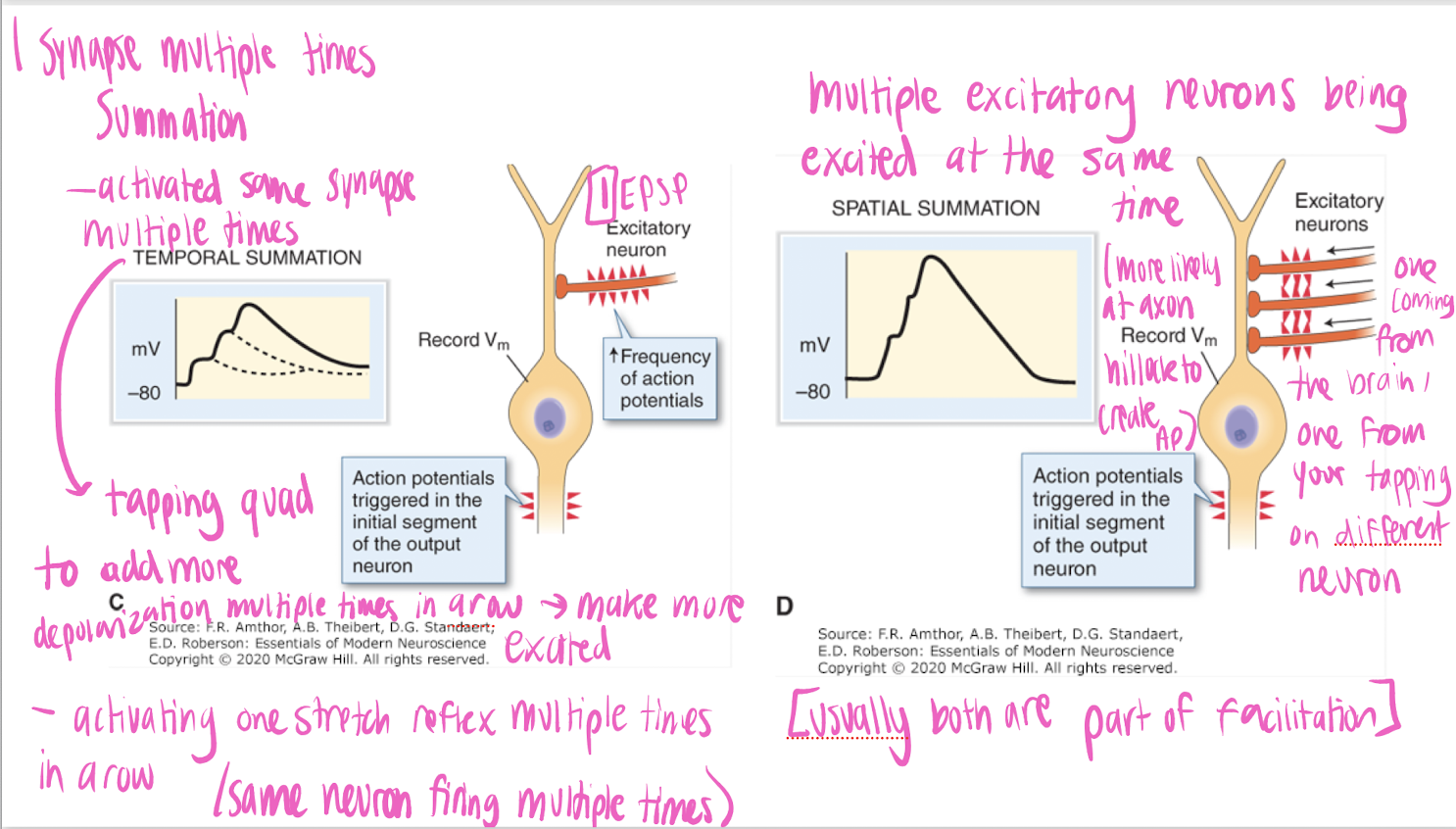
Temporal Summation
At one site, two potentials occur sequentially (close together in time)
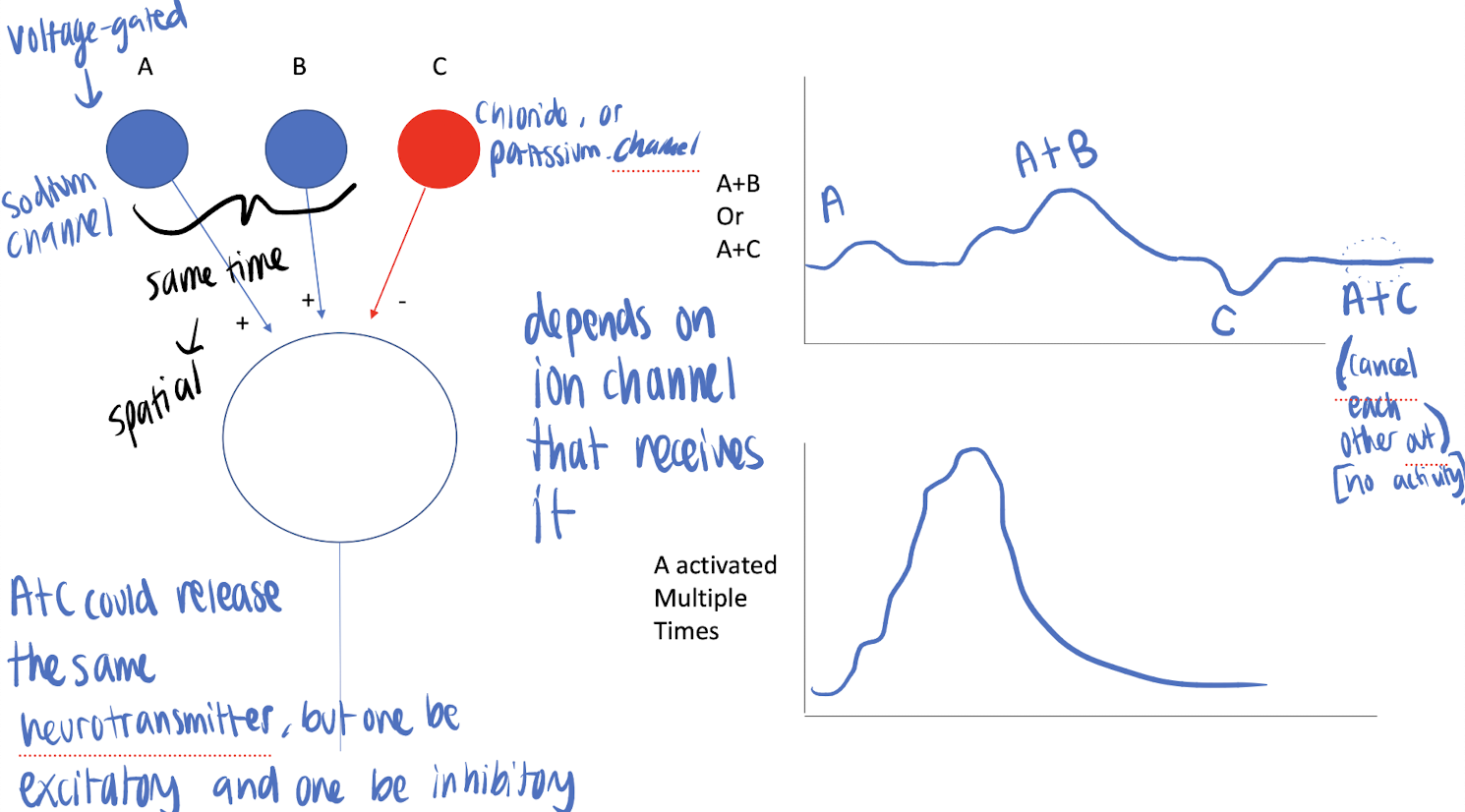
The two potentials can add together, creating a larger graded potential and move the membrane potential farther from resting (A+A+A…)
Spatial Summation
Potentials come in from two different synapses in different locations onto one cell
The graded potentials passively spread along until they occupy the same space of membrane
Temporal Summation and Spatial Summation Picture
Slide 11
 Note
Note  Flashcards (62)