BIOL 201 - Cell Bio & Metabolism

0.0(0)
Studied by 1 person
call kaiCall Kai
learnLearn
examPractice Test
spaced repetitionSpaced Repetition
heart puzzleMatch
flashcardsFlashcards
GameKnowt Play
Card Sorting

1/220

encourage image

There's no tags or description

Looks like no tags are added yet.

Last updated 9:01 PM on 3/26/26
Name
Mastery
Learn
Test
Matching
Spaced
Call with Kai

No analytics yet

Send a link to your students to track their progress

221 Terms

1
New cards

First Law of Thermodynamics

  • in an isolated system, the total amount of energy remains constant over time

  • energy is neither created nor destroyed, just converted from one form to another

2
New cards

Second Law of Thermodynamics

  • an isolated system always tends towards disorder

3
New cards

metabolism

  • science of energy conversions

  • organisms devote 20% of genome to this

  • high-quality → low-quality energy

<ul><li><p>science of energy conversions</p></li><li><p>organisms devote 20% of genome to this</p></li><li><p>high-quality → low-quality energy</p></li></ul><p></p>
4
New cards

caveats of energy

  1. organisms store energy during growth

  2. organisms store energy temporarily during activity

5
New cards

inequality of energy

  • “Low quality’ = HEAT (random kinetic energy)

    • less order

  • “High quality” = Potential energy of mass on a pull

    • more ordered/structured

  • Joule’s Experiment

  • Organisms convert high-quality → low-quality energy

6
New cards

Gibbs free energy

  • available energy to an organism

  • H – “unavailable energy”

  • G = H – TS

  • Released by ATP hydrolysis

    • Cells capture it to create order

  • the change in this determines whether a process occurs spontaneously
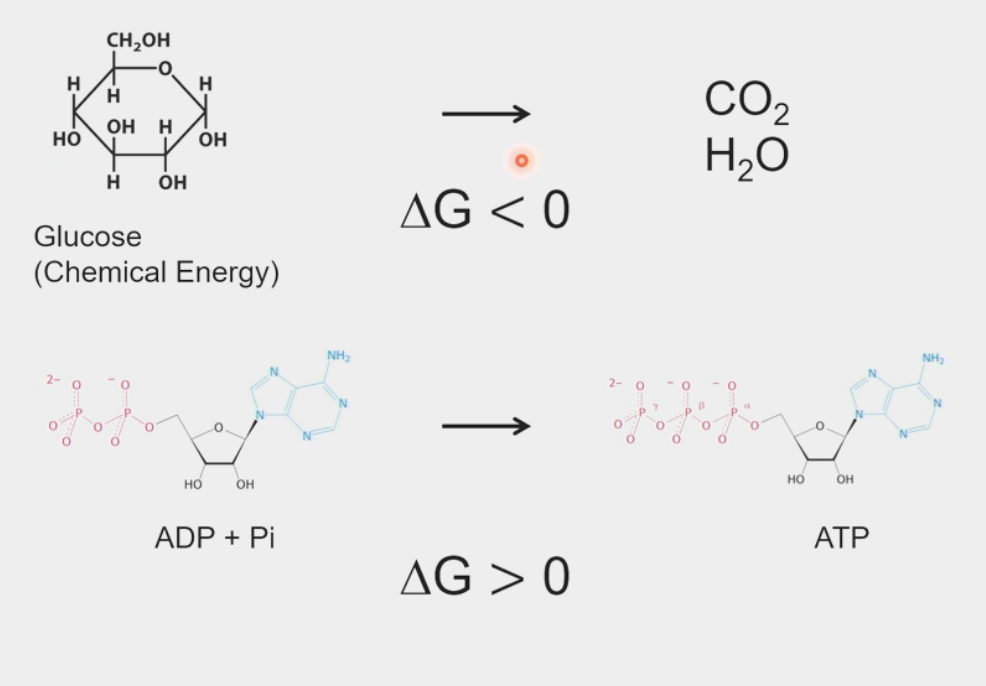
<ul><li><p><strong>available </strong>energy to an organism</p></li><li><p>H – “unavailable energy”</p></li><li><p>G = H – TS</p></li><li><p>Released by ATP hydrolysis</p><ul><li><p>Cells capture it to create order</p></li></ul></li><li><p>the <strong>change</strong> in this determines whether a process occurs spontaneously</p></li></ul><p></p>
7
New cards

Enthalpy

  • total energy in a system

  • H

8
New cards

Entropy

  • disorder in a given system

  • S

9
New cards

ATP binding

  • free energy can temporarily distort the 3D structure of proteins

  • induces strain

  • protein relaxes back into native configuration → chemical reaction forced to occur
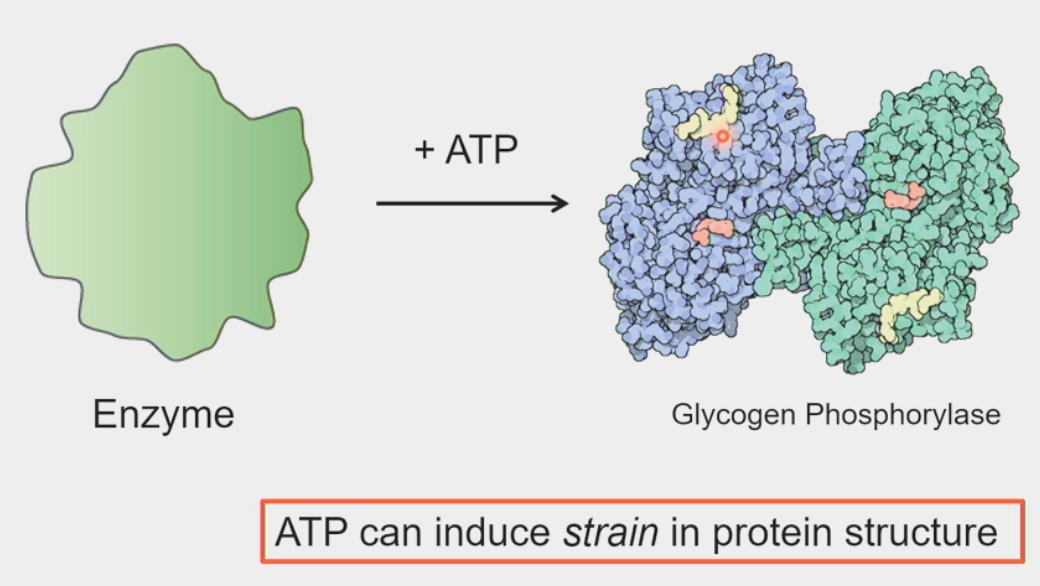
<ul><li><p>free energy can temporarily distort the 3D structure of proteins</p></li><li><p>induces <u>strain</u></p></li><li><p>protein relaxes back into native configuration → chemical reaction forced to occur</p></li></ul><p></p>
10
New cards

change in free energy

  • determines whether a process occurs spontaneously

  • ΔG = Gfinal – Ginitial

  • ΔG = ΔH – TΔS

    • for “isolated system”, ΔH = 0

    • entropy always increases; ΔS > 0

  • ΔG < 0 for a spontaneous process

  • values are standardized (ΔGº’)

    • T = 298K, P = 1atm, pH = 7.0, all concentrations = 1M

    • standard free energies are additive → “coupled” reactions

11
New cards

Redox reactions

  • Reduction = gaining an electron

  • Oxidation = losing an electron

  • provide a basis for energy transduction

  • fuels are oxidized by metabolic enzymes

12
New cards

NAD+

  • principal electron acceptor in metabolic redox reactions

  • GAPDH brings this into position to be reduced to NADH

  • may be useful in a wide range of therapies

    • ex: tuberculosis drug Isoniazid → active form binds NADH, inhibits cell wall synthesis enzyme

  • FAD used when available free energy can’t reduce this

  • requires ΔGº’ = 52.6 kcal/mol to capture e-
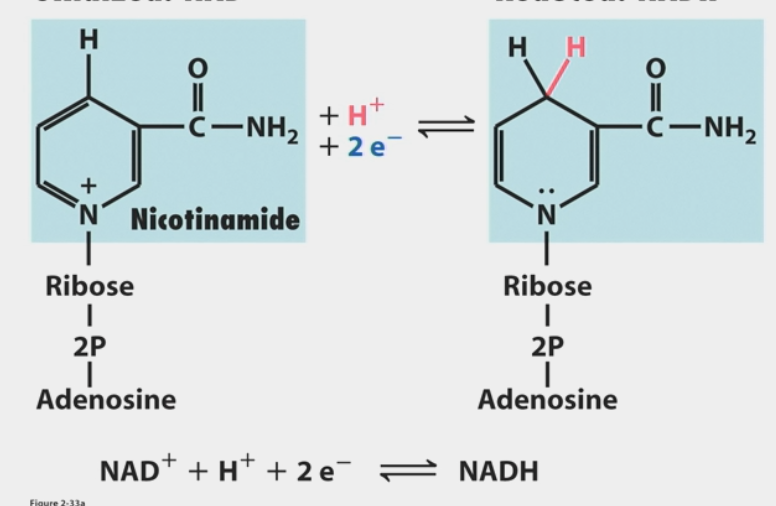
<ul><li><p>principal electron <strong>acceptor</strong> in metabolic redox reactions</p></li><li><p>GAPDH brings this into position to be <strong>reduced </strong>to NADH</p></li><li><p>may be useful in a wide range of therapies</p><ul><li><p>ex: tuberculosis drug Isoniazid → active form binds NADH, inhibits cell wall synthesis enzyme</p></li></ul></li><li><p>FAD used when available free energy can’t reduce this</p></li><li><p>requires ΔGº’ = 52.6 kcal/mol to capture e<sup>-</sup></p></li></ul><p></p>
13
New cards

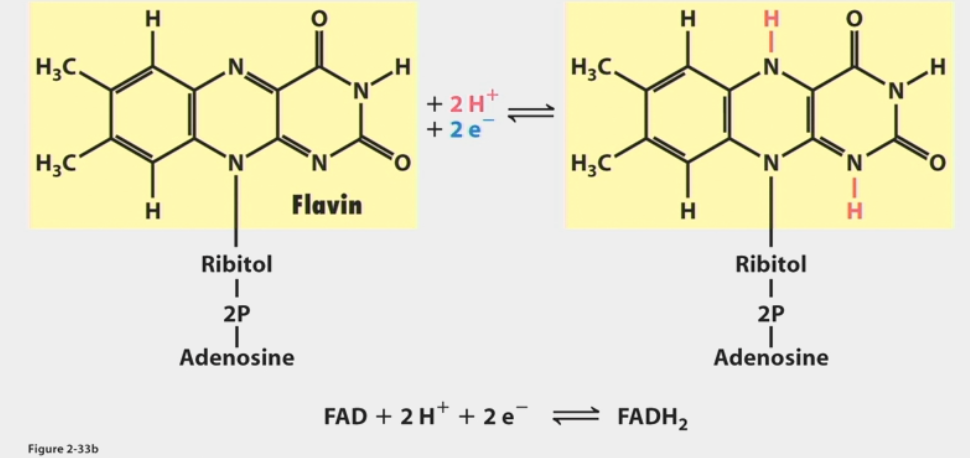
FAD

  • used when available free energy can’t reduce NAD+

  • less ΔGº’ required than NAD+ → NADH (43.4 kcal/mol vs. 52.6)

  • reduced to FADH2

<ul><li><p>used when available free energy can’t reduce NAD<sup>+</sup></p></li><li><p><strong>less</strong> ΔGº’ required than NAD<sup>+</sup> → NADH (43.4 kcal/mol vs. 52.6)</p></li><li><p>reduced to FADH<sub>2</sub></p></li></ul><p></p>
14
New cards

ATP

  • “energy currency” of the cell (like a $20)

  • needs ΔGº’ = -7.3 kcal/mol to be hydrolyzed (20 kBT)

  • big enough to do something with but small enough to avoid too much waste

15
New cards

thermal energy

  • serves as baseline for cellular energy scales

  • 〈E〉= 3/2kBT

  • kB = Boltzmann’s constant

  • kBT = 0.6 kcal/mol

    • average amount of energy an H2O molecule has when it collides

  • ATP hydrolysis ≈ 20 kBT (physiological conditions)

16
New cards

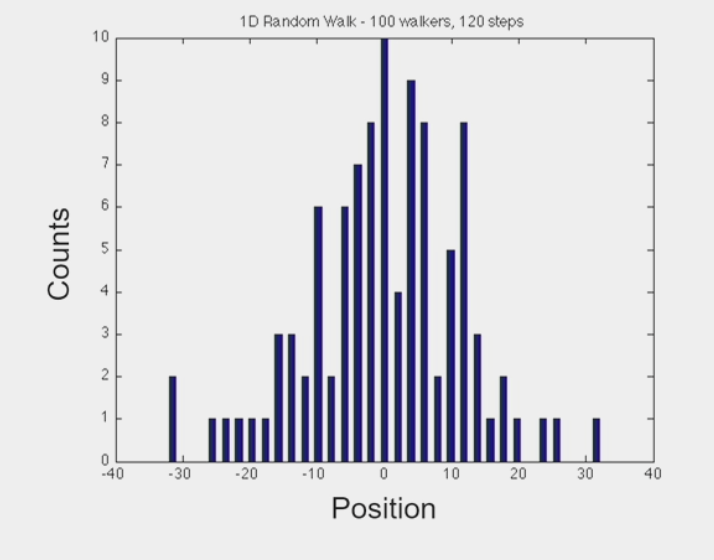
Brownian motion

  • the random motion of particles suspended in a medium

    • molecules continuously undergo small, random fluctuations

  • “random walk” → at any given moment, molecule shifts left OR right

  • as # “steps” increases, particles start to diffuse away from each other

  • molecules diffuse w/ characteristic diffusion coefficient (D)

    • smaller molecules = “faster” diffusion, larger D

    • Diffusion coefficient (D) describes spread of population of molecules

    • diffusion is mostly ACTIVE (a bit thermal, but it’s negligible in cells)

  • explores a lot of space, but on average gets nowhere

    • Mean Squared-Displacement: 〈x2〉= 2Dt

<ul><li><p><span>the </span><strong><span>random</span></strong><span> motion of particles suspended in a medium</span></p><ul><li><p>molecules <u>continuously</u> undergo small, random fluctuations</p></li></ul></li><li><p>“random walk” → at any given moment, molecule shifts left OR right</p></li><li><p>as # “steps” increases, particles start to diffuse <strong>away</strong> from each other</p></li><li><p>molecules diffuse w/ characteristic diffusion coefficient (<em>D</em>)</p><ul><li><p><strong>smaller</strong> molecules = “faster” diffusion, <strong>larger</strong> D</p></li><li><p>Diffusion coefficient (D) describes spread of <strong>population</strong> of molecules</p></li><li><p>diffusion is mostly ACTIVE (a bit thermal, but it’s negligible in cells)</p></li></ul></li><li><p>explores a lot of space, but on average gets <strong>nowhere</strong></p><ul><li><p>Mean Squared-Displacement: 〈x<sup>2</sup>〉= 2Dt</p></li></ul></li></ul><p></p>
17
New cards

mechanical energy

  • energy that is possessed by an object due to its motion or due to its position

    • sum of kinetic and potential

  • cells and subcellular structures feel and produce mechanical forces

  • 1 N (newton) = 1kg x 1 m/s2

  • cellular forces measured in pN (piconewton) to nN (nanonewton)

    • 1 pN = 10-12 N

    • kBT = 4.1 pN nm

    • ATP hydrolysis ≈ 20 kBT ≈ 80 pN nm (a tiny amount of work)

18
New cards

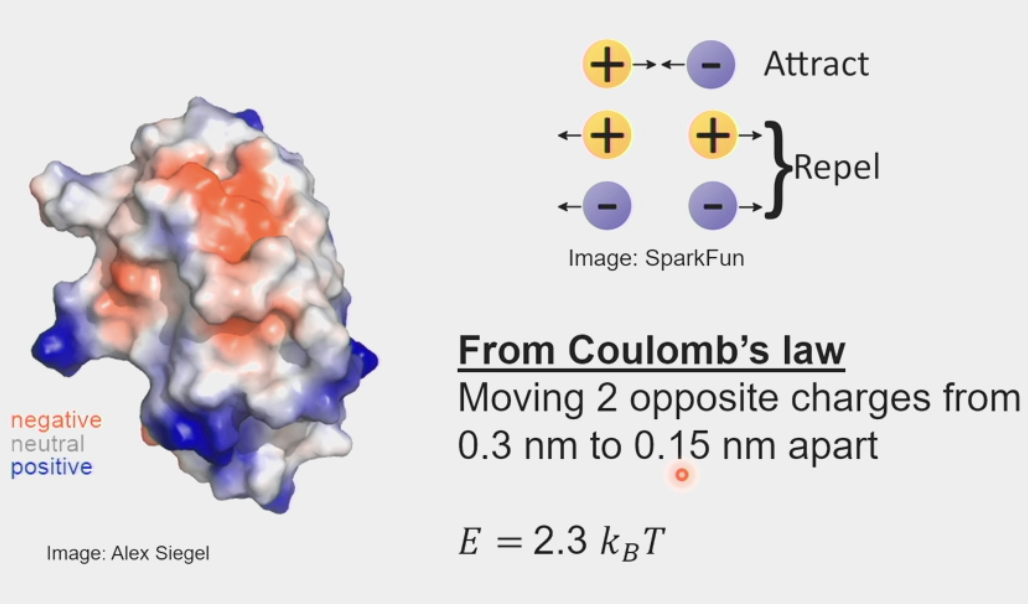
electromagnetic energy

  • the various energies that travel as wavelengths through space at the speed of light

  • photons absorbed and emitted (electric + magnetic fields)

  • electrostatic potentials

    • surfaces of protons contain many charged residues

    • Coulomb’s Law: electrical force between two charged objects is directly proportional to the product of the quantity of charge on the objects

    • moving 2 opposite charges from 0.3 nm to 0.15 nm apart

    • E = 2.3 kBT (pretty small) → need a large surface area for 2 proteins to stick together

  • a little stronger than thermal energy

<ul><li><p><span><span>the various energies that travel as wavelengths through space at the speed of light</span></span></p></li><li><p><span><span>photons absorbed and emitted (electric + magnetic fields)</span></span></p></li><li><p><span><span>electrostatic potentials</span></span></p><ul><li><p>surfaces of protons contain many <strong>charged</strong> residues</p></li><li><p>Coulomb’s Law: <span><span>electrical force between two charged objects is </span><strong><span>directly proportional</span></strong><span> to the product of the quantity of charge on the objects</span></span></p></li><li><p><span><span>moving 2 opposite charges from 0.3 nm to 0.15 nm apart</span></span></p></li><li><p>E = 2.3 k<sub>B</sub>T (pretty small) → need a <strong>large surface area</strong> for 2 proteins to stick together</p></li></ul></li><li><p>a little stronger than thermal energy</p></li></ul><p></p>
19
New cards

photons

  • elementary particle that is a quantum of the electromagnetic field

  • E (energy) = hν

    • h = Planck’s constant

    • ν = frequency in Hz

    • visible particle ≈ 2 eV = 80 kBT

  • kBT = 25 meV (milli-electric Volts)

  • absorbed to ultimately produce ATP in photosynthesis

20
New cards

breaking bonds

  • non-covalent bonds (ex. H-bonds)

    • 2-12 kBT → varies because of random motion of thermal energy

  • electrostatic bonds

  • probability of breaking: P = e–E/kBT

    • ex. P = e-3 = 0.05 → 5% of breaking

  • 1011 collisions per second

21
New cards

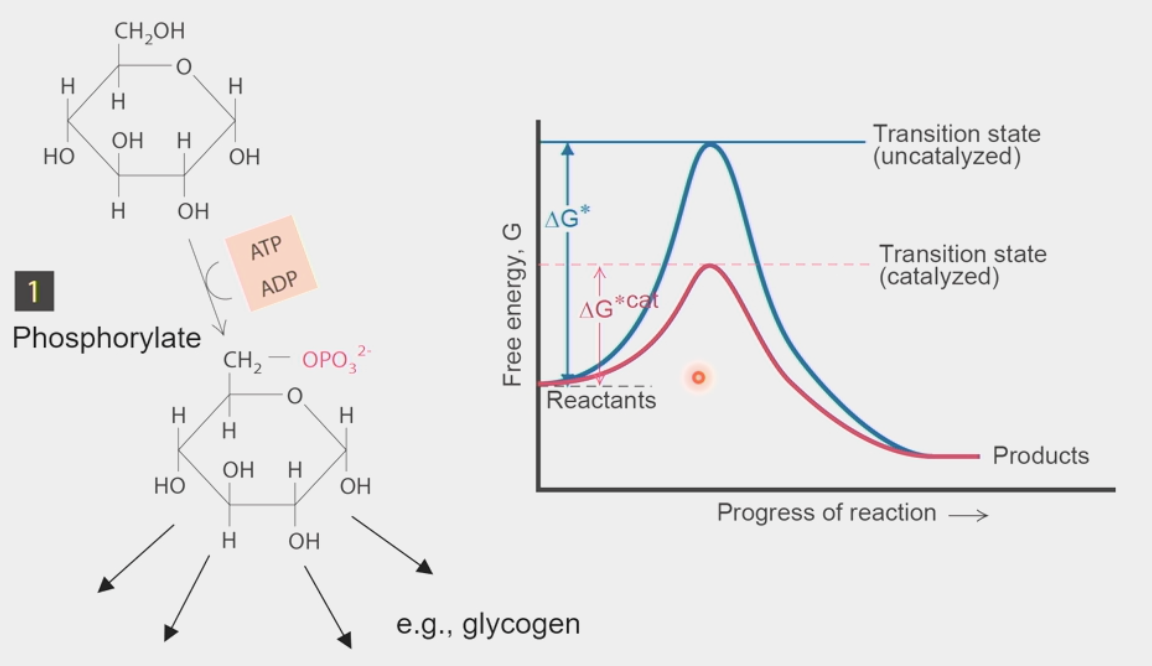
transition state

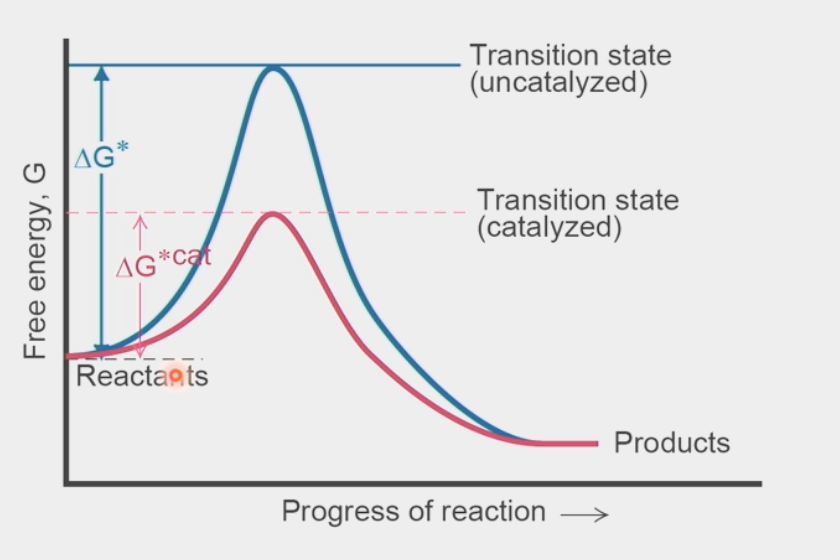
  • short-lived configuration of atoms at a local energy maximum (highest potential energy) in a reaction-energy diagram

  • catalysts lower this value → less ΔG required to get over this point

    • energy obtained from random collisions → if value is lower, then higher probability to get over it

  • products have LOWER ΔG than reactants (overall negative = spontaneous rxn)
<ul><li><p><span><span>short-lived configuration of atoms at a local energy maximum (highest </span><strong><span>potential</span></strong><span> energy) in a reaction-energy diagram </span></span></p></li><li><p><span><span>catalysts lower this value → less ΔG required to get over this point</span></span></p><ul><li><p>energy obtained from random collisions → if value is lower, then<strong> higher probability </strong>to get over it</p></li></ul></li><li><p><span><span>products have </span><u><span>LOWER</span></u><span> ΔG than reactants (overall negative = </span><strong><span>spontaneous</span></strong><span> rxn)</span></span></p></li></ul><p></p>
22
New cards

covalent bonds

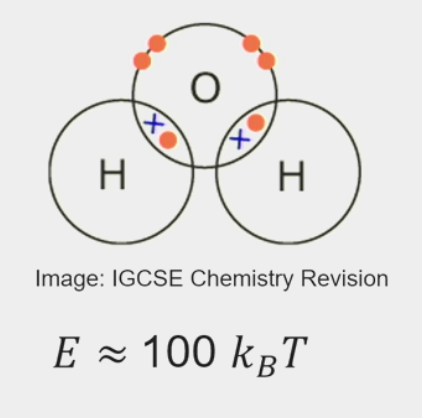
  • chemical bond that involves the sharing of electrons to form electron pairs between atoms

  • very stable

  • E ≈ 100 kBT

  • probability of breaking: P = e-100 = 3.7×10-44

    • by itself, a collision will break this every 1024 years
<ul><li><p><span><span>chemical bond that involves the </span><strong><span>sharing</span></strong><span> of electrons to form electron pairs between atoms</span></span></p></li><li><p><span><span>very stable</span></span></p></li><li><p><span><span>E ≈ 100 k</span><sub><span>B</span></sub><span>T</span></span></p></li><li><p><span><span>probability of breaking: P = e</span><sup><span>-100</span></sup><span> = 3.7×10</span><sup><span>-44</span></sup></span></p><ul><li><p>by itself, a collision will break this every 10<sup>24</sup> years</p></li></ul></li></ul><p></p>
23
New cards

cytoplasm

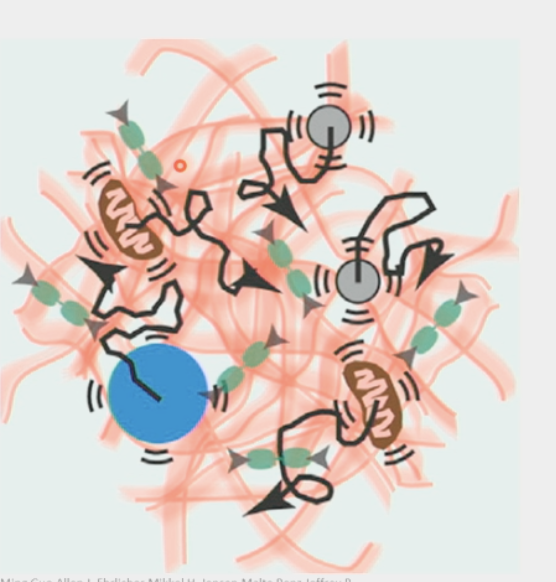
  • an active material in the cell

  • far from equilibrium because of ATP hydrolysis

  • has different consistencies depending on the size of the particle in it

    • for ions: like water

    • for organelles/macromolecular complexes: like glass

  • carbon/ATP depletion causes transformation into glass consistency (molecules frozen)

  1. very CROWDED

    • contains ions & H2O (0.1nm), sugars, amino acids, proteins & DNA & RNA(10-100 nm), organelles (1µm), etc.

    • as packed as protein crystals (20-60% protein by weight)

  2. rough-and-tumble place

    • proteins in constant motion → constantly smashing into each other

    • Brownian motion → “random walk”, 1-D: 50% step right, 50% step left

    • as # “steps” increases, particles start to diffuse away from each other

    • Diffusion coefficient (D) describes spread of population of molecules

    • cells have to fight to maintain spatial organization

    • collisions distort structure of individual proteins → conformational changes

    • large organelles/proteins move in place, tiny ions/particles basically move freely

  3. viscous

    • inertia = resistance of an object to any change in its state of motion

    • viscosity = measure of a fluid’s resistance to flow

    • Reynold’s Number: Re = inertial forces/viscous forces = ρνL / µ = (density)(velocity)(Length) / (dynamic viscosity)

      • cells, organelles, proteins are in LOW Re environment (~10-4)

      • inertia is completely negligible here

  4. elastic

    • elasticity = tendency of an object to return to its original shape after deformation

  5. meshwork

    • long filamentous proteins → actin filaments

    • organelles, polymers, other structures define “pore size” → this is why larger macromolecular complexes are “trapped”/unable to move on their own
<ul><li><p>an <strong>active</strong> material in the cell</p></li><li><p>far from equilibrium because of ATP hydrolysis</p></li><li><p>has different consistencies depending on the size of the particle in it</p><ul><li><p>for ions: like water</p></li><li><p>for organelles/macromolecular complexes: like glass</p></li></ul></li><li><p>carbon/ATP <strong>depletion</strong> causes transformation into glass consistency (molecules frozen)</p></li></ul><ol><li><p><u>very CROWDED</u></p><ul><li><p>contains ions &amp; H<sub>2</sub>O (0.1nm), sugars, amino acids, proteins &amp; DNA &amp; RNA(10-100 nm), organelles (1µm), etc.</p></li><li><p>as packed as protein crystals (20-60% protein by weight)</p></li></ul></li><li><p><u>rough-and-tumble place</u></p><ul><li><p>proteins in <strong>constant</strong> motion → constantly smashing into each other</p></li><li><p>Brownian motion → “random walk”, 1-D: 50% step right, 50% step left</p></li><li><p>as # “steps” increases, particles start to diffuse <strong>away</strong> from each other</p></li><li><p>Diffusion coefficient (D) describes spread of <strong>population</strong> of molecules</p></li><li><p>cells have to fight to maintain spatial organization</p></li><li><p>collisions distort structure of individual proteins → conformational changes</p></li><li><p>large organelles/proteins move in place, tiny ions/particles basically move freely</p></li></ul></li><li><p><u>viscous</u></p><ul><li><p><strong>inertia</strong> = resistance of an object to any change in its state of motion</p></li><li><p><strong>viscosity</strong> = measure of a fluid’s resistance to flow</p></li><li><p><strong>Reynold’s Number:</strong> Re = inertial forces/viscous forces = ρνL / µ = (density)(velocity)(Length) / (dynamic viscosity)</p><ul><li><p>cells, organelles, proteins are in <strong>LOW</strong> Re environment (~10<sup>-4</sup>)</p></li><li><p>inertia is completely <strong>negligible</strong> here</p></li></ul></li></ul></li><li><p><u>elastic</u></p><ul><li><p><strong>elasticity</strong> = tendency of an object to return to its original shape after deformation</p></li></ul></li><li><p><u>meshwork</u></p><ul><li><p>long filamentous proteins → actin filaments</p></li><li><p>organelles, polymers, other structures define “pore size” → this is why larger macromolecular complexes are “trapped”/unable to move on their own</p></li></ul></li></ol><p></p>
24
New cards

inertia

  • resistance of an object to any change in its state of motion

25
New cards

viscosity

  • measure of a fluid’s resistance to flow

26
New cards

Reynold’s number

  • dimensionless quantity that helps predict fluid flow patterns

  • Re = inertial forces/viscous forces = ρνL / µ = (density)(velocity)(Length) / (dynamic viscosity)

27
New cards

elasticity

  • tendency of an object to return to its original shape after deformation

28
New cards

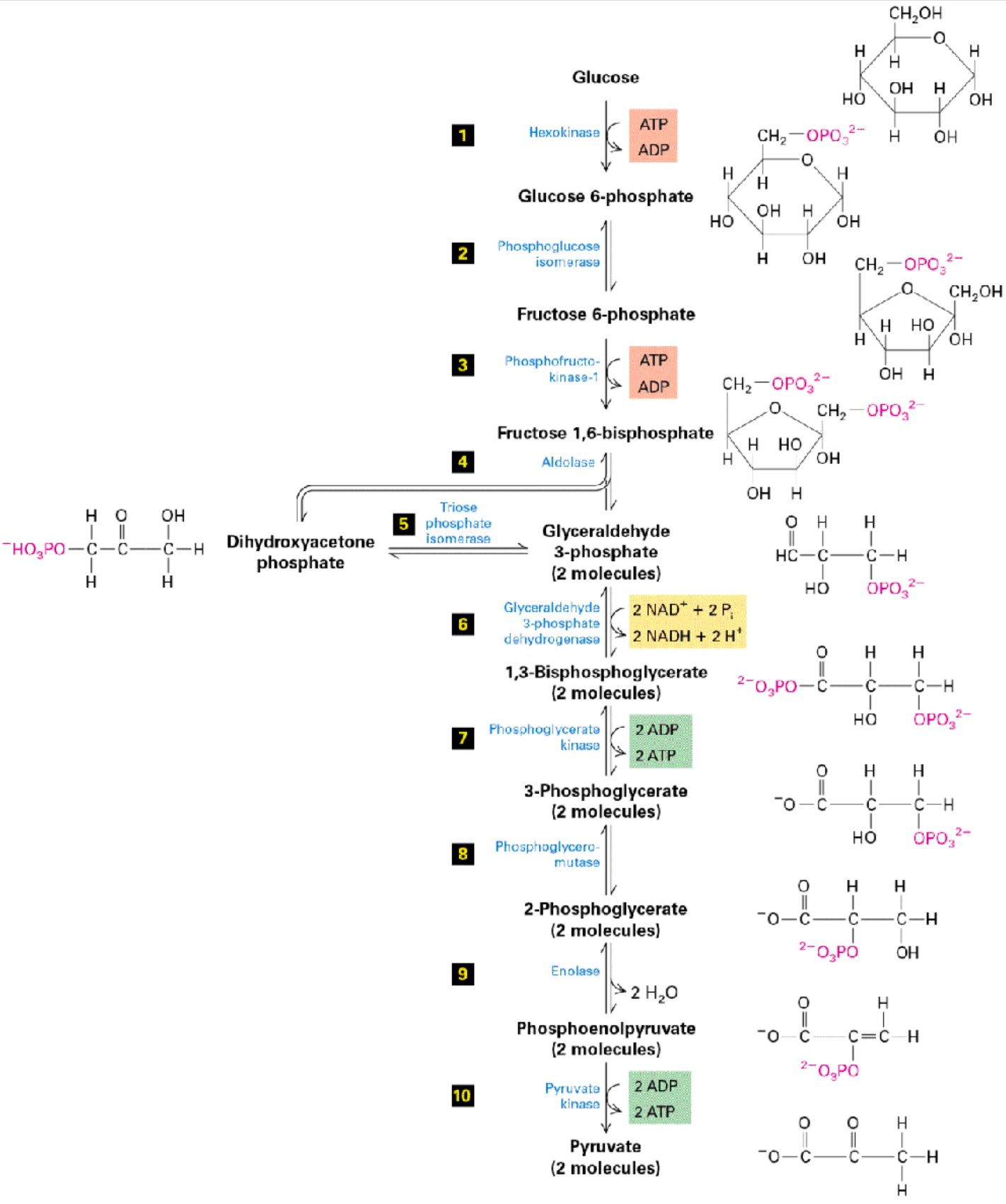
glycolysis

  • Stage 1 of metabolism

  • converts glucose (C6H12O6) into pyruvate

  • harvesting electrons

  • yields NET production of 2 ATP per 1 glucose

  1. Phosphorylate glucose by adding Pi from ATP

    • Creates glucose 6-phosphate → goes on to form other metabolites

    • Catalyzed by hexokinase enzyme

  2. Change glucose ring → fructose ring

    • hexameric → pentameric

    • catalyzed by phosphoglucose isomerase

    • fructose 6-phosphate → used for downstream processes like making glycolipids

  3. Phosphorylate again w/ another ATP

    • produces fructose 1,6-bisphosphate

    • catalyzed by phosphofructokinase

  4. Formation of dihydroxyacetone phosphate

    • catalyzed by aldolase

  5. Split into 2 molecules

    • 2 x glyceraldehyde 3-phosphate (G3P)

  6. 2 NAD+ used to make 2 NADH

    • Oxidizing G3P with glyceraldehyde 3-phosphate dehydrogenase

    • 1,3-bisphosphoglycerate formed

  7. Dephosphorylation

    • 2 ADP → 2 ATP produced

    • 3-phosphoglycerate formed by phosphoglycerate kinase

  8. 3-phosphoglycerate mutated → 2-phosphoglycerate

    • catalyzed by phosphoglycerol mutase

  9. Condensation → H2O produced

    • done by enolase

  10. Dephosphorylation

    • 2 ADP → 2 ATP produced

    • pyruvate formed

    • catalyzed by pyruvate kinase

<ul><li><p>Stage 1 of metabolism</p></li><li><p>converts glucose (C<sub>6</sub>H<sub>12</sub>O<sub>6</sub>) into pyruvate</p></li><li><p>harvesting electrons</p></li><li><p>yields NET production of 2 ATP per 1 glucose</p></li></ul><ol><li><p>Phosphorylate glucose by adding P<sub>i</sub> from ATP</p><ul><li><p>Creates glucose 6-phosphate → goes on to form other metabolites</p></li><li><p>Catalyzed by hexokinase enzyme</p></li></ul></li><li><p>Change glucose ring → fructose ring</p><ul><li><p>hexameric → pentameric</p></li><li><p>catalyzed by phosphoglucose isomerase</p></li><li><p>fructose 6-phosphate → used for downstream processes like making glycolipids</p></li></ul></li><li><p>Phosphorylate again w/ another ATP</p><ul><li><p>produces fructose 1,6-bisphosphate</p></li><li><p>catalyzed by phosphofructokinase</p></li></ul></li><li><p>Formation of <span><span>dihydroxyacetone phosphate</span></span></p><ul><li><p>catalyzed by aldolase</p></li></ul></li><li><p>Split into 2 molecules</p><ul><li><p>2 x glyceraldehyde 3-phosphate (G3P)</p></li></ul></li><li><p>2 NAD<sup>+</sup> used to make 2 NADH</p><ul><li><p>Oxidizing G3P with glyceraldehyde 3-phosphate dehydrogenase</p></li><li><p>1,3-bisphosphoglycerate formed</p></li></ul></li><li><p>Dephosphorylation</p><ul><li><p>2 ADP → 2 ATP produced</p></li><li><p>3-phosphoglycerate formed by phosphoglycerate kinase</p></li></ul></li><li><p>3-phosphoglycerate mutated → 2-phosphoglycerate</p><ul><li><p>catalyzed by phosphoglycerol mutase</p></li></ul></li><li><p>Condensation → H<sub>2</sub>O produced</p><ul><li><p>done by enolase</p></li></ul></li><li><p>Dephosphorylation</p><ul><li><p>2 ADP → 2 ATP produced</p></li><li><p><strong>pyruvate</strong> formed</p></li><li><p>catalyzed by pyruvate kinase</p></li></ul></li></ol><p></p>
29
New cards

pump priming

  • generates useful metabolite

  • increases free energy of reactants

    • larger ΔG, smaller activation barrier to get over transition state

  • NOT catalysis

<ul><li><p>generates useful metabolite</p></li><li><p><strong>increases</strong> free energy of reactants</p><ul><li><p><strong>larger</strong> ΔG, <strong>smaller</strong> activation barrier to get over transition state</p></li></ul></li><li><p><u>NOT</u> catalysis</p></li></ul><p></p>
30
New cards

regulation of glycolysis

  • huge enzymes like “disassembly line”

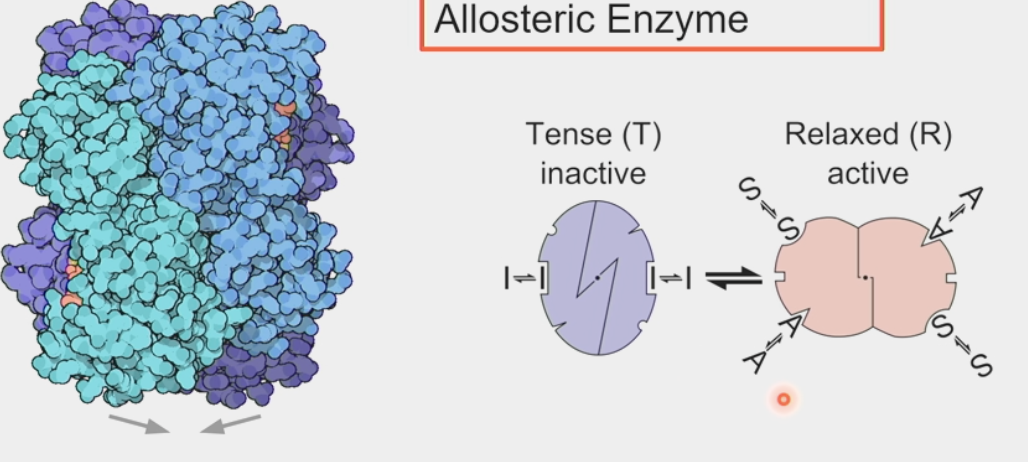
  • cells must monitor glycolytic flux by conformational switches to enzymes modulated by allosteric activators and inhibitors

  • cancer cells → increased flux

    • mutations in glycolytic enzymes found in tumors → block product inhibition of enzyme

    • cause is DNA damage, NOT misregulation of glycolysis

  • steps w/ big –ΔG effectively irreversible

  • PFK1 → gatekeeper

    • also catalyzes step 3 (phosphorylation of fructose 6-phospate → fructose 1,6)

    • once this step is done, you can’t go back
<ul><li><p>huge enzymes like “disassembly line”</p></li><li><p>cells must monitor glycolytic flux by conformational switches to enzymes <strong>modulated by allosteric activators and inhibitors</strong></p></li><li><p>cancer cells → increased flux</p><ul><li><p>mutations in glycolytic enzymes found in tumors → block product inhibition of enzyme</p></li><li><p>cause is DNA damage, NOT misregulation of glycolysis</p></li></ul></li><li><p>steps w/ big –ΔG effectively <u>irreversible</u></p></li><li><p>PFK1 → <strong>gatekeeper</strong></p><ul><li><p>also catalyzes step 3 (phosphorylation of fructose 6-phospate → fructose 1,6)</p></li><li><p>once this step is done, <u>you can’t go back</u></p></li></ul></li></ul><p></p>
31
New cards

PFK1

  • phosphofructokinase → controls glycolytic flux

  • tetramer → 4 individual polypeptide chains linked together

  • switches between active and inactive states by conformational change

    • tense = inactive, relaxed = active

    • 2 substrate binding sites open in active state

    • inhibitors at inactive state

  • allosteric enzyme

    • enables cells to have control over switching glycolysis on/off

  • inhibited by its products → ATP and citrate

    • ATP also a substrate → as its concentration increases, it becomes an inhibitor

  • activated directly by AMP, indirectly by excess fructose-6-phosphate (starting material for step 3)

    • AMP = starting material for ATP (adenosine monophosphate)

    • PFK2 starts phosphorylating when there is excess → produces fructose 2,6-bisphosphate which acts as direct activator for PFK1
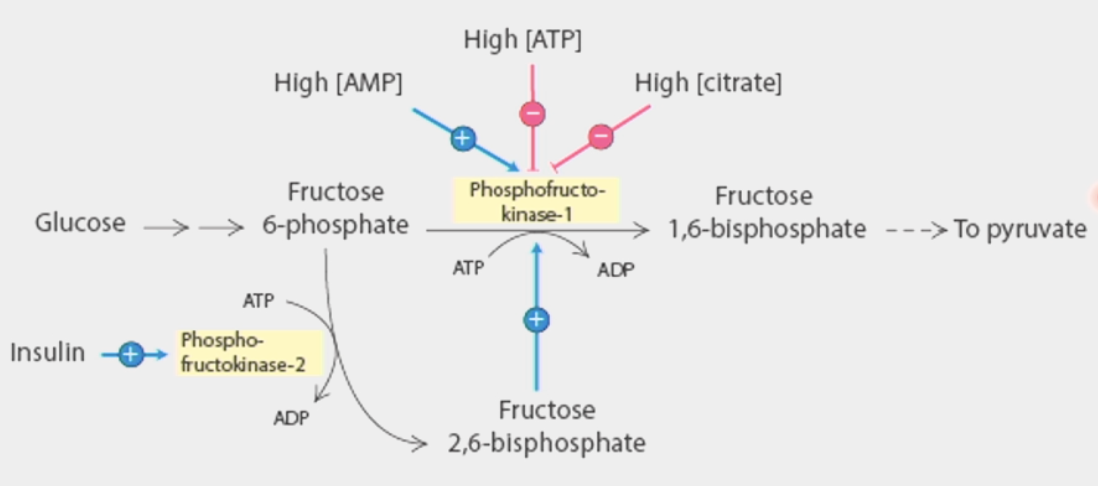
<ul><li><p>phosphofructokinase → <strong>controls glycolytic flux</strong></p></li><li><p><strong>tetramer</strong> → 4 individual polypeptide chains linked together</p></li><li><p>switches between <strong>active</strong> and <strong>inactive</strong> states by conformational change</p><ul><li><p>tense = inactive, relaxed = active</p></li><li><p>2 substrate binding sites <u>open in active state</u></p></li><li><p><strong>inhibitors</strong> at inactive state</p></li></ul></li><li><p><u>allosteric enzyme</u></p><ul><li><p>enables cells to have control over switching glycolysis on/off</p></li></ul></li></ul><ul><li><p><strong>inhibited</strong> by its products → ATP and citrate</p><ul><li><p>ATP <strong>also</strong> a substrate → as its concentration <u>increases</u>, it becomes an <u>inhibitor</u></p></li></ul></li><li><p>activated <strong>directly</strong> by AMP, <strong>indirectly</strong> by <u>excess</u> fructose-6-phosphate (starting material for step 3)</p><ul><li><p>AMP = starting material for ATP (adenosine <strong>mono</strong>phosphate)</p></li><li><p>PFK2 starts phosphorylating when there is excess → produces fructose 2,6-bisphosphate which acts as direct <strong>activator</strong> for PFK1</p></li></ul></li></ul><p></p>
32
New cards

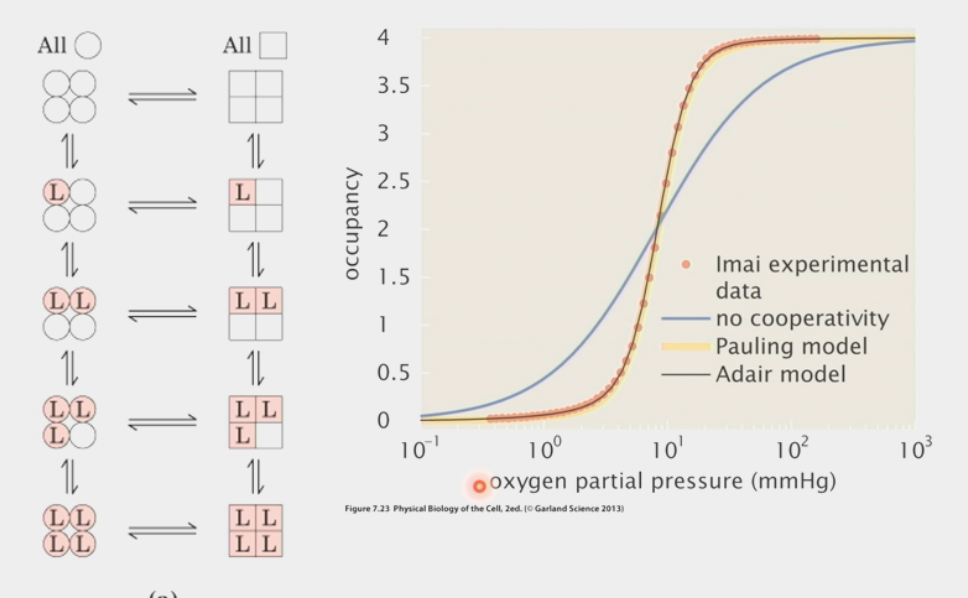
MWC model

  • explains allostery: when allosteric enzyme switches between active/inactive conformation, ALL 4 subunits must switch at once

  • one ligand binds in inactive state → rapid switch of molecule to active state

    • then all other ligands bind, enzyme performs rxn

  • as soon as one ligand is lost → rapid switch to inactive state

    • all other ligands dumped immediately

  • S-shaped sigmoid curve

  • used to find hemoglobin

<ul><li><p>explains allostery: when allosteric enzyme switches between active/inactive conformation, <strong>ALL 4 subunits must switch at once</strong></p></li><li><p>one ligand binds in <u>inactive</u> state → <strong>rapid switch</strong> of molecule to <u>active</u> state</p><ul><li><p>then all other ligands bind, enzyme performs rxn</p></li></ul></li><li><p>as soon as one ligand is <strong>lost</strong> → rapid switch to <u>inactive</u> state</p><ul><li><p>all other ligands <strong>dumped</strong> immediately</p></li></ul></li><li><p>S-shaped sigmoid curve</p></li><li><p>used to find hemoglobin</p></li></ul><p></p>
33
New cards

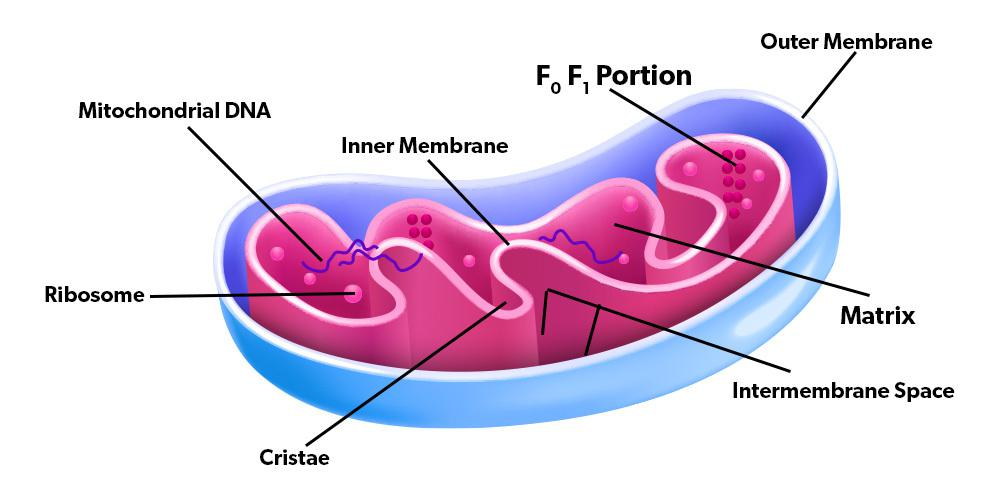
mitochondria

  • eukaryotic organelle

  • double membrane structure

  • form complex network of tubes

  • originated from bacteria → Endosymbiont hypothesis

    • aerobic respiration was the driver of this

    • evolutionary advantage

    • helped cells produce more power per gene

  • make their own ribosomes, segregate their own DNA (mtDNA), etc.

  • have their own genetic code & different codon usage

    • ex. UGA = Stop for standard code, Trp for mitochondria

    • determines protein length

  • function influences lifespan

    • ex. mice w/ homozygous mutation die very young

    • ex. mutations in mitochondrial proteins like ETC increased lifespan in C. elegans

  • mutations affect 1/5000 live births

    • can cause problems in all tissues/cell type of body

    • morphology varies

<ul><li><p>eukaryotic organelle</p></li><li><p>double membrane structure</p></li><li><p>form complex network of tubes</p></li><li><p>originated from bacteria → Endosymbiont hypothesis</p><ul><li><p><strong>aerobic respiration</strong> was the driver of this</p></li><li><p>evolutionary advantage</p></li><li><p>helped cells produce <strong>more power</strong> per gene</p></li></ul></li><li><p>make their own ribosomes, segregate their own DNA (mtDNA), etc.</p></li><li><p>have their own genetic code &amp; different codon usage</p><ul><li><p>ex. UGA = Stop for standard code, Trp for mitochondria</p></li><li><p>determines protein length</p></li></ul></li><li><p>function <u>influences lifespan</u></p><ul><li><p>ex. mice w/ homozygous mutation die very young</p></li><li><p>ex. mutations in mitochondrial proteins like ETC <strong>increased</strong> lifespan in C. elegans</p></li></ul></li><li><p>mutations affect 1/5000 live births</p><ul><li><p>can cause problems in all tissues/cell type of body</p></li><li><p>morphology varies</p></li></ul></li></ul><p></p>
34
New cards

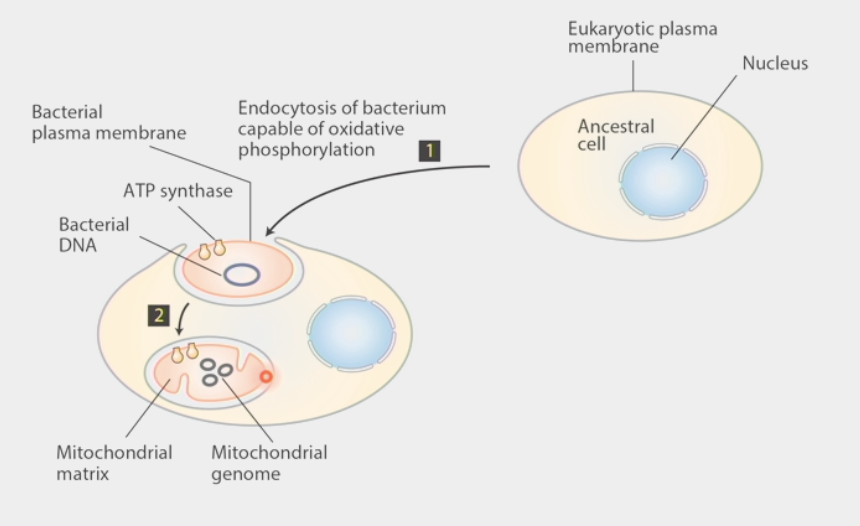
Endosymbiont hypothesis

  • ancestral cell w/ nucleus & eukaryotic plasma membrane

  • engulfed a bacteria capable of oxidative phosphorylation w/ ATP synthase, bacterial DNA, bacterial plasma membrane

  • bacteria became mitochondria w/ mitochondrial matrix and unique genome (mtDNA)

  • controversial hypothesis!!

    • alternative: aerobic proto-eukaryote enlarged & engulfed its respiratory surfaces (ATP synthase complexes)

    • central counter: host was already aerobic

    • DNA sequence analysis proved these wrong → chicken liver mitochondria closer to E.coli than bovine erythrocyte

  • mitochondria increased power per gene

<ul><li><p>ancestral cell w/ nucleus &amp; eukaryotic plasma membrane</p></li><li><p>engulfed a bacteria capable of oxidative phosphorylation w/ ATP synthase, bacterial DNA, bacterial plasma membrane</p></li><li><p>bacteria became mitochondria w/ mitochondrial matrix and unique genome (mtDNA)</p></li><li><p>controversial hypothesis!!</p><ul><li><p>alternative: aerobic proto-eukaryote enlarged &amp; engulfed its respiratory surfaces (ATP synthase complexes)</p></li><li><p>central counter: host was <strong>already aerobic</strong></p></li><li><p>DNA sequence analysis proved these wrong → chicken liver mitochondria <strong>closer</strong> to E.coli than bovine erythrocyte</p></li></ul></li><li><p>mitochondria <strong>increased</strong> power per gene</p></li></ul><p></p>
35
New cards

mitochondrial proteins

  • built from a combination of nuclear DNA and mtDNA

    • small % of mitochondrial proteome is built from the mitochondrial genome

  • ribosome: built from some proteins synthesized in cytoplasm and imported, combined w/ locally synthesized proteins

  • several translocases work as channels to bring cytosolic proteins into mitochondrial matrix
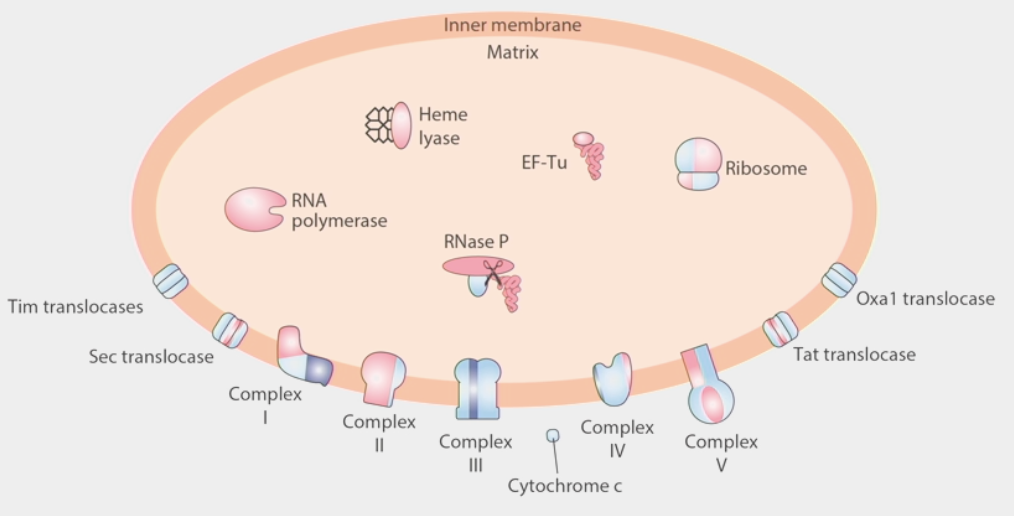
<ul><li><p>built from a <u>combination</u> of nuclear DNA and mtDNA</p><ul><li><p>small % of mitochondrial proteome is built from the mitochondrial genome</p></li></ul></li><li><p><strong>ribosome</strong>: built from some proteins synthesized in cytoplasm and imported, combined w/ locally synthesized proteins</p></li><li><p>several translocases work as channels to bring cytosolic proteins into mitochondrial matrix</p></li></ul><p></p>
36
New cards

mtDNA inheritance

  • modeled from petite mutation in yeast (inhibits growth)

  • 2 haploid (1n) parents w/ wild-type nuclear genes → one w/ normal mitochondria, one w/ petite

    • mating by cell fusion → diploid (2n) zygote

    • yeast sporulate → even segregation of nuclear DNA

    • mitochondrial segregation is RANDOM

  • petite cells occur by chance due to random segregation of mtDNA
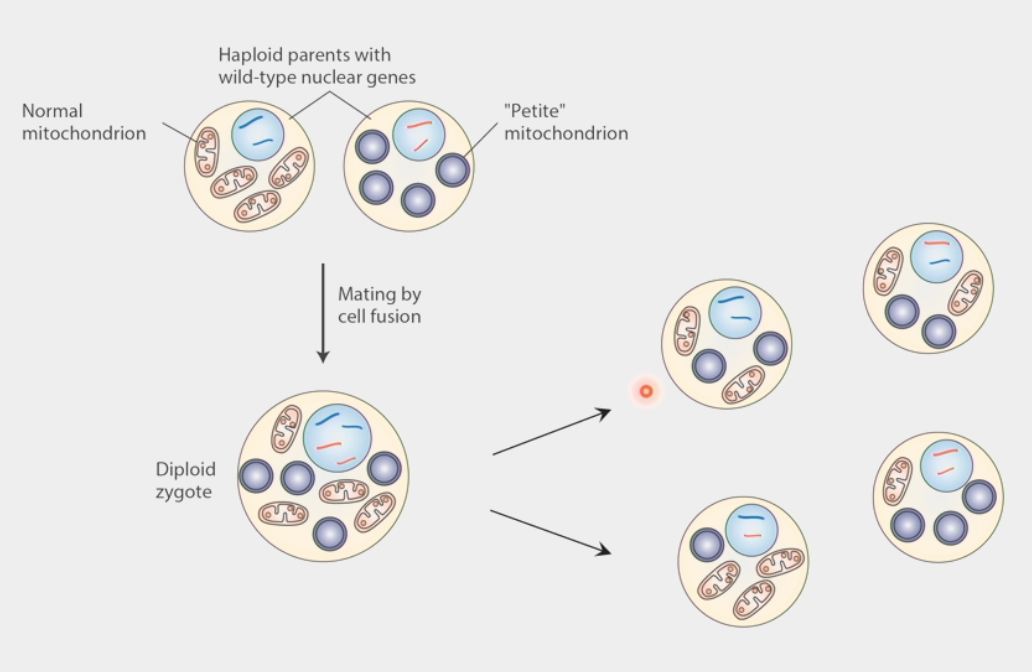
<ul><li><p>modeled from <em>petite</em> mutation in yeast (inhibits growth)</p></li><li><p>2 haploid (1n) parents w/ wild-type nuclear genes → one w/ normal mitochondria, one w/ <em>petite</em></p><ul><li><p>mating by cell fusion → diploid (2n) zygote</p></li><li><p>yeast sporulate → even segregation of nuclear DNA</p></li><li><p>mitochondrial segregation is <strong>RANDOM</strong></p></li></ul></li><li><p><em>petite</em> cells occur by <strong>chance</strong> due to random segregation of mtDNA</p></li></ul><p></p>
37
New cards

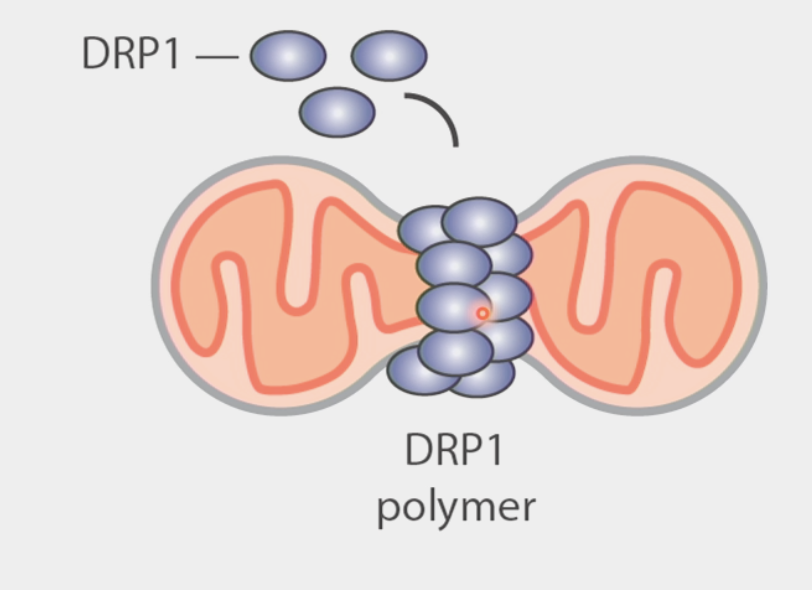
mitochondrial fission

  • the process by which mitochondria divide or segregate into two separate mitochondrial organelles

  • GTPase called DRP1 oligamerizes in ring shape on mitochondrial membrane and squeezes it apart

  • mutants have opposite phenotypes to fusion

  • continuous and ongoing at all times

  • promotes equal segregation of mitochondria into daughter cells

    • as cells enter mitosis, they fragment mitochondria into as many small pieces as possible

    • DRP1-/- cells segregate mitochondria asymmetrically

  • often occurs at point of Endoplasmic Reticulum-mitochondrial contact

    • triggers recruitment of DRP1

<ul><li><p><span>the process by which mitochondria divide or segregate into two separate mitochondrial organelles</span></p></li><li><p><span>GTPase called DRP1 oligamerizes in ring shape on mitochondrial membrane and squeezes it apart</span></p></li><li><p><span>mutants have </span><strong><span>opposite</span></strong><span> phenotypes to fusion</span></p></li><li><p><span>continuous and ongoing at all times</span></p></li><li><p><span>promotes </span><strong><span>equal</span></strong><span> segregation of mitochondria into daughter cells</span></p><ul><li><p>as cells enter mitosis, they <u>fragment</u> mitochondria into as many small pieces as possible</p></li><li><p>DRP1<sup>-/-</sup> cells segregate mitochondria <strong>asymmetrically</strong></p></li></ul></li><li><p>often occurs at point of<strong> Endoplasmic Reticulum-mitochondrial contact</strong></p><ul><li><p>triggers recruitment of DRP1</p></li></ul></li></ul><p></p>
38
New cards

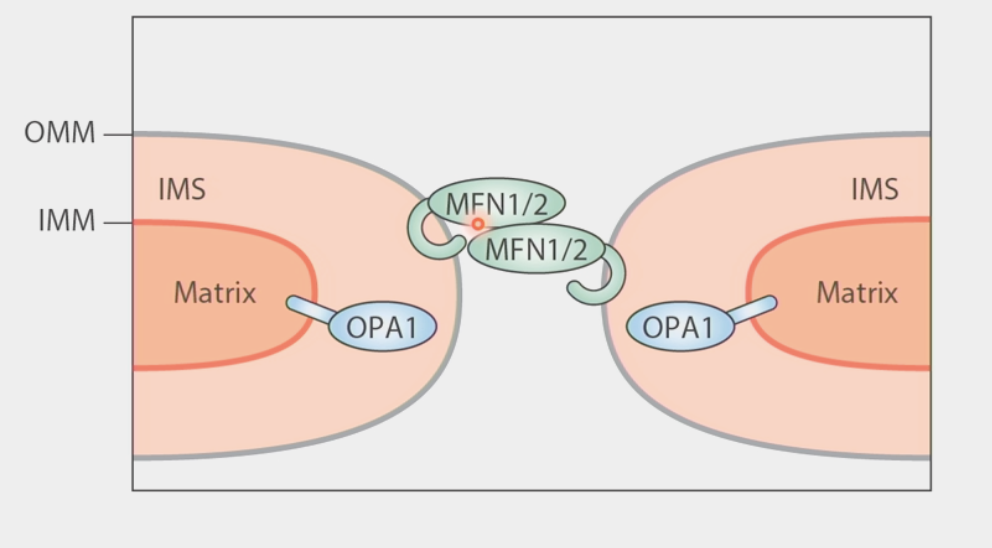
mitochondrial fusion

  • merging of two or more mitochondria within a cell to form a single compartment

  • 2-step process because of the double membrane:

    • Mitofusins (MFN1/2) form trans-dimer extending from one mitochondria to another

    • conformational change in MFN1/2 brings outer membranes together

    • Inner membrane: 2 copies of OPA1 dimerize → undergo conformational change to smash inner membranes together

  • mutants have opposite phenotypes to fission

  • continuous and ongoing at all times

<ul><li><p>merging of two or more mitochondria within a cell to form a single compartment</p></li><li><p>2-step process because of the double membrane:</p><ul><li><p>Mitofusins (MFN1/2) form trans-dimer extending from one mitochondria to another</p></li><li><p>conformational change in MFN1/2 brings outer membranes together</p></li><li><p>Inner membrane: 2 copies of OPA1 dimerize → undergo conformational change to smash inner membranes together</p></li></ul></li><li><p><span>mutants have </span><strong><span>opposite</span></strong><span> phenotypes to fission</span></p></li><li><p><span>continuous and ongoing at all times</span></p></li></ul><p></p>
39
New cards

mitochondrial repair

  • damage accumulated to mtDNA and protein contents

    • reactive oxygen species → byproduct of metabolism, toxic waste!!

  • fission & fusion promote mixing of mitochondrial contents & enable “rescue”

    • defective mitochondrion fused w/ working mitochondrion → now able to produce proteins to rebuild machinery → undergoes fission again to create “rescued” mitochondrion w/ its own genome
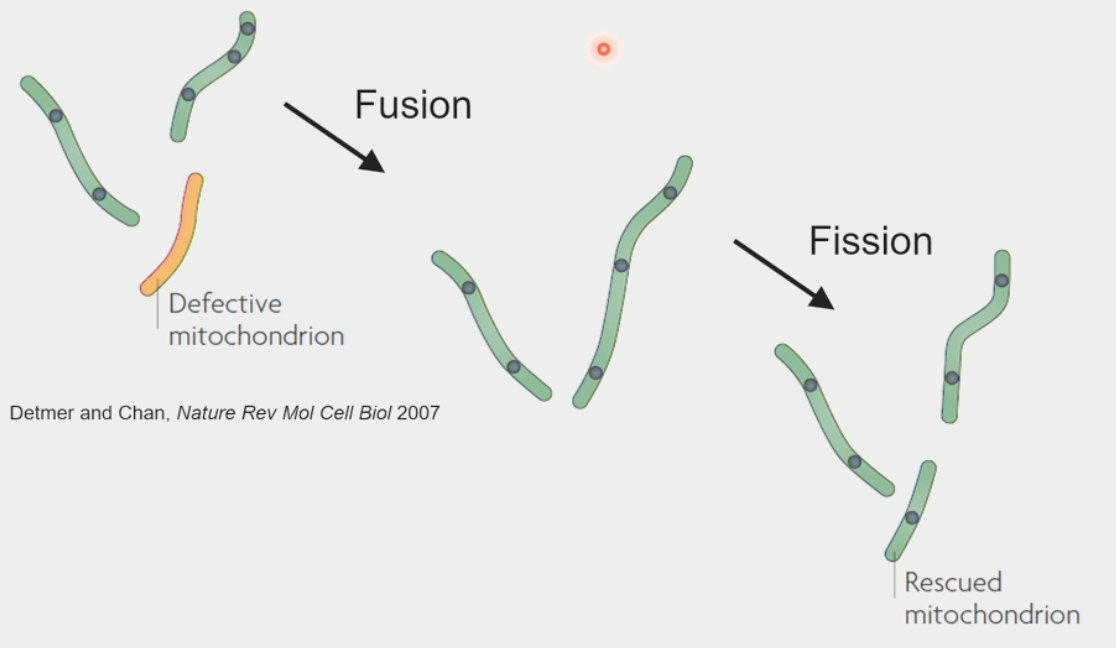
<ul><li><p>damage accumulated to mtDNA and protein contents</p><ul><li><p>reactive oxygen species → byproduct of metabolism, toxic waste!!</p></li></ul></li><li><p>fission &amp; fusion promote mixing of mitochondrial contents &amp; enable “rescue”</p><ul><li><p><strong>defective</strong> mitochondrion fused w/ working mitochondrion → now able to produce proteins to rebuild machinery → undergoes fission again to create “rescued” mitochondrion w/ its own genome</p></li></ul></li></ul><p></p>
40
New cards

mitophagy

  • the process of cells degrading their mitochondria

  • clears out dysfunctional mitochondria and controls number

  • eaten by large multi-protein organelle autophagosome

    • spits out nucleic & amino acids for rebuilding

  • PINK1 → identifies/targets damaged mitochondria

  • Parkin → tags mitochondria for degradation

    • Ubiquitin ligase, recruits autophagosome

  • Autosomal Recessive Early-Onset Parkinson’s Disease linked to misregulation of this process

    • PINK1 & Parkin mutations - dysfunctional mitochondria not degraded

    • tolerated for decades, then triggers disease later in life
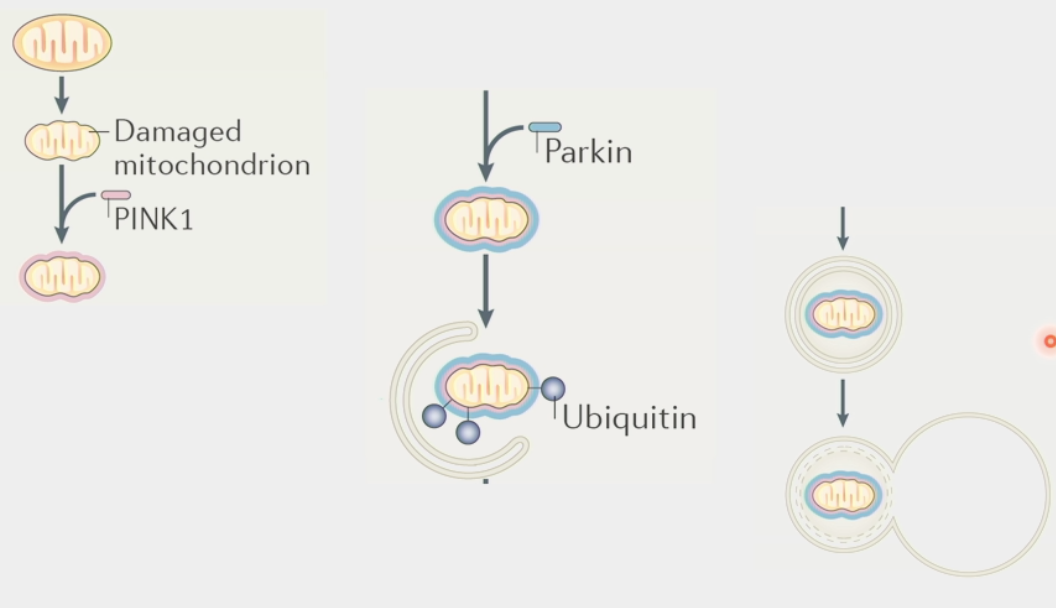
<ul><li><p>the process of cells degrading their mitochondria</p></li><li><p>clears out dysfunctional mitochondria and controls number</p></li><li><p>eaten by large multi-protein organelle autophagosome</p><ul><li><p>spits out nucleic &amp; amino acids for rebuilding</p></li></ul></li><li><p><strong>PINK1</strong> → identifies/targets damaged mitochondria</p></li><li><p><strong>Parkin</strong> → tags mitochondria for degradation</p><ul><li><p>Ubiquitin ligase, recruits autophagosome</p></li></ul></li><li><p>Autosomal Recessive Early-Onset Parkinson’s Disease linked to misregulation of this process</p><ul><li><p>PINK1 &amp; Parkin mutations - dysfunctional mitochondria <strong>not</strong> degraded</p></li><li><p>tolerated for decades, then triggers disease later in life</p></li></ul></li></ul><p></p>
41
New cards

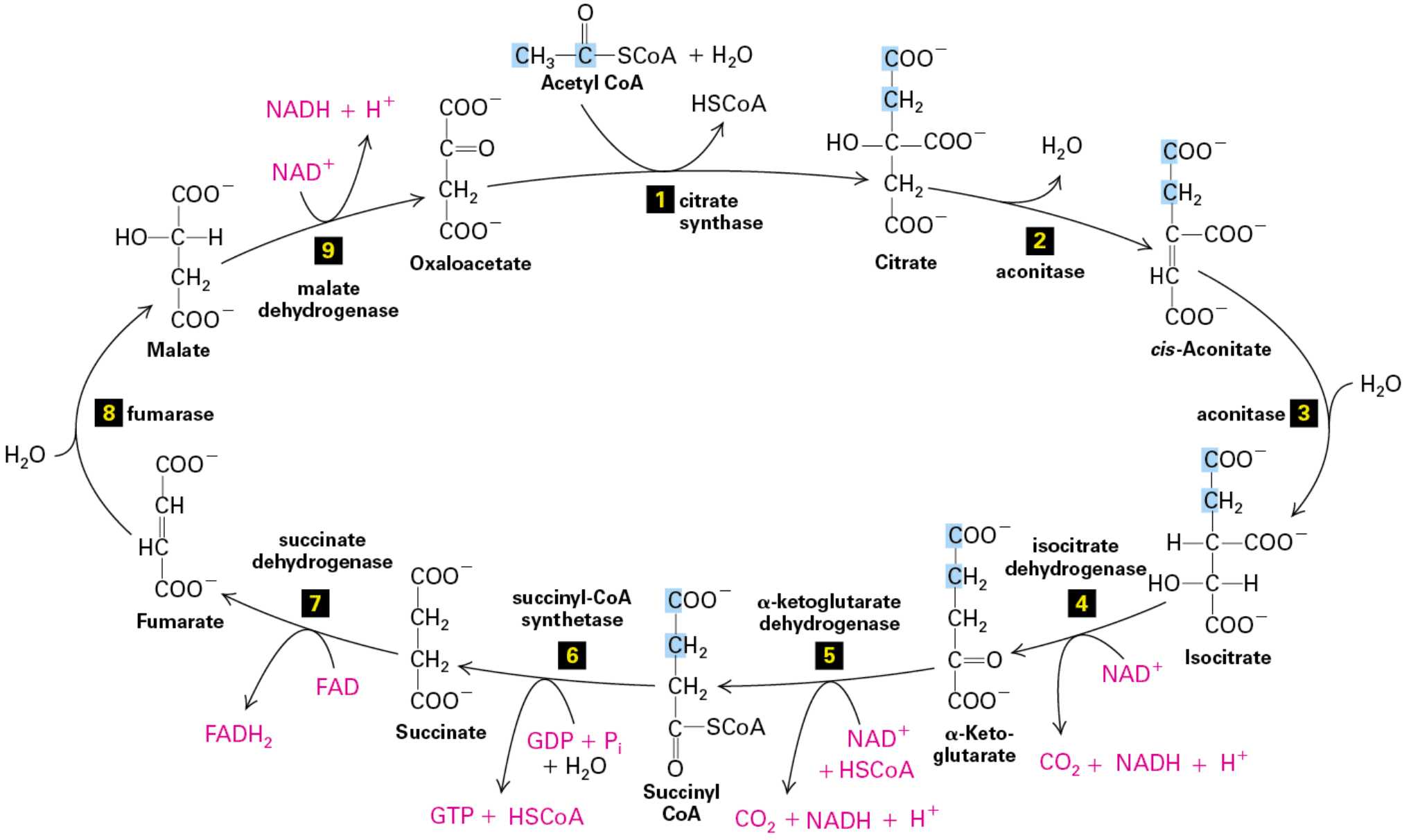
citric acid cycle

  • Stage II of metabolism

  • pyruvate enters cycle as C2 (2 carbon) acetyl group on acetyl-CoA

    • bound to CoA (Coenzyme A) in 3-step process

    • 1. Decarboxylation

    • 2. Oxidation (NAD+ → NADH)

    • 3. Transfer of acetyl group

    • performed by huge pyruvate dehydrogenase complex

    • ΔGº’ = -80kcal/mol, basically irreversible rxn

  • Krebs measured O2 consumption of pigeon muscle w/ manometer (U-shaped pressure thingy)

    • addition of citrate increased rate of consumption

  1. C2 acetyl group added to oxaloacetate (C4 carrier) by citrate synthase

    • citrate formed

    • oxaloacetate binding to citrate synthase creates binding site for Acetyl-CoA (INDUCED FIT)

  2. Citrate converted → cis-Aconitate → isocitrate (less stable form)

    • done by aconitase

    • H2O out, then H2O in

  1. C6 isocitrate converted → ⍺-ketoglutarate

    • done by isocitrate dehydrogenase

    • also converts NAD+CO2 + NADH + H+

  2. ⍺-ketoglutarate converted → C4 Succinyl-CoA

    • done by ⍺-ketoglutarate dehydrogenase (same steps as pyruvate dehydrogenase)

    • also converts NAD+ + HSCoA CO2 + NADH + H+

  3. Succinyl CoA converted → Succinate

    • done by succinyl-CoA synthetase

    • also converts GDP + Pi + H2O → GTP + HSCoA

  4. Succinate converted → Fumarate

    • done by succinate dehydrogenase

    • also converts FAD → FADH2 (less energy to reduce than NAD)

  5. Fumarate converted → Malate

    • done by fumarase

    • H2O comes in

  6. Malate converted back to oxaloacetate

    • done by malate dehydrogenase

    • also converts NAD+ → NADH + H+

<ul><li><p>Stage II of metabolism</p></li><li><p>pyruvate <strong>enters</strong> cycle as C2 (2 carbon) acetyl group on acetyl-CoA</p><ul><li><p>bound to CoA (Coenzyme A) in 3-step process</p></li><li><p>1. Decarboxylation</p></li><li><p>2. Oxidation (NAD<sup>+</sup> → NADH)</p></li><li><p>3. Transfer of acetyl group</p></li><li><p>performed by <strong>huge</strong> pyruvate dehydrogenase complex</p></li><li><p>ΔGº’ = -80kcal/mol, basically irreversible rxn</p></li></ul></li><li><p>Krebs measured O<sub>2</sub> consumption of pigeon muscle w/ manometer (U-shaped pressure thingy)</p><ul><li><p>addition of citrate <strong>increased</strong> rate of consumption</p></li></ul></li></ul><ol><li><p>C2 acetyl group added to oxaloacetate (C4 carrier) by citrate synthase</p><ul><li><p>citrate formed</p></li><li><p>oxaloacetate binding to citrate synthase <strong>creates binding site </strong>for Acetyl-CoA (INDUCED FIT)</p></li></ul></li><li><p>Citrate converted → <em>cis</em>-Aconitate → isocitrate (less stable form)</p><ul><li><p>done by aconitase</p></li><li><p>H<sub>2</sub>O out, then H<sub>2</sub>O in</p></li></ul></li></ol><ol start="4"><li><p>C6 isocitrate converted → ⍺-ketoglutarate</p><ul><li><p>done by isocitrate dehydrogenase</p></li><li><p>also converts NAD<sup>+</sup> → <strong>C</strong>O<sub>2</sub> + NADH + H<sup>+</sup></p></li></ul></li><li><p>⍺-ketoglutarate converted → C4 Succinyl-CoA</p><ul><li><p>done by ⍺-ketoglutarate dehydrogenase (same steps as pyruvate dehydrogenase)</p></li><li><p>also converts NAD<sup>+</sup> + <strong>HSCoA </strong>→ <strong>C</strong>O<sub>2</sub> + NADH + H<sup>+</sup></p></li></ul></li><li><p>Succinyl CoA converted → Succinate</p><ul><li><p>done by succinyl-CoA synthetase</p></li><li><p>also converts GDP + P<sub>i</sub> + H<sub>2</sub>O → GTP + HSCoA</p></li></ul></li><li><p>Succinate converted → Fumarate</p><ul><li><p>done by succinate dehydrogenase</p></li><li><p>also converts FAD → FADH<sub>2 </sub>(less energy to reduce than NAD)</p></li></ul></li><li><p>Fumarate converted → Malate</p><ul><li><p>done by fumarase</p></li><li><p>H<sub>2</sub>O comes in</p></li></ul></li><li><p>Malate converted back to <strong>oxaloacetate</strong></p><ul><li><p>done by malate dehydrogenase</p></li><li><p>also converts NAD<sup>+</sup> → NADH + H<sup>+</sup></p></li></ul></li></ol><p></p>
42
New cards

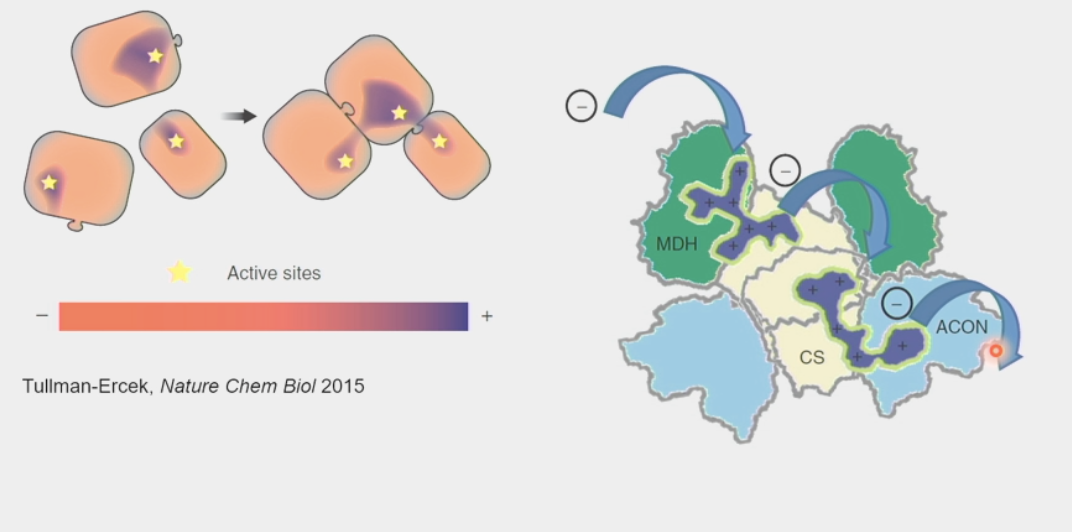
substrate channeling

  • enabled by large metabolic complexes

  • passing of the intermediary metabolic product of one enzyme directly to another enzyme or active site WITHOUT its release into solution

  • increase reaction rates and preserve orientation

  • ex. ETC

<ul><li><p>enabled by large metabolic complexes</p></li><li><p><span><span>passing of the intermediary metabolic product of one enzyme </span><strong><span>directly</span></strong><span> to another enzyme or active site </span><strong><span>WITHOUT its release into solution</span></strong></span></p></li><li><p>increase reaction rates and preserve orientation</p></li><li><p>ex. ETC</p></li></ul><p></p>
43
New cards

radioactive carbons

  • Carbon-14 allowed scientists to track fates of metabolites in citric acid cycle

  • learned that the 2C that enter cycle do NOT leave the first time around (from CO2 produced by steps 4 & 5)

    • carbons cleaved off from bottom to form CO2 → next carbons in molecule move down

    • symmetry of molecules makes succinate dehydrogenase unable to distinguish orientation after step 5

  • 0% radioactivity 1st time → 50% radioactivity 2nd time, etc.

44
New cards

citric acid cycle enzymes

  • major oncogenes

    • mutations in isocitrate dehydrogenase produce “oncogenic metabolite”

    • produces 2-hydroxy-glutarate instead of ⍺-Ketoglutarate

    • inhibits histone demethylation → change in gene expression → cancer

  • TCA metabolites → source of biosynthetic precursors & cofactors

    • fatty acids, sterols, glutamate, other amino acids, purines, etc…

    • exit of intermediates from citric acid cycle
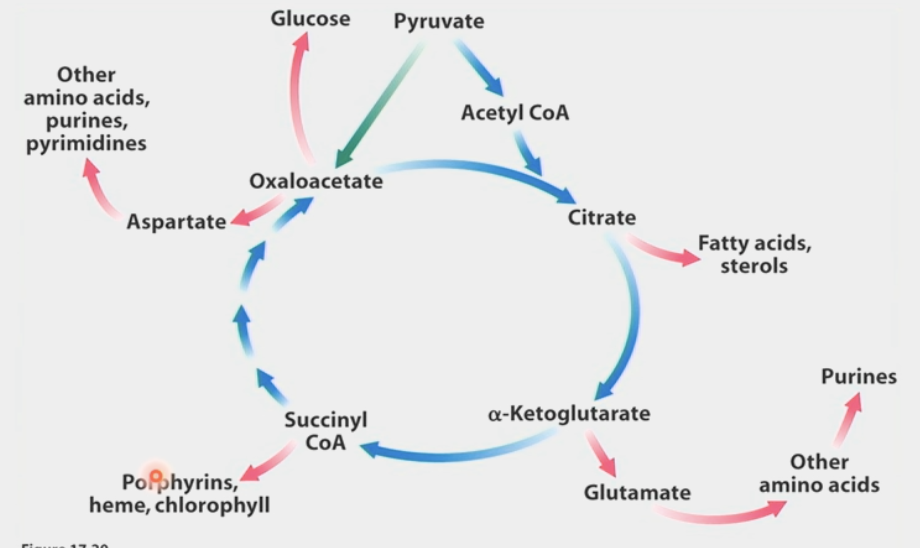
<ul><li><p>major oncogenes</p><ul><li><p>mutations in <strong>isocitrate dehydrogenase</strong> produce “oncogenic metabolite”</p></li><li><p>produces 2-hydroxy-glutarate instead of ⍺-Ketoglutarate</p></li><li><p><u>inhibits</u> histone demethylation → change in gene expression → cancer</p></li></ul></li><li><p>TCA metabolites → source of biosynthetic precursors &amp; cofactors</p><ul><li><p>fatty acids, sterols, glutamate, other amino acids, purines, etc…</p></li><li><p>exit of intermediates from citric acid cycle</p></li></ul></li></ul><p></p>
45
New cards

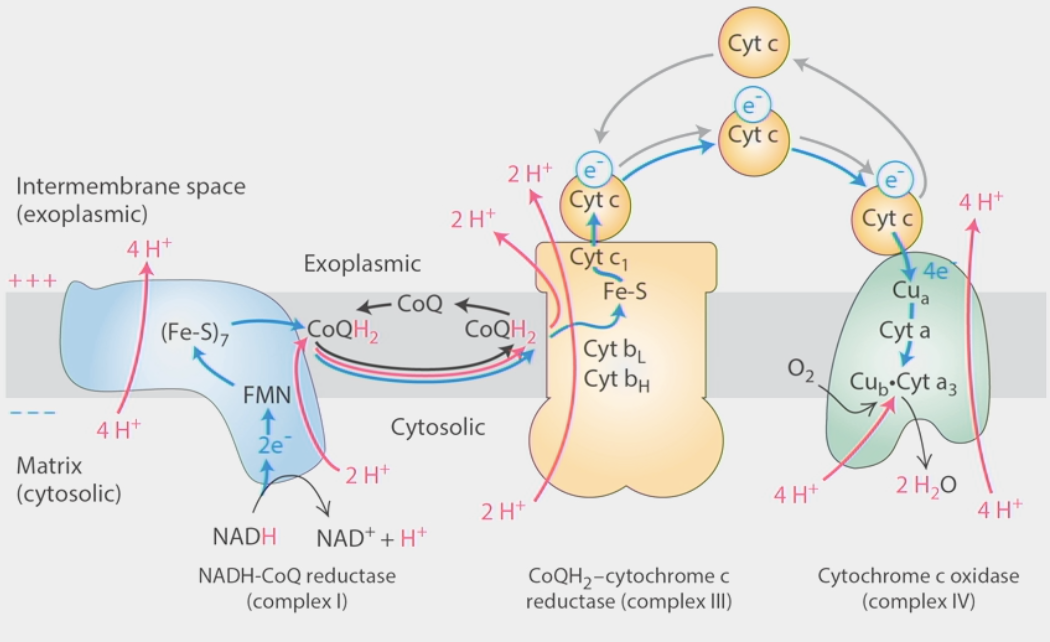
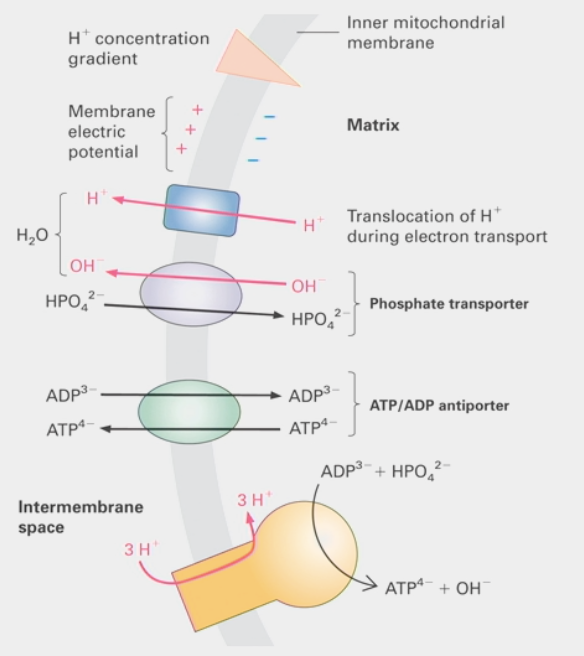
Electron Transport Chain

  • Stage III of metabolism

  • converts NADH reduction into a proton gradient

    • intermembrane space → positively charged

    • cytosolic matrix → negatively charged

  • iron clusters & other “prosthetic groups” pass e- downhill

    • decentralized electron clouds

    • Hemes, Fe-S clusters

  • Complex I: NADH-CoQ reductase

    • NADH → NAD+ + H+ sends 2 e- in

    • e- pass through Fe-S clusters (different e- comes out each time)

    • 4H+ move against concentration gradient SEPARATE from e- transfer → transverse helix pump

    • e- passed to ubiquinone (CoQ) → lipid-like carrier

    • 2H+ + 2e- + CoQ → CoQH2

    • CoQH2 transfers e- to complex III

  • Complex II: from citric acid cycle (succinate-CoQ reductase)

    • transfers e- to CoQ from succinate

    • NOT near other complexes!!!

  • Complex III: CoQH2-cytochrome c

    • e- transferred by CoQH2 to cytochrome C

    • 2 e- hit Q0 site →1 goes up to Cyt c, other goes down, interacts w/ Qi site

    • Cyt c dissociates, e- released, new Cyt c binds to complex

    • unloaded CoQ leaves, new CoQH2 comes in → 2nd e- that goes down joins the 1st one in Qi site, makes another CoQH2 w/ 2H+

    • TOTAL: 4e- IN, 2H+ IN, 2CoQH2 IN → 2e- OUT (Cyt c), 1 CoQH2 OUT, 4H+ pumped ACROSS

  • Complex IV: Cytochrome c oxidase

    • passes e- from Cytochrome C → O2

    • e- pass down thru prosthetic groups (e- carriers), meet with O2 + 4H+ → 2H2O

    • 1e- per Cyt C, 4 needed to produce 2 H2O out of 1 O2

    • 4H+ also pumped across gradient

  • activity level measured w/ changes in pH

  • without O2 → TCA cycle & ETC STOP b/c NAD+ is depleted

  • ΔGº’ = 52.6 kcal/mol

<ul><li><p>Stage III of metabolism</p></li><li><p>converts NADH reduction into a proton gradient</p><ul><li><p>intermembrane space → positively charged</p></li><li><p>cytosolic matrix → negatively charged</p></li></ul></li><li><p>iron clusters &amp; other “prosthetic groups” pass e<sup>-</sup> downhill</p><ul><li><p><strong>decentralized electron clouds</strong></p></li><li><p>Hemes, Fe-S clusters</p></li></ul></li><li><p><u>Complex I:</u> NADH-CoQ reductase</p><ul><li><p>NADH → NAD<sup>+</sup> + H<sup>+</sup> sends 2 e<sup>-</sup> in</p></li><li><p>e<sup>-</sup> pass through Fe-S clusters (<strong>different</strong> e<sup>-</sup> comes out each time)</p></li><li><p>4H<sup>+</sup> move against concentration gradient SEPARATE from e<sup>-</sup> transfer → <strong>transverse helix pump</strong></p></li><li><p>e<sup>-</sup> passed to ubiquinone (CoQ) → lipid-like carrier</p></li><li><p>2H<sup>+</sup> + 2e<sup>-</sup> + CoQ → CoQH<sub>2</sub></p></li><li><p>CoQH<sub>2</sub> <strong>transfers</strong> e<sup>-</sup> to complex III</p></li></ul></li><li><p><u>Complex II:</u> from citric acid cycle (succinate-CoQ reductase)</p><ul><li><p>transfers e<sup>-</sup> to CoQ from succinate</p></li><li><p><strong>NOT</strong> near other complexes!!!</p></li></ul></li><li><p><u>Complex III:</u> CoQH<sub>2</sub>-cytochrome c</p><ul><li><p>e<sup>-</sup> transferred by CoQH<sub>2 </sub>to cytochrome C</p></li><li><p>2 e<sup>-</sup> hit Q<sub>0</sub> site →1 goes up to Cyt c, other goes down, interacts w/ Q<sub>i</sub> site</p></li><li><p>Cyt c dissociates, e<sup>-</sup> released, new Cyt c binds to complex</p></li><li><p>unloaded CoQ leaves, new CoQH<sub>2</sub> comes in → 2nd e<sup>-</sup> that goes down joins the 1st one in Q<sub>i</sub> site, makes <strong>another</strong> CoQH<sub>2</sub> w/ 2H<sup>+</sup></p></li><li><p>TOTAL: 4e<sup>-</sup> IN, 2H<sup>+</sup> IN, 2CoQH<sub>2</sub> IN → 2e<sup>- </sup>OUT (Cyt c), 1 CoQH<sub>2</sub> OUT, 4H<sup>+</sup> pumped ACROSS</p></li></ul></li><li><p><u>Complex IV: </u>Cytochrome c oxidase</p><ul><li><p>passes e<sup>-</sup> from Cytochrome C → O<sub>2</sub></p></li><li><p>e<sup>-</sup> pass down thru prosthetic groups (e<sup>-</sup> carriers), meet with O<sub>2</sub> + 4H<sup>+</sup> → 2H<sub>2</sub>O</p></li><li><p>1e<sup>-</sup> per Cyt C, 4 <strong>needed</strong> to produce 2 H<sub>2</sub>O out of 1 O<sub>2</sub></p></li><li><p>4H<sup>+</sup> also pumped across gradient</p></li></ul></li><li><p>activity level measured w/ changes in pH</p></li><li><p>without O<sub>2</sub> → TCA cycle &amp; ETC STOP b/c NAD<sup>+</sup> is depleted</p></li><li><p>ΔGº’ = 52.6 kcal/mol</p></li></ul><p></p>
46
New cards

electron carrier

  • iron clusters and other groups that pass electrons downhill

    • Hemes, Fe-S clusters (ex. in Complex I of ETC)

    • have decentralized electron clouds

  • reduction potential (readiness to gain e-) increases down the chain

    • ΔG decreases

  • electrons moved to higher reduction potential groups all the way to O2 in ETC
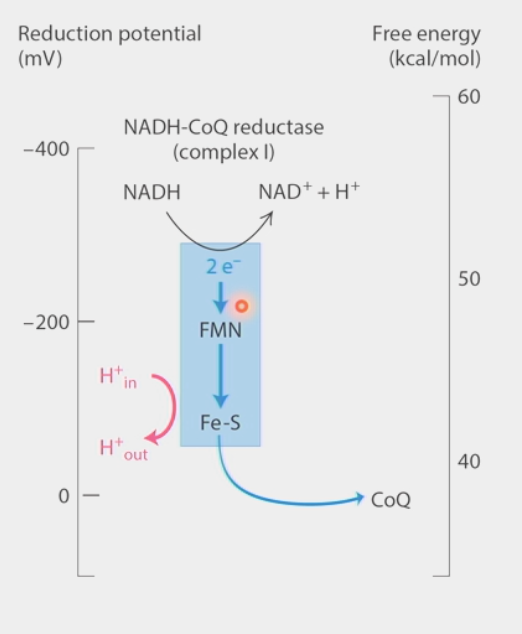
<ul><li><p>iron clusters and other groups that pass electrons downhill</p><ul><li><p>Hemes, Fe-S clusters (ex. in Complex I of ETC)</p></li><li><p>have <strong>decentralized</strong> electron clouds</p></li></ul></li><li><p>reduction potential (readiness to gain e<sup>-</sup>) <strong>increases</strong> down the chain</p><ul><li><p>ΔG <strong>decreases</strong></p></li></ul></li><li><p>electrons moved to higher reduction potential groups all the way to O<sub>2</sub> in ETC</p></li></ul><p></p>
47
New cards

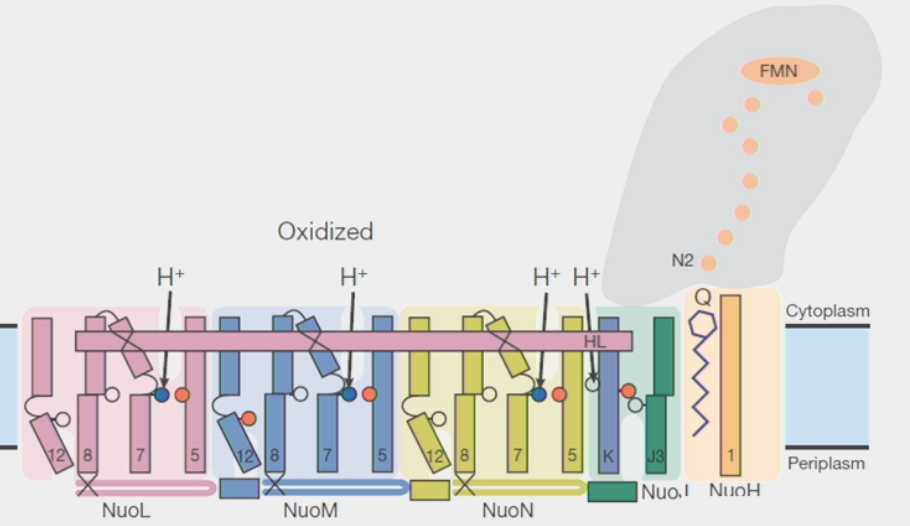
proton translocation

  • in Complex I of ETC

  • 4 separate gated proton channels for 4H+ moving against concentration gradient

  • separate from electron transfer

  • channels have residues with regulated pKa

    • Ka = acid dissociation constant (affinity for protons)

    • pKa = -log10 Ka

    • lysine residues in Complex I bind and release protons in response to CoQ reduction

    • gate = 2 Lys connected to half-channels in membrane

  • transverse helix (t-helix) couples changes at CoQ site to conformational changes in pKa of Lys

    • sliding left: CoQ oxidized, H+ caught → right: CoQ reduced, H+ dropped → repeat

    • PUMP motion

  • 300x a second!!

<ul><li><p>in Complex I of ETC</p></li><li><p>4 <strong>separate</strong> <strong>gated</strong> proton channels for 4H<sup>+ </sup>moving against concentration gradient</p></li><li><p><strong>separate</strong> from electron transfer</p></li><li><p>channels have residues with regulated pKa</p><ul><li><p>Ka = acid dissociation constant (affinity for protons)</p></li><li><p>pKa = -log<sub>10</sub> Ka</p></li><li><p>lysine residues in Complex I bind and release protons in response to CoQ <strong>reduction</strong></p></li><li><p>gate = 2 Lys connected to <u>half-channels</u> in membrane</p></li></ul></li><li><p><strong>transverse helix (t-helix) </strong>couples changes at CoQ site to conformational changes in pKa of Lys</p><ul><li><p>sliding left: CoQ oxidized, H<sup>+</sup> <strong>caught</strong> → right: CoQ reduced, H<sup>+ </sup><strong>dropped</strong> → repeat</p></li><li><p>PUMP motion</p></li></ul></li><li><p>300x a second!!</p></li></ul><p></p>
48
New cards

supramolecular assemblies

  • parts of the structure are held together by very strong interactions, but not necessarily by covalent bonds

  • ex. Electron Transport Chain → complexes are adjacent, molecules do not have to diffuse far
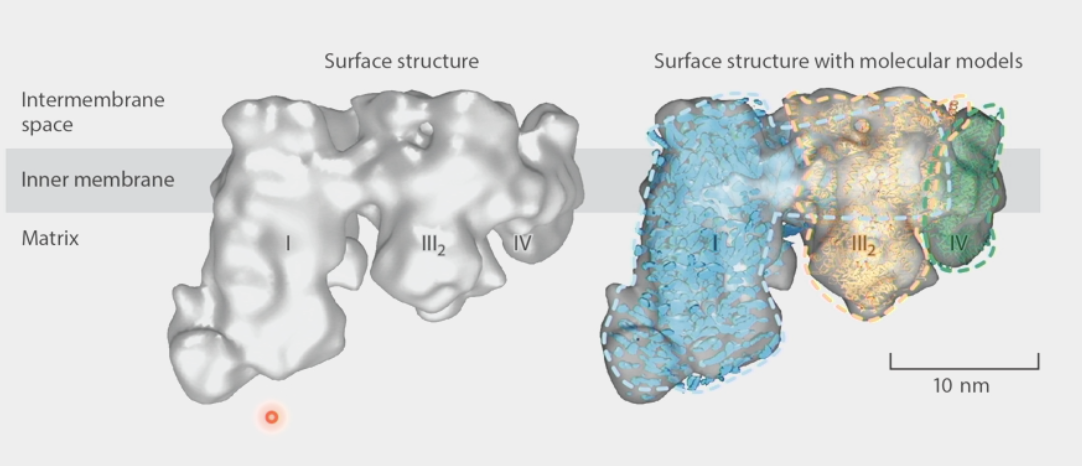
<ul><li><p><span><span>parts of the structure are held together by very strong interactions, but not necessarily by covalent bonds</span></span></p></li><li><p>ex. Electron Transport Chain → complexes are <strong>adjacent</strong>, molecules do not have to diffuse far</p></li></ul><p></p>
49
New cards

electron shuttle

  • how cells regenerate cytoplasmic NAD+ pools

  • 2 transport molecules → transport intermediate metabolites (malate & aspartate) across inner mitochondrial membrane in opposite directions

    • malate: cytosol → matrix

    • aspartate: matrix→ cytosol

  • enzymes couple creation of malate from oxaloacetate to oxidation of NADH → NAD+

    • malate travels across membrane → is reduced back to oxaloacetate → NAD+ becomes NADH again

  • oxaloacetate created from aspartate by transaminase in cytosol, turned back into aspartate in matrix
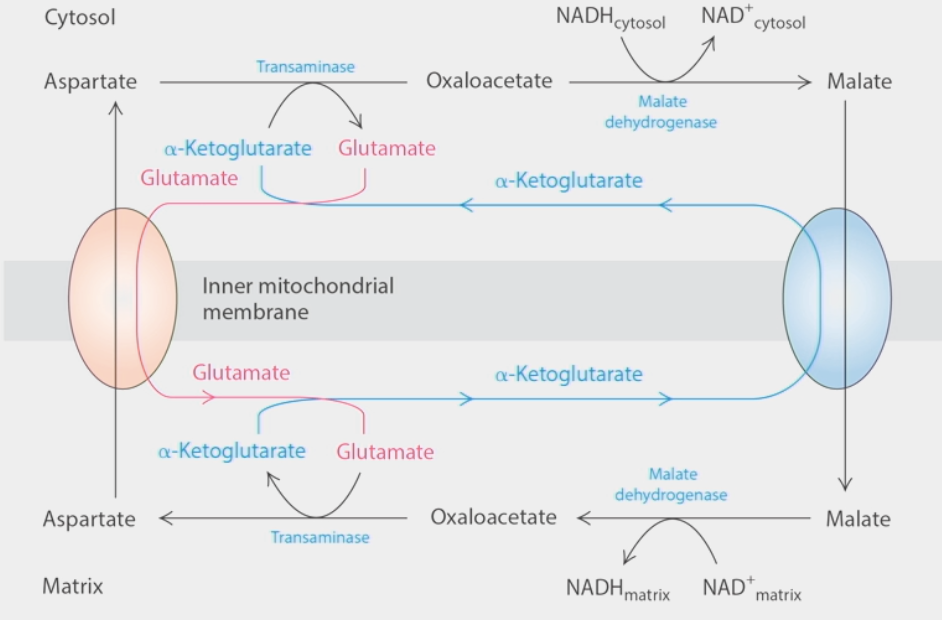
<ul><li><p>how cells <strong>regenerate</strong> cytoplasmic NAD<sup>+</sup> pools</p></li><li><p>2 transport molecules → transport intermediate metabolites (malate &amp; aspartate) across inner mitochondrial membrane in opposite directions</p><ul><li><p><strong>malate</strong>: cytosol → matrix</p></li><li><p><strong>aspartate</strong>: matrix→ cytosol</p></li></ul></li><li><p>enzymes couple creation of  malate from oxaloacetate <strong>to</strong> oxidation of NADH → NAD<sup>+</sup></p><ul><li><p>malate travels across membrane → is reduced back to oxaloacetate → NAD<sup>+</sup> becomes <strong>NADH</strong> again</p></li></ul></li><li><p>oxaloacetate created from <strong>aspartate</strong> by transaminase in cytosol, turned <strong>back</strong> into aspartate in matrix</p></li></ul><p></p>
50
New cards

ATP synthase

  • molecule that harnesses proton-motive force from inner mitochondrial membrane to make ATP

  • H+ want to flow from high concentration → low concentration side: energy can be harvested!

  • Split into Fragment 0 & 1 (F0 & F1)

  • F0:

    • subunit a → proton half-channels I & II

      • H+ flow up through half-channels

    • c ring → made of 10-14 identical c subunits

      • H+ flow from half-channel I → bind to negatively-charged residue in c subunit

      • ROTATES 360º until H+ reaches half-channel II → flows up & out

      • rotation drives enzymatic activity in F1 → ATP synthesis

    • stator → made of 2 b subunits & δ subunit

      • holds ⍺ & β subunits in the head stationary while c ring rotates

  • F1:

    • 𝛾 subunit → non-symmetric shape, rotates!!

      • sticks up from c ring to head group

      • rotation physically pushes β subunits thru 3-stage cycle of reaction where they change conformations

      • 130 rotations per second = 1000 H+ = 300 ATP per synthase per second!

    • β subunits → 3 configurations

      • O config = OPEN → ADP + Pi can pop IN and OUT

      • L config = LOOSE → ADP + Pi trapped but NON-reactive

      • T config = TIGHT → ADP + Pi converted to ATP (REVERSIBLE)

      • 12 H+ needed for 360º rotation = 3 ATP

  • ancient innovation → same structure found in bacteria, yeast, chloroplasts, etc.

  • can run backwards to generate proton gradient FROM ATP

  • ΔGº’ = 3 × 7.3 kcal/mol (50% efficient from ETC)
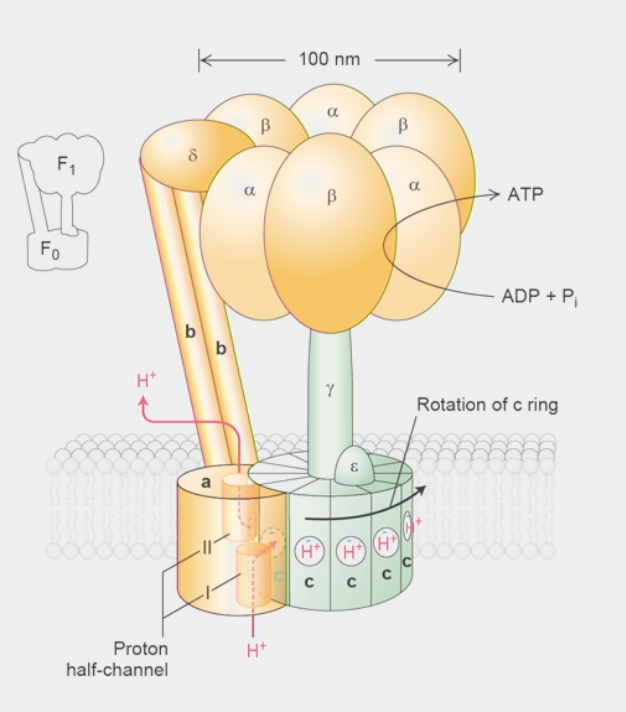
<ul><li><p>molecule that harnesses <u>proton-motive force</u> from inner mitochondrial membrane to make ATP</p></li><li><p>H<sup>+</sup> want to flow from high concentration → low concentration side: energy can be harvested!</p></li><li><p>Split into Fragment 0 &amp; 1 (F<sub>0</sub> &amp; F<sub>1</sub>)</p></li><li><p>F<sub>0</sub>:</p><ul><li><p>subunit <strong>a</strong> → proton half-channels I &amp; II</p><ul><li><p>H<sup>+</sup> flow up through half-channels</p></li></ul></li><li><p><strong>c ring</strong> → made of 10-14 identical <strong>c</strong> subunits</p><ul><li><p>H<sup>+</sup> flow from half-channel I → bind to <strong>negatively</strong>-charged residue in <strong>c</strong> subunit</p></li><li><p>ROTATES 360º until H<sup>+</sup> reaches half-channel II → flows up &amp; <strong>out</strong></p></li><li><p>rotation drives enzymatic activity in F<sub>1<sup> </sup></sub>→ ATP synthesis</p></li></ul></li><li><p><strong>stator</strong> → made of 2 <strong>b</strong> subunits &amp; <strong>δ</strong> subunit</p><ul><li><p>holds ⍺ &amp; β subunits in the head <strong>stationary</strong> while c ring rotates</p></li></ul></li></ul></li><li><p>F<sub>1</sub>:</p><ul><li><p><strong>𝛾</strong> subunit → <strong>non</strong>-symmetric shape, rotates!!</p><ul><li><p>sticks up from c ring to head group</p></li><li><p>rotation physically pushes β subunits thru 3-stage cycle of reaction where they <strong>change</strong> conformations</p></li><li><p>130 rotations per second = 1000 H<sup>+</sup> = 300 ATP per synthase per second!</p></li></ul></li><li><p><strong>β</strong> subunits → 3 configurations</p><ul><li><p>O config = <strong>OPEN</strong> → ADP + P<sub>i</sub> can pop IN and OUT</p></li><li><p>L config = <strong>LOOSE → </strong>ADP + P<sub>i</sub> <u>trapped</u> but <strong>NON-reactive</strong></p></li><li><p>T config = <strong>TIGHT → </strong>ADP + P<sub>i<sup> </sup></sub>converted to ATP (<strong>REVERSIBLE</strong>)</p></li><li><p>12 H<sup>+</sup> needed for 360º rotation = 3 ATP</p></li></ul></li></ul></li><li><p>ancient innovation → same structure found in bacteria, yeast, chloroplasts, etc.</p></li><li><p>can run backwards to generate proton gradient FROM ATP</p></li><li><p>ΔGº’ = 3 × 7.3 kcal/mol (50% efficient from ETC)</p></li></ul><p></p>
51
New cards

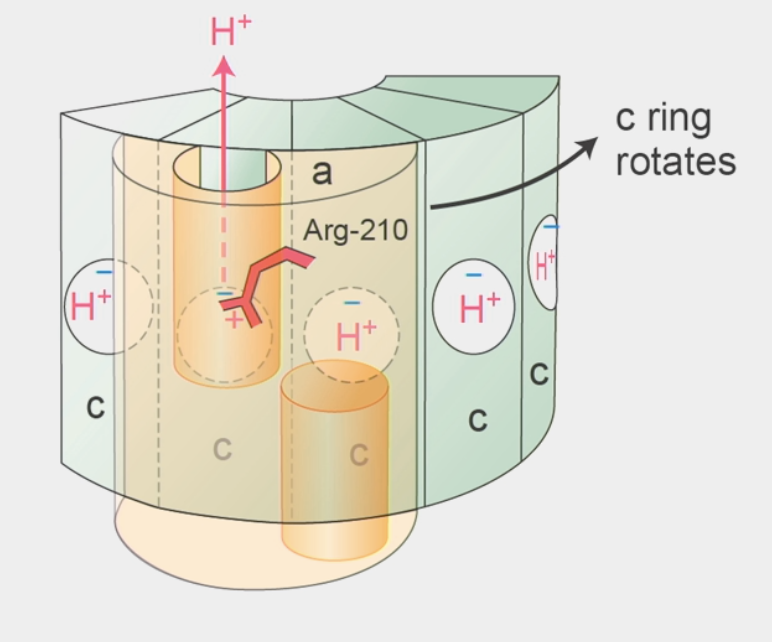
c ring rotation

  • a subunit has Arg-210 residue (like Lys, can be protonated/deprotonated)

    • carries positive charge → interacts w/ negative residue in a c subunit

  • proton comes up through half-channel I → binds w/ same negative residue and displaces Arg-210 to next c subunit

    • Arg-210 undergoes conformational change → kicks out fully rotated H+ in next subunit to bind w/ negative residue

    • H+ leaves out of half-channel II

    • c ring rotates always in ONE direction!!

    • Arg-210 back in original position → REPEAT process

  • “Brownian Ratchet” → rotation driven by HEAT/random thermal collisions

    • must be “rectified” to avoid breaking 2nd Law by H+ concentrations on sides of membrane

    • Arg-210 = pawl of ratchet

<ul><li><p>a subunit has Arg-210 residue (like Lys, can be protonated/deprotonated)</p><ul><li><p>carries <strong>positive</strong> charge → interacts w/ <strong>negative</strong> residue in a <strong>c</strong> subunit</p></li></ul></li><li><p>proton comes up through half-channel I → binds w/ same negative residue and <strong>displaces</strong> Arg-210 to <u>next c subunit</u></p><ul><li><p>Arg-210 undergoes conformational change → <strong>kicks out</strong> fully rotated H<sup>+</sup> in next subunit to bind w/ negative residue</p></li><li><p>H<sup>+</sup> leaves out of half-channel II</p></li><li><p><strong>c ring rotates always in ONE direction!!</strong></p></li><li><p>Arg-210 back in <strong>original position</strong> → REPEAT process</p></li></ul></li><li><p>“Brownian Ratchet” → rotation driven by HEAT/random thermal collisions</p><ul><li><p>must be “rectified” to avoid breaking 2nd Law by H<sup>+</sup> concentrations on sides of membrane</p></li><li><p>Arg-210 = pawl of ratchet</p></li></ul></li></ul><p></p>
52
New cards

ATP/ADP antiporter

  • integral membrane protein that uses secondary active transport

    • uses energetically favorable movement of one molecule down its electrochemical gradient

  • how ATP escapes mitochondrial matrix

    • lets ATP out while letting ADP in

<ul><li><p><span>integral membrane protein that uses </span><strong><span>secondary</span></strong><span> active transport</span></p><ul><li><p><span>uses energetically </span><strong><span>favorable</span></strong><span> movement of one molecule down its electrochemical gradient</span></p></li></ul></li><li><p>how ATP escapes mitochondrial matrix</p><ul><li><p>lets ATP out while letting ADP in</p></li></ul></li></ul><p></p>
53
New cards

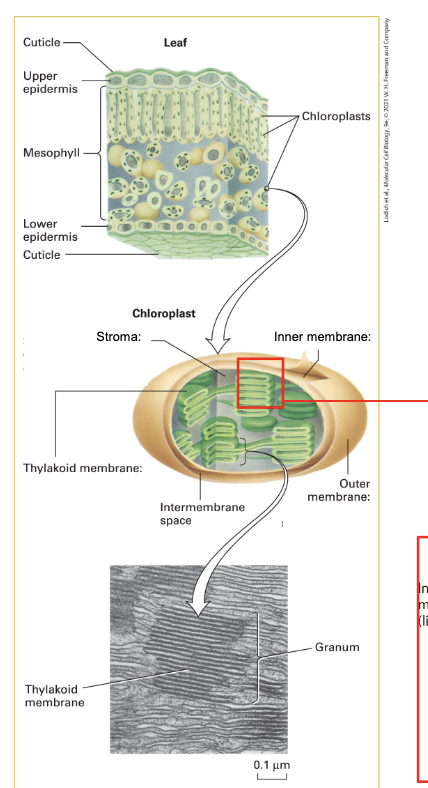
chloroplast

  • double membrane organelle

    • outer membrane = highly permeable to small molecules

    • inner membrane = less permeable, requires transporters

  • intermembrane space = stroma (like cytoplasm)

  • stroma contains thylakoids (membranous structure) → form stacks called grana

    • enclose distinct space called lumen

<ul><li><p><strong>double</strong> membrane organelle</p><ul><li><p><strong>outer</strong> membrane = highly permeable to small molecules</p></li><li><p><strong>inner</strong> membrane = less permeable, requires transporters</p></li></ul></li><li><p>intermembrane space = <strong>stroma</strong> (like cytoplasm)</p></li><li><p>stroma contains <strong>thylakoids </strong>(membranous structure) → form stacks called <strong>grana</strong></p><ul><li><p>enclose distinct space called <strong>lumen</strong></p></li></ul></li></ul><p></p>
54
New cards

photoelectric effect

  • emission of electrons from a material caused by electromagnetic radiation

  • ex. ejection of electrons from a metal when light falls on it

  • photosynthesis takes advantage of this!
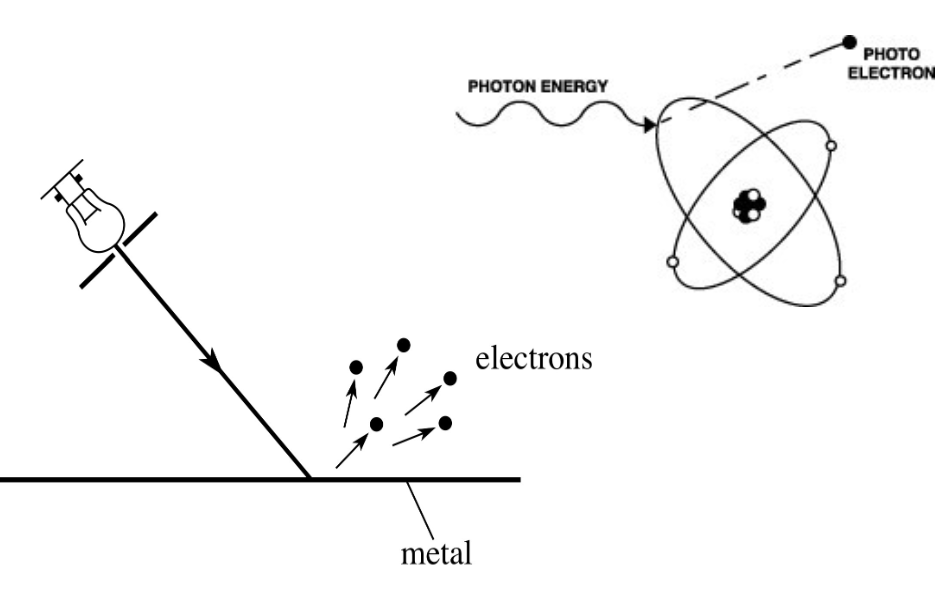
<ul><li><p><span><span>emission of electrons from a material caused by electromagnetic radiation</span></span></p></li><li><p><span><span>ex. ejection of electrons from a metal when light falls on it</span></span></p></li><li><p>photosynthesis takes advantage of this!</p></li></ul><p></p>
55
New cards

chlorophyll

  • photosynthetic pigment that absorbs light energy

  • has porphyrin ring structure → central ion is Mg2+, has hydrophobic tail

  • extensive system of conjugated double bonds around Mg2+ where e- move

  • when light (photon) strikes it → excites e- → they delocalize over bonds surrounding Mg2+

    • excited state is unstable

    • excitation energy can be lost in 3 ways:

      1. as heat + fluorescence

      2. transferred to neighboring pigments through resonance energy transfer

      3. eject and transfer e- w/ high energy to a nearby e- acceptor → ground state achieved by acquisition of low energy e- from nearby e- donor

  • look green because mainly blue and red wavelengths of visible light are absorbed while green is reflected

  • largely found in thylakoid membrane in photosystems
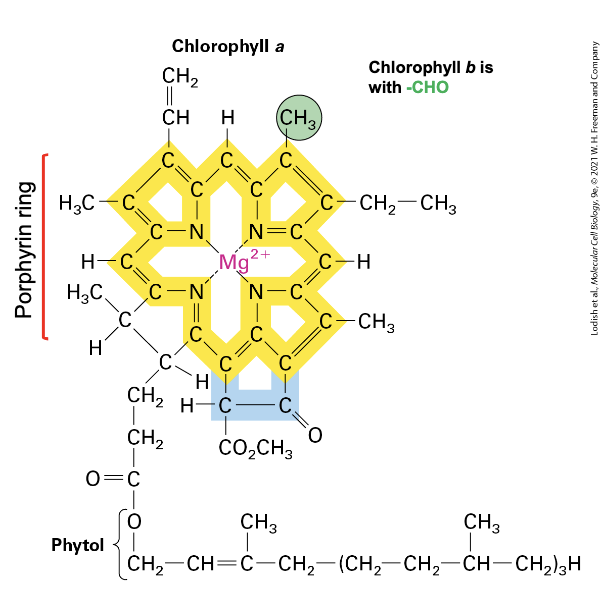
<ul><li><p>photosynthetic pigment that absorbs light energy</p></li><li><p>has porphyrin ring structure → central ion is Mg<sup>2+</sup>, has <strong>hydrophobic</strong> tail</p></li><li><p>extensive system of conjugated double bonds around Mg<sup>2+</sup> where e<sup>-</sup> move</p></li><li><p>when light (photon) strikes it → excites e<sup>-</sup> → they <strong>delocalize</strong> over bonds surrounding Mg<sup>2+</sup></p><ul><li><p>excited state is <strong>unstable</strong></p></li><li><p>excitation energy can be lost in 3 ways:</p><ol><li><p>as heat + fluorescence</p></li><li><p>transferred to neighboring pigments through resonance energy transfer</p></li><li><p>eject and transfer e<sup>-</sup> w/ high energy to a nearby e<sup>-</sup> <strong>acceptor</strong> → ground state achieved by acquisition of <strong>low</strong> energy e<sup>-</sup> from nearby e<sup>-</sup> <strong>donor</strong></p></li></ol></li></ul></li><li><p>look green because mainly blue and red wavelengths of visible light are <strong>absorbed</strong> while green is <strong>reflected</strong></p></li><li><p>largely found in <strong>thylakoid membrane</strong> in photosystems</p></li></ul><p></p>
56
New cards

photosystems

  • where light reactions occur during photosynthesis

  • 2 of them are coupled in thylakoid membrane → light harvested twice

  • Z scheme of redox potential

  • evolved from cyanobacteria (produced first O2 in atmosphere = Great Oxidation Event) → algae → plants

  • has a Light Harvesting Complex (LHC) → consists of hundreds of bridging chlorophylls

  • has a reaction center w/ special pair of chlorophylls

  • light energy captured by chlorophylls in LHC → funneled to special pair in reaction center

    • capture light of different wavelengths → absorbed energy transmits one-by-one thru resonance energy transfer

  • energy excites e- → ejects from special chlorophyll in reaction center to e- carrier
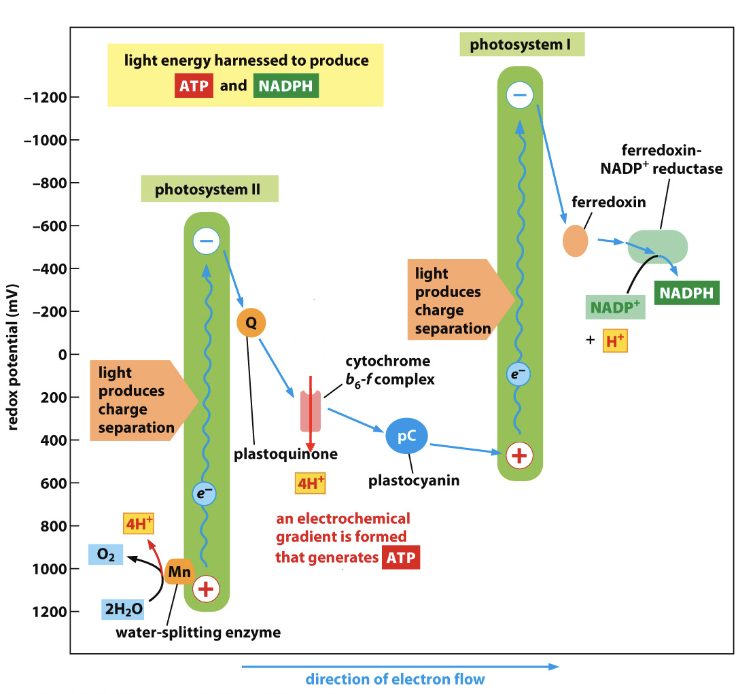
<ul><li><p>where light reactions occur during photosynthesis</p></li><li><p>2 of them are coupled in thylakoid membrane → light harvested <strong>twice</strong></p></li><li><p><strong>Z scheme</strong> of redox potential</p></li><li><p>evolved from <strong>cyanobacteria</strong> (produced first O<sub>2</sub> in atmosphere = Great Oxidation Event) → algae → plants</p></li><li><p>has a <strong>Light Harvesting Complex (LHC)</strong> → consists of hundreds of bridging chlorophylls</p></li><li><p>has a reaction center w/ <strong>special</strong> pair of chlorophylls</p></li><li><p>light energy captured by chlorophylls in LHC → funneled to special pair in reaction center</p><ul><li><p>capture light of different wavelengths → absorbed energy transmits <strong>one-by-one</strong> thru resonance energy transfer</p></li></ul></li><li><p>energy excites e<sup>-</sup> → ejects from special chlorophyll in reaction center to e<sup>-</sup> carrier</p></li></ul><p></p>
57
New cards

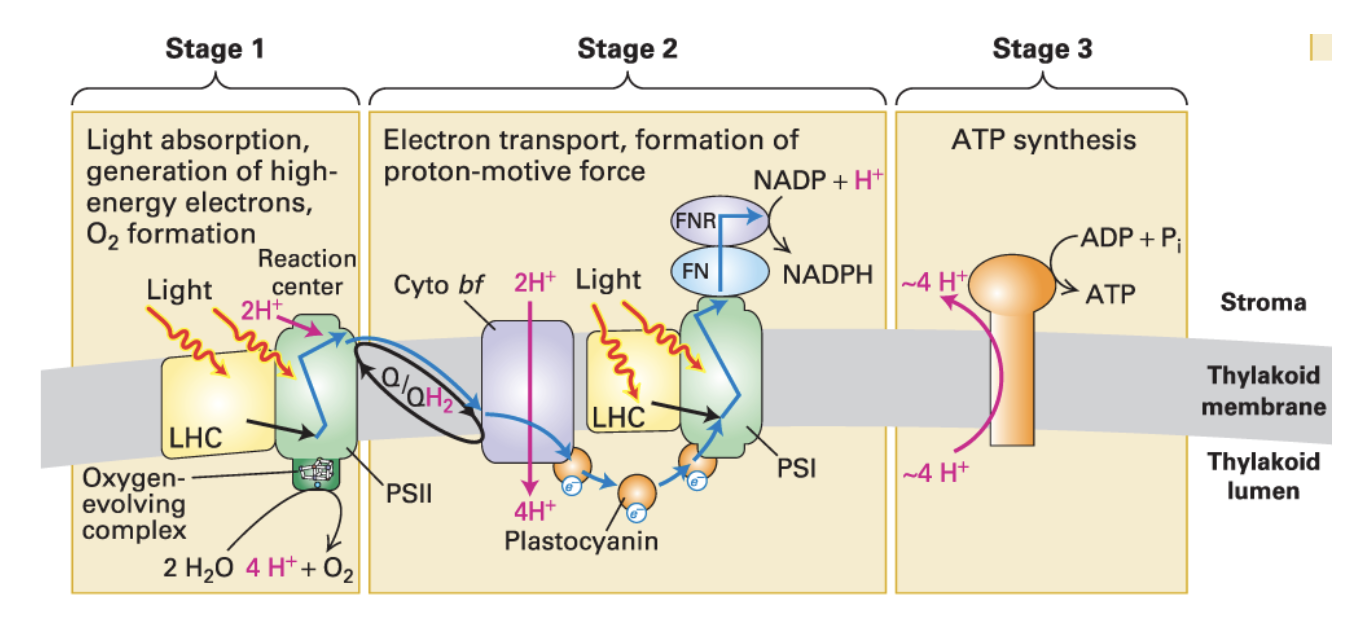
light reactions

  • 3 major complexes: PSII, Cyto bf, PSI

  • 5 electron carriers: H2O, plastoquinone (Q), plastocyanin (pC), ferredoxin (Fn,) NADPH'

  • 2 key enzymes: Water-splitting complex (O2-evolving), ferredoxin-NADP+ reductase (FNR)

  • Stage 1:

    • Light absorption, generation of high-energy e-, O2 formation

  • Stage 2:

    • During e- transport, H+ are pumped into thylakoid membrane → proton-motive force formed

  • Stage 3:

    • ATP synthesis

<ul><li><p>3 major complexes: PSII, Cyto <em>bf</em><strong><em>, </em></strong>PSI</p></li><li><p>5 electron carriers: H<sub>2</sub>O, plastoquinone (Q), plastocyanin (pC), ferredoxin (Fn,) NADPH'</p></li><li><p>2 key enzymes: Water-splitting complex (O<sub>2</sub>-evolving), ferredoxin-NADP<sup>+</sup> reductase (FNR)</p></li><li><p>Stage 1:</p><ul><li><p>Light absorption, generation of high-energy e<sup>-</sup>, O<sub>2</sub> formation</p></li></ul></li><li><p>Stage 2:</p><ul><li><p>During e<sup>-</sup> transport, H<sup>+</sup> are pumped into thylakoid membrane → <strong>proton-motive force </strong>formed</p></li></ul></li><li><p>Stage 3:</p><ul><li><p>ATP synthesis</p></li></ul></li></ul><p></p>
58
New cards

Photosystem II

  • discovered second, but comes first

  • light energy funneled from LHCs → reaction center ejects excited electron from P680 chlorophyll → transferred to Q

  • Q picks up 2H+ and is reduced to QH2

  • ionized P680 extracts 4e- from water-splitting complex, one at a time from 2H2O → oxidized to form O2 → released into lumenatmosphere (all O2 has been generated this way)

    • 4H+ also released to lumen → contribute to proton gradient across thylakoid membrane → produces ATP

    • NET: 2H2O → 4H+ + 4e- + O2

  • P680 = ONLY molecule on Earth that can extract e- from H2O
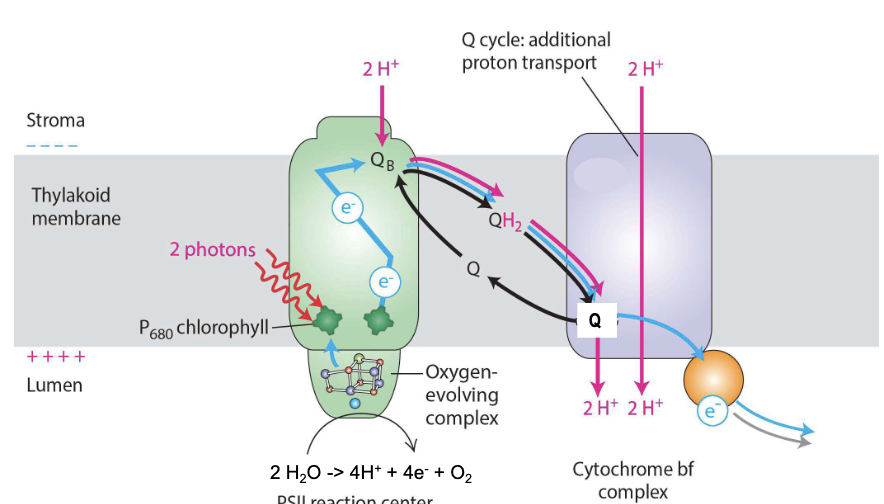
<ul><li><p>discovered second, but comes <strong>first</strong></p></li><li><p>light energy funneled from LHCs → reaction center <strong>ejects</strong> excited electron from P680 chlorophyll → transferred to Q</p></li><li><p>Q picks up 2H<sup>+</sup> and is <strong>reduced</strong> to QH<sub>2</sub></p></li><li><p>ionized P680 extracts 4e<sup>-</sup> from<strong> water-splitting complex</strong>, one at a time from 2H<sub>2</sub>O → oxidized to form O<sub>2</sub> → released into <strong>lumen</strong> → <u>atmosphere</u> (all O<sub>2</sub> has been generated this way)</p><ul><li><p>4H<sup>+</sup> also released to lumen → contribute to proton gradient across thylakoid membrane → produces ATP</p></li><li><p>NET: 2H<sub>2</sub>O → 4H<sup>+ </sup>+ 4e<sup>-</sup> + O<sub>2</sub></p></li></ul></li><li><p>P680 = ONLY molecule on Earth that can extract e<sup>-</sup> from H<sub>2</sub>O</p></li></ul><p></p>
59
New cards

Cytochrome bf complex

  • functional equivalent of cytochrome c reductase (Complex III) in mitochondria

  • Reduced QH2 passes its 2e- to plastocyanin (pC) in 2 steps (Q cycle)

    • increases efficiency of proton pumping from stroma to lumen for ATP synthesis

    • NET: 2QH2 + 2pCoxidized + 2H+stroma → QH2 + Q + 2pCreduced + 4H+lumen
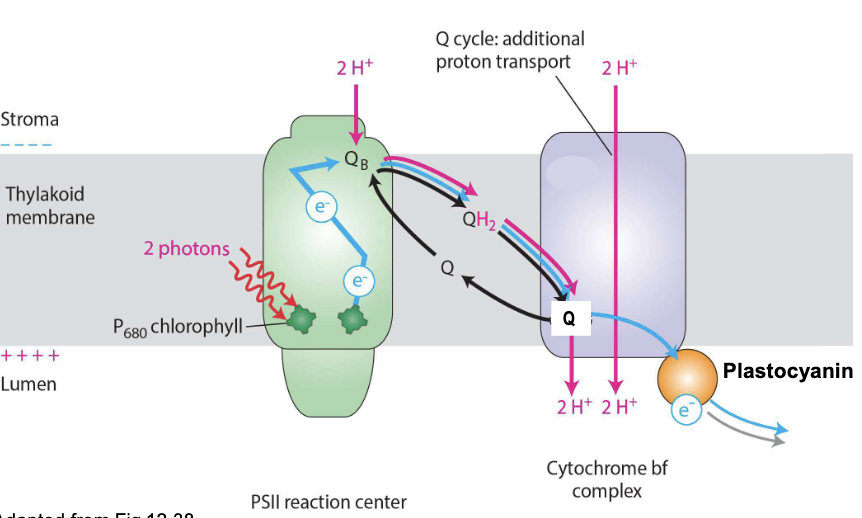
<ul><li><p>functional equivalent of cytochrome c reductase (Complex III) in mitochondria</p></li><li><p>Reduced QH<sub>2</sub> passes its 2e<sup>-</sup> to plastocyanin (pC) in 2 steps (<strong>Q cycle</strong>)</p><ul><li><p>increases efficiency of proton pumping from stroma to lumen for ATP synthesis</p></li><li><p>NET: 2QH<sub>2</sub> + 2pC<sub>oxidized</sub> + 2H<sup>+</sup><sub>stroma</sub> → QH<sub>2</sub> + Q + 2pC<sub>reduced</sub> + 4H<sup>+</sup><sub>lumen</sub></p></li></ul></li></ul><p></p>
60
New cards

Photosystem I

  • discovered first, comes last

  • pC passes e- to P700 (special pair chlorophyll) → energy of e- boosted by light energy (photons)

  • boosted e- move within reaction center → ferredoxin (Fn)

  • Fn transfers e- w/ high energy → NADP+, which picks H+ to form NADPH

    • requires action of ferredoxin-NADP+ reductase (FNR)
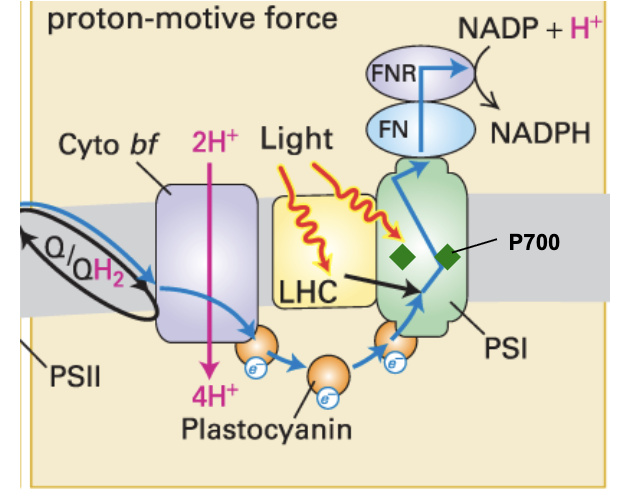
<ul><li><p>discovered first, comes last</p></li><li><p>pC passes e<sup>-</sup> to P700 (special pair chlorophyll) → energy of e<sup>-</sup> boosted by light energy (photons)</p></li><li><p>boosted e<sup>-</sup> move within reaction center → <strong>ferredoxin</strong> (Fn)</p></li><li><p>Fn transfers e<sup>-</sup> w/ high energy → NADP<sup>+</sup>, which picks H<sup>+</sup> to form <strong>NADPH</strong></p><ul><li><p>requires action of ferredoxin-NADP<sup>+</sup> reductase (FNR)</p></li></ul></li></ul><p></p>
61
New cards

cyanobacteria

  • PSII with water-splitting complex + PSI

    • extract and transfer e- from H2O to make ATP & NADPH for CO2 fixation into sugar

    • produced the oxygen that fundamentally transformed Earth's atmosphere → Great Oxidation Event ~ 2.0-2.5 bya

    • then transferred by endosymbiosis → algae → plants

  • 3 key innovations:

    1. P680 chlorophyll in PSII → when oxidized has greater affinity for e-

    2. Special H2O splitting complex in PSII

    3. 2 light-harvesting photosystems in tandem

62
New cards

RuBisCO

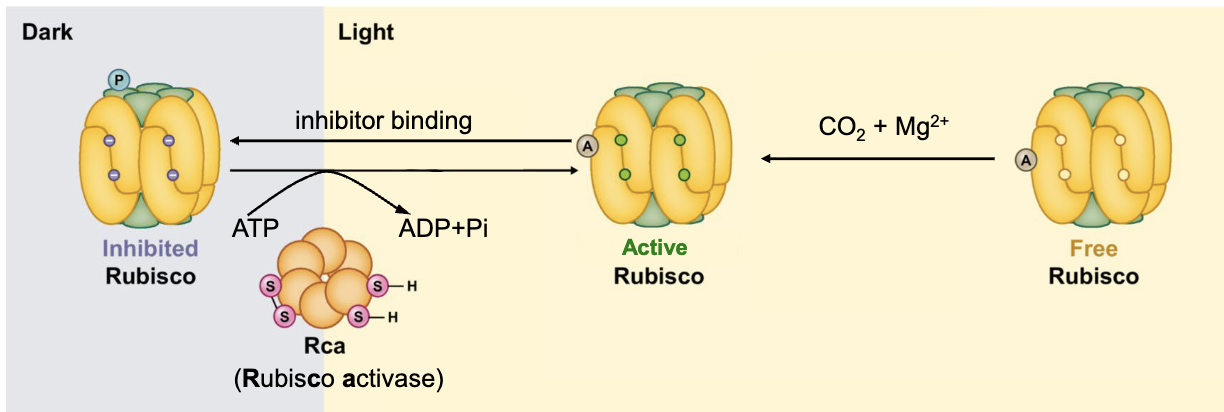
  • constitutes >50% of total chloroplast proteins → most abundant on earth!!

  • 8 large and 8 small subunits

  • active in presence of CO2, Mg2+, light

  • when light intensity increases, Rca (Rubisco activase) removes inhibitor → promotes conformational change in ATP-dependent manner to activate

    • action of Rca is under regulation of Thioredoxin (Tx) in light-dependent manner

  • catalyzes CO2 fixation: CO2 (1C) + RuBP (5C) = Intermediate (6C) → 2x 3-Phosphoglycerate (3C)

  • happens in chloroplast stroma

<ul><li><p>constitutes &gt;50% of total chloroplast proteins → most abundant on earth!!</p></li><li><p>8 large and 8 small subunits</p></li><li><p>active in presence of CO<sub>2</sub>, Mg<sup>2+</sup>, light</p></li><li><p>when light intensity increases, Rca (Rubisco activase) removes inhibitor → promotes conformational change in ATP-dependent manner to activate</p><ul><li><p>action of Rca is under regulation of <strong>Thioredoxin (</strong>Tx) in light-dependent manner</p></li></ul></li><li><p><strong>catalyzes</strong> CO<sub>2</sub> fixation: CO<sub>2</sub> (1C) + RuBP (5C) = Intermediate (6C) →                           2x 3-Phosphoglycerate (3C)</p></li><li><p>happens in chloroplast <strong>stroma</strong></p></li></ul><p></p>
63
New cards

Calvin Cycle

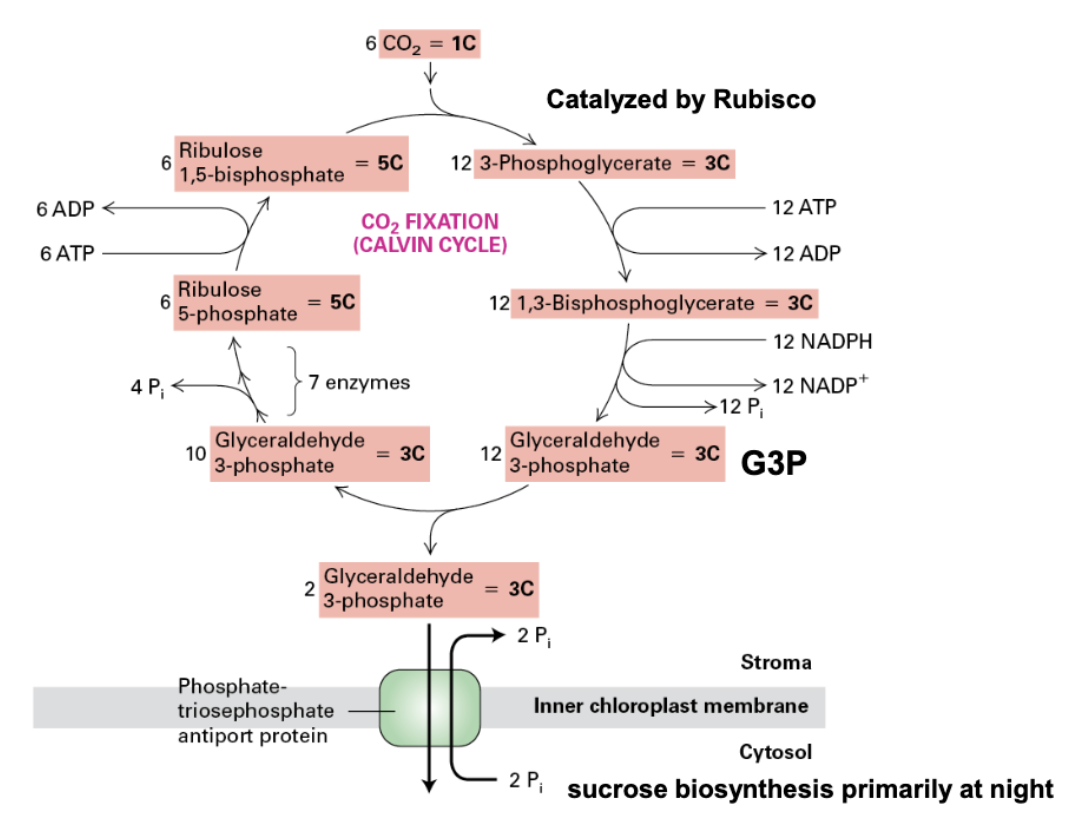
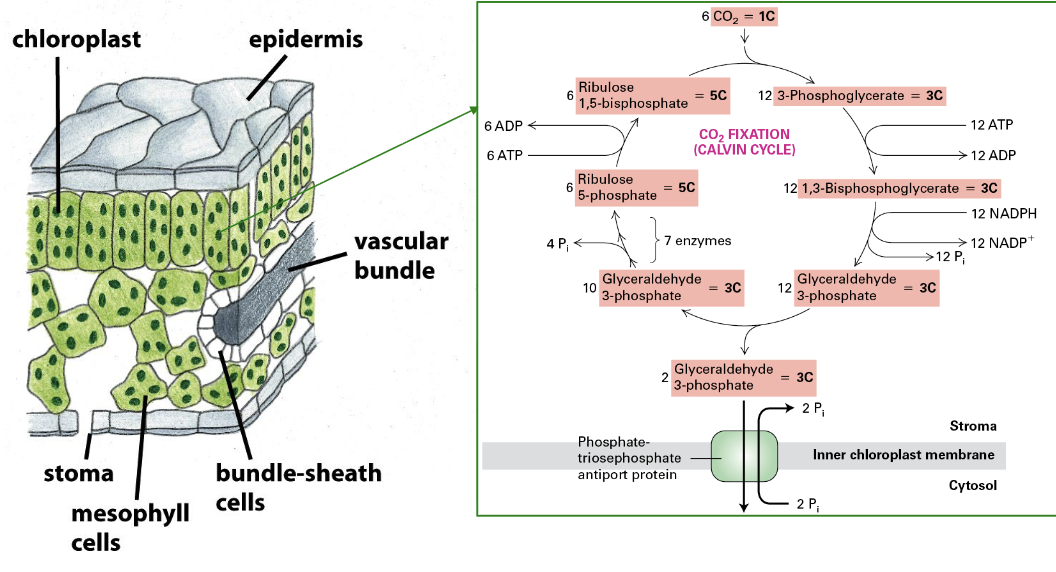
  • fixes CO2 → glyceraldehyde-3-phosphate (G3P)

  • 6 CO2 → 12 PGA (3C) → 12 ATP used to make 12 1,3-bisphosphoglycerate (3C) → 12 NADPH used to make 12 G3P (3C)

  • 2 G3P used to produce sucrose

  • 10 G3P recycled → interact w/ 7 enzymes → 6 Ribulose 3-phosphate (5C) → 6 ATP used to convert to 6 RuBP (5C) → REPEAT!

  • 18 ATP TOTAL, 12 NADPH TOTAL NEEDED

<ul><li><p>fixes CO<sub>2</sub> → glyceraldehyde-3-phosphate (G3P)</p></li><li><p>6 CO<sub>2</sub> → 12 PGA (3C) → 12 ATP used to make 12 1,3-bisphosphoglycerate (3C) → 12 NADPH used to make 12 G3P (3C)</p></li><li><p>2 G3P used to produce sucrose</p></li><li><p>10 G3P recycled → interact w/ 7 enzymes → 6 Ribulose 3-phosphate (5C) → 6 ATP used to convert to 6 RuBP (5C) → REPEAT!</p></li><li><p>18 ATP TOTAL, 12 NADPH TOTAL NEEDED</p></li></ul><p></p>
64
New cards

sucrose production

  • converted from G3P primary at night (nocturnally)

  • basically the reverse of glycolysis

  • 2 G3P (3C) → 1 Fructose 1,6-bisphosphate (6C) x2

  • 1 of of the fructose molecules stays as is

  • other fructose → glucose 1-phosphate (6C) → UDP-glucose (UTP needed)

  • UDP-glucose + Fructose 6-phosphate = 1 sucrose 6-phosphate (12C), UDP OUT → Sucrose (12C)
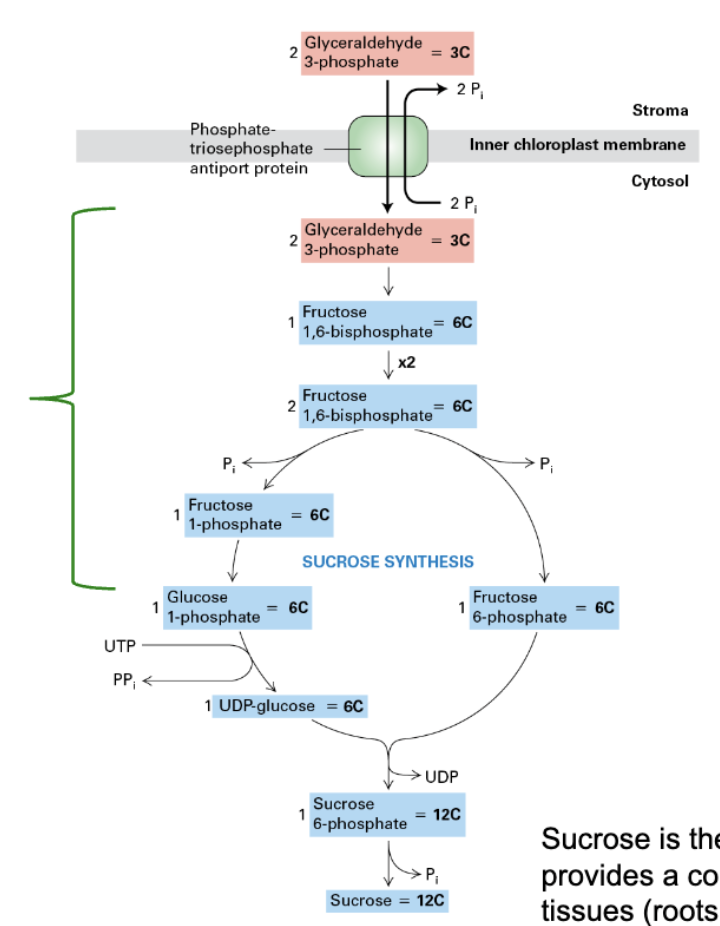
<ul><li><p>converted from G3P primary <strong>at night</strong> (nocturnally)</p></li><li><p>basically the <strong>reverse</strong> of glycolysis</p></li><li><p>2 G3P (3C) → 1 Fructose 1,6-bisphosphate (6C) x2 </p></li><li><p>1 of of the fructose molecules stays as is</p></li><li><p>other fructose → glucose 1-phosphate (6C) → UDP-glucose (UTP needed)</p></li><li><p>UDP-glucose + Fructose 6-phosphate = 1 sucrose 6-phosphate (<strong>12C</strong>), UDP OUT → <strong>Sucrose</strong> (12C)</p></li></ul><p></p>
65
New cards

sucrose

  • main sugar transported within plants

  • provides constant energy supply to non-photosynthetic tissues (roots, fruits, etc.)

66
New cards

photorespiration

  • catalyzed by RuBisCO (also an oxygenase) when CO2 is low

  • O2 binds to RuBP → PGA + Phosphoglycolate + H2O → Glycolate x2 → CO2 OUT, Glycerate produced → ATP used up to convert back to PGA

  • produces toxic 2-phosphoglycolate that needs to be converted back to PGA (a COSTLY process)
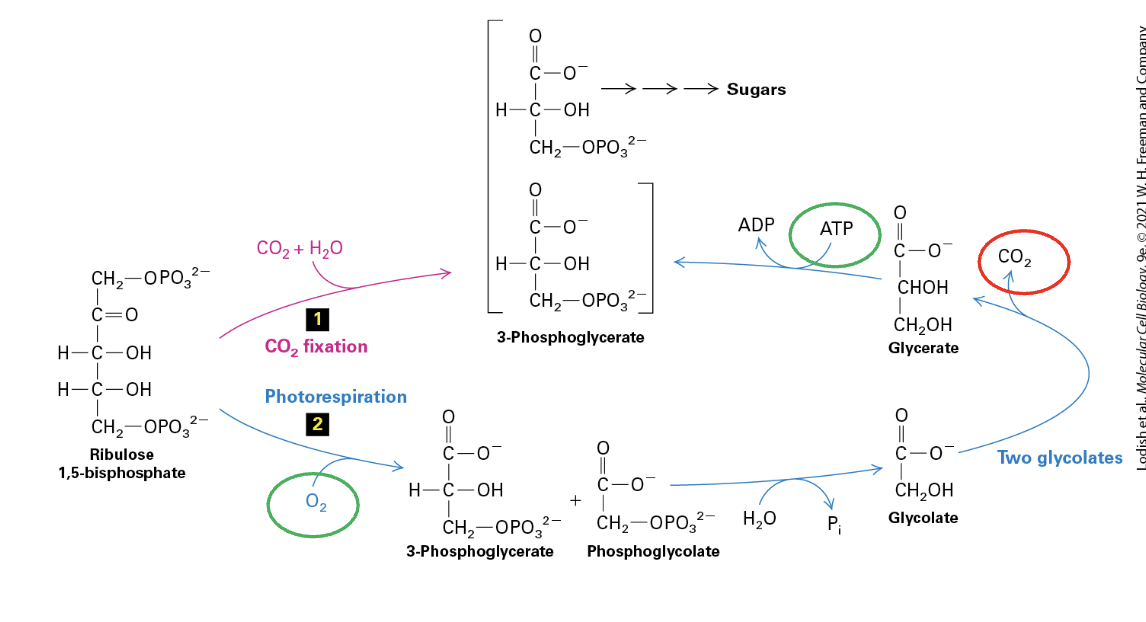
<ul><li><p>catalyzed by RuBisCO (also an oxygenase) when CO<sub>2</sub> is <strong>low</strong></p></li><li><p>O<sub>2</sub> binds to RuBP → PGA + Phosphoglycolate + H<sub>2</sub>O → Glycolate x2 → CO<sub>2</sub> OUT, Glycerate produced → <strong>ATP</strong> <strong>used up</strong> to convert back to PGA</p></li><li><p>produces toxic 2-phosphoglycolate that needs to be converted back to PGA (a COSTLY process)</p></li></ul><p></p>
67
New cards

C3 plants

  • major plants that fix CO2 in all mesophyll cells of leaves

  • no special features to combat photorespiration

    • not as efficient at fixation

  • ex. rice

<ul><li><p>major plants that fix CO<sub>2</sub> in <strong>all</strong> <strong>mesophyll</strong> cells of leaves</p></li><li><p>no special features to combat photorespiration</p><ul><li><p>not as efficient at fixation</p></li></ul></li><li><p>ex. rice</p></li></ul><p></p>
68
New cards

C4 plants

  • CO2 fixation is compartmentalized in these plants

    • ex. maize

  • enhances fixation and reduces photorespiration

  • PEP carboxylase takes up CO2low concentration in mesophyll

    • used to convert to oxaloacetate → NADPH needed → Malate → bundle-sheath cells

    • bundle-sheath cells are deeper in leaves → high CO2 concentration → Calvin Cycle

    • Malate → NADP+ used → Pyruvate → Mesophyll → Phosphoenolpyruvate → + CO2 → Oxaloacetate → REPEAT

  • projects trying to change C3 crop composition to this to be more efficient
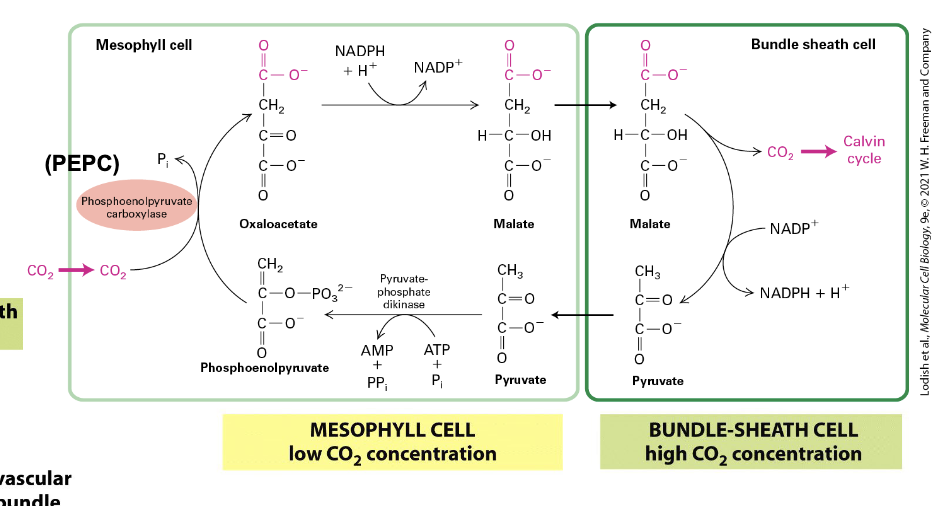
<ul><li><p>CO<sub>2</sub> fixation is compartmentalized in these plants</p><ul><li><p>ex. maize</p></li></ul></li><li><p>enhances fixation and <strong>reduces</strong> photorespiration</p></li><li><p>PEP carboxylase takes up CO<sub>2</sub> → <strong>low</strong> concentration in mesophyll</p><ul><li><p>used to convert to oxaloacetate → NADPH needed → Malate → <strong>bundle-sheath cells</strong></p></li><li><p>bundle-sheath cells are <strong>deeper</strong> in leaves → <strong>high</strong> CO<sub>2</sub> concentration → Calvin Cycle</p></li><li><p>Malate → NADP<sup>+</sup> used → Pyruvate → Mesophyll → Phosphoenolpyruvate → + CO<sub>2</sub> → Oxaloacetate → REPEAT</p></li></ul></li><li><p>projects trying to change C3 crop composition to this to be more efficient</p></li></ul><p></p>
69
New cards

chloroplast genetic systems

  • most prokaryotic genes were transferred → nucleus during evolution

  • 2 separate systems to make functional chloroplast

  • ~4500 genes → nuclear genome → transcribed in nucleus → translated by cytoplasmic ribosomes → imported in chloroplasts

  • ~90 protein coding genes still maintained in chloroplasts → transcribed & translated WITHIN organelle

    • >300 chloroplast genomes sequenced

    • all contain ~45x rRNAs + tRNAs and ~90x protein-coding genes → encode proteins found in PSI, PSII, Cyto bf, ATP synthase, RuBisCO, proteins involved in gene transcription & protein translation
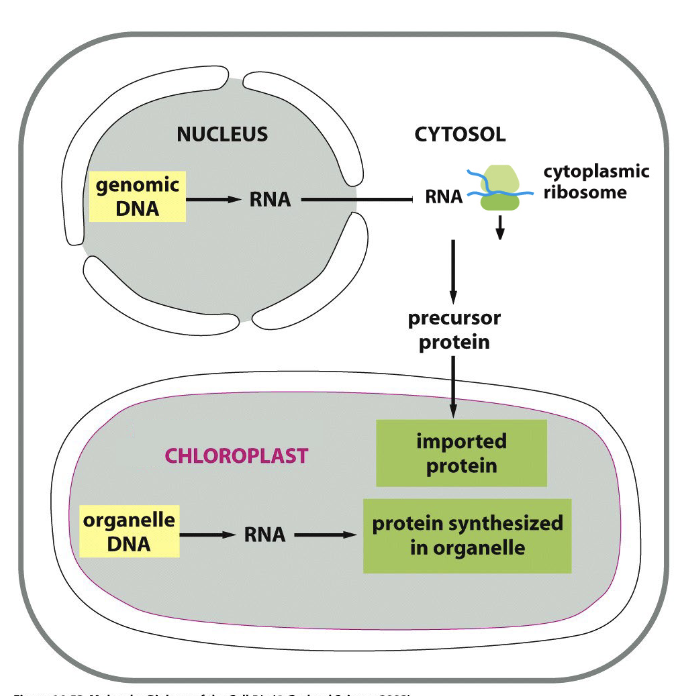
<ul><li><p>most prokaryotic genes were transferred → nucleus during evolution</p></li><li><p>2 <strong>separate</strong> systems to make functional chloroplast</p></li><li><p>~4500 genes → nuclear genome → transcribed in nucleus → translated by cytoplasmic ribosomes → <strong>imported</strong> in chloroplasts</p></li><li><p>~90 protein coding genes still maintained in chloroplasts → transcribed &amp; translated WITHIN organelle</p><ul><li><p>&gt;300 chloroplast genomes sequenced</p></li><li><p>all contain ~45x rRNAs + tRNAs and ~90x protein-coding genes → encode proteins found in PSI, PSII, Cyto bf, ATP synthase, RuBisCO, proteins involved in gene transcription &amp; protein translation</p></li></ul></li></ul><p></p>
70
New cards

chloroplast fission

  • FtsZ: tubulin-like protein

    • self assembles into dynamic ring of protofilaments (Z-ring) beneath inner membrane of chloroplasts

    • Z-ring acts as scaffold for recruitment of other cell division proteins → generates contractile force → membrane constriction → division

  • Dynamin: GTPase protein responsible for endocytosis in the eukaryotic cell

    • comes from cytosol → forms dynamin ring for outer membrane fission

  • chloroplast fusion unclear → linked w/ tubular channels called stromules
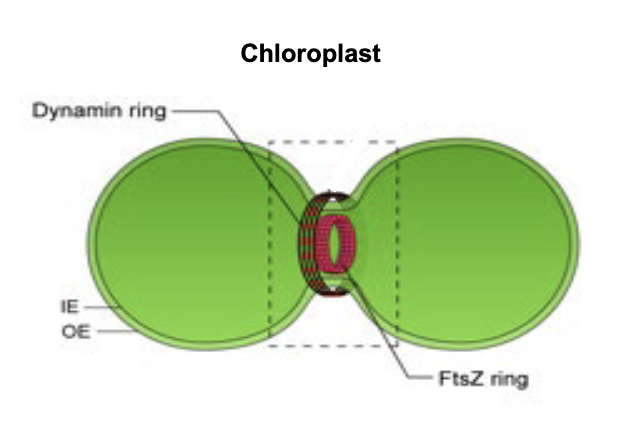
<ul><li><p><strong>FtsZ</strong>: tubulin-like protein</p><ul><li><p>self assembles into dynamic ring of protofilaments (Z-ring) beneath inner membrane of chloroplasts</p></li><li><p>Z-ring acts as scaffold for recruitment of other cell division proteins → generates contractile force → membrane constriction → <strong>division</strong></p></li></ul></li><li><p><strong>Dynamin</strong>: <span><span>GTPase protein responsible for endocytosis in the eukaryotic cell</span></span></p><ul><li><p>comes from cytosol → forms dynamin ring for outer membrane fission</p></li></ul></li><li><p>chloroplast fusion <strong>unclear</strong> → linked w/ tubular channels called <u>stromules</u></p></li></ul><p></p>
71
New cards

animals that photosynthesize

  • Elysia timida (sea slug) → has chloroplasts on its back

  • Scientists created plant-animal hybrids (in hamster cells) w/ chloroplasts

    • maintained electron transport activity in cultured cells for 2 days after incorporation
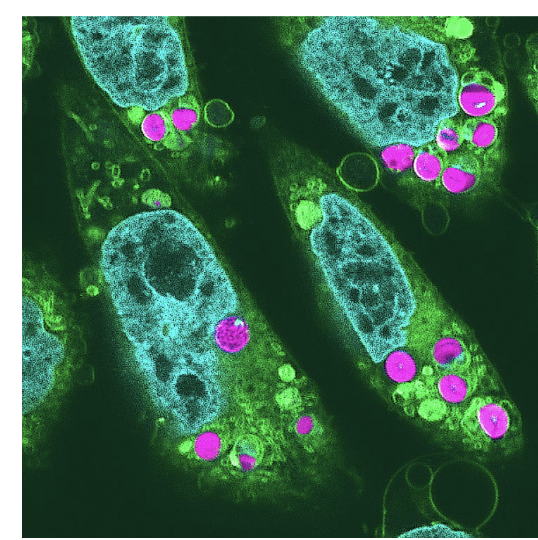
<ul><li><p>Elysia timida (sea slug) → has chloroplasts on its back</p></li><li><p>Scientists created plant-animal hybrids (in hamster cells) w/ chloroplasts</p><ul><li><p>maintained electron transport activity in cultured cells for<strong> 2 days after incorporation</strong></p></li></ul></li></ul><p></p>
72
New cards

cell-cell adhesion

  • physical connection

  • molecules bind to one another and to intracellular proteins

  • mediated through membrane proteins called cell adhesion molecules (CAMs)

  • strengthened by adding up many weak interactions

    • cell alters adhesion by deciding how many interactions are on its surface

  • sorts out cells of different types into clusters

    • H.V. Wilson sponge experiments: mixing cells of two different species makes them grow separately, adhere only to cells of their own species
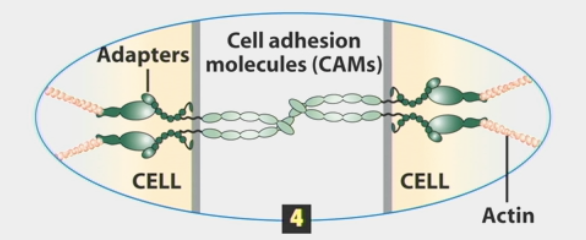
<ul><li><p>physical connection</p></li><li><p>molecules bind to one another and to intracellular proteins</p></li><li><p>mediated through membrane proteins called <strong>cell adhesion molecules</strong> (CAMs)</p></li><li><p>strengthened by adding up <strong>many weak</strong> interactions</p><ul><li><p>cell alters adhesion by deciding how many interactions are on its surface</p></li></ul></li><li><p>sorts out cells of different types into <strong>clusters</strong></p><ul><li><p>H.V. Wilson sponge experiments: mixing cells of two different species makes them grow <u>separately</u>, adhere only to cells of their own species</p></li></ul></li></ul><p></p>
73
New cards

cell-matrix adhesion

  • cells sticking to a non-membrane surface (the ECM)

  • adhesion receptors or CAMs stick to ECM and get information from it

    • ECM released by other cells to send info
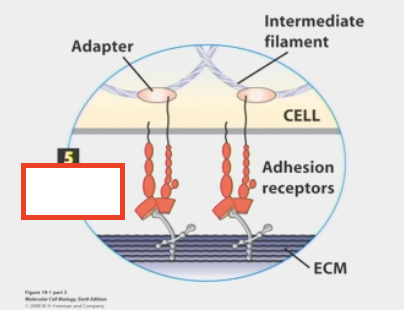
<ul><li><p>cells sticking to a non-membrane surface (the ECM)</p></li><li><p>adhesion receptors or CAMs stick to ECM and get information from it</p><ul><li><p>ECM released by other cells to send info</p></li></ul></li></ul><p></p>
74
New cards

cell adhesion molecules

  • membrane proteins that mediate cell adhesions

  • cells express a wide, diverse range

    • many classes (ex. Cadherins, Integrins, Claudin, etc.) that each perform a specific function

    • each class has many individual molecules that share similar structures

  • Ex. Cadherins

    • homotypic interactions: extracellular domain binds to similar extracellular domain of another cell

    • calcium binding sites

  • Ex. Integrins

    • can function as both cell-cell and cell-matrix molecules
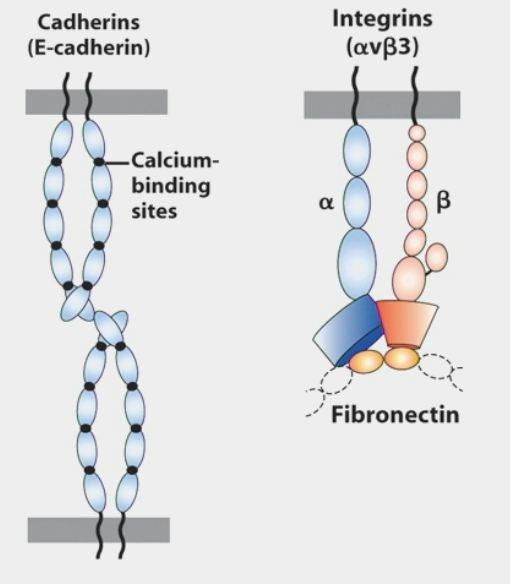
<ul><li><p>membrane proteins that mediate cell adhesions</p></li><li><p>cells express a wide, diverse range</p><ul><li><p>many classes (ex. Cadherins, Integrins, Claudin, etc.) that each perform a specific function</p></li><li><p>each class has many individual molecules that share similar structures</p></li></ul></li><li><p>Ex. Cadherins</p><ul><li><p><u>homotypic interactions</u>: extracellular domain binds to similar extracellular domain of another cell</p></li><li><p>calcium binding sites</p></li></ul></li><li><p>Ex. Integrins</p><ul><li><p>can function as both cell-cell and cell-matrix molecules</p></li></ul></li></ul><p></p>
75
New cards

homotypic adhesion

  • adhesive interactions between cells of the same type

76
New cards

heterotypic adhesion

  • adhesive interactions between cells of different types

77
New cards

trans interactions

  • intercellular/adhesive

  • CAMs on one cell bind to the CAMs on an adjacent cell

  • usually combined with cis interactions
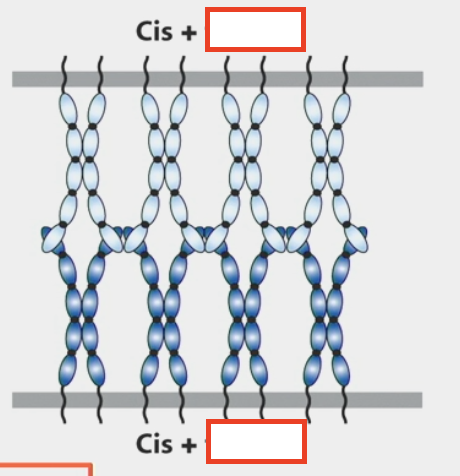
<ul><li><p>intercellular/adhesive</p></li><li><p><span>CAMs on one cell bind to the CAMs on an adjacent cell</span></p></li><li><p><span>usually combined with cis interactions</span></p></li></ul><p></p>
78
New cards

cis interactions

  • lateral/in the same cell

  • monomeric CAMs on one cell bind to one or more CAMs in the same cell’s plasma membrane
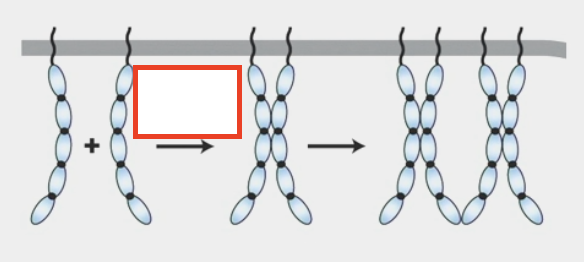
<ul><li><p>lateral/in the same cell</p></li><li><p><span>monomeric CAMs on one cell bind to one or more CAMs in the same cell’s plasma membrane</span></p></li></ul><p></p>
79
New cards

cadherins

  • calcium-dependent cell-cell adhesion molecules

  • removing calcium → cells no longer adhere

  • connect to cytoskeleton via adapter proteins that bind to intracellular domain or to other proteins (ex. Catenins, Vinculin, VASP, ZO1) → eventually bind to actin
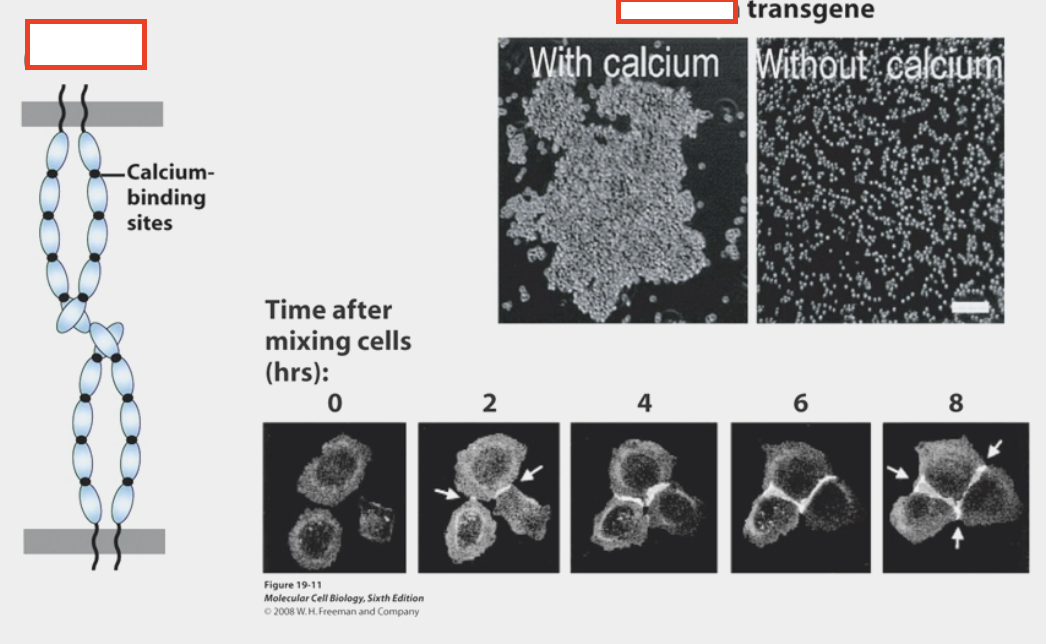
<ul><li><p>calcium-dependent cell-cell adhesion molecules</p></li><li><p>removing calcium → cells no longer adhere</p></li><li><p>connect to cytoskeleton via adapter proteins that bind to intracellular domain or to other proteins (ex. Catenins, Vinculin, VASP, ZO1) → eventually bind to actin</p></li></ul><p></p>
80
New cards

adapter proteins

  • physically link one protein to another protein by binding to both of them

  • directly / indirectly (via additional adapters) connect cell-adhesion molecules or adhesion receptors to elements of the cytoskeleton OR to intracellular signaling proteins

81
New cards

extracellular matrix

  • a complex combination of proteins and polysaccharides that is secreted and assembled by cells into a network in which the components bind to one another

  • often involved in holding cells and tissues together

  • mostly made up of Type IV collagen fibrils, but also Laminin, Entactin, Perlecan

    • Connected to intermediate filament cytoskeleton via Laminin

    • Collagen acts as intermediary between connected cells
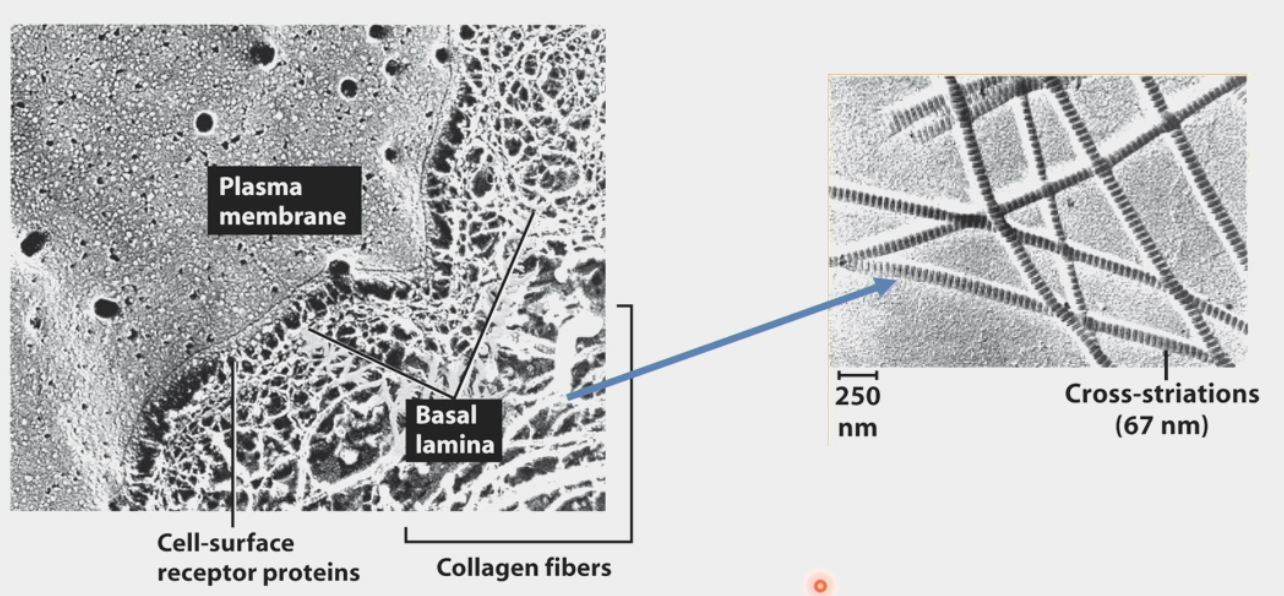
<ul><li><p>a complex combination of proteins and polysaccharides that is secreted and assembled by cells into a network in which the components <strong>bind</strong> to one another</p></li><li><p>often involved in holding cells and tissues together</p></li><li><p>mostly made up of Type IV collagen fibrils, but also Laminin, Entactin, Perlecan</p><ul><li><p>Connected to intermediate filament cytoskeleton via Laminin</p></li><li><p>Collagen acts as intermediary between connected cells</p></li></ul></li></ul><p></p>
82
New cards

collagen

  • makes up the ECM (type IV)

  • Type I, II, III, IV

  • 25% of protein mass of human body

  • triple-helix structure like a rope

  • built from propeptides that are cleaved and cross-linked

    1. Protein peptides form from Rough ER

    2. Processed in various ways

    3. 3 wind around each other to form procollagen

    4. Transport to Golgi complex

    5. Processing in Golgi; lateral association

    6. Export out of cell

    7. Propeptide cleavage

    8. Higher order fibril self-assembly and cross-linking

  • sends important information to the cell that it responds to, changes shape or direction of migration

  • scurvy (vitamin C deficit) defect results indirectly from lack of this

    • Vitamin C is necessary cofactor for an enzyme that hydroxylates propeptides (strong interactions → higher annealing temp)
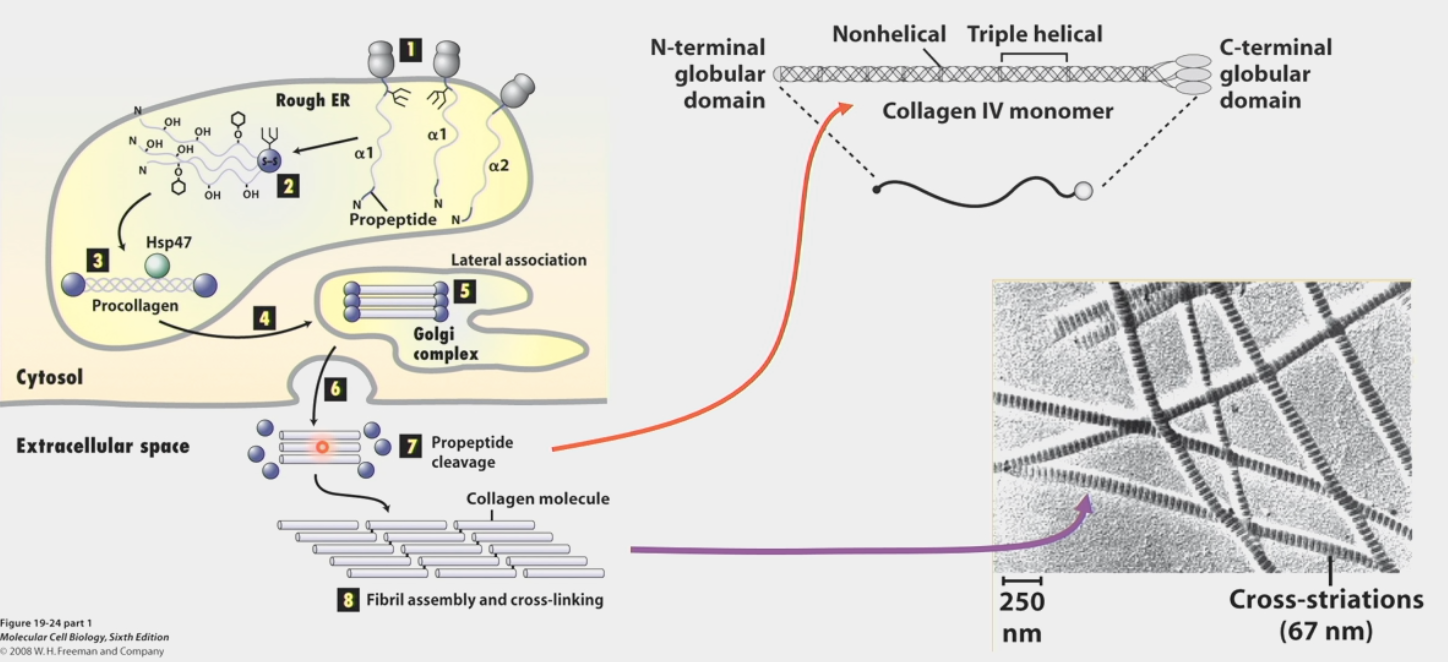
<ul><li><p>makes up the ECM (type IV)</p></li><li><p>Type I, II, III, IV</p></li><li><p>25% of protein mass of human body</p></li><li><p><strong>triple-helix</strong> structure like a rope</p></li><li><p>built from propeptides that are cleaved and cross-linked</p><ol><li><p>Protein peptides form from Rough ER</p></li><li><p>Processed in various ways</p></li><li><p>3 wind around each other to form procollagen</p></li><li><p>Transport to Golgi complex</p></li><li><p>Processing in Golgi; lateral association</p></li><li><p>Export out of cell</p></li><li><p>Propeptide cleavage</p></li><li><p>Higher order fibril <strong>self-assembly</strong> and cross-linking</p></li></ol></li><li><p>sends important information to the cell that it responds to, changes shape or direction of migration</p></li><li><p><strong>scurvy</strong> (vitamin C deficit) defect results indirectly from lack of this</p><ul><li><p>Vitamin C is necessary cofactor for an enzyme that hydroxylates propeptides (strong interactions → higher annealing temp)</p></li></ul></li></ul><p></p>
83
New cards

heterogeneous polymers

  • characteristic of Collagen IV networks

  • globular domains at the ends of triple helices bind to other collagen molecules in specific ways

    • C-terminal end forms dimer w/ C-terminal end of another collagen

    • N-terminal end forms tetramer w/ 3 other N-terminal ends

    • combine in endless series to get network of collagen that attracts other ECM components
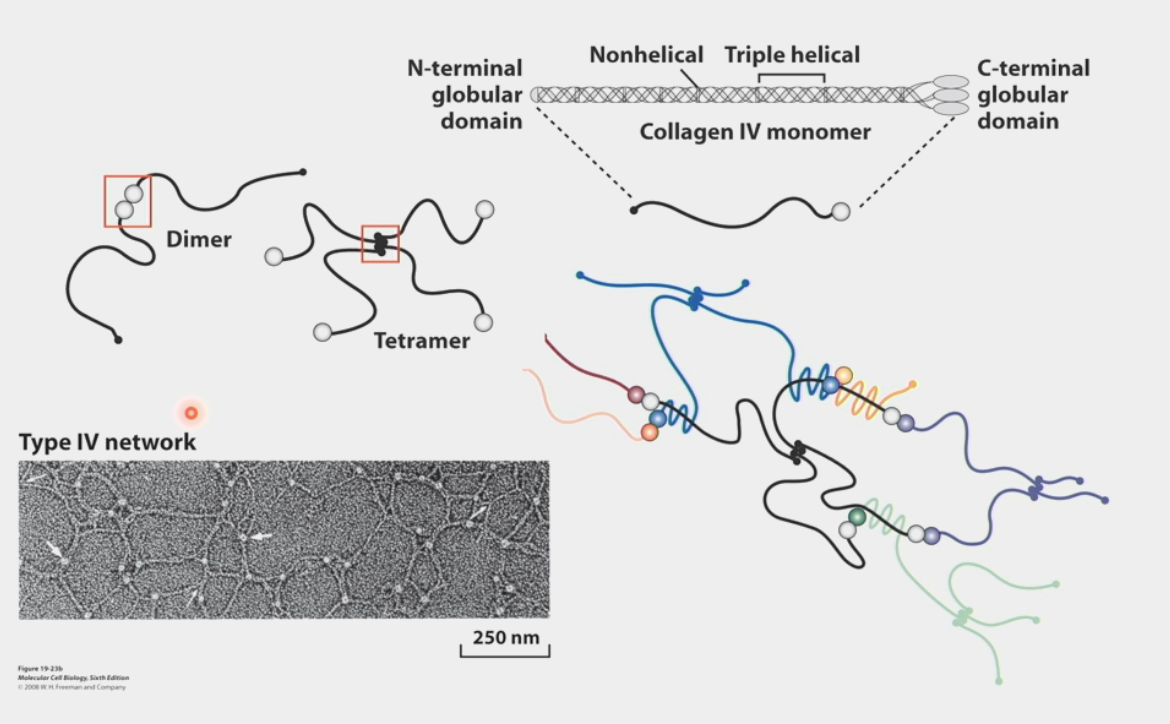
<ul><li><p>characteristic of Collagen IV networks</p></li><li><p>globular domains at the ends of triple helices bind to other collagen molecules in <strong>specific</strong> ways</p><ul><li><p>C-terminal end forms <strong>dimer</strong> w/ C-terminal end of another collagen</p></li><li><p>N-terminal end forms <strong>tetramer</strong> w/ 3 other N-terminal ends</p></li><li><p>combine in endless series to get network of collagen that attracts other ECM components</p></li></ul></li></ul><p></p>
84
New cards

laminin

  • multi-adhesive ECM protein

  • triple-helix and cross structure

  • has different globular domains from various peptides that can either attach to each other heterogeneously like Type IV collagen or attach to other trans-membrane proteins (integrins, collagen, other cellular receptors)
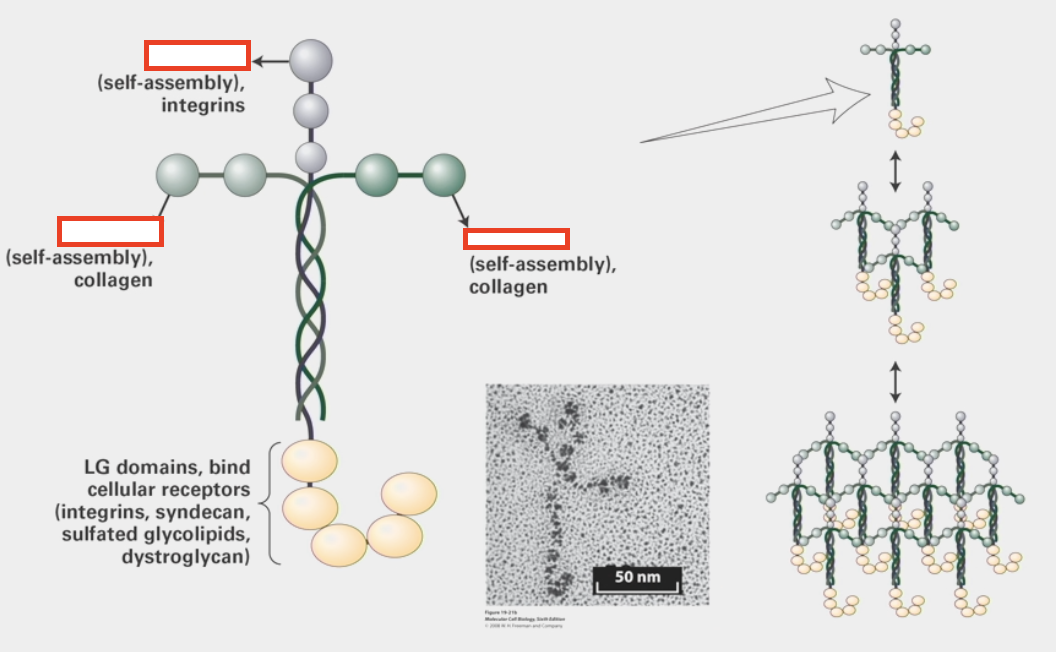
<ul><li><p>multi-adhesive ECM protein</p></li><li><p>triple-helix and cross structure</p></li><li><p>has different globular domains from various peptides that can <strong>either</strong> attach to each other heterogeneously like Type IV collagen or attach to other trans-membrane proteins (integrins, collagen, other cellular receptors)</p></li></ul><p></p>
85
New cards

integrins

  • cell-matrix adhesion molecules

  • straighten upon activation

  • cell controls ability of laminin binding to them

    • Talin signal binds to intracellular domain, Kindlin binds to Talin

    • Activates extended conformation change that is able to bind to laminin
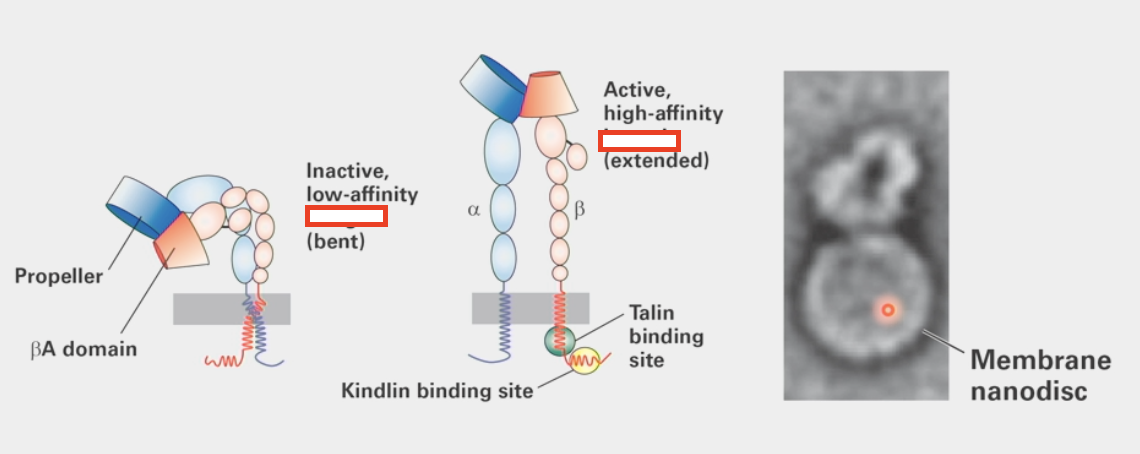
<ul><li><p>cell-matrix adhesion molecules</p></li><li><p><strong>straighten</strong> upon activation</p></li><li><p>cell controls ability of laminin binding to them</p><ul><li><p>Talin signal binds to intracellular domain, Kindlin binds to Talin</p></li><li><p>Activates <strong>extended</strong> conformation change that is able to bind to laminin</p></li></ul></li></ul><p></p>
86
New cards

desmosome

  • a trans-membrane structure by which two adjacent cells are attached

  • formed from protein plaques in the cell membranes linked by intermediate filament cytoskeleton

    • forms trans-cellular network of “cables”

  • disruption compromises epithelial tissue integrity
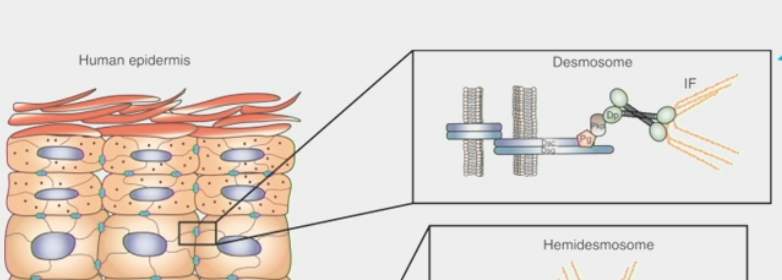
<ul><li><p>a trans-membrane structure by which two adjacent cells are attached</p></li><li><p>formed from protein plaques in the cell membranes linked by <strong>intermediate filament </strong>cytoskeleton</p><ul><li><p>forms trans-cellular network of “cables”</p></li></ul></li><li><p>disruption compromises <strong>epithelial</strong> tissue integrity</p></li></ul><p></p>
87
New cards

focal adhesion complexes

  • integrins cluster into these rather than being uniformly spread

  • act like the “feet” of the cell → important for cell movement

  • attach to actin filaments (dynamic force-generating cytoskeleton)

  • connect to signaling pathways (intracellular) through intermediate proteins that interact w/ other receptors receiving non-adhesion info

  • have a layered structure

    • membrane-apposed integrin signalling layer w/ integrin cytoplasmic tails, adhesion kinase, paxillin

    • intermediate force-transduction layer w/ talin and vinculin

    • uppermost actin-regulatory layer w/ zyxin, vasodilator-stimulated phosphoprotein, a-actinin

    • integrin/ECM layer? actin layer?

<ul><li><p>integrins cluster into these rather than being uniformly spread</p></li><li><p>act like the “feet” of the cell → important for cell movement</p></li><li><p>attach to actin filaments (dynamic force-generating cytoskeleton)</p></li><li><p>connect to signaling pathways (intracellular) through intermediate proteins that interact w/ other receptors receiving <strong>non-adhesion</strong> info</p></li><li><p>have a layered structure</p><ul><li><p>membrane-apposed integrin signalling layer w/ integrin cytoplasmic tails, adhesion kinase, paxillin</p></li><li><p>intermediate force-transduction layer w/ talin and vinculin</p></li><li><p>uppermost actin-regulatory layer w/ zyxin, vasodilator-stimulated phosphoprotein, a-actinin</p></li><li><p>integrin/ECM layer? actin layer?</p></li></ul></li></ul><p></p>
88
New cards

endocrine signaling

  • type of chemical signaling between cells

  • endocrine glands secrete hormones that affect distant target cells through blood/circulatory system

  • ex. epinephrine (adrenaline) secreted by the adrenal glands, insulin secreted by pancreas
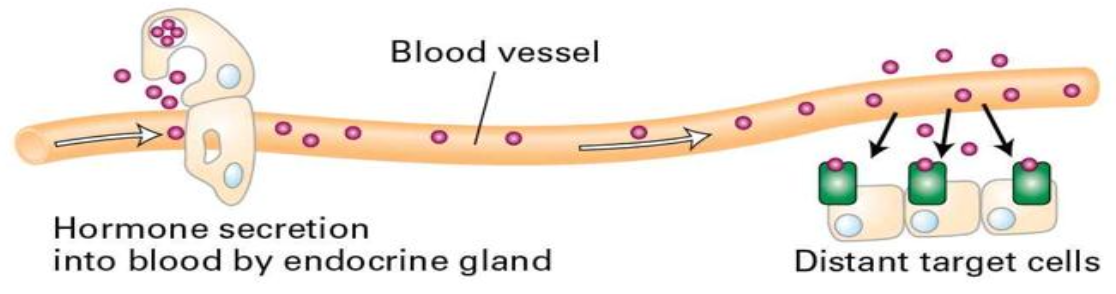
<ul><li><p>type of chemical signaling between cells</p></li><li><p>endocrine glands secrete hormones that affect distant target cells through blood/circulatory system</p></li><li><p>ex. epinephrine (adrenaline) secreted by the adrenal glands, insulin secreted by pancreas</p></li></ul><p></p>
89
New cards

chemical signalling

  • type of communication between cells

  • signals are received by cell surface receptors

    • usually chemicals that are soluble so they can be transported through blood

    • receptors help signals cross lipid bilayer and transduce to interior of cell

  • signals change internal state of cell:

    • modification of cellular metabolism, function, movement

    • OR modification of gene expression, development

  • cellular response can be short-term OR long-term

    • short-term = rapidly executed, rapidly inactivated, NOT “all or nothing”

    • long-term = time frame is less critical, “decision” is more critical, developmental, signals can determine cell fate

  • property of ligand binding to receptors according to chemical equilibrium

  • competitive balance between stimulation and inhibition
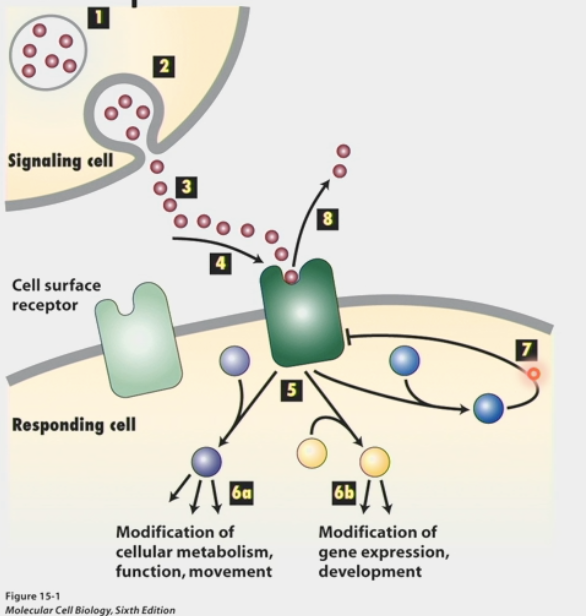
<ul><li><p>type of communication between cells</p></li><li><p>signals are received by cell surface receptors</p><ul><li><p>usually chemicals that are soluble so they can be transported through blood</p></li><li><p>receptors help signals cross lipid bilayer and transduce to interior of cell</p></li></ul></li><li><p>signals <strong>change internal state of cell</strong>:</p><ul><li><p>modification of cellular metabolism, function, movement</p></li><li><p>OR modification of gene expression, development</p></li></ul></li><li><p>cellular response can be short-term OR long-term</p><ul><li><p><u>short-term</u> = rapidly executed, rapidly inactivated, NOT “all or nothing”</p></li><li><p><u>long-term</u> = time frame is less critical, “decision” is more critical, developmental, signals can determine cell fate</p></li></ul></li><li><p>property of ligand binding to receptors according to chemical equilibrium</p></li><li><p><strong>competitive balance </strong>between stimulation and inhibition</p></li></ul><p></p>
90
New cards

ligand binding

  • binding to receptors according to chemical equilibrium

  • R + L ←→ RL

    • R = receptor, L = ligand, RL = ligand bound to receptor

    • reversible chemical rxn

  • Kd = ([R][L]) / [RL]

    • Kd = concentration of unbound [L] at which half of the total molecules of R are associated with L

  • as ligand concentration increases, there is a higher fraction of surface receptors with a bound ligand

    • but the physiological response of cells is often more sensitive than anticipated

  • signalling pathways = series of REVERSIBLE chem rxns → binding drives rxn towards HIGH PKA activity

    • [GPCR] + [hormone] ←→ kbind[GPCR][hormone] / krelease[GPCR:hormone] ←→ [GPCR:hormone]

<ul><li><p>binding to receptors according to chemical equilibrium</p></li><li><p>R + L ←→ RL</p><ul><li><p>R = receptor, L = ligand, RL = ligand bound to receptor</p></li><li><p>reversible chemical rxn</p></li></ul></li><li><p>K<sub>d</sub> = ([R][L]) / [RL]</p><ul><li><p>K<sub>d</sub> = concentration of unbound [L] at which <strong>half</strong> of the total molecules of R are associated with L</p></li></ul></li><li><p>as ligand concentration increases, there is a higher fraction of surface receptors with a bound ligand</p><ul><li><p>but the physiological response of cells is often <strong>more sensitive</strong> than anticipated</p></li></ul></li><li><p><strong>signalling pathways</strong> = series of <strong>REVERSIBLE</strong> chem rxns → binding drives rxn towards <strong>HIGH</strong> PKA activity</p><ul><li><p>[GPCR] + [hormone] ←→ k<sub>bind</sub>[GPCR][hormone] / k<sub>release</sub>[GPCR:hormone] ←→ [GPCR:hormone]</p></li></ul></li></ul><p></p>
91
New cards

adrenaline

  • hormone that triggers short-term responses

  • in cardiac muscle: increases contraction

  • in liver: converts glycogen to glucose for release into bloodstream, inhibits glycogen synthesis

  • in skeletal muscle: converts glycogen to glucose

  • used as vasoconstrictive medicine (EpiPen)
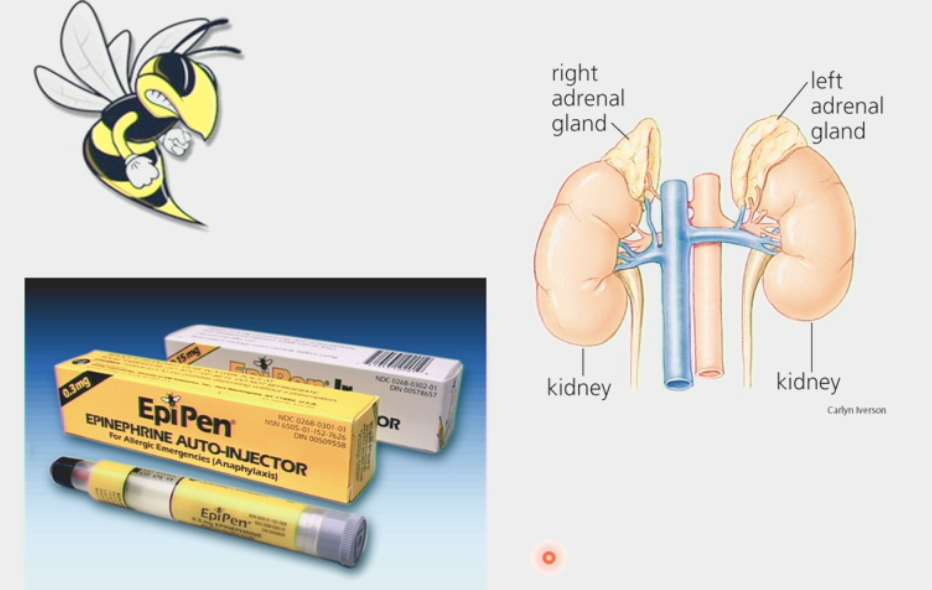
<ul><li><p>hormone that triggers <u>short-term</u> responses</p></li><li><p>in<strong> cardiac muscle:</strong> increases contraction</p></li><li><p>in <strong>liver</strong>: converts glycogen to glucose for release into bloodstream, inhibits glycogen synthesis</p></li><li><p>in skeletal muscle: converts glycogen to glucose</p></li><li><p>used as vasoconstrictive medicine (EpiPen)</p></li></ul><p></p>
92
New cards

G-protein coupled receptors

  • large family of receptors that respond to many hormone signals

  • have 7 trans-membrane domains

  • loops on exoplasmic face and cytosolic face are specific for a particular ligand to bind on

  • ligand binding changes overall conformation of receptor → changes ability to bind other proteins

  • hormone binding recruits the G-protein

    1. binding of hormone induces conformational change in receptor

    2. activated receptor binds to G subunit

    3. Binding of GTP to G triggers dissociation of G both from receptor and from Gβ𝛾

    4. Hormone dissociates from receptor; Gbinds to effector molecule in GTP-bound state & activates it

    5. Hydrolysis of GTP → GDP causes G to dissociate from effector and reassociate with Gβ𝛾

  • not only for hormones!

    • subfamily that has different specificities for odorants (smells)

    • have own specialized Golf G-protein

    • ~400 genes in humans, ~1200 in mice, dogs, etc.
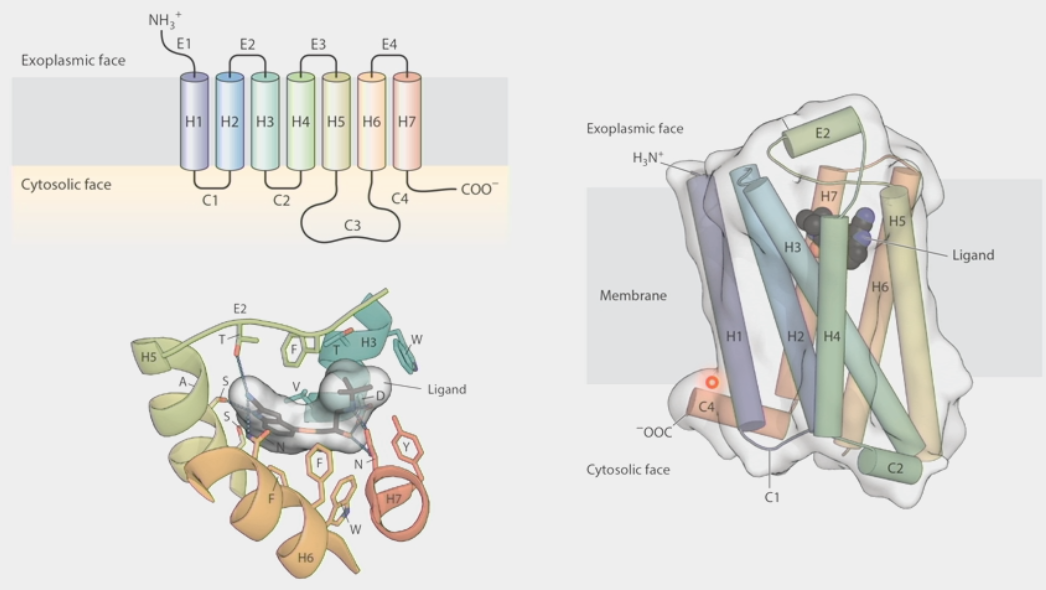
<ul><li><p>large family of receptors that respond to many hormone signals</p></li><li><p>have 7 trans-membrane domains</p></li><li><p>loops on exoplasmic face and cytosolic face are specific for a particular ligand to bind on</p></li><li><p>ligand binding changes overall conformation of receptor → changes ability to bind other proteins</p></li><li><p>hormone binding recruits the G-protein</p><ol><li><p>binding of hormone induces conformational change in receptor</p></li><li><p>activated receptor binds to G<sub>⍺</sub> subunit</p></li><li><p>Binding of GTP to G<sub>⍺</sub> triggers <strong>dissociation</strong> of G<sub>⍺</sub> both from receptor and from G<sub>β𝛾</sub></p></li><li><p>Hormone dissociates from receptor; G<sub>⍺ </sub>binds to <strong>effector</strong> <strong>molecule</strong> in GTP-bound state &amp; <u>activates</u> it</p></li><li><p>Hydrolysis of GTP → GDP causes G<sub>⍺</sub> to dissociate from effector and <strong>reassociate </strong>with G<sub>β𝛾</sub></p></li></ol></li><li><p>not only for hormones!</p><ul><li><p>subfamily that has different specificities for <strong>odorants</strong> (smells)</p></li><li><p>have own specialized G<sub>olf</sub> G-protein</p></li><li><p>~400 genes in humans, ~1200 in mice, dogs, etc.</p></li></ul></li></ul><p></p>
93
New cards

G-proteins

  • trimeric GTPases that transduce hormone signals

    • ⍺, β, 𝛾 subunits tethered to membrane through attached lipid

  • GDP-bound “off” state: subunits are close together

  • GTP-bound “on” state: ⍺ subunit dissociates from other subunits

  • automatic off switch → subunits have enzymatic activity to convert GTP back to GDP

  • dissociate within seconds of ligand binding

  • β𝛾 subunits can also activate effector molecules (ex. K+ channel)

  • some can inhibit effector molecules while others activate them (competitive balance)

    • ex. stimulatory hormones epinephrine, glucagon, ACTH v.s. inhibitory hormones PGE1 & adenosine
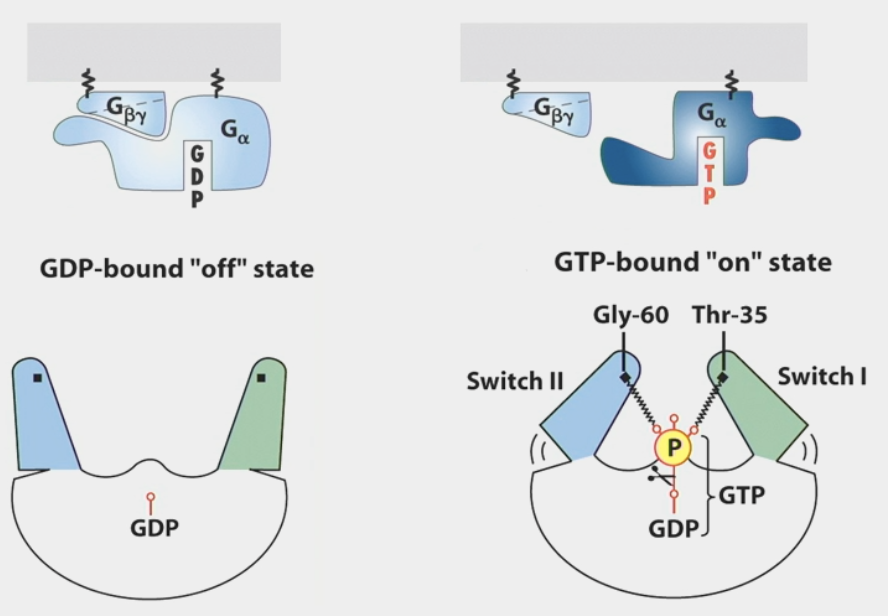
<ul><li><p>trimeric GTPases that transduce hormone signals</p><ul><li><p>⍺, β, 𝛾 subunits tethered to membrane through attached lipid</p></li></ul></li><li><p>GDP-bound “off” state: subunits are close together</p></li><li><p>GTP-bound “on” state: ⍺ subunit <strong>dissociates</strong> from other subunits</p></li><li><p>automatic <strong>off</strong> switch → subunits have enzymatic activity to convert GTP back to GDP</p></li><li><p>dissociate within <strong>seconds</strong> of ligand binding</p></li><li><p>β𝛾 subunits can also activate effector molecules (ex. K<sup>+</sup> channel)</p></li><li><p>some can <strong>inhibit</strong> effector molecules while others <strong>activate</strong> them (competitive balance)</p><ul><li><p>ex. <strong>stimulatory</strong> hormones epinephrine, glucagon, ACTH v.s. <strong>inhibitory</strong> hormones PGE<sub>1</sub> &amp; adenosine</p></li></ul></li></ul><p></p>
94
New cards

Fluorescence resonance energy transfer

  • biophysical technique to determine the proximity of two molecules

  • attach fluorescent molecules w/ different absorption & emission spectra to the two proteins to see if they are touching

  • shine excitation light on one fluorescent protein and see if it reflects light back or transfers to another fluorophore with an absorption spectrum that is equal to the 1st fluorophore’s emission spectrum (ex. CFP and YFP)

    • second fluorophore will emit light in a different emission spectrum if in close proximity to 1st fluorophore
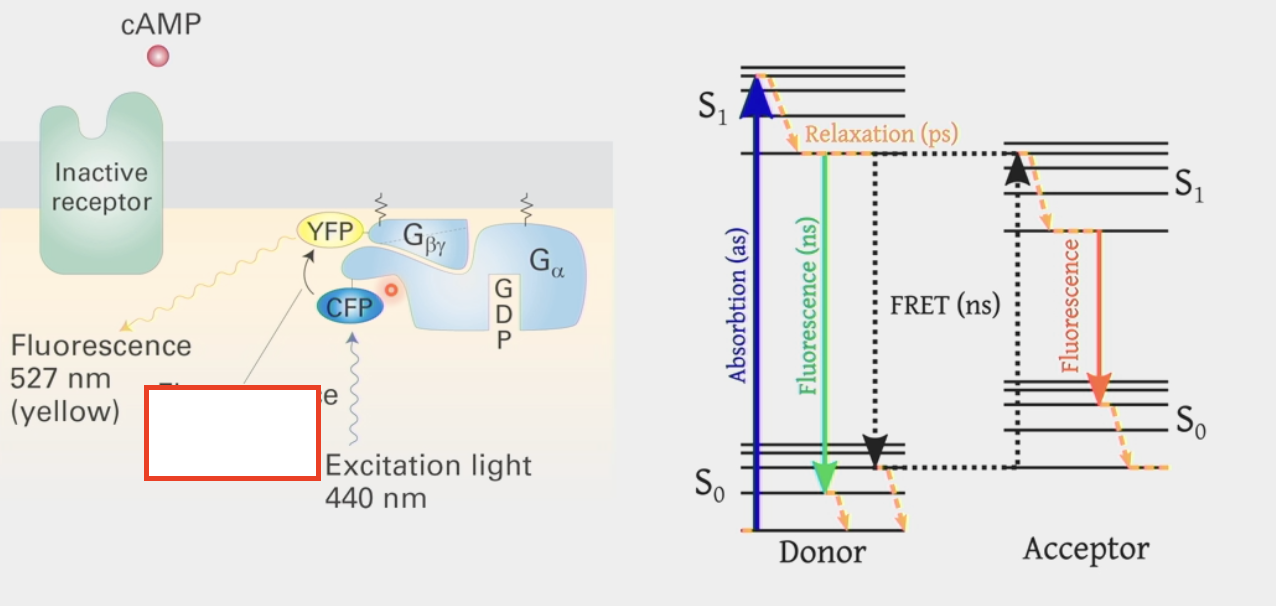
<ul><li><p>biophysical technique to determine the <strong>proximity</strong> of two molecules</p></li><li><p>attach fluorescent molecules w/ different absorption &amp; emission spectra to the two proteins to see if they are touching</p></li><li><p>shine excitation light on one fluorescent protein and see if it <strong>reflects</strong> light back or <strong>transfers</strong> to another fluorophore with an absorption spectrum that is <strong>equal</strong> to the 1st fluorophore’s emission spectrum (ex. CFP and YFP)</p><ul><li><p>second fluorophore will emit light in a different emission spectrum if in close proximity to 1st fluorophore</p></li></ul></li></ul><p></p>
95
New cards

cAMP

  • made by adenylyl cyclase (common effector of activated G-proteins)

    • stimulatory hormone can be epinephrine, glucagon, ACTH

  • second messenger

  • activates Protein Kinase A (PKA)

<ul><li><p>made by adenylyl cyclase (common effector of activated G-proteins)</p><ul><li><p>stimulatory hormone can be epinephrine, glucagon, ACTH</p></li></ul></li><li><p>second messenger</p></li><li><p>activates Protein Kinase A (PKA)</p></li></ul><p></p>
96
New cards

Protein Kinase A

  • activated by cAMP

  • a protein that regulates activity of other proteins by covalently adding phosphate groups to them

  • consists of 4 subunits (2 regulatory, 2 catalytic)

    • when activated → catalytic sites begin phosphorylating other proteins

  • directly controls molecules of glycogen metabolism

    • stimulation of glycogen breakdown

    • inhibition of glycogen synthesis

<ul><li><p>activated by cAMP</p></li><li><p>a protein that regulates activity of other proteins by covalently adding phosphate groups to them</p></li><li><p>consists of 4 subunits (2 regulatory, 2 catalytic)</p><ul><li><p>when activated → catalytic sites begin phosphorylating other proteins</p></li></ul></li><li><p>directly controls molecules of <strong>glycogen metabolism</strong></p><ul><li><p>stimulation of glycogen breakdown</p></li><li><p>inhibition of glycogen synthesis</p></li></ul></li></ul><p></p>
97
New cards

signal amplification

  • due to multi-step activation

  • ex. single epinephrine signal (10-10 M) → many adenylyl cyclases → cAMP (10-6 M) → PKA → many activated enzymes → more product

  • response of cells is more sensitive than anticipated!!
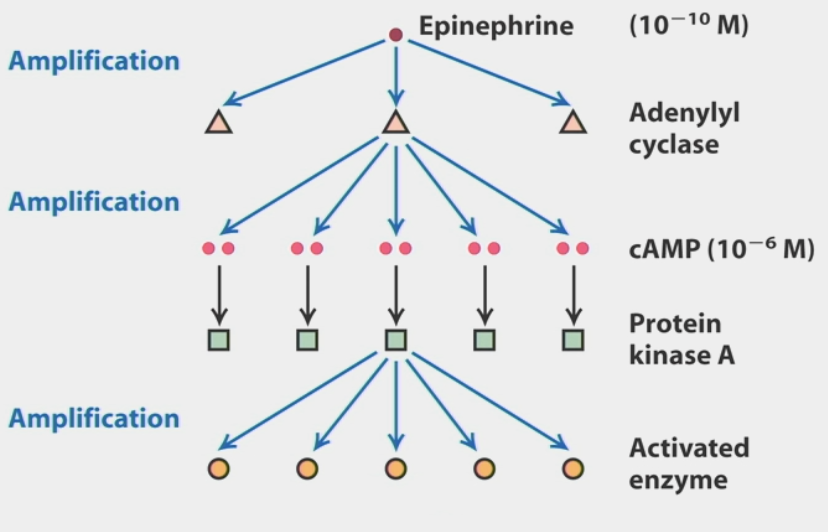
<ul><li><p>due to multi-step activation</p></li><li><p>ex. single epinephrine signal (10<sup>-10</sup> M) → many adenylyl cyclases → cAMP (10<sup>-6</sup> M) → PKA → <strong>many</strong> activated enzymes → more product</p></li><li><p>response of cells is more sensitive than anticipated!!</p></li></ul><p></p>
98
New cards

second messengers

  • common feature of signaling pathways

  • intracellular signaling molecules released by the cell in response to exposure to extracellular signaling molecules

  • different effector molecules will release different ones

    • ex. IP3 and DAG are produced by stimulation of Phospholipase C (effector)
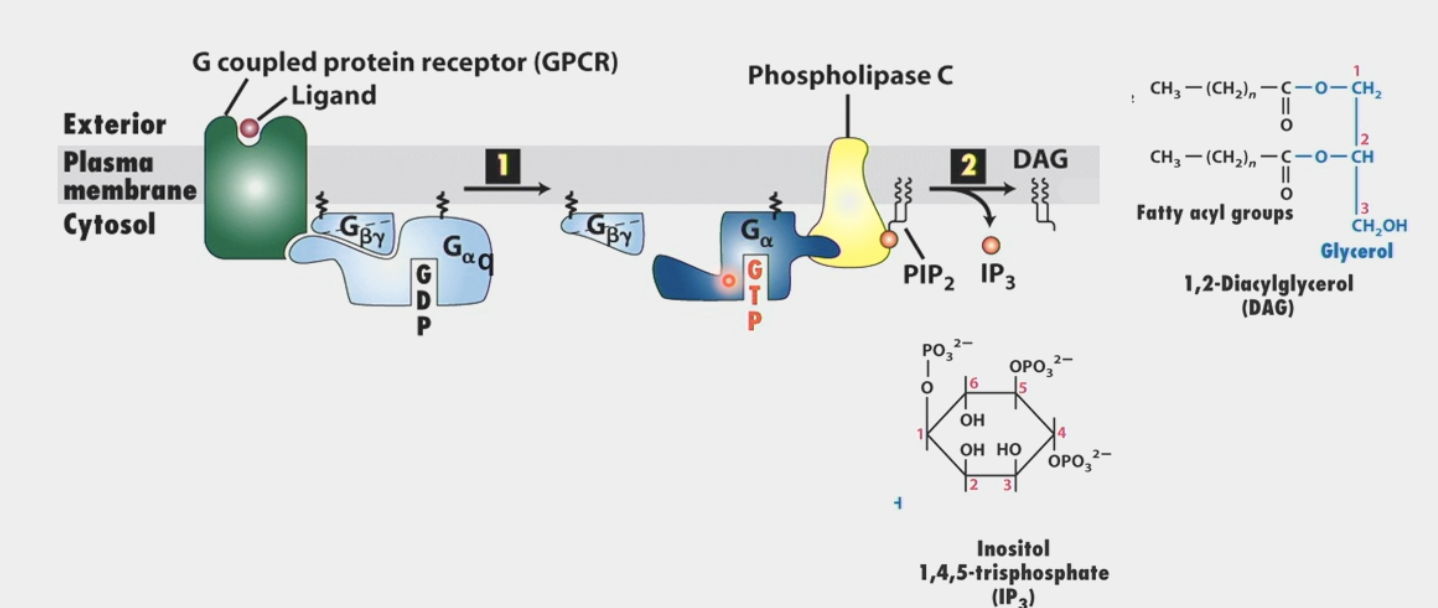
<ul><li><p>common feature of signaling pathways</p></li><li><p><span>intracellular signaling molecules released by the cell in response to exposure to extracellular signaling molecules</span></p></li><li><p><span>different effector molecules will release different ones</span></p><ul><li><p><span>ex. IP<sub>3</sub> and DAG are produced by stimulation of Phospholipase C (effector)</span></p></li></ul></li></ul><p></p>
99
New cards

IP3

  • second messenger

  • binds to Ca2+ channel in the ER

    • allows calcium to be released from internal stores → cytoplasm

  • activates Protein Kinase C

    • binds to other second messenger DAG → phosphorylation of substrates
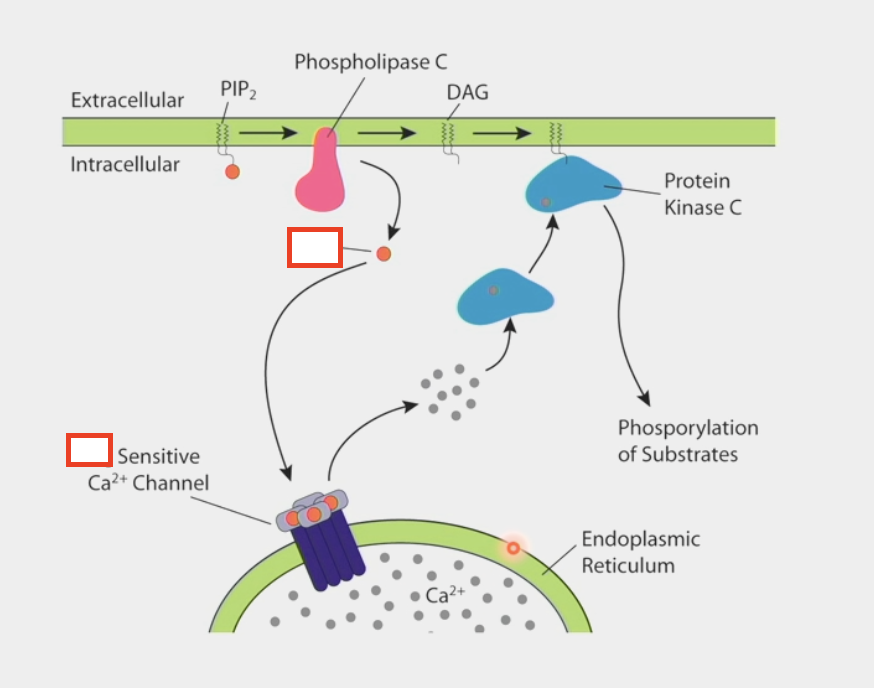
<ul><li><p>second messenger</p></li><li><p>binds to Ca<sup>2+</sup> channel in the ER</p><ul><li><p>allows calcium to be released from internal stores → cytoplasm</p></li></ul></li><li><p>activates Protein Kinase C</p><ul><li><p>binds to other second messenger DAG → phosphorylation of substrates</p></li></ul></li></ul><p></p>
100
New cards

nuclear hormone receptors

  • intracellular receptors for steroid hormones

  • hormones can diffuse through lipid bilayer membrane into the cell

  • control gene expression and other processes
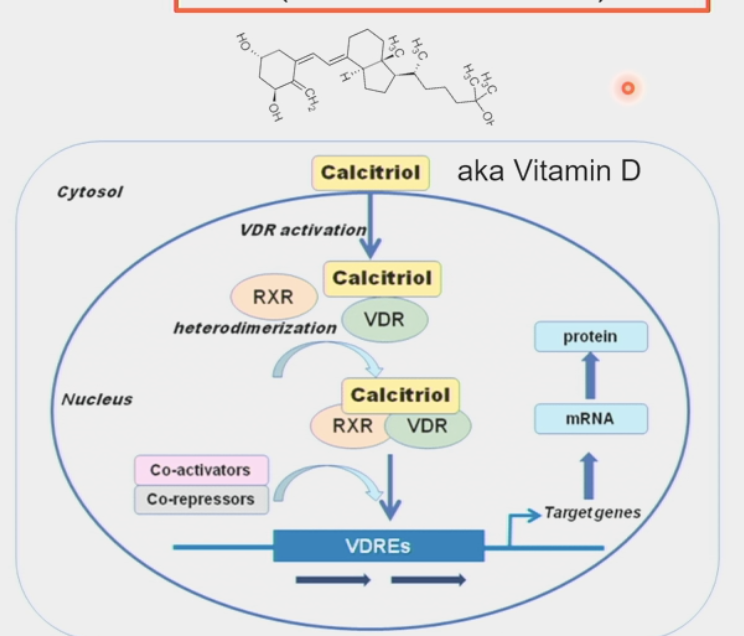
<ul><li><p>intracellular receptors for steroid hormones</p></li><li><p>hormones can diffuse through lipid bilayer membrane into the cell</p></li><li><p>control gene expression and other processes</p></li></ul><p></p>

Explore top notes

note
AP Biology Course Review Part 2
Updated 1636d ago
0.0(0)
note
June exam
Updated 1029d ago
0.0(0)
note
Medical Terminology
Updated 1220d ago
0.0(0)
note
Travail et État — Philosophes
Updated 1027d ago
0.0(0)
note
APES 5.3
Updated 443d ago
0.0(0)
note
Chapter 7: Impulse and Momentum
Updated 716d ago
0.0(0)
note
Sources of Finance for Businesses
Updated 361d ago
0.0(0)
note
AP Biology Course Review Part 2
Updated 1636d ago
0.0(0)
note
June exam
Updated 1029d ago
0.0(0)
note
Medical Terminology
Updated 1220d ago
0.0(0)
note
Travail et État — Philosophes
Updated 1027d ago
0.0(0)
note
APES 5.3
Updated 443d ago
0.0(0)
note
Chapter 7: Impulse and Momentum
Updated 716d ago
0.0(0)
note
Sources of Finance for Businesses
Updated 361d ago
0.0(0)

Explore top flashcards

flashcards
vocab lesson 19 and 20
95
Updated 1046d ago
0.0(0)
flashcards
psych chapter 8
33
Updated 1232d ago
0.0(0)
flashcards
Latin Wk. 2
54
Updated 953d ago
0.0(0)
flashcards
Nl woorden 23-44
22
Updated 158d ago
0.0(0)
flashcards
PSY 411 Chapter 1 Notes
39
Updated 1124d ago
0.0(0)
flashcards
vocab lesson 19 and 20
95
Updated 1046d ago
0.0(0)
flashcards
psych chapter 8
33
Updated 1232d ago
0.0(0)
flashcards
Latin Wk. 2
54
Updated 953d ago
0.0(0)
flashcards
Nl woorden 23-44
22
Updated 158d ago
0.0(0)
flashcards
PSY 411 Chapter 1 Notes
39
Updated 1124d ago
0.0(0)