BIOL 1450 Exam 2
 Studied by 0 people
 Call with Kai
 Learn
Learn Practice Test
 Spaced Repetition
 Match
Match Flashcards
 Knowt Play
1/107

There's no tags or description
Looks like no tags are added yet.
Name | Mastery | Learn | Test | Matching | Spaced | Call with Kai |
|---|
No study sessions yet.
108 Terms
homeostasis
ability of an organism to keep internal conditions within a specific range (required for proper functioning of ALL organisms)
which of the following correctly describes homeostasis?
continuous monitoring and adjusting of specific internal conditions
In homeostasis are the internal conditions held constant?
no
it is a dynamic process
external conditions change (e.g. temperature)
internal conditions change (e.g. skip breakfast)
proper range for an internal condition may need to change under different conditions (e.g. when stressed)
stimulus
a signal to which an organism responds
sensor
cells/organs that detect internal and external conditions
- an individual sensor monitors specific condition(s)
- send signals to integrating center (constantly or only when condition changes)
- one condition often monitored by many different sensors
effector
cells that receive messages from integrating centers
- alter behavior to carry out response
- do NOT send signals to sensors or integrating centers
integrating center
receive and interpret messages from many sensors regarding same and/or different conditions
- integrate information (sum total of signals leads to particular response)
- communicate messages to effectors ONLY if response is necessary
negative feedback
response counteracts change in condition
positive feedback
o [RARE]
o Response "amplifies" change in condition; does not occur indefinitely
o Ex. Child birth
Central Nervous System (CNS)
o brain + spinal cord
o processes, integrates, and coordinates sensory data and motor commands
brain is also center for intelligence, emotion, learning, and memory
peripheral nervous system (PNS)
the sensory and motor neurons that connect the central nervous system (CNS) to the rest of the body.
o sensory division
§ collects information regarding internal and external environments - e.g. skin
o motor division
§ distributes information to effectors that carry out appropriate response - e.g. muscles
neuron
o cells that carry nervous system signals (present in PNS and CNS)
3 functional categories (sensory neurons, interneurons, and motor neurons)
axon
the extension of a neuron, ending in branching terminal fibers, through which messages pass to other neurons or to muscles or glands
transmits signals
cell body
o receives and integrates signals (from dendrites and other cells)
axon hillock
point where cell body and axon meet (signals start here)
dendrites
highly branched extensions that receive signals ; transmit to cell body
synaptic terminals
ends of axon branches where signals are transmitted to next cell
glial cells (glia)
function as neuron support system (multiple types)
do not transmit signals
sensory neuron
collect and transmit information regarding conditions
interneuron
integrate information and send directions
motor neuron
carry directions to effectors
selectively permeable membrane
proteins in membranes (membrane proteins tightly control movement of molecules in and out of neuron
voltage gated channel
open/close in response to changes in relative charge inside vs outside neuron allowing molecules to move from higher to lower concentrations
chemically gated channels
open/close in response to interaction of molecules
requires molecules that interact with membrane protein to open/close
sodium-potassium pump
use energy to move Na+ and K+ in specific directions
§ 3 Na+ ions out for every 2 K+ ions in
§ ALWAYS FUNCTIONING
resting potential
o membrane potential of neuron when NOT sending signals (gated Na+ and K+ channels closed; sodium-potassium pumps functioning)
o outside more positive compared to inside; inside more negative compared to outside)
action potential
o generated when membrane potential reversal reaches threshold amount
involves coordinated opening of voltage-gated Na+ and K+ channels
o local events - occur at a specific place in membrane; inactivation of voltage-gated Na+ channels prevents another action potential from occurring in the same place for a brief period of time
o transmitted in one direction - initiated at axon hillock; transmitted towards synaptic terminals always to get to end of neuron
o all or nothing - do not vary in size and strength of stimuli communicated by frequency of action potentials (so more frequent = stronger stimulus)
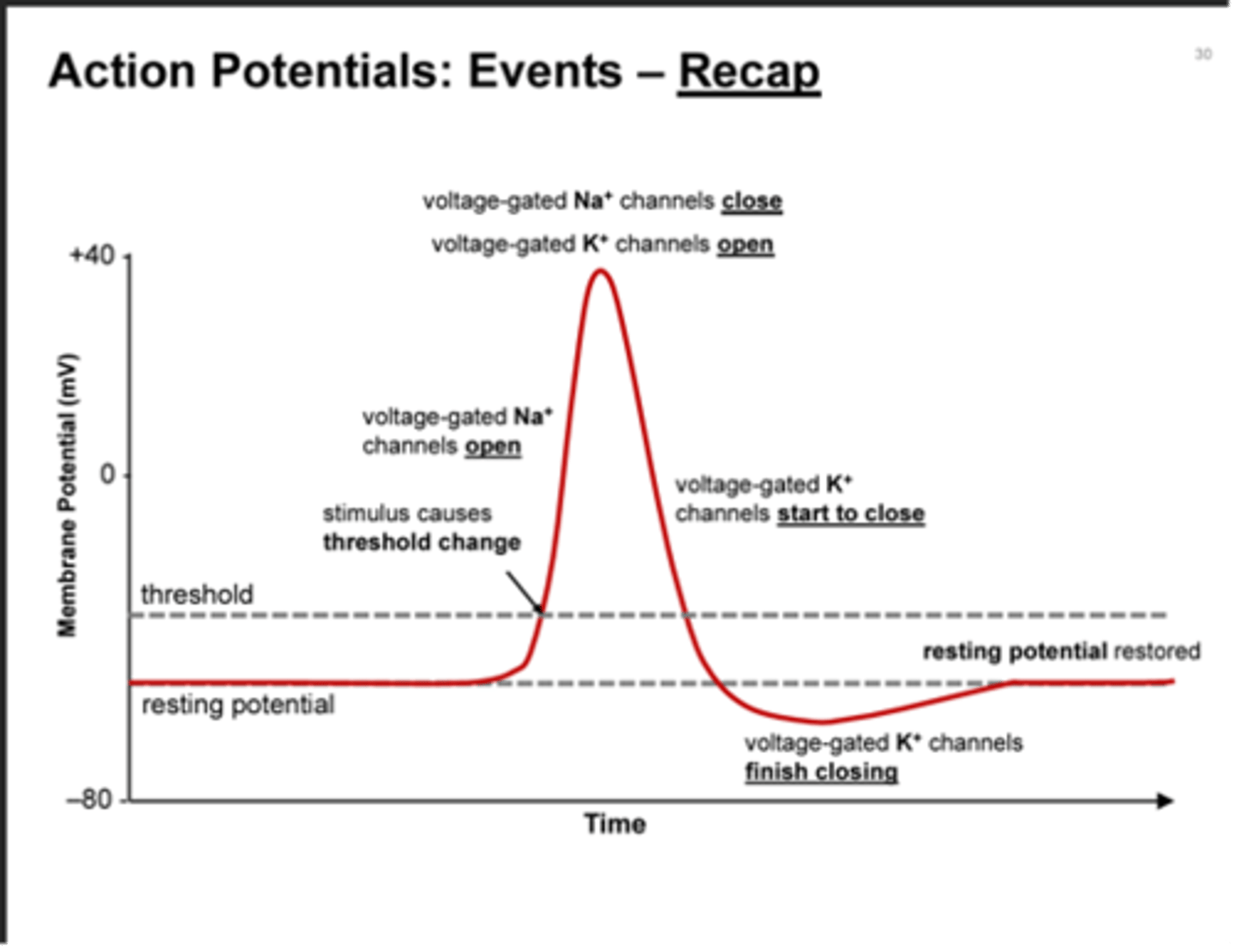
threshold
level of stimulation needed to trigger a neural impulse
myelin sheath (myelinated)
o layers of schwann cells wrapped around axon
§ help prevent transmission of signal to a different neuron if their axons touch each other (cross wiring)
§ affect speed of transmission
· action potentials cannot be generated where the axon is wrapped in a Schwann cell – only occur at nodes
· fewer action potentials – so action potential signals travel faster along myelinated axons
synapse
points where synaptic terminals contact receiving cell (neuron or effector)
chemical synapse
o signal transmitted by chemicals (neurotransmitters)
§ gap between sending and receiving cells – electrical signals cannot cross (because no direct contact)
§ transmission occurs more slowly
§ signal CAN be modified
o 1) action potential reaches synaptic terminal of sending neuron
o 2) triggers release of stored neurotransmitters into synaptic cleft
o 3) neurotransmitters interact with specific receptor proteins in receiving neuron’s membrane
§ Synaptic terminals of sending neurons do NOT have receptors for the neurotransmitters they release – prevents neurotransmitters in synaptic cleft from affecting sending neuron
electrical synapse
o rare
o action potential signals transmitted directly (DIRECT CONTACT)
§ ions flow from sending neuron to receiving cell
§ transmission occurs rapidly
cannot modify signal
neurotransmitter
o chemical messages that transmit nervous system signals
§ different types of neurons produce different types of neurotransmitters
§ stored in vesicles (membrane sacs) in synaptic terminals
§ interact with receptor proteins on membrane of receiving cells (receptor proteins are specific for specific neurotransmitters)
o effects depend on type of neurotransmitter
§ can increase or decrease ability of receiving neuron to generate action potentials
§ same neurotransmitter can have different effects at different chemical synapses (e.g. interacts with different receptors)
o are rapidly removed from synaptic cleft - two mechanisms (reuptake and degradation)
excitatory neurotransmitters
o bring membrane potential closer to threshold (e.g. opens Na+ channels)
inhibitory neurotransmitter
make membrane potential farther from threshold (e.g. opens K+ channels)
reuptake (of neurotransmitters)
transported back into sending neuron
degradation (of neurotransmitters)
broken down (cross out in diagram)
sensory system
the part of your nervous system that collects information and transmits to CNS
sensory receptor cell
detect stimuli and convert into signals
ex. Modified epithelial cell
- change in membrane potential alters neurotransmitter release (excitatory or inhibitory)
-neurotransmitter's effects on sensory neuron determine if action potential signals are sent
receptor protein
a protein that binds specific signal molecules, which causes the cell to respond
perception
o conscious awareness of a stimulus via interpretation and integration of signals by CNS
- many stimuli are processed subconsciously
- level of perception can vary based on conditions (ex. Time moving slower when working vs watching tv)
sensory adaptation
o decreased response to a continuous stimulus
- ex. Not aware of the feeling of your clothes on your skin all the time
- BENEFICIAL because allows CNS to focus on environmental changes and respond to them
o Two mechanisms
- Sensory receptor cell stops responding
- CNS filters out signals
* pain receptor cells typically do not adapt vs taste receptor cells adapt VERY QUICKLY
photoreceptor
sensory receptor cells that detect and convert light stimuli into nervous system signals
signaling pathway of photoreceptor
1. Photoreceptor cells absorb light - change in membrane potential decreases inhibitory neurotransmitter release
2. Decrease in inhibitory neurotransmitter alters membrane potential of bipolar cells - release excitatory neurotransmitter
3. Excitatory neurotransmitter reverses membrane potential of ganglion cells - send action potential signals to brain IF change reaches threshold
retina
light sensitive layer of eye that contains rods and cones
rod
very sensitive to light (able to detect low levels)
signals are not interpreted as different colors
signals from MANY RODS are transmitted to one bipolar cell - amplifies dim light signals but makes images fuzzier
cone
less sensitive to light than rods
3 kinds that detect different wavelengths (colors) of light
Interpretation and integration of signals from all 3 types of cones by interneurons in brain allows us to perceive a wide range of colors
Signals from FEW CONES are transmitted to one bipolar cell - images are sharper in bright light
retinal pigment
pigment molecule in rods AND cones that absorbs light
- absorption of light causes retinal pigment to change shape
- retinal shape change alters the membrane potential
· decreases amount of neurotransmitter released
- straight form of retinal cannot absorb light - must be released and replaced (why it takes time for your eyes to adjust to a dark room from a light room)
opsin protein
determines which wavelengths of light retinal can absorb (detect)
- rods = ONE type of opsin protein
- cones = each type of cone has a different kind of opsin protein
bipolar cell
transmit signals from photoreceptors to ganglion cells
ganglion cell
receive neurotransmitter signals from bipolar cells and send action potential signals to interneurons in the brain
chemoreceptor
sensory receptor cells that detect chemicals
- chemicals interact with receptor proteins in cells' membranes
- each type of receptor protein ONLY interacts with specific chemicals
- the interaction of chemical with receptor proteins alters the membrane potential of chemoreceptor - chemical signal converted into action potential signals
taste receptor cell
o respond to chemicals associated with taste
- organized in taste buds and multiple per bud
- transmitted to brain via sensory neurons
· interpreted by interneurons
olfactory neuron
detect airborne chemicals
interaction of chemicals with these receptor proteins alters membrane potential
taste bud
grouping of taste receptor cells with hair-like extensions that protrude into the central pore of the taste bud
papilla (plural, papillae)
a small, round, or cone-shaped projection or peg on the top of the tongue that may contain taste buds
hormone
chemical messages important for long-distance communication
- produced and released in response to specific stimuli
- travel through the bloodstream in animals
- reach ALL cells but only cause a response in target cells
target cell
cell that has a receptor for a particular hormone
endocrine system
all cells that produce/release hormones - part of specialized organs or present
endocrine cell
produce and release hormones in response to signals (e.g. other hormone, level of certain molecule)
neurosecretory cell
receive and send nervous and endocrine system signals
negative feedback loop
Causes a system to change in the opposite direction from which it is moving
antagonistic hormones
causes changes in target cells that have the opposite effect on a particular condition
synergistic hormones
cause changes in target cells that have the same effect on a particular condition
hypothalamus
main control system of endocrine system; part of brain
line between nervous and endocrine systems - integrates and transmits both system signals
involved in regulating many but not all hormones; transmission of hormone signals to other cells/organs involve pituitary
pituitary gland
releases hormones in response to hypothalamus signals which communicate to other cells in body
anterior pituitary
endocrine cells, release hormones
release of hormones controlled by hypothalamus hormone signals
posterior pituitary
extension of hypothalamus, neurosecretory cells,
Hormones - two types released in response to nervous system signals (ADH (triggers changes that help maintain water balance) and oxytocin (involved in child birth, lactation, reproductive behavior))
releasing hormones
promotes the release of specific anterior pituitary hormones
inhibiting hormones
inhibit release of specific anterior pituitary hormones
pancreas
regulates blood sugar; insulin and glucago
Glucagon
produced and released by alpha cells
alpha cells detect low blood glucose levels and release glucagon into blood stream
responses of target cells lead to production and release of glucose from cells into bloodstream
increased blood glucose levels detected by alpha cells - release less glucagon
insulin
produced and released by beta cells
beta cells detect increased blood glucose and release insulin into blood stream
responses of target cells lead to removal of glucose from blood stream
reduced blood glucose levels detected by beta cells - release less insulin
alpha and beta cells
act as sensors and integrating censors in regulation of blood glucose levels
general stress response
wide array of changes that occur in response to many different stressors
adrenal glands
a pair of endocrine glands that sit just above the kidneys and secrete hormones (epinephrine and norepinephrine) that help arouse the body in times of stress
adrenal cortex
covering portion, release hormones in response to other hormone signals
adrenal medulla
middle, neurosecretory cells that release hormones in response to neurotransmitters
Epinephrine
main hormone for a short term stress response
- short term stress response prepares body for immediate action - acts quickly, response is short-lived
increases heart rate, opens airways, increases blood glucose
cortisol
main hormone for a long term stress response
- long term causes changes that help maintain homeostasis during continued stress - takes longer to initiate, response causes longer-lasting changes
liver cells release glucose, immune system cells reduce activity, inhibits growth
which of the following correctly describes homeostasis?
continuous monitoring and adjusting of specific internal conditions
3 multiple choice options
in homeostasis are the internal conditions held constant?
no, it is a dynamic process; external conditions change (e.g. temperature), internal conditions change (e.g. skip breakfast); proper range for an internal condition may need to change under different conditions (e.g. when stressed
Based on their roles in nervous system signaling, are sensory neurons of the CNS or PNS? What about interneurons? Motor neurons?
o Sensory neurons are part of the PNS
o Interneurons are part of the CNS - ONLY FOUND HERE
o Motor neurons are part of the PNS
Thinking about what sodium-potassium pumps do, is the concentration of Na+ higher outside or inside a neuron? What about the concentration of K+?
o The concentration of Na+ is higher outside the neuron and the concentration of K+ is higher inside the neuron
-- THINK - 3 Na+ out for every 2 K+ in so there will always be a higher concentration of Na+ outside to maintain the negative charge on the inside of the membrane
Is the outside or inside of a neuron more positively charged compared to the other side of the membrane? Why?
o The outside of the neuron is more positively charged compared to the other side
THINK - nucleus has negative charge naturally so must stay negative on inside of the cells membrane
Stimuli that open gated ion channels can cause a reversal in membrane potential that reaches the threshold. Therefore, an action potential could occur when
gated sodium ion channels open allowing sodium ions to move from outside to inside the cell
3 multiple choice options
what part(s) of a neuron receive(s) signals?
cell body and dendrites
3 multiple choice options
When a neuron is not sending signals (resting), gated sodium and potassium ion channels are closed and the sodium-potassium pump is functioning. Therefore, the outside of a resting neuron has a higher concentration of _____ ions and is _______ charged compared to inside the neuron
sodium; more positively
3 multiple choice options
What explains why action potentials are only transmitted in one direction along an axon (hillock to synaptic terminals)?
After voltage-gated Na + channels open and voltage-gated channels close, they are inactivated and cannot re-open for a brief period of time.
3 multiple choice options
- Which of the following correctly describes action potentials?
Once an action potential is generated at the axon hillock, it always reaches the synaptic terminals.
3 multiple choice options
Neurotransmitters often affect chemically gated sodium or potassium ion channels. Based on what you know about action potentials, excitatory neurotransmitters could open gated _____ channels, and inhibitory neurotransmitters could open gated ______ channels
sodium ion; potassium ion
3 multiple choice options
Drugs that affect reuptake or degradation of neurotransmitters in the synaptic cleft can alter nervous system signaling. A drug that inhibits reuptake would result in _________ signaling at a synapse. A drug that inhibits neurotransmitter degradation would result in _________ signaling at a synapse
increased; increased
3 multiple choice options
Certain sensory receptor neurons in your skin detect touch (pressure). Based on how nervous system signaling works, what determines whether an individual touch receptor neuron sends action potential signals to your brain when something touches your skin
whether the membrane potential change reaches the threshold
3 multiple choice options
If the sensory receptor cells in your ear sent signals to the interneurons in your brain that normally receive messages from red light sensory receptor cells, what would happen?
You would see the color red when there was noise
3 multiple choice options
Absorption of light by photoreceptor cells ultimately leads to an increase in action potential signals sent to the brain. Based on this information, it is reasonable to predict that the neurotransmitter released by a photoreceptor is classified as ________.
inhibitory
You're given a group of cone cells that are all the same type (either all blue, green, or red). Which of the following would allow you to determine what type of cone cell you have?
all of the above
3 multiple choice options
Which of the following, if any, accurately describes human chemoreceptors involved in taste and smell?
A chemoreceptor must have a receptor protein to be able to detect a chemical
3 multiple choice options
- Which hypothesis, if either, is supported by the data?
An individual papilla can detect a variety of chemicals that are interpreted as different tastes
2 multiple choice options
- Studies show that an individual taste receptor cell in a taste bud can only detect one type of chemical. Based on your knowledge of chemoreceptors and the sensory system, which of the following would explain why?
It only has one type of receptor protein
3 multiple choice options
Based on the video and what we've discussed, which of the following correctly describe(s) BOTH your sense of taste and your sense of smell?
all of the above
3 multiple choice options
 Note
Note  Flashcards (100)