Herp exam 2
 Call Kai
 Learn
Learn Practice Test
 Spaced Repetition
 Match
Match Flashcards
 Knowt Play
1/95

There's no tags or description
Looks like no tags are added yet.
Name | Mastery | Learn | Test | Matching | Spaced | Call with Kai |
|---|
No analytics yet
Send a link to your students to track their progress
96 Terms
Amniotes
early reptiles
most numerous and largest radiation of reptiles
Mesozoic
Lepidosauromorphs evolution
2nd major diapsid lineage
1st lizards
hylanomus
When did snakes start evolving more rapidly
Jurassic period
ruling reptiles of mesozoic
Archosauromorphs
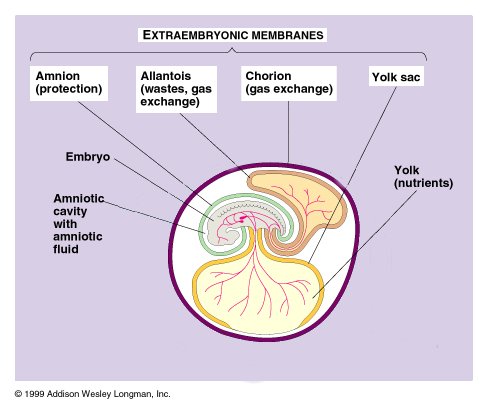
Amniotic egg anatomy
4 membranes
Yolk sac - nutrients (connected to embryo, below)
Amnion - cushion from impact (around embryo)
Chorion - gas exchange (outer layer)
Allantois - storage waste (connected to embryo, above)
Stratum corneum
thick outer layer of dead epidermal cells
Stratum germinativum
cell derivatives produced by living cells of deep epidermal layer
Scales or scutes (turtles) are
folded areas of epidermis, made up of keratins process called embryogenesis
Osteoderms
bony pates or deposits within the skin
Lenticular sense organ (scale organs)
small circular sense organs ; mechanoreceptors
Columella
single sound transmitting bone in inner ear, Assists in detection of vibrations
Copulatory organs of Squamata
Hemipenes - everted during copulation
Acrodont teeth
attached to crest of jawbone
Pleurodont
attached inner sides of jaw bone
polyphyodont
continuously replace teeth ; most are poly
Panthenogenesis
ability to reproduce without offspring
Many have temperature dependent sex determination
Caudal autotomy
ail breaks off
• Anti-predation
• Can be intravertebral or intervertebral
Intravertebral autotomy
Fracture planes in tissue and vertebrae for ease of break
Intervertebral autotomy
Involuntary, tail will not regenerate
Venom
synthesized proteins
Snakes vs other reptiles
Protective Cover: Snakes have a spectacle (transparent scale); lizards do not.
Focus & Structure: Lizards use ciliary muscles to shape the lens and almost all have scleral ossicles (bony supports).
Light Filtering:
Lizards: Use colored macrolipid droplets and always have clear lenses.
Snakes: Use colorless microlipids; diurnal species have amber lenses to filter blue light.
Processing: Both use retinal motility to adjust light, but their brains process images differently: lizards use the tectum, while snakes use the thalamus.
pit organs
Snakes have pit organs that detect infrared radiation
Aglyph
homodont dentition - aka no fangs
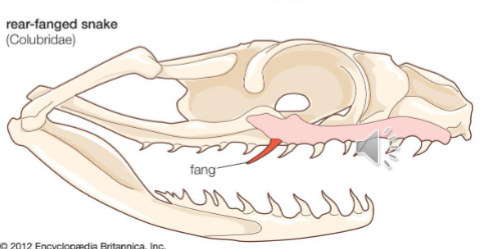
Opisthoglyph
rear fangs
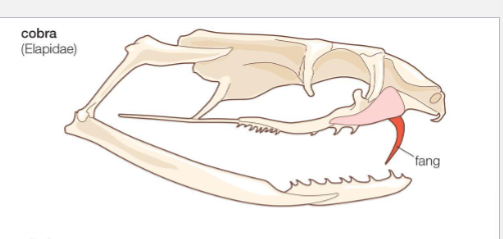
Proteroglyph
hollow fangs on anterior end
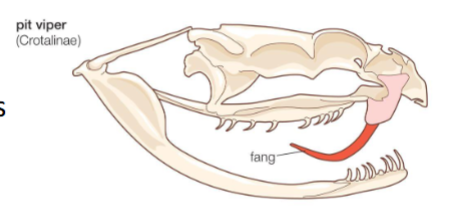
Solenoglyph
Vitellogenesis
accumulation of nutrients, nutrients will later become the yolk
Cleiodoic egg
shelled egg
Parthenogenesis
females reproduce without males or sperm
Genotypic sex determination
Males XY, females ZW. can be heterogametic
TSD (temp sex determination) pattern la
males produce at cooler temps, females higher (turtles, squamates)
TSD (temp sex determination) pattern lb
females produced at cooler temps, males warmer (tuatara, squamates, crocs lizards)
TSD (temp sex determination) pattern ll
females produced at both cool and warm temps, and males at intermediate temps
Pre depositional parental care
finding and building nest
Post depositional parental care
guarding her eggs
vivipary
live birth
Ovovivipary
eggs retain longer inside then live birth
characteristics of a species produce single clutch
Delayed maturity (>1 year after hatching)
Require more time to grow
Typically produce large numbers of small eggs or small number of large eggs
Longer lived
Species produce multiple clutches
Early maturity
Rapid growth
Lay eggs consistently
High reproduction offset by high mortality
Shorter lifespans
Gas exchange - aspiration pumping
lungs using negative pressure
Expiration
raise pressure in lungs and force air out
Inhalation
lower pressure in lungs and draw air in
Relaxation
small gap of time before reptiles expirate again
Lizards use same muscles to shift air between lungs when
moving, running. They don't breathe when running
how many lungs do snakes have
2, one is 98-99% smaller - increase surface area, limit blood supply, buoyancy
Crocodylians have _____ of air in lungs (similar to birds)
unidirectional flow
Turtles air flow
Shell prevents normal expansion of rib cage. visceral cavity expands and contracts for air flow in lungs
Systemic blood flow
vessels into capillaries = high pressure - oxygenated blood to parts of the body
Pulmonary blood flow
some capillaries = low pressure - deoxygenated blood deposits waste
Crocodiles have a/an __ chambered heart
4
Frogs hearts
spiral valve, very minimal mixing of blood
Turtles and squamates hearts
near full separation of blood, 3 chambered heart
ATP synthesis
energy gained from aerobic respiration
oxidative respiration
aerobic metabolism
glycolytic respiration
anaerobic metabolism
VO2 rest
you are motionless
VO2
rises when the animal starts to walk, rises as locomotion rises
VO2 max
highest speed that can be sustained by oxidative metabolism
Optimal foraging theory
no animal will expend more energy than the meal itself gives
Aestivation
long term dormancy
Hibernation
dormancy during periods of cold and food scarcity
Inertial suction
Snake necked Turtles - Creates inward flow of water
Projectile Feeding
High-speed extension of the tongue or jaw to capture prey at a distance.
Akinetic Feeding
Feeding with a rigid, non-moving skull (common in turtles/crocs).
Kinetic Feeding
Feeding involving moving joints within the skull to increase gape or bite force (common in snakes/lizards).
Reaction force
equal and opposite force on surface when a limb is pressing on ground
Vertical component
up and down pressure from locomotion
Propulsive component
forward and backward movement
footfall pattern
pattern on how left and right hind and forefeet fall
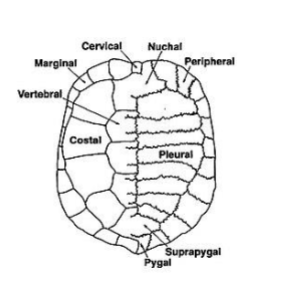
Cervical
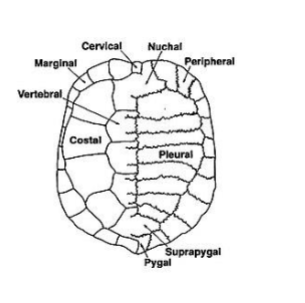
Nuchal
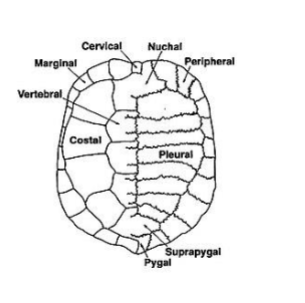
Peripheral
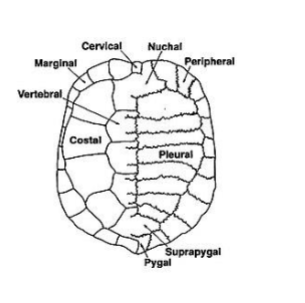
Pleural
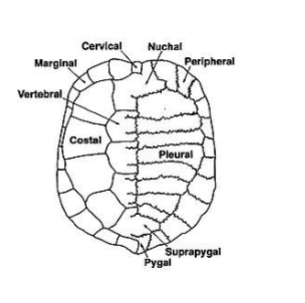
Suprapygal
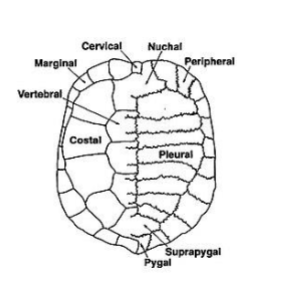
Costal
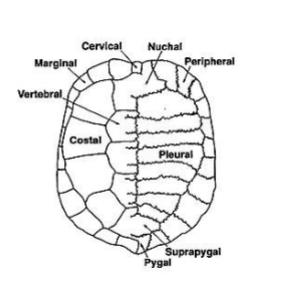
Vertebral
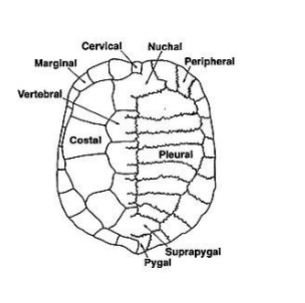
Marginal