3b more exchange and transport systems
 Call Kai
 Learn
Learn Practice Test
 Spaced Repetition
 Match
Match Flashcards
 Knowt Play
1/38

There's no tags or description
Looks like no tags are added yet.
Name | Mastery | Learn | Test | Matching | Spaced | Call with Kai |
|---|
No analytics yet
Send a link to your students to track their progress
39 Terms
the basis of digestion
digestion is where large biological molecules (like starch and proteins) are broken down into smaller molecules (glucose and amino acids) to be absorbed. this is because they can’t fit through cell membranes
they are digested by digestive enzymes
amylase and the digestion og carbohydrates
amylase is a digestive enzyme that catalyses the hydrolysis reaction that breaks down gylcosidic bonds in starch to turn it into maltose
amylase is produced by the salivary glands and the pancreas, releasing amylase into the mouth and small intestine
membrane-bound disaccharidases
these are enzymes attached to the cell membranes of epithelial cells lining the ileum (end of small intestine). they break down disaccharides into monosaccharides
the digestion of lipids
lipase is a digestive enzyme that catalyses the brakdown of lipids into monoglycerides and fatty acids by hydrolysing the ester bonds.
lipase is made in the pancreas and released into the small intestine
bile salts emulsify lipids (they cause them to form small droplets). they are not enzymes, but they increase the surface area of lipids so lipase works more efficiently. they are found in the liver
after the lipid has been broken down, the products stick to the bile salt, they form small micelles which increase absorption
the digestion of proteins
endopeptidases hydrolyse peptide bonds within a protein and exopeptidases hydrolyses peptide bonds on either end of a protein. they only remove single amino acids
dipeptidases work specifically on dipeptides. they are usually found on the cell membrane of epithelial cells in the small intestine
monosaccharide absorption
glucose is absorbed by active transport by a co-transporter. galactose also uses this same co-transporter
fructose is absorbed by facilitated diffusion by another transporter protein
monoglyceride and fatty acid absorption
micelles move monoglycerides and fatty acids to the epithelium. micelles are constantly breaking up and reforming, meaning they can ‘release’ monoglycerides and fatty acids, allowing them to be absorbed
since they are lipid-soluble, they diffuse directly across the cell membrane
amino acid absorption
amino acids are absorbed by co-transport. sodium ions are actively transported out of the epithelial cells of the ileum into the blood, creating a sodium ion concentration gradient. sodium ions then diffuse from the lumen of the ileum back into the epithelial cells with a co-transporter, alongside the amino acids.
haemoglobin and oxyhaemoglobin
haemoglobin a chemically similar molecule found in many different organisms. it is found in red blood cells and carries oxygen around the body
it is a large protein with a quaternary structure, made up of four polypeptide chains. each chain has a haem group with one iron ion, giving it it’s red colour. each haem group carries one oxygen molecule
in the lungs, oxygen joins to the haemoglobin, forming oxyhaemoglobin. this is a reversible reaction. this is called association and dissociation
affinity and partial pressure of oxygen
affinity for oxygen is the tendency for a molecule to bind with oxygen. for haemoglobin, it varies depending on some conditions, including the partial pressure of oxygen
partial pressure (pO2) is a measure of oxygen concentration. as pO2 increases, haemoglobin’s affinity for oxygen increases
oxygen loads at a high pO2
oxygen unloads at a low pO2
partial pressure and respiration
alveoli in the lungs have a high pO2 so oxygen loads onto haemoglobin. when cells respire, they use up oxygen, lowering pO2. red blood cells deliver oxygen to respiring tissues, whereoxygen unloads, and the haemolobin returns to the lungs to repeat the process
haemoglobin dissociation curve
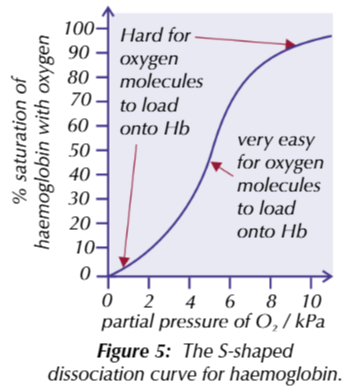
the saturation of haemoglobin affects it’s affinity for oxygen. this causes an S shaped dissociation curve
when haemoglobin combines with the first O2 molecule, the shape alters, making it easier for other O2 molecules to join too. however, as more oxygen loads, there are less spaces for other O2 molecules, lowering the affinity
when the curve is steep, a small change in pO2 causes a large change in the amount of oxygen carried by the haemoglobin
pCO2 and the Bohr effect
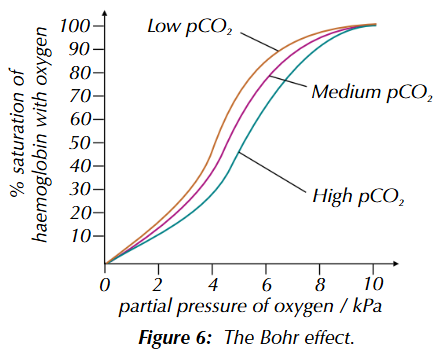
the partial pressure of carbon dioxide (pCO2) is the concentration of carbon dioxide in a cell, which affects the affinity of haemoglobin. at a higher pCO2, haemoglobin gives up oxygen more readily
when cells respire they produce carbon dioxide, increasing rate of oxygen unloading. this will cause a dissociation curve to shift left at a low pCO2 and right at a high pCO2. the saturation of blood with oxygen is lower for the same pO2, meaning more oxygen is being released. this is called the Bohr effect
haemoglobin adaptations for low oxygen enviroments, high activity levels, and size
low oxygen environments: organisms have haemoglobin with a higher affinity for oxygen than human haemoglobin. there isn’t much oxygen so the haemoglobin haa to be good at loading it. the dissociation curve is to the left of ours
high activity levels: active organisms have a high oxygen demand so have haemoglobin with a lower affinity for oxygen. oxygen needs to be unloaded easily, so it’s readily available to use. the dissociation curve is to the right of ours
size: small mammals have a higher surface area to volume ratio than larger mammals. therefore they lose heat quickly, so they have a higher metabolic rate to keep them warm. mammals smaller than humans have a lower affinity for oxygen since the haemoglobin easily unloads oxygen for their high demand. the dissociation curve is to the right of ours
circulatory system structure and names
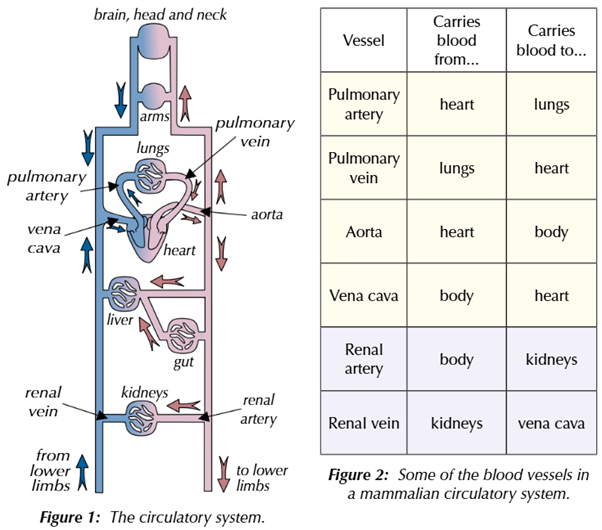
blood takes respiratory gases, products of digestion, metabolic wastes, and hormones around the body. one circuit takes blood from the heart to the lungs and back and the other takes blood from the heart to the rest of the body and back
the heart gets supplied it’s own blood by the coronary arteries
artery structure and function
arteries carry blood from the heart to the rest of the body. they carry oxygenated blood, except for the pulmonary arteries
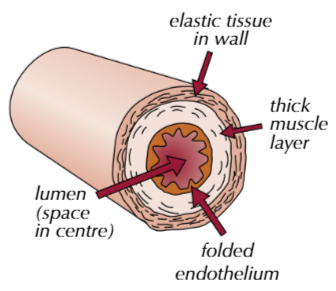
they have thick, muscular walls and elastic tissue which stretches and recoils as the heart beats, maintaining high pressure. the endothelium is folded, allowing it to stretch and maintain high pressure.
arteriole structure and function
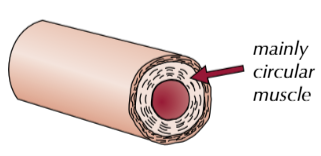
arterioles are arteries that have divided into smaller vessels, forming a network throughout the body
arterioles are mainly made up of circular muscle, which contract or relax to direct blood to different areas of the body
vein structure and function
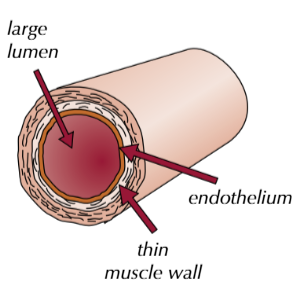
they take blood back to the heart under low pressure. all veins carry deoxygenated blood, except for the pulmonary veins
they have a wide lumen with little elastic and muscle tissue. they also contain valves, stopping blood from flowing backwards. blood flow is directed by body muscles surrounding the vein rather than inside of it.
capillary structure and function
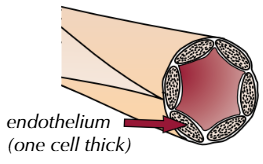
arterioles branch into capillaries, the smallest blood vessel. they are adapted for efficient diffusion, and are found near cells in exchange tissues to shorten the diffusion pathway
their walls are one cell thick, shortening the diffusion pathway further. there are many capillaries, increasing surface area. these are called capillary beds
tissue fluid
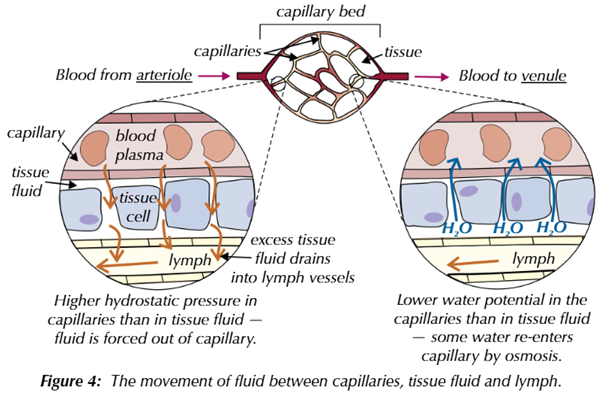
tissue fluid is the fluid that surrounds cells in tissues, made from small molecules that leave the blood plasma. cells take in oxygen and nutrients from the tissue fluid and release metabolic waste into it. in a capillary bed, substances move out of the capillaries in to the tissue fluid by pressure filtration
at the start of the capillary bed (near arteries) the hydrostatic pressure inside the capillaries is greater than in the tissue fluid. therefore, fluid is forced out the capillaries. hydrostatic pressure is much lower at the venule end of the capillary bed
due to fluid loss, there is a larger concentration of plasma proteins that don’t leave the capillaries, so the water potential is lower at the venule end of the capillary bed is lower than in the tissue fluid. this means some water re-enters the capillaries by osmosis. any excess tissue fluid is drained by the lymphatic system, passing it back into the circulatory system
structure of the heart
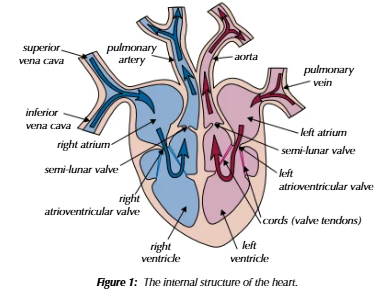
the right side of the heart pumps deoxygenated blood to the lungs, and the left side of the heart pumps oxygenated blood to the whole body
the left ventricle has thick, muscular walls, so it can more powerfully pump blood further
the ventricles have thicker walls than the atria to push blood all the way out of the heart
the atrioventricular valves link the atria and the ventricles. it stops blood flowing backwards into the atria. the semi-lunar valves connect the ventricles to the main arteries (pulmonary artery and aorta) to stop backflow into the ventricles. if there’s higher pressure behind a valve, it’s forced open, and vice versa
the cords attach the atrioventricular valves to the ventricles to stop them being forced up into the atria
required practical 5
heart dissection
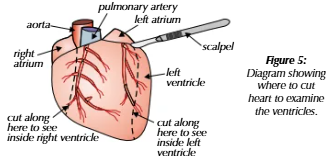
place your heart onto the dissecting tray and identify the four main vessels
identify the left and right atria and ventricles and the coronary arteries
cut along the lines show using a scalpel and look inside the ventricles, especially the differences in wall thickness
cut open the atria and look inside too
find the atrioventricular valves and the semi-lunar valves
wash your hands and disinfect all equipment
the cardiac cycle
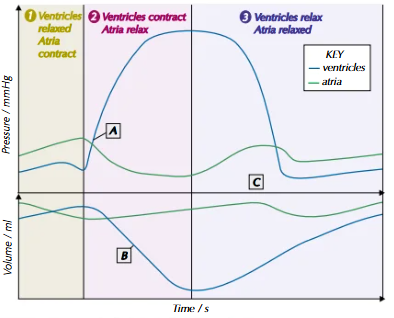
atrial systole: the ventricles relax and the atria contract. this increases pressure inside the atria, forcing open the atrioventricular valve, and pushing blood into the ventricles
ventricular systole: the atria relax and the ventricles contract. pressure is high in the ventricles, closing the atrioventricular valve. the semi-lunar valve is forced open and blood is forced into the arteries
diastole: the ventricles and atria relax. pressure is high in the main arteries so the semi-lunar valve is closed. blood returns to the heart so the atria fill again due to high pressure in the main veins. blood flows passively into the atria and ventricles
cardiac cycle graph
at point a, ventricles contract, increasing their pressure. the atrioventricular valve shuts and blood is forced into the aorta
at point b, ventricular volume decreases, because the ventricles are contracting
at point c, the ventricles are relaxed and refilling, so the pressure is higher in the main arteries. the semi-lunar valve is closed
cardiac output
cardiac volume (cm³ min^-1) = stroke volume x heart rate
heart rate: the number of beats per minute (bpm)
stroke volume: the volume of blood pumped during each heartbeat (cm³)
atheroma formation
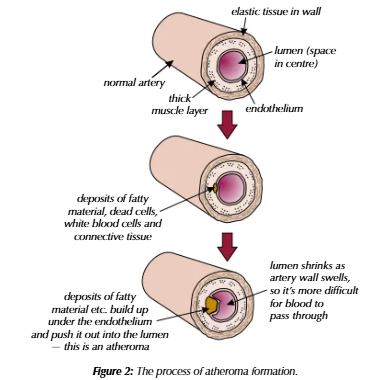
if damage occurs in the endothelium, white blood cells and lipids from the blood clump together under the lining to form fatty streaks. over time, this hardens to form a plaque called an atheroma
types of cardiovascular disease (aneurysm, thrombosis, myocardial infarction)
aneurysm: a balloon-like swelling of the artery, starting with atheromas. atheromas damage and narrow arteries, increasing blood pressure. when blood travels through a weakened artery, it may push the inner layers of the artery through the outer elastic layer to form an aneurysm. it can burst
thrombosis: a blood clot, beginning with atheromas. atheromas can rupture the endothelium, leaving a rough surface. platelets and proteins accumulate at the site, causing a blood clot. it can block a blood vessel
myocardial infarction (heart attack): if a coronary artery becomes blocked, the heart can be cut off of it’s blood supply, causing a heart attack. this can cause damage t the heart
high blood pressure as a risk factor for cardiovascular disease
this increases risk of damage to the artery walls, increasing the risk of an atheroma formation. this can cause blood clots, further high blood pressure, possible resulting in a heart attack
anything that increases blood pressure increases risk of cardiovascular disease e.g. being overweight, not exercising, or drinking alcohol
high blood cholesterol/poor diet as a risk factor for cardiovascular disease
if blood cholesterol is high then risk of cardiovascular disease is higher. cholesterol is a main fatty deposit forming atheromas. these lead to increased blood pressure and clots, leading to a heart attack
a diet high in saturated fat is associated with high blood cholesterol, a diet high in salt is associated with high blood pressure
cigarette smoking as a risk factor for cardiovascular disease
carbon monoxide and nicotine are in cigarette smoke, increasing the risk of cardiovascular disease
carbon monoxide combines with haemoglobin, reducing the amount of oxygen transported, possibly leading to a heart attack
smoking decreases the amount of antioxidants in the blood, leading to cell damage in the coronary walls, leading to an atheroma formation
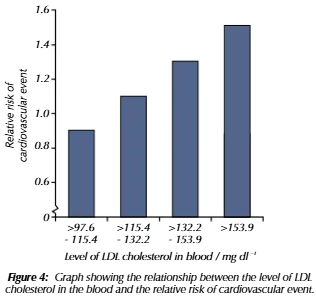
interpreting data on risk factors and cardiovascular disease
describe the data: the risk of cardiovascular disease increases as cholesterol increases
draw conclusions: positive correlation
check any conclusions are valid: make sure conclusions match the data
conflicting evidence for risk factors of cardiovascular disease
one study might conclude that a factor isn’t a health risk, whereas another study might conclude that the same factor is a health risk. if two studies have produced conflicting results, there may be reasons (variables)
you may have to carry out more studies to collect more results
xylem
xylem tissue transports water and mineral ions in solution. these substances move up the plant from the roots to the leaves
phloem
phloem tissue transports organic substances like sugars (also in solution) both up and down the plant
xylem structure
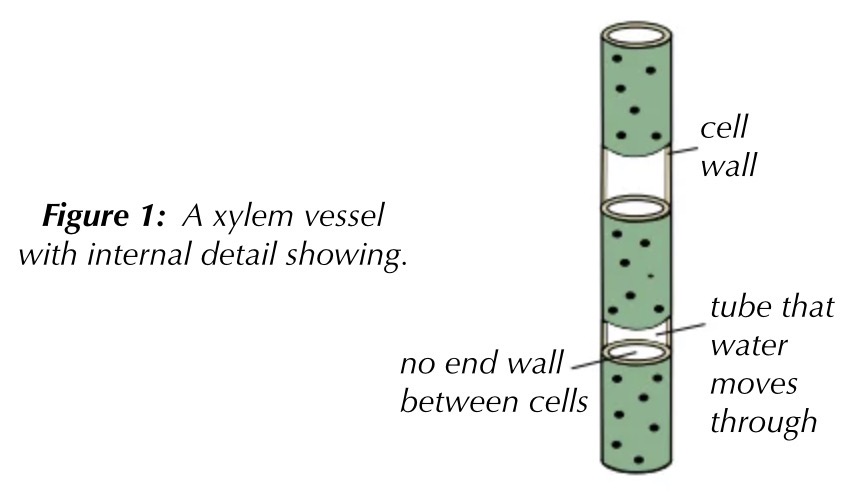
xylem vessels are very long, tube-like structures formed from dead cells joined end to end. there are no end walls on these cells, making an uninterrupted tube that allows water to pass up through the middle easily
the cohesion-tension theory
water evaporates from the leaves of a plant (transpiration)
suction tension is created, pulling more water into the leaf
water is cohesive so other water molecules follow. therefore the entire column of watee is pulled up
water enters the stem through the roots
transpiration and the factors affecting it
transpiration is the evaporation of water from a plant’s surface, especially the leaves. when stomata open, collected water moves out of the leaf
the lighter it is the more transpiration due to open stomata for photosynthesis
the higher the temperature the more transpiration since warm molecules have more kinetic energy, evaporating faster
the lower the humidity the more transpiration. if it’s dry, there id a higher WP gradient between water and the air
the windier it is, the more transpiration due to lots of air movement blowing away water
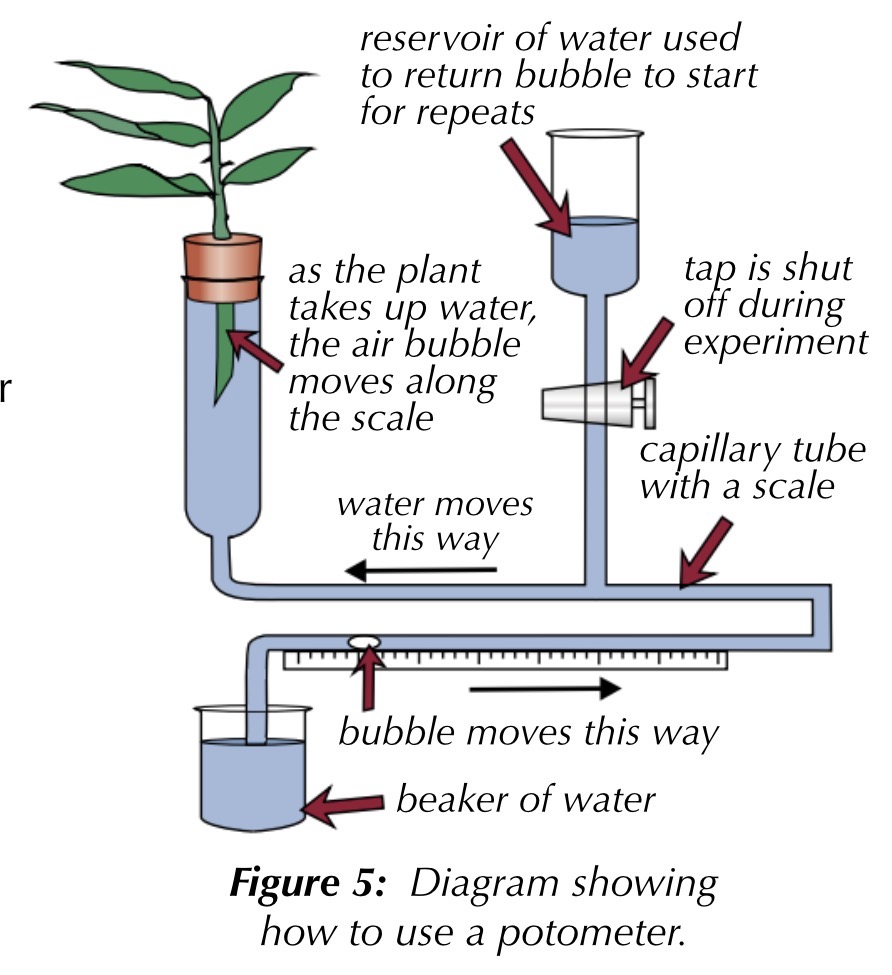
estimating transpiration rate using a potometer
cut a shoot underwater to prevent air from entering the xylem (cut a slant to increase surface area)
assemble the potometer underwater and insert shoot so no air enters
keep capillary tube submerged in a beaker of water
dry the leaves and wait, then shut the tap (let the shoot acclimatise)
allow an air bubble in by removing the beaker for a second
record the starting position and start a stopwatch. then record an ending position and calculate rate of transpiration
required practical 5
looking at the xylem and phloem in a stem
cut a thin cross section of the stem with a scalpel
place the sections in water with tweezers to avoid drying out
add a drop of water to a slide, the section, and then a stain. leave for 1 minute
add a cover slip
you can then see the blue-green xylem and the pink-purple phloem

