BIOMI 1100 Prelim 2
 Call Kai
 Learn
Learn Practice Test
 Spaced Repetition
 Match
Match Flashcards
 Knowt Play
1/75

There's no tags or description
Looks like no tags are added yet.
Name | Mastery | Learn | Test | Matching | Spaced | Call with Kai |
|---|
No analytics yet
Send a link to your students to track their progress
76 Terms
Which of the following is NOT true about fungi?
(a) They can be filamentous and multicellular
(b) They can produce spores
(c ) They get their food by absorptive nutrition
(d) They do NOT have chlorophyll
(e) They all produce mushrooms
(e) They all produce mushrooms
Breaking down macromolecules for energy and nutrition is a form of …
(a) catabolism
(b) anabolism
(c) photosynthesis
(d) lithotrophy
(a) catabolism
What is the target of most common over the counter (OTC) antifungal compounds?
(a) cell membrane
(b) chloroplast
© DNA
(d) ribosome
(a) cell membrane
What part of most fungi is responsible for spreading INFECTIONS?
(a) Fruiting body (mushroom)
(b) Hyphaes
(c) Mycotoxins
(d) Spores
(d) Spores
Athlete's foot is caused by:
(a) a type of protozoa
(b) a bacterial infection
(c) a fungal infection known as ringworm
(d) a virus infection
(c) a fungal infection known as ringworm
How does the fungus that synthesizes penicillin act to block growth of bacteria?
(a) blocks RNA synthesis
(b) blocks protein synthesis
(c) blocks cell wall synthesis
(d) blocks DNA synthesis
(c) blocks cell wall synthesis
What is a mycotoxin? More than one answer may be correct.
(a) a fungal toxin that when consumed can cause neurological disorders and other health problems
(b) a type of fungi used as a food ingredient
(c) A toxin produced by bacteria
(d) a toxin produced by a type of fungi that grows on crops
(a) a fungal toxin that when consumed can cause neurological disorders and other health problems
(d) a toxin produced by a type of fungi that grows on crops
How do fungi make fruit soften?
(a) attack fruit
(b) secrete digestive enzymes to break down cell walls of fruit
(c) no answer is correct
(d) wait for someone else to soften the fruit for them
(b) secrete digestive enzymes to break down cell walls of fruit
Which of the following is true about mycelium?
(a) help keep the forest healthy
(b) All answers are correct
(c) found in the soil
(d) passes nutrients and other compounds to tree roots
(b) All answers are correct
What types of pathogens have been reported to infect people at pools?
(a) Viruses
(b) Bacteria
(c) Parasites
(d) All of these
(d) All of these
How do we normally count native (i.e. not human) aquatic bacteria)
(a) With the naked eye
(b) By growing them on plates
(c) By looking at them using a light microscope
(d) By looking at them using an epifluorescence microscope
(e) By using electron microscopy
(d) By looking at them using an epifluorescence microscope
If there are so many potentially pathogenic bacteria shed from swimmers, why don't more people get sick?
(a) Frequent swimmers become immune to the pathogens through exposure
(b) Chlorine/Bromine kills the pathogens
(c) Pathogens are selectively filtered out via the filtration system
(d) Swimsuit materials filter out pathogens
(b) Chlorine/Bromine kills the pathogens
How many bacteria on average are there in a drop of seawater?
(a) 100
(b) 1000
(c) 10,000
(d) 100,000
(e) 1,000,000
(f) 1,000,000,000
(e) 1,000,000
Pool filters remove bacteria and viruses?
(a) True
(b) False
(b) False
What are life guards usually testing?
(a) pH
(b) Chlorine levels
(c ) Bacterial levels
(d) All of these
(e) None of the above
(a) pH
Why does the pH of the pool matter?
(a) If it’s too high or too low it can irritate the skin
(b) If it’s too high the chlorine disinfectant can’t penetrate and kill bacteria
(c ) If it’s too low the chlorine disinfectant can’t penetrate and kill bacteria
(d) A and B
(e) B and C
(f) None of these
(d) A and B
What types of microbes in pools can cause human infections?
(a) All of these
(b) Viruses
(c) Bacteria
(d) Eukaryotic parasites
(a) All of these
Which of the following methods would be the best way to count how many bacteria there are in a sample?
(a) use fluorescent stain and count number of bacteria
(b) use a light microscope
(c) No answer is correct
(d) just add bacteria to a petri dish and count what grows!
(a) use fluorescent stain and count number of bacteria
Which types of bacteria do we often find in a swimming pool?
(a) All answers are correct
(b) fecal bacteria
(c) mycobacteria
(d) skin bacteria
(a) All answers are correct
Why are both pH and chlorine levels monitored and adjusted at swimming pools?
(a) To ensure that chlorine maintains its disinfecting properties
(b) To degrade oils that wash off swimmers bodies
(c) To avoid causing skin rashes
(d) To prevent the filters from clogging
(a) To ensure that chlorine maintains its disinfecting properties
Most pathogenic bacteria do not live longer than 1 day in a swimming pool. Can they still cause infections?
(a) Yes, the chlorine actually makes them more infectious
(b) No, even if they survive, they are no longer infectious
(c) Yes, contact through skin breaks, swallowing pool water, or inhaling aerosols can still result in infection
(d) No because bacteriophage make the remaining bacteria incapable of causing infections
(c) Yes, contact through skin breaks, swallowing pool water, or inhaling aerosols can still result in infection
What makes us stink when we workout?
(a) The moisture from our sweat is full of odors
(b) The bacteria on our skin feed on nutrients in our sweat and break it down into stinky by-products
(c) When we are wet with sweat, we attract dirt
(d) Athletic people were born with a 'certain smell'
(e) None of the above
(b) The bacteria on our skin feed on nutrients in our sweat and break it down into stinky by-products
Which BoZone has the most unique smell (voc) profile?
(a) Mouth
(b) Bowels
(c) Armpits
(d) Feet
(b) Bowels
True of False: some people are attracted to armpit odor
True
True or False: Can infectious disease be detected from body odor?
True
Does mosquitoes prefer certain body odors over others?
(a) No, mosquitoes have no preference
(b) Yes! Some people’s smells are more attractive to mosquitoes than others
(c) It all has to do with your clothing
(d) It all has to do with the type of deodorant you use
(b) Yes! Some people’s smells are more attractive to mosquitoes than others
What causes body odor?
(a) pure sweat!
(b) deodorants
(d) commensal microbes metabolize sweat into stinky compounds
(e) soap
(d) commensal microbes metabolize sweat into stinky compounds
What are volatile organic compounds?
(a) include volatile fatty acids and thioalcohols
(b) travel through the air
(c) produced by microbes such as Corynebacterium
(d) All answers are correct
(d) All answers are correct
How do deodorants work?
(a) They block sweat glands
(b) They kill microbes
(c) They release volatile organic compounds
(d) No answer is correct
(b) They kill microbes
Choose the best answer: body odor arises from which of the following locations?
(a) Anywhere with eccrine sweat glands
(b) Armpits only
(c) Anywhere with aprocrine sweat glands
(d) Groin only
(c) Anywhere with aprocrine sweat glands
How can body odor be used to diagnose infections and disease?
(a) there is no way to diagnose differences
(b) only works for diseases carried by mosquitoes
(c) specific volatiles are released from skin of people with disease
(d) No answer is correct
(c) specific volatiles are released from skin of people with disease
Which of the following likely has a greatly reduced genome?
(a) facultative commensal
(b) obligate parasite
(c) facultative parasite
(d) none of the these
(b) obligate parasite
How does T. pallidum evade the immune system?
(a) It has lots of outer membrane proteins to help it deal with immune responses
(b) It has outer membrane proteins that look like human proteins
(c) Its flagellae are similar to human cilia
(d) It produces toxins that "blind" the immune system
(b) It has outer membrane proteins that look like human proteins
How many students in this class (~300) would you expect to have chlamydia?
(a) 1
(b) 3
(c) 6
(d) 12
(d) 12
How does Syphilis evade the immune system?
(a) it eats white blood cells
(b) it's outer sheath contains compounds which look like human compounds
(c) it produces a lot of membrane proteins
(d) it produces toxins
(b) it's outer sheath contains compounds which look like human compounds
What is a unique feature of spirochetes?
(a) they have endoflagella
(b) they have a nucleus
(c) they have ribosomes
(d) they have chloroplasts
(a) they have endoflagella
What is a secondary sign of syphilis?
(a) a cough
(b) rash on palms of hands and soles of feet
(c) acne on face
(d) rash all over body
(b) rash on palms of hands and soles of feet
Which of the following produce spore like elementary bodies that enhance the survival of the pathogen when transmitted between hosts
(a) Gonorrhea
(b) Trichomonas
(c) Treponema
(d) Chlamydia
(d) Chlamydia
Which of the following is true about Chlamydia? Choose all that apply
(a) there is a functional vaccine
(b) it enters and reprograms the host cell
(c) it is a fungus that cannot be treated with traditional antibiotics
(d) it's prevalence is greater in college age women than in college age men
(b) it enters and reprograms the host cell
(d) it's prevalence is greater in college age women than in college age men
Where on the tree of life do we find viruses?
(a) Eukaryotes
(b) Bacteria
(c) Archaea
(d) None of the above
(d) None of the above
Infection by which of these viruses can be prevented by taking prescription antivirals?
(a) HIV (AIDS)
(b) Herpes (cold sores)
(c) Vericella (chicken pox/shingles)
(d) HPV (genital warts)
(a) HIV (AIDS)
How are HPV and HIV similar?
(a) Both infect immune cells
(b) Both infect nerve cells
(c) Both integrate into the host genome
(d) Both can cause cancer
(d) Both can cause cancer
All viruses contain which of the following (multiple answers)?
(a) protein
(b) lipid envelope
(c) nucleic acid
(d) enzymes
(a) protein
(c) nucleic acid
The Baltimore viral classification system is based on which of the following?
(a) What organisms the virus infects
(b) The type of genetic material
(c) Whether or not it has a host derived "envelope"
(d) The way the viral genome is replicated
(b) The type of genetic material
Which of the following are true about HIV that causes AIDS?
(a) It integrates it's genome into the host's genome
(b) Requires reverse transcriptase
(c) All answers are correct
(d) It can be treated with antiviral drugs
(c) All answers are correct
How is Herpes Simplex Virus (HSV) distinct from Human Papilloma Virus (HPV)?
(a) HSV has a lipid envelope while HPV does not
(b) HSV has a linear genome whereas HPV has a circular genome
(c) Only HPV has an effective vaccine
(d) HSV can travel through nerve cells while HPV infects epithelial cells
(e) All answers are correct
(e) All answers are correct
Which of the following is NOT true about HIV
(a) It integrates into the host genome
(b) It is a dsDNA virus
(c) It can be prevented with antiviral drugs
(d) It requires reverse transcriptase
(b) It is a dsDNA virus
What viral surface protein is typically used to classify SARS-Cov2 variants?
(a) Spike
(b) Neuramidase
(c) Hemagglutinin
(d) Serine protease
(a) Spike
SARS-Cov2 evolves through which of the following processes?
(a) Drift
(b) Shift
(c) Reassortment
(d) Recombination
(a) Drift
(d) Recombination
Which of the following viral diseases have zoonotic origins?
(a) HIV (AIDS)
(b) Influenza
(c) SARS-Cov2
(d) All of these
(e) None of the above
(d) All of these
What do the H# and N# of influenza variants refer to?
(a) Proteins responsible for attachment and release of the virus
(b) Proteins responsible for reverse transcription
(c) Proteins responsible for integration into the host genome
(d) Proteins that captured from different species
(a) Proteins responsible for attachment and release of the virus
The specificity of viral attack of specific cells, tissues, and hosts is called which of the following?
(a) Transposition
(b) Transcription
(c) Tropism
(d) Translation
(c) Tropism
Which of the following are common hosts for the influenza virus?
(a) All of these
(b) Humans
(c) Poultry
(d) Swine
(a) All of these
Why do we need a seasonal flu shot?
(a) you can only catch the flu in the winter
(b) its spike protein keeps mutating
(c) we run out of antibodies each season
(d) the virus keeps changing by genetic shifts aka "reassortment"
(d) the virus keeps changing by genetic shifts aka "reassortment"
What do the influenza virus, COVID-19 and RSV all have in common? Select all that apply
(a) there is a vaccine for all of them
(b) they can be treated with reverse transcriptase inhibitors
(c) they are all respiratory viruses
(d) they are all RNA viruses
(a) there is a vaccine for all of them
(c) they are all respiratory viruses
(d) they are all RNA viruses
What drives the production of different COVID variants?
(a) mutations all over the virus genome
(b) mutations in the replicase
(c) not by mutation
(d) mutations in the spike protein
(d) mutations in the spike protein
Which of the following is FALSE
(a) Resistance to antibiotics is inevitable
(b) Most big pharma companies have abandoned antibiotic discovery
(c) By 2050 antibiotic resistant bacteria are likely to kill more people than cancer
(d) None of these
(d) None of these
Which of the following infectious diseases has been completely eradicated from the world?
(a) measles
(b) smallpox
(c) black plague
(d) HIV
(e) polio
(b) smallpox
What is herd immunity?
(a) Vaccination of domesticated animals so they can’t act as reservoir of disease
(b) Vaccination of every person which is required for disease eradication
(c) The percent of the population that needs to be vaccinated to limit spread of the disease
(d) Getting protective antibodies from the animals we eat
(c) The percent of the population that needs to be vaccinated to limit spread of the disease
Based on Ro, which of the following diseases is the most contagious?
(a) Polio (Ro = 5-7)
(b) Smallpox (Ro = 4-7)
(c) Measles (Ro = 12-18)
(d) Mumps (Ro = 5-7)
(e) SARS Cov2 (Ro = 2-10)
(c) Measles (Ro = 12-18)
True or false: Anti-vaccine misinformation is a new phenomenon in society
False
What sort of immune response does the COVID-19 vaccine provide?
(a) Sterilizing immunity
(b) Protective immunity
(b) Protective immunity
Which of the following are important ways for preventing infectious disease? Choose all that apply
(a) Hygiene
(b) Vector control
(c) Antimicrobials
(d) Vaccination
(All of the Above)
(a) Hygiene
(b) Vector control
(c) Antimicrobials
(d) Vaccination
What are the differences between the innate and the adaptive immune systems?
(a) the innate immune response includes phagocytic cells such as macrophages, which engulf and destroy pathogens
(b) All answers are correct
(c) innate immunity is fast and adaptive immunity is slow
(d) the adaptive immune response involves antibody production
(b) All answers are correct
What does the Ro number of an infectious disease tell us?
(a) Correlation between disease incidence and mortality
(b) Number of vaccine doses an individual needs
(c) Overall disease transmissibility
(d) Biological growth rate of the pathogen
(c) Overall disease transmissibility
What do we mean by live attenuated vaccine?
(a) the pathogen is broken down into individual components , which are inoculated into humans
(b) RNA from the pathogen is introduced into human cells via a lipoparticle
(c) after passaging in cell culture many times, the pathogen loses it's virulence in humans yet retains its immunogenicity
(d) nucleic acid from the pathogen is inserted into a virus vector like adenovirus, which is used to infect human cells
(c) after passaging in cell culture many times, the pathogen loses it's virulence in humans yet retains its immunogenicity
Which of the following statements is true for COVID-19 RNA vaccines?
(a) the vaccine provides protective immunity
(b) the vaccine provides no immunity
(c) the vaccine provides equal protection against all COVID-19 variants
(d) the vaccine provides sterilizing immunity
(a) the vaccine provides protective immunity
Which of the following have efficacious vaccines that are widely available right now?
(a) HIV
(b) Tuberculosis
(c) Malaria
(d) None of these
(d) None of these
What is the main point of this figure?
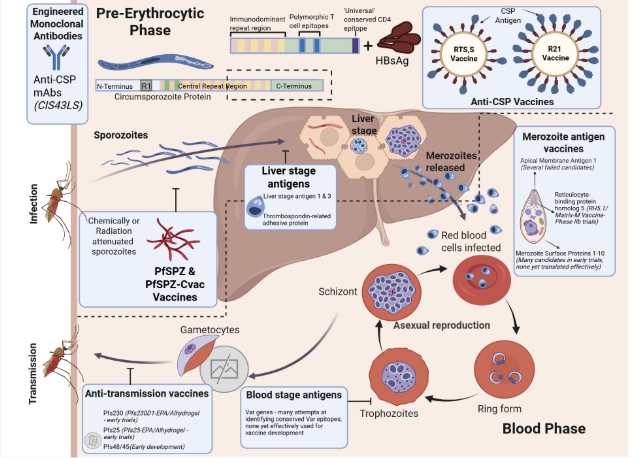
(a) The multistage lifecycle of plasmodium species provides many other antigenic targets for vaccines
(b) Only the spike protein is suitable antigenic target for malaria
(c) Hemaglutinen and neuramidase are both good antigenic targets for malaria
(d) All life stages need to be targeted simultaneously for malaria control
(a) The multistage lifecycle of plasmodium species provides many other antigenic targets for vaccines
Microbes are key to genetic engineering which of the following?
(a) Plants
(b) Animals
(c) Humans
(d) All of these
(e) None of these
(d) All of these
The use of Agrobacterium to genetically engineer plants relies on which process?
(a) Conjugation
(b) Transduction
(c) Transfection
(d) Ballistic impact from the gene gun
(a) Conjugation
Which of the following is TRUE regarding vaccines?
(a) we have an efficacious vaccine for HIV
(b) there is an association between vaccines and autism
(c) while safe for most, vaccines are not safe for everyone
(d) measles has been eradicated so there is no need to vaccinate
(c) while safe for most, vaccines are not safe for everyone
What is true about horizontal gene transfer?
(a) takes place from mother to child
(b) only occurs between microbes
(c) only performed by scientists
(d) movement of genetic material from one organism to an organism other than its offspring
(d) movement of genetic material from one organism to an organism other than its offspring
How does genome editing differ from transgenesis?
(a) Genome editing deletes or modifies any genes
(b) Transgenics is the insertion of a gene from a different organism
(c) Only GMOs are made in the lab
(d) Genome editing only works in bacteria
(e) They are both the same thing!
(a) Genome editing deletes or modifies any genes
What would you need to edit a plant genome using CRISPR?
(a) plasmid DNA, bacterial cells
(b) agrobacterium and the gene of interest
(c) guide RNA, Cas9, DNA template
(d) ribosomes, RNA polymerase
(c) guide RNA, Cas9, DNA template
How is agrobacterium used to make a transgenic plant?
(a) Ti plasmid DNA containing the gene of interest is transformed into Agrobacterium
(b) All answers are correct
(c) The Ti DNA with the insert is transferred into the plant cell and incorporated into the chromosome of the plant
(d) Agrobacterium infects plant cells
(b) All answers are correct

