Power Electronics
 Studied by 2 people
 Call Kai
 Learn
Learn Practice Test
 Spaced Repetition
 Match
Match Flashcards
 Knowt Play
1/25

There's no tags or description
Looks like no tags are added yet.
Name | Mastery | Learn | Test | Matching | Spaced |
|---|
No study sessions yet.
26 Terms
List different application of power electronics devices
Resistance Fan Regulator - Uses variable resistor; required large space
Electronic Fan Regulator - Uses power semiconductor devices; remarkably smaller
CFL - Uses mercury (hazardous); requires ballast to regulate current; longer warmup time to reach full brightness
LEDs - Energy efficient and long lifespan; environmentally friendly; instant start with full brightness; Power electronics for efficient and safe operation, also enabling features like dimming
Linear power supply - Dissipates excess power as heat; large transformers, heat sinks and capacitors make it bulkier
Switched mode power supply - High-frequency switching for efficient power conversion; Smaller, lighter components due to advanced semiconductor technology
Why power electronics is highly efficient?
30V input → 5V output
Using a resistor causes heat dissipation
Replacing resistor with transistor still wastes power as heat
Operate the transistor as switch
The switch operates by quickly turning ON and OFF
Since it doesn’t waste energy as heat, the system is highly efficient

With a neat block diagram, explain power electronic system
Power converter: Uses semiconductor devices to convert power to the desired output levels
Control unit: Regulates the power converter for efficient, stable operation

Explain power semiconductor devices
Building blocks of power electronics
Highly efficient in handling large voltages and currents
Act as switches in power conversion units, enabling efficient energy management
They operate in two states:
ON (Conducting state): Switch closed
OFF (Blocking state): Switch opened
Explain the difference between ideal & practical states of power electronic devices?
Ideal Power Electronic switch: Features
Zero ON State resistance - No voltage drop; 0 conduction loss
Infinite OFF state resistance - No current flow; 0 blocking loss
Instantaneous Switching: Transition between ON and OFF occurs in no time; switching loss is 0
Practical Power Electronic switch: Features
Finite ON State resistance - voltage drop; power loss
Finite OFF state resistance - current leakage; power dissipation
Switching - Transition between ON and OFF takes a finite amount of time; turn on and turn off times results in switching losses
Give the classification of Power Semiconductor devices
Uncontrolled switches (Diode): Only allows current flow in one direction
Semi-controlled switches (Thyristors): Can be turned ON by a control signal and naturally turns OFF when current turns to zero
Fully-controlled switches (Power transistors [Power MOSFET,IGBT]) - Can be turned ON and OFF by control signals
What are the different semiconductor devices used in power electronics?

Give classification of power electronic converters.

Give applications of different power electronic converters.

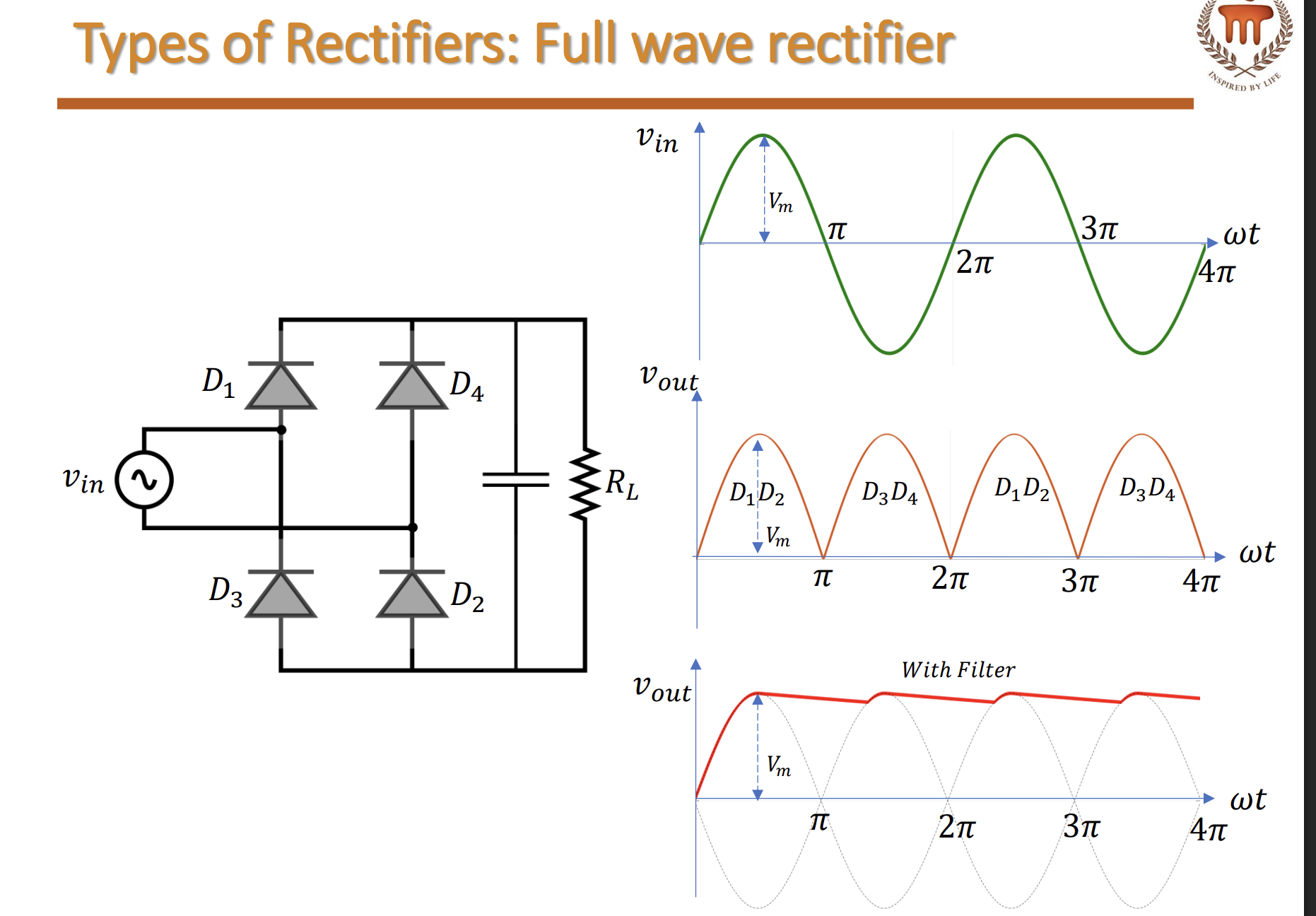
Explain rectifiers (AC-DC) along with their types. Give their applications also
or
Explain the operation of single-phase half-wave and full-wave rectifiers with the help of circuit diagrams and waveforms.
Converts AC from mains to DC
Types:
Single phase Half-wave rectifiers
Single phase Full-wave rectifiers
Three phase rectifiers
Applications: Power supplies for computers and other electronic devices


Explain choppers (DC-DC) along with their types. Give their applications also.
A DC-DC converter is an electronic device that converts direct current (DC) electrical power from one voltage level to another
Used to regulate voltage, improve efficiency and performance in various electronic devices
Types:
Buck Converters: Steps down the voltage.
Boost Converters: Steps up the voltage.
Buck-Boost Converters: Can step-up or step-down voltage
Applications:
Consumer electronics: Smartphones, LED lightnings, laptops, SMPS
Electric vehicles: Power management systems
Renewable energy systems: Solar inverters and battery chargers

Explain AC voltage regulators and cycloconverters (AC-AC). Give applications also.
Convert alternating current (AC) of one voltage level to another and/or modify its frequency
Types:
AC Voltage regulators: Converts fixed AC input voltage to variable AC output voltage but with constant frequency
Cycloconverters: Converts fixed AC input to variable AC output
Applications: Motor Drives

Explain Inverters (DC-AC) along with their types. Give applications also.
Converts AC back to DC
Types:
Square wave inverter: Generates a square wave output signal
PWM inverter (pulse width modulation): Modulates the width of the pulses to approximate a sine wave output.
Applications: Used in solar power systems, uninterruptible power supply (UPS) and electric vehicle

Describe power stages in Laptop and Desktops with diagram.
Power source (Laptop):
AC Adapter: Converts AC power to DC for the laptop
Battery: Provides portable power with management to control battery life
Power source (Desktop)
Power Supply Unit (PSU): Converts AC to multiple DC voltages
No battery backup: Relies on AC power, with an optional external UPS for outages
Power management unit (Laptop):
Manages power between AC adapter and battery
Optimizes power usage to conserve battery. Eg: lowers CPU speed when on battery power
Power management unit (Desktop):
No dedicated PMU
Power management is less critical due to no battery; focuses more on performance
DC-DC Converters and Voltage Regulation
Both use buck converter to step down voltage required by components
Voltage regulators provide stable power to components like CPU, GPU, and RAM.
Laptops use advanced power management to save energy, while desktops focus on delivering stable power.

Describe Linear Power Supply (LPS) with block diagram
Power supplies convert AC (Alternating Current) to DC (Direct Current) required by electronic devices
Linear Power Supply: It uses linear regulators (transistors operating in linear regions) to regulate the voltage
Step down transformer: Reduces AC voltage
Rectifier: Converts AC to DC
Filter: Smoothens the rectified DC
Regulator: Maintains constant output voltage regardless of variations in input voltage or load conditions

Commonly used linear voltage regulators include:
LM7805 - Provides a fixed +5V output
LM7812 - Provides a fixed +12V output
LM317 - Provides an adjustable voltage regulator

Describe Switch Mode Power Supply (SMPS) with block diagram
A Switch Mode Power Supply converts AC input into regulated DC output using high-frequency switching. The main blocks are:
AC Input: The supply receives AC from the mains.
Input Rectifier and Filter: The AC is converted into pulsating DC and filtered to reduce ripples.
High-Frequency Switch: A transistor turns ON and OFF at a very high frequency using PWM control to regulate how much energy is sent forward.
Power Transformer: The high-frequency pulses pass through a small transformer which steps the voltage up or down.
Output Rectifier and Filter: The transformer output is rectified again and filtered to produce smooth, stable DC.
Control Circuit: It senses the output voltage and adjusts the PWM duty cycle to maintain a constant, regulated output.
An SMPS is highly efficient because the switching device operates mostly in ON/OFF states, reducing power loss as heat.

Difference between LPS &SMPS
LPS:
Advantages:
Simple design
Low noise
Good regulation with minimal ripple
Disadvantages:
Inefficient (high heat dissipation)
Heavy and bulky due to transformers
Applications (used in low noise applications):
Audio equipment
Laboratory instruments
Medical devices
SMPS:
Advantages
High efficiency (less heat)
Compact and lightweight
Suitable for high power applications
Disadvantages:
Complex design
Higher noise due to switching
High EMI
Applications:
Computers and servers
Consumer electronics (TVs, laptops)
Telecommunication equipment
Industrial automation
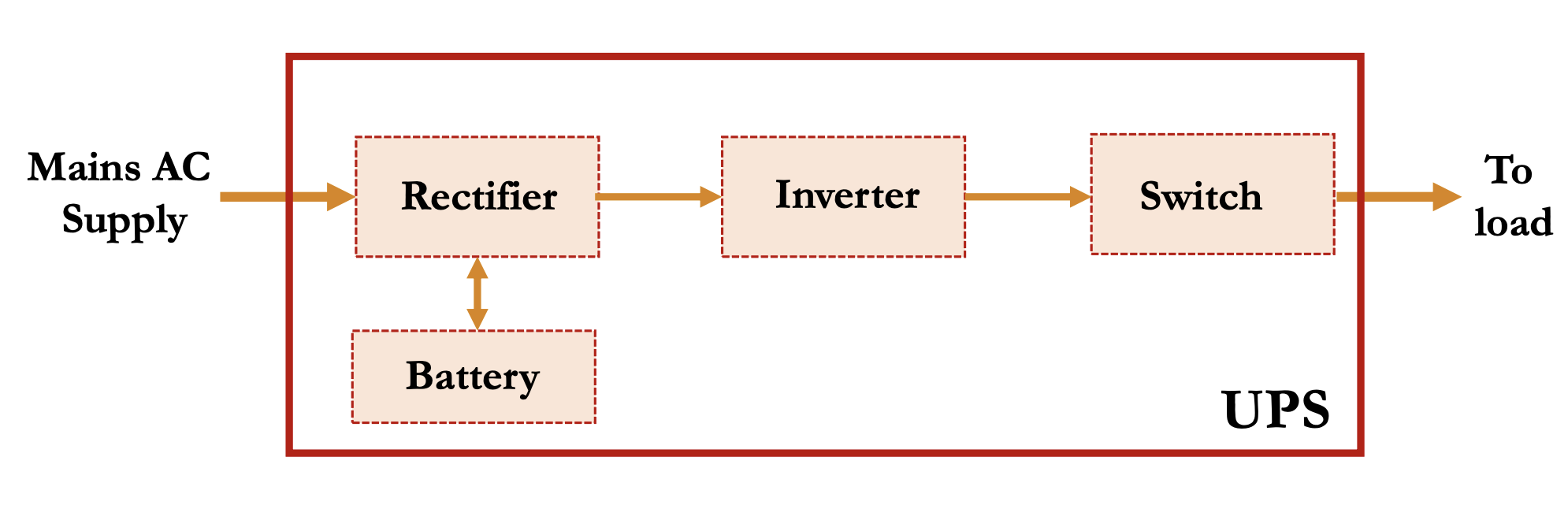
Describe Uninterrupted Power Supply (UPS) with block diagram
A device that provides emergency power to the load when the main power fails
Serves to protect electronic equipment and systems from power interruptions and/or fluctuations.
Eg: V-Gaurd, Eaton, Sorotek
Layout of a UPS:
Rectfier: Converts AC to DC to charge the battery
Battery: Stores energy to be used during power outage
Inverter: Converts stored DC back to AC to power the load
Switch: Transfers input power source
Explain different types of UPS.
Offline:
Stand by UPS: Offers basic protection with quick switchover to battery power.
Line-Interactive UPS: Corrects minor power fluctuations without switching to battery.
Online:
Double conversion UPS:
Offers highest protection
Continously powers the load from inverter ensuring clean and consistent power
Cost:
Offline - low to medium running cost
Online - high cost
Power rating:
Offline UPS: 1 kVA to 3 kVA
Online UPS: Upto 10 kVA (single-phase)
Online UPS: 0 kVA – several MW (three-phase)

What are the applications of a UPS
Computer and servers: Protects data and ensures smooth operation during power interruptions.
Telecommunication equipment: Maintains communication services during power outages
Medical equipment: Ensures uninterrupted operation of critical medical devices.
Industrial Control systems: Prevents downtime in manufacturing processes.
Home and office electronics: Provides backup for personal computers, modems, and other essential devices.
What are the advantages of EVs?
Reduced greenhouse gas emission
Energy efficiency
Increased use of renewable energy
Energy conservation through efficient battery management & regenerative braking
Explain EV with the help of block diagram.
Battery Charging Unit (AC-DC): Converts the AC power from charging stations into DC power to store in the battery
Battery Pack: The battery pack is the main energy source of the EV. It stores DC power and supplies it to the motor, auxiliaries, and other systems
Battery Management System: Monitors voltage, temperature and ensures safe operation
DC-DC converter: Converts high battery voltage DC to lower voltage levels for auxiliary systems like lighting, sensors, dashboard electronics etc. and power the controller
DC–AC Inverter (Traction inverter): Converts battery DC to controlled AC for the traction motor; sets torque and speed.
Motor/Generator: Drives the vehicle during motoring; during braking it acts as a generator and sends energy back through the inverter to the battery (regeneration), under BMS limits.
Controller: The controller manages the inverter and coordinates the motor’s operation. It regulates power flow during driving.
Mechanical transmission with differential gears: Matches motor output to the wheels and splits torque to left/right.

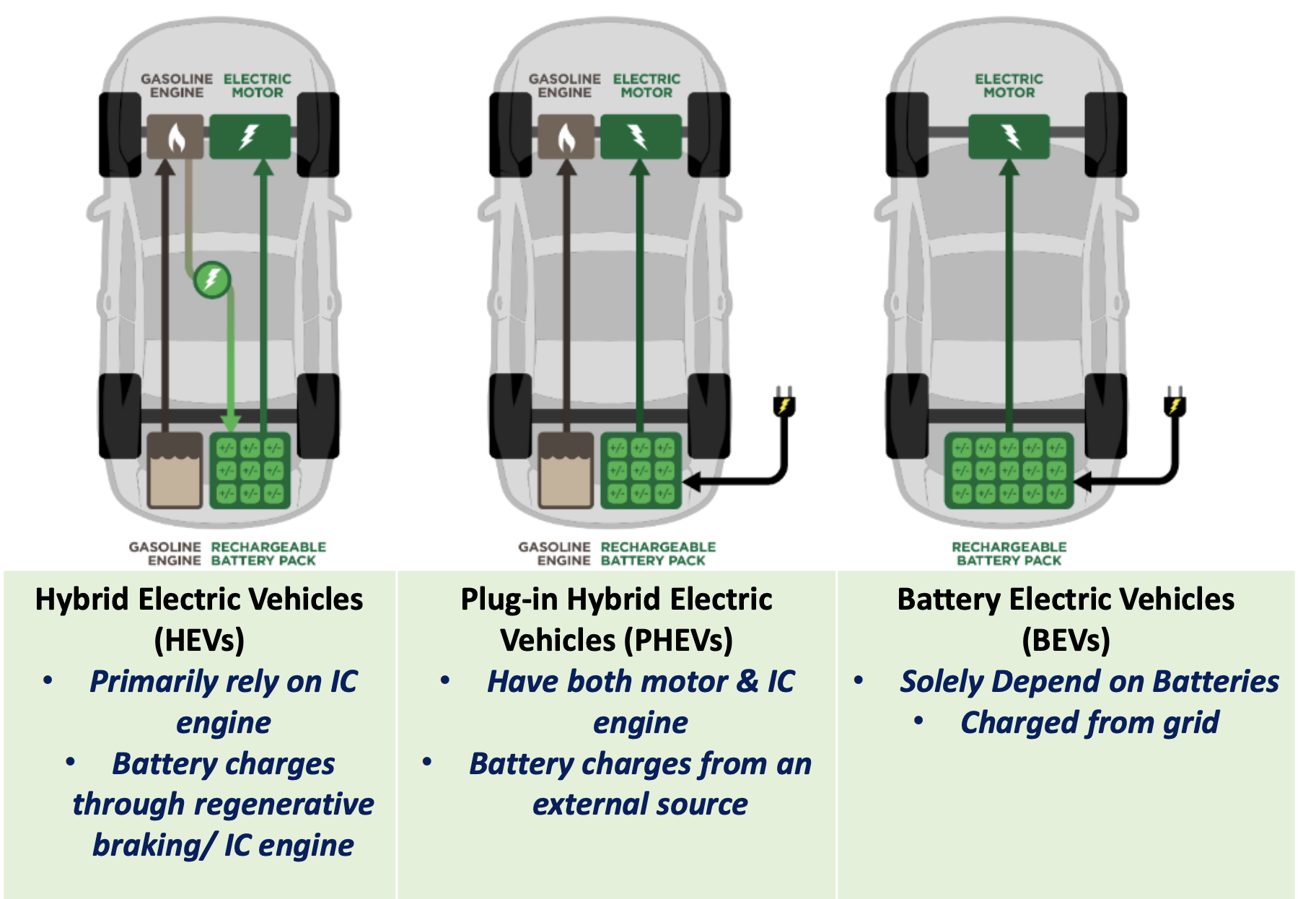
List the types of EVs
List the challenges associated with EVs
Charging stations
Consumer perception
Initial cost
Maintenance and repairs
Battery technology and range
Supply chain issues
Battery disposal and recycling
Safety and reliability
Policy and regulation

Government support in EV
FAME India scheme: Provides subsidies for EV purchases and supports charging infrastructure.
State Level Incentives
Charging Infrastructure Development
Production-Linked Incentive (PLI)
Registration relaxations (Do not require Registration):
Bicycles and E-bikes (up to 250 Watts & 25km/h)
Electric Scooters & Electric Skateboards (under a certain speed or power limit)
Personal Mobility Devices (electric unicycles or hoverboards)
India aims for EVs to comprise 30% of total vehicle sales by 2030
List the Emerging EV Technologies.
Wheel hub motors: Motors placed inside the wheels for direct drive and improved efficiency
Solid-state batteries: Safer batteries with higher energy density and faster charging.
Vehicle-to-Grid (V2G) technology: Allows EVs to send power back to the grid when needed.
Wireless charging: Charges the EV through electromagnetic induction without cables.
Autonomous driving: Uses sensors and AI to enable self-driving functions in EVs.
Smart charging solutions: Adjust charging based on grid load, electricity price, and user needs.
 Note
Note  Flashcards (34)