fuck evo bio fr i hate this mf i HATE HIM
 Studied by 0 people
 Call Kai
 Learn
Learn Practice Test
 Spaced Repetition
 Match
Match Flashcards
 Knowt Play
1/22

There's no tags or description
Looks like no tags are added yet.
Name | Mastery | Learn | Test | Matching | Spaced | Call with Kai |
|---|
No analytics yet
Send a link to your students to track their progress
23 Terms
Primates- origin, sister order, characteristics, diversification
Order of mammals that contains 145 species
Most recent common ancestor of ALL primates lived 80 MYA
sister order = Scandentia
Arboreal and tropical, stereoscopic color vision, bony orbits to protect eyes, and large brains relative to body
Diverged into lemurs/lorises, Tarsiers, New-world monkeys and old world monkeys
New World Monkeys vs. Old World Monkeys
New world monkeys- Platyrrine monkeys
Old world minkeys- Catarrhine monkeys, includes cheek pouch monkeys, apes and humans (Hominoidea) , and leaf eating monkeys
Hominidae split from Old World Minkey 30 MYA
Describe Homonoidea ,Hominidae and Homininae, what each includes and their relationship to eachother
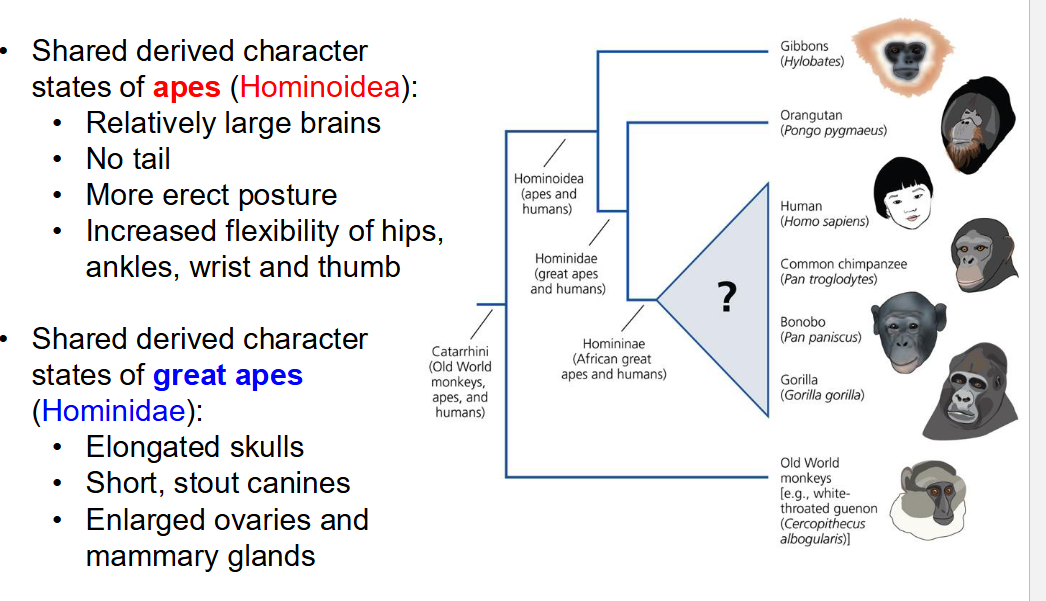
List genuses in the Hominidae clade (great apes) Which is NOT an african great ape? Which are part of the Homininae clade?
Orangutangs (Pongo) (NOT african great ape)
Gorilla (gorilla)
Chimp (Pan)
Bonobo (Pan)
Human (Homo)
All other genuses are part of the homininae clade
Species of Orangutangs
Borean
Sumatran
Tapanuli
Describe habitual brachiation and which genuses do it?
Swinging from tree branches to move around
All great apes did this (Pan, Homo, Gorilla, Pongo)
Describe the Pan genus
closest relative of homo sapien (split 5.5 MYA)
Chimpanzees- extended childcare, use of tools, feed and sleep in trees but otherwise on ground, polygamous and highly social
Bonobos- live in Congo, less violent, resources controlled by females in hierarchical bands, standing is inherited by mothers’
Describe Gorilla genus
two types; western and eastern
live in small male-dominated groups
Males 2x big as females
How are humans unique from other apes?
Slow and weak
bipedal
culture and language
Huge brains
Why did intermediate steps in hominin evolution occur? What characteristics evolved first/last?
Change in diet as a result of climate change (less fruits available)
Bipedalism, large brains, small teeth
Define Hominin
Any species more closely related to human than chimps
Describe Homonin transition to bipedalism, small brai andsmall teeth and the distinct genuses/ species involvd
Sahelanthropus- earliest common ancestor of chimps and humans, flat face and small brain
Ardipithecus- first MOSTLY bipedal primate, still had grasping thumb, long face and long neck and arms BUT neck was attached to bottom of skull, had SMALL TEETH and open pelvis (one of earliest homonins)
Australopithicus- FULLY bipedal homonin, but was capable of walking and climbing, think LUCY
Appearance of Homo genus- flat face large brain, stone tools (Homo habilis and Homo rudolfensis) “transitional hominins”
Homo erectus and homo neanderthal- “premodern humans”, erect, flat face, large brain and longer legs, made for migration and traveled out of Africa and into Europe and Asia
Homo sapiens- 0.2 MYA, largest brains and tallest, anatomically modern human
Describe the two models for the origin of H. sapien, which one is correct?
African replacement moddel- H. sapien emerged in africa and colonized each region, replacing other lineages
Multiregional evolution- H. erectus and descendants colonized each region and H. sapien was the result in each one (gene flow within regions)
Most support African Replacement model
Describe genetic divrsity among human populations on a small vs large scale
Genetic diversity is more significant WITHIN populations than between populations
“Racial” differences are less genetically significant
Migration in a continent-island system equation
change in p = m(pm-P)
change in p= change in allele frequency on island
p = allele frequency on island before migration
m= migration rate
pm= allele frequency on continent
eventually p=pm and the two will be in equilibrium
What does genetic drift do in a population?
fixes non-heterozygous genotypes and either dominant or recessive allles
probability that alelle will be fixated = allele frequency in current population
How to predict heterozygosity in next generation
remember to use effective population size and raiseto the power of t (time)
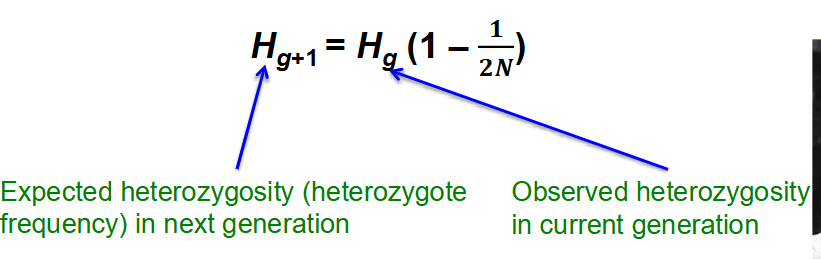
Effect of drift vs effect of flow
OPPOSITE
Gene flow diversifies and drift fixates!
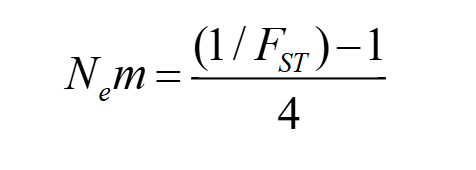
Fst and migration rate
Ne= effective population size
m= migration rate
Selection differential vs responseto selection
Selection differential
S= trait mean after selection - trait mean before selection
how the CURRENT population is affected by selection
Response to selecytion
difference between generations after selection event
R is always smaller than S!!!
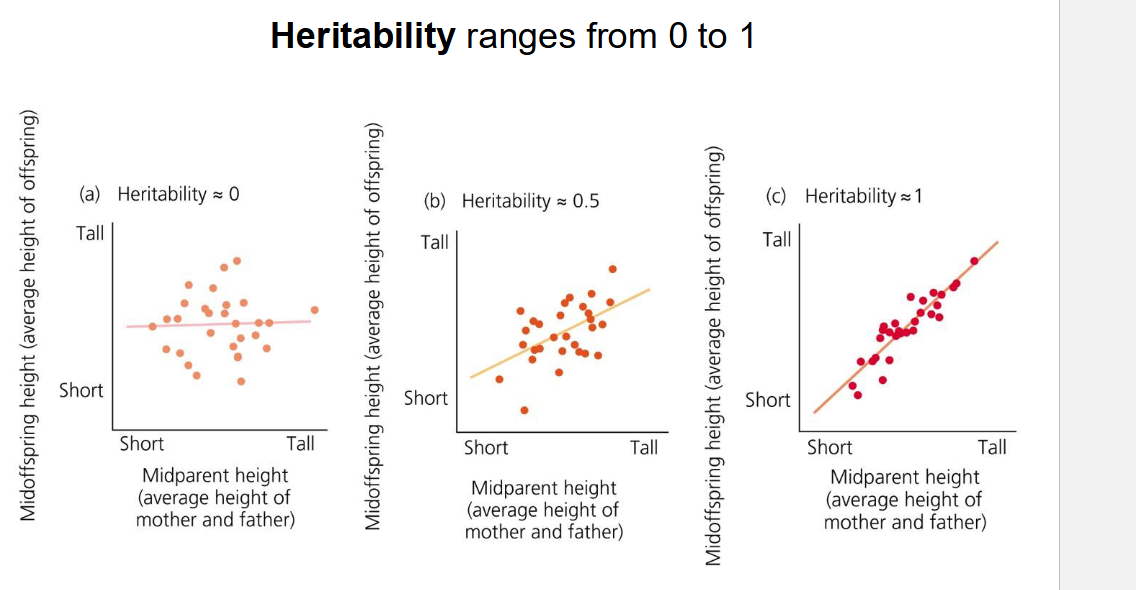
Breeders equation purpose and variables
predict outcome of evolution using heritability
S x H = R
Heritability ranges 0-1, the clearer the slop of the line, the higher the heritability
Equillibrium frequency equation

How to tell when selection or drift will be favored
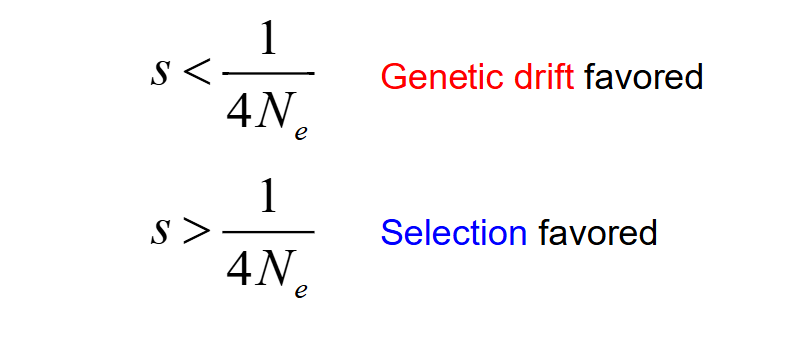
 Note
Note  Flashcards (20)