Fungal animal interactions, fermentation, slime molds, and chytrids
 Studied by 0 people
 Call Kai
 Learn
Learn Practice Test
 Spaced Repetition
 Match
Match Flashcards
 Knowt Play
1/45

There's no tags or description
Looks like no tags are added yet.
Name | Mastery | Learn | Test | Matching | Spaced | Call with Kai |
|---|
No analytics yet
Send a link to your students to track their progress
46 Terms
Leaf cutter ants (Attine ants) and their fungal garden
Leaf-cutter ants are the dominant herbivore in Neotropical forests
• They eat a wide diversity of plants
• They remove 15-20% of vegetation
• They can be serious agricultural pests
• They depend on fungal gardens to live!
What types of fungi do attine ants cultivate?
Leucoagaricus with special adaptions for feeding ants. They have swollen cells called gongylidia. Most ant species destroy the fruiting bodies before they occur.
How do attine ants manage the fungus gardens when they are attacked by specialized parasites in the genus Escovopsis?
The ant harbor actinomycetes (filamentous bacteria in the genus pseudonocardia) in special glands. The apply the bacteria to the nest to control the Escovopsis parasite.
What is another association that is similar to the attine ants?
Termites and Termitomyces (the largest edible mushroom!)
Old World termites in subfamily Macrotermitinae always
associate with Agaricales genus Termitomyces
• Instead of protist endosymbionts like some termites, Macrotermitinae build “combs” from their “pseudofeces” and cultivate fungi
• The fungi are allowed to fruit and transmission can be horizontal or vertical.
• Sometimes colonies will cultivate several Termitomyces spp.
Ambrosia beetles and their fungal association.
There are many polyphyletic ambrosia beetles that cultivate fungi, also polyphyletic. Some include, Ophiostomatales, Microascales, Hypocreales, and basidiomycete.
Fungi that trick arthropods
Saprobric fungus Fibularhizoctonia (Atheliales) forms sclerotia that grow in nests of termites (genus Reticulitermes).
• The fungus uses physical and chemical camouflage to trick the termites into stacking the sclerotia with their eggs
• Association may benefit termite eggs (antibacterial, antifungal?) as higher survival observed when eggs were stacked with sclerotia. However, fungus causes termites to spend energy tending sclerotia instead of eggs (& sometimes the fungus eats the eggs!)
• The fungus benefits from competition-free environment
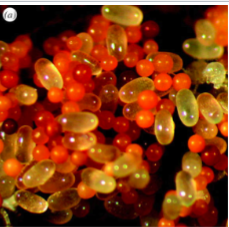
Fungal farming by a snail
Intertidal snail Littoraria irrorate grazes live grasses (Spartina) - mostly to prepare the leaves as a substrate for fungi ( Phaeosphaeria& Mycosphaerella). Creates and maintain wounds on the grass and then deposits feces to increase fungal colonization!
Fungal mimics that trick insects
Some species of Uromyces (Pucciniomycotina) make “pseudoflowers” on Euphorbia spp. The pseudoflowers prevent the plant from flowering, and lure insects with drops of honeydew!
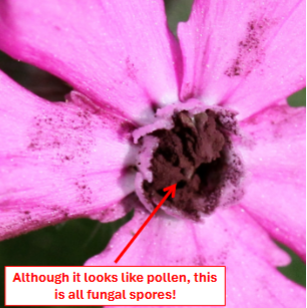
Another group of Pucciniomycotina, the Microbotrytales (‘anther smuts’) resemble pollen.
These are flower parasites spread by insects.
Chytridiomycosis
Batrachochytrium dendrobatidis has caused the decline of over 200 species of amphibians worldwide (+ several proven extinctions).
Evidence of multiple lineages – most deadly one was probably a hybrid that has been moved worldwide by humans. Recently, second species Batrachochytrium
salamandrivorans have been found to cause lethal skin infections in salamanders
White-nose syndrome of Bats (WNS)
Pseudogymnoascus destructans psychrophilic fungus that can grow at 4°C
• Infects skin of the muzzle, ears, and wings of hibernating bats
• Only one mating type in North America
• Originated in Europe / Asia
Snake Fungal Disease (SFD)
Caused by ophidiomyces ophiodiicolda (onygenales) multiple introduction events
Cavity excavation symbiosis
Red cockaded woodpeckers (RCW) carry fungal communities similar to those found in their excavations. They facilitate fungal colonization by making a hole in a tree and by transmitting fungi to their cavity starts.
Mycophagy
Mammal mycophagy is well known in the Northern Hemisphere and Australia. Birds squirrels and hogs.
How do fungi eat?
Fungi are heterotrophs. They use absorptive nutrition (osmotrophy)
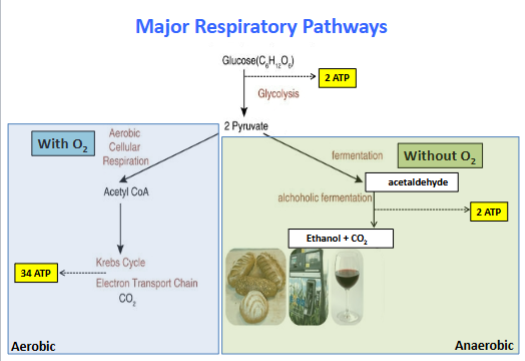
What are the two ways fermentation can be used?
1. Officially, fermentation refers specifically to ethanol fermentation – an anaerobic metabolic process which converts sugar to ethanol & CO2
2. Loosely, the term refers to “using microbes and their metabolic processes to make foods healthier, safer, or easier to digest.”
What are the major respiratory pathways for Saccaromyces cervisiae?
It can grow aerobically and anaerobically. It outcompetes other microbes in anaerobic high-sugar conditions.
What are other fermentation drinks?
Kasiri, sake, Parakari
Labyrinthules
Net slime molds.Occur mostly in freshwater and marine habitats
• Amoeboid cells attached and sheathed in a slime network
• Feeding by absorption
• Zoospores with 2 flagella (1 whiplash, 1 tinsel)
• Feeding on microbes and/or on plant material
• 2 important disease problems. Rapid blight on turf, caused by watering with salty water. Eelgrass wasting disease.
Slime Molds: Fungal-like organisms that
Studied with fungi for several reasons:
• traditionally studied by mycologists
• morphological similarities to fungi = spores
• Ecological similarities to fungi = hetereotrophy
• often found in same habitats as fungi
• Once people find out you know something about fungi.... they will bring you samples!
Why are slime molds distinct from fungi in several important ways?
Vegetative state is not hyphae or yeast – instead an amoeba or plasmodium
• When present, flagellated stages have two flagella (unlike true fungi)
• Amoeba or plasmodia feed by ingestion (phagocytosis) rather than absorption
What are the 3 main groups of Mycetoza?
Dictyostelids (cellular slime molds), Myxogastrids (plasmodial slime molds), and Protostelids (“micro” plasmodial slime molds.
How do Dictyostelids spend their life?
They are called cellular slime molds because they spend most of their lifecycle as amoeba. They can move freely in moist habitats and they eat bacteria, yeast cells, fungal spores, algae… They injest food and digest internally (like animals, not like fungi)
What happens when the amoeba run out of food?
They aggregate together to form a pseudoplasmodium. Once aggregated together, they are encased in a cellulose sheath and look like a slug. The name for this stage is a slug or grex. The slug migrates toward a location with optimal conditions for spore dispersal.
What type of fruiting body is formed by a Dictyostelids?
They for a sorocarp. It has a stalk and the spore mass. The stalk cells die and will not reproduce and then germinate as amoeba.
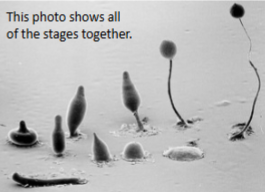
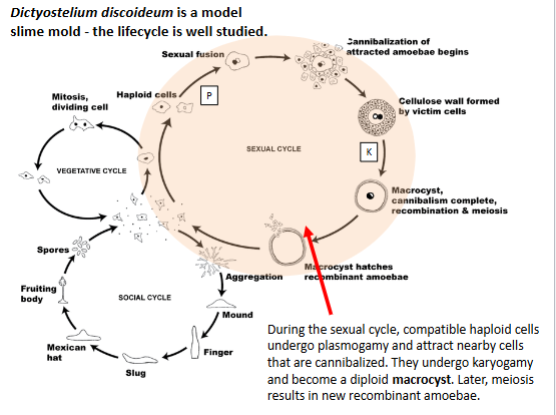
Lifecycle of Dictyostelium
Has a vegetative cycle, social cycle, and a sexual cycle. In the sexual cycle, it undergoes plasmogamy and karyogamy.
Myxogastrids or plasmodial slime molds
The most visible stage is a plasmodium. A plasmodium is a huge cytoplasm with many nuclei. Can be many colors and sizes. The most diverse group with 1000+ species. Can form SPOROCARPS.
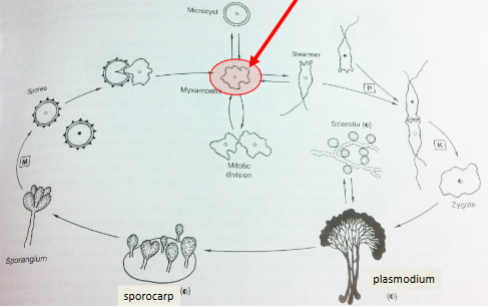
What is the lifecycle of a typical plasmodial slime mold?
Majority of lifecycle is a haploid microscopic amoeba (myxamoeba) that reproduces asexually. Myxamoeba feed by phagocytosis (they ingest bacteria, yeasts, and other organic materials)
What are the four main types of sporocarps formed by myxamoeba?
Sporangium, Plasmodiocarp, Aethalium, and Pseudoaethalium. They also have ornamented spores.
Protostelids or “micro” plasmodial slime molds
Form plasmodia and some species can also form swarmers. These are challenging because they are mostly microscopic but they are common in all terrestrial biomes across the globe.
What are specialized fungal parasites of slime molds?
Nectriopsis exigua (Hypocreales) and Stilbella byssiseda (Hypocreals)
Chytrids
Reduced or simple fungi, generally “single-celled”, but with structures
• Reproduce by posteriorly flagellated zoospore. Retained mobility from opisthokont (animals + fungi) ancestor
• Cell wall with chitin produced upon encystment. Zoospore finds suitable substrate. Retracts flagellum
• Thallus produces zoosporangium (-a), which releases more zoospores upon maturation
Chtrid Morphology
Zoospore-Cell membrane lack ergosterol, single posterior flagellum, traditionally considered haploid but new studies suggest diploid or polyploid
Thallus type-Holocarpic and Eucarpic
Rhizoids- Eucarpic chytrids have rhizoids. Absorptive, adhesive vegetative growth, holds to substrate. Rhizoids lack septa & nuclei. May originate from one axis or multiple axes on zoosporangium
Zoosporangium- Cell wall composed of chitin. Cytoplasm cleaved into individual zoospores. Papillae=site of zoospore discharging. Monocentric and Polycentric
Operculum- Lid-like cap on zoosporangium, trait evolved multiple times, still useful for identification.
Life Cycles
Reproduction may be sexual or asexual reproduction. Sexual reproduction by anastomis ofrhizoids or zoosporangia or zoosporic function. Resting spores = the outcome of mating. Sexual reproduction is rare or unknown for many taxa.
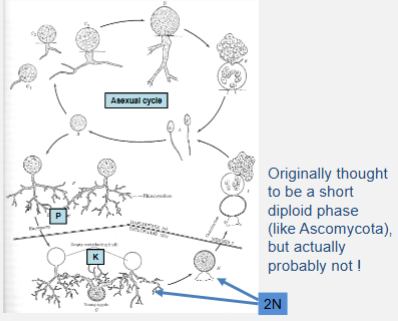
Typical Chytridmycota Life Cycle
Includes Neocallimastigales
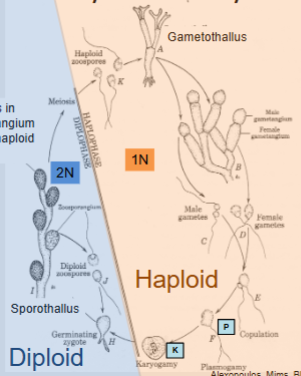
Blastocladiomycota life cycle
Meiosis occurs in resistant sporangium and releases haploid gametes. Alternation of generations is more similar to the lifecycles of mosses than to most other fungi!
What is the ecological significance?
They are saprobes, ruminant symbionts, pathogens of plants, invertebratesm Fungi and fungi and amphibians.
Saprobic chytrids
found in most habitats, but are low in abundance. Apparently outcompeted by Dikarys and zygos. They are more dominant in wet, “barren” soils
What are ruminant symbionts called?
Neocallimastigales. Single or multiple flagella on one zoospore
• Anaerobic – possess reduced mitochondria called hydrogenosomes
• Disrupt cellulose-based substrates, opening niches for other gut flora
• Aid ruminant digestion by producing cellulases and xylanases
• Evidence of horizontal gene transfer from bacteria to facilitate anaerobic lifestyle
What are some plant pathogens caused by chytrids?
Physoderms spp. aquatic and semiawuatic plants or wet maize. Synchytrium spp. ecocnomically significant, 200+ species cause potato wart disease.
What two fungi cause algae pathogens?
Chytridiomycota and blastocladiomycota
What are invertebrate pathogens?
Mainly cause by blastocladiomycotaa. Polycaryum laeve infects water flea (Daphina)
What is the unique one that has a two host lifecycle?
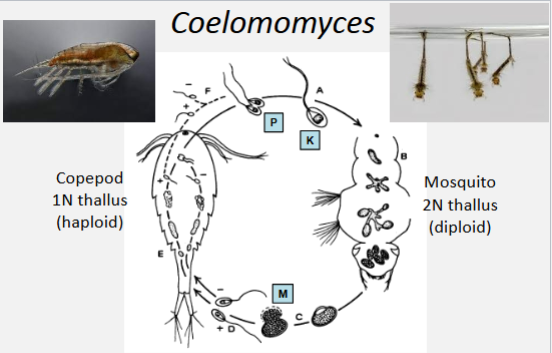
The Coelomomyces infects mosquito larvae and alternate host is copepod (crustacens). It could potentially work as biocontrold, however it cannot be grown commercially.
What has caused the global decline of amphibians worldwide?
Batrachochytrium dendrobatidis (Bd) aka Chytridiomycosis. Infection of kertinized epidermal tissue of amphibians. All new data points to an Asian orgin for the genus.
What are some parasites of Fungi and fungi?
Septosperma- Hyper-parasite of chytrids
Gaertneriomyces semiglobifer- Parasite of Entomophaga (Entomophthorales that kills gypsy moth.
Rozella - Internal parasite of chytrids and oomycets
Microsporidia
Chytrids gone bad? Obligate parasite of animals. Considered protozoans, but no obvious morphologial connections to fungi, but they do produce some chitin. No mitochondria, instead mitosomes and ATP stealing from the hosts. Related to the Rozellamycota/Cryptomycota lineage. Large host range including nematodes, insects, fish, crustaceans, and mammals. Wide range of symptoms.
What is the life cycle of Microsporidia?
Infective spore, polar tube eversion, infect host cytoplasm, growth, and maturation into spores.
 Note
Note  Flashcards (33)