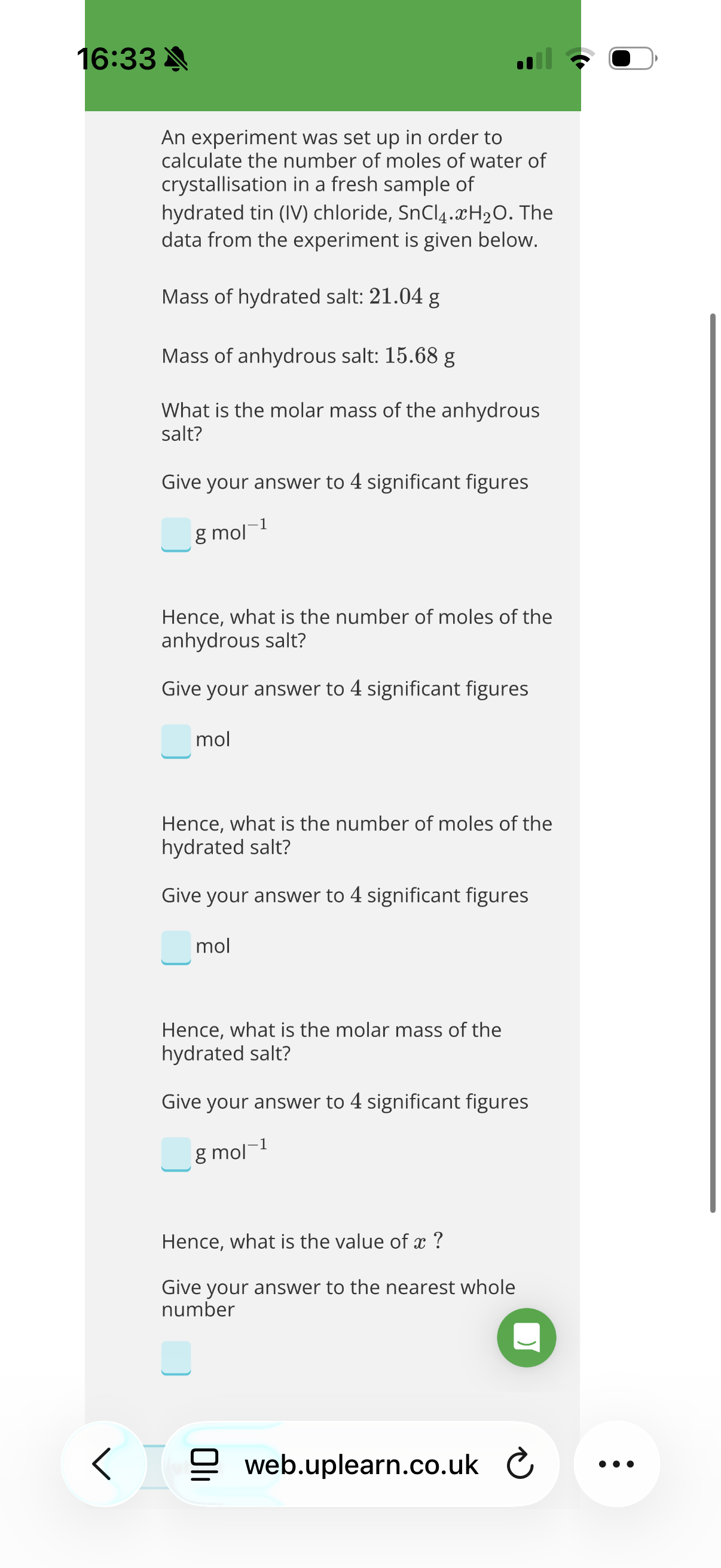
water of crystallisaton Calculations

0.0(0)
Studied by 0 people
call kaiCall Kai
learnLearn
examPractice Test
spaced repetitionSpaced Repetition
heart puzzleMatch
flashcardsFlashcards
GameKnowt Play
Card Sorting

1/13

encourage image

There's no tags or description

Looks like no tags are added yet.

Last updated 3:35 PM on 4/6/26
Name
Mastery
Learn
Test
Matching
Spaced
Call with Kai

No analytics yet

Send a link to your students to track their progress

14 Terms
1
New cards
<p><strong><span>The Molar Mass of Hydrated Salts:</span></strong></p><ol><li><p><span style="font-size: var(--ck-content-font-size);"><span>What is the molar mass of MgSO4?</span><span><br></span><span>Give your answer to 1 decimal place.</span><span><br></span><span>=g mol−1</span></span></p></li></ol><p>note:<span>Magnesium (Mg): 24.3</span></p><p><span>• Sulfur (S): 32.1</span></p><p><span>• Oxygen (O): 16.0</span></p><ol start="2"><li><p><span style="font-size: var(--ck-content-font-size);"><span>What is the molar mass of H2O?</span><span><br></span><span>Give your answer to 1 decimal place</span></span></p></li><li><p><span style="font-size: var(--ck-content-font-size);"><span>What is the molar mass of MgSO4.7H2O?</span><span><br></span></span></p><p class="sc-fQpSrZ sc-jrISjm fmbeOa jQioZF"><span style="font-size: var(--ck-content-font-size);"><span>The molar mass of MgSO4=120.4g mol−1 and the molar mass of H2O=18.0g mol−1</span></span></p><p class="sc-fQpSrZ bvYkPV"><span style="font-size: var(--ck-content-font-size);"><span>A: 120.4+4⁢(18.0)g mol−1</span></span></p><p class="sc-fQpSrZ bvYkPV"><span style="font-size: var(--ck-content-font-size);"><span>B: 7⁢(120.4)+18.0g mol−1</span></span></p><p class="sc-fQpSrZ bvYkPV"><span style="font-size: var(--ck-content-font-size);"><span>C: 120.4+18.0g mol−1</span></span></p><p class="sc-fQpSrZ bvYkPV"><span style="font-size: var(--ck-content-font-size);"><span>D: 120.4+7⁢(18.0)g mol−1</span></span></p></li></ol><p class="sc-fQpSrZ bvYkPV"></p><ol start="4"><li><p class="sc-fQpSrZ bvYkPV"><span style="font-size: var(--ck-content-font-size);"><span>What is the molar mass of CuCl2.2H2O?</span><span><br></span><span>Give your answer as a number to one decimal place.</span></span></p></li></ol><p class="sc-fQpSrZ sc-jrISjm fmbeOa jQioZF">note:<span>• Copper (Cu): 63.5</span></p><p><span>• Chlorine (Cl): 35.5</span></p><p><span>• Hydrogen (H): 1.0</span></p><p><span>• Oxygen (O): 16.0</span></p><p></p><ol start="5"><li><p><span style="font-size: var(--ck-content-font-size);"><span>In terms of x, what is the molar mass of MgSO4.⁢xH2O?</span><span><br></span></span></p><p class="sc-fQpSrZ sc-jrISjm fmbeOa jQioZF"><span style="font-size: var(--ck-content-font-size);"><span>The molar mass of MgSO4=120.4g mol−1 and the molar mass of H2O=18.0g mol−1</span></span></p><p><span style="line-height: 0.75rem;"><span>Correct answersYour answers</span></span></p><p class="sc-fQpSrZ bvYkPV"><span style="font-size: var(--ck-content-font-size);"><span>A: 120.4+x⁢(18.0)g mol−1</span></span></p><p class="sc-fQpSrZ bvYkPV"><span style="font-size: var(--ck-content-font-size);"><span>B: x⁢(120.4)+18.0g mol−1</span></span></p><p class="sc-fQpSrZ bvYkPV"><span style="font-size: var(--ck-content-font-size);"><span>C: 120.4+18.0+x g mol−1</span></span></p><p class="sc-fQpSrZ bvYkPV"><span style="font-size: var(--ck-content-font-size);"><span>D: 120.4+18.0g mol−1</span></span></p></li></ol><p class="sc-fQpSrZ bvYkPV"></p><ol start="6"><li><p class="sc-fQpSrZ bvYkPV"><span style="font-size: var(--ck-content-font-size);"><span>The molar mass of CaCl2.⁢xH2O is equal to...</span></span></p><p class="sc-fQpSrZ bvYkPV"><span style="font-size: var(--ck-content-font-size);"><span>A: molar mass of CaCl2+x⁢(18.0)</span></span></p><p class="sc-fQpSrZ bvYkPV"><span style="font-size: var(--ck-content-font-size);"><span>B: molar mass of CaCl2+18.0</span></span></p><p class="sc-fQpSrZ bvYkPV"><span style="font-size: var(--ck-content-font-size);"><span>C: molar mass of CaCl2+x</span></span></p><p class="sc-fQpSrZ bvYkPV"><span style="font-size: var(--ck-content-font-size);"><span>D: molar mass of CaCl2+18.0+x</span></span></p></li></ol><p></p>

The Molar Mass of Hydrated Salts:

  1. What is the molar mass of MgSO4?
    Give your answer to 1 decimal place.
    =g mol−1

note:Magnesium (Mg): 24.3

• Sulfur (S): 32.1

• Oxygen (O): 16.0

  1. What is the molar mass of H2O?
    Give your answer to 1 decimal place

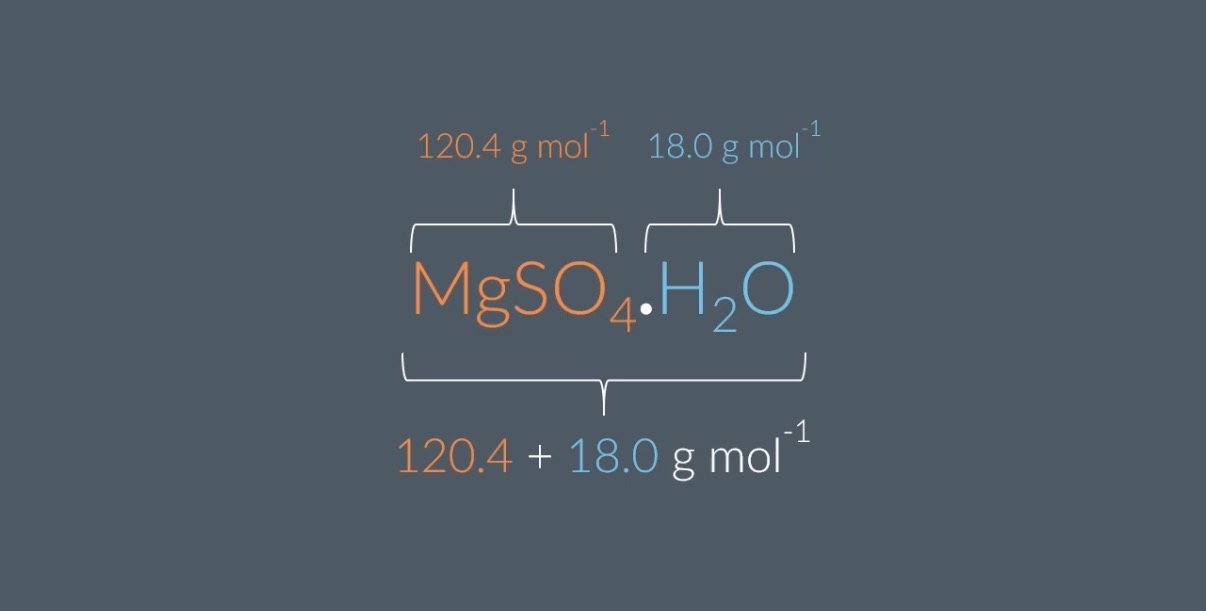
  2. What is the molar mass of MgSO4.7H2O?

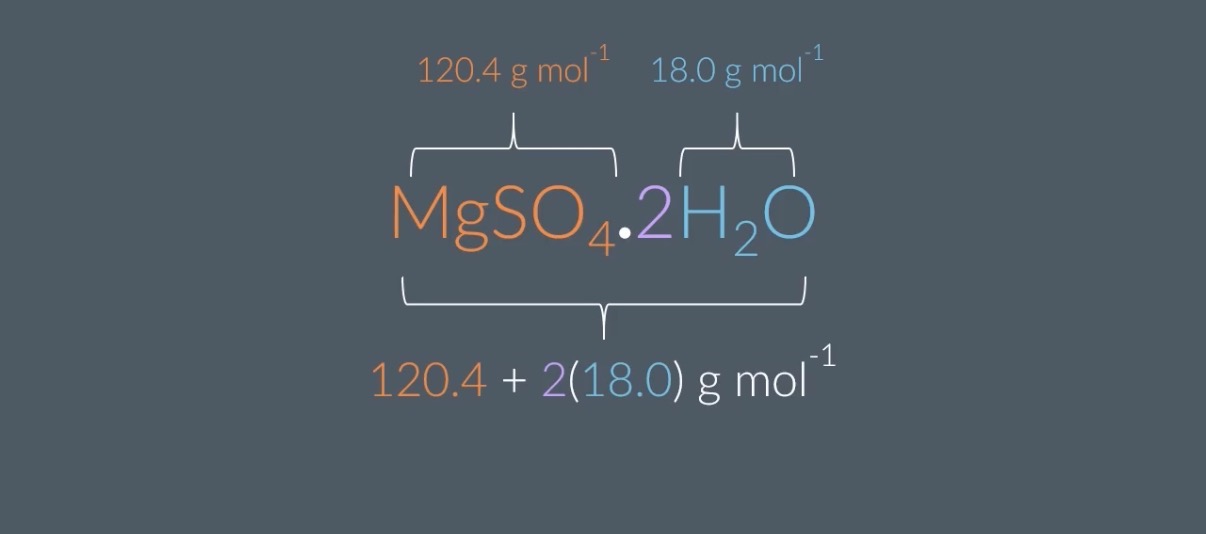
    The molar mass of MgSO4=120.4g mol−1 and the molar mass of H2O=18.0g mol−1

    A: 120.4+4⁢(18.0)g mol−1

    B: 7⁢(120.4)+18.0g mol−1

    C: 120.4+18.0g mol−1

    D: 120.4+7⁢(18.0)g mol−1

  1. What is the molar mass of CuCl2.2H2O?
    Give your answer as a number to one decimal place.

note:• Copper (Cu): 63.5

• Chlorine (Cl): 35.5

• Hydrogen (H): 1.0

• Oxygen (O): 16.0

  1. In terms of x, what is the molar mass of MgSO4.⁢xH2O?

    The molar mass of MgSO4=120.4g mol−1 and the molar mass of H2O=18.0g mol−1

    Correct answersYour answers

    A: 120.4+x⁢(18.0)g mol−1

    B: x⁢(120.4)+18.0g mol−1

    C: 120.4+18.0+x g mol−1

    D: 120.4+18.0g mol−1

  1. The molar mass of CaCl2.⁢xH2O is equal to...

    A: molar mass of CaCl2+x⁢(18.0)

    B: molar mass of CaCl2+18.0

    C: molar mass of CaCl2+x

    D: molar mass of CaCl2+18.0+x

  1. 120.4 g mol-1. 2. 18.0 g mol-1

    3.D

    1. 170.5 g mol-1 (Explanation

      Molar mass of CuCl2=134.5g mol−1

      Molar mass of H2O=18.0g mol−1

      Molar mass of CuCl2.2H2O=134.5+2⁢(18.0)= 170.5g mol−1

      5.A. 6.A

<ol><li><p>120.4 g mol-1. 2. 18.0 g mol-1</p><p>3.D</p><ol start="4"><li><p><span>170.5 g mol-1 (</span>Explanation</p><p class="sc-fQpSrZ bvYkPV"><span style="font-size: var(--ck-content-font-size);"><span>Molar mass of CuCl2=134.5g mol−1</span><span><br></span><span><br></span><span>Molar mass of H2O=18.0g mol−1</span><span><br></span><span><br></span><span>Molar mass of CuCl2.2H2O=134.5+2⁢(18.0)= 170.5g mol−1</span></span></p><p class="sc-fQpSrZ bvYkPV"></p><p class="sc-fQpSrZ bvYkPV">5.A. 6.A</p><p></p></li></ol></li></ol><p></p>
2
New cards

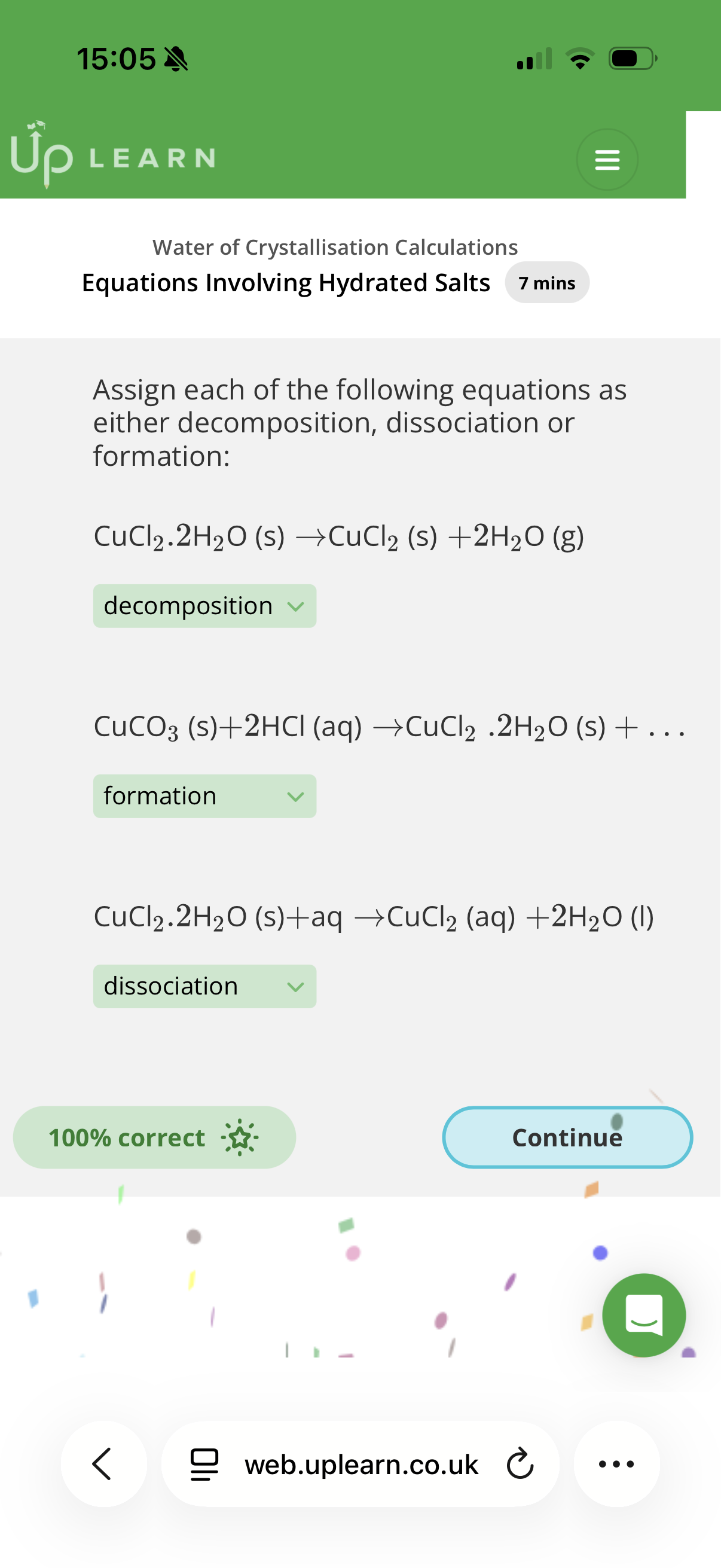
Equations Involving Hydrated Salts

  1. We can turn a hydrated salt into an anhydrous salt by…. (This is decomposition)

    Correct answersYour answers

    A: heating it gently

    B: heating it vigorously

    C: dissolving it in water

    D: adding a drying agent

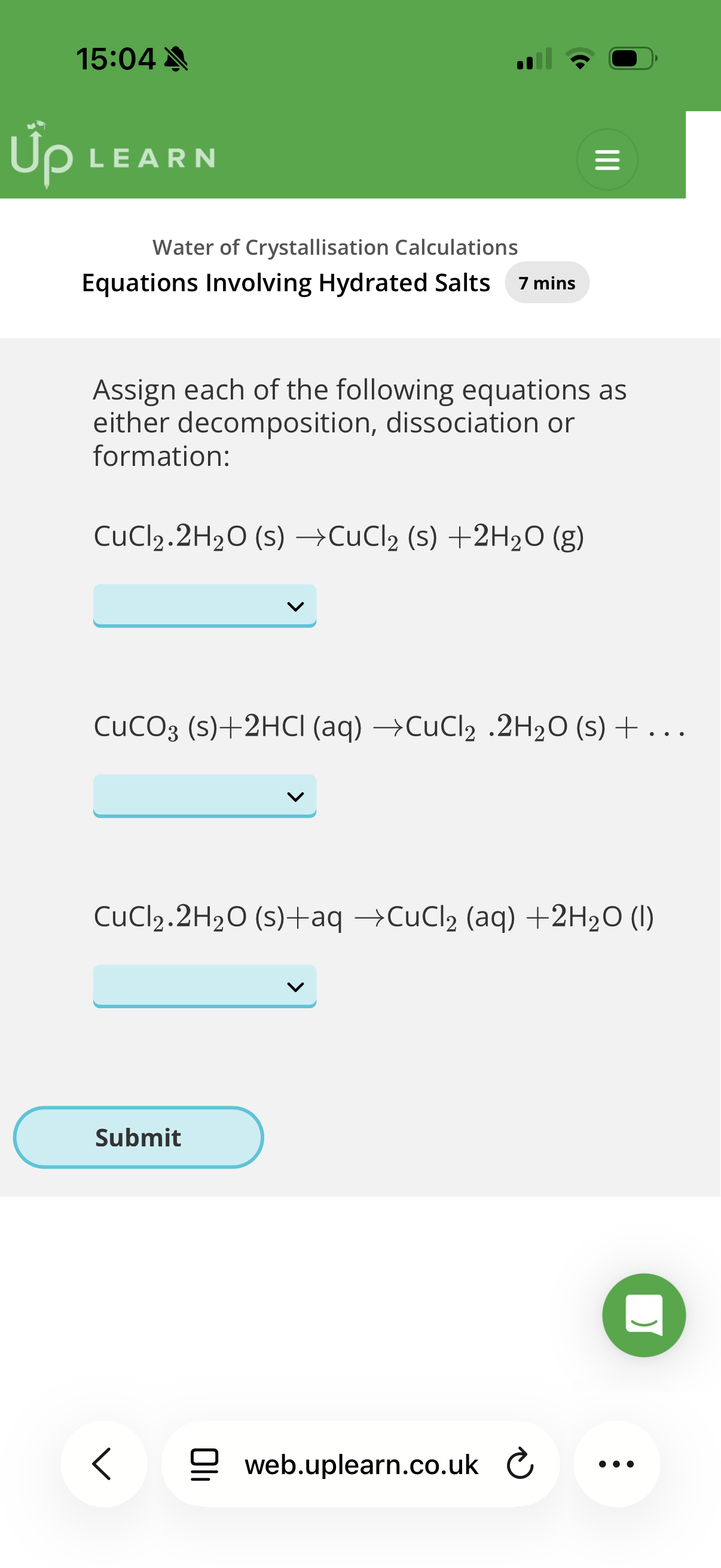
  2. Complete the equation for the decomposition of CuCl2.2H2O (s).

    Only include the products and state symbols in your answer

Dissociation

Write the complete equation for the dissociation(dissolving in water to seperate the water ions and CuCl2 ions) of CuCl2.2H2O (s).

Include state symbols in your answer

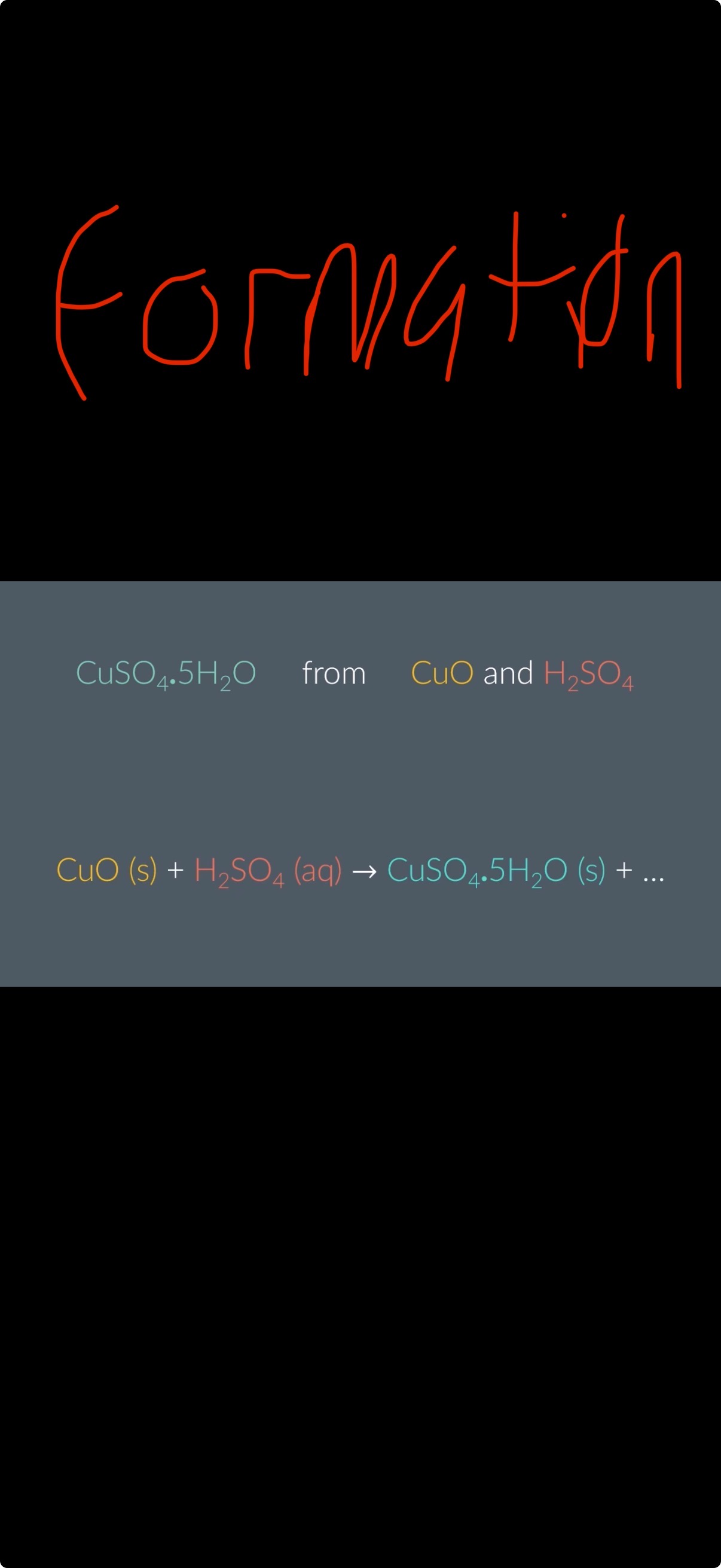
Formation

4.Which of the following reactions will form a salt…
A: Acid + metal

B: acid + metal oxide

C: acid + metal carbonate

  1. We represent forming CuCl2.2H2O (s) from CuCO3(s)and HCl (aq) like…

    Correct answersYour answers

    A: CuCO3(s)+2HCl (aq)→CuCl2.2H2O (s)+…

    B: CuCO3(s)+HCl (aq)→CuCl2.2H2O (s)+…

    C: CuCl2.2H2O (s)→CuCO3(s)+2HCl (aq)+…

    D: CuCl2.2H2O (s)→CuCO3(s)+HCl (aq)+…

    note: We just make sure the ions which form the salt are balanced, rather than focusing on balancing the whole thing.

  1. B (Gentle heating is not usually enough to remove the water of crystallisation)

    • C⁢u⁢Cl2(s)+2H2O⁢(g⁡)

      • C⁢u⁢Cl2∙2H2O⁢(s)+a⁢q→ C⁢u⁢Cl2(a⁢q) + 2H2O⁢(l)

      (note- The aq represents the dissociating in water)

  1. A,B,C (A-salt+hydrogen. B-Salt+water. C-Salt+water+CO2)

  2. A(The Chlorines and coppers are balanced on each side)
<ol><li><p>B (<span>Gentle heating is not usually enough to remove the water of crystallisation)</span></p></li><li><p class="sc-fQpSrZ bvYkPV"></p><ul><li><p><strong><span>C⁢u⁢Cl2(s)+2H2O⁢(g⁡)</span></strong></p></li></ul><ol start="3"><li><p></p><ul><li><p><strong><span>C⁢u⁢Cl2∙2H2O⁢(s)+a⁢q→ C⁢u⁢Cl2(a⁢q) + 2H2O⁢(l)</span></strong></p></li></ul><p>(note- The aq represents the dissociating in water)</p></li></ol></li></ol><ol start="4"><li><p>A,B,C (A-salt+hydrogen. B-Salt+water. C-Salt+water+CO2)</p></li><li><p>A(The Chlorines and coppers are balanced on each side)</p></li></ol><p></p>
3
New cards
<ol><li><p>Answer image q?</p><p>•At a level, there are 3 common types of reaction that contain hydrated salts which are…2?</p></li></ol><p></p>
  1. Answer image q?

    •At a level, there are 3 common types of reaction that contain hydrated salts which are…2?

  1. Decomposition, dissociation, formation
<ol start="2"><li><p>Decomposition, dissociation, formation</p></li></ol><p></p>
4
New cards
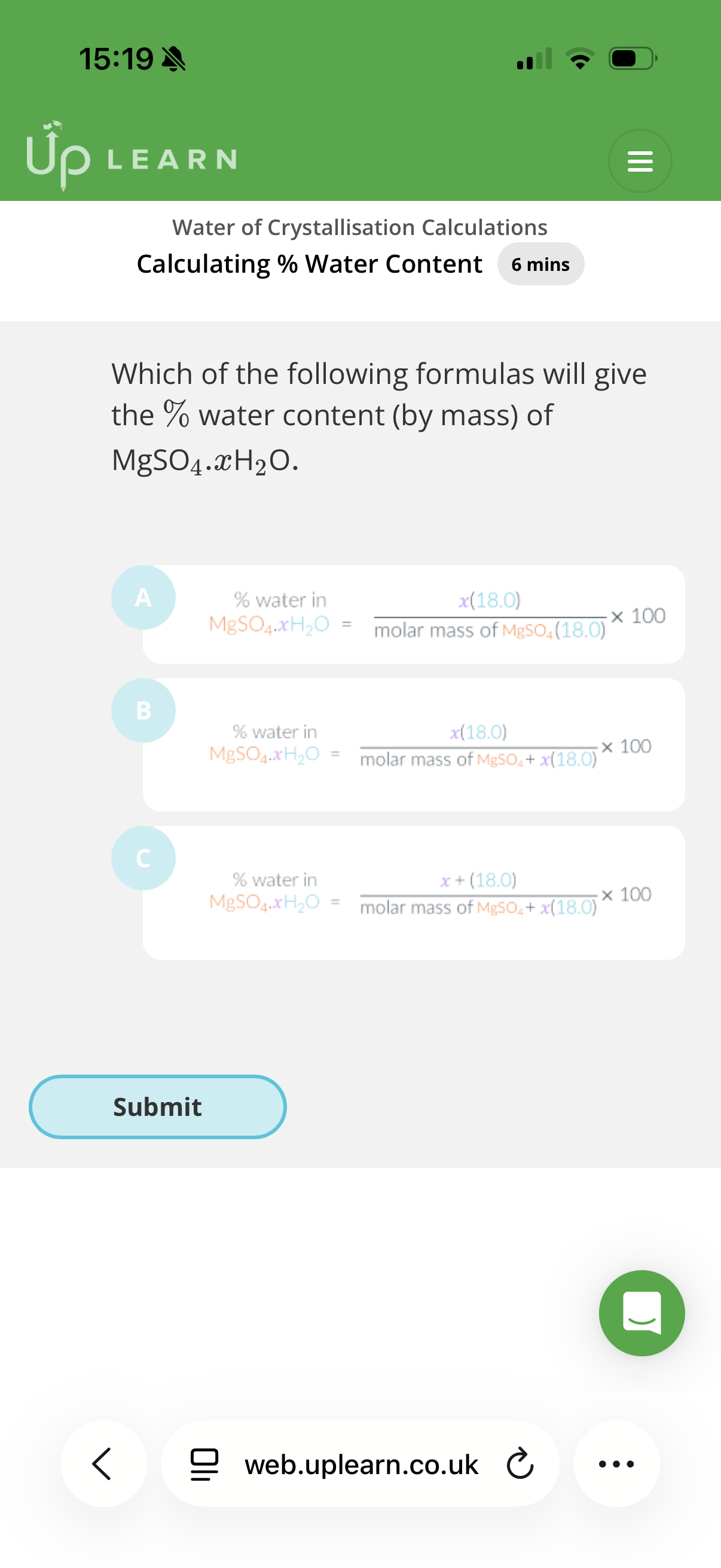
<p><strong><span>Calculating % Water Content</span></strong></p><ol><li><p><span style="font-size: var(--ck-content-font-size);"><span>The molar mass of CuSO4 is… </span><span><br></span><span>Give your answer to 1 decimal place</span></span></p></li></ol><p class="sc-fQpSrZ sc-ctNHci bvYkPV hgwtJz"><span style="font-size: var(--ck-content-font-size);"><span>The molar mass of H2O is…</span><span><br></span><span>Give your answer to 1 decimal place</span></span></p><p class="sc-fQpSrZ sc-ctNHci bvYkPV hgwtJz">Note:<span>Copper (Cu): 63.5</span></p><p><span>• Sulfur (S): 32.1</span></p><p><span>• Oxygen (O): 16.0</span></p><p><span>•Hydrogen (H): 1.0</span></p><p>(Image shows example of the % water content)</p><p>2.<span style="font-size: var(--ck-content-font-size);"><span>The percentage water content (by mass) of Na2CO3.10H2O is…</span><span><br></span><span>Note: </span></span><span>• Sodium (\text{Na}): 23.0 \text{g mol}^{-1}</span></p><p><span>• Carbon: 12.0 {g mol}^{-1}&nbsp;</span></p><p><span>• Oxygen : 16.0 {g mol}^{-1}</span></p><p><span>• Hydrogen ): 1.0{g mol}^{-1}</span></p><p class="sc-fQpSrZ sc-jrISjm fmbeOa jQioZF"><span style="font-size: var(--ck-content-font-size);"><span>Give your answer to 1 decimal place</span></span></p><ol start="3"><li><p class="sc-fQpSrZ sc-jrISjm fmbeOa jQioZF">Answer the image question that’s in the other side?</p></li></ol><p></p>

Calculating % Water Content

  1. The molar mass of CuSO4 is…
    Give your answer to 1 decimal place

The molar mass of H2O is…
Give your answer to 1 decimal place

Note:Copper (Cu): 63.5

• Sulfur (S): 32.1

• Oxygen (O): 16.0

•Hydrogen (H): 1.0

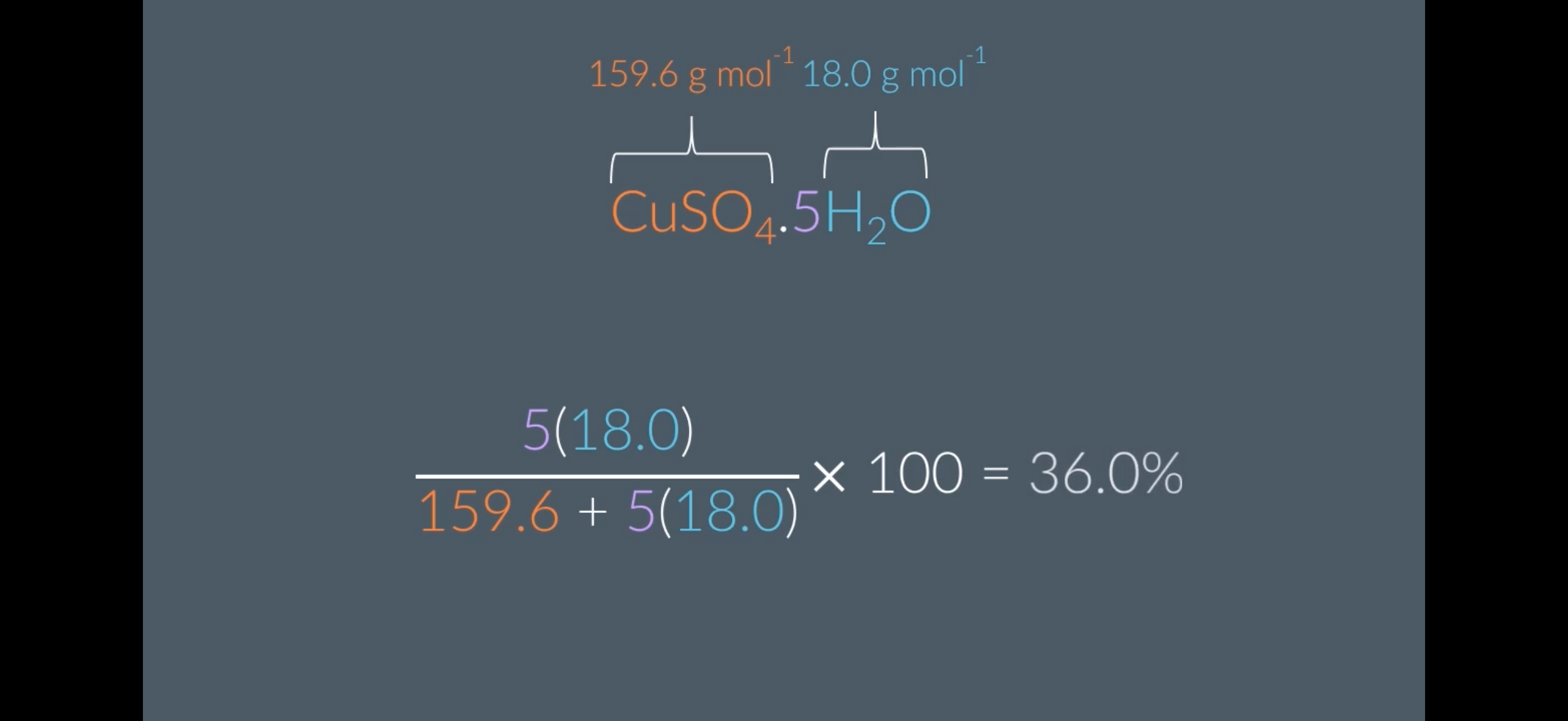
(Image shows example of the % water content)

2.The percentage water content (by mass) of Na2CO3.10H2O is…
Note:
• Sodium (\text{Na}): 23.0 \text{g mol}^{-1}

• Carbon: 12.0 {g mol}^{-1} 

• Oxygen : 16.0 {g mol}^{-1}

• Hydrogen ): 1.0{g mol}^{-1}

Give your answer to 1 decimal place

  1. Answer the image question that’s in the other side?

  1. The molar mass of CUSO4 is 159.6 g mol-1

    molar mass of H2O is 18.0 g mol-1

  2. 62.9%

  3. A

<ol><li><p><span>The molar mass of CUSO4 is 159.6 g mol-1</span></p><p>molar mass of H2O is 18.0 g mol-1</p></li><li><p>62.9%</p></li><li><p>A</p></li></ol><p></p>
5
New cards
<ol><li><p>Answer image q?</p></li></ol><p></p>
  1. Answer image q?

B

6
New cards

Solving For x Using Molar Mass

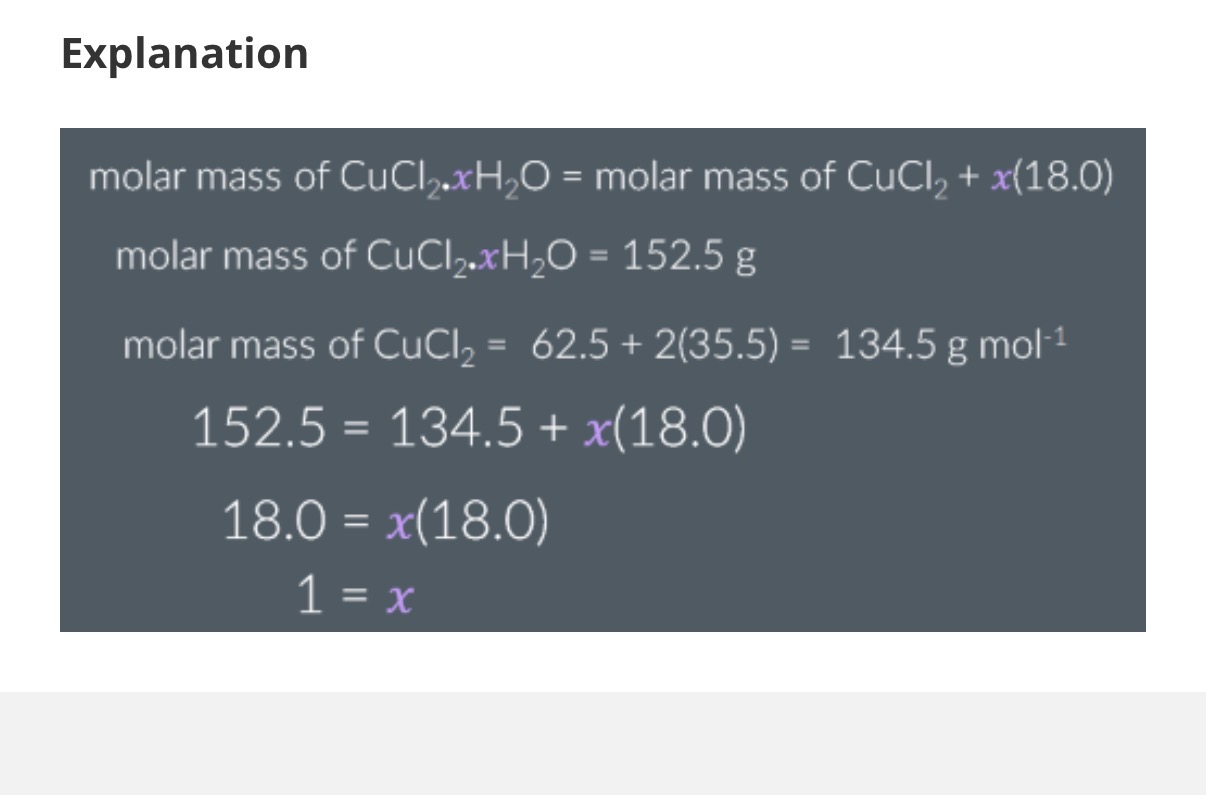
1.The molar mass of CuCl2.⁢xH2O is 152.5g mol−1. What is the value of x?
Note:
First, we use standard atomic masses:

• Copper (Cu): 63.5

• Chlorine (Cl): 35.5 

• Hydrogen (H): 1.0

• Oxygen (O): 16.0

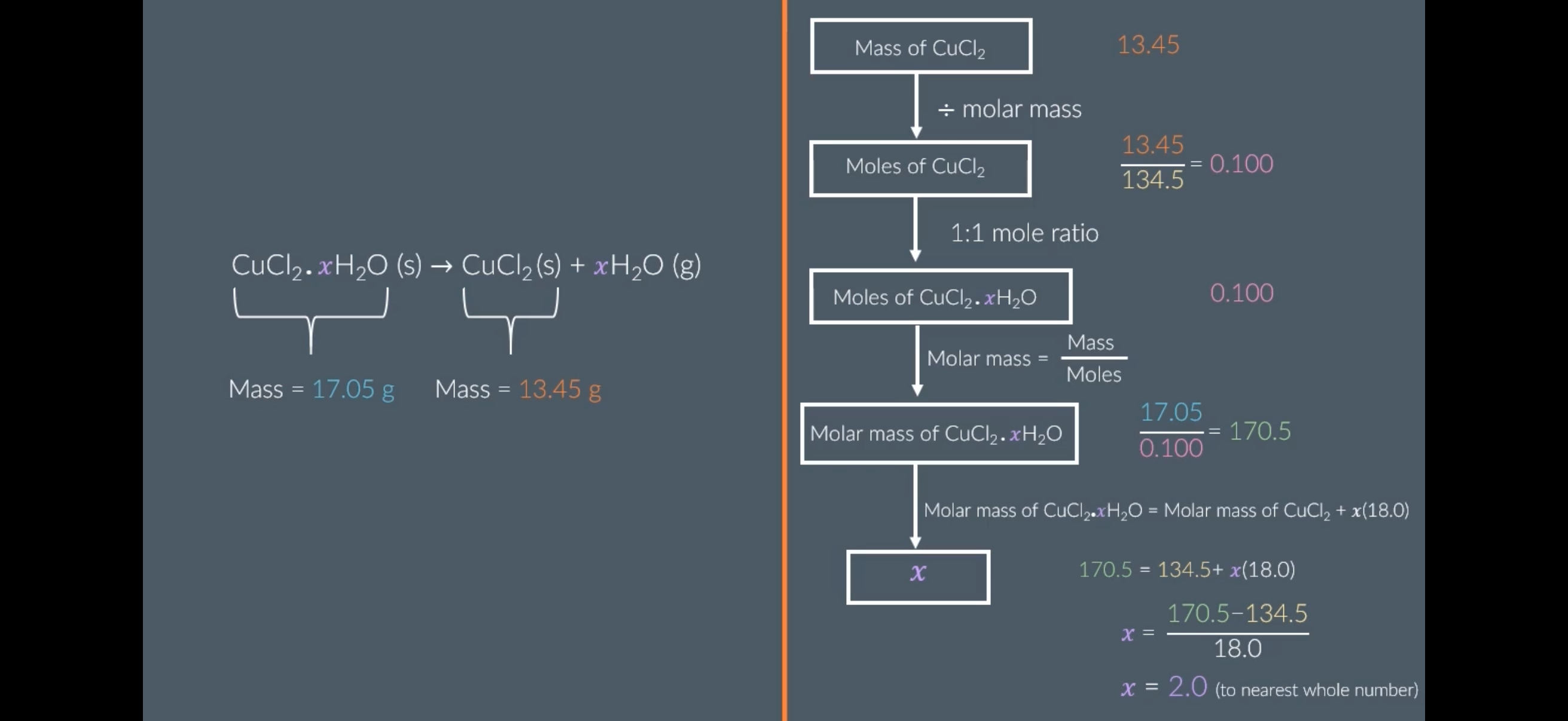
Give your answer to the nearest whole number. (Answer is in other side image)

2.The molar mass of hydrated sodium phosphate(PO4*3-) is 380.0g mol−1. Calculate the number of moles of water of crystallisation per mole of salt.

Atomic Masses

• Sodium (Na): 23.0

• Phosphorus (P): 31.0

• Oxygen (O): 16.0

• Hydrogen (H): 1.0

Give your answer to the nearest whole number

  1. X=12

<ol start="2"><li><p>X=12</p></li></ol><p></p>
7
New cards
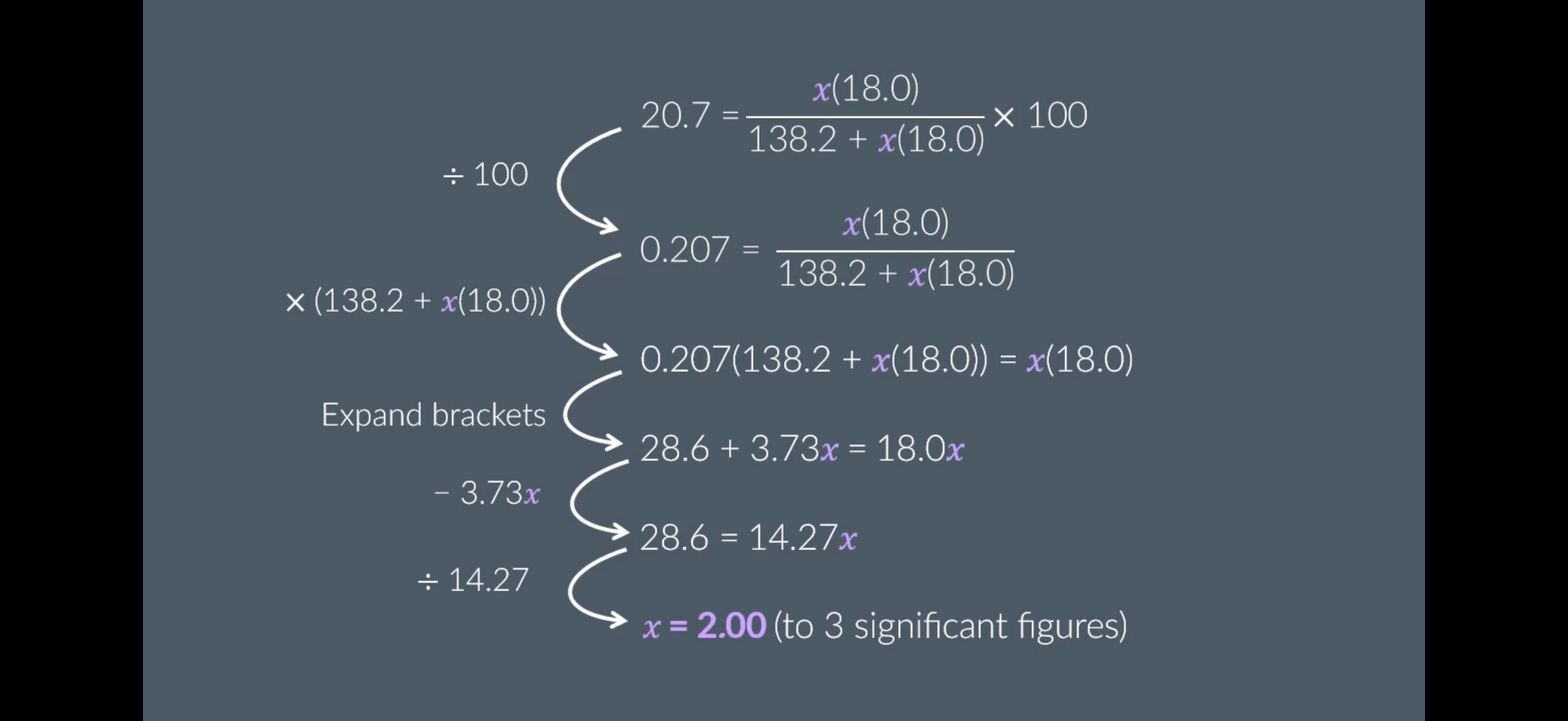
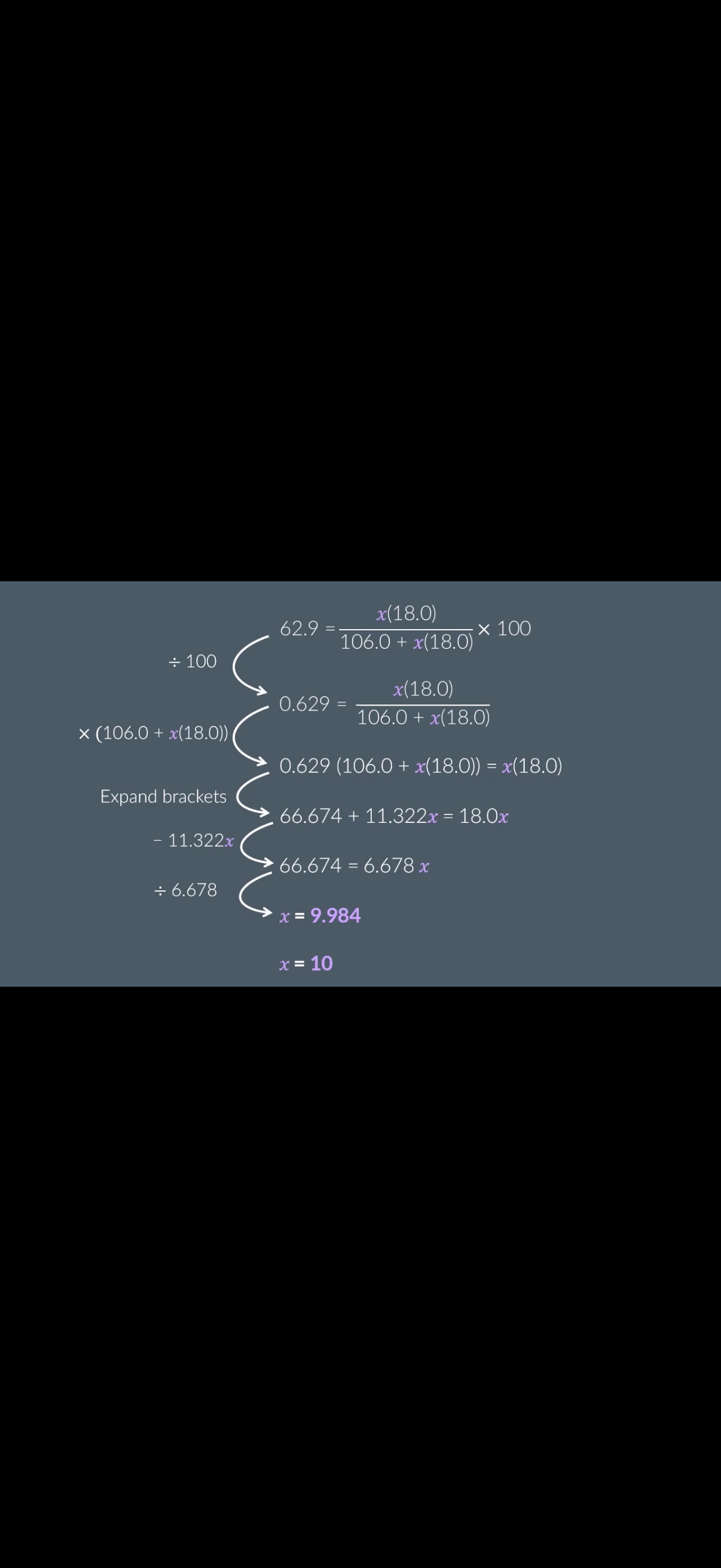
<p><strong><span>Solving For x Using % Water Content</span></strong></p><p><span>Note: the image is an example of the calculation.</span></p><ol><li><p><span style="font-size: var(--ck-content-font-size);"><span>Sodium carbonate can occur as a hydrated compound, Na2CO3.⁢xH2O.</span><span><br></span><span><br></span><span>Analysis of this hydrated compound showed that it contained 62.9⁢% by mass of water. </span><span><br></span><span><br></span><span>Determine the value of x.</span></span></p><p><span>Individual Atomic Masses (A_r)</span></p><p><span>• Sodium (Na): 23.0</span></p><p><span>• Carbon (C): 12.0</span></p><p><span>• Oxygen (O): 16.0</span></p><p></p><p class="sc-fQpSrZ sc-jrISjm fmbeOa jQioZF"><span style="font-size: var(--ck-content-font-size);"><span>Give your answer to the nearest whole number</span></span></p></li></ol><p></p>

Solving For x Using % Water Content

Note: the image is an example of the calculation.

  1. Sodium carbonate can occur as a hydrated compound, Na2CO3.⁢xH2O.

    Analysis of this hydrated compound showed that it contained 62.9⁢% by mass of water.

    Determine the value of x.

    Individual Atomic Masses (A_r)

    • Sodium (Na): 23.0

    • Carbon (C): 12.0

    • Oxygen (O): 16.0

    Give your answer to the nearest whole number

  1. 10 (calculation in image)

<ol><li><p>10 (calculation in image)</p></li></ol><p></p>
8
New cards
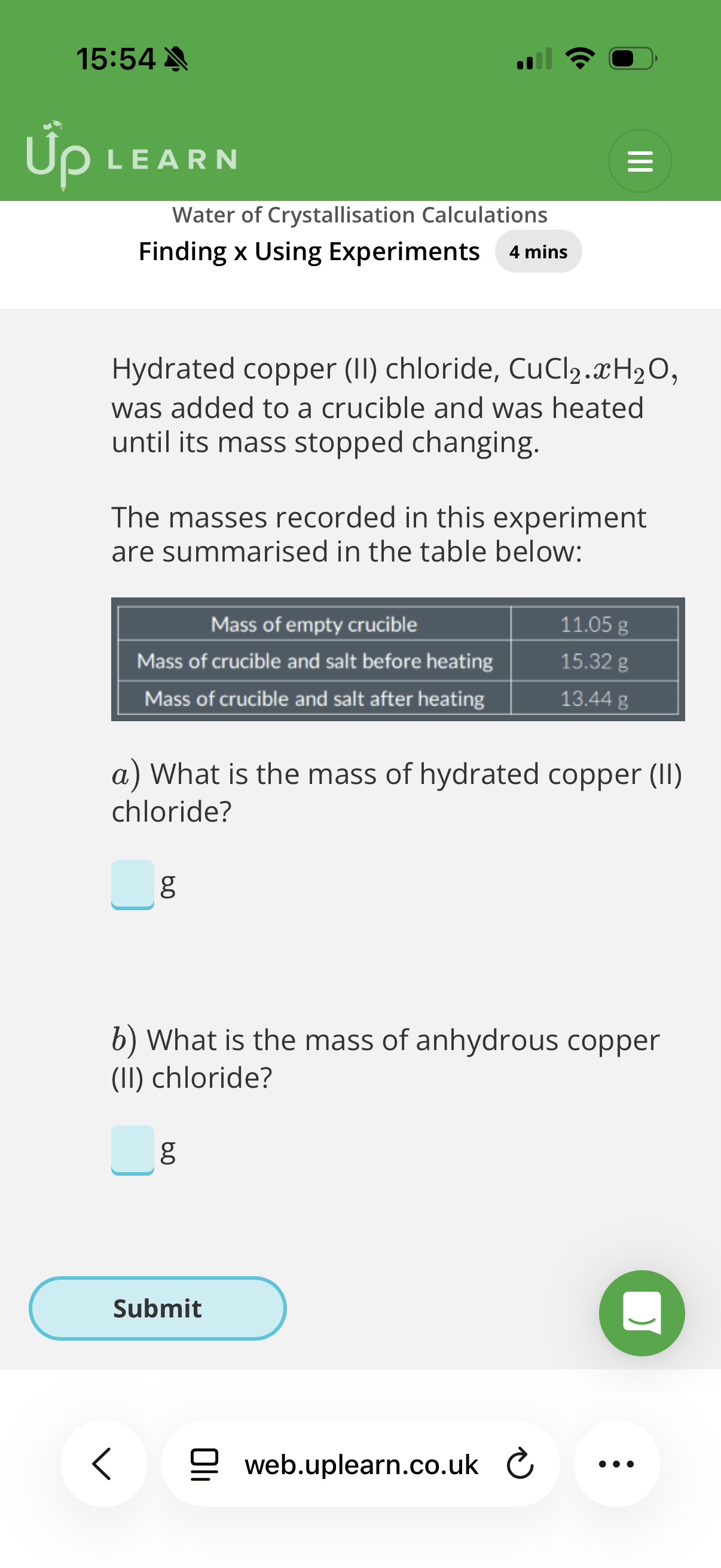
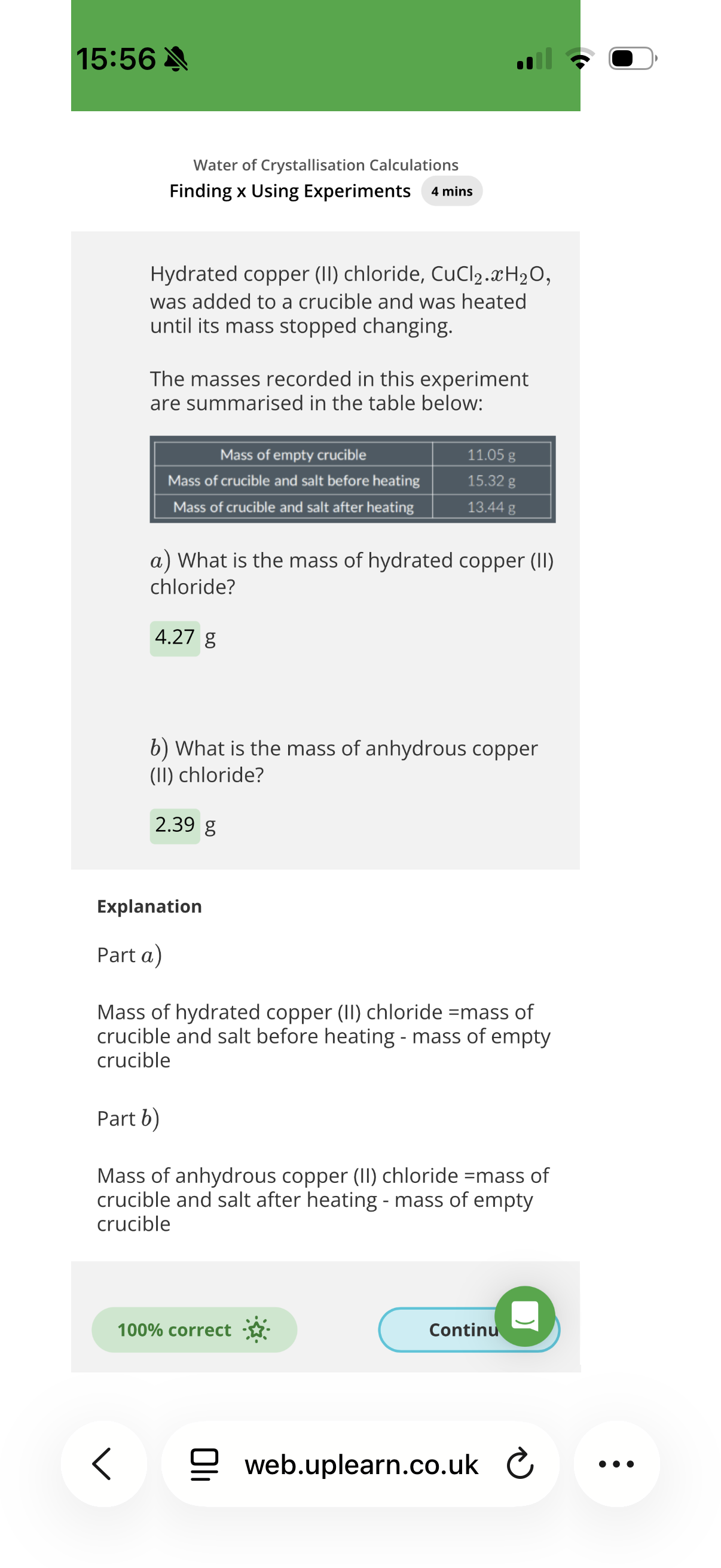
<p><strong><span>Finding x Using Experiments</span></strong></p><ol><li><p>Answer image q?</p></li><li><p><span style="font-size: var(--ck-content-font-size);"><span>If we have a sample of CuCl2.⁢xH2O with a known mass, we can find x by...</span></span></p><p class="sc-fQpSrZ bvYkPV"><span style="font-size: var(--ck-content-font-size);"><span>A: heating the sample vigorously and measuring its mass afterwards</span></span></p><p class="sc-fQpSrZ bvYkPV"><span style="font-size: var(--ck-content-font-size);"><span>B: dissolving the sample in water and measuring its mass afterwards</span></span></p><p class="sc-fQpSrZ bvYkPV"><span style="font-size: var(--ck-content-font-size);"><span>C: adding a small volume of water to the sample and measuring its mass after</span></span></p><p class="sc-fQpSrZ bvYkPV"><span style="font-size: var(--ck-content-font-size);"><span>D: reacting the sample with an acid and measuring the volume of gas produced.</span></span></p></li></ol><p class="sc-fQpSrZ bvYkPV"></p><p class="sc-fQpSrZ bvYkPV">3.<span style="font-size: var(--ck-content-font-size);"><span>If we have a sample of CuCl2.⁢xH2O with a known mass, we can find x by heating the sample vigorously (to remove the water of crystallisation) and measuring its mass afterwards. </span><span><br></span><span><br></span><span>During this experiment, we make sure all the water of crystallisation has escaped by...</span></span></p><p class="sc-fQpSrZ bvYkPV"><span style="font-size: var(--ck-content-font-size);"><span>A: heating the sample at 1000°C</span></span></p><p class="sc-fQpSrZ bvYkPV"><span style="font-size: var(--ck-content-font-size);"><span>B: adding a drying agent to the crucible</span></span></p><p class="sc-fQpSrZ bvYkPV"><span style="font-size: var(--ck-content-font-size);"><span>C: heating the sample until its mass stops changing</span></span></p><p class="sc-fQpSrZ bvYkPV"><span style="font-size: var(--ck-content-font-size);"><span>D: performing the experiment in a arid climate</span></span></p><p></p>

Finding x Using Experiments

  1. Answer image q?

  2. If we have a sample of CuCl2.⁢xH2O with a known mass, we can find x by...

    A: heating the sample vigorously and measuring its mass afterwards

    B: dissolving the sample in water and measuring its mass afterwards

    C: adding a small volume of water to the sample and measuring its mass after

    D: reacting the sample with an acid and measuring the volume of gas produced.

3.If we have a sample of CuCl2.⁢xH2O with a known mass, we can find x by heating the sample vigorously (to remove the water of crystallisation) and measuring its mass afterwards.

During this experiment, we make sure all the water of crystallisation has escaped by...

A: heating the sample at 1000°C

B: adding a drying agent to the crucible

C: heating the sample until its mass stops changing

D: performing the experiment in a arid climate

  1. A. 3.C

<ol start="2"><li><p>A.  3.C</p></li></ol><p></p>
9
New cards
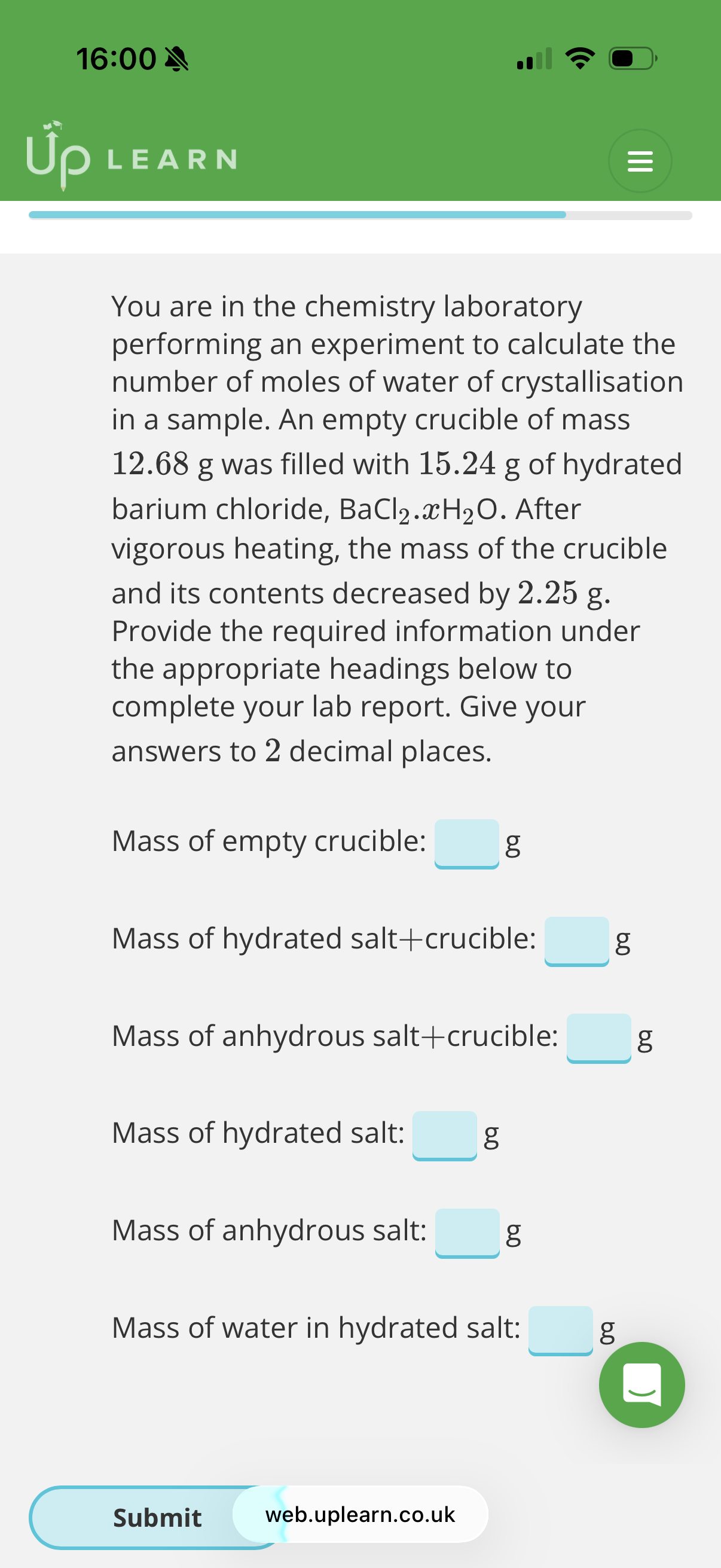
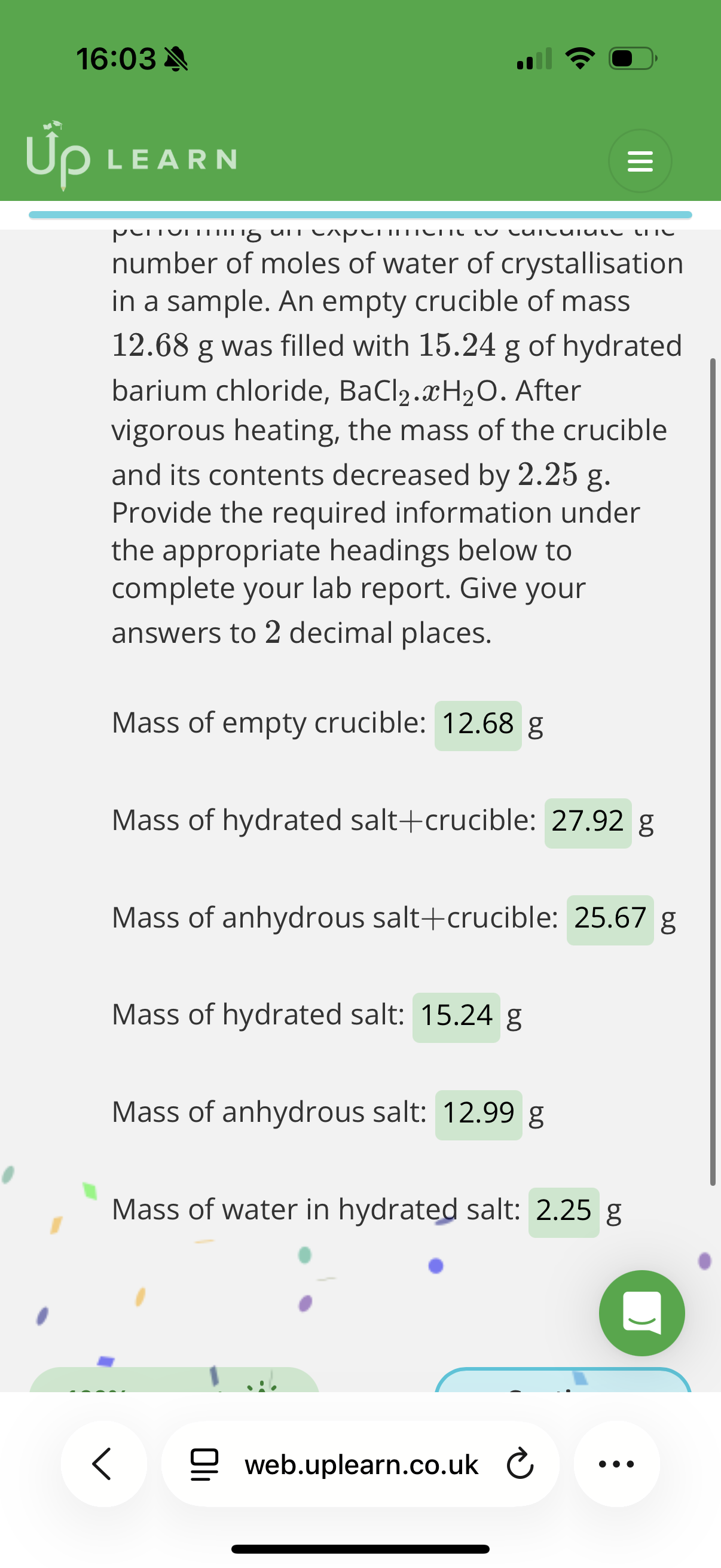
<p>Answer image q?</p>

Answer image q?

knowt flashcard image
10
New cards
<p><strong><span>Solving For x Using Experiments:</span></strong></p><p><span>Image: The image shows an example of calculating the moles by using experimental values.</span></p><p></p>

Solving For x Using Experiments:

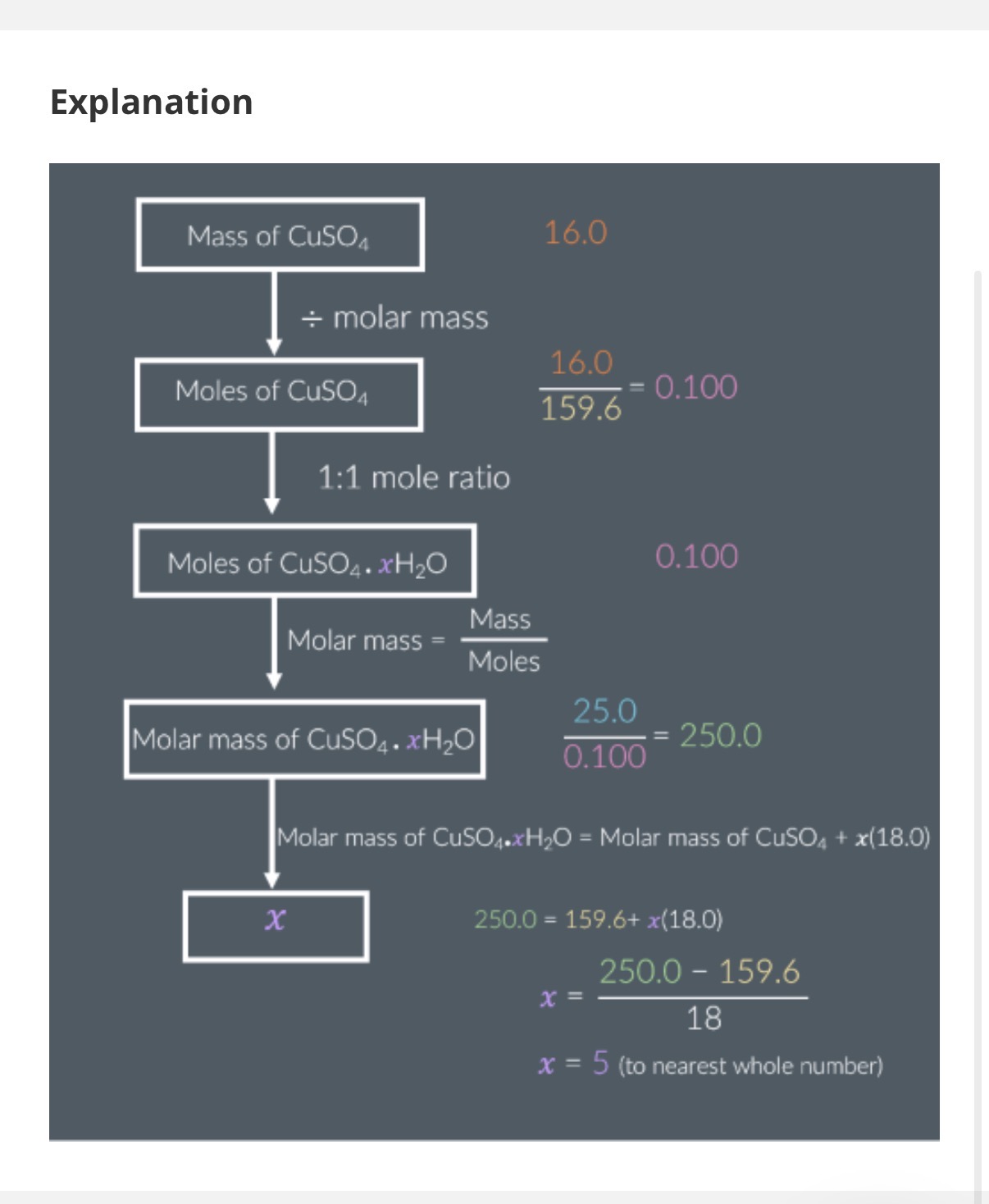
Image: The image shows an example of calculating the moles by using experimental values.
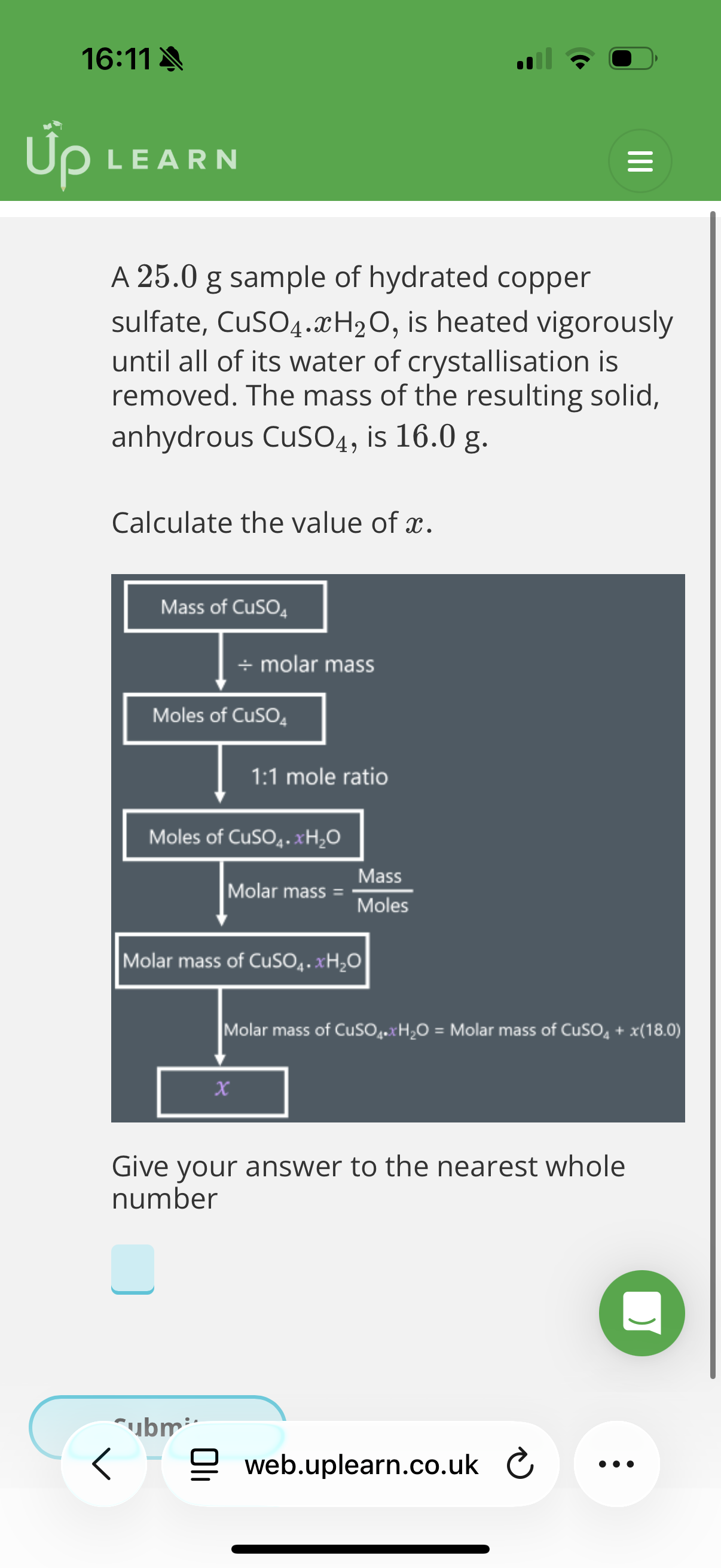
11
New cards
<ol><li><p>Answer image question?</p><p></p></li></ol><p></p>
  1. Answer image question?

knowt flashcard image
12
New cards

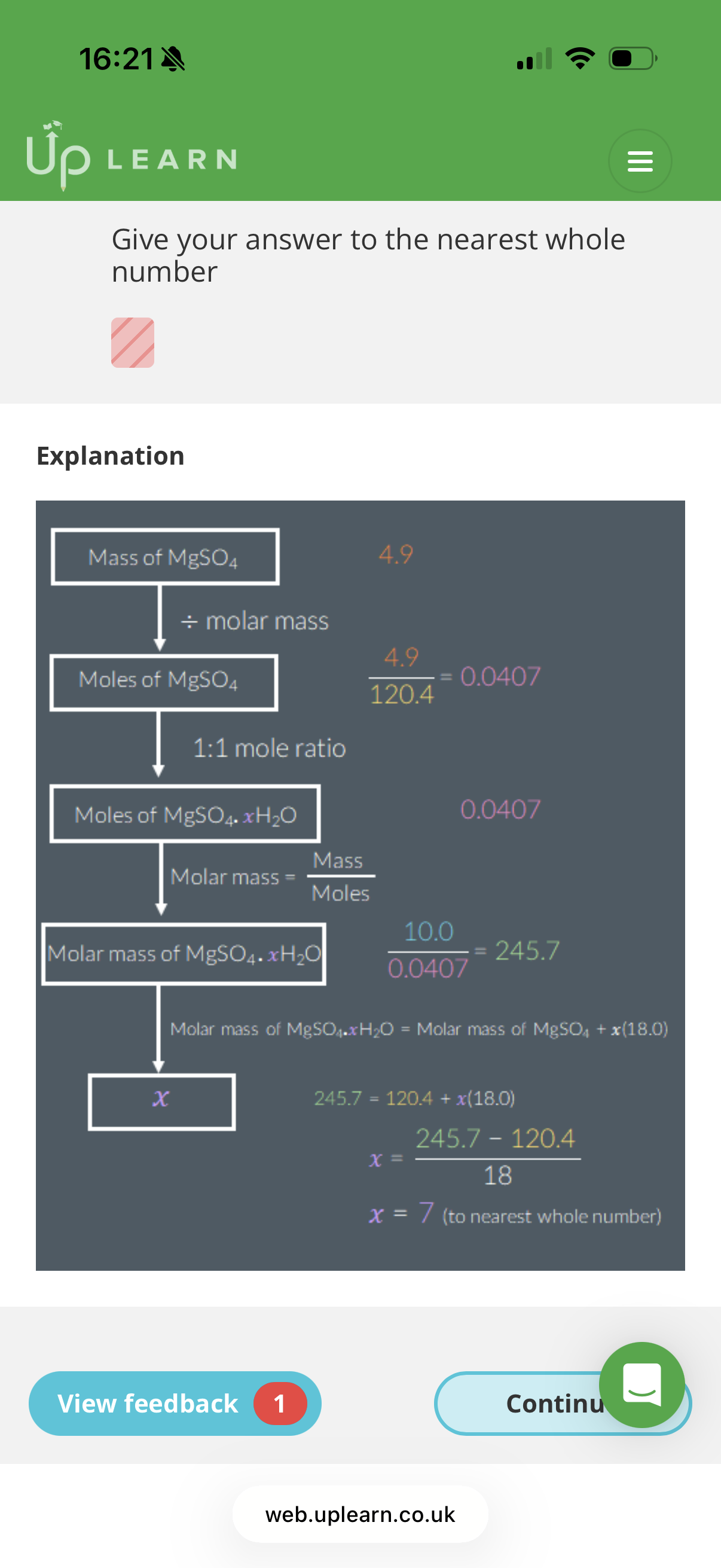
A 10.0g sample of hydrated magnesium sulfate, MgSO4.⁢xH2O, is heated vigorously until all of its mass stops changing. The mass of the resulting solid is 4.9g.

Calculate the value of x.
Ar: Mg-24.31 S:32.06 O: 16.00

Give your answer to the nearest whole number
knowt flashcard image
13
New cards
<p><span><strong><span>Does x Have to be a Whole Number?</span></strong></span></p><ol><li><p><span style="font-size: var(--ck-content-font-size);"><span>Jas performs an experiment heating hydrated copper sulfate, but fails to heat the crystals enough to remove all the water of crystallisation. This would mean the measurement he uses for...</span></span></p></li></ol><p><span style="line-height: 0.75rem;"><span>Correct answersYour answers</span></span></p><p class="sc-fQpSrZ bvYkPV"><span style="font-size: var(--ck-content-font-size);"><span>A: the mass of anhydrous copper sulfate is too high</span></span></p><p class="sc-fQpSrZ bvYkPV"><span style="font-size: var(--ck-content-font-size);"><span>B: the mass of hydrated copper sulfate is too high</span></span></p><p class="sc-fQpSrZ bvYkPV"><span style="font-size: var(--ck-content-font-size);"><span>C: the mass of anhydrous copper sulfate is too low</span></span></p><p class="sc-fQpSrZ bvYkPV"><span style="font-size: var(--ck-content-font-size);"><span>D: the mass of hydrated copper sulfate is too low</span></span></p><p class="sc-fQpSrZ bvYkPV"></p><ol start="2"><li><p class="sc-fQpSrZ bvYkPV"><span style="font-size: var(--ck-content-font-size);"><span>What experimental errors could lead to an incorrect value for x.</span><span><br></span></span></p><p class="sc-fQpSrZ sc-jrISjm fmbeOa jQioZF"><span style="font-size: var(--ck-content-font-size);"><span>Select all that apply</span></span></p><p class="sc-fQpSrZ bvYkPV"><span style="font-size: var(--ck-content-font-size);"><span>A: The hydrated crystals weren’t heated to remove all the water of crystallisation</span></span></p><p class="sc-fQpSrZ bvYkPV"><span style="font-size: var(--ck-content-font-size);"><span>B: The hydrated crystals lost some water to the surroundings before they were weighed</span></span></p><p class="sc-fQpSrZ bvYkPV"><span style="font-size: var(--ck-content-font-size);"><span>C: The anhydrous crystals formed after heating absorbed some water from the surroundings before they were weighed</span></span></p><p class="sc-fQpSrZ bvYkPV"><span style="font-size: var(--ck-content-font-size);"><span>D: The resultant anhydrous crystals lost some water to the surroundings before they were weighed</span></span></p></li></ol><p></p><p>3.<span style="font-size: var(--ck-content-font-size);"><span>A lab technician left a 10.0g sample of hydrated copper sulfate, CuSO4.⁢xH2O in a beaker overnight. The day after she reweighed the sample and found it had a mass of 9.8g.</span><span><br></span><span><br></span><span>This change in mass suggests that, over the course of the night, the value of xhas...</span></span></p><p><span style="line-height: 0.75rem;"><span>Correct answersYour answers</span></span></p><p class="sc-fQpSrZ bvYkPV"><span style="font-size: var(--ck-content-font-size);"><span>A: decreased, because water of crystallisation is lost to the environment.</span></span></p><p class="sc-fQpSrZ bvYkPV"><span style="font-size: var(--ck-content-font-size);"><span>B: decreased, because copper sulfate is lost to the environment.</span></span></p><p class="sc-fQpSrZ bvYkPV"></p><ol start="4"><li><p class="sc-fQpSrZ bvYkPV">Answer image q?</p></li></ol><p></p>

Does x Have to be a Whole Number?

  1. Jas performs an experiment heating hydrated copper sulfate, but fails to heat the crystals enough to remove all the water of crystallisation. This would mean the measurement he uses for...

Correct answersYour answers

A: the mass of anhydrous copper sulfate is too high

B: the mass of hydrated copper sulfate is too high

C: the mass of anhydrous copper sulfate is too low

D: the mass of hydrated copper sulfate is too low

  1. What experimental errors could lead to an incorrect value for x.

    Select all that apply

    A: The hydrated crystals weren’t heated to remove all the water of crystallisation

    B: The hydrated crystals lost some water to the surroundings before they were weighed

    C: The anhydrous crystals formed after heating absorbed some water from the surroundings before they were weighed

    D: The resultant anhydrous crystals lost some water to the surroundings before they were weighed

3.A lab technician left a 10.0g sample of hydrated copper sulfate, CuSO4.⁢xH2O in a beaker overnight. The day after she reweighed the sample and found it had a mass of 9.8g.

This change in mass suggests that, over the course of the night, the value of xhas...

Correct answersYour answers

A: decreased, because water of crystallisation is lost to the environment.

B: decreased, because copper sulfate is lost to the environment.

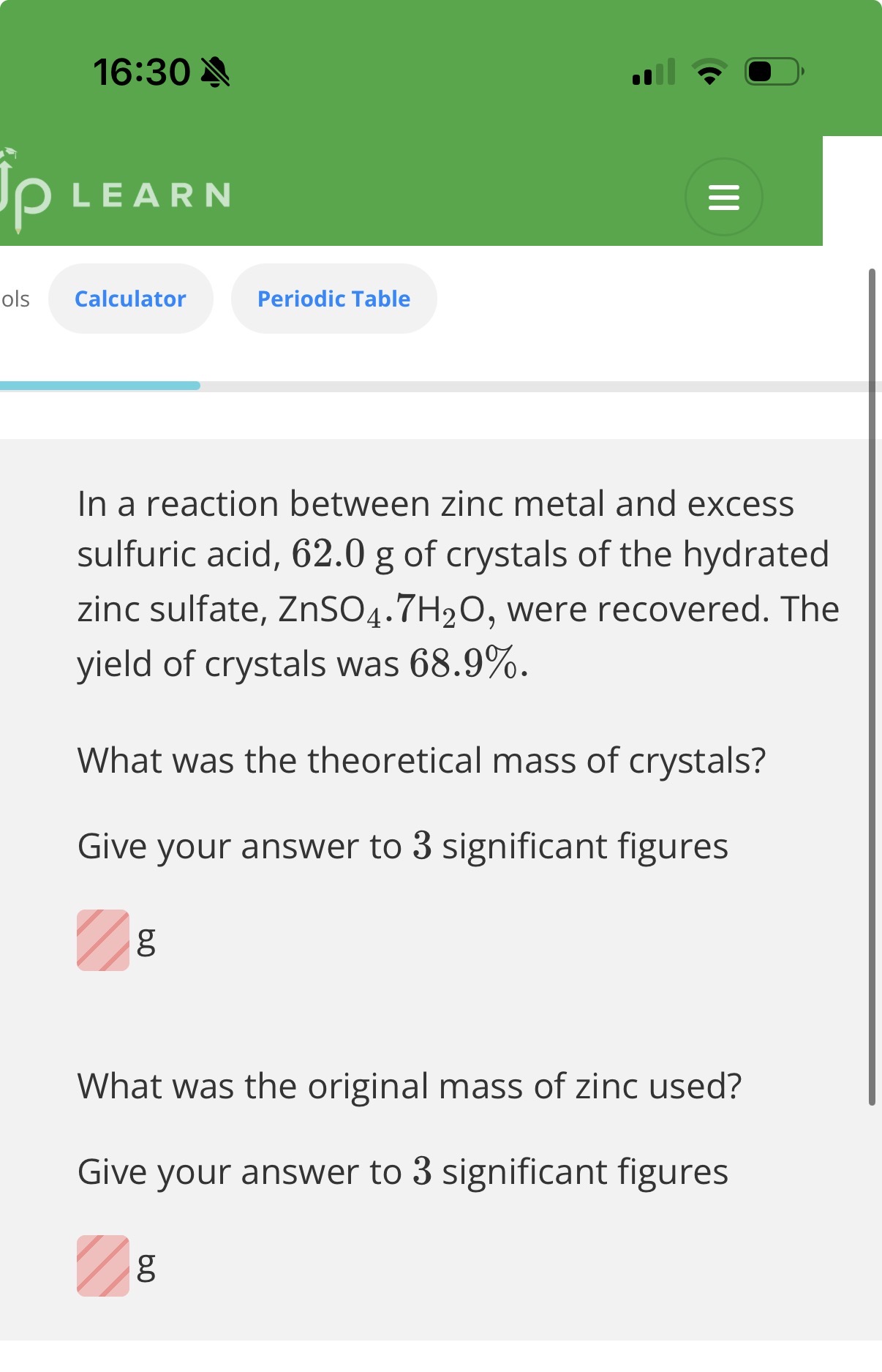
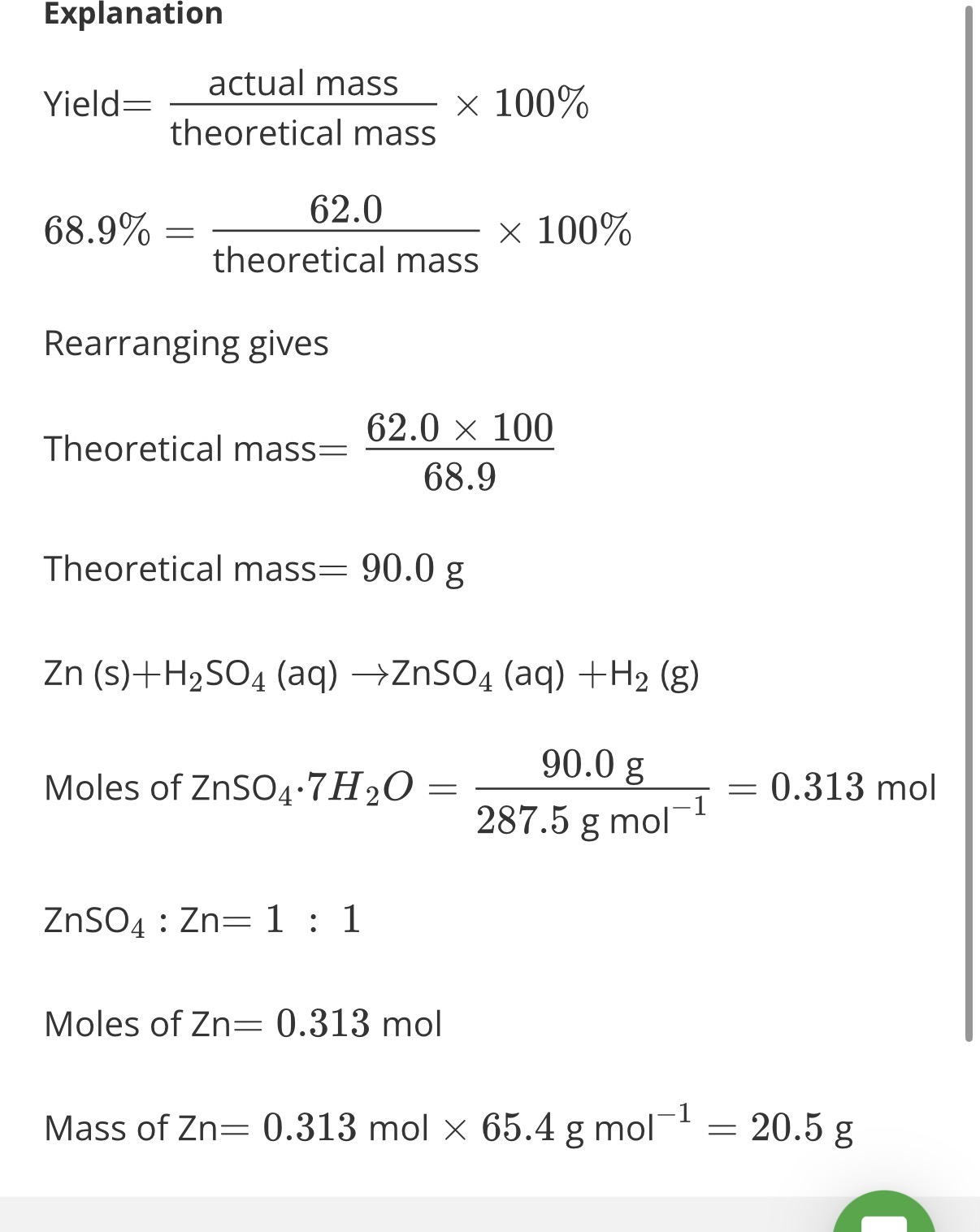
  1. Answer image q?

  1. A. 2.A,B,C. 3.A(Explanation

    The mass of hydrated copper sulfate has decreased overnight. This suggests that it has lost some water of crystallisation to the surroundings. Since there are now fewer moles of water of crystallisation in the hydrated salt, the value of x will decrease

    1. 90g then 20.5g

<ol><li><p>A.     2.A,B,C.   3.A(Explanation</p><p class="sc-fQpSrZ bvYkPV"><span style="font-size: var(--ck-content-font-size);"><span>The mass of hydrated copper sulfate has decreased overnight. This suggests that it has lost some water of crystallisation to the surroundings. Since there are now fewer moles of water of crystallisation in the hydrated salt, the value of x will decrease</span></span></p><ol start="4"><li><p class="sc-fQpSrZ bvYkPV">90g then 20.5g</p></li></ol></li></ol><p></p>
14
New cards
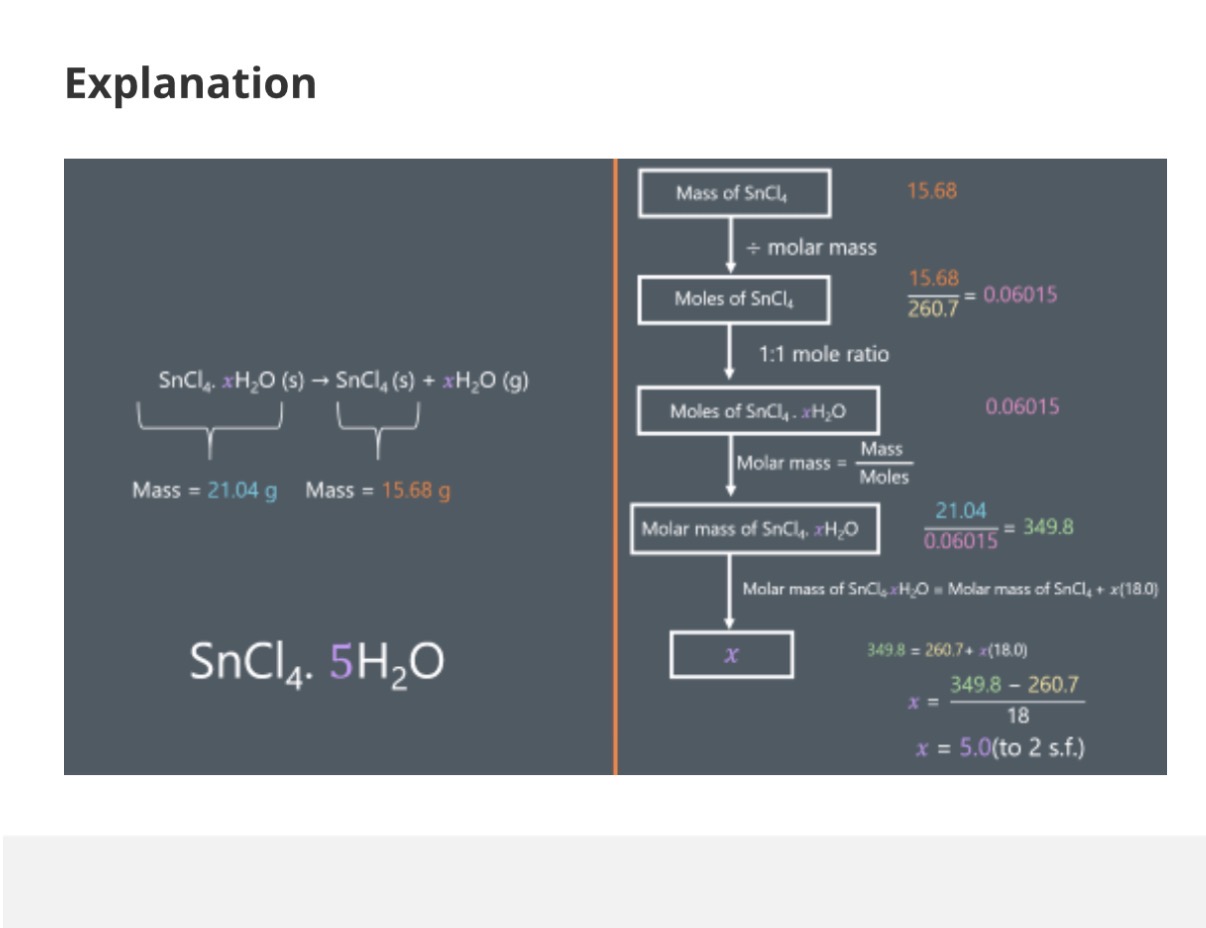
<ol><li><p>Answer image w?</p></li><li><p><span style="font-size: var(--ck-content-font-size);"><span>What would have happened to x if the sample of hydrated salt, SnCl4.⁢xH2O, had been left out overnight before doing the analysis to determine the amount of water of crystallisation in the sample?</span></span></p><p><span style="line-height: 0.75rem;"><span>Correct answersYour answers</span></span></p><p class="sc-fQpSrZ bvYkPV"><span style="font-size: var(--ck-content-font-size);"><span>A: x would have increased because the hydrated salt would gain water from the environment.</span></span></p><p class="sc-fQpSrZ bvYkPV"><span style="font-size: var(--ck-content-font-size);"><span>B: x would have decreased because the hydrated salt would lose water to the environment.</span></span></p></li></ol><p></p>
  1. Answer image w?

  2. What would have happened to x if the sample of hydrated salt, SnCl4.⁢xH2O, had been left out overnight before doing the analysis to determine the amount of water of crystallisation in the sample?

    Correct answersYour answers

    A: x would have increased because the hydrated salt would gain water from the environment.

    B: x would have decreased because the hydrated salt would lose water to the environment.

2.B
<p>2.B</p>

Explore top notes

note
Evolution
Updated 1160d ago
0.0(0)
note
Unit 1 - Chemistry of Life
Updated 1090d ago
0.0(0)
note
Nervous System & Mental Health
Updated 508d ago
0.0(0)
note
Chapter 3: Differentiation
Updated 1084d ago
0.0(0)
note
Required Documents
Updated 721d ago
0.0(0)
note
The Mole and Equations
Updated 1195d ago
0.0(0)
note
Beware of Banking Fees
Updated 1246d ago
0.0(0)
note
Evolution
Updated 1160d ago
0.0(0)
note
Unit 1 - Chemistry of Life
Updated 1090d ago
0.0(0)
note
Nervous System & Mental Health
Updated 508d ago
0.0(0)
note
Chapter 3: Differentiation
Updated 1084d ago
0.0(0)
note
Required Documents
Updated 721d ago
0.0(0)
note
The Mole and Equations
Updated 1195d ago
0.0(0)
note
Beware of Banking Fees
Updated 1246d ago
0.0(0)

Explore top flashcards

flashcards
Unit 5 Lesson 1
43
Updated 1062d ago
0.0(0)
flashcards
Unit 1-2 BIO Midterms
49
Updated 1133d ago
0.0(0)
flashcards
La inmigración
84
Updated 117d ago
0.0(0)
flashcards
Vocab Unit 5
25
Updated 1180d ago
0.0(0)
flashcards
apush
33
Updated 1220d ago
0.0(0)
flashcards
Biology - DNA to Protein
40
Updated 1214d ago
0.0(0)
flashcards
Unit 5 Lesson 1
43
Updated 1062d ago
0.0(0)
flashcards
Unit 1-2 BIO Midterms
49
Updated 1133d ago
0.0(0)
flashcards
La inmigración
84
Updated 117d ago
0.0(0)
flashcards
Vocab Unit 5
25
Updated 1180d ago
0.0(0)
flashcards
apush
33
Updated 1220d ago
0.0(0)
flashcards
Biology - DNA to Protein
40
Updated 1214d ago
0.0(0)