Methods Week 7 - Choosing Statistical Tests (1/2)
 Studied by 0 people
 Call Kai
 Learn
Learn Practice Test
 Spaced Repetition
 Match
Match Flashcards
 Knowt Play
1/19

There's no tags or description
Looks like no tags are added yet.
Name | Mastery | Learn | Test | Matching | Spaced |
|---|
No study sessions yet.
20 Terms
z-tests
a statistical test used to determine whether there is a significant
difference between sample and population means
what do you need to do a z-test
the population parameters (know about the pop. ex. IQ is known)
know the mean and SD
one-sample t-tests
compare the mean of a single sample to a known population
mean to determine if there is a statistically significant difference
know the mean but not the SD
finding the diff between the sample and the world
between-group T-test
compare the means of two independent groups to
determine if there is a statistically significant difference between them.
don’t know the mean or SD
finding the difference between two groups
paired/within T-test
compare the means of two related groups to determine if
there is a statistically significant difference between them
testing means between the same group
don’t know the mean or SD
finding difference in one group between two points in time
One-way ANOVA
compares the means of two or more independent groups based on one independent variable (factor).
a t-test but can run two or more independent variables
ex. compare coffee, tea, or water before bed
repeated measures ANOVA
compares the means of one group based on two or more independent variable levels (conditions).
can compare at more than two different time points
within subject ANOVA
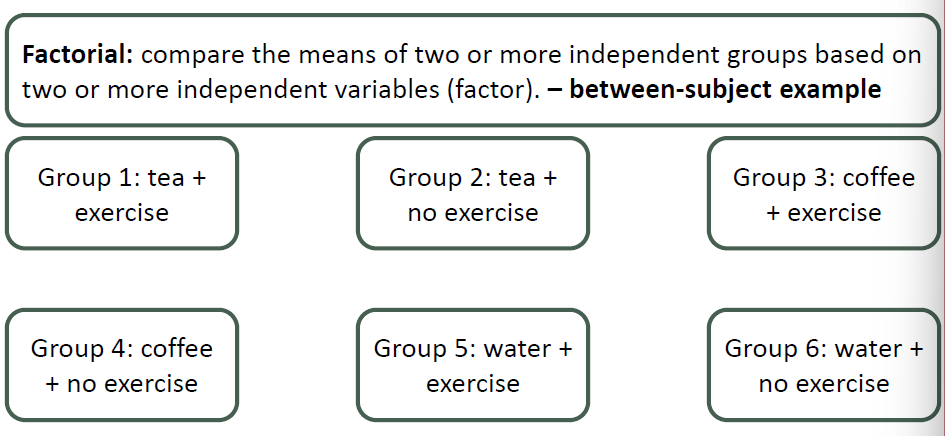
Factorial ANOVA between subject example
compare the means of two or more independent groups based on two or more independent variables (factor).
ex. comparing independent variable 1: type of drink before bed to independent variable 2: exercise before bed or not
Mixed (factorial) ANOVA
compare the means of two or more independent groups based on one or more between-subject IV, and one or more within-subject IV
requires a mixed design (between subject and within subject design)
how to calculate how many factors you have in factorial AVOVA
multiply the levels you have in the independent variable groups by each other
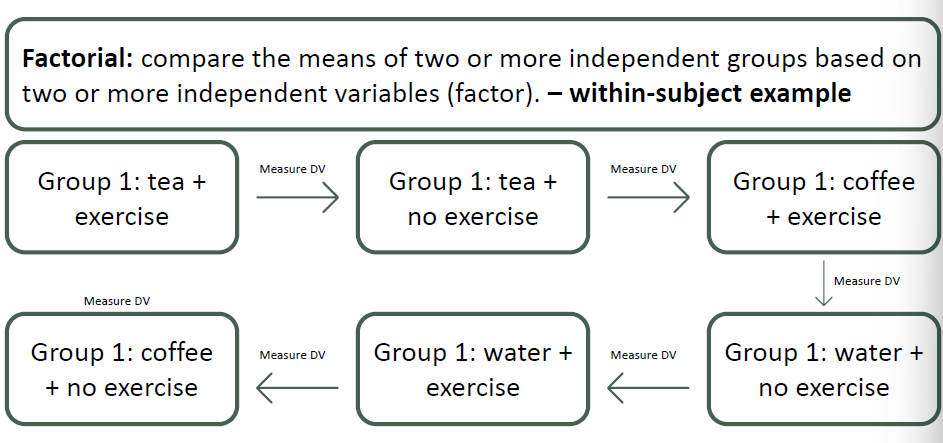
factorial ANOVA within-subject example
measuring DV in ONE group
why are ANOVA’s good?
good at looking at interactions as well as multiple comparisons
what are interactions
ex. if one level of one iV effects other levels of the other IV differently
ex. does drinking coffee before bed impact young and elderly groups differently
Eta squared
measures effect size for ANOVA’s
what do you do to measure effect size of
t-tests: cohon’s d
ANOVA’s: Eta squared
what is an ANOVA and how is it different from Bonferri’s correction?
ANOVAs are a way of comparing means across 3+ groups. it reduces the amount of work and correction you have to do BUT it only tells you IF there is a difference at all between the 3+ groups.
To figure out which group had the difference, then you would have to do Bonferri’s correction to find the specific differences. This method is also a correction for addition rule, reducing type 1 error.
which ANOVA type compares the means of 3+ groups with one IV
one-way ANOVA
which ANOVA type compares the means of one group with 3+ IV
repeated measures ANOVA
which ANOVA type compares the means of 2+ independent groups with 2+ IV
factorial ANOVA
which ANOVA type compares the means of 2+ groups with one btwn group and one within group
mixed ANOVA
 Note
Note  Flashcards (129)