Ecology Exam 2 (work-in-progress)
 Call Kai
 Learn
Learn Practice Test
 Spaced Repetition
 Match
Match Flashcards
 Knowt Play
1/30

Earn XP
Description and Tags
BIOL0420
Name | Mastery | Learn | Test | Matching | Spaced | Call with Kai |
|---|
No analytics yet
Send a link to your students to track their progress
31 Terms
Define endoparasites and ectoparasites, giving an example of each. Describe some advantages and disadvantages associated with each of these types of parasitism.
Endoparasites live inside their hosts, while ectoparasites live on the surface of their host. Ectoparasitism advantages include easier dispersal and more safety from the host’s immune system, while disadvantages include more difficult feeding, greater exposure to the external environment, and greater vulnerability to natural enemies. Endoparasitism advantages include easier feeding and more protection from the external environment, while disadvantages include more difficult dispersal and greater vulnerability to the host’s immune system.
Given the effects that parasites can have on host individuals and host populations, would you expect that parasites could also alter the outcomes of species interactions and the composition of ecological communities? Explain.
Parasites can affect the outcomes of species interactions because they can affect host performance. They can alter competitive outcomes depending on which species the parasite infects. Parasites can also alter predator-prey outcomes; they decrease the physical condition of infected individuals, making predators less able to catch prey or prey less able to escape predation.
Summarize the mechanisms that host organisms use to kill parasites or reduce the severity of their attack.
Host organisms use their immune systems, biochemical defenses (eg: transferrins), and defensive symbionts (symbiotic bacteria and fungi).
Do you think the following statement from a news report could be true? The parasite has a mild effect on a plant species in Australia, but after it was introduced for the first time to Europe, it had devastating effects on European populations of the same plant species. Explain your reasoning, and illustrate your argument with an example of how the plant defense mechanism might work – or fail to work – in a situation such as this.
This could very well be true. The plants in Europe may lack certain biochemical defenses, such as transferrins, that the Australian plants have. Additionally, the European plants likely have different symbionts that may be less effective at defending against the parasites than those of the Australian plants’. The parasite and the Australian plant have likely coevolved for many years, leading to specific defenses that made the parasite less lethal, but when the parasite migrates to Europe, the plants lack those specific defenses and are more susceptible to the parasite.
Summarize the key features of positive interactions described in Concept 15.1.
In positive interactions, no species is harmed, and the benefits are greater than the costs for at least one species.
Researchers who study mutualism do not think of it as an altruistic interaction. Explain why.
Organisms who participate in mutualism do not act with the intent to help the other species; they partake to improve their own conditions and would do the same regardless of the impact on the other species.
High water temperature is one of the several stressors that can cause coral bleaching, in which a coral expels its algal mutualists and hence loses its color. If bleaching occurs repeatedly, coral death may result Some corals are more sensitive than others to high water temperatures. If a reef containing a mixture of coral species were exposed to increasingly high water temperatures over a series of years, how might the community change over time?
The coral would lose the long-term benefits that the algae provides, and thus performance will decrease. Because of this performance decrease of coral, the performance of competitors will increase and their populations will increase as well. This would decrease the species richness of the community because the distribution of coral vs other species will be skewed.
What is the formal definition of a community? Why is incorporating species interactions into that definition important?
A community is a group of interacting species that occur together at the same place and time. It is important to incorporate species interactions into that definition because interactions among multiple species and their physical environment give communities their character and function.
Species diversity measurements take into account both species richness and species evenness. Why would these measurements be preferred to species richness alone? What do rank abundance curves add to one’s knowledge about community structure?
Both of these measurements are taken into account to measure both the number of species present and the relative frequency of the different species, so the combination of these figures allows ecologists to derive a fuller understanding of the community as a whole. Rank abundance curves allow us to visually compare the proportional abundance of different species to determine how abundant they are in comparison to each other.
Species vary in the strength of their interactions with other species. Species that interact strongly with other species include foundation species, keystone species, and ecosystem engineers. Describe the differences among these three types of species and give some examples. Can foundation and keystone species also be ecosystem engineers?
Foundation species have large, community-wide effects on the habitat or food of another species by virtue of its size or abundance (trees, coral, kelp). Keystone species are strong interactor species that have an effect on energy flow and community structure that is disproportionate to its small size, abundance, or biomass (beavers, sea otters, wolves, fig trees). Ecosystem engineers create, modify, maintain, or destroy habitats by altering biotic or abiotic materials, significantly affecting resource availability and habitat structure for other species (beavers, coral, elephants, earthworms). Foundation and keystone species can definitely be ecosystem engineers as well (beavers, coral).
List some abiotic and biotic agents of change in communities. Describe the intensities and frequencies with which they are likely to act.
Abiotic agents of change include waves/currents (low intensity/high frequency), wind (low intensity/high frequency), water supply (high intensity/low frequency), chemical composition, temperature (high intensity/low frequency), and volcanic activity (high intensity/low frequency). Biotic agents of change include negative species interactions: generally low intensity/high frequency but some more severe cases perhaps can be high intensity/low frequency eg bubonic plague.
Describe the differences between primary and secondary succession and what those differences mean for colonizing species.
Primary succession involves the colonization of habitats completely devoid of life. Secondary succession involves the reestablishment of a community in which some, but not all, of the organisms have been destroyed. Thus, primary succession is much slower than secondary succession because the pioneer species typically face extremely inhospitable conditions because basic resources tend to be lacking.
Connell and Slatyer proposed three separate models of succession: the facilitation model, the tolerance model, and the inhibition model. Choose a hypothetical community and describe the different circumstances that would be required to support each of the models.
Hypothetical community: barren rock area from volcanic eruption.
Facilitation model: conditions must be extreme enough so that only certain hardy species can survive. This pioneer species must then modify the environment so that other early successional species are less able to survive, but late succession species are more likely to survive. This facilitation would then occur until the pioneer species can no longer facilitate the growth of the late succession species.
Tolerance model: resource levels are moderate, but space is limited. Any species can establish themselves after the disturbance, but pioneer species make the environment less suitable for fellow pioneer species because they are occupying the limited available space. Late succession species can live in the presence of pioneer species because waiting would mean that the space is already occupied. Later, the pioneer species are outcompeted by the late succession species and the pioneers are eliminated.
Inhibition model: high resource levels, low space. Pioneer species rapidly colonize the available space, preventing other species from succeeding unless the pioneers are removed by another disturbance.
Why is it hard to determine whether a community is stable? Do you think John Sutherland was able to demonstrate alternate stable states on his ceramic tiles? Why or why not?
It is difficult to determine stability because it depends on many spatial and temporal factors, as well as species interactions. I think John Sutherland was able to demonstrate alternate stable states because he discovered different circumstances that led to the tiles being colonized by two different species that were unable to be disturbed by the later introduction of the other species.
Spatial scale is important to the biogeographic patterns of species diversity and composition that we see on Earth. Define the various spatial scales that are important to biogeography, and describe how they are related to or interconnected with one another.
Biogeographic patterns of species diversity and composition vary at global, regional, and local spatial scales. They are interconnected in a hierarchical manner, with patterns at one spatial scale setting the conditions for patterns at smaller spatial scales. Global patterns result from variations in speciation, extinction, and dispersal at latitudinal and continental spatial scales and evolutionary time scales. Regional patterns (gamma diversity) are driven by dispersal across the landscape. Local and regional scales are connected by turnover (the difference in species diversity and composition (beta diversity) from one community type to another across the landscape). Local patterns (alpha diversity) are driven by physical conditions and species interactions.
Describe the factors that Alfred Russel Wallace believed created biogeographic regions on land and in the ocean.
Alfred Russel Wallace believed biogeographic regions were created by a combination of geological history, climate, and dispersal barriers.
Geological history: continental drift allowed species to move and later become separated, leading to vicariance.
Climate: long-term climatic changes dictate the distribution of species.
Dispersal barriers: deep water channels prevent land dispersal and ocean currents, depth, and temperature differences prevent oceanic dispersal, leading to distinct provinces.
Latitudinal gradients in species diversity and composition are strong global features of biogeography. Describe three hypotheses proposed to explain why species diversity is higher in the tropics and decreases toward the poles for the majority of taxonomic groups.
1: The rate of species diversification in the tropics is greater than that in temperate regions.
2: the rates of diversification in the tropics and at higher latitudes are similar, but that the evolutionary time available for diversification has been much greater in the tropics.
3: resources are more plentiful in the tropics because of higher productivity, and thus that species there have higher carrying capacities and a greater ability to coexist.
Suppose you are an ecologist studying prairie grassland communities in Minnesota. As you are doing your fieldwork, grass seeds with hooked spines attach themselves to your shoes. You then travel to New Zealand to study the grasslands on the South Island. When you enter the customs area in the Auckland airport, the officers in charge ask if you have visited a natural area or farm recently. You say yes, and they tell you to take off your shoes and wait while they disinfect them with bleach. Given what you know about the mechanisms important to community membership, is it worth the time and money required to clean all that footwear before allowing it into New Zealand?
Yes, it is worth it to spend resources disinfecting all of the shoes. The seed is passing the Species Supply Filter because the shoes are providing the seed with the ability to disperse through regional species pools. It is likely that the seed would pass through the abiotic filter because it is entering another grassland biome, so it is likely that the resources needed for establishment are present. Then, the seed will likely also pass through the biotic filter because the co-evolved regulators of the species will be absent in New Zealand, allowing for unchecked species growth. Therefore, it is likely that the population of the grass will grow rapidly if introduced in New Zealand and the money spent disinfecting shoes will likely be much less than the money caused in damages by the grass or spent attempting to eradicate it from the environment.
We know that species diversity varies greatly among communities. Describe how some of the models proposed to explain this variation differ in their explanations of the mechanisms involved.
The intermediate disturbance hypothesis proposes that species diversity in communities should be greatest at intermediate levels of disturbance (or stress or predation) because competitive exclusion at low levels of disturbance and mortality at high levels of disturbance should reduce species diversity. The lottery/neutral model proposes that species diversity in communities is maintained by a “lottery” in which resources made available by the effects of disturbance, stress, or predation are captured at random by recruits from a larger pool of potential colonists. They differ in that the IDH is based on the frequency of disturbance, whereas the neutral/lottery model is based on randomness and dispersal.
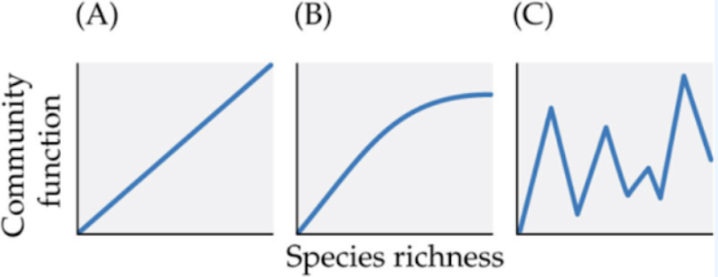
Recent experimental work in communities has shown positive relationships between species diversity and community function. We learned that there is considerable debate about the relationships and their controlling mechanisms and that at least three hypotheses have been developed to explain them. Below are three graphs of species richness-community function relationships that vary in the shapes of their curves. Describe which hypothesis best fits each curve, and why.
Graph A is the complementarity hypothesis because each species added to the community has an equal effect on community function.
Graph B is the redundancy hypothesis because once species richness reaches some threshold, additional species are redundant.
Graph C is the idiosyncratic hypothesis because the addition of particular dominant species has a greater effect on community function than species richness per se.
Suppose one population of coyotes (population A) demonstrates a greater degree of omnivory than another population (population B). Population A relies on a diet that includes road-killed animal carcasses, plants, and rotten food from dumpsters, while population B has a steady diet of small rodents. Which population should have a higher assimilation efficiency, and why?
Population B would have a higher assimilation efficiency (proportion of ingested food that is assimilated) because the quality of food availability of food available to herbivores and detritivores is generally lower than that of the food available to carnivores. Plants and detritus are composed of relatively complex carbon compounds, such as cellulose, lignins, and humic acids, that are not easily digested. Also, plants and detritus have low concentrations of nutrients. Animal bodies, on the other hand, have carbon-to-nutrient ratios that are usually very similar to those of the animals consuming them and so are assimilated more readily. A.E. of herbivores and detritivores is 20-50%, while A.E. of carnivores is about 80%.
Mammals in temperate terrestrial and temperate marine ecosystems occupying similar trophic levels may have different production efficiencies. Assuming similar food quality, food abundance, and food capture rates, explain why the production efficiencies of these mammals would differ between a marine ecosystem and a terrestrial ecosystem. (Hint: consider how the mammals maintain their body heat, as well as the temperature variation of their environments as described in Chapter 2).
Because they are surrounded by water, marine ecosystems are more thermally stable, so aquatic mammals require less energy for thermoregulation due to their thick blubber conserving heat, making their production efficiency (proportion of assimilated food that is used to produce new consumer biomass) greater than that of terrestrial mammals.. Terrestrial ecosystems face more variable temperatures, so terrestrial mammals must spend more energy on warmth.
Which ecosystem would you expect to have a greater total amount of energy passing through its trophic levels: a lake or a forest adjacent to the lake? Which of these ecosystems would have a higher proportion of NPP moving through all of its trophic levels, the first of the lake?
Since the amount of autotroph biomass consumed is higher in aquatic ecosystems than in terrestrial ecosystems, the lake would have a greater consumption efficiency and thus a greater total amount of energy passing through its trophic levels. Then, since the lake’s production efficiency is higher than the forests (see previous question) a higher proportion of the total NPP will be moving through the trophic levels in the lake.
Provide a definition for a “defensive symbiont”
A defensive symbiont is an organism that has a mutualistic relationship with a plant that provides the plant with defense against parasites. Typically bacteria and fungi.
Describe the coevolutionary pattern observed by rabbits and the myxoma virus in Australia.
Rabbit populations were growing out of control in Australia after they were introduced and other population control methods (shooting, poisoning, predator introduction) were not proving to be effective. Government officials then decided to introduce the myxoma virus (99.8% lethal) to control the rabbit population and millions of rabbits were then killed in the following decades. Rabbit populations eventually evolved resistance to the virus, and the virus evolved to become less lethal, so when officials want to use the myxoma virus for population control, they must search for new, more lethal strains that the rabbit is not resistant to.
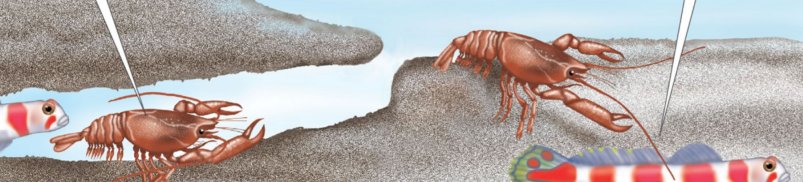
Describe what the figure is showing and the general ecological phenomena it illustrates.
This figure is showing a shrimp and a goby in a mutualistic relationship. The shrimp digs a burrow, which it shares with a goby. Outside of its burrow, the nearly blind shrimp keeps an antenna on the goby, whose movements warn it of danger. This is an illustration of habitat mutualism, in which one partner provides the other with shelter, a place to live, or favorable habitat.
In the context of community ecology, what is a “guild”?
A guild is a subset of a community that includes species that use the same resources, whether or not they are taxonomically related.
Describe the difference between a foundation and keystone species.
A foundation species has a large impact on its community as a virtue of its large population size, whereas a keystone species has a large impact on its community despite its relatively small population size.
What is the difference between primary and secondary succession?
Primary succession is succession following a disturbance after which no life remains, while secondary succession is succession following a disturbance after which only some life remains.
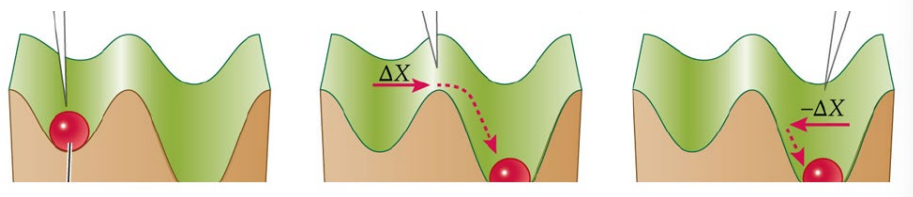
What process or concept is this figure illustrating?
This is showing the idea of alternate stable states. On the left, you have one stable state under certain conditions. In the middle, a change to the initial conditions is enacted that changes the state of the system to a different stable state. On the right, that change is reversed, but the state of the system remains in the second stable state because the reversal is not enough to disturb the stability of the new system.
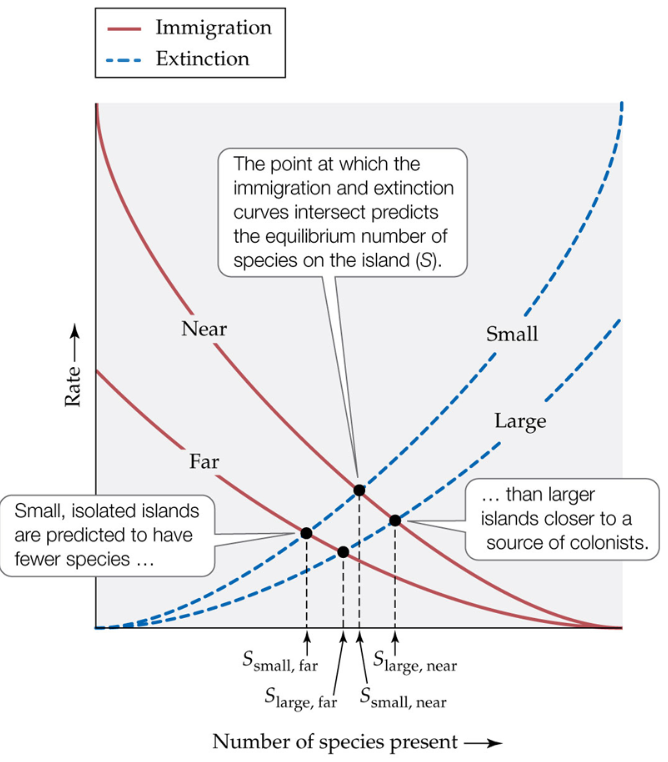
Draw the graphical model used by MacArthur and Wilson to show Island Biogeography Theory. Be sure to label the plot axes and to include (and label) two separate immigration and extinction curves. Use your work to show what type of island should have the largest equilibrium level of species diversity.