Dog and cat fleas
 Call Kai
 Learn
Learn Practice Test
 Spaced Repetition
 Match
Match Flashcards
 Knowt Play
1/38

There's no tags or description
Looks like no tags are added yet.
Name | Mastery | Learn | Test | Matching | Spaced | Call with Kai |
|---|
No analytics yet
Send a link to your students to track their progress
39 Terms
What are fleas
Insects
Six legs
Distinct body regions
Adult fleas suck blood
How many flea species are ectoparasitic on mammals
95%
What wild animals do fleas live on
All rodents
Carnivores
Birds
Domestic small and companion animals
What is the general morphology of a flea
Dark glossy brown
Laterally compressed to fit between hairs
Third pair of longer stout legs
Bony spines
How big are fleas
1-6 mm
What do fleas look like
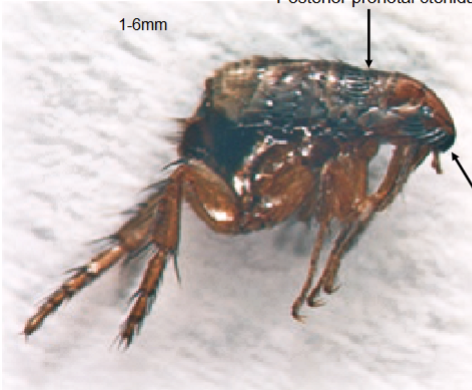
What role does resilin in insect back legs play in jumping
Is it compressed to store energy and then rapidly decompresses to release it producing accelerations of 100G
How do you clear and preserve specimens to see their characteristics
Place flea in 10% Potassium hydroxide
Place in water
Dehydrate in an alcohol series to 100%
Xylene to clear
DPX or similar to mount on a glass slide
Nuce clear prep for ID
What are cat fleas
C. felis
What are dog fleas
C. canis
What is the veterinary importance of fleas in the UK
It is the most common cause of skin problems in cats
What do fleas cause
Intense irritation
Anaemia
What is FAD
Flea allergic dermatitis
Where are flea eggs laid and what happens next
Eggs are laid on the host but fall to the ground where larvae develop
How many larval stages do fleas have and where do they occur
Fleas have 3 larval stages
All occurring in the environment
95% of their life cycle is hidden outside the host
How long does flea development take at different temperatures
3 weeks at 30oC
8 weeks at 15oC
How long can flea pupae survive
They can survive up to 1 year in the environment before emerging as adults
How does an adult flea find a host
Adult fleas emerge from pupae and jump onto a host in response to stimuli such as CO2, vibration, shadows, or temperature
How long do adult fleas live on a host and how often do they feed?
Adult fleas like 21 days on a host
Take multiple blood meals per day
Females begin laying eggs 36 hours after the first feed
Deposit 20-30 eggs a day
Why is treating the animal not the best solution
It only treats 5% of the infestation
Pupae are protected from the effect of insecticides
Can survive up to 1 year
How do you diagnose fleas
Presence of fleas
Pruritis
Presence of flea dirt
How do you diagnose fleas by flea dirt
Comb hair and put debris on water paper towel
Flea dirt appears red rich
It is a food source for larvae
Where do larvae actively move
Away from light
What do larvae look like
Maggot like
Distinct brown head
13 segments
Posterior bristles
What does it mean that larvae are susceptible to desiccation
It is easy harmed or killed by drying out
How do larvae move
Looping movement and can move several meters
What are the clinical signs of flea allergy dermatitis
Alopecia
Excessive grooming
Skin damage
Hypersensitivity to allergens in flea saliva
One flea can trigger a response
Secondary infections possible
How is Dipylidium caninum transmitted
Mature tapeworm proglottids disintergrate producing eggs
Forms an egg packet
Flea larvae or Trichodectes ingest eggs
Cysticercoids develop
Adult tapeworms develop when infected flears or lice are swallowed
How is Dipylidium caninum transmitted via fleas and lice
Tapeworm segments can emerge from the hosts anus and crawl onto the coat, releasing egg packets that are ingested by fleas or lice which then act as intermediate hosts
What are examples of adulticide treatments for fleas
Isoxazolines - Fluralaner chewable or spot on
Phenylpyrazoles - Fipronil spot on or spray
Neonicotinoids - Imidacloprid spot on
Others - Nitenpyram tablets
What kills eggs and larvae
Insect growth regulators
What are the two insect growth regulators
Chitin synthetase inhibitors - inhibit egg hatch and proper moulting
Juveline hormone analogues - prevents moulting and pupation
What kills larvae and adults
Insecticides
What are insecticides
Synthetic pyrethroids - toxic to cats
Low efficacy 23-86%
Present in some flea sprays
Why is using only adulticide or environmental treatment often insufficient for flea control
Fleas will still be seen on the pet because new adults continue to emerge from pupae if only one approach is used
What happens if both adulticide and environmental treatments are used inconsistently or just once
Reinfestation occurs as adults continue to emerge from pupae in the environment
How long should a combined flea control approach be maintained
A combined approach targeting fleas on the host and in the environment should be used for 2-4 months minimum to control infestations
What is crucial for effective flea control in the household
Continuous coverage and owner compliance are paramount for successful flea control
What hygiene measures can help control flea eggs, larvae, and pupae
Vacuuming the house and washing bedding kills eggs, larvae and pupae

