CPA_FAR_Accounts Receivable
 Call Kai
 Learn
Learn Practice Test
 Spaced Repetition
 Match
Match Flashcards
 Knowt Play
1/32

There's no tags or description
Looks like no tags are added yet.
Name | Mastery | Learn | Test | Matching | Spaced | Call with Kai |
|---|
No analytics yet
Send a link to your students to track their progress
33 Terms
What are the 2 Approaches for accounting for Bad Debt?
Direct write off method
Allowance method
Write off - Allowance Method
When a receivable is formally, determined to be uncollectible, the following entry is made:
Assume a $800 receivable is deemed worthless.
Debit allowance for credit losses $800 (bal sheet)
Credit accounts receivable $800 (bal sheet)
There is no income statement impact at this point. We estimate for credit losses at year-end.
There is no impact on total current assets – both the asset and contra asset are decreasing.

What happens to the credit loss expense on the income statement when an account receivable is written off under the allowance method?
When an account receivable is written off under the allowance method, the “credit loss expense” on the income statement, remains unchanged.
The credit loss expense has already been recognized in the period. The expense was estimated and the allowance was increased for that estimate. The write offs is simply a realization of the previous estimate, and affects only the balance sheet accounts – specifically, the “accounts receivable” and the “allowance for credit losses”.
There is no additional expense recorded on the income statement at the time of the write off.

Credit Loss replaces the term (Bad debt expense)
Allowance for credit losses replaces the term (allowance for bad debt)
Even if no customers, default, credit loss expense is recognized each year because US GAAP wants companies to estimate and match the expense in the year of the sale.
The journal entry to recognize credit loss expense is a debit to credit loss expense (IS) and a credit to allowance for credit losses (BS).
The allowance for credit losses is a contra asset and represents the portion of accounts receivable that the entity does not expect to collect.
The allowance for credit losses is deducted from the accounts receivable balance to arrive at the net realizable value of accounts receivable on the balance sheet.

Gross method
A discount is expressed as a percentage of the selling price. 2/10 net 30 simply means that if you pay us within 10 days, take a 2% discount.
If you don’t pay us within 10 days, the full amount is due in 30 days.
The Gross method ignores the discount when the receivable is first booked.
The rationale behind the Gross method is that we don’t think the customer is going to take the discount.
If we use the Gross method, an entry will be needed to adjust for any discount taken.
The account “sales discounts” is a contra revenue account so it has a normal debit balance.


Net Method
The net method records, sales and accounts receivable net of the available discount.
An adjustment is not needed if payment is received would end a discount. Period.
However, if payment is received after the discount period, an account called, “sales discount not taken”, must be credit.


Trade discounts
Trade discounts are quantity discounts, offered to good customers who buy heavy volume.
The sales revenue and the accounts receivable should be reported net of the trade discount.
Note: if you have 2 trade discounts, do not take them together. They must be taken one at a time. (See picture 30% taken first, followed by the 10%.)
Trade discounts - Gross/Net Method
The trade discount must be applied first regardless of what method gross or net is being used.
Example: a company offers trade discounts of 30% and a sales discount of 2/10 net 30 on its sales. A customer bought items with a list price of $70,000 on April 1. If the gross method is being used, the trade discount of 30% will still be applied first.
a. After the trade discount has been applied, then you would apply the appropriate method Gross or net.

Discounting without recourse example
When can Direct write-off be used?
Can only be used when bad debt expense is an immaterial item on income statement
The Allowance Method Approach
There are 2 approaches: 1. Income Approach 2. Balance Sheet Appt
Allowance for Credit Losses - how is this shown on a T account!
As a credit balance
How to know what method of allowance is being used for the Income Approach?
If for example the estimate is based on past experience, 2% of credit sales tend to go bad. This indicates the Income Statement Approach.

Balance sheet approach.
See the attached picture to determine what the allowance for credit losses would be for the period.
Be sure to ignore any income statements amounts, as this is the balance sheet approach not the income statement approach.
Beginning allowance balance will normally be provided (ex: $1,000) This may be reflected as the previous period ending allowance.
Ending accounts receivable will also normally be provided.
The question will provide the estimate based on experience, (I.e 5%) to apply to the ending account accounts receivable.
If ending accounts receivable is $200,000, with a 5% estimate based on experience the ending allowance balance will be $10,000.
Note: this is not the allowance for credit losses amount, credit loss expense is not determined directly but reflects the adjustment of the allowance to its ending balance.
This leads to allowance for credit losses of $9,000. This is a credit amount.

Balance sheet method continued with write off entry.
Write-off entry example:
Debit allowance for credit loss $xxx
Credit accounts receivable. $xxx

Aging of receivables


Aging of receivables - cont’d
Note: if the question ask for the ending balance in the allowance account, using the aging method that amount is strictly determined by the estimated %s that are given.
The beginning credit or debit balance in the uncollectible allowance account will be ignored.
a. The beginning balance only applies if the question is asking for the adjustment amount needed to arrive at the ending balance. (I.e. the adjustment needed for “allowance for credit losses”)
What to do if you receive payment on a previously written off bad debt?
Start by reversing the original write off entry. Original entry: debit Allowance for bad debt $2k and credit A/R for $2k
Reversal: debit A/R for $2k and credit Allowance for bad debt $2k
Record the entry BAU ex: debit cash $2k and credit A/R $2k

Factoring, pledging and assignment
If there are “Sales Returns”, the following journal entry will need to be made:
Debit: “Sales Returns and Allowances” $xxx
Credit: “Receivable from Factor” $xxx
Note: ultimately if there are sales returns, the merchant is responsible regardless of with or without recourse.


Factoring, pledging and assignment - cont’d
Note: if the factor is without recourse, any noncollectible accounts are not relevant, they are the responsibility of the factor.
In other words, if the question includes noncollectible amount, do not subtract that from the cash that will be received by the merchant. You will only apply the percentage of the factor fee, and if there is a percentage for returns, those will be subtracted as well.


Factoring, pledging and assignment With Recourse
factoring with recourse, the merchant will show a loss for the fees and have to worry about customers who keep their item but default on payment.
The merchant will need to record a “recourse liability” for default since there is recourse.
Note: with recourse if there is a default from customers, the merchant bears the cost not the factor


Assignment of accounts receivable
When accounts receivable are assigned the borrower assigns specific accounts receivable as collateral for a loan with a bank.
The receivables stay on the books of the merchant, but if the merchant defaults on the loan, then the proceeds from the receivables belong to the bank.
The borrower must re-classify the receivables as “A/R assigned”.
Factoring of receivables → This is treated as a sale of receivables, so the accounts receivable are removed from the transferor’s books.

Pledged equals using receivables as security for a loan. What do you need to remember?
Pledging receivables, requires footnote disclosure.
With pledging the accounts, receivables remain on the books of the merchant.
a. However, if there is a default on the loan, then the bank can take title to the receivables.
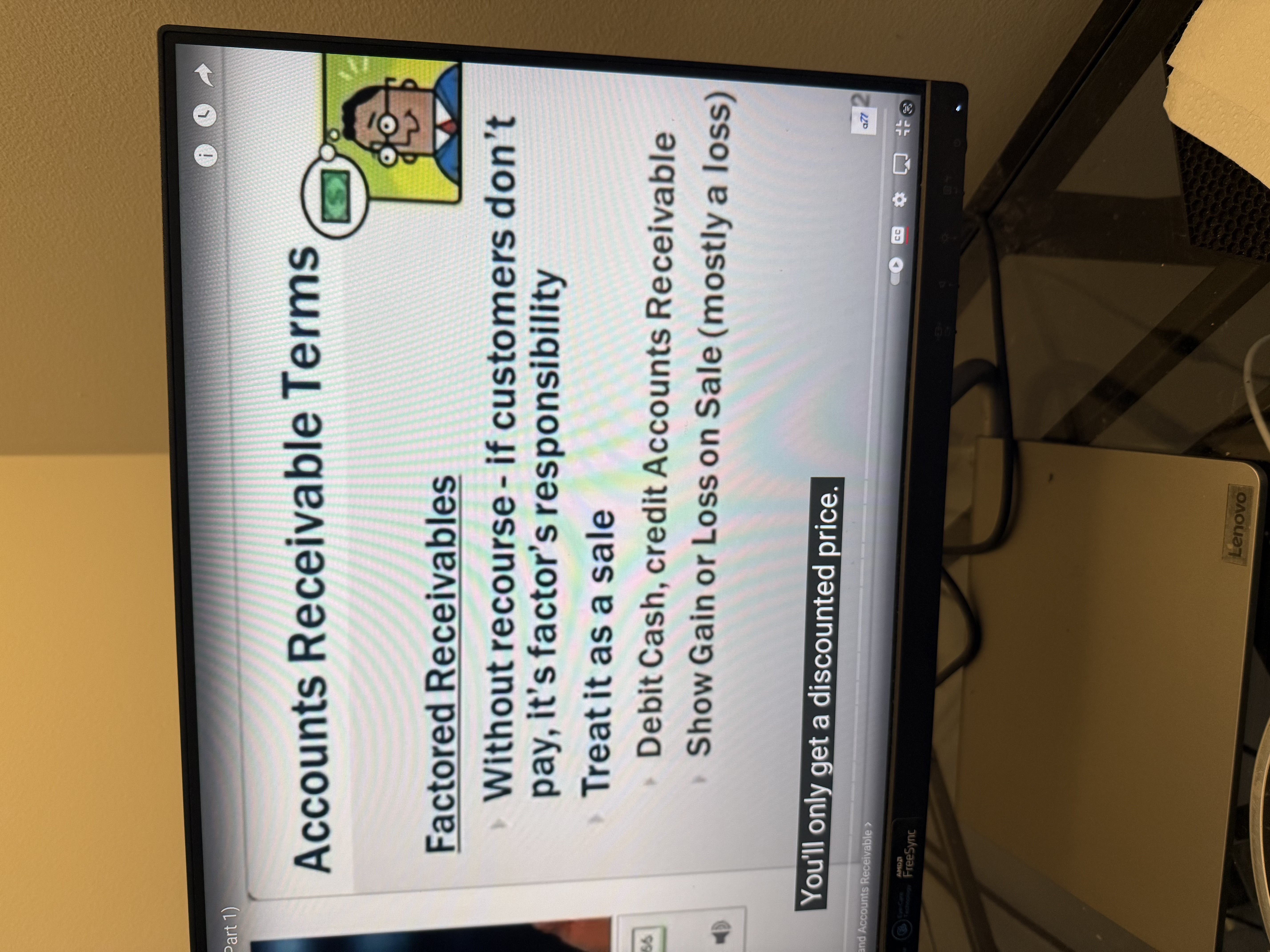
Factored = selling receivables to a factor.
Without recourse = if customers don’t pay, it’s factors responsibility.
With recourse = Company/seller keeps receivables.
Separate factored accounts receivable from other accounts receivable on the balance sheet.

Notes receivable
Notes classified as current assets are usually recorded at face amount minus an allowance for credit losses, but notes maturing in less than one year are not discounted to present value. Any allowance decreases the carrying amount to reflect potential uncollectible amounts.
Notes classified as long-term are recorded at the present value of the expected future cash flows and are reported minus an allowance for credit losses. Any allowance decreases the carrying amount to reflect potential uncollectible amounts.
An allowance for credit losses is recorded for notes receivable to comply with GAAP requirements, the “expected credit loss model”.
When an interest bearing note receivable is issued, the note is recorded at the present value of the expected future cash flow flows, discounted using the market interest rate at the time of issuance. (NOT the stated rate) This is a requirement under US GAAP to ensure the note reflects its fair value.


Interest bearing note receivable example
If you’re asked to determine the amount to be recorded for an interest bearing note:
Do NOT automatically apply the present value factor.
First, you must calculate the total future cash flows.
Assume the interest bearing note receivable is $50,000, with a stated interest rate of 8%, due in five years,
a. interest payment (accrued over 5 years): Total interest = principle x stated rate x time. ($50k x 8% x 5 = $20k)
b. Total future cash flows: Principal + Total Interest ($50k + $20k = $70k)
Calculate present value of total future cash flows: To find the present value of the total future, cash flows, use the present value factor for the market rate. Assume the market rate present value factor is 0.621. ($70k x 0.621 = $43,470)

Non-Interest Bearing Notes Receivables
Even though a note does not explicitly state an interest rate, it is assumed to carry an implicit interest cost.
For a note classified as current asset, show it at face value ignore any present value factors given.
For non-current notes, the present value of the note is determined using the implicit rate of interest, the market rate of interest for similar instruments.
The difference between the face value and a present value is recognized as a discount on the note.
Effective interest method
This indicates that your starting point for amortization is not the original face value of the note. This amount will have already been adjusted for example, interest revenue for a period. (in other words the effective interest method is based on the carrying value of the note)
See picture

Present value note regarding when to use present value factor versus verse determining future cash flow flows
Present value always discounts future cash flows.
So the first question is how much cash will be received and when?
Only after you know, the future cash payments can you apply a present value factor.
Mental shortcut: ask yourself, is interest paid at maturity?
a. if yes, discount the maturity value
b. if no, discount face value.

Discounting a note at a bank


Discounting a note at a bank - cont’d

