GCSE Physics Paper 1 (copy)
 Call Kai
 Learn
Learn Practice Test
 Spaced Repetition
 Match
Match Flashcards
 Knowt Play
1/276

Name | Mastery | Learn | Test | Matching | Spaced | Call with Kai |
|---|
No analytics yet
Send a link to your students to track their progress
277 Terms
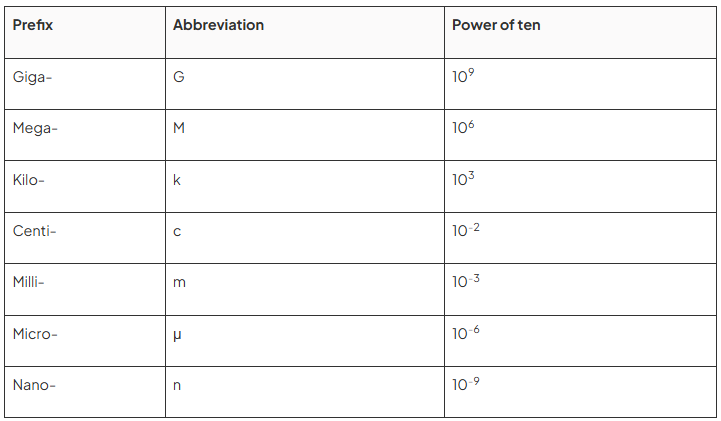
prefixes
scalars
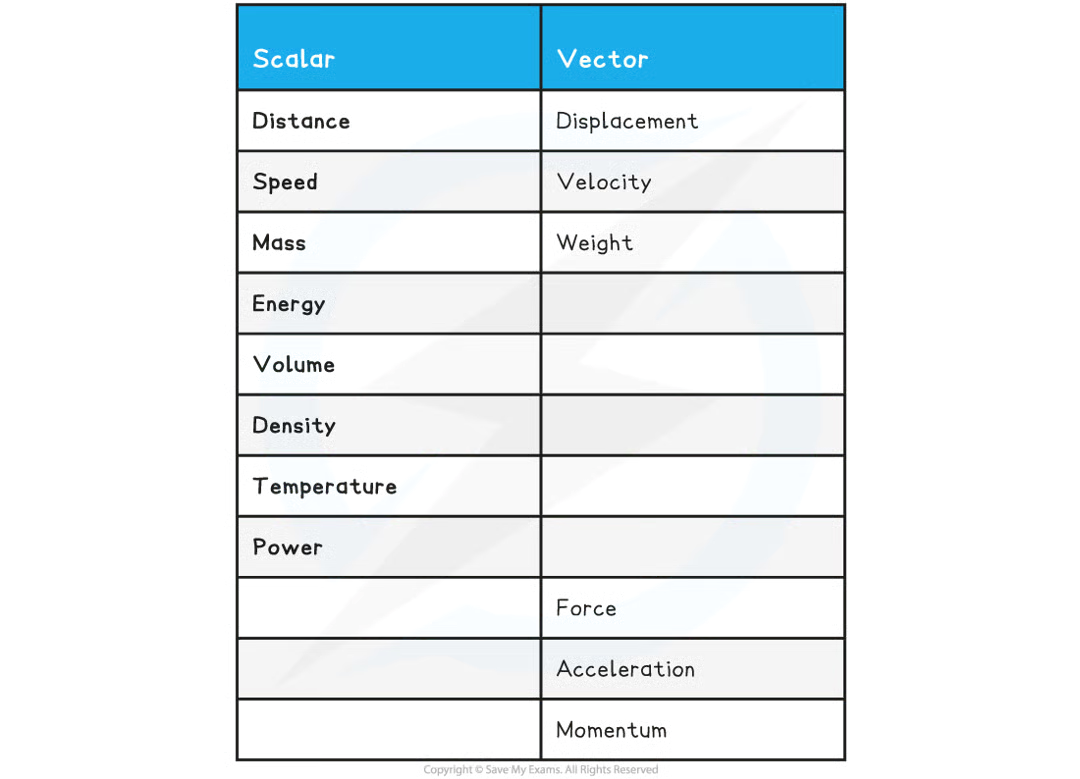
quantities that only have a magnitude not direction e.g. mass & distance
vectors
quantities that have both magnitude & direction e.g. velocity (need to mention both speed & direction)
distance is a scalar quantity while displacement is a vector quantity as it has direction
scalar & vector examples
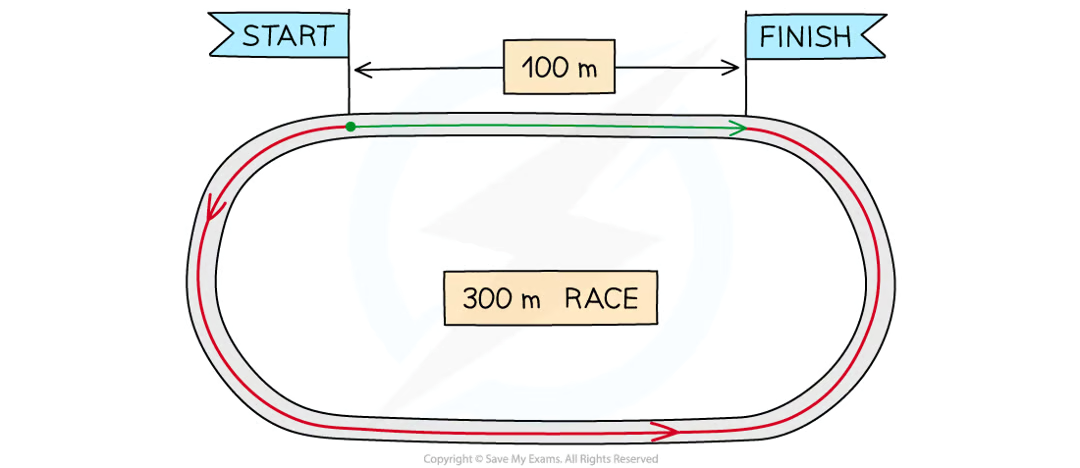
distance & displacement
distance = how far an object travels (scalar)
displacement = the distance of an object from its starting position + its direction (vector)
speed + equations
the distance an object travels every second (scalar)
speed (m/s) = distance travelled (m) / time taken (s)
average speed = total distance / time taken
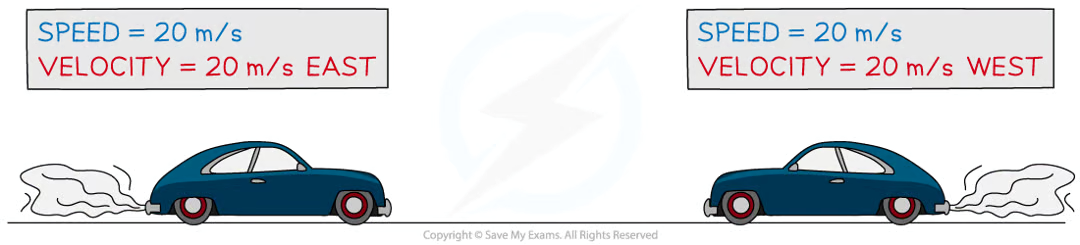
velocity
the speed of a moving object with its direction - vector e.g. 15m/s south
distance-time graphs
shows how the distance of an object moving in a straight line from a starting position varies over time. shows if an object is moving at a constant speed and how big / small the speed is
straight line = constant speed
slope of line = magnitude of speed. steep slope = large speed, shallow slope = small speed, flat horizontal line = stationary
changing speed = curve. slope increasing = accelerating, slope decreasing = decelerating
speed can be calculated from the gradient of a line - rise/run or Δy/Δz. use the whole line to calculate gradient
acceleration
the rate of change of velocity aka how much an object’s velocity changes every second
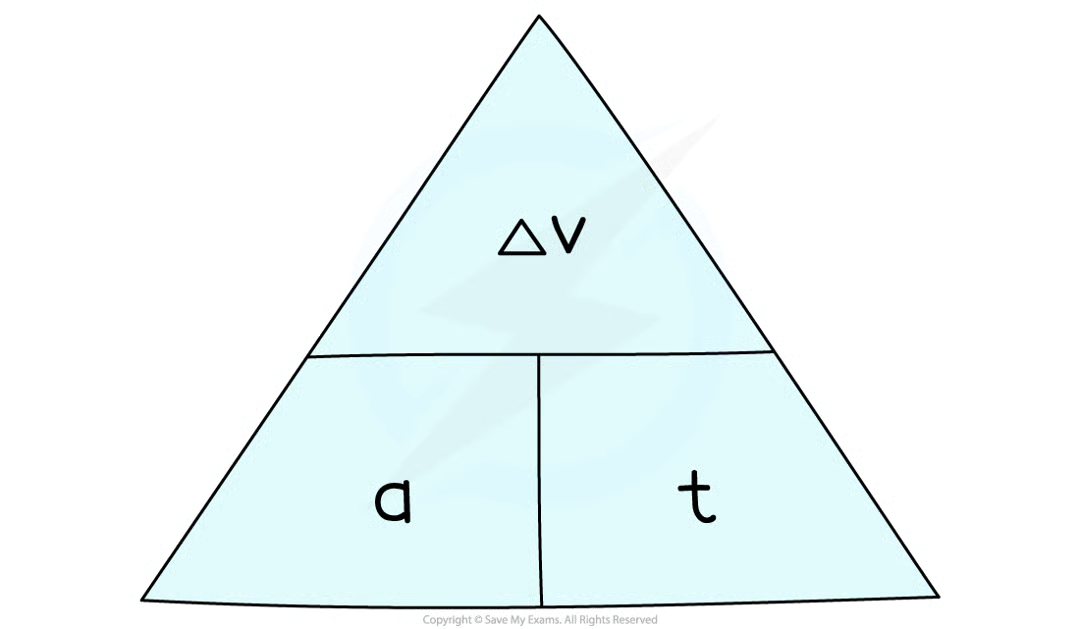
a = Δv / t
acceleration (m/s2) = change in velocity (m/s) / time taken (s)
Δv = v - u
change in velocity = final velocity - initial velocity
the acceleration of an object can be positive or negative depending on whether the object is accelerating or decelerating
speed of acceleration due to gravity
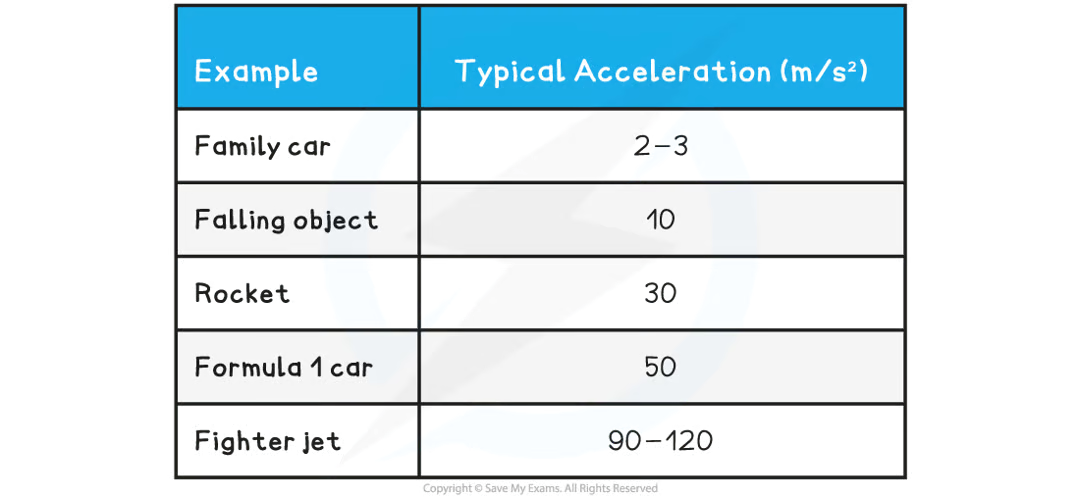
10m/s2
typical accelerations
uniform acceleration (equation)
applies to objects moving with uniform (constant) acceleration:
v2 - u2 = 2ax
final speed2 (m/s) - initial speed2 (m/s) = 2 x acceleration (m/s2) x distance travelled (m)
useful for where time isn’t known
velocity-time grapha
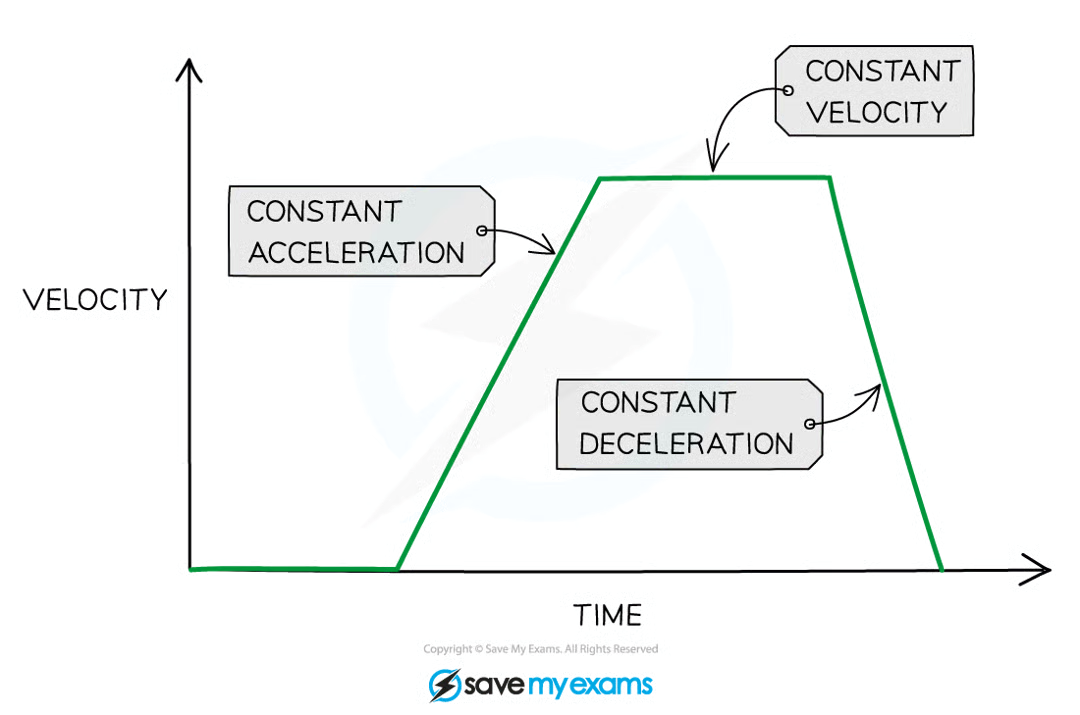
shows how the velocity of a moving object varies with time. shows if the object is moving with a constant acceleration / deceleration & the magnitude of this
straight line = constant acceleration
slope of line = magnitude of acceleration. steep = large, gentle = small
a flat line = 0 acceleration - constant speed
acceleration can be calculated using gradient - rise/run or Δy/Δx
area under a velocity-time graph = displacement / distance travelled by object. break it up into shapes & calculate the area
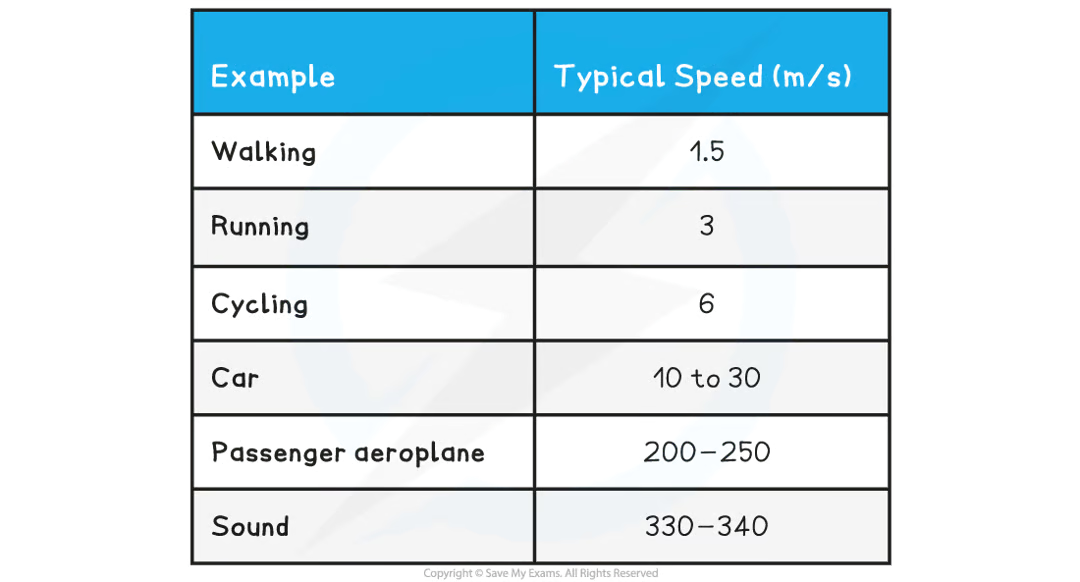
typical speeds table
(but these things do depend on factors e.g. age / fitness, type of car)
simple measuring falling speed practical
compare average falling speed of objects e.g. tennis ball, plastic cone:
metre rule used to measure distance they fall from
or a tape measure / trundle wheel for larger distances
timer used to measure how long they take to reach the ground
measuring speed using light gates practical
light gates are pieces of digital equipment that allow times to be measured more accurately. they can be used to start / stop a timer when an object passes through - flags on top of moving object blocks beam of light as it passes through the light gate
a single light gate can be used to measure speed:
timer measures how long light gate is blocked by flag for
distance = length of flag
speed calculated through speed = distance / time
newton’s first law of motion
objects will remain at rest or move with a constant velocity unless acted on by a resultant force
so if an object is at rest / constant velocity there are no resultant forces acting on it
newton’s second law
the acceleration of an object is proportional to the resultant force acting on it and inversely proportional to the object’s mass
aka an object will accelerate (change velocity) in response to a resultant force. the bigger the resultant force, the larger the acceleration. but the bigger the object’s mass, the smaller the acceleration
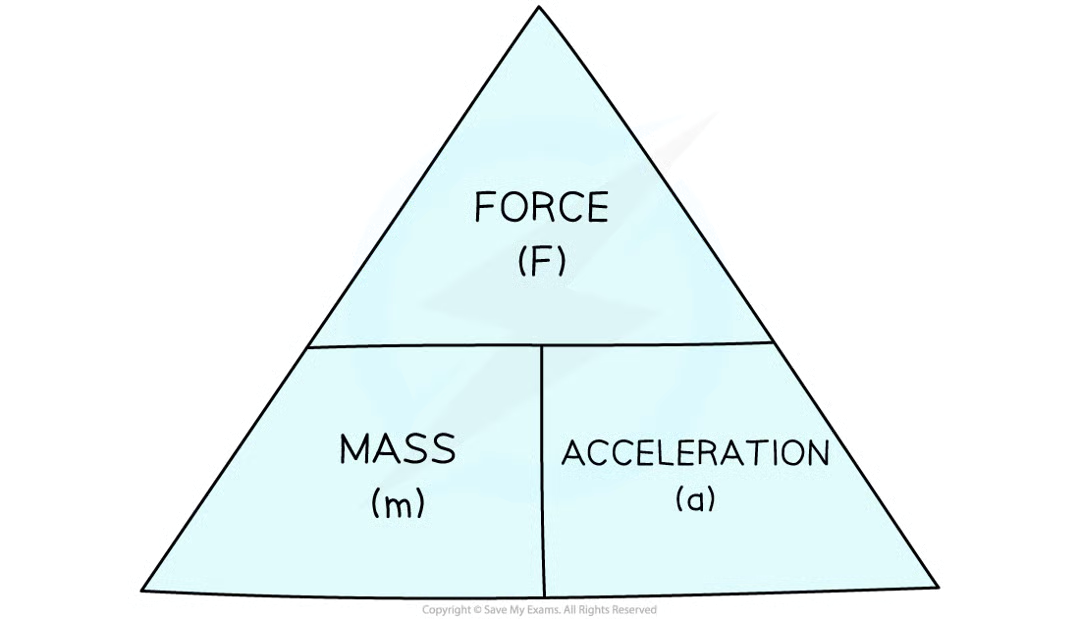
force & acceleration equation (newton’s second law)
F = ma
force (N) = mass (kg) x acceleration (m/s2)
investigating force & acceleration practical - experiment 1: investigating the effect of force on acceleration
aim - invesetigate the effect of varying force on the acceleration of an object of constant mass
independent variable = force, dependent variable = acceleration, control variable = mass
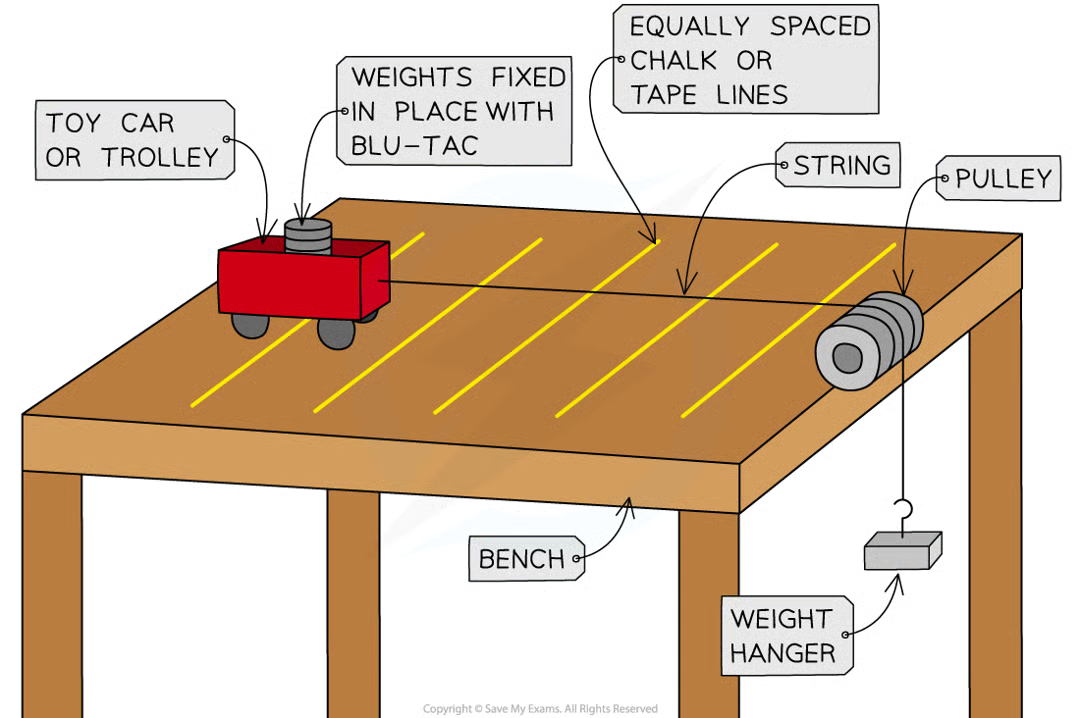
use ruler to measure out intervals on bench & mark out with pencil / chalk
attach bench pulley to end of bench
tie string to toy car / trolley & pass it over the pulley. attach the mass hanger to the other end. make sure the string is horizontal & in line with the trolley
hold the trolley at start point & attach the full set of weights to the end of the string
release the trolley & start the stopwatch. press the stopwatch in lap mode at each measured interval on the bench until the end
repeat to calculate an average time & record results in a table
repeat with decreasing weights. place masses you remove from the weight stack onto the top of the trolley using blue tac
use results table to determine average speed of trolley in different intervals (s=d/t) & compare the speeds between the first & last intervals. calculate the acceleration between first & last intervals (a=Δv/t)
systematic errors - ensure any weight removed from hanger are transferred to car to ensure total mass of system remains constant
random errors - take repeat readings of time to keep timing errors to a minimum. start the car by releasing it, don’t give it a push
safety - don’t stand under the weight hanger in case any weight fall. place a crash mat under the hanger in case this happens
independent variable
the variable you change, unaffected by other variables
dependent variable
the variable you measure, dependent on other varaible
investigating force & acceleration practical - experiment 2: investigating the effect of mass on acceleration
aim = investigate the effect of varying mass on the acceleration of an object produced by a constant force
independent variable = mass, dependent variable = acceleration, control variables = force
use ruler to measure out intervals on bench & mark out with pencil / chalk
attach bench pulley to end of bench
put a 200g mass on car
tie string to car & pass it over the pulley & attach the mass hanger to the other end. make sure string is horizontal & in line with the car
put a weight on the weight hanger that will gently accelerate the car along the bench
hold the car at the starting point
release the car & start the stopwatch. lap the stopwatch at each measured interval
repeat to find average & record results in a table
repeat with increasing masses
calculate average speed intervals (s=d/t) & compare average speed between first & last intervals for different weights. calculate acceleration between first & last intervals (a=Δv/t)
random errors - take repeat readings of time to keep timing errors to a minimum. start the car by releasing it, don’t give it a push
safety - don’t stand under the weight hanger in case any weight fall. place a crash mat under the hanger in case this happens
how to answer questions about practicals
If you need to use an equation to calculate something, start off by giving it as this will give you some hints about what you need to mention later
List the apparatus that you need
State what measurements you need to make (your equation will give you some hints) and how you will measure them
Finally, state that you will repeat each measurement several times and take averages
newton’s third law
describes the effects of the forces involved when 2 different objects interact with each other
Whenever two bodies interact, the forces they exert on each other are equal and opposite
force pairs = the pair of forces exerted by the interacting objects
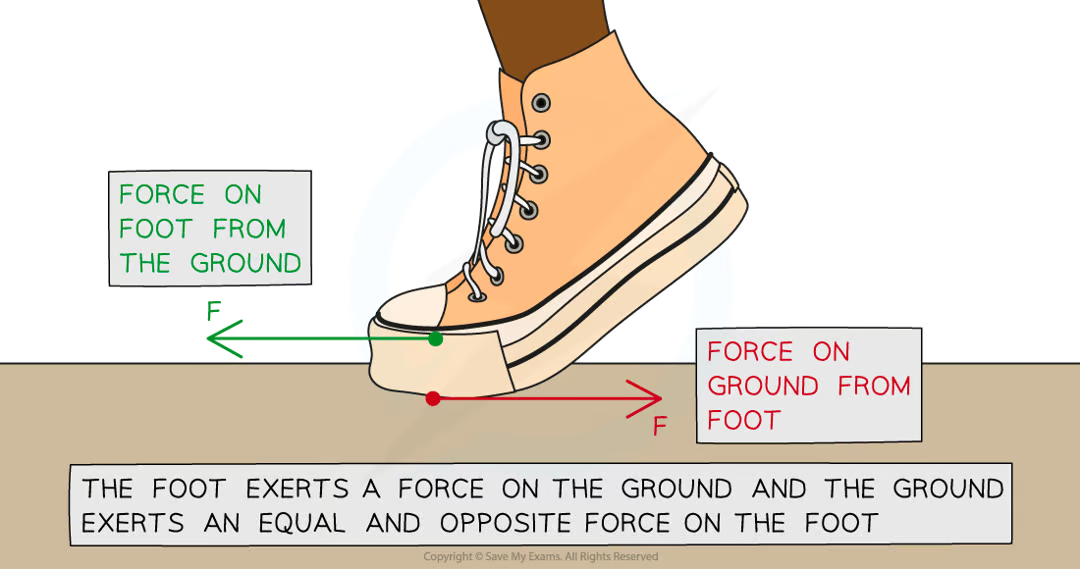
e.g. when walking:
two objects interacting = foot & ground
foot exerts push force on ground
ground exerts push force on foot
the forces are equal in magnitude & opposite in direction
how to identify newton’s third law
the two forces are:
acting on different objects
equal in size
acting in opposite directions
the same type (weight, reaction force etc)
you can describe forces as a push/pull force if you don’t know the name
weight
the force acting on an object due to gravitational attraction
planets have strong gravitational fields so they attract nearby masses using gravitational force
because of weight objects stay on the ground, will always fall to the ground, and satellites are kept in orbit
weight equation
W = mg
weight (N) = mass (kg) x acceleration due to gravity on earth (9.81 N/kg or ms-2)
weight and mass
the weight that an object experiences depends on the object’s mass and the mass of the planet attracting it (w = mg)
mass is measured in kilograms and is related to the amount of matter in an object
weight is measured in newtons and is the force of gravity on mass
the weight & mass of an object are directly proportional, and the size of weight depends on the gravitational field strength
weight is a force so it’s a vector quantity. mass is an amount so is a scalar quantity
measuring weight
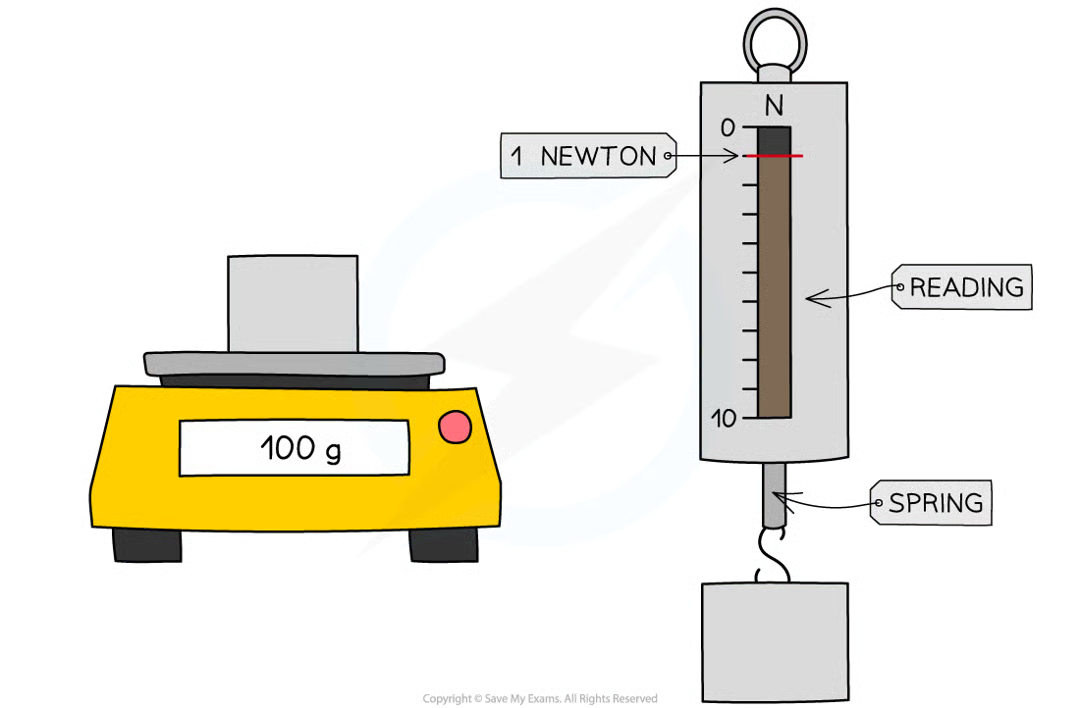
mass is commonly measured with a top pan balance and then weight is found using w = mg
weight can also be measured directly using a newton-meter, a type of weighing scale that measures force in newtons. it consists of a spring fixed at one end with a hook to attach an object at the other
weight and gravity - weight on different planets
the strength of gravity on different planets alter an object’s weight on that planet
an object’s mass will always stay the same but its weight will change depending on the strength of the gravitational field on different planets
gravitational field strength varies from planet to planet depending on their mass and radius. planets’ strong gravitational fields attract nearby masses, meaning objects stay firmly into ground & will always fall to the ground, and satellites are kept in orbit
circular motion
because velocity is a vector, when an object travels in a circle its velocity is always changing, even if the speed is the same, because the direction is always changing
this means an object moving in circular motion travels at a constant speed but has a changing velocity
centripetal force
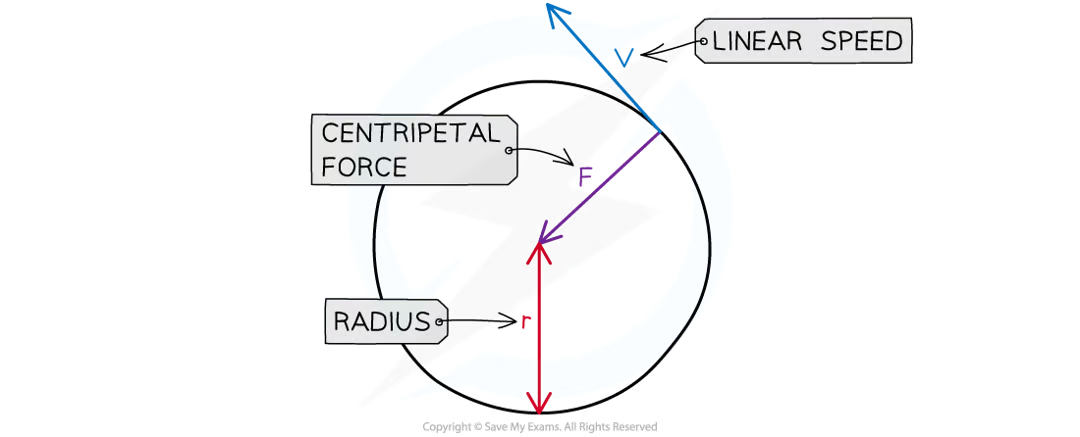
an object moving in a circle isn’t in equilibrium as it has a resultant force acting on it. this force is centripetal force and is what keeps the object moving in a circle.
centripetal force (F) = the resultant perpendicular force towards the centre of the circle required to keep a body in uniform circular motion
it’s always perpendicular to the direction of travel and is directed towards the centre of the circle
due to newton’s second law, centripetal force and centripetal acceleration act in the same direction
centripetal force isn’t a separate force of its own - it can be any type of force depending on the situation for example:
car going round a roundabout = friction between car tires & road
bell attached to rope moving in a circle = tension in the rope
earth orbiting the sun = gravitational force
momentum equation
p = mv
momentum (kg m/s) = mass (kg) x velocity (m/s)
momentum
a moving object has momentum, but if it’s at rest it has no momentum. it’s measured in kg m/s
momentum keeps an object moving in the same direction - it’s hard to change the direction of an object with a large momentum
because velocity is a vector the momentum of an object depends on the direction of travel. so it can be either positive or negative. generally right & up are positive and down & left are negative but its up to you
the momentum of an object will change if:
the object accelerates / decelerates
the object changes direction
the mass of the object changes
momentum in collisions
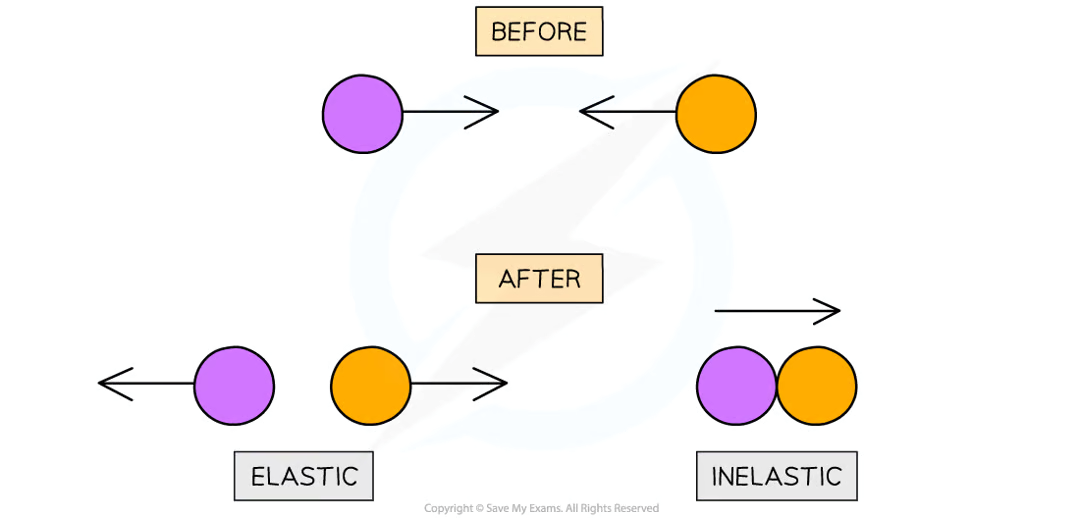
elastic collision - when objects collide and move in opposite directions
each object has a different velocity depending on its mass & initial momentum
inelastic collision - when objects collide and move in the same direction together
the 2 objects will have a combined mass & velocity
momentum is always conserved in a collision
what to do in questions that ask you to analyse a collision
consider the motion before & after the collision. state the velocities of each object and the direction each moves in
state whether the collision was elastic or inelastic & explain your reasoning (do they stick together or not?)
describe any energy transfers that occur if kinetic energy isn’t conserved e.g. it may be converted into heat, sound, elastic potential energy etc
conservation of momentum
principle of conservation of momentum - in a closed system the total momentum before an event = the total momentum after the event
closed system = energy in system is constant + no external forces like friction
aka total momentum before collision = total momentum after collision
since momentum is a vector, objects moving in opposite directions (eg towards each other) have an overall momentum of 0 as they cancel each other out
newton’s 3rd law
when 2 bodies interact the forces they exert on each other are equal & oppsite
this means when object 1 exerts a force on object 2, object 2 will exert an equal force on object 1 in the opposite direction
when 2 objects collide they will both react
change in momentum equation
Δp = mv – mu
change in momentum = (mass x final velocity) - (mass x initial velocity)
can also be written as final momentum - initial momentum
inertia
the tendency of an object to continue in its state of rest or in uniform motion unless acted upon by an external force - aka an object’s resistance to change in motion
if an object’s at rest it will tend to remain at rest, and if it’s moving at a constant velocity it will continue to do so
inertial mass
how difficult it is to change an object’s velocity. the ratio between the force applied and the acceleration it experiences:
m = F / a
inertial mass (kg) = force (N) / acceleration (m/s2)
this equation shows that for a given force inertial mass is inversely proportional to acceleration.
stopping distance
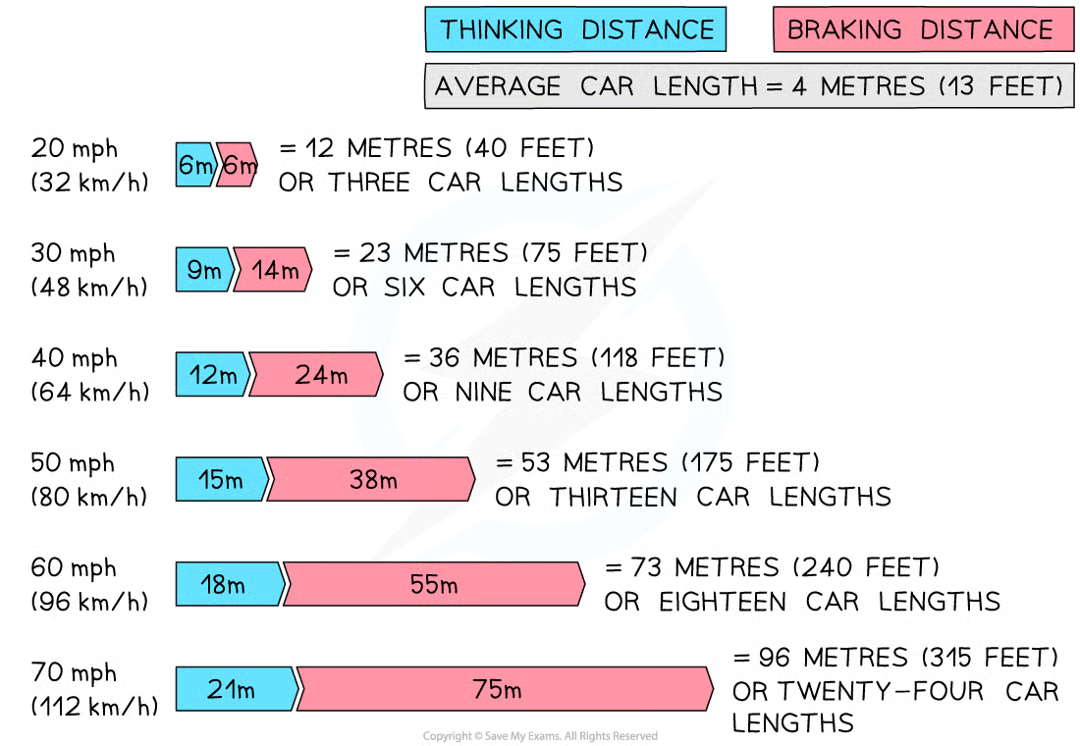
the total distance travelled during the time it takes for a car to stop in response to some emergency
stopping distance = thinking distance + braking distance
thinking distance: the distance travelled in the time it takes the driver to react (reaction time)
braking distance: the distance travelled under the braking force
for a given breaking force, the greater the speed of the vehicle, the greater the stopping distance
all are measured in meters
dangers on the road: overheating of breaks
the breaks of a vehicle reduce its speed by creating a friction force between the brake and the wheel
the kinetic energy of the vehicle is converted to the thermal energy of the breaks
if the breaks get too hot they can fail, meaning they won’t work effectively next time they’re used
dangers on the road: loss of control and injury
when a vehicle undergoes a deceleration the driver & passengers also experience a deceleration
this can cause injuries like whiplash - a neck injury caused when a person’s head moving suddenly, relatively to the body
it’s also more difficult to control a vehicle that’s decelerating. losing control can cause a collision
reaction time
a measure of how much time passes between seeing something and reacting to it
the human reaction time for someone who is alert (waiting for something to happen) is usually ~0.2 - 0.9 seconds
measuring reaction time
person A holds a 30cm ruler vertically so the bottom hovers over the top of the hand of person B
person A releases the ruler unexpectedly
as soon as person B sees the ruler move they close their hand to catch it
the ruler is marked at the point at which it was caught by person B, giving the measurement of the distance the ruler fell
greater distance = longer reaction time
braking distance
the distance travelled by a car under the breaking force - while it’s slowing down
the main factor affecting braking distance is the car’s speed - the greater the speed, the greater the breaking distance. other factors include:
vehicle condition - eg worn tires or poor brakes
road condition - wet/icy roads make it harder to decelerate (smoother road = less friction between tyres and road)
vehicle mass - a heavy vehicle (eg a lorry) takes longer to stop
the braking distance is the ratio of the kinetic energy of the car and the braking force. (this is because the work done in bringing a car to rest is the transfer of all its kinetic energy into other forms eg thermal, sound)
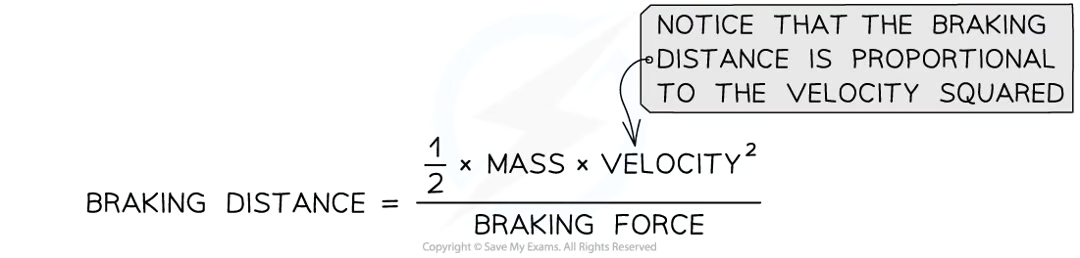
as KE = ½mv2, braking distance is proportional to velocity squared. so if the velocity doubles the braking distance increases by 22 or 4 times
thinking distance
the distance travelled by a car from when a driver realises they need to brake to when they apply the brakes
reaction distance = speed of car x driver’s reaction time
main factor that affects thinking distance is the car’s speed but additional factors include tiredness, distractions (eg mobile phone), and intoxication (eg consumption of alcohol/drugs)
estimating stopping distances
for a given force, the speed of a vehicle determines the size of the stopping distance. greater speed = larger stopping distance
calculating braking distance
when a vehicle stops its kinetic energy is transferred to the thermal energy in the brakes, which does work
braking force x braking distance = ½ x mass x velocity2
braking force x braking distance = work done by brakes
½ x mass x velocity2 = kinetic energy of the car
this equation shows that the work done is the transfer of kinetic energy. we can use it to estimate the decelerating forces required for a typical vehicle moving at everyday speeds. the equation can be rearranged to show how the braking distance depends on velocity:
braking distance = ½ x mass x velocity2 / braking force
this equation shows that the braking distance is proportional to the vehicle’s velocity squared. however at very high speeds it doesn’t apply because the brakes get hot & become less effective, reducing braking force & causing the braking distance to increase.
gravitational potential energy + equation
energy in the gravitational store of an object = the energy an object has due to its height in a gravitational field
if an object is lifted up, energy is transferred to its gravitational potential store. if it falls, energy is transferred away from its gravitational potential store
ΔGPE = m x g x Δh
change in gravitational potential energy (J) = mass (kg) x gravitational field strength (N/kg) x change in vertical height (M)
gravitational field strength on different planets
g on earth is approx 10 N/kg. the gravitational field strength on the moon is less than on earth, meaning it’s easier to lift a mass on the moon than on earth. g on gas giants (eg jupiter & saturn) is more than on earth.
kinetic energy + equation
the amount of energy an object has as a result of its mass and speed. any object in motion has energy in its kinetic store
KE = ½ x m x v2
kinetic energy (J) = ½ x mass (kg) x speed of object2 (m/s)
closed systems
system = a certain number of objects under consideration. a way of narrowing the parameters to focus on only what’s relevant
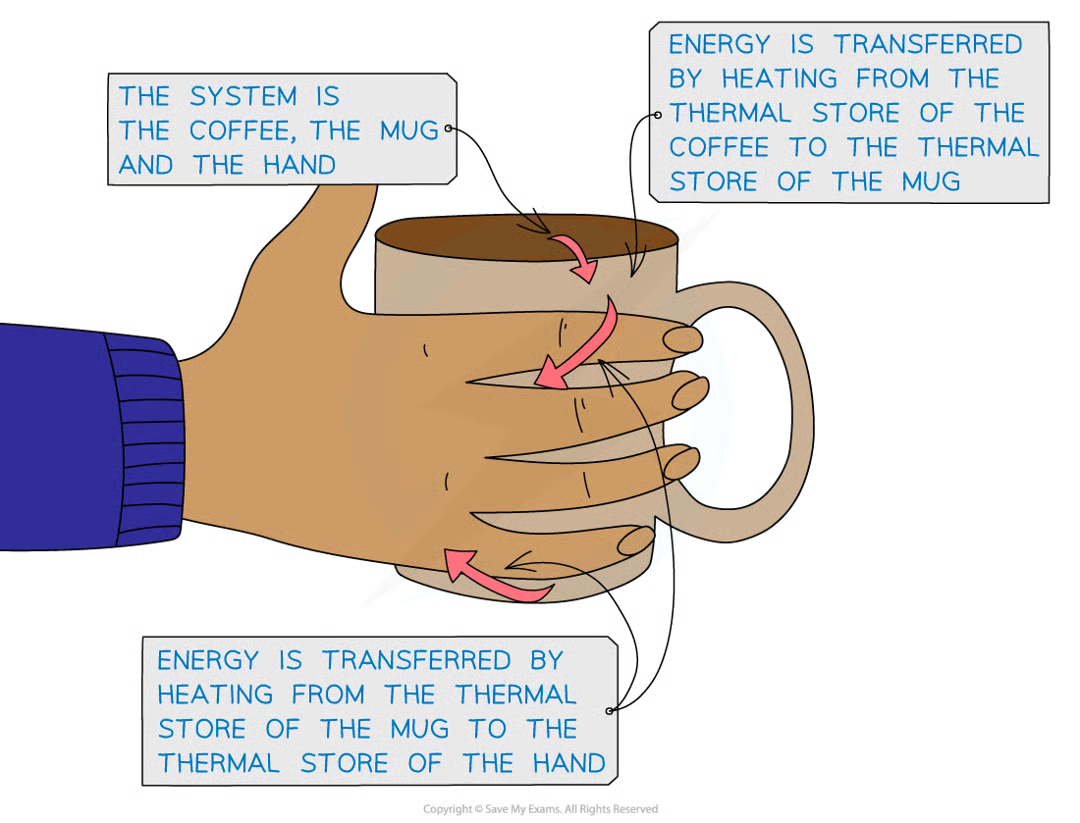
when a system is in equilibrium, nothing changes & nothing happens. when there is a change in a system, energy is transferred
closed system = a system where there is no net change to the total energy in that system. the total amount of energy in the system remains constant (due to conservation of energy)
conservation of energy
principle of conservation of energy - energy can’t be created or destroyed, it can only be transferred from one store to another. this means the total amount of energy in a closed system stays constant
total energy transferred into a system must = total energy transferred out
so energy is never lost but it can be transferred to the surroundings - dissipated (spread out) to the surroundings by heating & radiation. dissipated energy transfers are often not useful & can be described as wasted energy
energy stores
energy is stored in objects in different energy stores
kinetic - moving objects
gravitational - when objects are lifted above ground
elastic - when objects are stretched
electrostatic - objects with charge interacting with each other
magnetic - magnetic materials interacting with each other
chemical - objects can release energy in chemical reactions
nuclear - when atomic nuclei release energy during nuclear reactions
thermal - all objects have energy in thermal store (hotter object = more energy)
energy transfers
energy is transferred between stores via transfer pathways:
mechanical working - when a force acts on an object eg pulling, pushing, stretching
electrical working - a charge (current) moving through a potential difference eg charge around a circuit
heating by particles - energy transferred from a hotter object to a colder one
heating by radiation - energy transferred by electromagnetic waves eg light
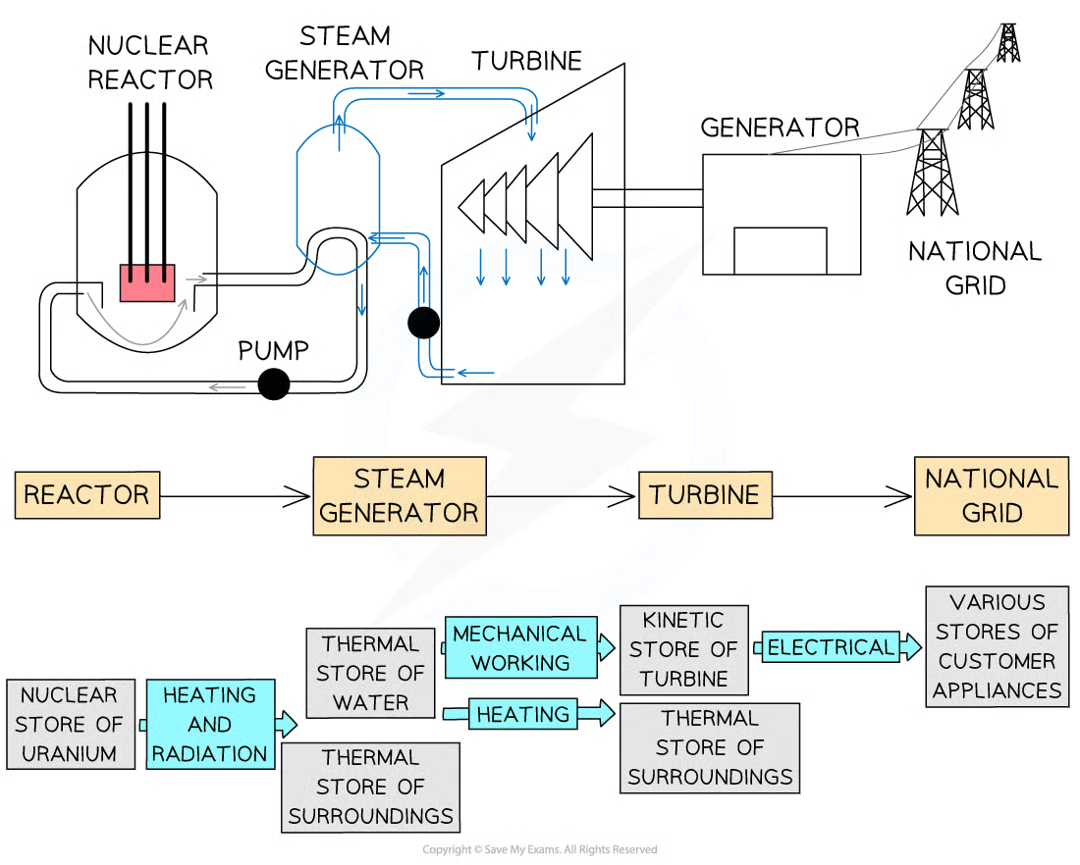
energy flow diagrams
energy stores & transfers can be represented using a flow diagram, which shows the stores & transfers within a system
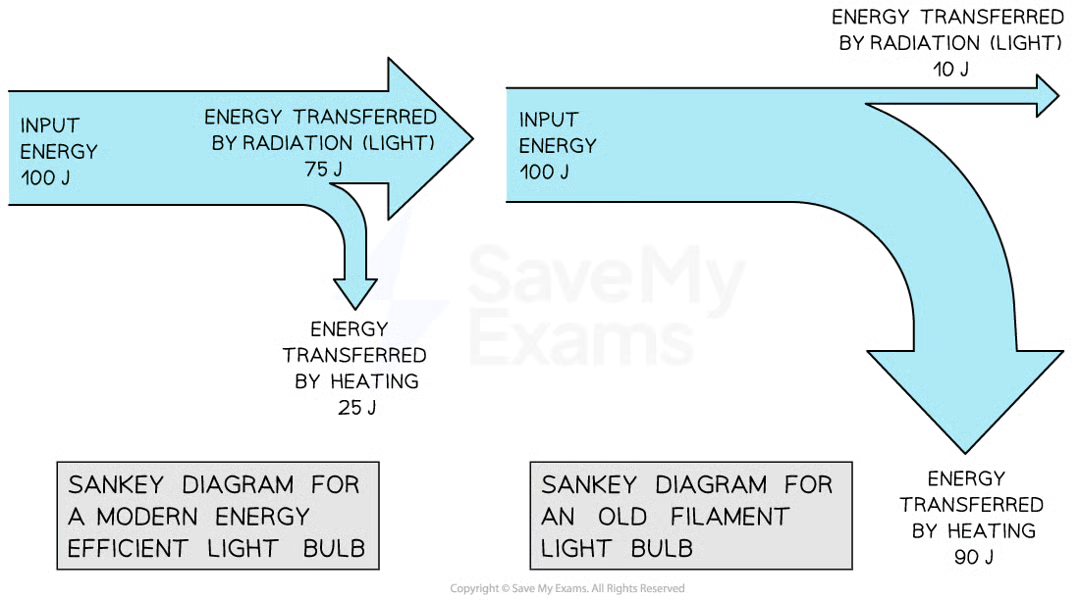
sankey diagrams
can be used to represent energy transfers using splitting arrows that show the proportions of the energy transfers taking place
left hand side of the arrow (flat end) = energy transferred into system
straight arrow pointing to the right = energy that ends up in desired store (useful energy output)
arrows that bend away = wasted energy
the width of each arrow is proportional to the amount of energy being transferred
example energy transfers: an object propelled upwards
when the person holds the ball they have energy in their chemical store
when the ball is thrown some of that energy is transferred to the kinetic store of the ball as it begins to move upwards
as the height of the ball increases, energy from the kinetic store of the ball is transferred to its gravitational potential store
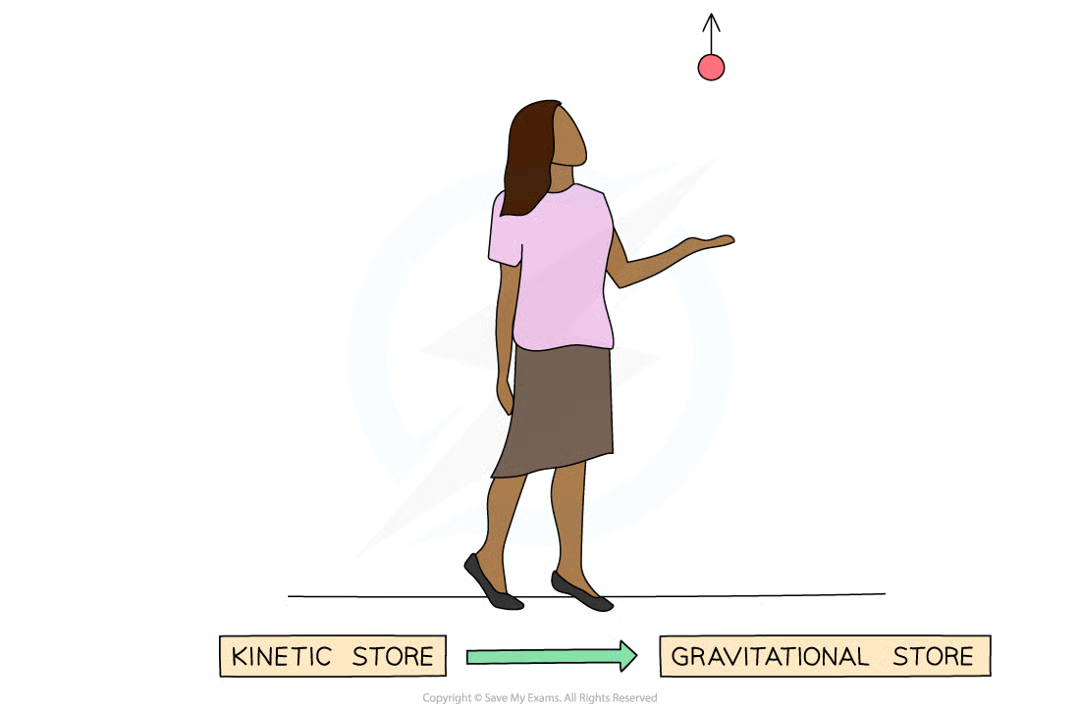
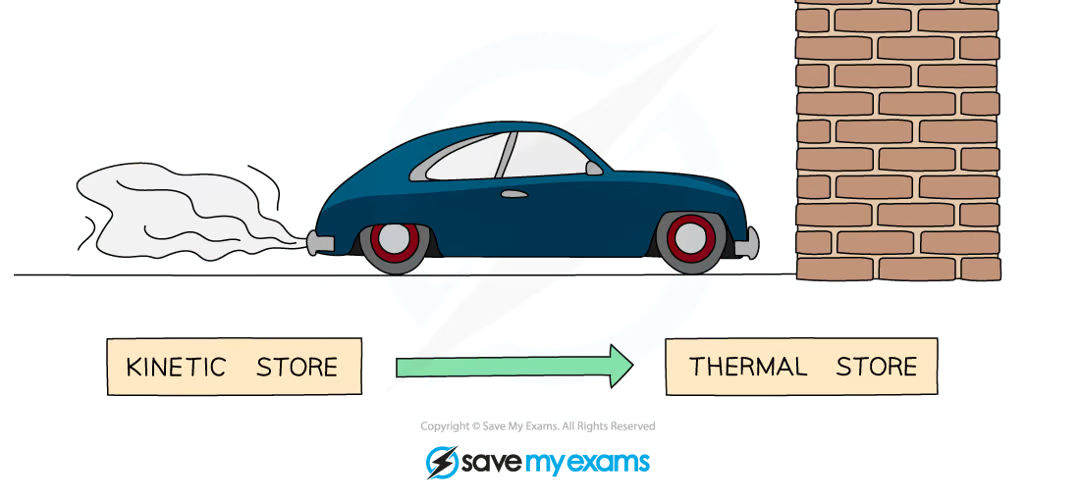
example energy transfers: moving object hitting an obstacle
if an object (like a car) hits an obstacle (like a wall) the speed of the car decreases very quickly, and the energy in its kinetic store decreases too
in this scenario most of the energy in the kinetic store is dissipated (transferred to the thermal store of the surroundings), transferred mechanically to the thermal store of the wall (for of the car on the wall), and transferred by heating to the thermal store of the air as sound waves transfer energy away from the system
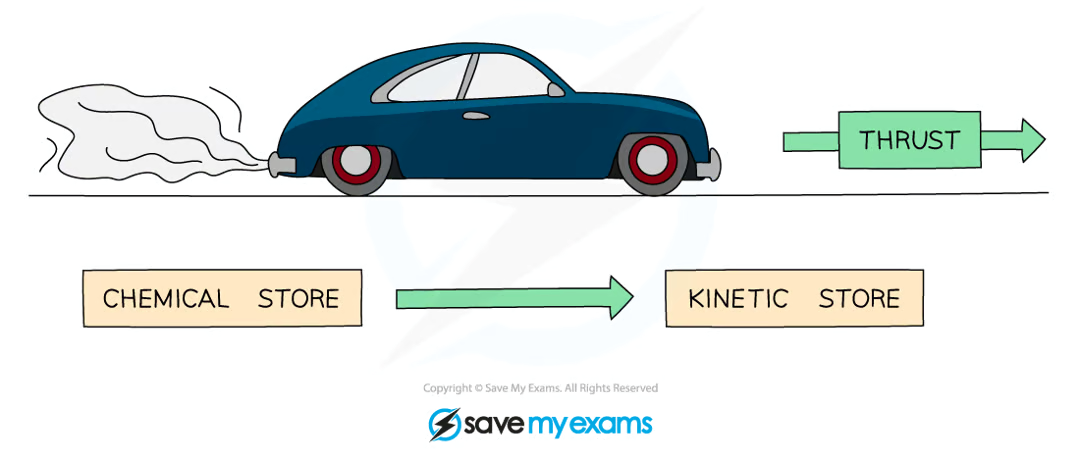
example energy transfers: vehicle being accelerated by a constant force
when an object like a vehicle is stationary it has energy in the chemical store of the fuel. when it accelerates, energy is transferred to the kinetic store of the car
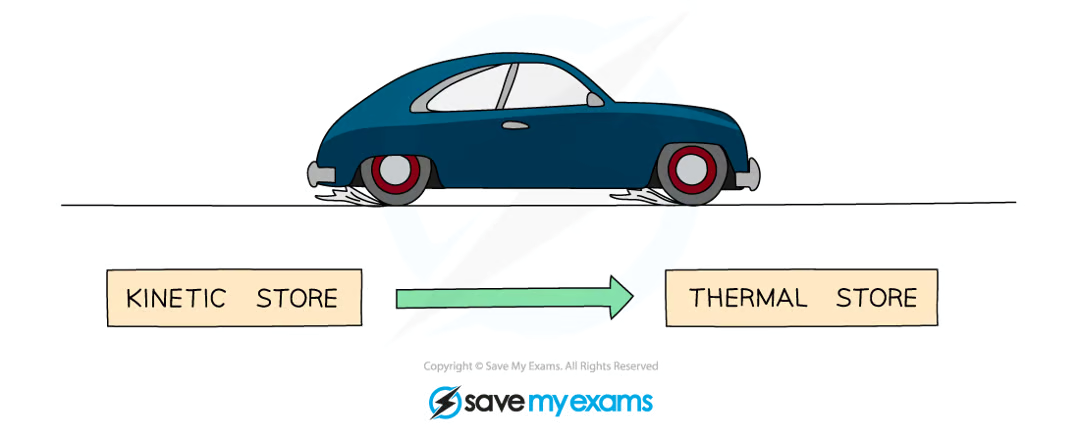
example energy transfers: vehicle slowing down
when a vehicle is moving it has energy in its kinetic store
as it decelerates energy is dissipated (transferred to the thermal store of the surroundings) by heating due to friction between the tyres & ground and between the brakes & brake pads, and by heating as sound waves transfer energy away from the system
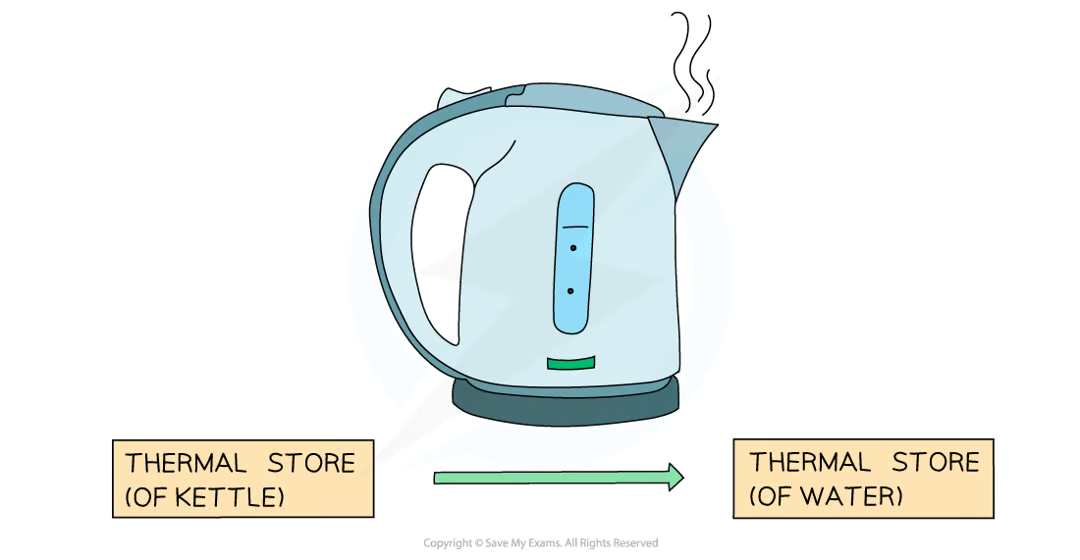
example energy transfers: boiling water in an electric kettle
when an electric kettle boils water energy is transferred electrically from the mains supply to the thermal store of the heating element in the kettle
as the heating element gets hotter energy is transferred by heating to the thermal store of the water
example energy transfers: trampoline
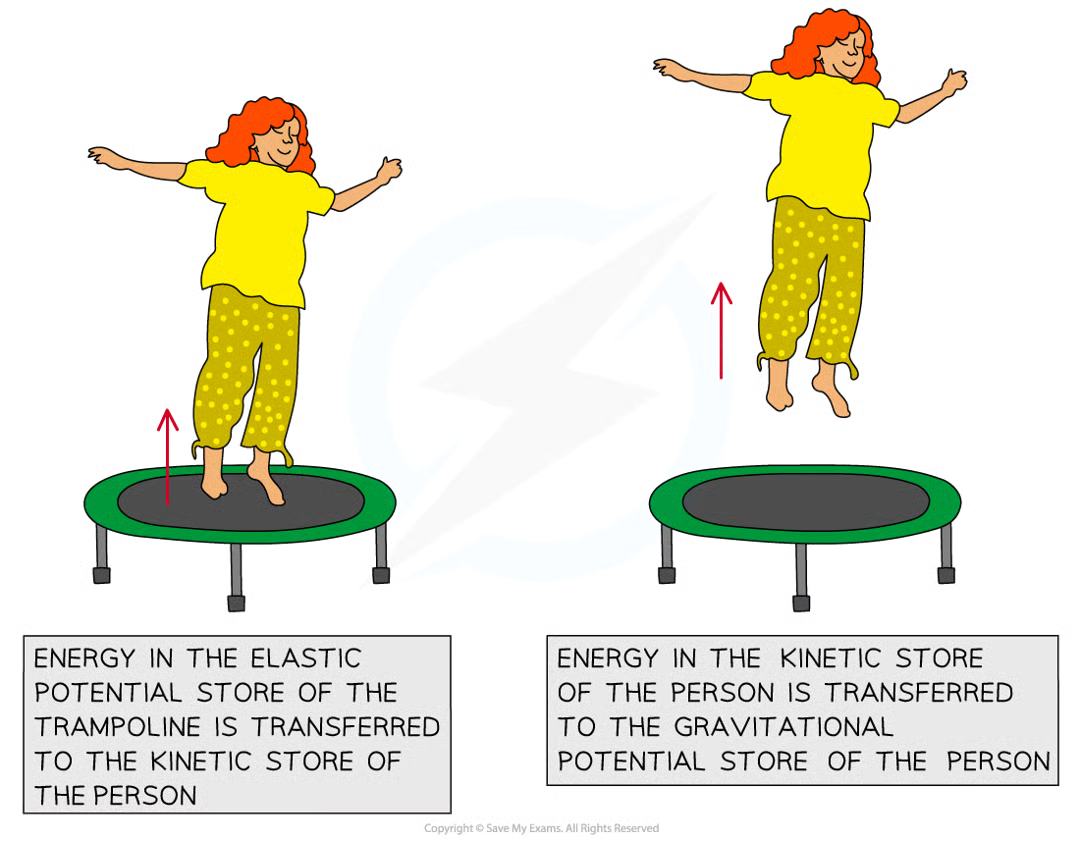
when jumping a person has energy in their kinetic store. when they land on the trampoline most of that energy is transferred to the elastic potential store of the trampoline. it’s then transferred back to the kinetic store of the person as they bounce up
energy is transferred from the person’s kinetic store to their gravitational potential store as they gain height
some energy is dissipated by heating to the thermal store of the surroundings (person, trampoline, air)
the useful energy transfers are elastic potential energy → kinetic energy → gravitational potential energy
useful vs wasted energy
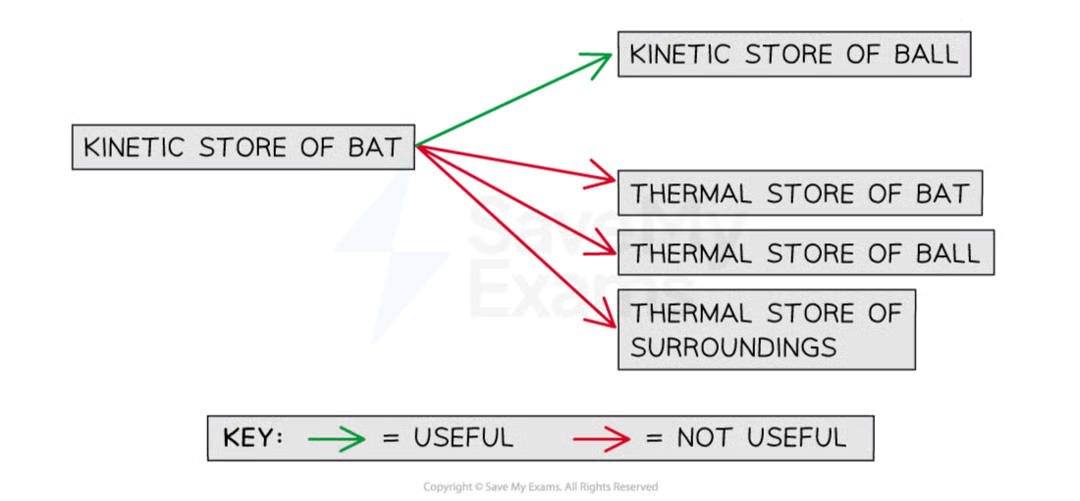
mechanical processes can become wasteful when they cause a rise in temperature, often when friction is involved. friction transfers energy from the kinetic store by heating to the objects & surroundings - aka dissipated (spread out). this energy can’t be used in a useful way so is called wasteful.
useful energy = an energy transfer that serves an intended purpose
wasted energy = an energy transfer that’s not useful for the intended purpose and is dissipated to the surroundings
dissipation of energy
energy transferred by heating & radiation have a tendency to spread out to the surroundings - this is dissipation
dissipated energy is hard to ‘gather’ to be used again, so becomes less useful. whenever a process produces unwanted heat / light / sound the energy is dissipated and essentially wasted
however not all dissipated energy is wasted, for example:
in a tv the useful energy transfer is when energy is transferred electrically from the mains supply and is dissipated to the surroundings by radiation as visible light & by heating as sound waves
in a heater, the useful energy transfer is when energy is transferred electrically from the mains supply to the thermal store of the heating element & then dissipated to the surroundings by heating
reducing energy loss
there are many situations where energy transfers are unwanted e.g. keeping a house/drink warm/cold or reducing friction of mechanical parts
when an appliance is used for heating it uses a lot of energy, which can become expensive and produces greenhouse gases. so it’s useful to find ways of reducing unwanted electricity transfers
energy that’s dissipated to the surroundings is often the main source of wasted energy transfers
if unwanted energy transfers can be prevented or reduced the useful energy transfers can be made more efficient
reducing energy loss: lubrication
friction is a major cause of wasted energy transfers - eg the gears on a bike become hot if they’re used for a long time. energy is transferred wastefully from the kinetic store of the bike to the thermal store of the gears & chain, meaning the person has to do more work to make the bike move as less energy is being transferred usefully
this wasted energy transfer can be reduced if the amount of friction is reduced. this can be done by lubricating the parts that rub together
reducing energy loss: insulation
reduces energy transfers from conduction. the effectiveness of an insulator depends on the material’s:
thermal conductivity: lower conductivity = less energy transferred
density: denser = more conduction can occur. in a denser material the particles are closer together so they can transfer energy to one another more easily
thickness: thicker = better insulator
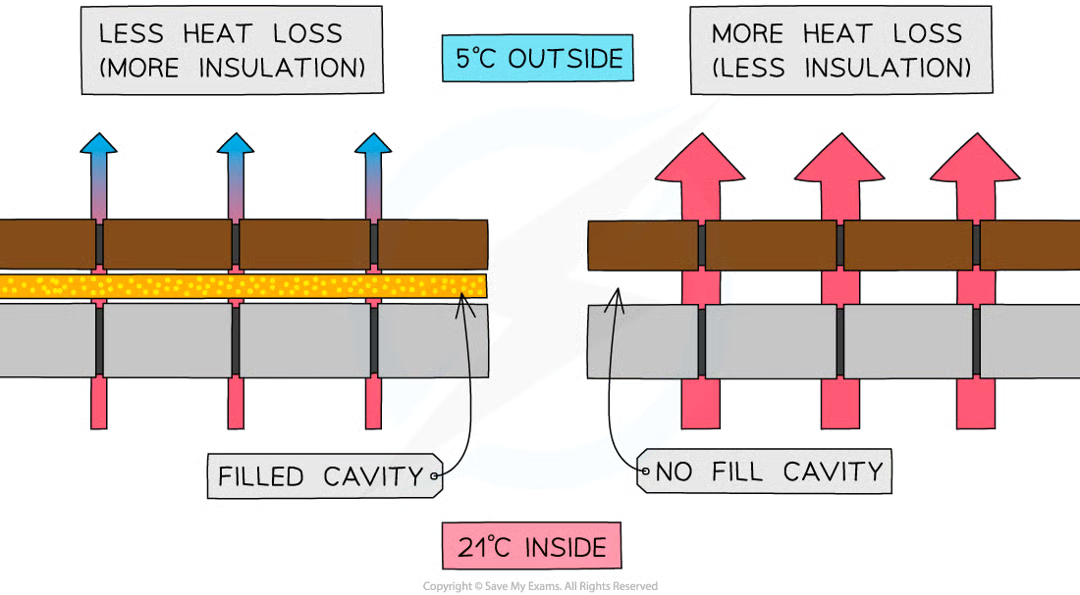
insulating houses lowers its rate of cooling meaning less energy is transferred outside. the insulation is usually made of fibreglass, a reinforced plastic composed of woven material with glass fibres laid across. the air trapped between the fibres makes it a good insulator
cavity wall insulation: when gaps or cavities between external walls are filled with insulation. often done by drilling a hole through the external wall to reach the cavity & filling it with foam made from blown mineral fibre filled with gas. this lowers the conduction of heat through the walls
conduction of heat
thermal conduction: when heat is transferred by vibrating particles in a substance. the main method of energy transfer by heating in solids. metals are very good thermal conductors, non-metals are poor thermal conductors & gases are extremely poor - they are called insulators
the vibrating particles transfer energy from their kinetic store to the kinetic store of neighbouring particles. the direction of energy transfer is always from hot to cold
higher thermal conductivity of a material = higher rate of energy transfer by conduction across the material. materials with high thermal conductivity heat up faster than materials with low thermal conductivity
objects will continue to lose/gain heat until they reach thermal equilibrium (equal temp) with their surroundings
factors affecting thermal conduction
thickness of the material
thermal conductivity of the material
temperature difference between the 2 areas of the material
you can reduce the rate of energy transfer by
increasing the thickness of the material
decreasing the thermal conductivity of the material
decreasing the temperature difference
efficiency
the ratio of the useful energy output from a system to its total energy output. a measure of the amount of wasted energy in an energy transfer. can be represented as a decimal or percentage
high efficiency = most energy transferred is useful
low efficiency = most energy transferred is wasted
efficiency = useful energy transferred by device / total energy supplied to device
improving efficiency
you can improve the efficiency of a device by reducing wasted energy transfers
friction between moving parts in machinery leads to unwanted energy transfers by heating. you can reduce this by adding bearings to prevent components directly rubbing and lubricating parts
in circuits there is electrical resistance as current flows, resulting in unwanted energy transfers by heating. this can be reduced by using components with lower resistance and reducing the current
air resistance causes a frictional force between a moving object and the air, resulting in unwanted energy transfers by heating. this can be reduced by streamlining the shapes of objects
noise is often created by moving parts of machinery, leading to unwanted energy transfers by heating as sound waves cause particles to vibrate. this can be reduced by tightening loose parts to reduce vibration and lubricating parts
energy resources
large stores of energy that can be used to generate electricity and heat buildings. can be renewable or non-renewable
a turbine turns, which turns a generator, which generates electricity. the element that differs is how the turbine is made to turn
renewable energy resources
an energy source that is replenished at a faster rate than the rate at which it’s being used. this means the source won’t run out.
solar, wind, bio-fuel, hydroelectricity, geothermal, tidal
non-renewable energy resources
energy sources that are being replenished at a slower rate than they’re being used, meaning they will eventually run out. fossil fuels (coal, oil, natural gas) and nuclear fuel
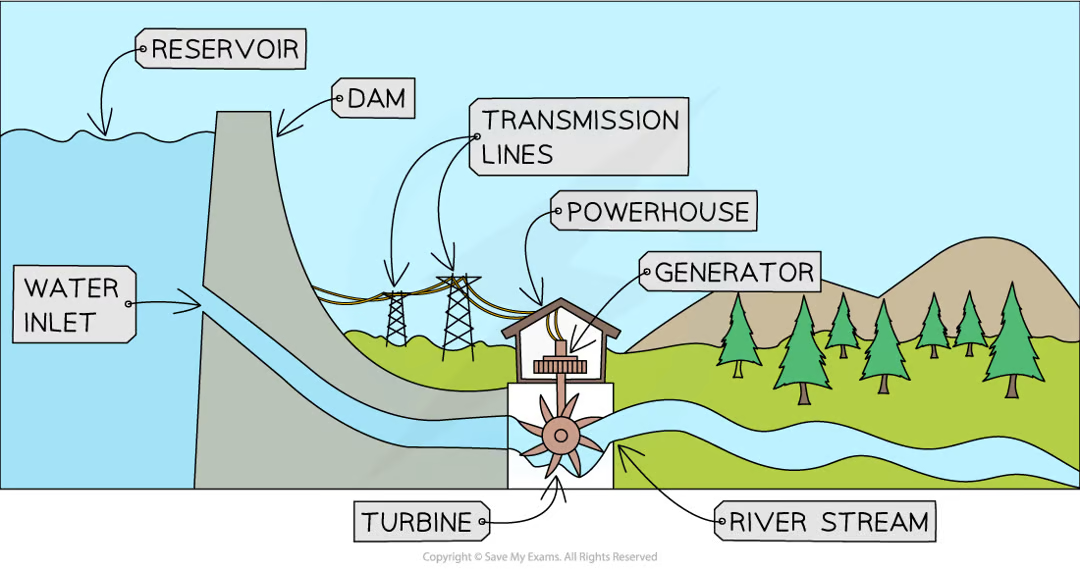
energy from water
water can be used to turn turbines in hydroelectric dams, tidal barrages & tidal turbines
energy in the kinetic store of the flowing water → kinetic store of the turbine → kinetic store of the generator → transferred electrically to the national grid
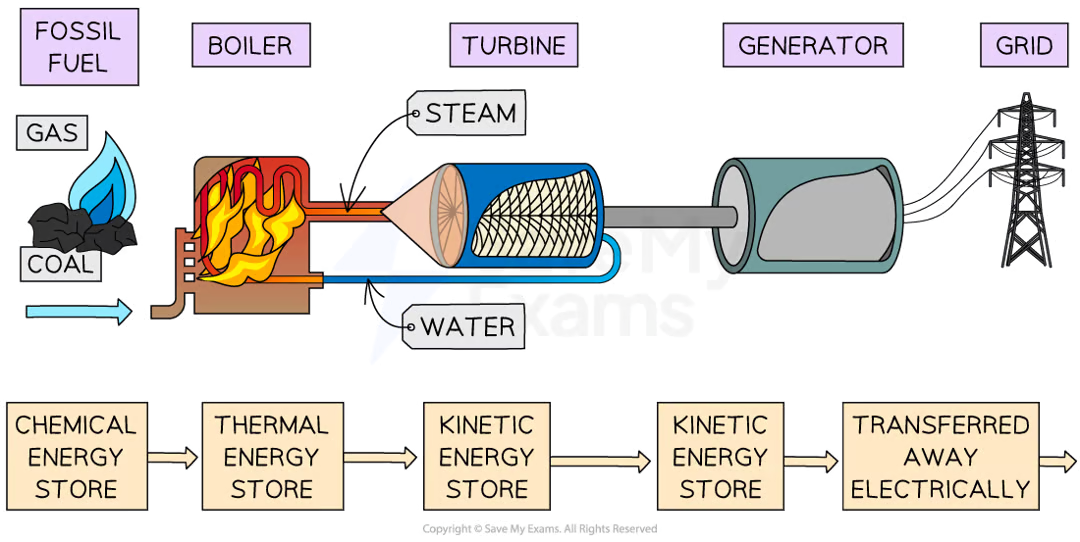
energy from fossil fuels
fossil fuels can be combusted to heat water and the steam produced can turn turbines
energy from chemical store of fuel → thermal store of water → kinetic store of turbine → kinetic store of generator → transferred electrically to the national grid
energy from nuclear fuel
nuclear fuel can be used to heat water to produce steam to turn turbines
energy in nuclear store of fuel → thermal store of water → kinetic store of turbine → kinetic store of generator → transferred away electrically
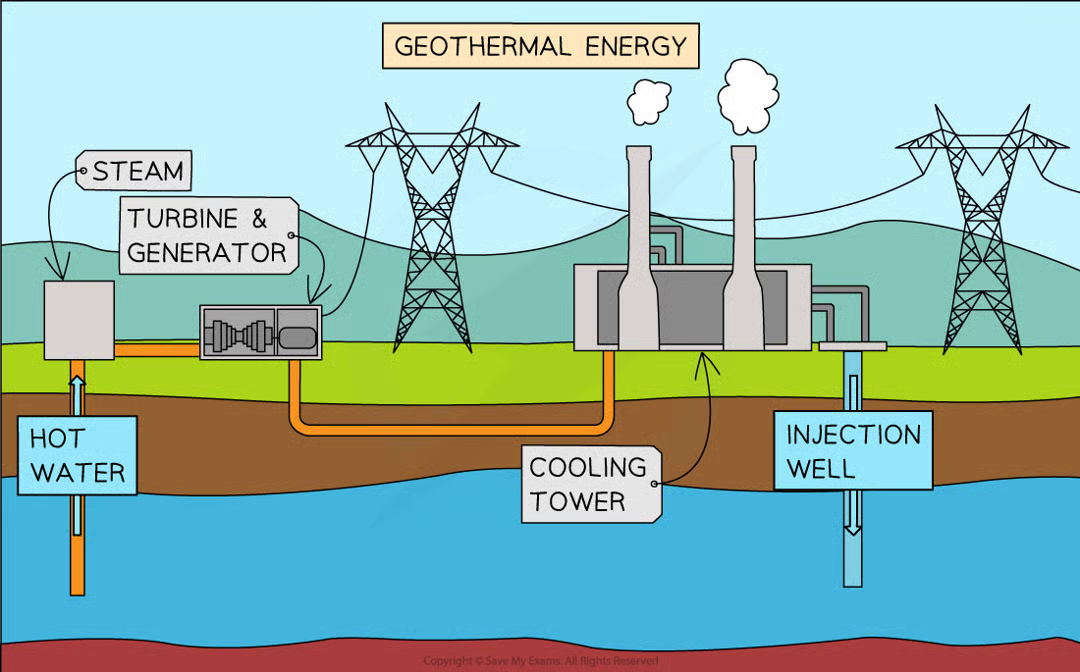
energy from geothermal sources
geothermal energy is another way to produce the steam that turns the turbines. water is pumped down to the hot rocks and returns through a fissure as steam
energy in the thermal store of rocks → thermal store of water → kinetic store of turbine → kinetic store of generator → transferred away electrically
types of energy resources
fossil fuels are combusted to heat water to produce steam to turn turbines to generate electricity
nucelar fuels are reacted to heat water to produce steam to turn turbines to generate electricity
bio-fuels like plant matter, ethanol or methane can be produced and used as fuel to heat the water
wind turns turbines to generate electricity
in a hydroelectric dam water is stored at height and released to turn turbines
the tidal movement of water turns turbines
geothermal energy in hot rocks underground are used to heat the water
solar cells use light to generate electricity
moving water due to waves turns turbines
reliable vs non-reliable energy
a reliable energy resource can produce energy at any time
a non-renewable resource can only produce energy some of the time
comparing energy resources
energy resource | renewable? | advantages | disadvantages |
fossil fuels | no | reliable, can produce lots of energy at short notice | produces greenhouse gasses & pollution |
nuclear | no | reliable, no greenhouse gases or pollution, lots of energy from little fuel | produces radioactive waste that takes 1000s of years to decay |
bio-fuels | yes | CO2 produced is balanced with CO2 absorbed while producing it | takes up lots of land & resources needed for food production |
wind | yes | no greenhouse gasses / pollution, land can still be used | not reliable, can be noise & ugly, not everywhere is suitable |
hydroelectric | yes | reliable, lots of energy at short notice, no greenhouse gasses / pollution | can involve flooding large areas & destroying wildlife habitats |
tidal | yes | tides are predictable, lots of energy at regular intervals | very few suitable locations, cause environmental harm & distrust shipping |
geothermal | yes | reliable, small stations | can release harmful gases from underground, not many suitable places |
solar | yes | no greenhouse gases / pollution, good for remote places | not reliable, solar farms take up lots of land |
use of energy resources: transport
most vehicles are powered by petroleum products like petrol, diesel & kerosene, which originate from crude oil, a fossil fuel
a growing number of vehicles are being powered by electricity, which produces 0 carbon emissions when driven but still uses the national grid to charge, which uses a mix of renewable & non-renewable energy
vehicles can also be powered by biofuel, a renewable resource. but the claim that biofuels are carbon-neutral is controversial
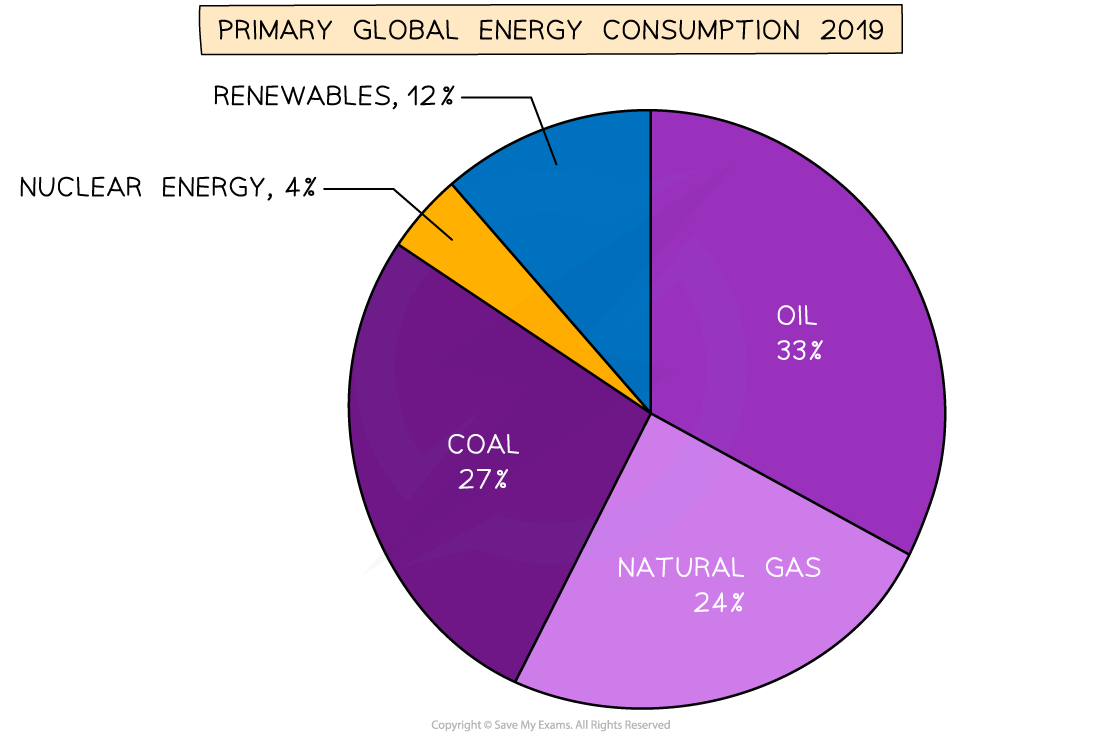
use of energy resources: electricity generation
demand for electricity is very high and all available energy resources are needed to keep up with it. most of the world’s energy is still produced by non-renewable, carbon-emitting sources. this has a negative impact on the environment
use of energy resources: heating
most homes in cold countries are fitted with central heating systems, which use natural gas to heat up water which can be pumped around radiators. but gas is a non-renewable energy resource
in geologically active countries (eg icleand) they can heat their homes using geothermal energy
waves
oscillations / vibrations about a fixed point. transfer energy and information. eg ripples causing particles of water to oscillate up & down or sound waves causing particles of air to vibrate back & forth
waves transfer energy without transferring matter
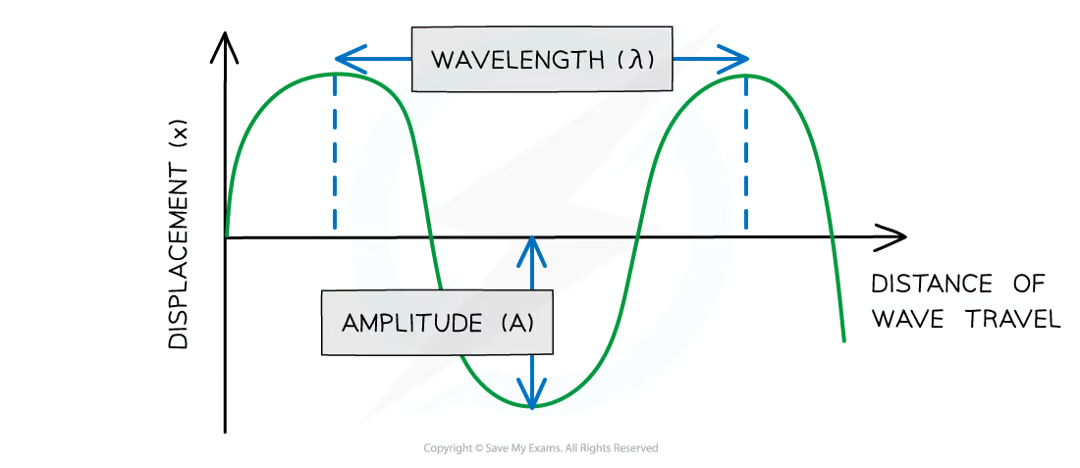
amplitude
the distance from the undisturbed position to the peak or trough of a wave
measured in meters, symbol A
on a graph where the vertical axis is displacement, the amplitude is from the undisturbed position (centre line) to either the highest point (peak) or lowest point (trough)
wavelength
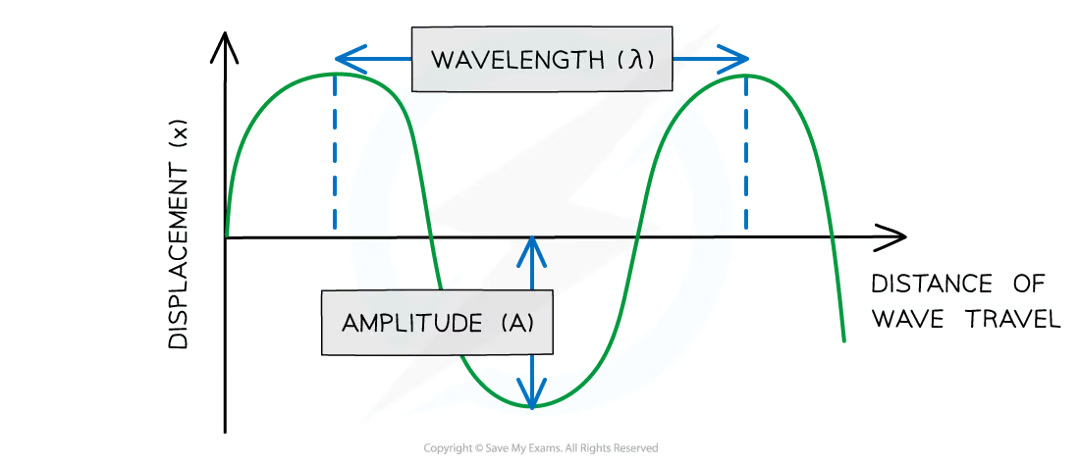
the distance from one point on a wave to the same point on the next wave
in a transverse wave from one peak to the next. in a longitudinal wave from the centre of one compression to the centre of the next
measured in meters, symbol λ (lambda)
wave frequency
the number of waves passing a point in a second
measured in hertz (Hz), symbol f
wave time period
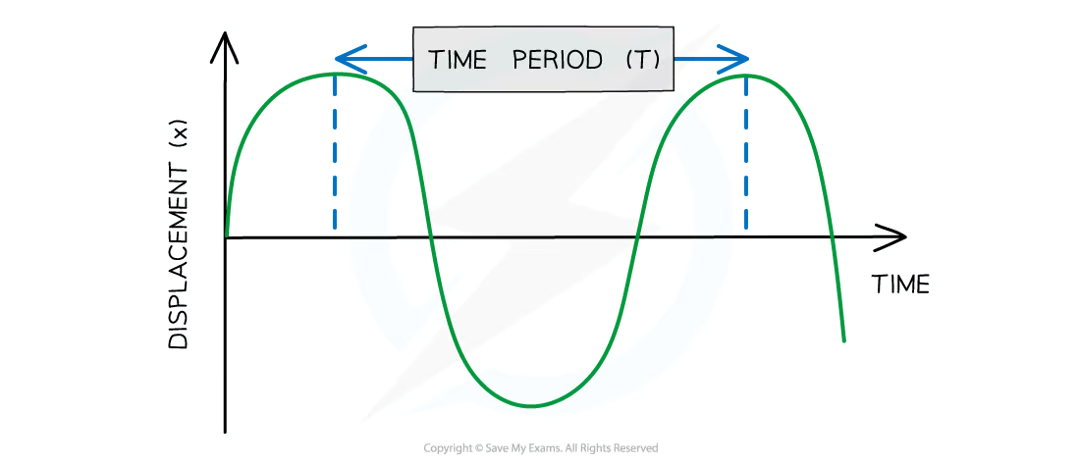
the time taken for a single wave to pass a point
measured in seconds, symbol T
determined by measuring the time from one point on the wave to the same point on the next one
frequency & period of a wave equation
f = 1 / T
frequency (Hz) = 1 / period (s)
wave speed
the distance travelled by a wave each second. the speed at which energy is transferred through a medium
wavefront
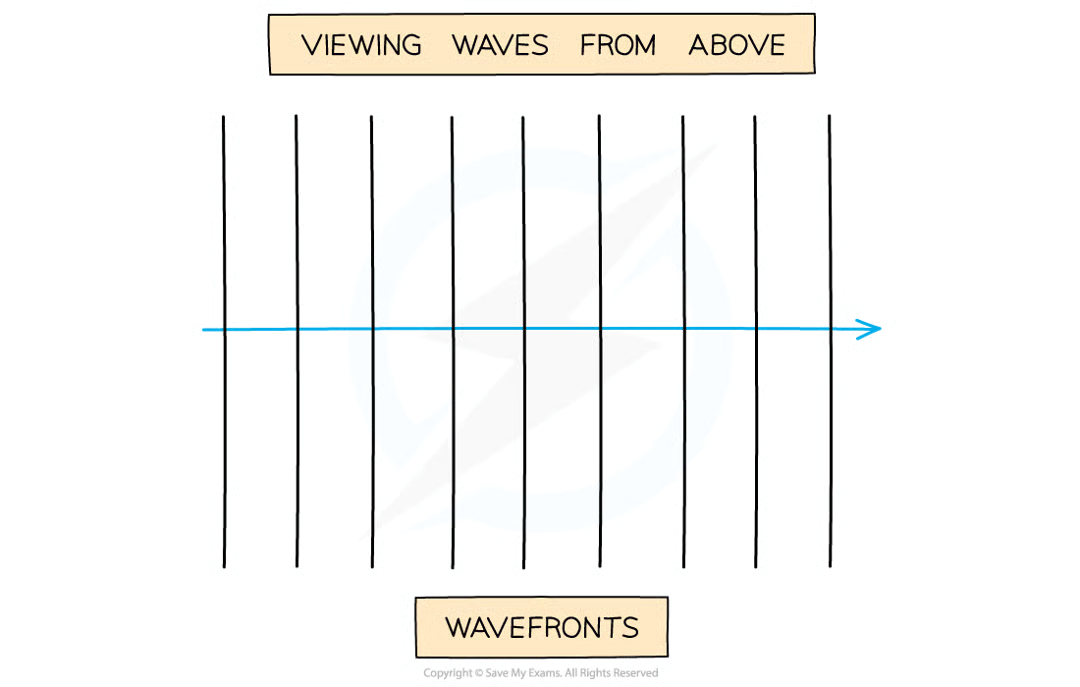
a way of picturing waves from above - each wave is represented by a single line
arrow (or ray) shows direction that the waves are moving
space between each wave front = wavelength. close together waves = short wavelength, far apart waves = long wavelength
transverse waves
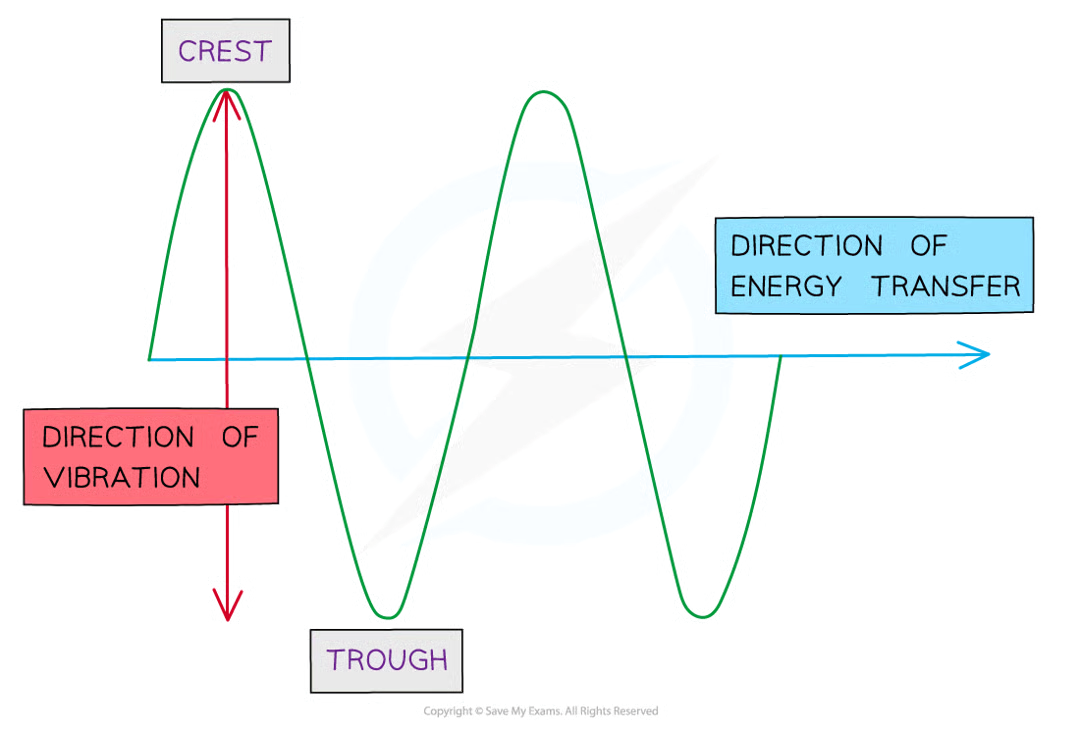
waves where the points along its length vibrate at 90 degrees to the direction of energy transfer - energy transfer is perpendicular to wave motion
can move in solids and on the surfaces of liquids but not inside liquids or gases. some transverse waves (eg em waves) can move in solids, liquids & a vacuum
examples of transverse waves:
ripples on surface of water
vibrations on a guitar string
s-waves (seismic waves)
electromagnetic waves (eg radio, lights, x-rays)
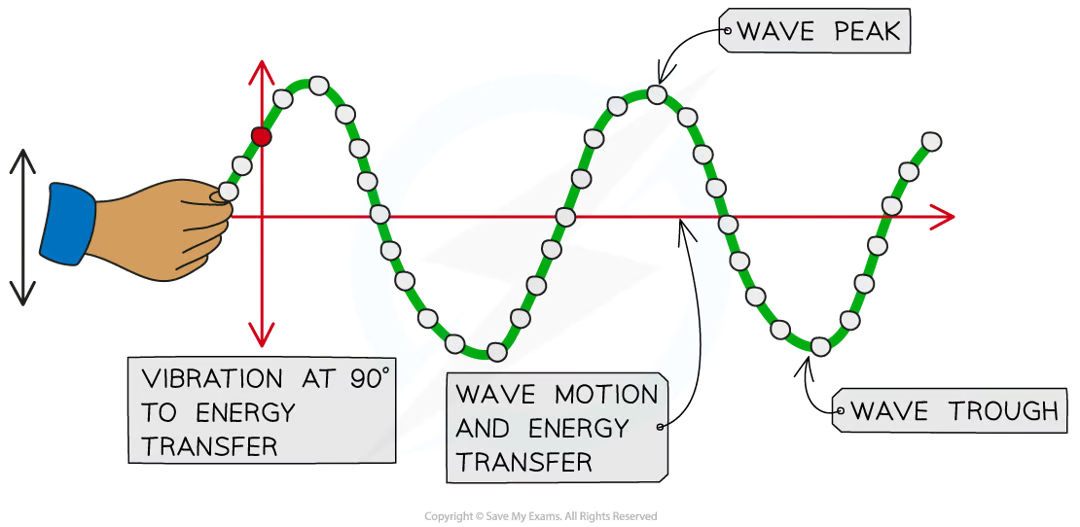
drawing transverse waves
drawn as a single undisturbed line, usually with a central line showing the undisturbed position
curves are drawn perpendicular to the direction of energy transfer and represent peaks & troughs
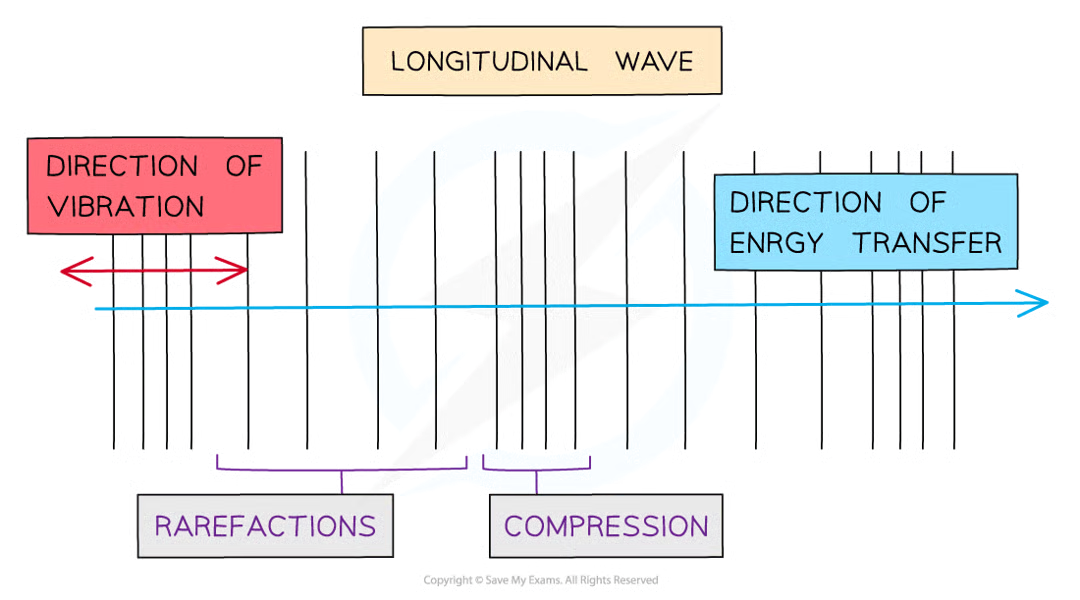
longitudinal waves
waves where the points along its length vibrate parallel to the direction of energy transfer
energy transfer is in the same direction as wave motion. can move in solids, liquids & gases, but not in a vacuum (no particles)
points close together are compressions, points spaced apart are rarefactions
examples of longitudinal waves:
sound waves
p-waves (seismic wave)
pressure waves caused by repeated movements in a liquid / gas
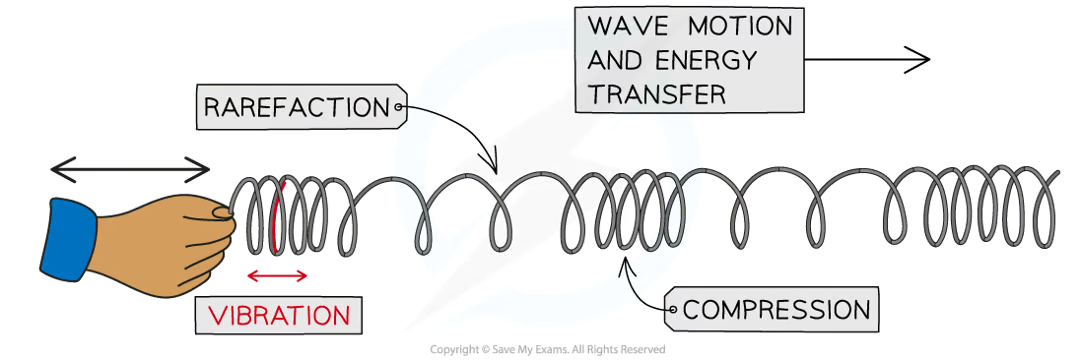
drawing longitudinal waves
drawn as several lines to show they’re moving parallel to the direction of energy transfer
close together lines represent compressions, far apart lines represent rarefactions