Lecture 18: Nucleic acids monomers / Polynucleotide chains (+ a little of lecture 17)
 Call Kai
 Learn
Learn Practice Test
 Spaced Repetition
 Match
Match Flashcards
 Knowt Play
1/61

There's no tags or description
Looks like no tags are added yet.
Name | Mastery | Learn | Test | Matching | Spaced | Call with Kai |
|---|
No analytics yet
Send a link to your students to track their progress
62 Terms
oligosaccharides
glycoprotein and glycolipids
Glycoproteins
Proteins that have small sugars or short sugar chains attached to themglyco
glycolipids
Lipid molecules that have short oligosaccharide chains attached to them
N-linked glycoproteins
Sugar moieties are attached to a protein through an amino acid with single-letter code N which is asparagine
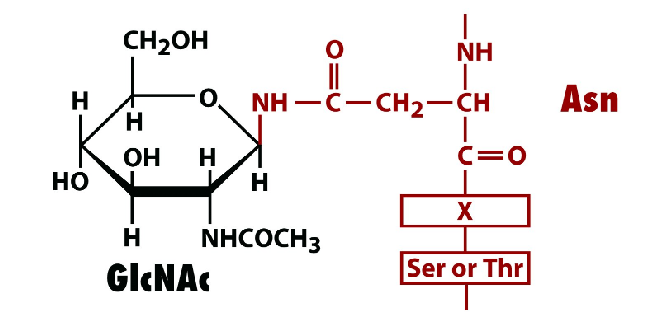
N-linked glycoproteins occurs
only in the endoplasmic reticulum through asparagine
N-linked glycoproteins Rule
at an Asn which is next to any amino acid (X), followed by Ser or Thr
O-linked glycoproteins
in proteins occur through amino acids with a hydroxyl group
serine, threonine and tyrosine
O-linked glycoproteins occurs in
endoplasmic reticulum
Blood group antigens
are examples of glycolipids
A, O, and B
Nucleotides are made of
base, sugar, and phosphate group
Two types of nitrogenous bases
Purines = large bases A, G
Pyrimidines = small bases T, U, C
DNA is negatively charged
because of the phosphate backbone
ribose
aldose, beta, and is furanose bc it is a 5 membered ring
Purines
large bases that have 2 aromatic rings A an G
Pyrimidines
small bases that have one aromatic ring U, C, and T
Structural convention for bases
On the top are the purines and the bottom are the pyrimidines
base-pairing edge
the side where most functional groups are present, this is the side involved in hydrogen bonding in DNA double helix formation
Hydrogen bond donors
Functional groups where hydrogen is attached to a more electronegative atom: NH and NH2
Hydrogen bond acceptors
Atoms with lone pairs that can accept a hydrogen bond: nitrogen with lone pair and oxygen with lone pair
Thymine vs uracil
thymine has a methyl group at position 5 but uracil does not
nucleoside
base + sugar
Adenine nucleosides RNA
adenine + ribose = adenosine and abbreviation still tied to A
Adenine nucleosides DNA
adenine + deoxyribose = deoxyadenosine and abbreviated as dA
Guanine nucleosides RNA
guanine + ribose = guanosine
Guanine nucleosides DNA
guanine + deoxyribose = deoxyguanosine
abbreviation dG
Rule for purines as nucleosides
purines get the suffix: -osine
adenosine and guanosine
Cytosine nucleosides RNA
cytosine + ribose = cytidine
Cytosine nucleosides DNA
cytosine + deoxyribose = deoxycytidine
abbreviation dC
Rule for pyrimidines as nucleosides
pyrimidines usually get the suffix: -idine
Uracil nucleosides RNA
uracil + ribose = uridine
Thymine nucleosides DNA
thymine + deoxyribose = deoxythymidine
abbreviation tied to T
nucleotide
base + sugar + phosphate group
Adenine nucleotides RNA
adenosine monophosphate = AMP
adenosine diphosphate = ADP
adenosine triphosphate = ATP
Adenine nucleotides DNA
deoxyadenosine monophosphate = dAMP
deoxyadenosine diphosphate = dADP
deoxyadenosine triphosphate = dATP
Guanine nucleotides RNA
guanosine monophosphate = GMP
guanosine diphosphate = GDP
guanosine triphosphate = GTP
Guanine nucleotides DNA
add deoxy
dGMP, dGDP, dGTP
Cytosine nucleotides RNA
cytidine monophosphate = CMP
cytidine diphosphate = CDP
cytidine triphosphate = CTP
Cytosine nucleotides DNA
add deoxy
dCMP, dCDP, dCTP
Uracil nucleotides RNA
uridine monophosphate = UMP
uridine diphosphate = UDP
uridine triphosphate = UTP
Thymine nucleotides DNA
deoxythymidine monophosphate = dTMP
deoxythymidine diphosphate = dTDP
deoxythymidine triphosphate = dTTP
Acid Anhydride
Acid + Acid =
Ester
Acid + Alcohol
Ether
Alcohol + Alcohol
Large base + acceptor
adenine
Large base + donor
guanine
Small base + acceptor
cytosine
Small base + donor
thymine / uracil
2 hydrogen bonds
A–T
3 hydrogen bonds
C–G
Polynucleotide direction
5′ to 3′
a free 5′ phosphate end and a free 3′ OH end
polynucleotides are formed
condensation reaction phosphodiester linkage
N-glycosidic linkage
between nitrogen of base and sugar
phosphoester bond
between 5′ OH of sugar and phosphate
Why ATP hydrolysis releases a lot of energy
ATP has a lot of (-) charge packed together causing repulsion, hydrolysis happens and less charge repulsion, and then new phosphate containing product is more soluble and stabilized
adenosine
adenine + ribose
Cyclic AMP
Adenosine is part of it and is a secondary messenger
formed from ATP by an enzyme
cyclic AMP contains a
intramolecular phosphodiester bond
Coenzyme A and Acetyl CoA
are coenzymes that help enzymes function adenosine is apart of these enzyme
NAD and NADP
regulates metabolism by acting as electron donors and acceptors
adenosine is apart of these enzymes
FAD
major role with metabolic enzymes and adenosine is also apart of this enzyme
all enzymes mentioned here
all contain ribose sugar

