Cognitive Psychology CH 8 - Remembering Complex Events
 Call Kai
 Learn
Learn Practice Test
 Spaced Repetition
 Match
Match Flashcards
 Knowt Play
1/23

There's no tags or description
Looks like no tags are added yet.
Name | Mastery | Learn | Test | Matching | Spaced | Call with Kai |
|---|
No analytics yet
Send a link to your students to track their progress
24 Terms
Hyperthymesia
A rare condition allowing individuals to recall almost every day of their lives in vivid, uncontrollable detail, often starting around age 10.
Sereal Position Effect
The tendency to recall the first and last items in a list better than those in the middle (Primacy Effect & Recency Effect).
Primacy Effect
The tendency to better remember items at the beginning of a list
Occurs because the words at the beginning of a list have made it into long-term memory and are still in your working memory
Recency Effect
The tendency to better remember items at the end of a list
Occurs because the words at the end of a list have made it into long-term memory and are still in your working memory
DRM Procedure
A memory experiment that examines/prompts false memories by presenting participants with related words that lead them to recall a non-presented, related item (Ex. Participants hear or read a list: strawberries, orange, apple, pear, cherry, kiwi, banana, melons. Participants then claim to recall hearing Fruit (falsely remembered due to theme activation)).
Memories Stored in Webs
Memories that are interconnected or organized in a network-like fashion, where one memory can trigger the recall of related memories. This structure helps in understanding how different pieces of information are related and can aid in retrieval.
Schemas and Gaps in Memory
Schemas are cognitive structures that organize knowledge and influence memory retrieval.
Schemas can be used to fill in gaps in memory
However, they can also lead to memory distortions and false memories.
Intrusion Errors
Errors that occur when extraneous information disrupts the recall of original memories, often leading to false recollections (Ex. details from similar experiences may intrude upon the memory of a specific event).
Misinformation Effect
A phenomenon where a person's recall of episodic memories becomes less accurate due to post-event misinformation, leading to distortions in memory.
People are more suceptable to misinformation under hypnosis
Mandela Effect
A phenomenon where a large group of people remember an event or fact differently than how it occurred, often attributed to collective false memories.
Ebbinghau
German psychologist known for his work on memory, particularly through his studies on nonsense syllables and the forgetting curve.
Nonsense Syllables
Randomly generated sequences of letters that have no meaning and are used in memory research to study memory retention and recall.
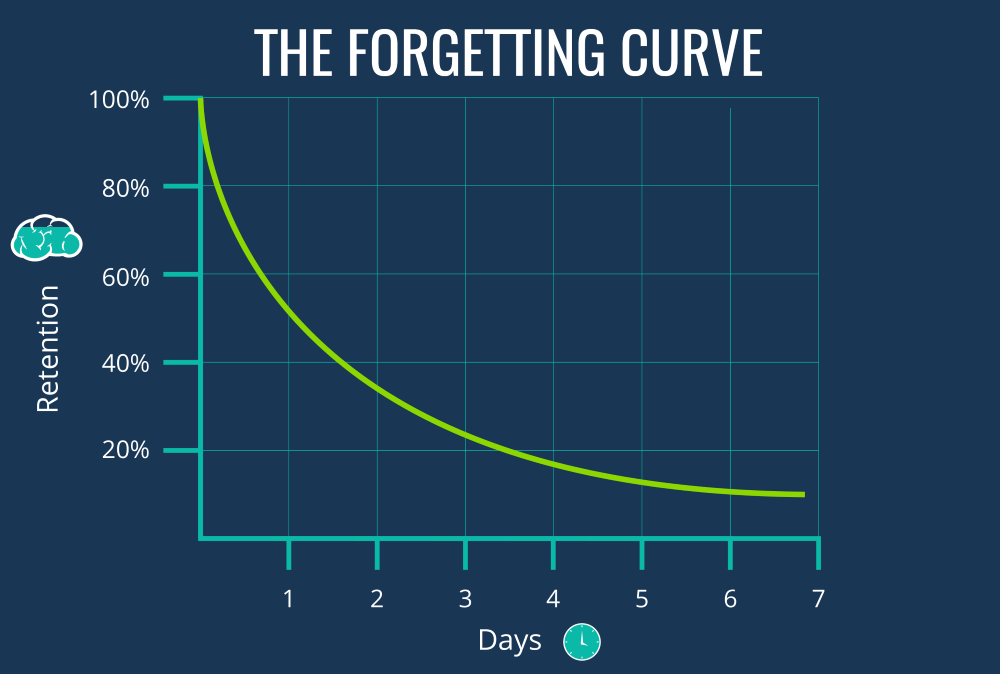
Ebbinghau’s Forgetting Curve
A graphical representation of the decline of memory retention over time, illustrating how information is most rapidly forgotten shortly after learning and then levels off.
Reasons for Forgetting
1.) Failure to Encode
2.) Decay
3.) Interference - proactive & retroactive
4.) Retrieval Failure (tip of the tongue)
Failure to Encode (Reasons for Forgetting 1/4)
The inability to process information into memory due to lack of attention or understanding, leading to a failure in retaining that information for later recall (Ex. learning something new then immediately getting distracted by a notification your phone, then forgetting the new information).
Decay (Reasons for Forgetting 2/4)
The gradual loss of memory over time when information is not retrieved or rehearsed, leading to decreased accessibility of the memory (Ex. Forgetting what you wore on the first day of elementary school years later).
Interference - Proactive and Retroactive (Reasons for Forgetting 3/4)
Proactive interference occurs when old information hinders the recall of new information. Retroactive interference occurs when new information impairs the recall of older information
Ex. for Proactive interference - Difficulty remembering a new phone number because you keep recalling the old one.
Ex. for Retroactive interference - Struggling to remember your old password after creating a new one
Retrieval Failure (tip of the tongue) (Reasons for Forgetting 4/4)
A temporary inability to access information/ the full extent of information stored in memory, often experienced as a feeling of knowing but being unable to recall the information. This phenomenon is commonly referred to as the "tip of the tongue" experience (Ex. Imagine you are talking to a friend about a classic movie. You can clearly recall the plot, the lead actor's face, and the genre, but you cannot retrieve the title of the film. You know the word is in your memory, but it feels "stuck" just outside your grasp).
Autobiographical Memory
A type of memory that involves recalling personal experiences and specific events from one’s own life, including the emotions and context associated with those events.
Reminiscence Bump
Phenomenon where individuals often have increased recall of autobiographical memories from adolescence and early adulthood, typically between the ages of 10 and 30, compared to memories from other life stages.
Flashbulb Memories
Vivid, detailed memories of significant events, often accompanied by strong emotional reactions (Ex. Trauma/Traumatic Events). These memories are typically recalled with high confidence and entail specific details surrounding the event.
Reasons for Inaccuracy (Flashbulb Memories)
Factors such as post-event misinformation from sharing of traumatic stories, memory decay, and the emotional intensity of the event can lead to inaccuracies in flashbulb memories. These influences can cause people to remember details that may not be entirely accurate or confabulated.
Stress and Tunnel Vision
A cognitive phenomenon where high levels of stress or anxiety narrow an individual's focus, resulting in a diminished ability to recall peripheral details of an event. This can lead to an emphasis on central features while neglecting potentially important surrounding information.

